
Zu lang; nicht gelesen:
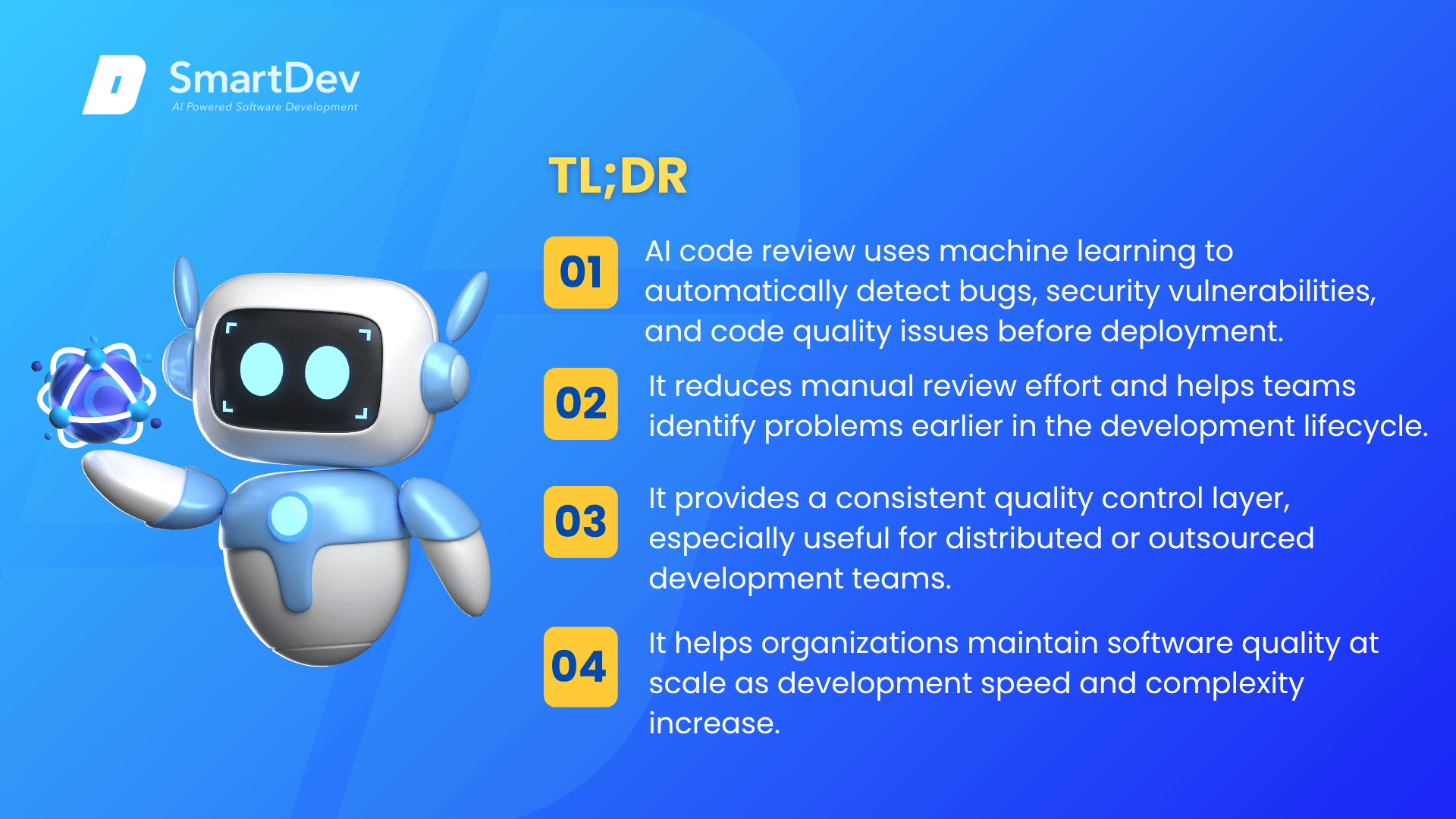
- AI code review uses machine learning to automatically check code for bugs, security flaws, and quality issues before it goes live.
- It reduces manual review time by up to 50% and helps teams catch problems earlier in the development process.
- For businesses using outsourced or distributed development, AI code review adds a consistent quality gate regardless of team location or size
AI code review is reshaping how software teams maintain quality at scale. As development cycles accelerate and teams grow more distributed, manual review processes struggle to keep up. This guide explains what AI code review is, why it matters for business leaders, how it works, and what it typically costs.
What is AI Code Review?
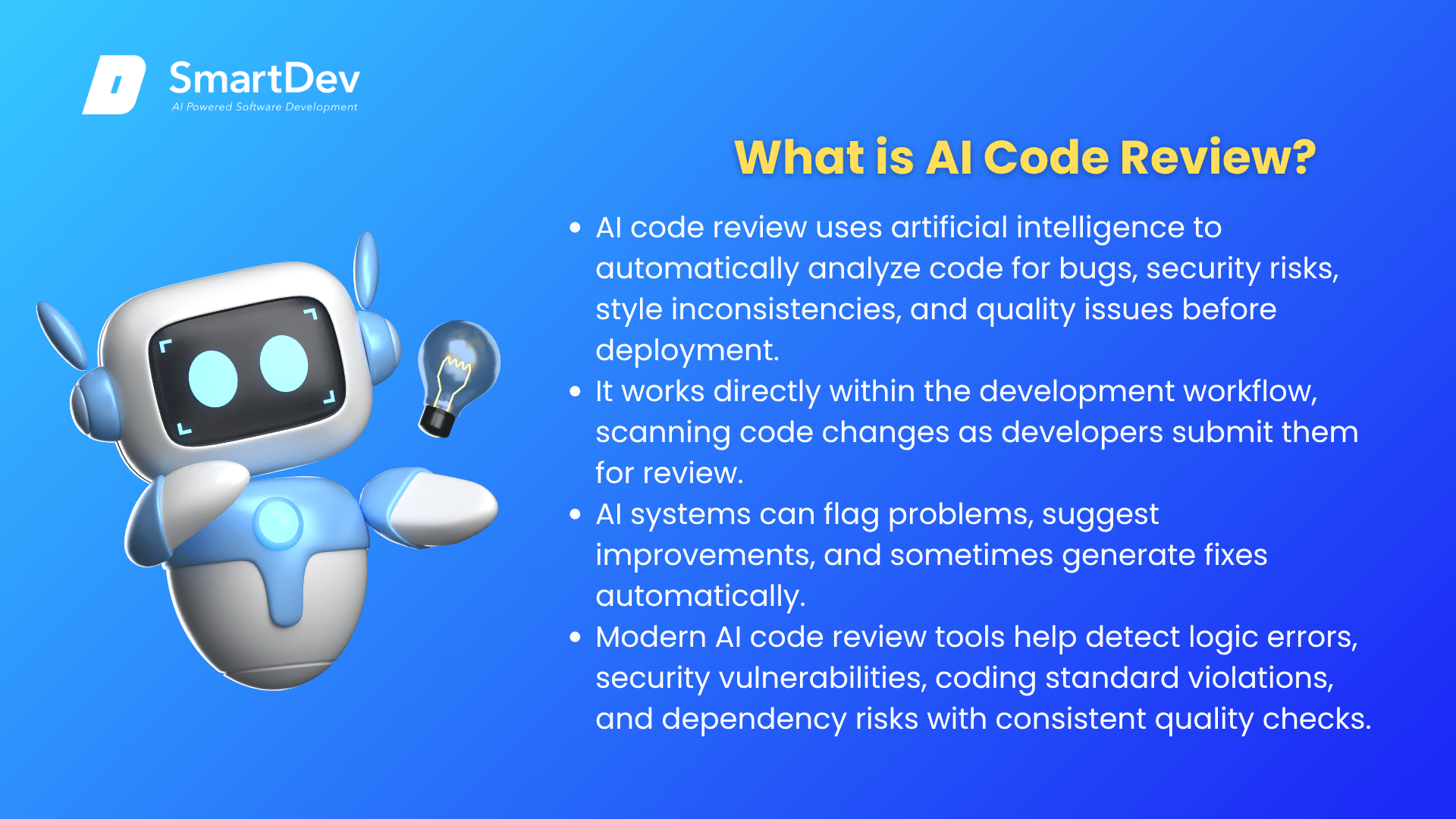
AI code review uses artificial intelligence to analyze software code for errors, security vulnerabilities, style inconsistencies, and quality issues automatically. It operates directly within development workflows by scanning code changes immediately after developers submit them for review. The system flags issues, suggests improvements, and sometimes proposes fixes before teams merge code into production environments. Unlike human reviewers, AI systems apply consistent standards across every code review without fatigue, delay, or operational inconsistency. Modern AI code review tools detect logic errors, coding standard violations, dependency risks, and common software security weaknesses effectively. These tools also identify issues such as SQL injection vulnerabilities, exposed credentials, and insecure implementation patterns before deployment occurs.
Warum ist das für Unternehmen wichtig?
Poor code quality is a direct business risk. Security breaches, system outages, and delayed product launches frequently trace back to code that was not reviewed thoroughly or quickly enough. AI code review addresses this at the source.
- Reduce time spent on manual code review by up to 50%, freeing senior developers for higher-value work.
- Increase detection speed of security vulnerabilities, with AI identifying issues up to 70% faster than manual review alone.
- Improve consistency across teams by applying uniform quality standards regardless of reviewer experience or workload.
- Accelerate release cycles by catching defects earlier, when they are cheaper and faster to fix.
For example, a retail technology company managing a distributed development team across three time zones implemented AI code review and reduced their average pull request cycle from three days to under four hours, while also cutting production bugs by 35% in the first quarter.
How Does AI Code Review Work?
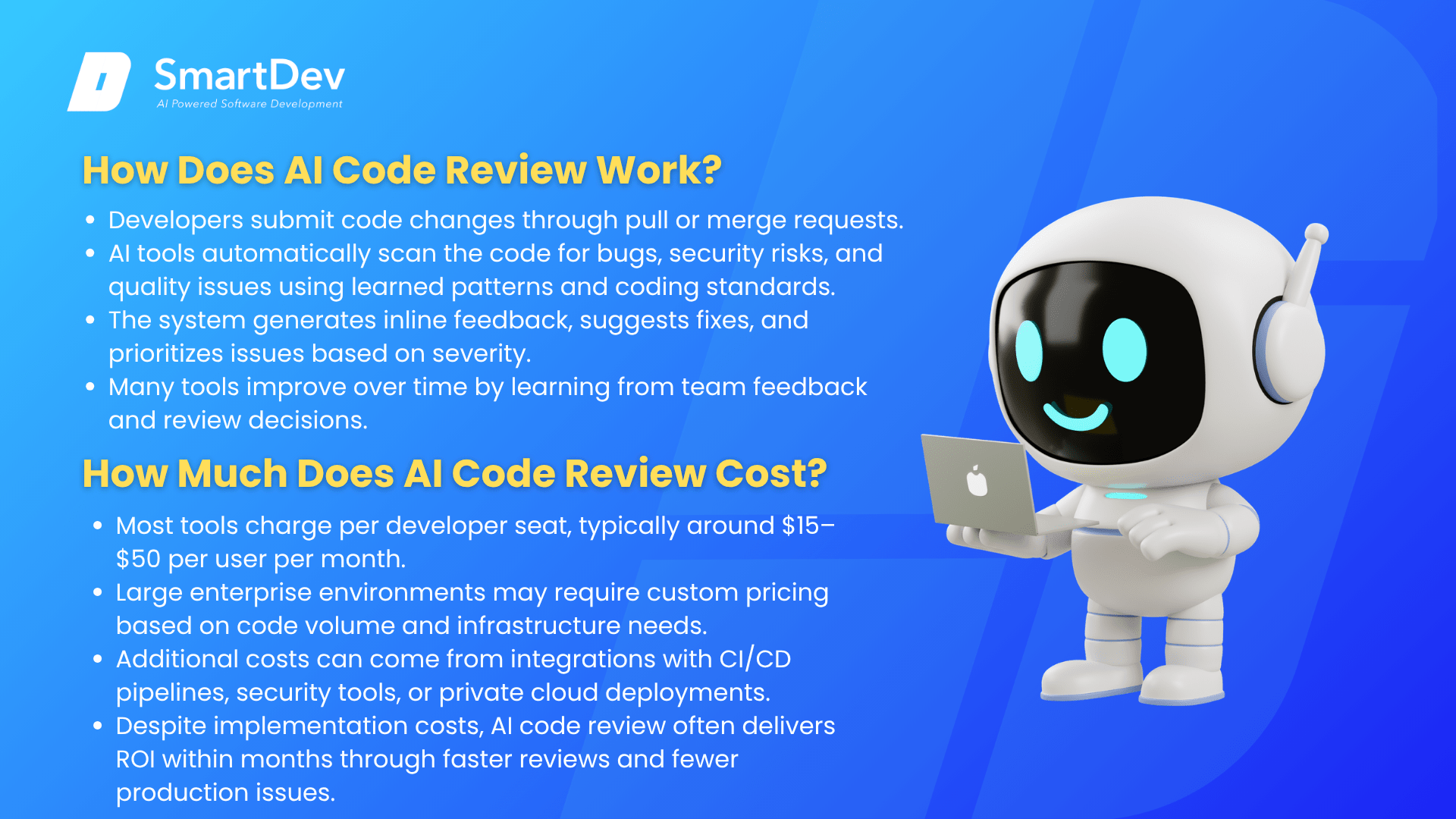
- Trigger: A developer submits a code change, known as a pull request or merge request, to the shared codebase.
- Automated scan: The AI tool reads the changed code and compares it against learned patterns, coding rules, and security benchmarks.
- Feedback generation: The tool posts inline comments on specific lines of code, explaining what the issue is and why it matters, often suggesting a corrected version.
- Prioritization: Issues are ranked by severity, so teams can address critical security flaws before minor style concerns.
- Continuous learning: Many enterprise tools adapt over time, learning from the team’s accepted and rejected suggestions to improve future recommendations.
The result is a faster, more reliable review process that catches problems before they reach production systems.
How Much Does AI Code Review Cost?
Pricing for AI code review tools varies based on team size, usage volume, and the level of features required.
- Team size: Most tools charge per active developer seat, typically ranging from $15 to $50 per developer per month for standard plans.
- Usage volume: High-volume enterprise environments with thousands of code changes per week may require custom enterprise pricing, which can range from $500 to several thousand dollars per month.
- Integration requirements: More complex setups, including integration with existing CI/CD pipelines, security compliance tools, or private cloud deployments, add to implementation cost.
Compared to building an equivalent internal review process with senior developer time, AI code review tools typically deliver a positive return on investment within the first three to six months, particularly for teams managing outsourced development where consistent quality control is harder to maintain manually.
Weitere verwandte Begriffe
- Multi-Agenten-System is an AI architecture where multiple specialized agents work together toward a shared goal. In AI code review, a multi-agent approach allows separate agents to handle different review tasks simultaneously — one scanning for bugs, another checking security vulnerabilities, and another enforcing style standards — delivering faster and more thorough feedback than a single-model review.
- AI Code Explanation: A feature where AI tools describe what existing code does in plain language, often used alongside code review to help teams understand unfamiliar code.
- AI CI/CD Pipeline: Continuous Integration and Continuous Delivery, the automated process of testing and deploying code changes, into which AI code review tools are typically integrated.
- Code Translation: Code Translation uses AI to convert code from one programming language or syntax style into another while preserving the original logic. AI Code Review checks whether the translated code is correct, secure, and consistent.