Kurz zusammengefasst
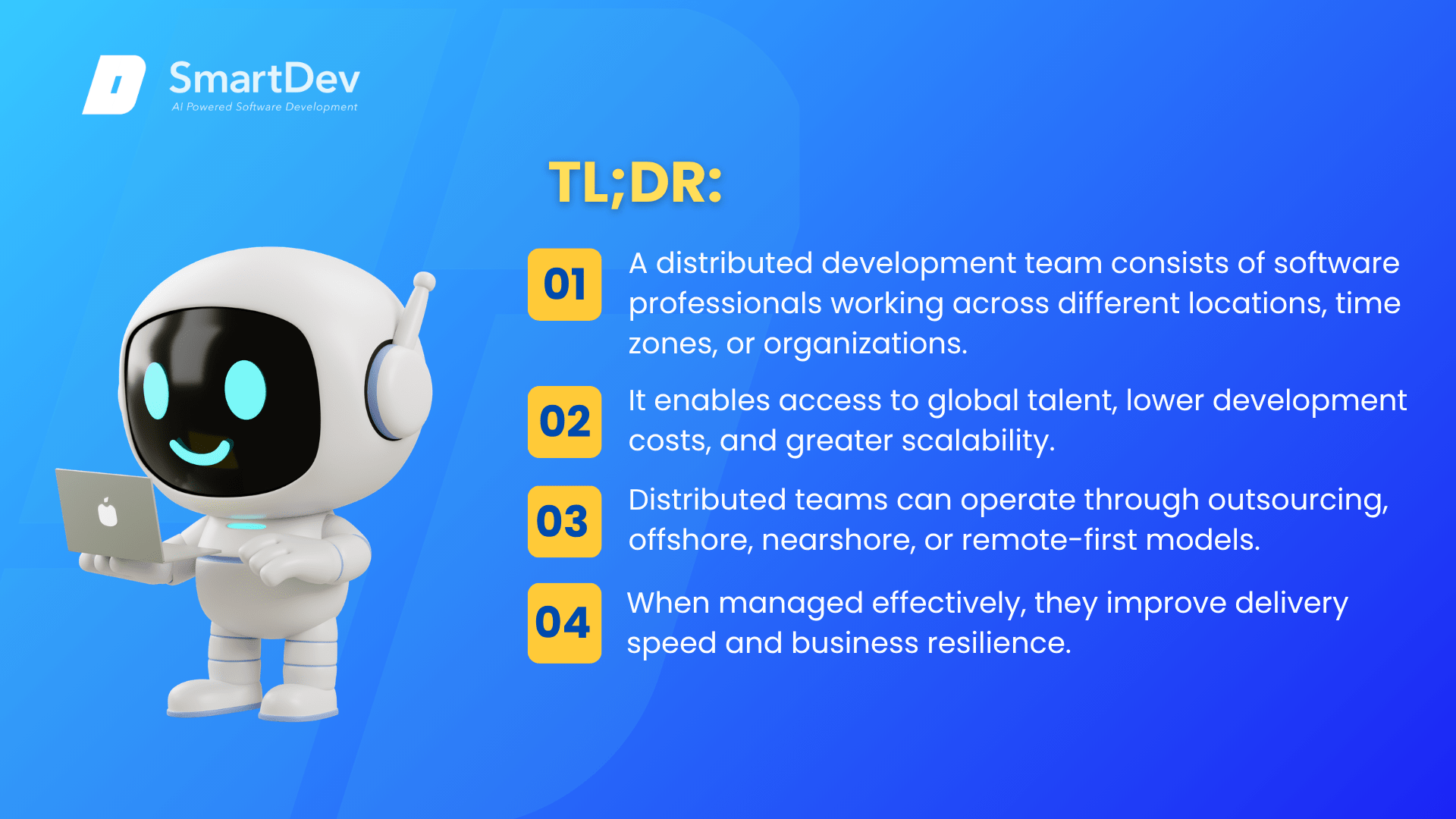
- A distributed development team is a software engineering team whose members work across multiple geographic locations, time zones, or organizations rather than in a single office.
- It gives businesses access to a global talent pool, reduces development costs, and enables around-the-clock productivity when structured correctly across time zones.
- Gartner estimates that by 2027, over 70% of digital product teams will rely on hybrid or distributed delivery models rather than fully in-house co-located teams.
Distributed development teams have become the dominant model for software delivery globally. Whether through outsourcing, nearshoring, or remote hiring, businesses build engineering teams that span borders to access talent, reduce costs, and accelerate delivery. This article explains what a distributed development team is, who uses this model, and what it costs.
What is a Distributed Development Team?
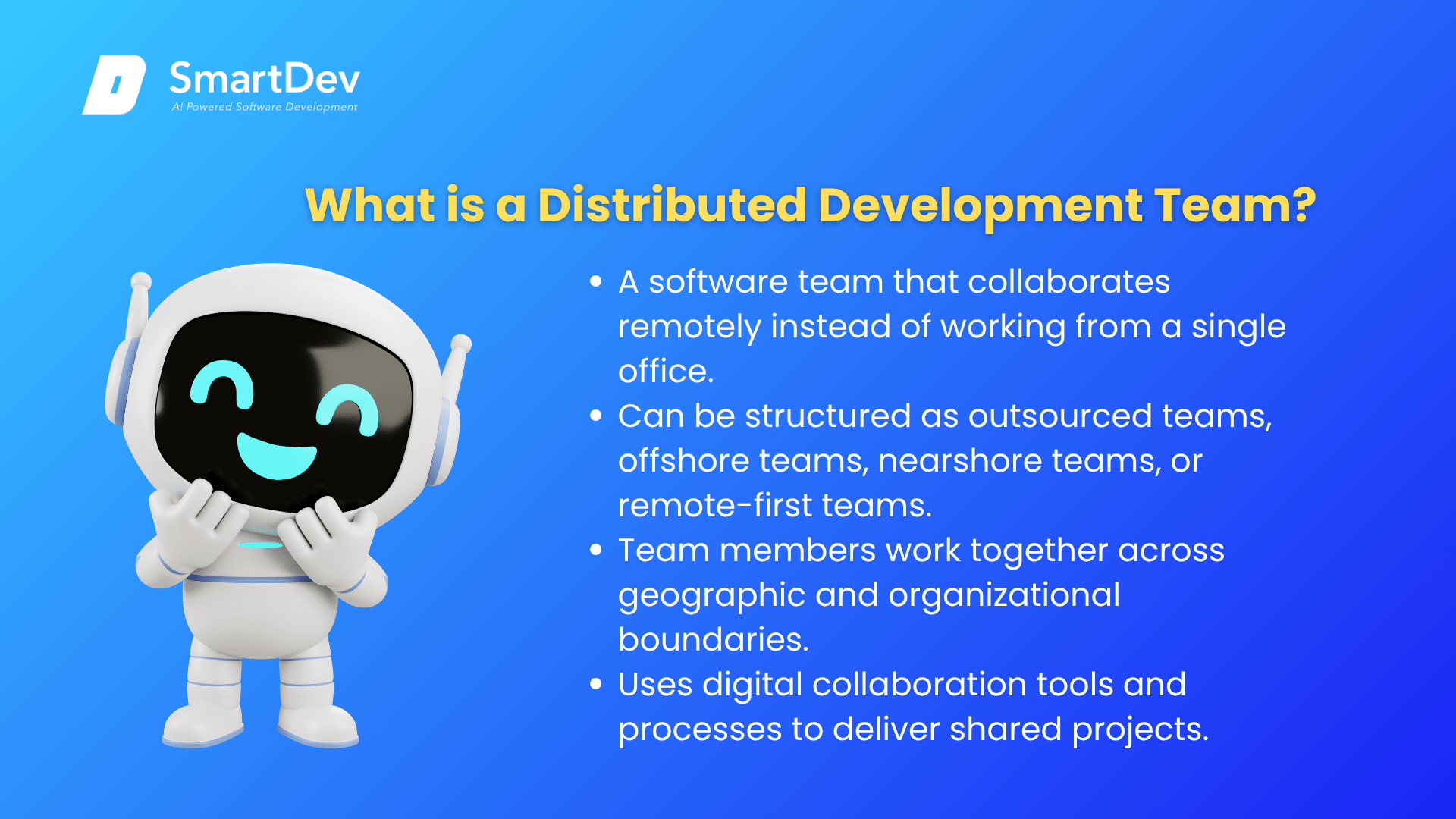
A distributed development team is a software engineering team whose members are located across multiple geographic locations, time zones, or organizations, collaborating remotely on a shared product or project rather than working together in a single office.
The term covers a range of engagement models that vary by how the team is structured and who employs the team members:
- Outsourced teams: An external vendor provides a complete development team, typically in a lower-cost geography, managed by the vendor and working to the client’s requirements.
- Dedicated offshore teams: A long-term team of developers embedded within a client’s product delivery organization, working exclusively on the client’s products but employed or managed through a local partner in an offshore location.
- Nearshore teams: Development teams located in geographically proximate countries with overlapping time zones, offering a balance between cost savings and cultural or time zone alignment.
- Remote-first distributed teams: Companies that hire developers globally without requiring a physical office presence, with team members distributed across many countries working asynchronously and synchronously.
Warum ist das für Unternehmen wichtig?
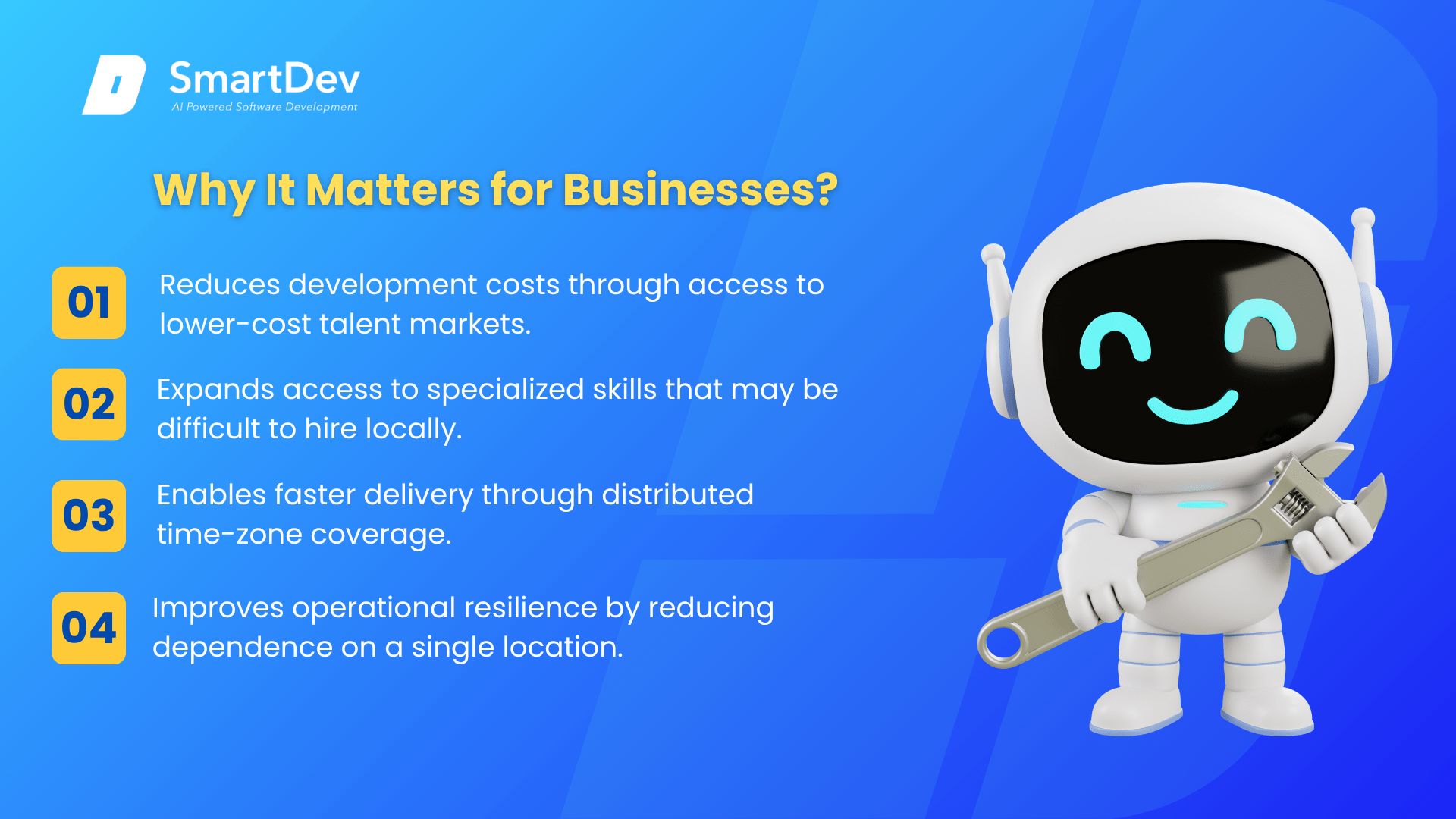
The global talent shortage in software engineering means that businesses relying only on local hiring face significant constraints. Distributed development teams solve this by giving organizations access to the full global pool of engineering talent, not just what is available within commuting distance of a single office.
- Reduce development costs: Offshore and nearshore development rates in regions such as Vietnam, Eastern Europe, and Latin America are 50 to 70% lower than equivalent rates in the US, UK, or Australia, allowing businesses to staff engineering teams at a fraction of local cost without sacrificing quality.
- Access specialized skills: Distributed models allow businesses to hire specialists in areas such as AI, cloud architecture, or cybersecurity that may be scarce or prohibitively expensive in their home market.
- Increase delivery speed: Teams distributed across time zones can enable near-continuous development cycles, where work progresses around the clock and handoffs between time zones keep momentum going across the full working day.
- Improve resilience: A distributed team is inherently less vulnerable to local disruptions such as natural disasters, office closures, or regional talent market shifts that can stall a co-located team entirely.
For example, a US-based SaaS company facing a 9-month hiring delay for senior backend engineers partnered with an outsourced distributed team in Vietnam. Within eight weeks, the team was onboarded and productive, delivering features at a cost 60% lower than equivalent US-market rates, while retaining the same code quality standards enforced through code review and CI/CD pipelines.
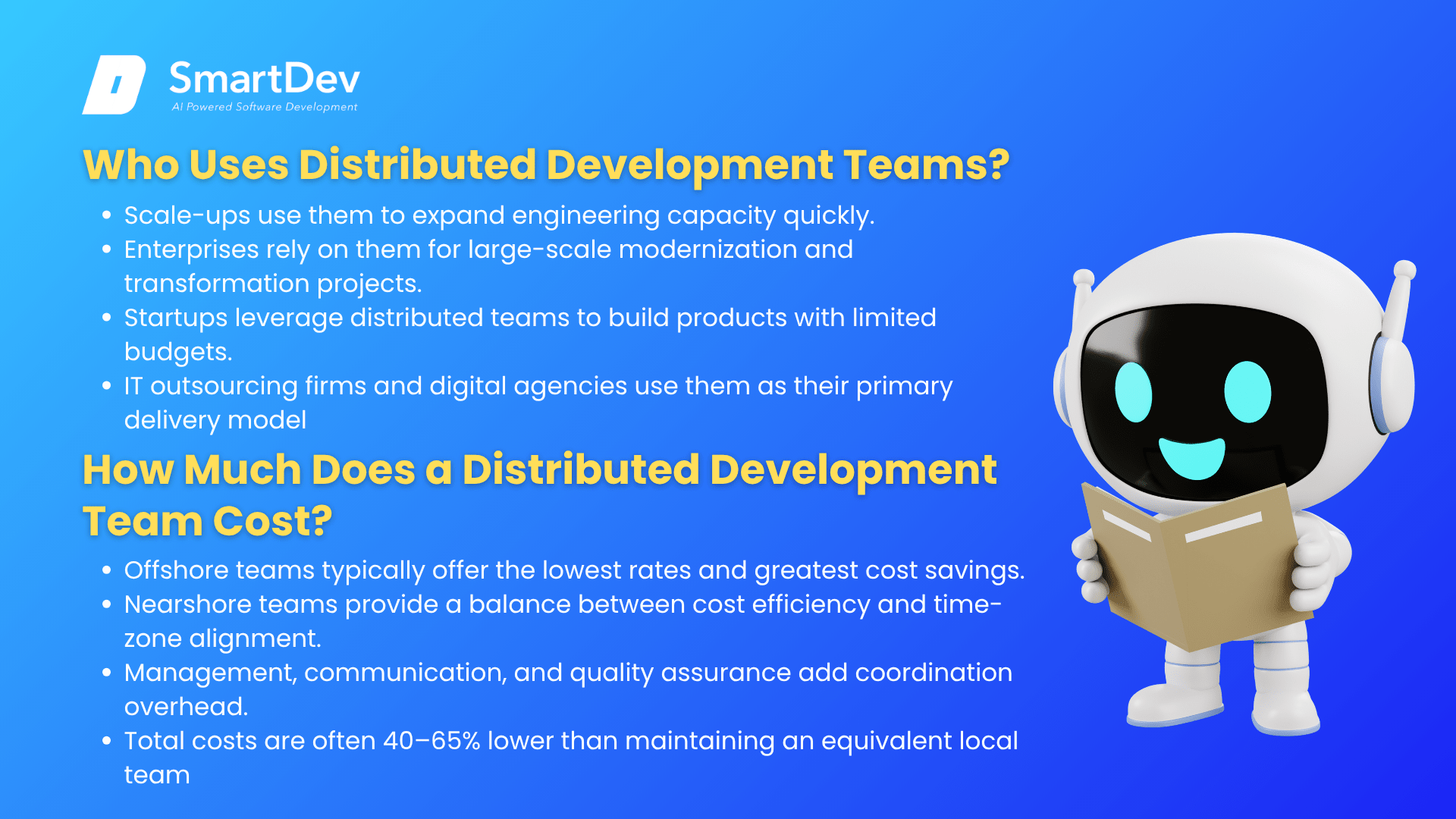
Who Uses Distributed Development Teams?
Distributed development teams are used across industries and company stages, but are most common among:
- Scale-up technology companies: Fast-growing software companies that need to expand engineering capacity quickly without the delays and costs of local hiring use distributed teams to scale rapidly in response to business growth.
- Enterprise IT departments: Large organizations with complex legacy modernization programs use distributed teams to supplement internal capacity for multi-year transformation projects that require more engineers than their internal team can supply.
- Startups: Early-stage companies with limited budgets use offshore or nearshore distributed teams to build their initial product at a cost that enables longer runway and faster iteration than local hiring would allow.
- Digital agencies and IT outsourcing firms: Agencies and MSPs build their own distributed delivery capability to serve clients across multiple engagement models and geographies.
Within organizations, distributed development teams are typically managed by an internal engineering lead or product owner who owns the product vision and backlog, while day-to-day delivery management is handled by a project manager or team lead embedded in the distributed team.
How Much Does a Distributed Development Team Cost?
The cost of a distributed development team depends primarily on the geography of the team and the engagement model chosen:
- Offshore rates (Vietnam, Philippines, India): Senior software engineers typically cost $25 to $50 per hour. A five-person team running full-time costs approximately $20,000 to $40,000 per month, compared to $80,000 to $120,000 or more for equivalent US-based talent.
- Nearshore rates (Eastern Europe, Latin America): Senior engineers in Poland, Romania, or Colombia typically cost $40 to $70 per hour, offering a middle ground between offshore cost savings and Western time zone proximity.
- Management and coordination overhead: Successfully managing a distributed team requires investment in communication tooling, project management practices, and team leads or delivery managers. Expect to add 15 to 25% to direct team costs to account for coordination and quality assurance infrastructure.
The total cost of a distributed team, including management overhead, is typically 40 to 65% lower than building an equivalent co-located team in a high-cost market, making it one of the highest-ROI decisions available to engineering leaders managing tight budgets.
Weitere verwandte Begriffe
- Technical Proposal: Acts as a foundational document in Business-to-Business (B2B) deals. You see it often in Information Technology (IT), engineering, and construction.
- Staff Augmentation: A model where individual engineers or specialists are added to an existing internal team on a temporary or long-term basis, providing flexible capacity without the overhead of building a full outsourced team structure.
- Agile Methodik: A set of iterative software development practices that provide the collaborative structure distributed teams need to work effectively across geographies, using sprints, daily standups, and regular retrospectives to maintain alignment.