In the high-stakes world of software development, the distance between a “good idea” and a “successful product” is often measured in wasted budget. For early-stage startups and scaling enterprises alike, the urge to start coding immediately is powerful. You have a vision, you have funding, and you want to see results. But launching into development without a validated map is the fastest way to burn through the runway.
This is where the transition from product discovery to roadmap becomes the most critical phase of your entire project lifecycle. It is the difference between building something and building the right thing. At SmartDev, we have refined this chaotic early stage into a structured 3-week product discovery process designed to de-risk your investment and provide crystal clear direction.
In this guide, we will walk you through exactly what happens during those three weeks, the concrete discovery phase deliverables you will own, and how we turn abstract discovery insights to strategy that is ready for execution.
The Cost of Skipping Discovery: Why Startups Fail
Before we dive into the “how,” we must address the “why.” Why should a business pause for three weeks before writing a single line of code?
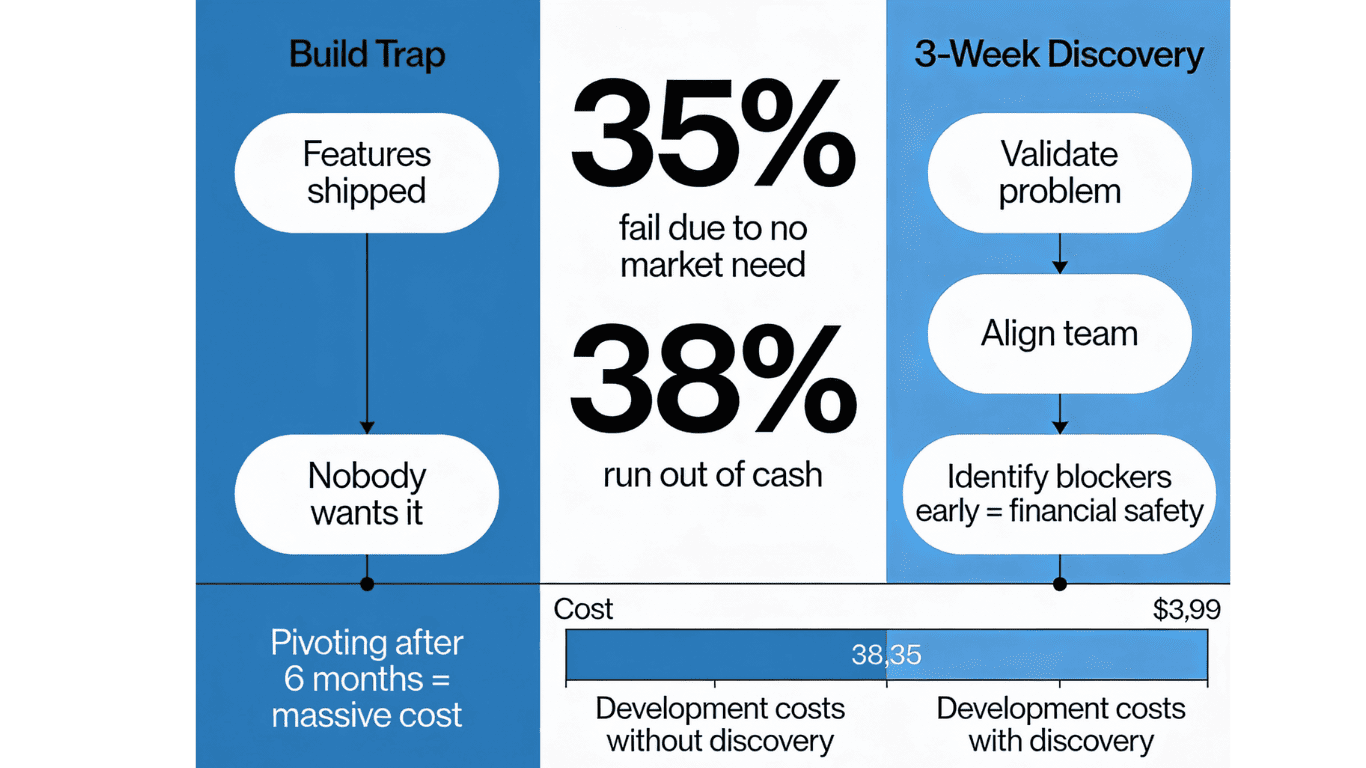
The statistics are sobering. According to extensive research by CB Insights, 35% of startups fail simply because there was no market need for what they built. Another 38% failed because they ran out of cash. These are not failures of engineering; they are failures of planning and validation.
Many founders fall into the “Build Trap.” They believe that progress equals features shipped. Consequently, they skip the startup product discovery service and move straight to development. Six months later, they emerge with a robust, bug-free application that nobody wants to use, or a platform that is technically unscalable.
The “3-Week” Paradox
Investing three weeks in a product discovery to roadmap phase might feel like a delay, but it is actually an accelerator. By compressing months of potential trial-and-error into a focused discovery sprint, you achieve financial safety by identifying technical blockers before hiring a full engineering team. You gain market validation by confirming user pain points before building solutions. And you establish stakeholder alignment by getting investors, founders, and developers on the exact same page.
A professional discovery phase is an insurance policy against the most expensive mistake in tech: building the wrong product. The cost of pivoting after six months of development is exponentially higher than discovering a flaw in Week 2 of discovery. This is why we recommend treating discovery as a non-negotiable investment, not an optional “nice-to-have.”
The 3-Week Product Discovery Process: A Week-by-Week Breakdown
At SmartDev, we don’t believe in open-ended consulting engagements that drag on for months. We believe in agility. Our 3-week product discovery process is intense, collaborative, and output-focused. Here is exactly what you and your business can expect during this sprint.
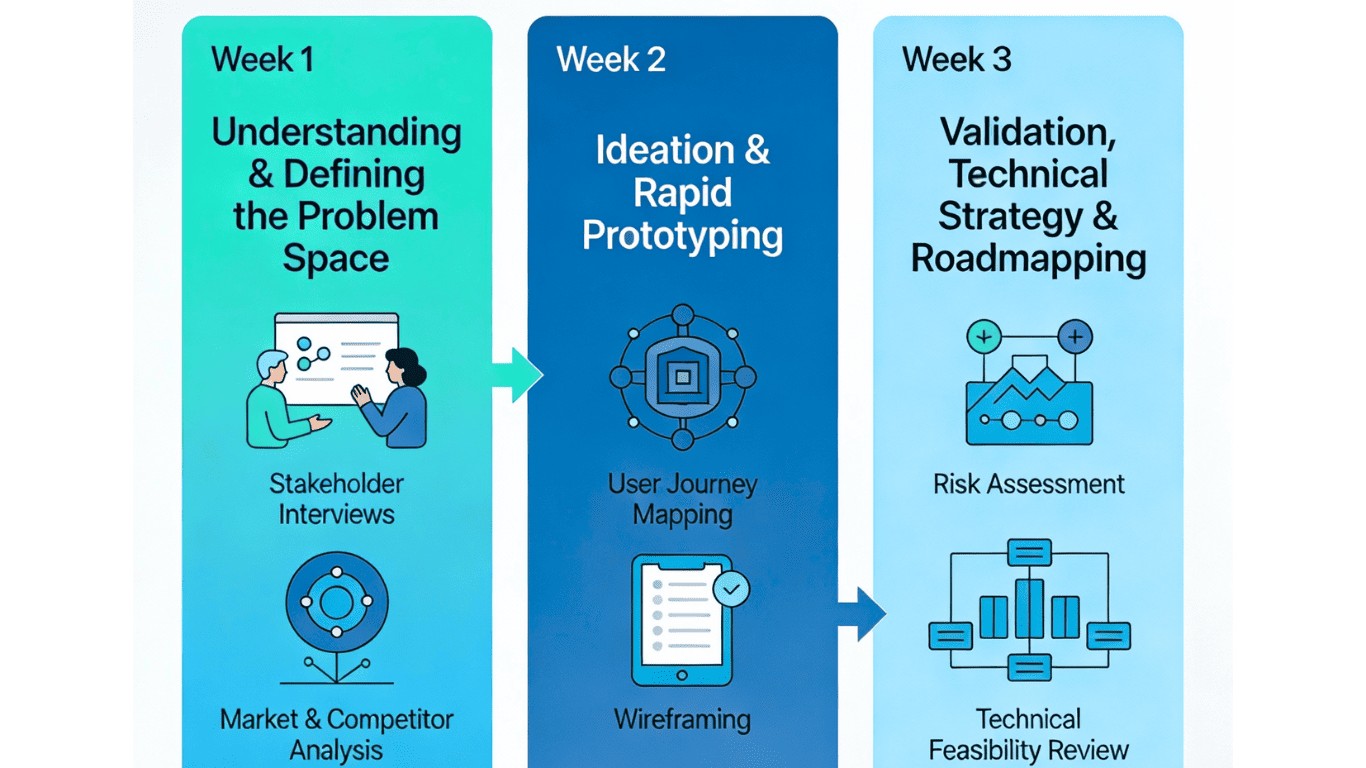
Week 1: Understanding & Defining the Problem Space
The first week is about immersion. We don’t just take your feature list at face value; we interrogate the underlying business goals using established User Research methods. Our team conducts stakeholder interviews to sit down with your founders, subject matter experts, and product leads to extract the core vision. What are the non-negotiables? What is the long-term definition of success?
Simultaneously, we conduct market and competitor analysis to understand who else is solving this problem and where they are falling short. We look for the “white space” in the market where your product can dominate and establish a unique competitive advantage. This isn’t about copying competitors; it’s about finding your unfair advantage.
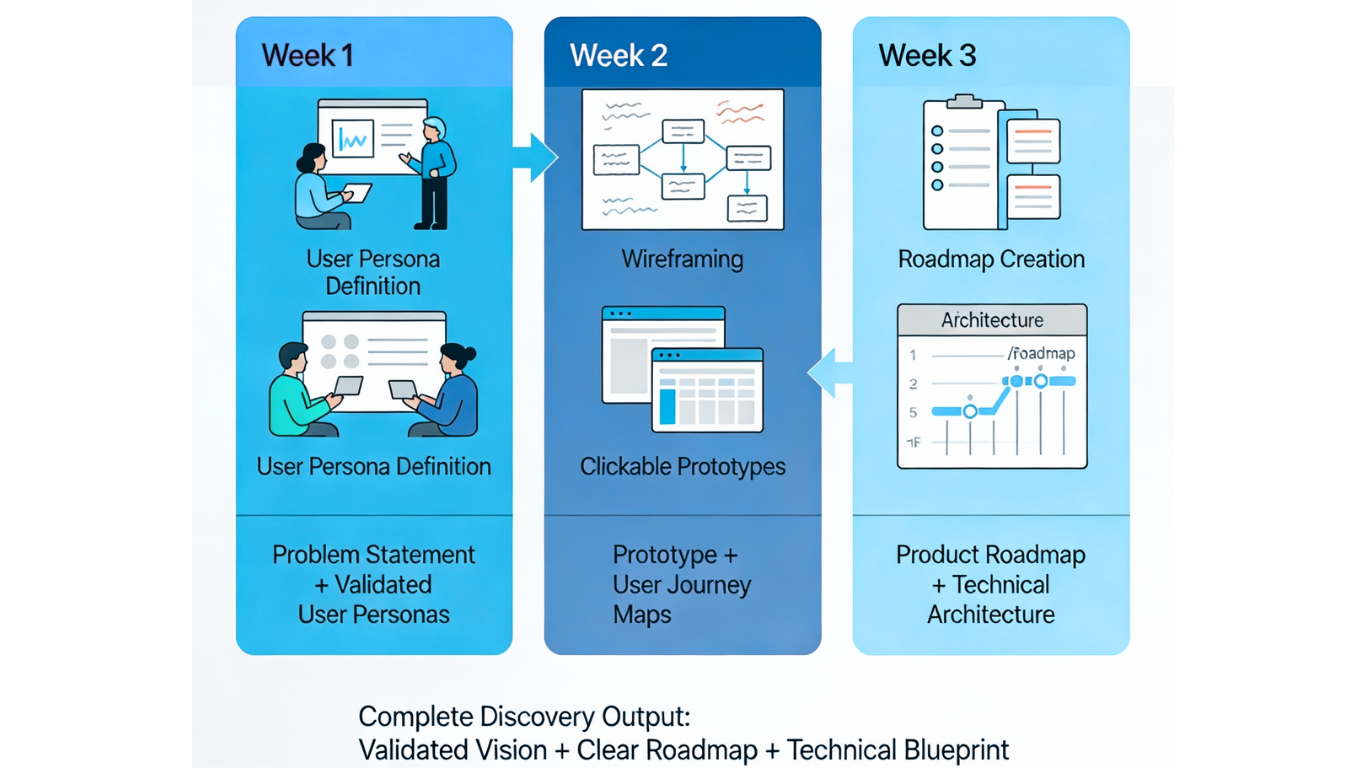
We also dive deep into user persona definition. We move beyond generic “users” to specific archetypes. Who is “Marketing Manager Mary”? What keeps her up at night? Why would she pay for your solution? By the end of Week 1, these personas are grounded in real research, not guesswork.
The Outcome of Week 1: A solidified “Problem Statement” and validated User Personas. We stop guessing who we are building for and align on why we are building it. This alignment becomes the North Star for all subsequent decisions.
Week 2: Ideation & Rapid Prototyping
Once we understand the problem, we move to the solution. This is not about writing production code yet; it’s about visualizing the future product to test our assumptions and get feedback before committing significant engineering resources.
We start with user journey mapping to outline the step-by-step flow a user takes to solve their problem using your product. This exposes friction points early. When we visualize the full user experience, we often discover moments where the flow breaks down or becomes confusing. Identifying these pain points in Week 2 is invaluable.
Our team then creates wireframes and low-fidelity designs for the core screens. We focus on information architecture, how data is organizerather than just colors and fonts. This is about answering the critical question: “Does this solution logically address the user’s problem?” The form follows function at this stage.
Finally, we build clickable prototypes that simulate the core user flow. This allows us to put something “real” in front of stakeholders and users to see if the logic holds up in practice. A prototype is worth a thousand words in a presentation. It makes abstract concrete.
The Outcome of Week 2: A tangible, visual representation of your product (a prototype) that proves the concept works in practice, not just in theory. This prototype becomes your communication tool with investors, team members, and early users.
Week 3: Validation, Technical Strategy & Roadmapping
The final week is about convergence. We take the validated design and apply engineering rigor to it, bridging the gap from discovery insights to strategy. Our application engineering teams review the features and assess technical feasibility. Can this be built within budget? Does it require AI integration or blockchain? What third-party APIs are needed?
We conduct a comprehensive risk assessment to identify potential pitfalls before they become expensive problems. This includes regulatory compliance considerations (GDPR/HIPAA), scalability bottlenecks, security vulnerabilities, and dependency risks. By being proactive about risk, we prevent costly surprises down the road.
We then create your strategic roadmap by prioritizing features into “Must Have,” “Should Have,” and “Could Have” using the MoSCoW method. We plot these prioritized features on a realistic timeline that accounts for resource constraints and technical dependencies.
The Outcome of Week 3: A comprehensive product roadmap after discovery that serves as your blueprint for the next 6-12 months. This roadmap is not theoretical; it’s grounded in technical assessment and real resource planning.
Ready to turn your product vision into a validated roadmap in just 3 weeks—before you burn through your development budget?
SmartDev's 3-week product discovery process replaces guesswork with strategic clarity. We identify risks early, align your team, and deliver a validated roadmap that accelerates your path to market.
De-risk your product launch, avoid costly pivots, and move into development with confidence.
Schedule Your Discovery Sprint TodayThe 5 Tangible Deliverables You Own After 3 Weeks
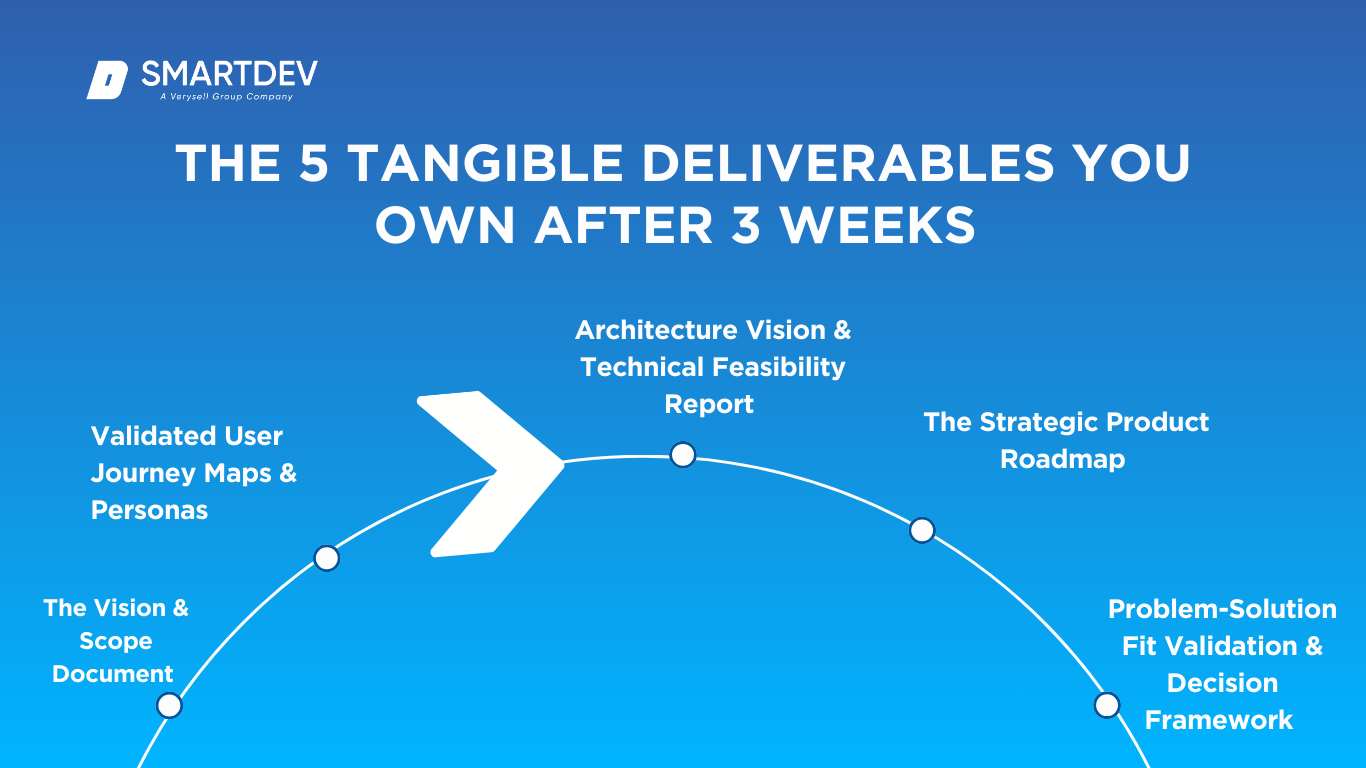
One of the common fears about consulting is paying for “advice” but receiving nothing tangible to show for it. With SmartDev’s startup product discovery service, you walk away with concrete assets. Even if you decide not to build with us, these assets belong to you and can be handed to any software development team in the world. You retain full ownership and intellectual property rights.
1. The Vision & Scope Document
This is your product’s “constitution.” It serves as the single source of truth for every stakeholder, from the board of directors to individual developers. The Vision & Scope Document includes high-level business goals, success metrics (KPIs), detailed user personas, and a glossary of terms to ensure everyone speaks the same language.
Why do you need this? It prevents “scope creep”—the silent killer of software budgets and timelines. When a new feature is requested later (and it will be), you can point to this document and ask, “Does this align with our agreed vision?” This document becomes your scope of protection mechanism.
2. Validated User Journey Maps & Personas
Data, not assumptions, should drive your feature set. Your validated user journey maps and personas include visual diagrams showing how different user types interact with your system, from initial login to the coveted “aha!” moment when they realize the value of your product.
Developers need context to make good decisions. When an engineer knows who they are coding for—what their goals are, what frustrates them, what they value—they make better micro-decisions throughout the codebase. This context transforms developers from code-writers into problem-solvers.
3. Architecture Vision & Technical Feasibility Report
This is where we de-risk engineering. The Architecture Vision & Feasibility Report includes recommendations for your technology stack (e.g., React Native vs. Flutter, AWS vs. Azure), database schema designs, and third-party integration plans. It addresses the hard technical questions that can make or break a product.
Why is this critical? It ensures your product is scalable from Day 1. It prevents you from building a foundation that will crumble under load. It answers questions like: “Will this database handle 100,000 concurrent users?” and “Is our third-party payment provider the right choice?” before you’ve spent thousands of dollars on the wrong infrastructure.
4. The Strategic Product Roadmap
Moving from product discovery to roadmap is the ultimate goal of the entire process. This isn’t just a calendar of features; it’s a strategic battle plan for the next 6-12 months. The roadmap includes a phased timeline (MVP, V1.0, V2.0), breaks down complex epics into manageable sprints, and defines dependencies between features.
Why do you need this? It gives you a realistic launch date. You can tell your investors, “We will launch the Beta in Q3,” with confidence because the estimation is based on engineering reality, not guesswork. See how Atlassian defines an effective roadmap for more guidance on roadmap best practices.
5. Problem-Solution Fit Validation & Decision Framework
This is the critical deliverable that bridges your product vision to strategic clarity. The Problem-Solution Fit Validation document confirms that the problem your product solves is real, urgent, and valuable enough to justify investment. It also includes a Go-or-No-Go Decision Framework that gives stakeholders confidence to move forward, adjust scope, or pause the initiative.
What does this include? A clear solution vision describing what your product enables for users and the business. High-level capabilities mapped to business objectives. Alignment between business ambitions and technical feasibility. This output is especially crucial if your product involves AI or machine learning components.
Why does this matter? Many teams move into development with misaligned expectations about what success looks like. The Problem-Solution Fit Validation ensures everyone, from executives to engineers—understands the value being created and the risks being managed. It replaces assumptions with validated insights. This is why business-first discovery is essential for AI initiatives, where problem definition and feasibility validation are even more critical than in traditional software.
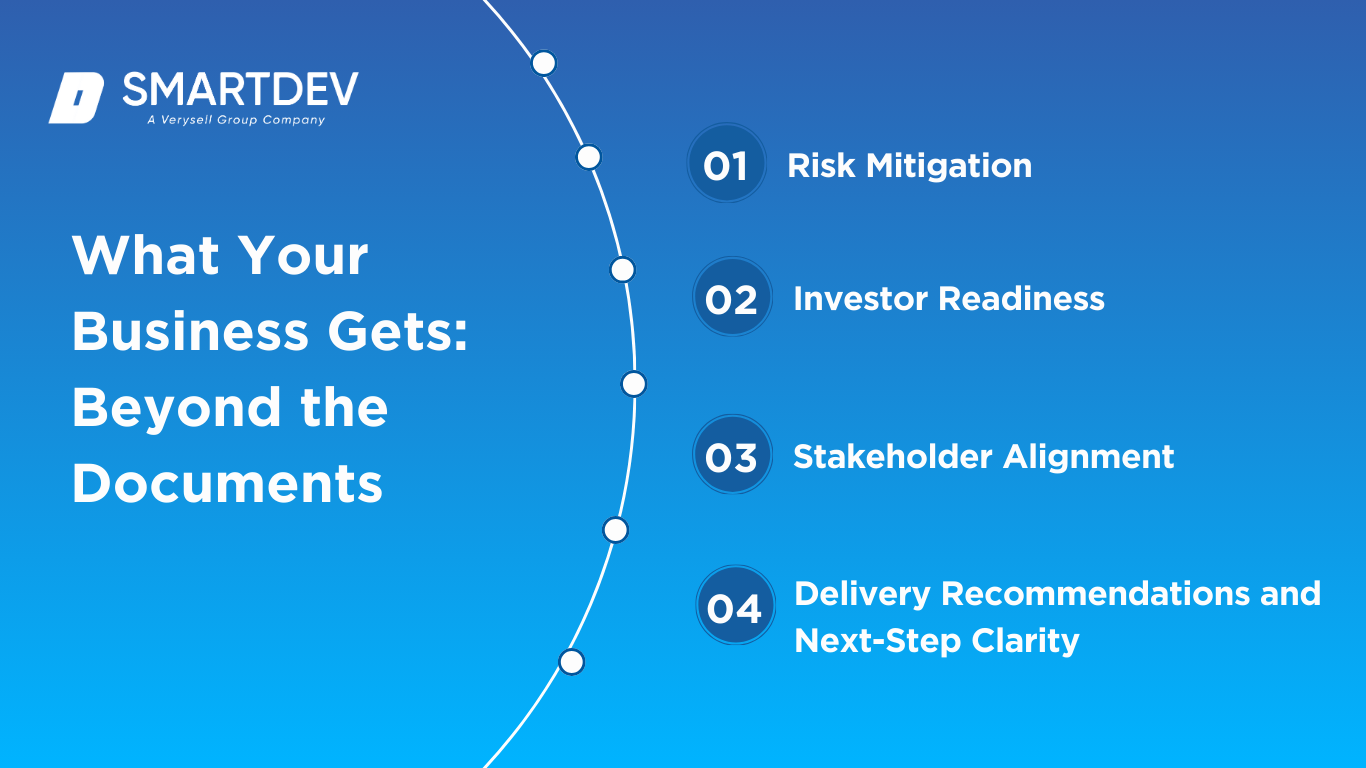
What Your Business Gets: Beyond the Documents
While the discovery phase deliverables are critical, the intangible value to your business is often even greater. Transforming discovery insights to strategy fundamentally changes the DNA of your project and how your team operates.
1. Risk Mitigation
Sometimes, the best outcome of a discovery phase is the realization that a product shouldn’t be built—at least not in its current form. This might happen because the market is too small, the technology is infeasible, or competitors have already dominated the space. Discovering a fatal flaw in Week 2 costs you a few thousand dollars. Discovering it in Month 6 of development costs you hundreds of thousands of dollars and months of lost time.
SmartDev’s discovery process acts as a safety filter for your capital. It gives you permission to kill bad ideas before they destroy your startup. This is often the most valuable service we provide.
2. Investor Readiness
For startups seeking Seed or Series A funding, a “cool idea” is rarely enough. Investors have heard thousands of pitches; most fail. Investors look for due diligence and evidence of execution capability. Walking into a pitch meeting with a validated prototype, a detailed technical architecture document, and a costed product roadmap after discovery separates you from the amateurs.
It demonstrates that you are an operator who understands execution, not just a dreamer with a PowerPoint deck. It shows you have thought through the hard problems and have a realistic plan to solve them. This is the difference between a rejected pitch and a funded startup.
3. Stakeholder Alignment
Internal conflict kills momentum faster than any external competitor. You have competing visions: Marketing wants AI features; Sales wants mobile support; CTOs worry about security and scalability. Without alignment, you end up building a product that satisfies no one fully and wastes resources on competing priorities.
Our discovery process forces these conversations to happen early, in a structured way. By the end of Week 3, everyone has signed off on the same plan. The internal friction is removed before the high-cost development clock starts ticking. A unified team moving in one direction will outpace a fractured team every time.
4. Delivery Recommendations and Next-Step Clarity
The output of discovery isn’t just “what to build,” but “how to build it.” We provide delivery recommendations: Should you use Kanban or Scrum? How often should you release? What is your QA strategy? Who should be your technical lead? You gain clarity on the operational machine needed to deliver the product sustainably.
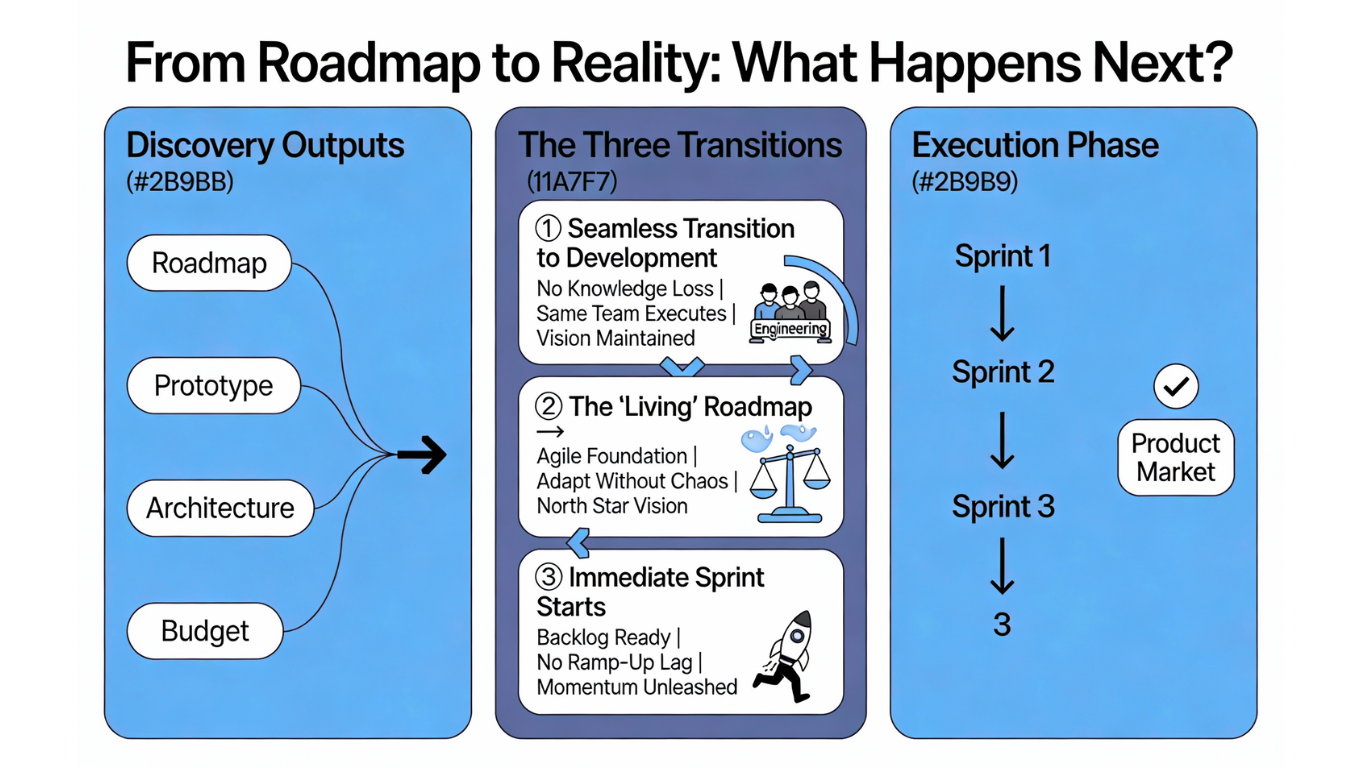
From Roadmap to Reality: What Happens Next?
You have finished the 3-week product discovery process. You have your roadmap, your prototype, your architecture, and your budget. The question now is: What comes next?
Seamless Transition to Development
Because SmartDev’s engineering leads were involved in the discovery phase (assessing feasibility and building the prototype), the transition to development is seamless. There is no knowledge loss during a “handover.” The team that estimated the roadmap is often the team that executes it. This continuity accelerates the project and maintains the vision.
The “Living” Roadmap
A product roadmap after discovery is not carved in stone. It is a living artifact that evolves as your business learns. As you move into development sprints, market conditions might shift. Customer feedback might reveal that your initial assumptions were wrong. New competitors might emerge.
Because we built the roadmap on a foundation of Agile principles, you can adapt without chaos. The discovery phase gives you the “North Star” vision, allowing you to be flexible on the tactical journey while staying true to your strategic destination. This balance between vision and flexibility is what separates successful products from failed pivots.
Immediate Sprint Starts
With the backlog defined during discovery, you can often start Sprint 1 immediately. There is no multi-week “ramp-up” lag where developers are trying to understand the requirements. Your development team hits the ground running with prioritized user stories ready for execution. This momentum is invaluable.
What’s Next: Reducing Risk Faster Than You Think
The 3-week discovery process we’ve outlined transforms your product vision into a validated roadmap, but the real power lies in how quickly it mitigates risk compared to traditional development approaches. Many founders ask us: “How is three weeks really enough to eliminate the uncertainties that could sink our product?”
The answer is in the methodology. We’ve engineered the discovery phase to expose the highest-risk assumptions first, prioritize them ruthlessly, and validate them through rapid iteration. This isn’t just fast; it’s strategically fast.
FAQ: Common Questions About Product Discovery
Is 3 weeks really enough time?
For most MVPs and distinct product modules, yes. We structure the workshops and activities tightly to maximize efficiency. For massive enterprise re-platforming projects that require deep integration with legacy systems, we may recommend a tailored extension, but 3 weeks is the “sweet spot” to maintain momentum without getting stuck in analysis paralysis. After 3 weeks, you have the 80% of insights that drive 95% of the decisions.
Can’t we just start coding and figure it out as we go?
You can, but it is the most expensive way to learn. Agile does not mean “no planning.” It means “adaptive planning.” Skipping discovery usually results in “refactoring” (rewriting code) later, which costs 3-4x more than writing it correctly the first time. The marginal cost of discovery is tiny compared to the cost of rework.
What if the discovery phase proves my idea isn’t viable?
Then we have succeeded. We have saved you months of development time and potentially hundreds of thousands of dollars in wasted engineering spend. We can then pivot the discovery insights to strategy to a direction that does work, or you can conserve your capital for a different opportunity. This is a win, not a failure.
What if my product involves AI or machine learning?
If AI is core to your solution, discovery becomes even more critical. The traditional discovery process must be extended to include problem-solution validation, data readiness assessment, and feasibility evaluation specific to AI. SmartDev’s AI Discovery process addresses these additional layers of complexity while maintaining the same 3-week timeline. It ensures that AI is applied intentionally to solve real business problems, not deployed experimentally
Conclusion: Stop Guessing, Start Building
The difference between a frantic, budget-bleeding startup and a calm, execution-focused company is often the quality of their preparation. Great products are not built in a chaotic rush; they are built by teams that have thought through the hard problems and have a clear plan.
SmartDev’s startup product discovery service is more than just a consulting gig; it is a rigorous, 3-week product discovery process stress test for your business idea. We take the fog of “innovation” and condense it into a clear, illuminated path forward. We validate your assumptions so you can move into development with confidence, not hope.
From product discovery to roadmap, we ensure that every dollar you spend on development is an investment in a validated feature, not a gamble on a guess. You walk away with a vision, a plan, and the confidence to execute. Your team knows what to build, why to build it, and how to build it.
Ready to validate your vision?
Don’t commit to a 6-month build without a 3-week product discovery process. Contact SmartDev today schedule your discovery sprint and turn your product ideas into an engineering roadmap.