En bref :
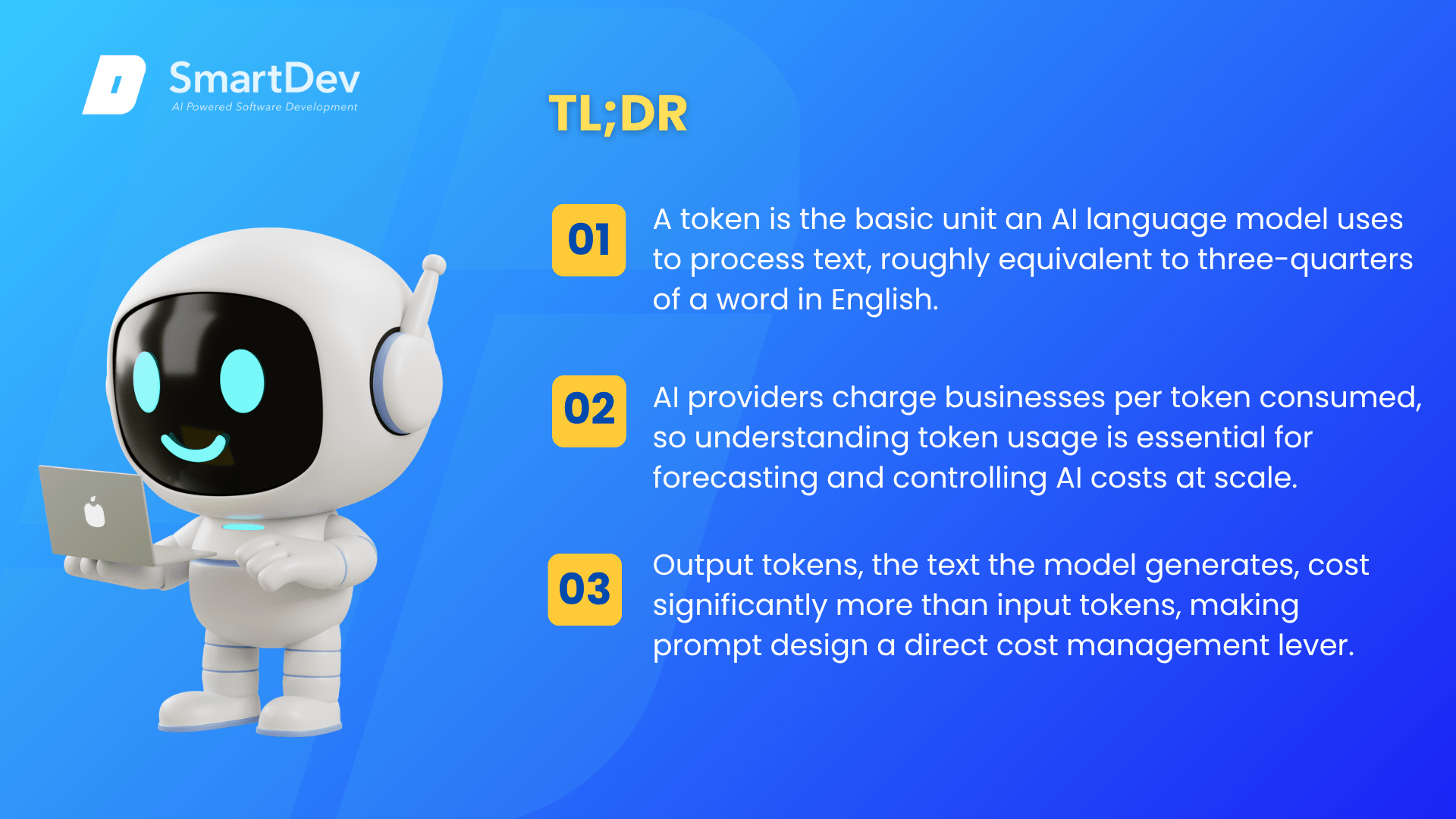
- AI token is the basic unit an AI language model uses to process text, roughly equivalent to three-quarters of a word in English.
- AI providers charge businesses per token consumed, so understanding token usage is essential for forecasting and controlling AI costs at scale.
- Output tokens, the text the model generates, cost significantly more than input tokens, making prompt design a direct cost management lever.
When your company pays for AI services, you are not paying per question or per session. You are paying per token. Tokens are the fundamental unit of measurement behind every AI language model interaction, and they directly determine your costs, your model’s performance limits, and the design of your AI workflows. For any business investing in AI tools or outsourcing AI development, understanding tokens is a practical financial necessity.
What is an AI Token?
AI token is a small unit of text that an AI language model processes as a single element, typically representing a word fragment, a whole short word, or a punctuation mark.
Language models do not read text the way humans do, word by word. They break text into tokens first, then process those tokens mathematically. In English, one token is roughly equivalent to four characters or about three-quarters of a word. The word “business” is one token. The phrase “IT outsourcing” is two tokens. A full sentence of twenty words might contain twenty-five to thirty tokens, depending on word length and complexity. Non-English languages and technical terms like code or chemical formulas often require more tokens per word because they are less common in training data.

Every interaction with a language model involves two categories of tokens. Input tokens are the text you send to the model, including your question, any background context, and system instructions. Output tokens are the text the model generates in response. Both are counted and billed separately, with output tokens consistently priced higher because generating text requires more computation than reading it.
Pourquoi c'est important pour les entreprises
Token pricing is how every major AI provider, including OpenAI, Anthropic, Google, and Amazon, charges for API access. For businesses deploying AI at scale, tokens are not a technical detail. They are a line item in the operating budget that can grow unexpectedly if not managed deliberately.
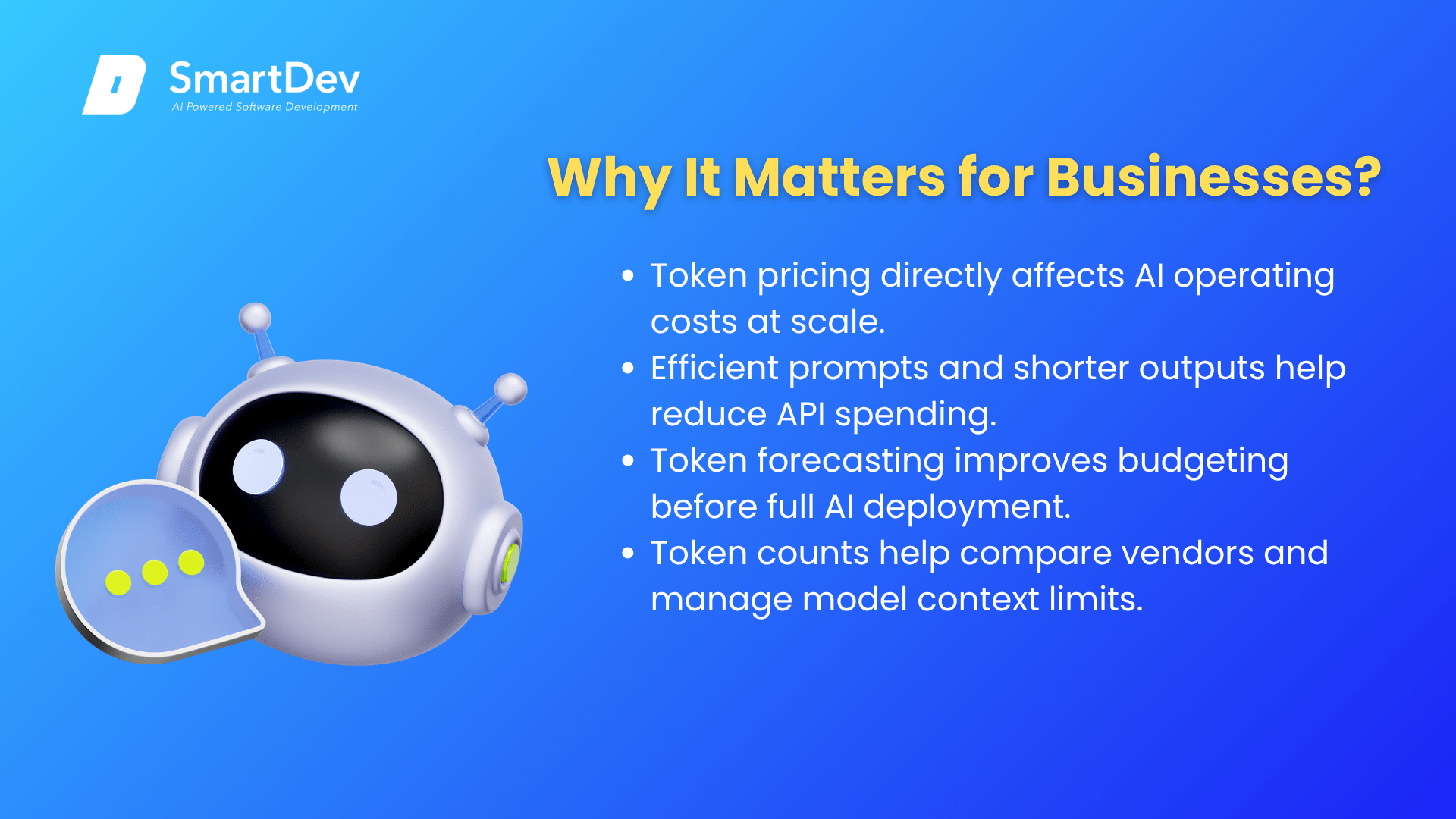
- Reduce AI operating costs by designing efficient prompts that achieve the desired output with fewer input tokens and shorter responses.
- Improve cost forecasting by estimating token volumes for each use case before committing to an AI deployment at scale.
- Protect performance by staying within the context window limit of a given model, the maximum number of tokens it can process in a single interaction.
- Accelerate vendor evaluation by using token counts as a consistent unit for comparing the true cost of different AI providers and models.
For example, a retail company deploying an AI-powered customer support assistant processed an average of 1,200 tokens per conversation. Across 50,000 monthly interactions, that totalled 60 million tokens. By streamlining system prompts and limiting response length for simple queries, the team reduced average tokens per conversation to 800, cutting monthly AI API costs by more than 30% without any reduction in customer satisfaction scores.
 How Does Token Processing Work?
- Text is submitted to the model. Your application sends a request containing the system prompt, the conversation history, and the user’s latest message.
- The model tokenizes the input. The text is broken into tokens using the model’s tokenizer, a vocabulary of fragments the model learned during training. Each fragment is assigned a numerical ID.
- The model processes the token sequence. The language model reads the full sequence of input tokens, computing the relationships between them to understand meaning and context.
- Output tokens are generated one at a time. The model predicts and produces the most likely next token repeatedly until it reaches a natural stopping point or a maximum output length you have configured.
- Tokens are counted and billed. Your AI provider tallies all input and output tokens from the interaction and adds the cost to your usage bill at the per-token rate for the model you selected.
The result is that every word in every prompt and every word in every response carries a measurable cost. Teams that treat prompt design as a cost management discipline consistently achieve lower API spend than those that do not.

How Much Does AI Token Processing Cost?
Token pricing varies significantly by model and provider. As of 2026, the market has seen substantial price reductions, with costs falling roughly 80% from 2024 to 2026 as competition among AI providers intensifies.
Current indicative ranges for leading models sit between $0.15 and $15 per million input tokens, and between $0.60 and $60 per million output tokens, depending on model capability. Frontier models with the strongest reasoning ability command premium prices, while smaller, faster models are priced far lower and suit high-volume, lower-complexity tasks.
Three factors drive your total AI token costs. First, the choice of model. More capable models cost more per token. Second, your prompt architecture. Lengthy system prompts, full conversation histories, and uncompressed context all add input tokens to every request. Third, output verbosity. Models that generate long, detailed responses by default consume more output tokens per interaction than those configured for concise answers.
Compared to building and hosting a proprietary AI model in-house, token-based API pricing remains substantially more cost-effective for most enterprise use cases, particularly for organizations still in the early stages of AI adoption.
Autres termes associés
Context Window: The maximum number of tokens a language model can process in a single interaction, combining both input and output, which determines how much information the model can consider at once.
Token Consumption: The total number of tokens an AI model uses in one interaction. Higher token consumption means higher API cost, more processing, and a greater chance of hitting the model’s context limit.
Prompt Engineering: The practice of designing AI inputs to achieve high-quality outputs efficiently, a key discipline for managing token consumption and controlling AI operating costs at scale.