
TL;DR
- Escalation management is the structured process of routing unresolved issues to higher levels of authority or expertise when they cannot be resolved at the first point of contact.
- A well-designed escalation system ensures that critical problems reach the right people quickly, minimizing the business impact of incidents, client dissatisfaction, and operational disruptions.
- In IT outsourcing and managed services, escalation management is a contractual and operational cornerstone that defines how issues are handled, who is accountable, and what response times are guaranteed.
Escalation management is what separates organizations that contain problems quickly from those that let them spiral. When a customer complaint, system incident, or project risk is not resolved promptly at the first point of contact, a clear escalation process ensures it reaches someone with the authority and expertise to act before the situation worsens. This article explains what escalation management is, why it matters, and how to implement it effectively.
What is Escalation Management?
Escalation management is the systematic process of elevating unresolved issues, incidents, or decisions through a predefined chain of authority or expertise when they cannot be addressed effectively at the level where they first arose. It is a core operational discipline in IT support, customer service, project management, and IT outsourcing.
Escalation processes typically operate across two dimensions:
- Functional escalation: Routing an issue to someone with more specialized technical knowledge or access. For example, a Tier 1 support agent escalates a complex database error to a Tier 2 database specialist who has the tools and expertise to diagnose and resolve it.
- Hierarchical escalation: Routing an issue to someone with greater authority or accountability. For example, an account manager escalates a client relationship risk to a VP of Client Success who has the authority to make commercial decisions and direct additional resources.
Effective escalation management defines three things for every issue type: the trigger conditions that require escalation, the escalation path specifying who the issue goes to and in what sequence, and the response time expectations at each level of the escalation chain.
Why It Matters for Businesses?
Without a structured escalation process, issues that should be resolved in hours fester for days. Support agents hold problems they cannot solve. Project risks go unreported until they become crises. Clients experience slow responses and feel ignored. The absence of escalation structure is a leading cause of customer churn, operational outages, and project failures in IT outsourcing engagements.
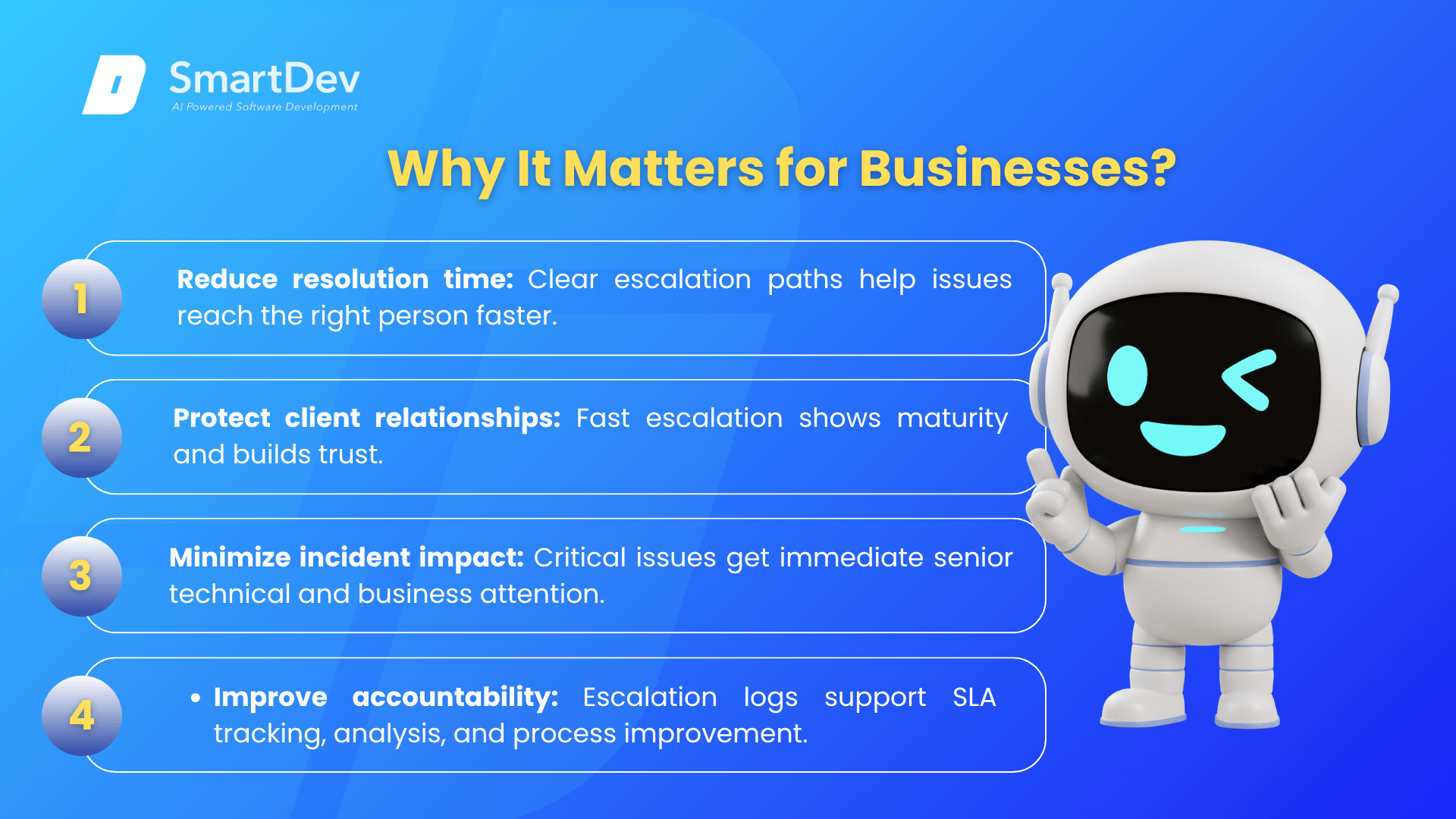
- Reduce issue resolution time: Clearly defined escalation paths eliminate ambiguity about who to contact when a problem exceeds a frontline agent’s capability, cutting resolution time by ensuring issues reach the right person without unnecessary delays.
- Protect client relationships: In outsourcing and managed services, clients measure vendor quality by how well problems are handled, not just how rarely they occur. Fast, structured escalation demonstrates operational maturity and builds client trust.
- Minimize business impact of incidents: Critical IT incidents such as production outages affect revenue, customer experience, and regulatory standing every minute they persist. Escalation management ensures high-severity incidents reach senior technical responders and business decision-makers immediately.
- Improve accountability and visibility: Documented escalation logs create a record of how issues were handled, enabling post-incident analysis, service level compliance reporting, and continuous improvement of resolution processes.
For example, an IT outsourcing firm serving a retail client implemented a tiered escalation protocol that automatically paged senior engineers and notified the account director whenever a Severity 1 incident remained open for more than 15 minutes. Average time to resolution for critical incidents dropped from 4.5 hours to 47 minutes, and the client’s annual satisfaction score increased significantly at renewal.
How Does Escalation Management Work?
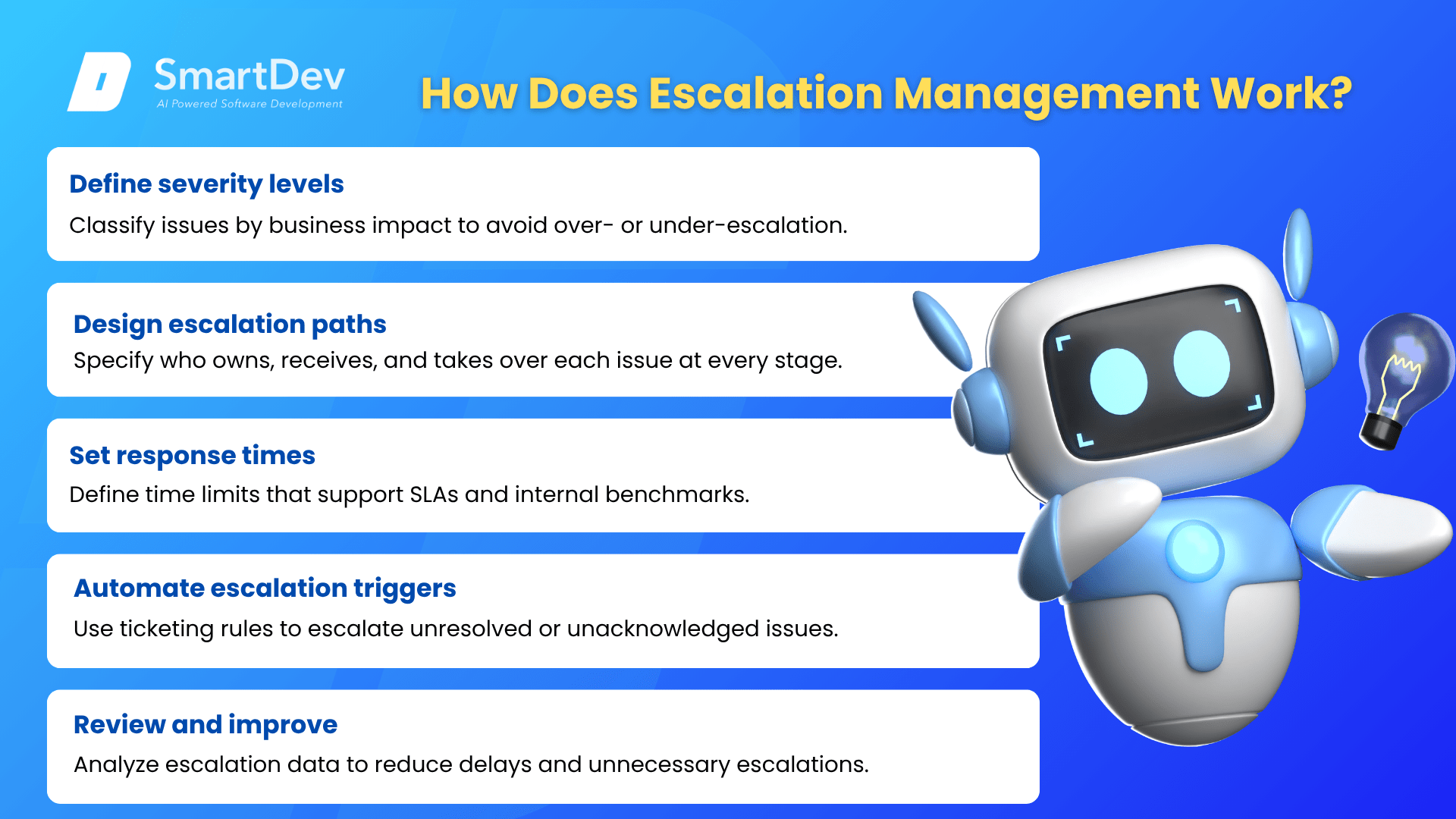
- Define severity levels: Classify issue types by business impact. A Severity 1 incident, such as a production system outage affecting all users, warrants immediate escalation and senior response. A Severity 3 issue, such as a non-critical UI bug, follows a normal support queue. Clear severity definitions prevent over-escalation and under-escalation.
- Design escalation paths: For each severity level, define the escalation chain: who the issue goes to first, who gets notified in parallel, and who takes ownership if the first responder cannot resolve it within a defined time window. Make these paths specific and named rather than generic and vague.
- Set response time commitments: Define maximum time limits at each stage of the escalation path. These become the basis for SLA (Service Level Agreement) commitments to clients and internal performance benchmarks for the support organization.
- Implement escalation triggers: Configure automated triggers where possible, such as ticketing systems that automatically escalate tickets after a defined period without resolution or acknowledgment. Automated triggers remove reliance on human judgment and reduce the risk of issues being overlooked under workload pressure.
- Review and improve: Analyze escalation data regularly to identify patterns: which issue types escalate most frequently, where delays occur in the escalation chain, and which escalations could have been resolved at a lower tier with better training or tooling. Use this data to improve frontline resolution capability and reduce unnecessary escalations over time.
The result is an organization where problems are contained and resolved at the right level, by the right people, within agreed timeframes, preserving both operational continuity and client confidence.
When to Use Escalation Management?
Escalation management is relevant whenever an organization handles ongoing service delivery, but becomes operationally critical when:
- You manage IT outsourcing or managed service contracts: Clients expect defined escalation procedures as part of their service agreement. Without them, disputes about response quality and accountability are inevitable.
- You operate customer-facing support functions: Any business with a support team handling customer issues needs escalation procedures to ensure complex problems reach specialists and that customers are not left waiting indefinitely at the wrong tier.
- You run production software systems: Systems with uptime requirements and SLAs need incident escalation procedures that activate automatically for high-severity events, ensuring the right engineers are engaged within minutes rather than hours.
When NOT to over-escalate:
- Frequent unnecessary escalation of low-severity issues overwhelms senior staff, reduces their availability for genuine emergencies, and prevents frontline teams from developing problem-solving capability. Escalation thresholds should be calibrated to route issues to the lowest effective level of resolution.
Other Related Terms
- Long-Term Coherence: Refers to an AI system’s ability to maintain consistency, logical continuity, and contextual relevance across extended exchanges, lengthy documents, or complex multi-step tasks.
- Rate Limiting: the practice of restricting the number of requests a user, application, or system can make to a service within a defined time period, in order to control resource consumption, protect system performance, and prevent abuse.