TL; DR:
- Kanban is a visual workflow system that helps teams organize, track, and complete tasks.
- The method encourages frequent process reviews, defining clear rules, real-time updates, and ongoing improvements to help teams stay responsive and aligned.
- Tools like Slack amplify Kanban principles by integrating real-time notifications, collaboration channels, and task tracking into daily workflows.
What is Kanban Workflow?
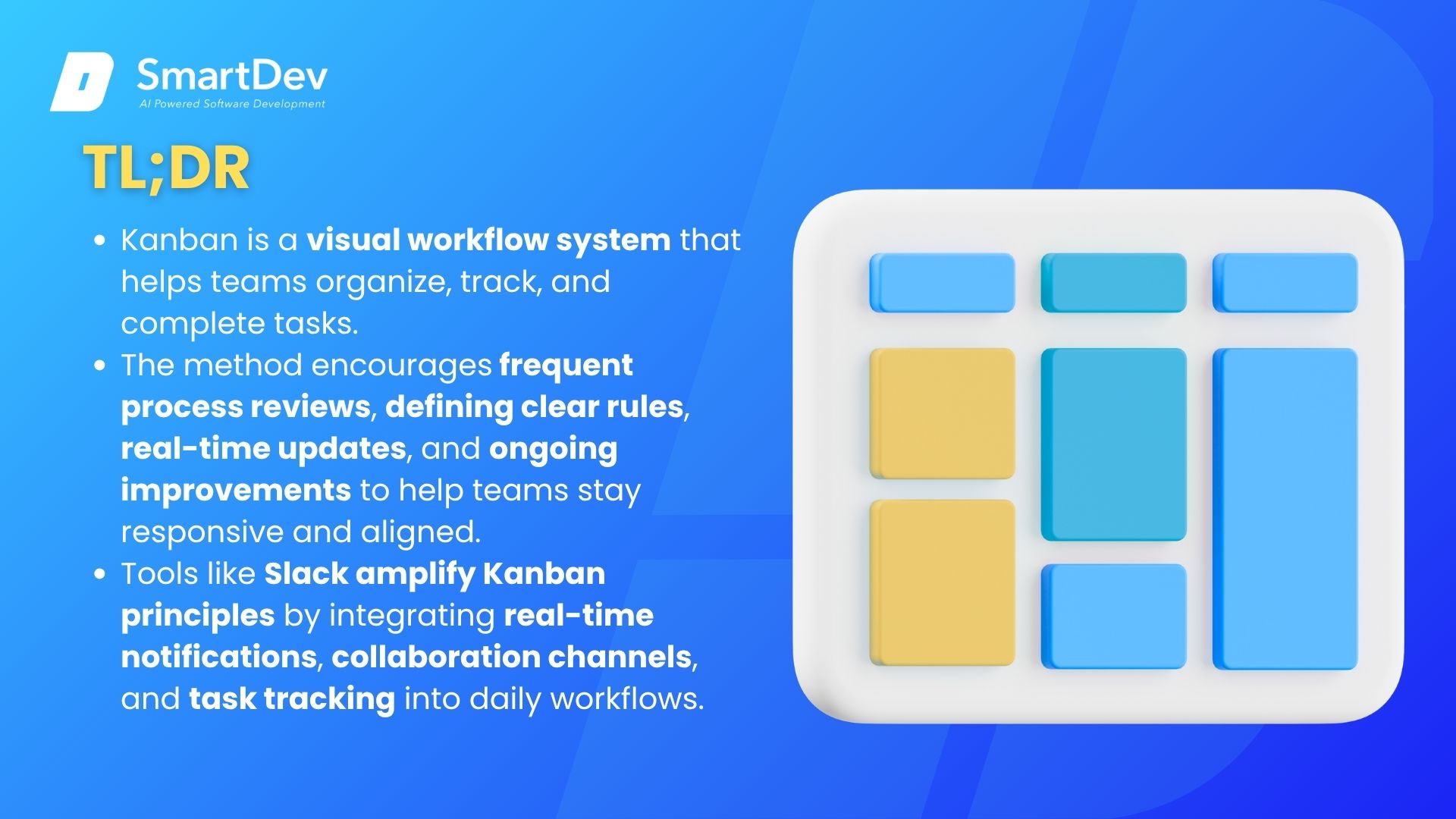
Kanban is a visual workflow management system that helps teams organize, track, and complete tasks using boards, columns, and cards. It enables teams to clearly see work progress and identify bottlenecks in real time. With the support of Kanban, it helps to understand its origins, why it works, and how to apply in modern workflows.
Why Use Kanban Workflow?
These practices improve visibility across all tasks and stages, so everyone can clearly see what’s happening, what’s in progress, and what’s blocked. That makes it easier to detect bottlenecks and inefficiencies early before they grow into larger delays, and it strengthens decision-making because teams have more up-to-date information. Over time, this transparency supports a culture of continuous improvement, since teams can regularly review outcomes, learn from what’s working, and refine how work is handled through feedback loops.
They also help prevent overload by limiting work in progress (WIP), ensuring that teams focus on completing existing work instead of constantly starting new items. With fewer tasks in motion at the same time, it’s easier to manage capacity, reduce context switching, and keep flow moving steadily. As a result, teams stay aligned around shared priorities, respond more quickly to changes, and maintain a sustainable pace that supports both quality and delivery.
How Does Kanban Workflow Work?
Adopting the Kanban method usually doesn’t call for a major operational overhaul. In many cases, it works best to begin with one straightforward board for a single team or project, learn from that pilot, and then expand and refine the process as you go.
1. Make a project board
To test your Kanban board, pick a single team or project. Simple columns like “To Do,” “In Progress,” and “Done” should be used initially. If necessary, add stages later. This allows everyone to become acquainted with the methodology and progressively embrace the procedure.
2. Describe the steps of the workflow
Determine the critical phases of your workflow by working with your team. These should not only indicate the optimal number of steps or stages to complete tasks, but also how work moves forward. A marketing team may contain columns like Intake Approved, Intake Denied, Backlog, Drafting, In Review, or Published.
3. Establishwork-in-progress limits
Determine the maximum number of tasks that can be at each stage at once. You may, for instance, restrict In Progress to three tasks. These boundaries encourage teams to concentrate on finishing projects rather than abandoning them. Limits should be modified over time in accordance with team capacity or business requirements.
4. Use Slack fornotifiication
To ensure that board updates, including new cards, status updates, and deadline reminders, are pushed in the appropriate channels, integrate Slack with your Kanban platform. This keeps everyone in sync and minimizes context switching. When work-in-progress restrictions are surpassed, Slack alerts can notify teams as well.
What Are Key Benefits of Kanban Workflow for Project Management?
There are serveral benefits of Kanban to simplify workflow management by streamlining processes and improving transparency and efficiency. Here are the top four benefits when applying the Kanban workflow to project management.
1. Improved productivity
Instead of juggling too many items at once, the Kanban technique lets you concentrate on finishing tasks. You may set up task list alerts and reminders by integrating Slack into this system, allowing team members to stay informed about project developments and deadlines without having to switch platforms.
2. Less bottlenecks & stressed
The Kanban approach assists you in promptly identifying the problem and resolving it before it slows down the project if work begins to pile up at one point or if certain team members are overburdened with chores. Besides, project managers can maintain acceptable workloads by restricting how many tasks each person takes on at once. Through automatic reminders and progress check-ins via project channels or team meetings, Slack may offer an extra degree of assistance.
3. Ongoing development
You may identify patterns and trends and provide insights that you can use for next projects with the aid of a Kanban process. You may gather the information required to streamline your process, discover fresh approaches to enhance it, and adjust for better outcomes, whether you’re aiming for improved time management or resource allocation.
How to Measure Kanban Success
Understanding how work flows and improving it over time are key components of measuring Kanban performance. This entails evaluating measurements with a focus on ongoing development rather than perfection. When assessing the effectiveness of any workflow, keep an eye on these crucial criteria.
- Lead time: The entire amount of time from job request to completion
- Cycle time: The amount of time between the beginning and end of a task
- Throughput: The quantity of work finished in each amount of time
- Trends in ongoing work: How frequently boundaries are met or surpassed
Teams may detect bottlenecks, forecast delivery times, and modify procedures by monitoring these KPIs. Dashboards with integrated analytics that display trends over time are a common feature of Kanban solutions. Alerts for sluggish cycle times or overcrowded columns, when coupled with Slack, enable teams to take prompt action before issues worsen. Additionally, teams may utilize Slack analytics to track member activity and channel participation to see how the team interacts with the project.
Other Related Terms
1. Scrum Framework
A structured Agile framework that organizes work into time-boxed iterations called sprints, with defined roles (e.g., Product Owner, Scrum Master) and ceremonies (e.g., daily stand-ups, sprint reviews). Unlike Kanban’s continuous flow, Scrum framework emphasizes planned delivery cycles and iterative development.
2. Agile Methodology
A broad project management approach that emphasizes flexibility, collaboration, and iterative progress. Kanban is one of several frameworks under Agile, focusing specifically on continuous workflow and real-time optimization rather than fixed iterations.
3. Continuous Delivery
A practice of delivering work incrementally and frequently, ensuring that updates are released smoothly without delays. It aligns closely with Kanban’s flow-based approach.