
TL;DR:
- Cloud architecture is the blueprint that defines how hardware, software, networking, and storage components work together in a cloud environment.
- Choosing the right cloud architecture model, whether public, private, hybrid, or multicloud, directly affects cost, performance, and business agility.
- Enterprise leaders who understand cloud architecture are better positioned to make informed decisions about IT investments and vendor selection.
Cloud computing has fundamentally changed how businesses build and operate technology. Yet for many decision-makers, the technical language around cloud environments remains a barrier to confident planning. Cloud architecture is one of the most foundational terms in this space, and understanding it clearly is essential for any organization evaluating or expanding its cloud footprint.
What is Cloud Architecture?
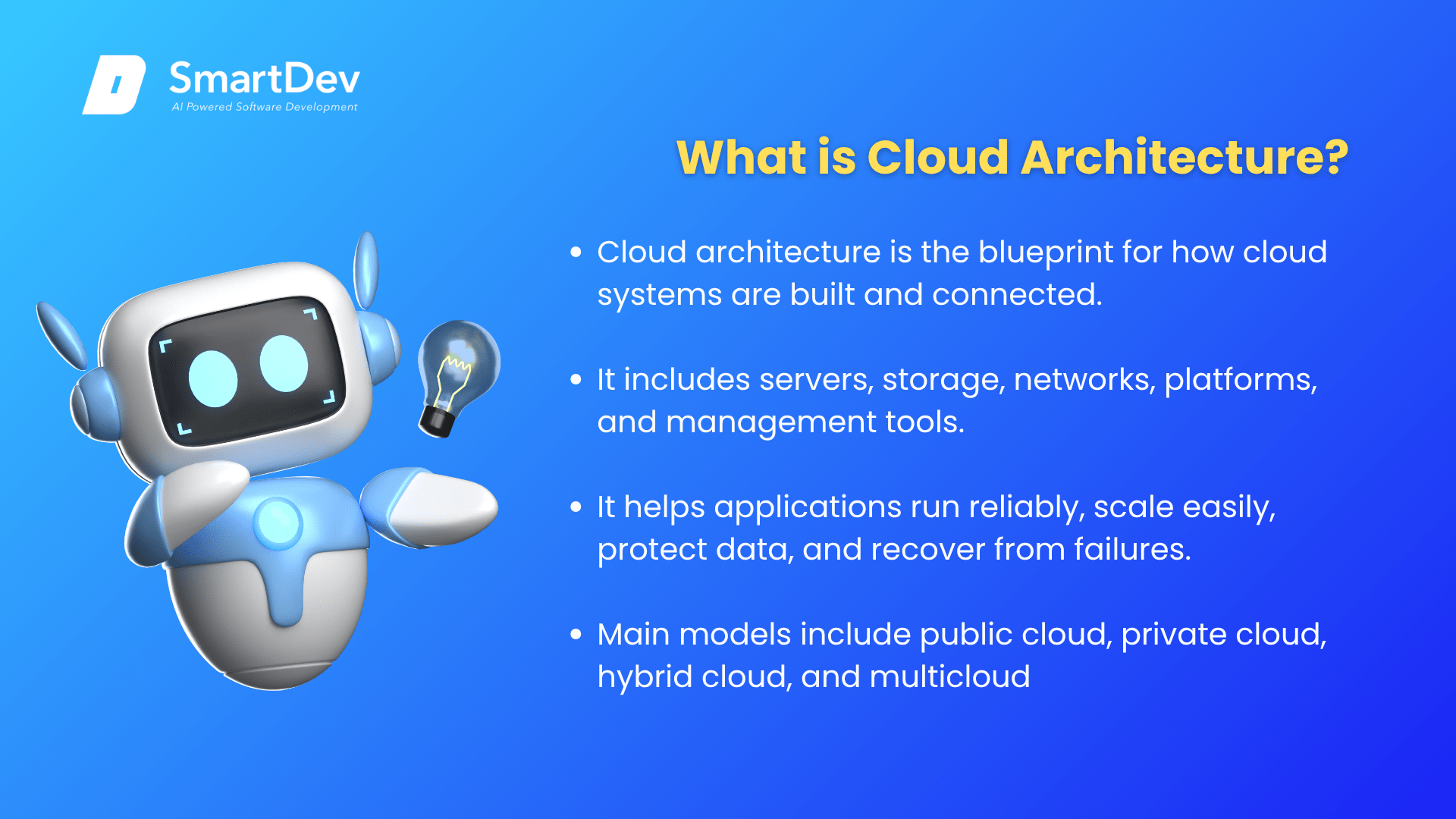
Cloud architecture refers to the way various cloud technology components interact and connect to create a functioning cloud computing environment. These components include servers, storage systems, networking infrastructure, virtualization layers, software platforms, and management tools. Together, they form a blueprint that defines how resources are organized, accessed, and scaled to meet specific business needs.
At its core, cloud architecture answers a practical question: how does an organization design its technology environment so that applications run reliably, data is accessible, and systems can grow without requiring constant manual intervention? The architecture defines not just which tools are used, but how they are connected, how traffic flows between them, how data is secured, and how the environment recovers from failures.
Cloud architecture is often discussed in terms of deployment models. A public cloud architecture uses shared infrastructure managed by a provider such as AWS, Microsoft Azure, or Google Cloud. A private cloud architecture dedicates resources exclusively to a single organization. A hybrid architecture combines both, allowing workloads to run where they are best suited. Most enterprises today operate a hybrid multicloud environment, drawing on multiple providers to optimize cost, performance, and redundancy.
なぜ企業にとって重要なのか
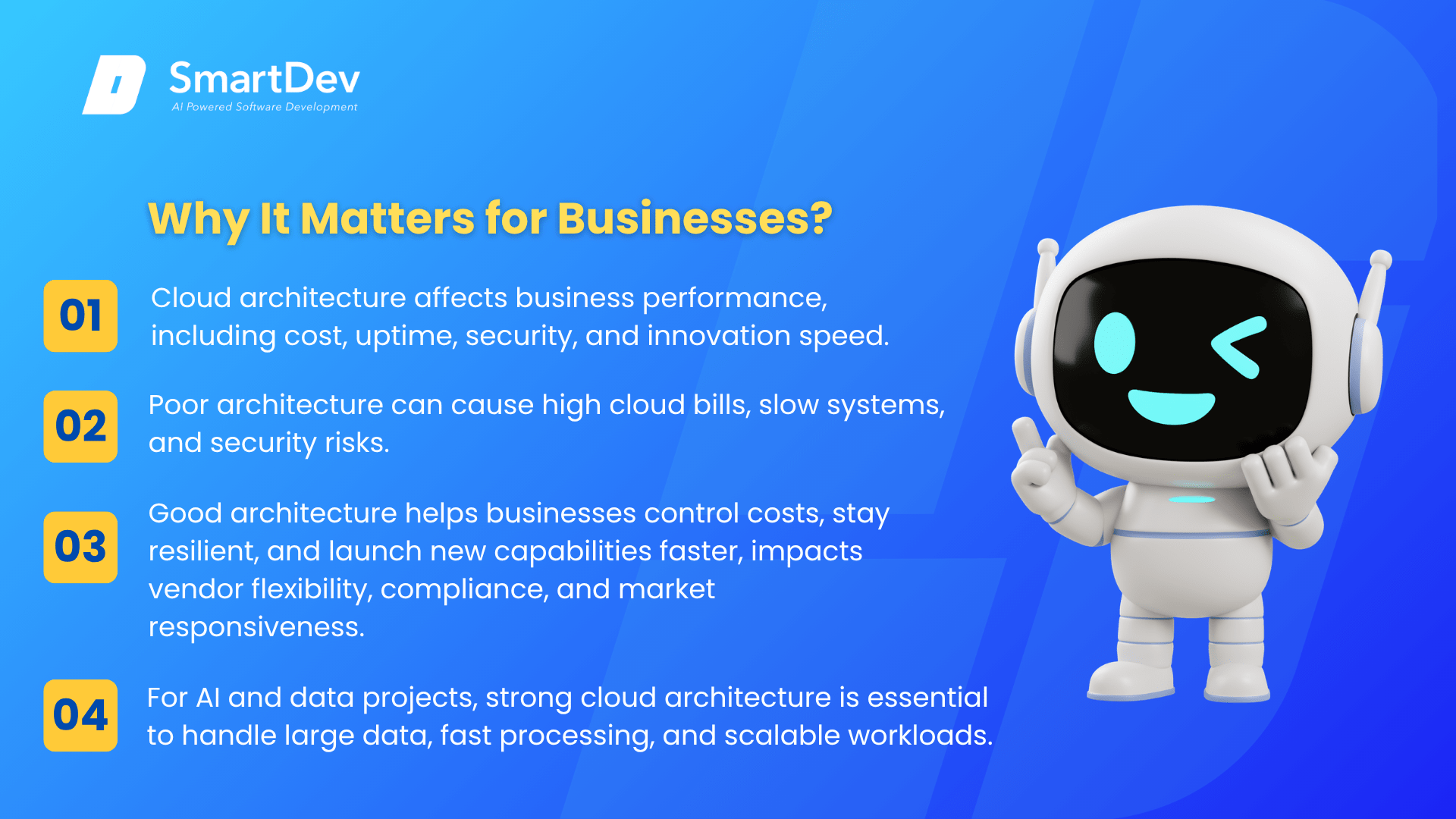
Cloud architecture directly shapes the cost structure, resilience, and innovation capacity of a business. A poorly designed architecture leads to unpredictable cloud bills, performance bottlenecks, and security gaps. A well-designed one delivers the opposite: predictable costs, consistent uptime, and the flexibility to deploy new capabilities quickly.
For business leaders, the architecture decision is not just a technical one. It affects vendor relationships, compliance posture, and the speed at which the organization can respond to market changes. A company locked into a single cloud provider without a well-considered architecture often finds itself unable to negotiate effectively or adapt when a provider changes pricing or discontinues a service.
Cloud architecture also underpins AI and data initiatives. Organizations looking to deploy AI models or build real-time analytics platforms depend heavily on cloud infrastructure that can handle large data volumes, low-latency processing, and on-demand scalability. Without the right architecture in place, these initiatives stall in development or fail in production.
How Is Cloud Architecture Designed?
Designing cloud architecture starts with understanding the workloads the organization needs to run. Different applications have different requirements. A customer-facing web application needs high availability and fast response times. A data analytics platform needs large storage capacity and high-throughput processing. A compliance-sensitive system may require data to remain within specific geographic boundaries.
Once workload requirements are understood, architects select the appropriate cloud model and services. This involves choosing between compute options such as virtual machines, containers, or serverless functions; selecting storage types; configuring networking and security boundaries; and planning for disaster recovery. The architecture is then documented so that development, operations, and security teams all work from a shared understanding of how the environment is structured.
Governance is an important part of architecture design. Cost management policies, access controls, and compliance requirements must be built into the architecture from the beginning rather than added as afterthoughts. Organizations that treat architecture as a living document, revisiting and updating it as business needs evolve, consistently achieve better outcomes than those that treat it as a one-time exercise.
Where Is Cloud Architecture Applied?
Cloud architecture applies across virtually every industry and business function. In financial services, it supports real-time payment processing, fraud detection, and regulatory reporting while maintaining strict data sovereignty requirements. In healthcare, it enables secure patient data management, telemedicine platforms, and clinical analytics. In retail and e-commerce, it powers dynamic pricing engines, inventory management systems, and personalized customer experiences that must scale rapidly during peak demand periods.
Within the enterprise, cloud architecture underpins the IT backbone that all other digital capabilities depend on. Development teams use cloud environments to build and test software faster. Operations teams use cloud monitoring tools to maintain system health. Data teams use cloud-native storage and processing platforms to run analytics at scale. As AI becomes more central to business operations, cloud architecture is increasingly the environment where AI models are trained, deployed, and monitored.
その他の関連用語
- Data Infrastructure: The full set of systems, tools, and technologies an organization uses to collect, store, process, and manage data, often built on top of cloud architecture.
- Production-Grade AI Development: The practice of building AI systems designed to run reliably in real business environments, requiring robust cloud architecture as a foundation.
- AI戦略: The enterprise-wide plan that defines how AI will create business value, with cloud architecture serving as a core component of the technical foundation.