TL;DR
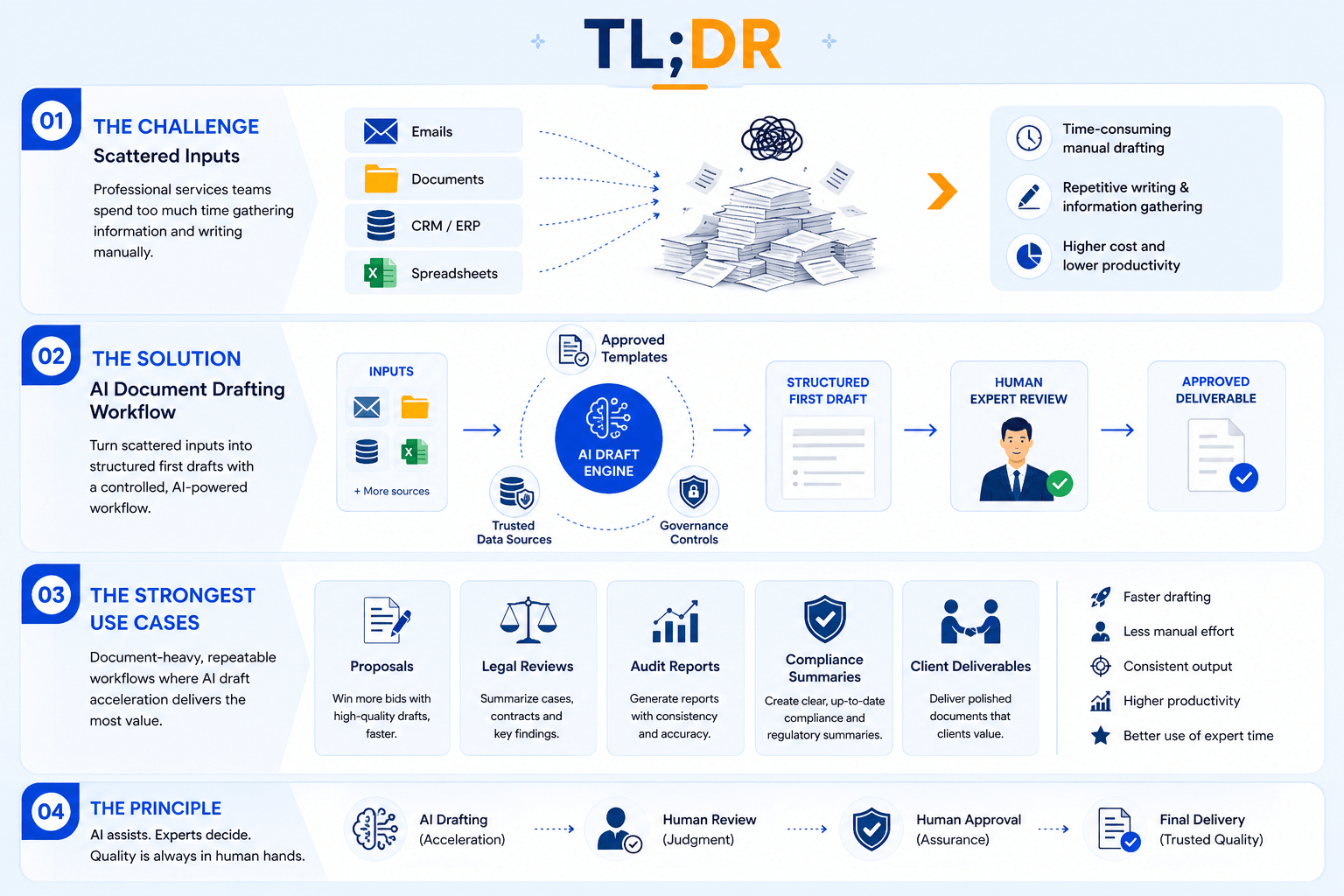
- Instead of spending hours gathering information and building documents from scratch, professional services teams can use AI to generate structured first drafts in minutes, freeing up time for higher-value client work.
- The strongest use cases are repeatable, document-heavy workflows such as proposals, legal reviews, audit reports, compliance summaries, and client deliverables.
- AI should not replace expert review; it works best as a controlled workflow with approved templates, trusted data sources, and human approval before final delivery.
Introduction
Professional services firms are being asked to deliver more work, faster, while maintaining the same level of quality and expertise. Across consulting, legal services, accounting, financial advisory, and compliance, clients now expect faster turnaround times, clearer documentation, and more personalized deliverables. This shift is part of a broader movement toward AI workflow automation, where organizations use intelligent systems to reduce repetitive work and improve service delivery.
Despite this pressure, document creation remains highly manual. Teams still spend hours drafting proposals, client reports, audit summaries, legal memos, and compliance documents. McKinsey research shows that generative AI can drive major productivity gains in knowledge-intensive work, particularly through content creation, summarization, and information synthesis.
AI document drafting helps teams move from blank page to structured first draft by pulling information from emails, meeting notes, CRM systems, templates, knowledge bases, and client documents. It is especially valuable for firms managing high volumes of recurring client documentation.
AI does not replace professional judgment. Instead, it creates a first version that experts can review, refine, and approve. This human-in-the-loop approach is critical in regulated environments, where accountability, auditability, and governance matter. For compliance-heavy workflows, platforms such as NORA show how AI can automate document-heavy operations while keeping professionals in control.
What Is AI Document Drafting?
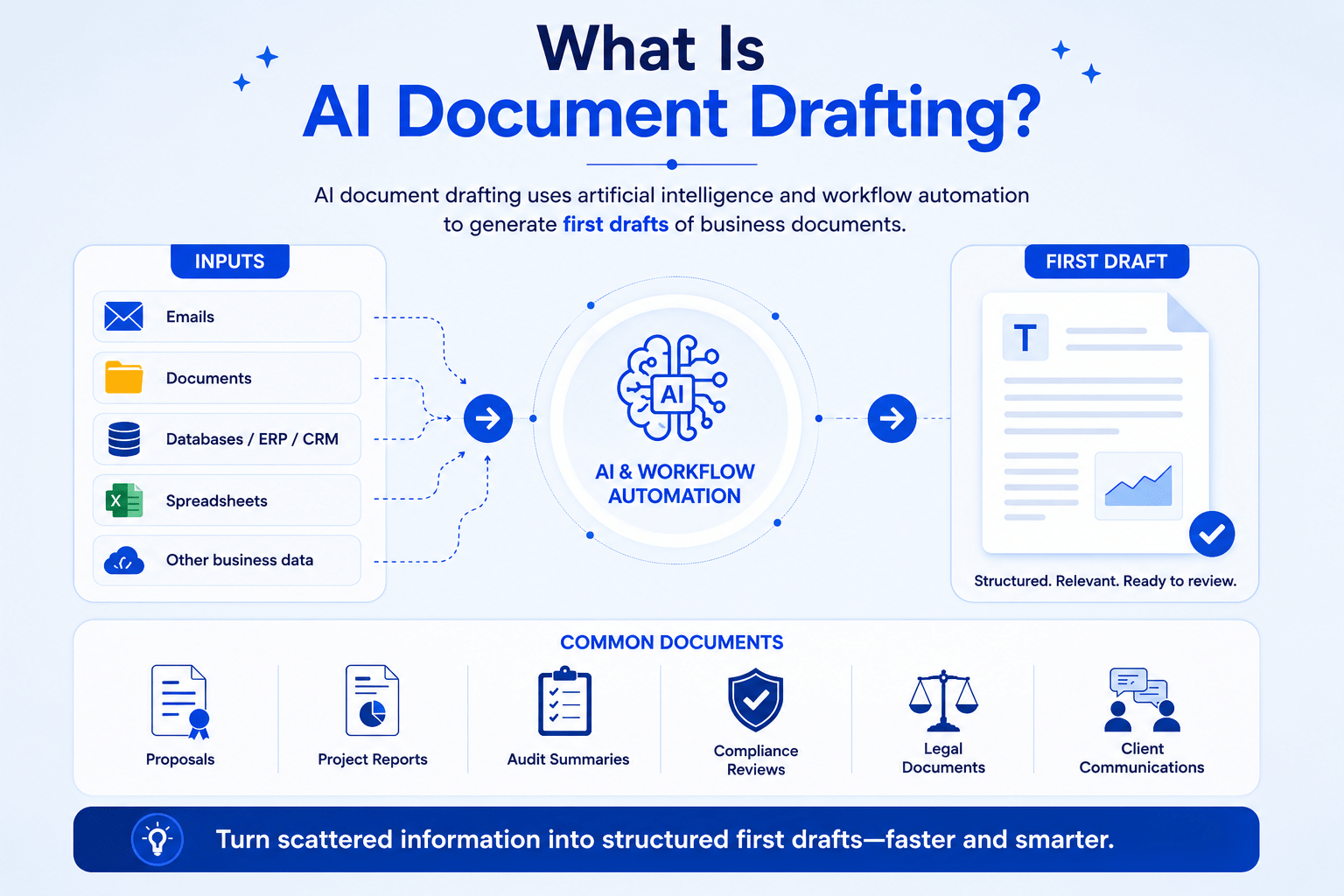
AI document drafting is the use of artificial intelligence and workflow automation to generate first drafts of business documents based on structured and unstructured data. These drafts may include proposals, project reports, audit summaries, legal documents, compliance reviews, client communications, and internal documentation. Unlike simple text generation, AI-powered drafting works best when connected to real workflow data, which is why it often sits alongside intelligent document processing and business process automation initiatives.
In practice, an AI drafting workflow may collect client details from a CRM, extract action points from a meeting transcript, reference a previous proposal, and apply a firm-approved document template. The system then generates a draft that follows the company’s structure, tone, and required sections. Research from Microsoft’s Work Trend Index highlights how employees are increasingly looking for AI support to manage information overload and repetitive work, which makes document drafting one of the clearest areas for practical adoption.
The Hidden Cost of Manual Document Drafting
Time Lost Searching for Information
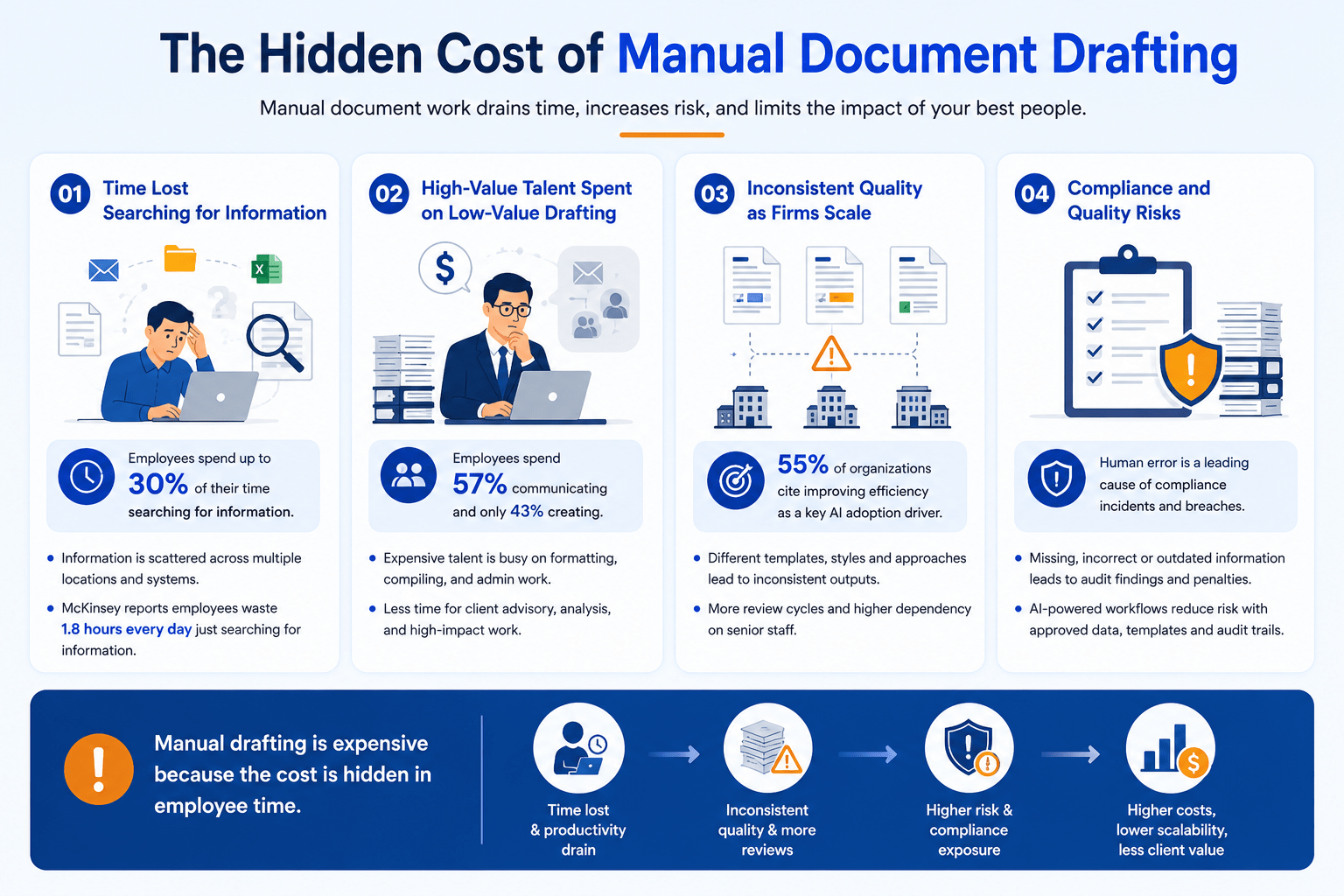
One of the most significant hidden costs of manual document management is the time employees spend searching for information. Studies reveal that employees can spend up to 30% of their time searching for information, especially when documents are stored in multiple locations or are poorly organized. According to a McKinsey report, employees waste 1.8 hours every day or nearly a quarter of their workweek just searching for information
High-Value Talent Spent on Low-Value Drafting
Manual drafting consumes valuable time from highly skilled professionals whose expertise commands premium rates. A consultant may spend several hours assembling a proposal, while an auditor or compliance analyst may dedicate significant effort to documenting findings and preparing reports. Research from Microsoft’s Work Trend Index found that employees spend 57% of their time communicating and only 43% creating, with much of that communication involving email, meetings, and document-related administrative work. For professional services organizations, this means expensive talent is often occupied with formatting, compiling, and documenting information instead of delivering strategic advice and client value.
Inconsistent Quality as Firms Scale
As firms grow, maintaining consistent document quality becomes increasingly difficult. Different employees may use different templates, writing styles, or documentation approaches, leading to inconsistent outputs across teams and offices. This creates additional review cycles and increases dependence on senior professionals. According to a Deloitte survey, 55% of organizations cite improving efficiency and productivity as a primary objective for generative AI adoption, largely because standardized AI-assisted workflows can reduce variability and improve consistency across knowledge-intensive processes. Without standardization, scaling document production often means scaling quality control costs as well.
Compliance and Quality Risks
Manual drafting also introduces significant compliance and operational risks. Information can be omitted, copied incorrectly, or pulled from outdated sources. In regulated industries such as finance, legal services, and audit, documentation errors can lead to audit findings, compliance breaches, client disputes, and reputational damage. Research from IBM’s Cost of a Data Breach Report consistently shows that human error remains one of the leading contributors to business risk and compliance incidents. While AI is not immune to mistakes, workflow-driven AI drafting can help reduce risk by automatically pulling information from approved systems, enforcing document templates, and creating auditable review processes that improve traceability and governance.
The problem becomes worse as firms scale. Document quality may depend too heavily on individual employees, creating inconsistency across teams. Junior staff may struggle to match the quality of senior experts, while experienced employees spend more time reviewing basic drafts. Over time, this creates a productivity ceiling. As Deloitte’s State of Generative AI report notes, many enterprises are moving beyond experimentation and looking for practical AI use cases that improve business operations.
Manual drafting also increases compliance and quality risks. Information can be missed, outdated templates can be reused, and important details may be copied incorrectly between systems. In regulated sectors such as finance, legal services, and audit, these errors are not small annoyances; they can create audit findings, client dissatisfaction, or regulatory exposure. This is why AI drafting should be treated as part of a controlled workflow rather than a random chatbot exercise.
How AI Workflow Automation Generates First Drafts
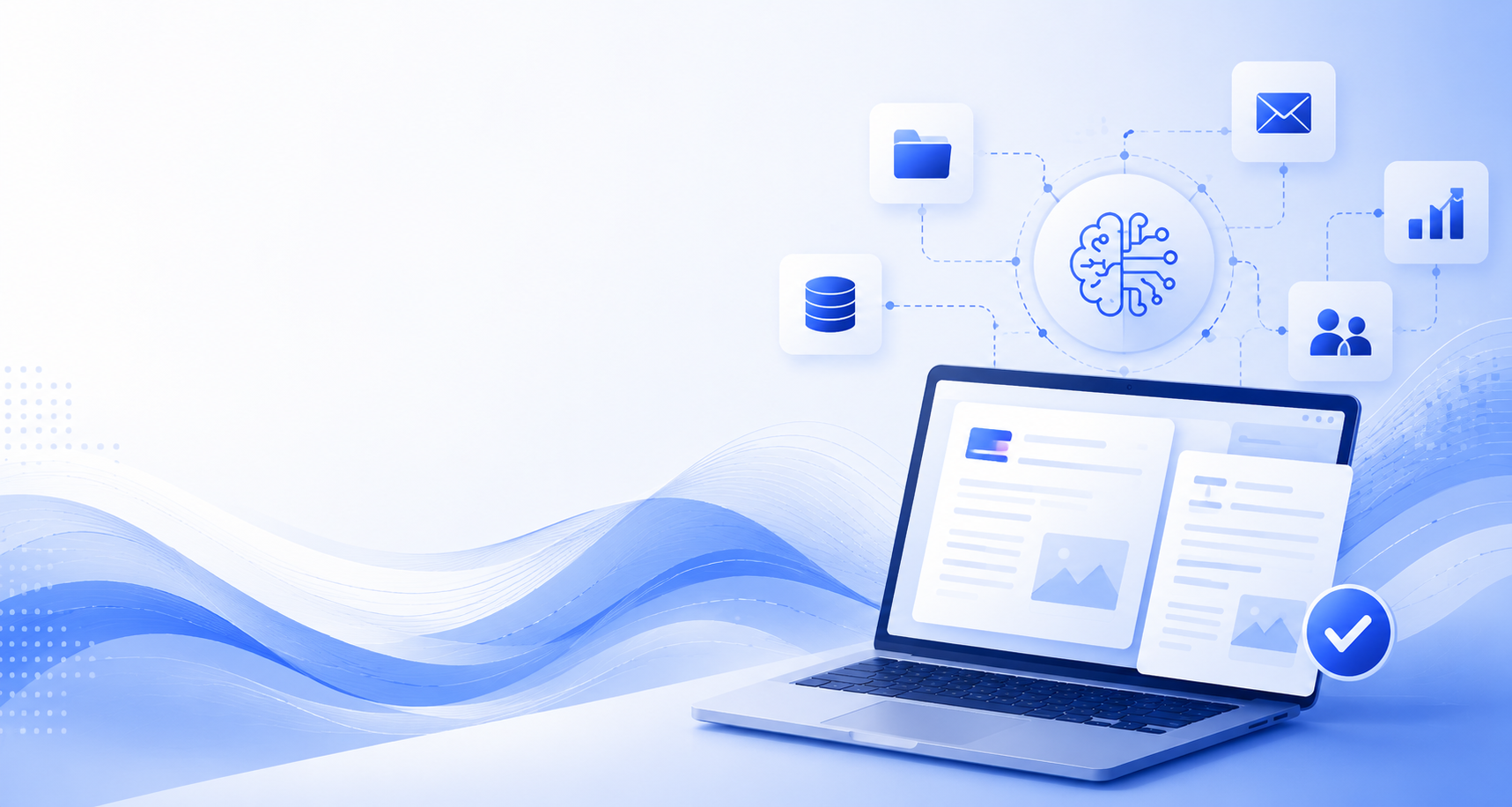
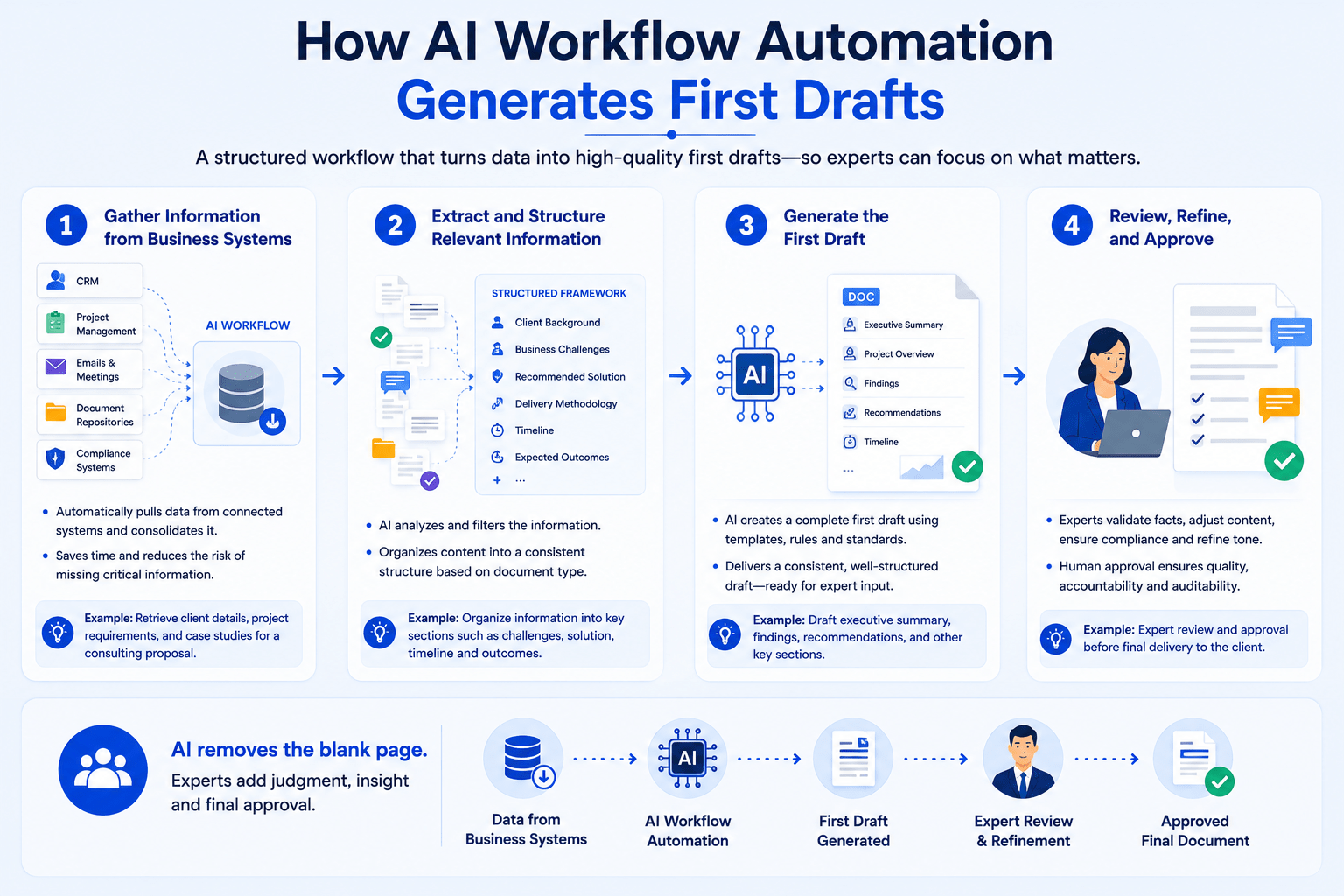
Modern AI document drafting is not simply a chatbot writing content on demand. It is a structured workflow that combines data collection, information processing, content generation, and human oversight. While implementations vary by organization, most AI-powered drafting workflows follow four key steps.
Step 1: Gather Information from Business Systems
The process begins by collecting relevant information from approved business systems. Depending on the document type, this may include CRM records, project management platforms, email conversations, meeting transcripts, client intake forms, document repositories, compliance systems, and internal knowledge bases.
Traditionally, employees would need to manually search across multiple platforms to gather these inputs before they could begin drafting. AI workflow automation eliminates much of this effort by automatically pulling information from connected systems and consolidating it into a single workflow. This not only saves time but also reduces the risk of missing critical information during the drafting process.
For example, when creating a consulting proposal, the system may automatically retrieve client details from the CRM, project requirements from discovery notes, and relevant case studies from the organization’s knowledge base.
Step 2: Extract and Structure Relevant Information
Once the data is collected, AI analyzes the available information and identifies the details most relevant to the document being created. Rather than copying everything into a report, the system filters, categorizes, and organizes content according to the required document structure.
For example, a proposal may require: Client background, business challenges, recommended solution, delivery methodology, timeline, expected outcomes. Similarly, a compliance report may require case summary, review findings, supporting evidence, risk assessment and recommended actions
This step transforms fragmented information into a structured framework, ensuring that documents follow consistent standards across projects and teams.
Step 3: Generate the First Draft
After the information has been organized, AI generates a complete first draft using predefined templates, business rules, and organizational standards. Instead of starting from a blank page, professionals receive a document that already contains the key sections, supporting information, and initial narrative.
The AI can draft executive summaries, project overviews, findings sections, recommendations, risk assessments, and client communications based on the information provided. Because the draft follows approved templates and workflows, it is often more consistent than manually created documents.
The objective is not to create a final deliverable automatically. The objective is to eliminate the repetitive work involved in assembling and structuring information, allowing professionals to focus on improving the content rather than creating it from scratch.
Step 4: Review, Refine, and Approve
The final step is human review. This stage remains essential regardless of how advanced the AI system becomes. Professionals must validate facts, verify recommendations, adjust tone and language, ensure regulatory compliance, and confirm that the document aligns with client expectations.
In regulated industries such as legal services, accounting, finance, and compliance, this review process is particularly important because organizations must maintain accountability and auditability for all client-facing documentation.
The most effective AI document drafting solutions do not remove humans from the process. Instead, they remove the “blank page problem.” By automating information gathering and first-draft creation while keeping experts responsible for final approval, organizations can achieve both higher productivity and stronger quality control.
Use Cases for AI Document Drafting in Professional Services
Consulting firm
Source: Vantage Advisory Group
Consulting firms can use AI document drafting to create project proposals, discovery reports, business assessments, and strategy documents.
A real-world example comes from Singapore consulting firm Vantage Advisory Group, which used AI to improve document drafting for proposals, client reports, and internal deliverables. Instead of asking consultants to build each document from scratch, the firm used AI to pull from previous engagements, standard templates, client information, and project context to generate structured first drafts. Consultants then reviewed, refined, and finalized the content before sharing it with clients. This AI-assisted drafting workflow helped reduce research time by 60%, speed up proposal development, and increase client capacity by 40% without adding headcount.
Legal service
Legal services teams can use AI to prepare first drafts of standard agreements, legal memos, due diligence summaries, and client updates. However, legal drafting requires strong governance and expert review. AI can assist with structure and initial language, but lawyers remain responsible for interpretation, risk assessment, and final approval.
Source: De Groote De Man
A real-world example comes from Belgian law firm De Groote – De Man, which adopted LEGALFLY’s generative AI platform to streamline contract reviews and due diligence processes across multiple practice areas. Facing growing workloads and limited resources, the firm used AI to automate first-pass document reviews while embedding its legal playbooks directly into the workflow. This enabled lawyers to receive structured draft analyses and recommendations before conducting their own review. As a result, the firm achieved faster document turnaround times, improved consistency across more than 50 lawyers, and reduced the repetitive manual work associated with contract analysis and due diligence. Most importantly, the solution helped the firm scale its expertise and handle higher volumes of legal work without increasing headcount.
Accounting and audit firms
Accounting and audit firms can use AI drafting to prepare management reports, audit summaries, risk assessments, and financial commentary. These documents often follow recurring structures but require accurate inputs and professional review. By connecting AI workflows to approved data sources and templates, firms can reduce repetitive documentation work while improving consistency across engagements.

Source: Westrock Advisors
A practical example comes from WestRock’s internal audit function, which adopted generative AI to streamline audit documentation and reporting. The team used AI to draft audit objectives, summarize findings, and prepare audit committee presentations, reducing the manual effort required to create audit-related documents. Rather than replacing auditors, the technology handled the first draft of routine documentation, allowing audit professionals to focus on risk assessment, stakeholder discussions, and final review. By integrating AI into multiple stages of the audit workflow, WestRock improved both productivity and documentation quality while maintaining human oversight throughout the process.
Compliance and risk teams are especially strong candidates for AI document drafting because their work is document-heavy, repetitive, and audit-sensitive. AI can generate KYC summaries, investigation reports, compliance review notes, and audit trail documentation based on existing workflow data. This connects directly to SmartDev’s focus on compliance workflow automation, where automation helps reduce manual workload while strengthening traceability.
Business Benefits of AI Document Drafting
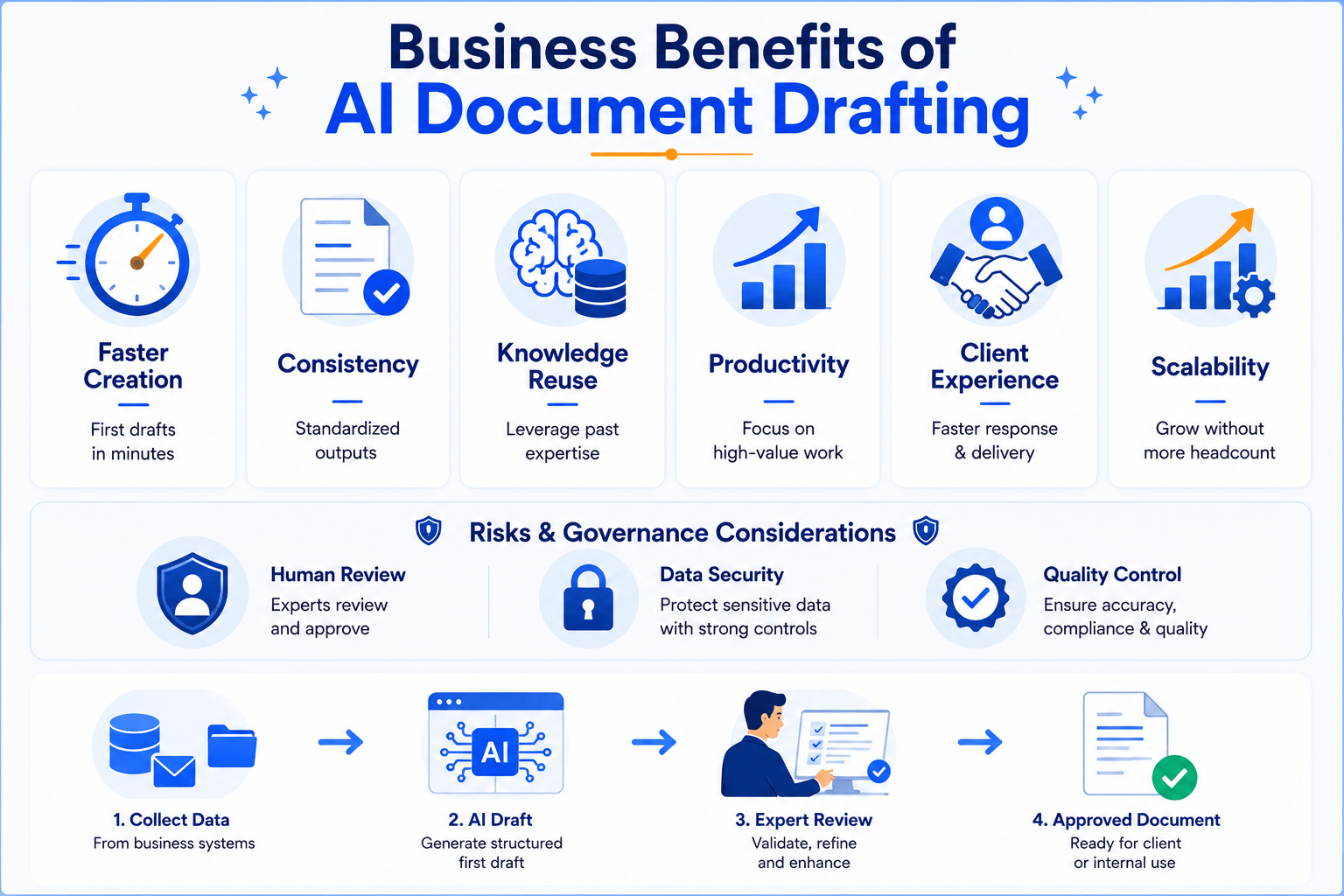
Faster Document Creation
The most immediate benefit of AI document drafting is speed. Teams can move from a blank page to a structured first draft in minutes, reducing the time spent on repetitive writing, formatting, and information gathering. Legal professionals can create first drafts 72% faster through AI-powered drafting systems, enabling dramatic improvements in productivity and client service delivery. While professionals still need to review and refine the content, starting with a draft instead of scattered notes can significantly accelerate document creation and improve overall productivity.
Greater Consistency Across Deliverables
AI-generated drafts follow approved templates, workflows, and business rules, helping organizations standardize document quality across teams and locations. This reduces variation in structure, language, and formatting while ensuring important sections are consistently included. For growing firms, this consistency becomes increasingly valuable as they scale delivery without compromising quality.
Better Knowledge Reuse
Professional services firms often have years of valuable expertise stored across previous proposals, reports, project files, and internal documentation. AI document drafting can help surface and reuse this knowledge more effectively by incorporating relevant examples, methodologies, and best practices into new drafts. This reduces dependency on individual employees and helps institutional knowledge scale across the organization.
Improved Employee Productivity
By automating repetitive drafting tasks, professionals can spend less time assembling documents and more time applying their expertise. Using generative AI in business improves users’ performance by 66%. Consultants can focus on recommendations instead of formatting proposals. Lawyers can concentrate on legal analysis rather than preparing standard contract language. Auditors can dedicate more attention to risk assessment instead of compiling reports. The result is a more productive workforce focused on higher-value activities.
Enhanced Client Experience
Clients benefit when firms can respond faster with well-structured, professional documentation. According to a NielsenIQ research, support agents who used AI could handle 13.8% more customer inquiries per hour. Faster proposal creation can shorten sales cycles. Faster reporting can improve project delivery. Faster compliance documentation can reduce approval delays. In a competitive market where responsiveness and quality matter, AI-assisted document drafting helps firms deliver a better overall client experience.
Increased Scalability Without Additional Headcount
As document volumes grow, organizations often face a choice between hiring more staff or increasing workloads for existing teams. AI document drafting provides a third option by helping teams handle more work with the same resources. In customer support scenarios, AI assistance helped agents resolve up to 15% more issues per hour, especially for less experienced staff. Teams become more efficient, agile, and innovative without adding headcount.
Risks and Governance Considerations
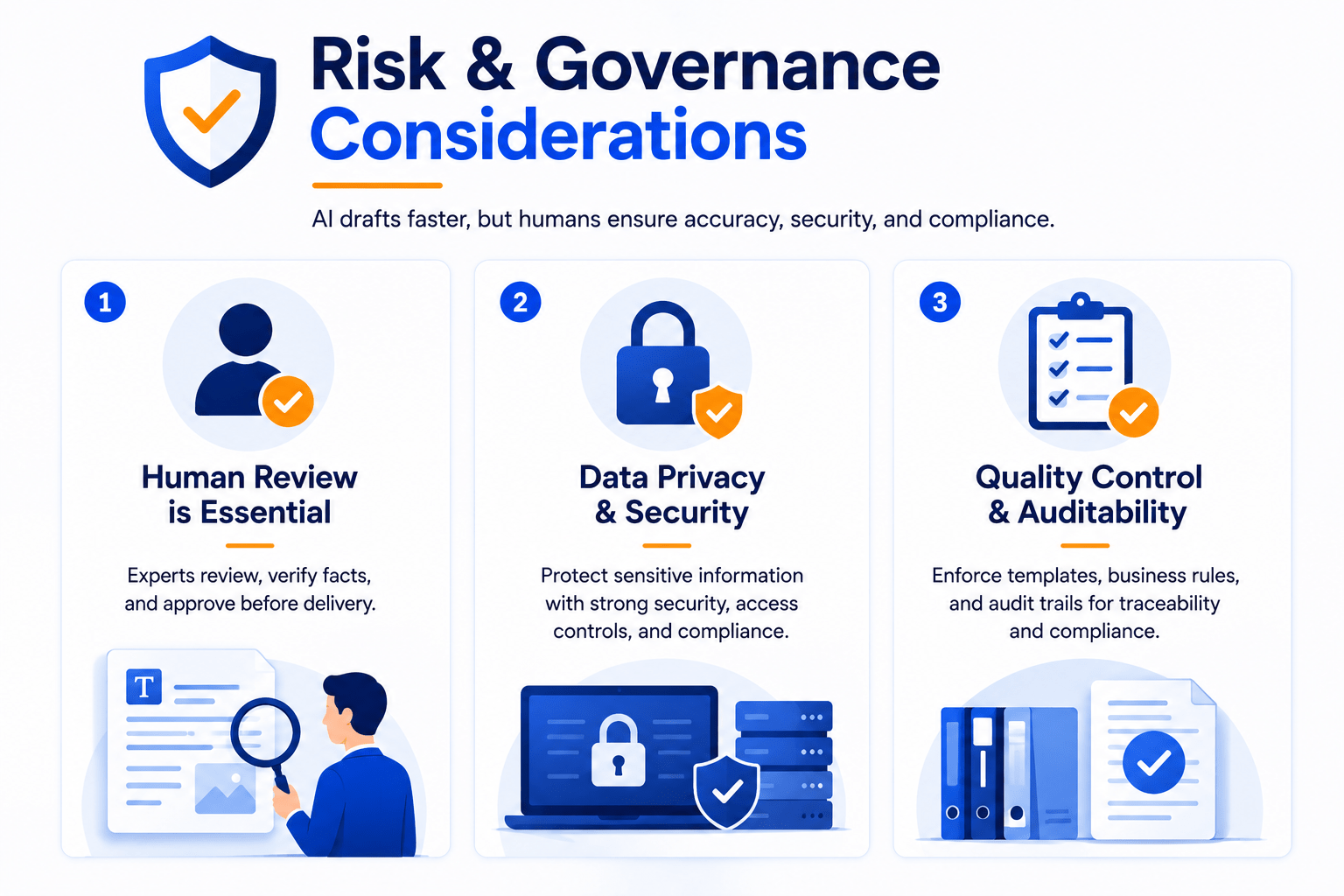
The biggest risk in AI document drafting is treating AI output as final output. That is a bad idea. AI-generated drafts can contain inaccuracies, unsupported claims, or language that does not fit the client context. Every AI drafting workflow should include human review, approval steps, and quality controls before any document is shared externally.
Data privacy is another critical consideration. Professional services firms often handle sensitive client information, financial data, legal materials, and confidential business records. Any AI solution must follow strong data security practices, access controls, and compliance requirements. For firms evaluating AI adoption, this should be part of a broader AI readiness assessment rather than an afterthought.
Organizations also need clear rules on what AI can and cannot draft. Low-risk internal summaries may require lighter review, while legal, audit, compliance, or client-facing documents require stricter controls. The goal is not to slow down automation, but to make sure automation does not create new risks while solving old ones.
Best Practices for Implementing AI Document Drafting
Start With High-Volume, Repeatable Documents
The best starting point is a document type that appears frequently and follows a predictable structure. Proposals, client summaries, meeting recaps, compliance reports, audit documentation, and project status reports are usually better starting points than highly complex strategic documents. A narrow use case allows the organization to test value quickly, improve the workflow, and build confidence before scaling.
Use Approved Templates and Knowledge Sources
AI drafting works best when it is connected to existing templates, approved language, and trusted knowledge sources. Letting AI generate documents without structure can lead to inconsistent results. A stronger approach is to define required sections, approved terminology, data sources, review steps, and escalation rules. This turns AI from a simple writing tool into a controlled business workflow.
Measure Performance and ROI
Measurement is essential. Firms should track drafting time saved, review time, document turnaround, quality issues, client satisfaction, and employee adoption. Without these metrics, AI initiatives become vague innovation theatre. With them, organizations can prove ROI, identify improvement areas, and scale the use case with confidence.
Conclusion
AI document drafting is one of the most practical applications of workflow automation for professional services. It targets a real operational pain point: the time professionals spend creating first drafts instead of applying expertise. By automating the repetitive parts of document creation, firms can improve productivity, consistency, and client responsiveness.
The future of professional services is not AI replacing experts. It is experts using AI to remove low-value work from their day. Firms that adopt this model early will be able to deliver faster, scale more efficiently, and create more space for the strategic thinking clients actually pay for.
For organizations exploring this shift, SmartDev helps design and implement AI workflow automation solutions that connect data, documents, and human review into scalable business processes. Explore more practical applications through the SmartDev AI Use Cases Hub or learn how NORA supports AI workflow automation for risk and compliance.