
TL;DR:
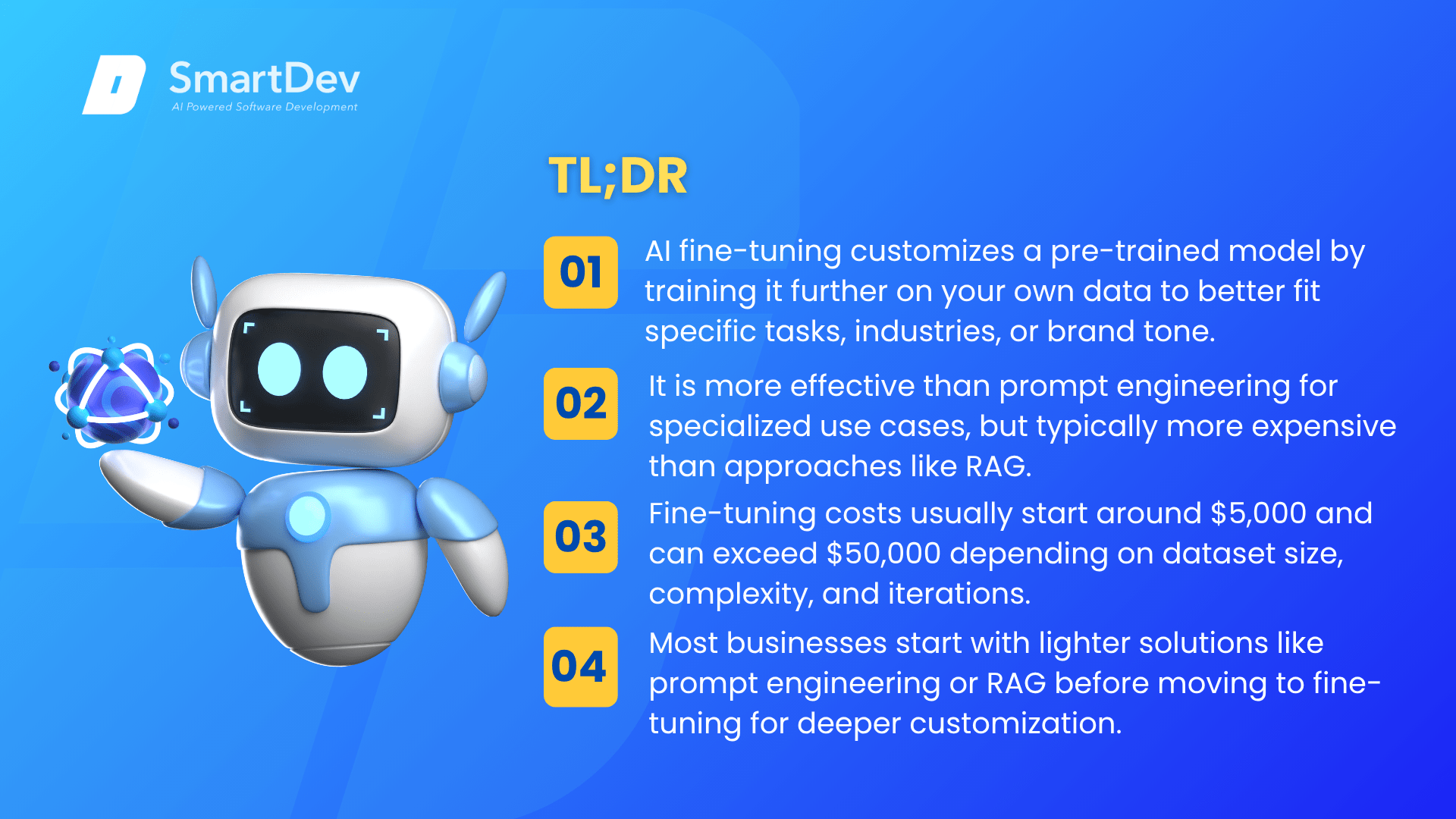
- AI fine-tuning adapts a pre-trained model to your specific industry, tone, or task by continuing its training on your own data.
- It is more powerful than prompt engineering for specialized tasks, but more expensive than RAG for most business use cases.
- Fine-tuning costs range from $5,000 to $50,000 or more for a first iteration; most businesses should start with RAG before investing here.
AI models trained on general internet data often fall short in specialized business environments. They misuse industry terminology, miss regulatory nuances, and produce outputs that do not match your brand voice. AI fine-tuning solves this by adapting a model directly to your context. This article explains what fine-tuning is, when it makes business sense, and what it will cost.
What is AI Fine-tuning?
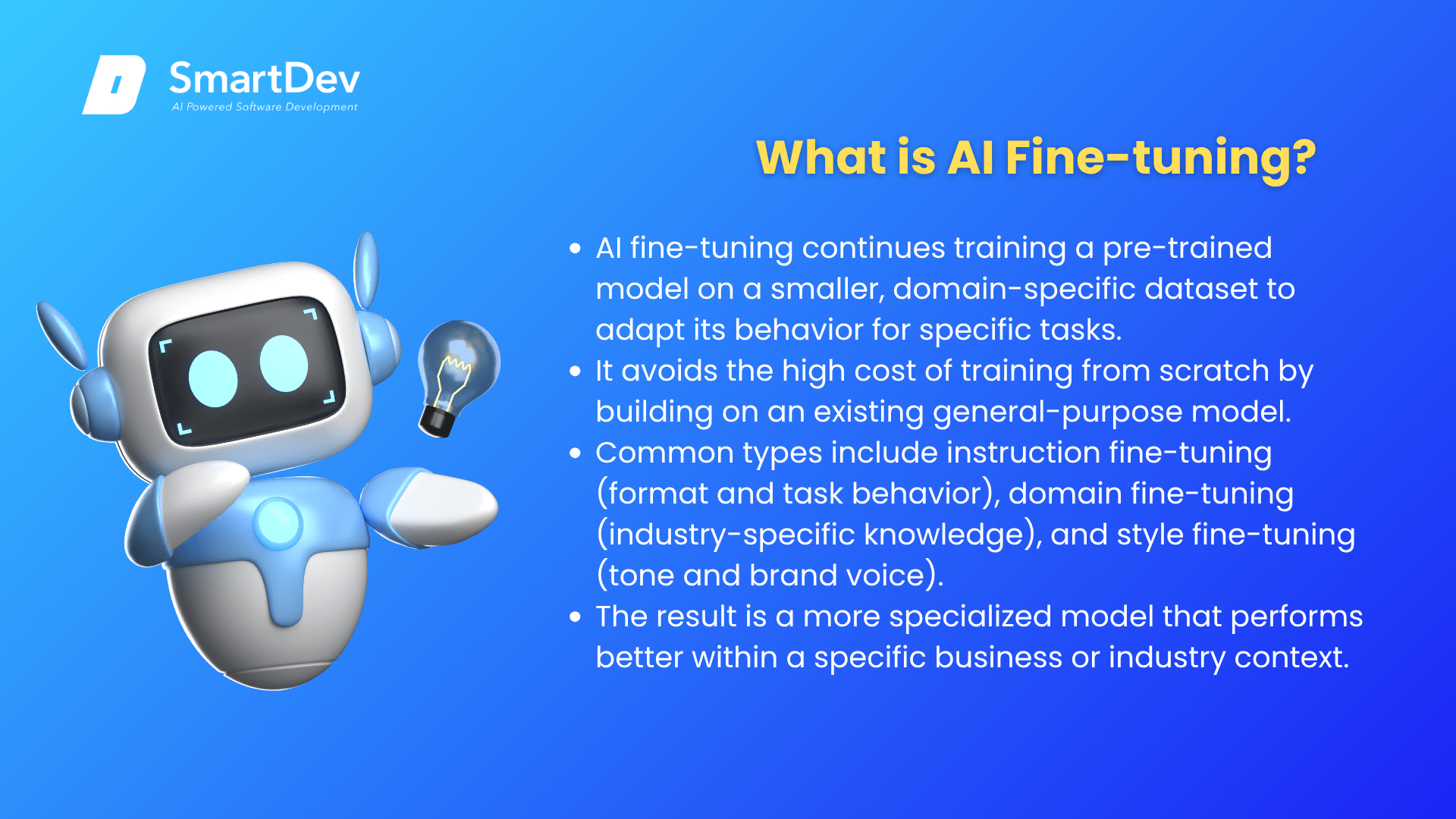
AI fine-tuning is the process of taking a pre-trained AI model and continuing its training on a smaller, domain-specific dataset to specialize its behavior. Rather than building a model from scratch, which can cost millions of dollars, fine-tuning starts with a powerful base model and adjusts its internal parameters to improve performance on a specific task or domain.
Fine-tuning types vary by goal:
- Instruction fine-tuning: Teaches the model to follow specific formats or step-by-step procedures.
- Domain fine-tuning: Trains the model on industry-specific language such as medical, legal, or financial terminology.
- Style fine-tuning: Aligns model tone and voice with a brand’s communication standards.
The result is a model that behaves like a specialist, not a generalist, for your specific business context.
비즈니스에 중요한 이유
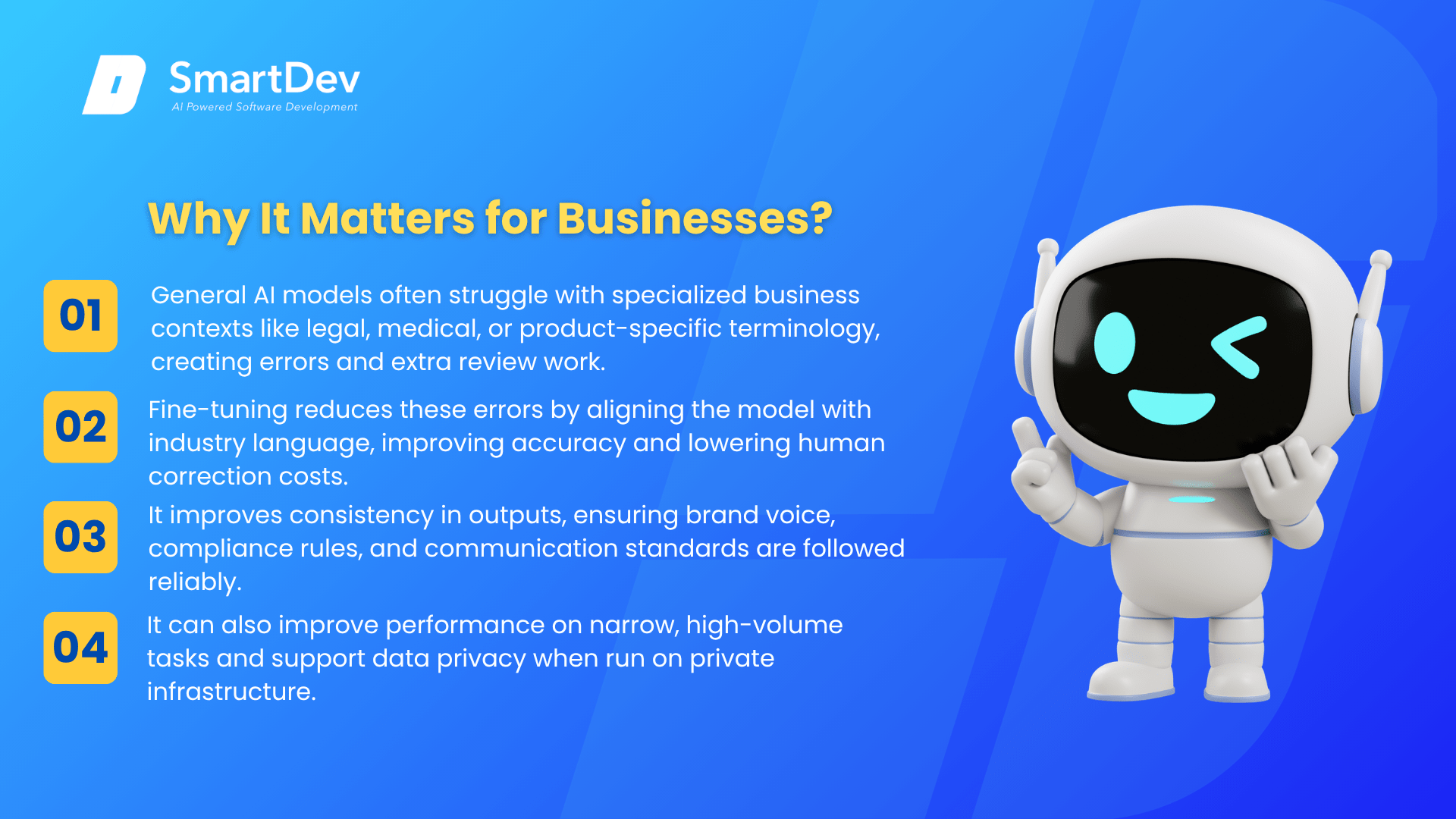
General AI models are trained on broad public data. They perform well on everyday tasks but struggle with specialized domains. A model that does not understand your product catalog, legal frameworks, or clinical terminology creates risk and extra correction work for your team.
- 줄이다 errors caused by misunderstood industry terminology in AI-generated outputs, lowering the cost of human review and correction.
- 증가시키다 output consistency so that customer-facing content always matches your brand voice and compliance requirements.
- 개선하다 accuracy on narrow, high-volume tasks where a smaller fine-tuned model outperforms much larger general models.
- Protect sensitive data by fine-tuning an open-source model inside your own private infrastructure, avoiding exposure to third-party cloud services.
For example, a mid-sized insurance company fine-tuned an open-source model on their policy documentation and claims procedures. The resulting model classified incoming claims 40% faster than their previous system, with fewer escalations to human reviewers and a measurable reduction in processing cost per claim.
When to Use AI Fine-tuning?
Fine-tuning is the right choice in specific circumstances:
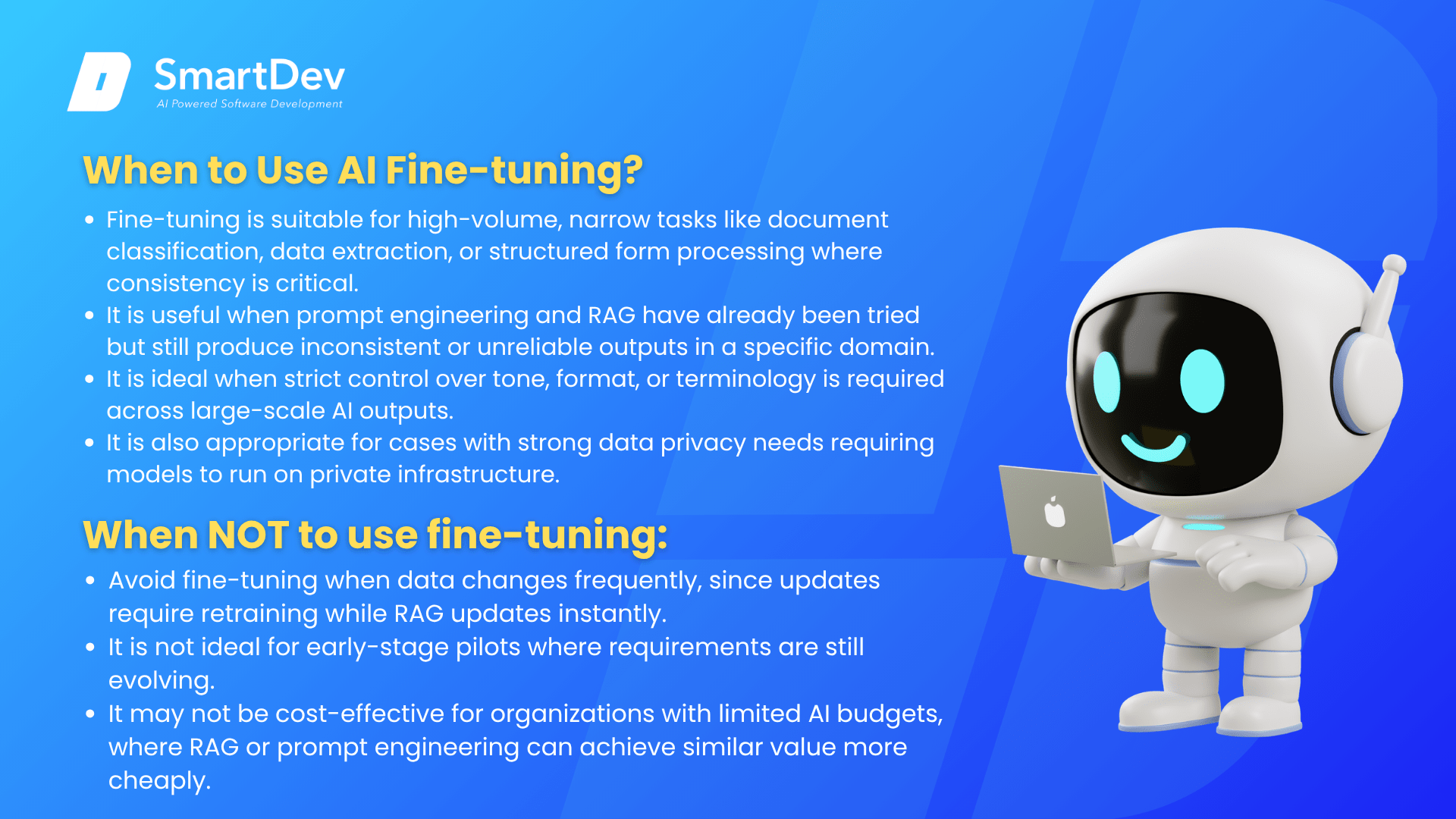
- Your team has a high-volume, narrow task such as document classification, structured data extraction, or form completion where consistency is critical.
- Prompt engineering and RAG have already been tried but still produce inconsistent or inaccurate results for your specific domain.
- You need outputs in a very specific format, tone, or terminology that generic models cannot reliably maintain across thousands of requests.
- Data privacy requirements mean you cannot send sensitive content to a public API, so you need to run your own model on private infrastructure.
When NOT to use fine-tuning:
- Your data changes frequently. Fine-tuned models require retraining when the underlying information changes. RAG updates instantly without retraining.
- You are still in the pilot stage. Start with prompt engineering or RAG before committing the budget and timeline a fine-tuning project requires.
- Your total AI budget is under $10,000. A RAG solution delivers most of the value at a fraction of the cost.
How Much Does AI Fine-tuning Cost?
Fine-tuning costs come from three areas:
- Data preparation: Curating, labeling, and formatting a training dataset takes weeks of work. Budget $5,000 to $20,000 depending on data complexity and volume.
- Compute costs: Training a model on GPU infrastructure ranges from $100 for lightweight fine-tuning of a small open-source model to $10,000 or more for large-scale runs. Cloud providers such as AWS, Azure, and Google offer managed fine-tuning services at roughly $8 per training hour.
- Engineering: Your first fine-tuning project requires ML engineering capacity, adding another $20,000 to $100,000 depending on team size and model complexity.
In total, a production-ready fine-tuned model typically costs $5,000 to $50,000 for the first iteration, with reduced costs for subsequent runs as the data pipeline matures. A fine-tuned model breaks even compared to a human specialist doing the same task within six to twelve months at production scale.
기타 관련 용어
- Prompt Engineering: The practice of crafting precise instructions to guide an AI model’s behavior without modifying the model itself. It is the fastest and lowest-cost starting point before considering fine-tuning.
- AI Context Window: The amount of information an AI system can temporarily remember and process during a conversation or task, including prompts, instructions, documents, and previous messages.
- Deterministic Output is the ability of an AI system to produce consistent, predictable results given the same input. Fine-tuning directly improves deterministic output — by training a model on domain-specific data, businesses reduce the variability and unpredictability that comes with using a general-purpose model out of the box.
- Agentic Engineering: refers to the design and implementation of AI systems that act as autonomous agents capable of pursuing goals with limited human intervention. These agents can reason, make decisions, execute actions, and continuously improve based on feedback and changing conditions.