
TL;DR:
- API rate limiting is the practice of capping how many requests a system accepts within a given time period, protecting performance, security, and cost control.
- For businesses using APIs or digital services, API rate limits directly affect what your systems can do and how much they cost to run.
- Understanding API rate limiting helps IT leaders plan infrastructure, negotiate vendor contracts, and protect systems from overload and abuse.
API rate limiting is a foundational concept in modern software infrastructure, and it affects nearly every business that uses APIs, cloud services, or customer-facing digital platforms. Whether you are building a product or buying software tools, API rate limits shape what is possible and what is not. This guide covers what API rate limiting is, why it matters for businesses, how it works, and when it applies.
What is API Rate Limiting?
API rate limiting is the practice of restricting the number of requests a user, application, or system can make to a service within a defined time period, in order to control resource consumption, protect system performance, and prevent abuse. It works like a traffic control system for digital services. When a user or application sends too many requests too quickly, the API rate limiter either slows them down or blocks further requests until the time window resets.
API rate limiting is applied in a wide range of contexts: APIs (Application Programming Interfaces, which are the connections that allow software systems to communicate), web servers, cloud platforms, and AI tools all use rate limiting.
API rate limits are typically expressed as requests per second, per minute, or per day — for example “1,000 API calls per hour per user.”

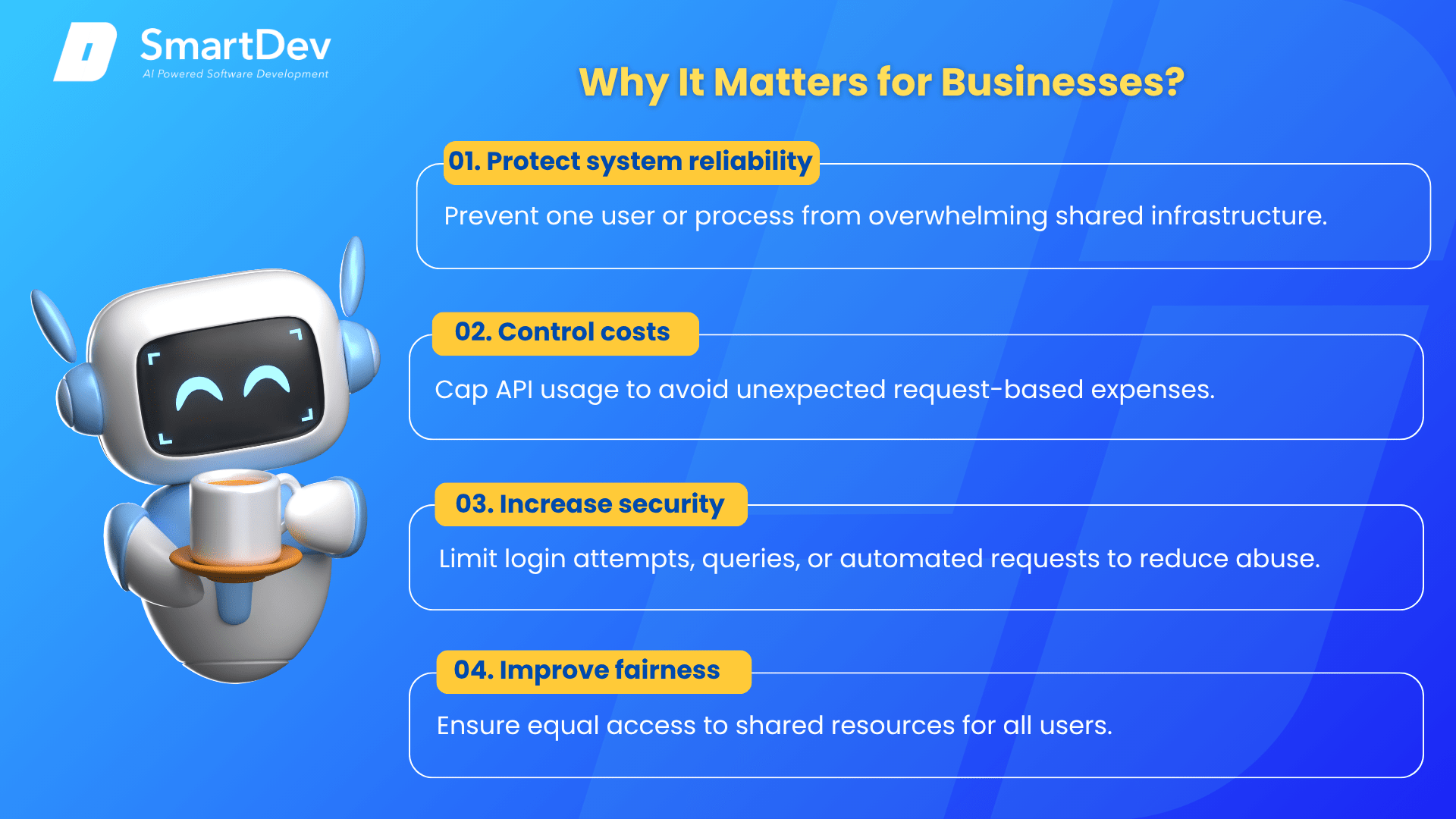
Why It Matters for Businesses?
For any business running or using digital services, rate limiting has direct implications for cost, performance, and security.
- Protect system reliability by preventing any single user or process from overwhelming shared infrastructure, which can cause slowdowns or outages for all users.
- Control costs by capping API usage within budget, since many services charge per request and unexpected spikes can lead to significant, unplanned expenses.
- Increase security by limiting the number of login attempts, data queries, or automated requests, making it significantly harder for malicious actors to attack or scrape your systems.
- Improve fairness by ensuring all users and customers get equal access to shared resources, regardless of their technical sophistication or ability to send high-volume requests.
For example, an enterprise using a third-party AI API for customer service automation discovered its system was hitting API rate limits during peak hours, causing delayed responses. By restructuring how requests were batched and distributed across the day, the team stayed within limits while maintaining service quality without needing to pay for a higher-tier plan.
How Does It Work?
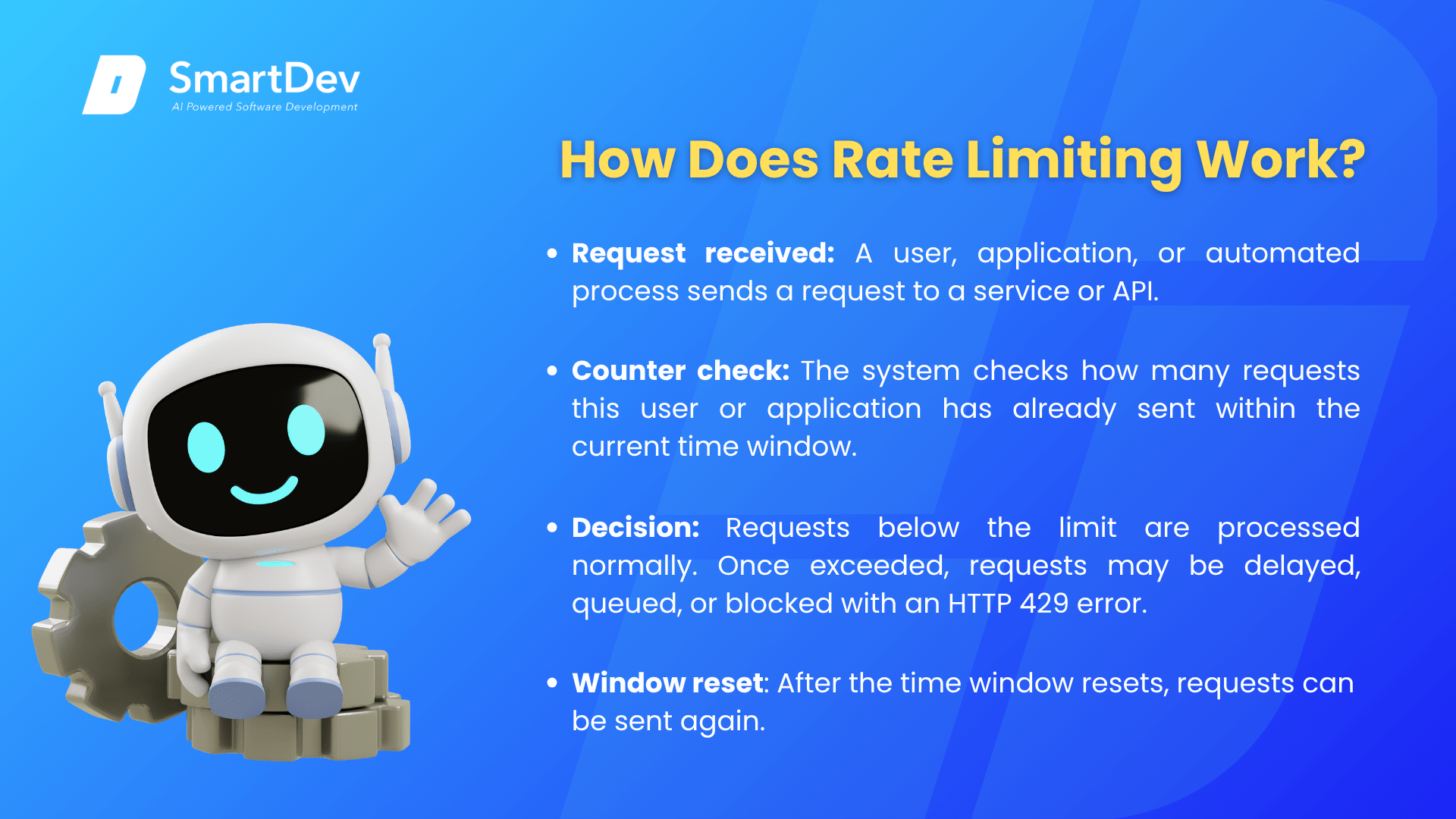
- Request received: A user, application, or automated process sends a request to a service or API.
- Counter check: The system checks how many requests this user or application has already sent within the current time window.
- Decision: If the request count is below the API rate limit, the request is processed normally. If the limit has been reached, the system either queues the request, delays it, or returns an error code (typically HTTP 429: “Too Many Requests”).
- Window reset: At the end of the defined time period, the counter resets and the user or application can send requests again.
The result is a controlled, predictable flow of traffic that keeps services stable, costs manageable, and systems protected from both accidental overload and intentional abuse.
When to Use API Rate Limiting?
API rate limiting is relevant in a range of situations that IT leaders and business owners regularly encounter:
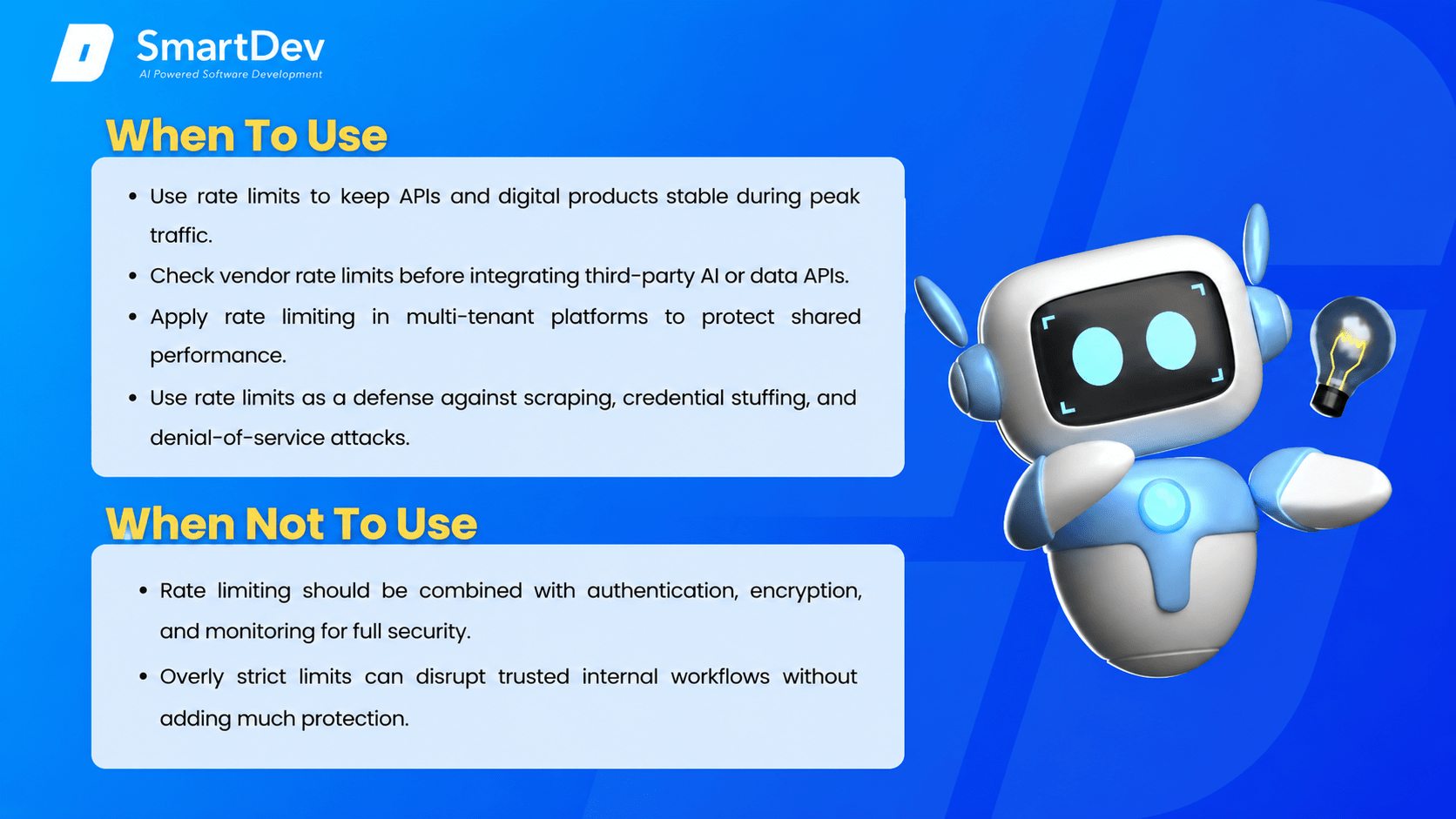
When building or selecting a customer-facing API or digital product, API rate limits must be designed to handle expected peak traffic without degrading performance.
When integrating third-party AI or data APIs into your operations, understanding vendor API rate limits is essential to avoid unexpected service interruptions.
When managing multi-tenant platforms where different customers share the same infrastructure, API rate limiting ensures no single customer degrades the experience for others.
When protecting against automated threats such as credential stuffing, data scraping, or denial-of-service attacks, API rate limiting is a frontline defense.
When NOT to rely on API rate limiting alone:
API rate limiting is not a complete security solution. It should be combined with authentication, encryption, and monitoring for full protection.
For internal systems where all users are trusted, overly aggressive API rate limits can impede legitimate workflows without meaningful security benefit.
Other Related Terms
API (Applicationb Programming Interface): The connection point between software systems through which rate limits are most commonly applied, controlling how frequently external applications can access your services or data.
Prompt Engineering: The systematic practice of designing, refining, and structuring the inputs, called prompts, given to AI tools in order to produce more accurate, consistent, and useful outputs.
Data Privacy: Refers to the practice of safeguarding personal and sensitive information from unauthorized access, use, or disclosure.