요약
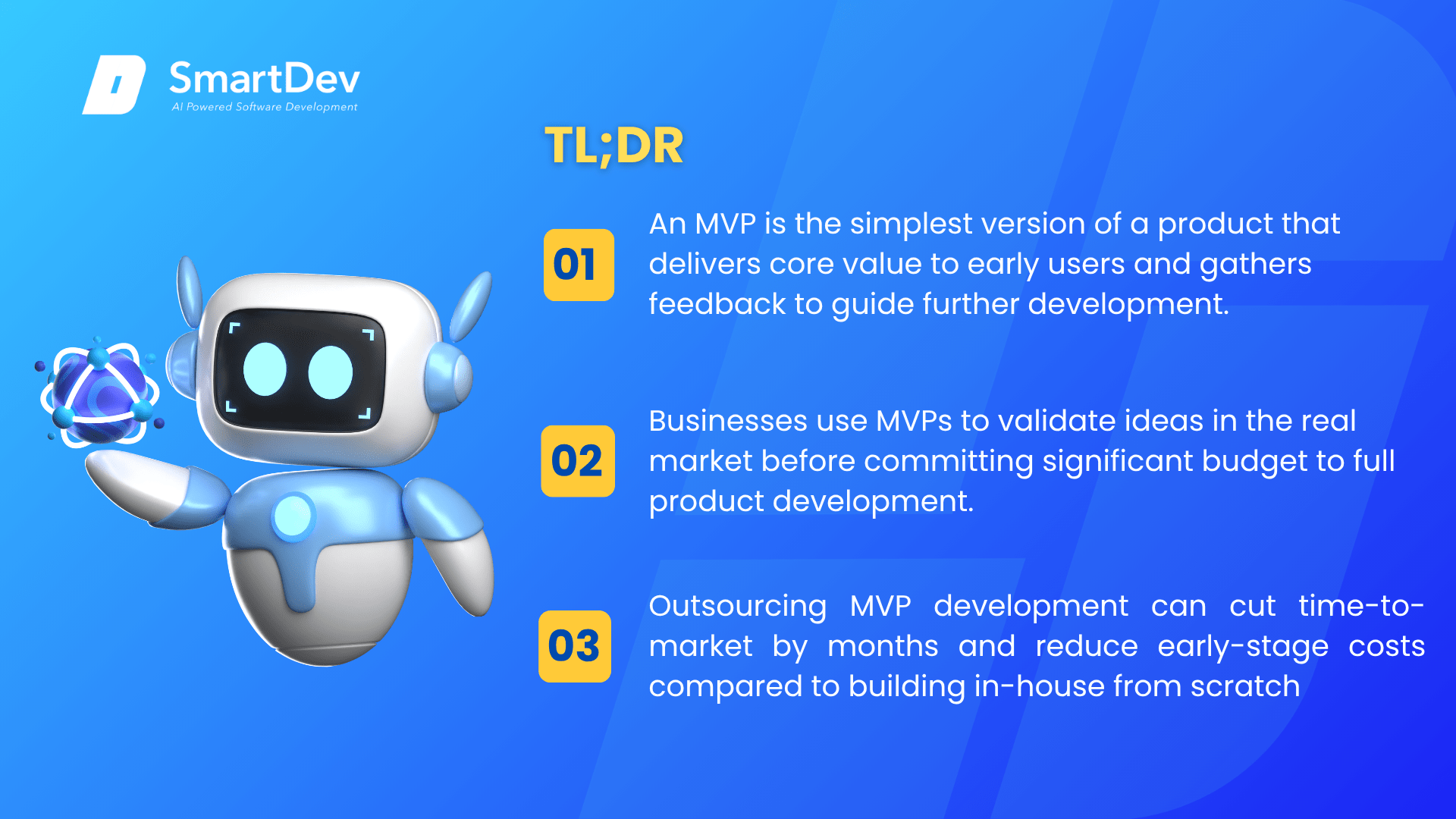
- An MVP is the simplest version of a product that delivers core value to early users and gathers feedback to guide further development.
- Businesses use MVPs to validate ideas in the real market before committing significant budget to full product development.
- Outsourcing MVP development can cut time-to-market by months and reduce early-stage costs compared to building in-house from scratch.
Launching a product without validating whether customers actually want it is one of the most expensive mistakes a business can make. The Minimum Viable Product (MVP) approach exists precisely to prevent this. By releasing a stripped-down version of your product to real users first, you gather the evidence needed to build the right thing, not just the perfect thing.
What is Minimum Viable Product (MVP)?
A Minimum Viable Product (MVP) is the earliest version of a product that includes only the core features necessary to deliver value to its first users and to collect meaningful feedback for future development.
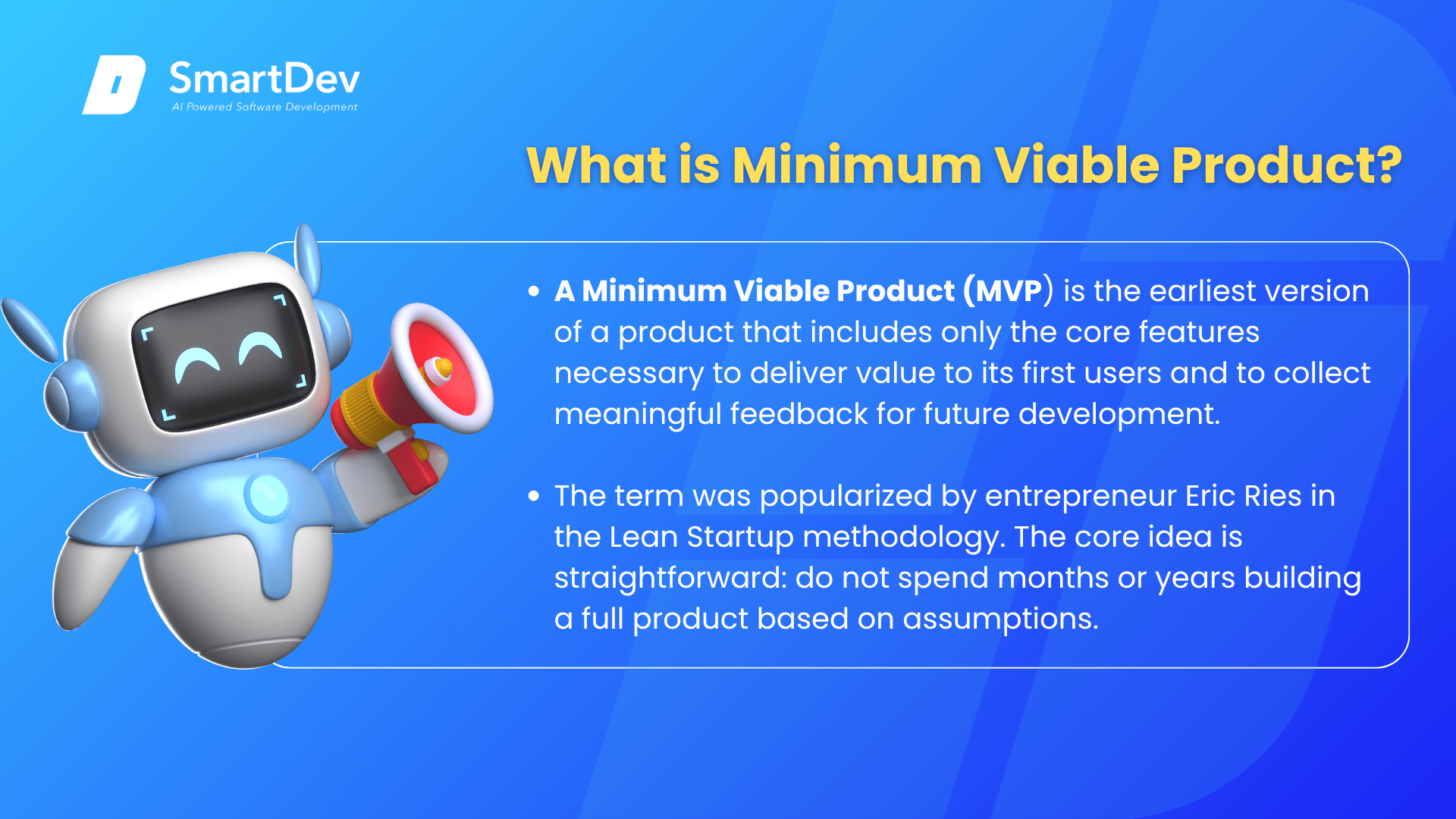
The term was popularized by entrepreneur Eric Ries in the Lean Startup methodology. The core idea is straightforward: do not spend months or years building a full product based on assumptions. Instead, release the smallest thing that tests your key hypothesis, learn what users actually need, and iterate from there.
An MVP is not a half-finished product or a beta version full of bugs. It is a deliberately scoped product that works well for a specific use case. Examples include a landing page that gauges interest, a manually operated service before automation is built, or an app with one core workflow that solves a real problem.
비즈니스에 중요한 이유
The cost of building the wrong product at full scale can be catastrophic. An MVP contains that risk while still moving the business forward.
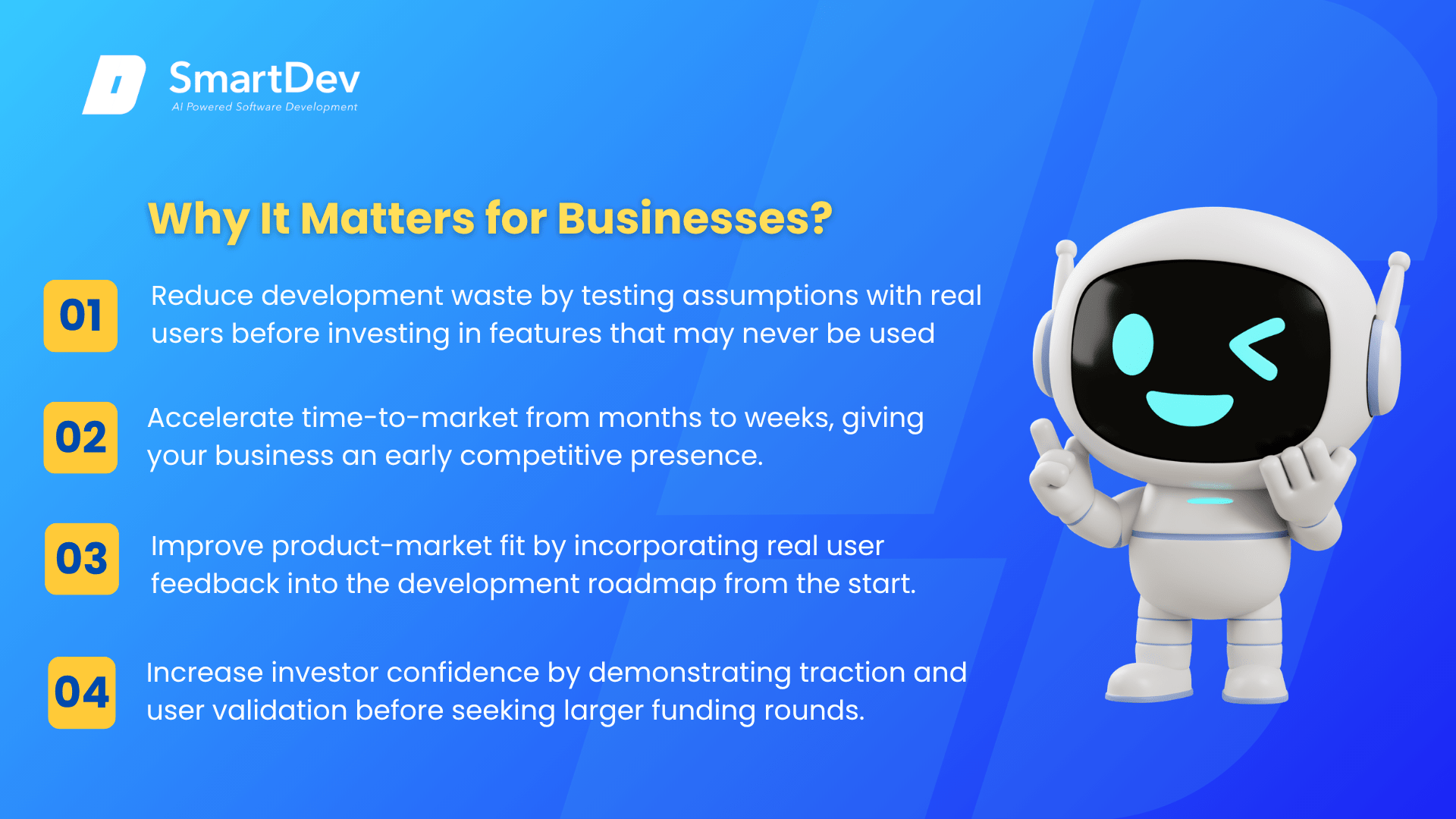
- 줄이다 development waste by testing assumptions with real users before investing in features that may never be used.
- 가속하다 time-to-market from months to weeks, giving your business an early competitive presence.
- 개선하다 product-market fit by incorporating real user feedback into the development roadmap from the start.
- 증가시키다 investor confidence by demonstrating traction and user validation before seeking larger funding rounds.
For example, a logistics startup that outsourced MVP development to an external team launched a working route optimization tool in eight weeks. Based on early feedback, they discovered their target users cared far more about real-time tracking than the advanced reporting features they had originally planned. That insight reshaped their roadmap and saved an estimated $200,000 in misdirected development.
How Does MVP Development Work?
- Define the Core Problem: Identify the single most pressing problem your product solves for your target customer. Everything in the MVP should serve this one goal.
- Map the Critical User Journey: Design only the workflow that a user needs to experience value. Remove every feature that does not contribute to this core journey.
- Build and Test: Develop the MVP using an agile approach, releasing functional increments and testing usability with real users as early as possible.
- Collect and Analyze Feedback: Use qualitative interviews, usage data, and conversion metrics to understand what is working and what needs to change.
- Iterate or Pivot: Based on evidence, either build on what is working (iterate) or change direction if the core assumption was wrong (pivot).
The result is a product development process grounded in real-world evidence rather than internal assumptions, saving time and budget while increasing the likelihood of long-term success.
When to Use MVP Development?
- Use an MVP when you are entering a new market and need to validate demand before committing to full-scale development.
- Use an MVP when your internal team lacks capacity to build the full product and you need to show progress to stakeholders quickly.
- Use an MVP when you want to attract early adopters or seed investors before your product is fully built out.
- Avoid MVP development when your industry requires regulatory approval or safety certification before any version can be released.
- Avoid MVP development when your product requires deep integrations or data volumes that make a minimal version unrepresentative of real-world performance.
기타 관련 용어
Pilot Project: A small-scale test implementation of a technology or process within an organization, similar to an MVP but typically used internally rather than for market validation.
Product Backlog: The prioritized list of features and improvements that follows an MVP release, guiding the next phases of product development.
Agile Development: The iterative software development methodology most commonly used to build and evolve an MVP based on ongoing user feedback.