
TL;DR:
- An AI oversight layer is the governance component in an AI system that monitors, controls, and audits AI behavior in real time.
- Without it, AI systems can make unchecked decisions that expose your business to compliance failures, financial loss, and reputational damage.
- For companies using outsourced AI, the oversight layer defines who is accountable when something goes wrong.
 The oversight layer is the control and governance component of an AI system responsible for monitoring outputs, enforcing boundaries, and ensuring human accountability. As AI takes on more autonomous tasks inside businesses, the oversight layer is what keeps it safe, compliant, and aligned with your organizational goals.
What is an AI Oversight Layer?
An oversight layer is a dedicated component within an AI system architecture that monitors AI behavior, enforces operational boundaries, and enables human intervention when needed.
It sits above the core AI models and automation logic, acting as a supervisory mechanism rather than part of the intelligence itself. Think of it the way you think of a compliance department inside a bank: the traders do the work, but the compliance team watches for violations, flags irregularities, and steps in when rules are broken.
In practice, an oversight layer typically includes:
- Continuous monitoring of AI outputs and actions
- Logging and audit trails for regulatory purposes
- Escalation protocols that route high-risk decisions to human reviewers
- Policy enforcement that restricts what the AI system can and cannot do
The term has gained urgency alongside the rise of agentic AI systems, where AI does not just generate answers but takes actions, sends messages, executes transactions, and manages workflows autonomously.
Why It Matters for Businesses?
When AI systems operate without an oversight layer, the business absorbs all the risk of whatever the AI decides. That risk is growing fast. A 2026 survey found that only 17% of professionals believe AI can operate reliably without human oversight, while 60% reported negative impacts from AI-driven outcomes in their organizations.
An oversight layer addresses this directly. Businesses that implement one can:
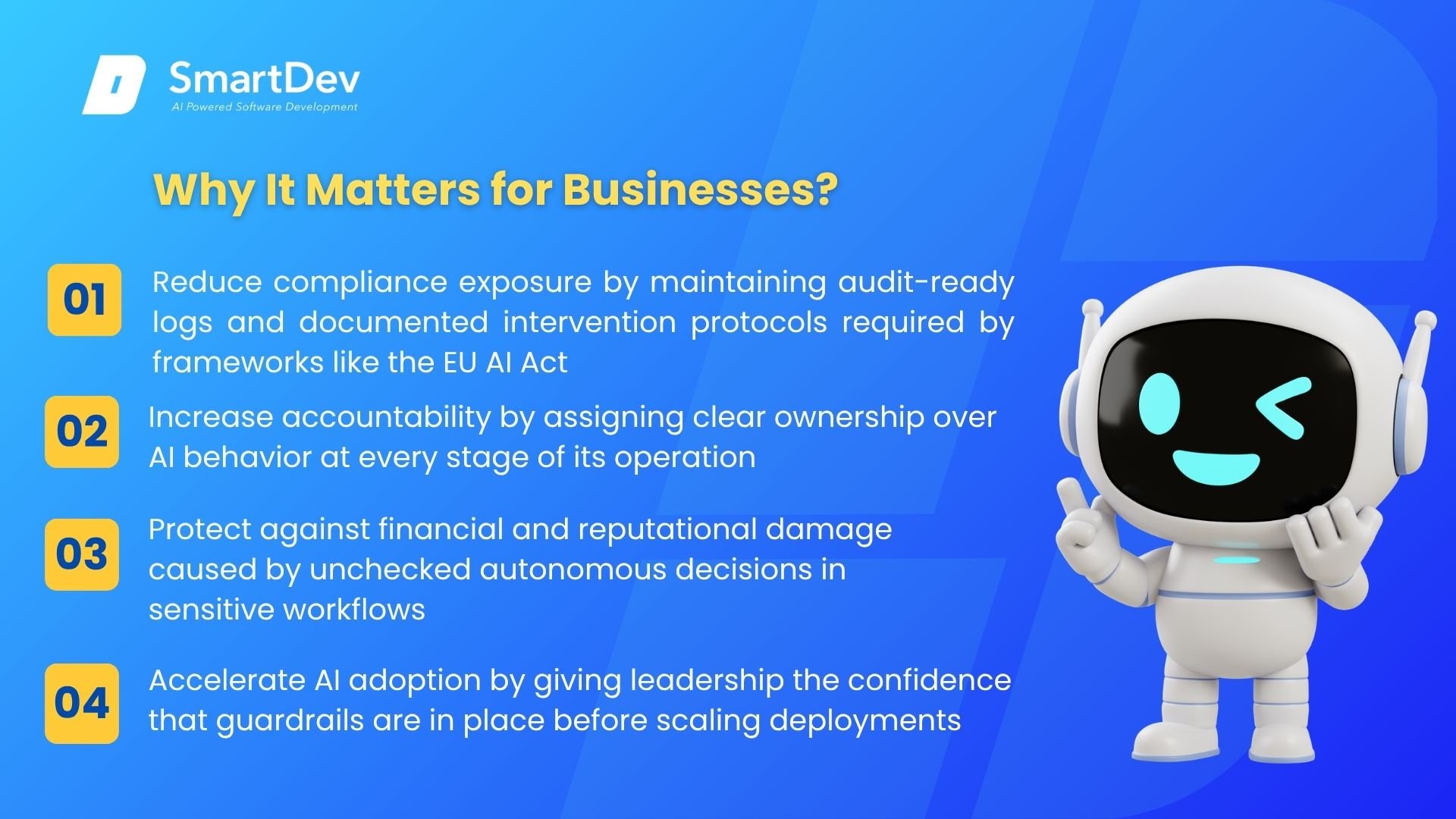
- Reduce compliance exposure by maintaining audit-ready logs and documented intervention protocols required by frameworks like the EU AI Act
- Increase accountability by assigning clear ownership over AI behavior at every stage of its operation
- Protect against financial and reputational damage caused by unchecked autonomous decisions in sensitive workflows
- Accelerate AI adoption by giving leadership the confidence that guardrails are in place before scaling deployments
For example, a financial services firm using AI to process vendor invoices implemented an oversight layer that flagged transactions above a threshold for human review. Within three months, the team detected a pattern of vendor overbilling that automated processing alone had missed, recovering a significant sum before it became a loss.
For companies using IT outsourcing partners to build or operate AI systems, the oversight layer also defines accountability. If the AI makes a costly error, the oversight layer is the paper trail that shows who was responsible for catching it and what protocols were in place.
How Does the Oversight Layer Work?
- Monitoring: The oversight layer continuously observes AI inputs, outputs, and actions. Every decision the AI makes is recorded, creating a real-time log that can be reviewed at any point.
- Policy Enforcement: Rules are defined in advance to set the boundaries of acceptable AI behavior. If an AI agent attempts an action outside those boundaries, the oversight layer blocks it automatically.
- Escalation: Not all decisions are equal. The oversight layer classifies actions by risk level. Low-risk decisions proceed automatically. High-risk decisions are routed to a designated human reviewer before they are executed.
- Audit and Reporting: All activity is compiled into structured logs that can be provided to internal compliance teams or external regulators on demand. This is the documentation layer that proves your AI operated within agreed parameters.
- Intervention: When a problem is detected, the oversight layer provides the mechanism to pause, roll back, or override an AI action without disrupting the broader system.
The result is a system where AI speed and automation are preserved, but human accountability is never removed from the equation.
Who Uses an Oversight Layer?
Any organization deploying AI in decision-making workflows needs an AI oversight layer. However, certain sectors face the most immediate pressure.
Financial services firms use oversight layers to satisfy model risk management requirements and catch anomalies in automated spend, fraud detection, and customer decisioning systems. Healthcare organizations apply them to ensure AI-generated clinical or administrative outputs are reviewed before action is taken. Regulated industries including insurance, legal services, and government contractors implement oversight layers to meet audit and documentation requirements tied to AI-specific legislation.
On the buyer side, the stakeholders responsible for implementing or demanding an oversight layer include Chief Technology Officers setting the architecture standard, IT Directors managing the deployment environment, and Chief Compliance Officers ensuring regulatory alignment. In outsourcing contexts, procurement leaders are increasingly adding oversight layer requirements to vendor contracts before AI systems go live.
Other Related Terms
- Multi-Agent System is an AI architecture where multiple specialized agents collaborate to complete complex tasks. An AI oversight layer is especially important in multi-agent systems, because it monitors how agents interact, catches cascading failures, and enforces shared governance rules across all agents before their actions reach production systems.
- Deterministic Output is the ability of an AI system to produce consistent, predictable results given the same input. An AI oversight layer helps enforce deterministic output by logging model decisions, comparing them against expected behaviors, and triggering reviews or rollbacks when responses drift outside approved thresholds.
- KI-Governance: The broader set of policies, roles, and processes that determine how AI is developed, deployed, and monitored across an organization; the oversight layer is the technical implementation of governance in practice.
- Human-in-the-Loop: A design approach where human review is embedded at specific decision points within an AI workflow, often activated and managed through the oversight layer’s escalation protocols.
- KI-Agent: A category of AI systems that take autonomous actions across business tools and workflows, making a functioning oversight layer especially critical because errors compound faster when the AI is acting rather than advising.