Zu lang; nicht gelesen:
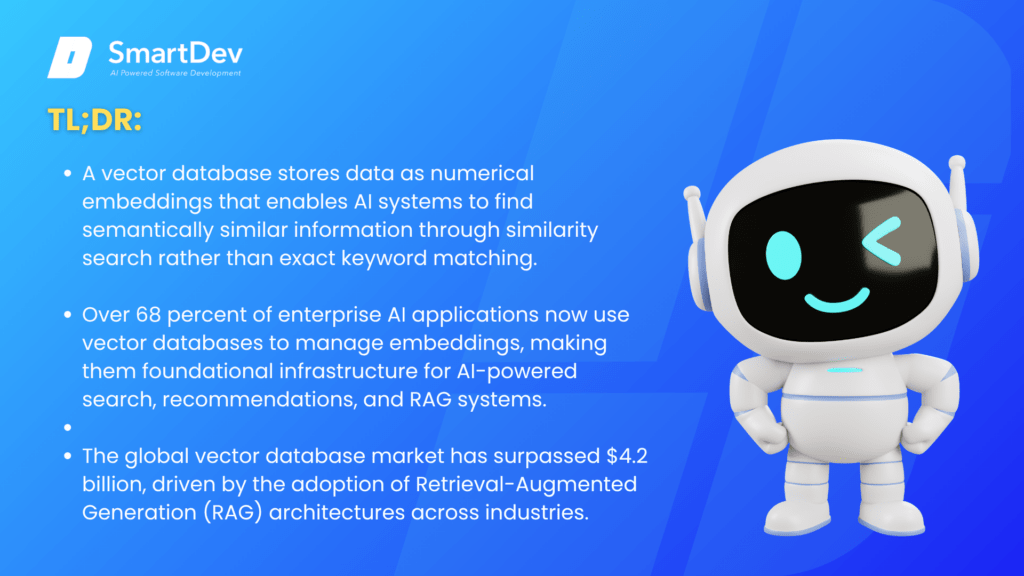
- A vector database stores data as numerical embeddings that capture meaning, enabling AI systems to find semantically similar information through similarity search rather than exact keyword matching.
- Over 68 percent of enterprise AI applications now use vector databases to manage embeddings, making them foundational infrastructure for AI-powered search, recommendations, and RAG systems.
- The global vector database market has surpassed $4.2 billion, driven by the explosive adoption of Retrieval-Augmented Generation (RAG) architectures across industries.
What Is a Vector Database?
A vector database is a specialized data storage system designed to store, index, and retrieve high-dimensional numerical arrays called vectors, or embeddings. An embedding is a mathematical representation of a piece of content, whether text, code, an image, or audio, where meaning is encoded as a sequence of numbers. Content that is semantically similar produces embeddings that are numerically close to each other in the vector space.
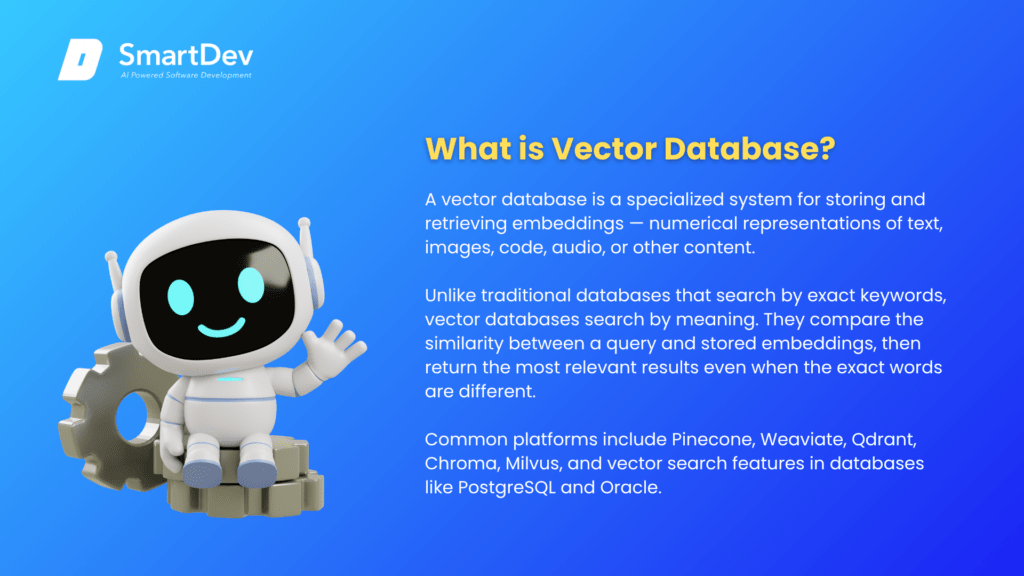
Unlike traditional relational databases that find records through exact field matches or keyword queries, a vector database retrieves content by calculating similarity between a query embedding and all stored embeddings. The database returns the closest matches by meaning, not by exact words. This makes it possible to ask an AI system to find documents related to a topic and receive relevant results even when those documents never use the exact search terms.
Major vector database platforms in 2026 include Pinecone, Weaviate, Qdrant, Chroma, and Milvus, as well as vector search capabilities embedded in traditional databases from Oracle, PostgreSQL, and others. Each platform offers trade-offs in performance, scalability, filtering capabilities, and integration with AI frameworks.
Warum ist das für Unternehmen wichtig?
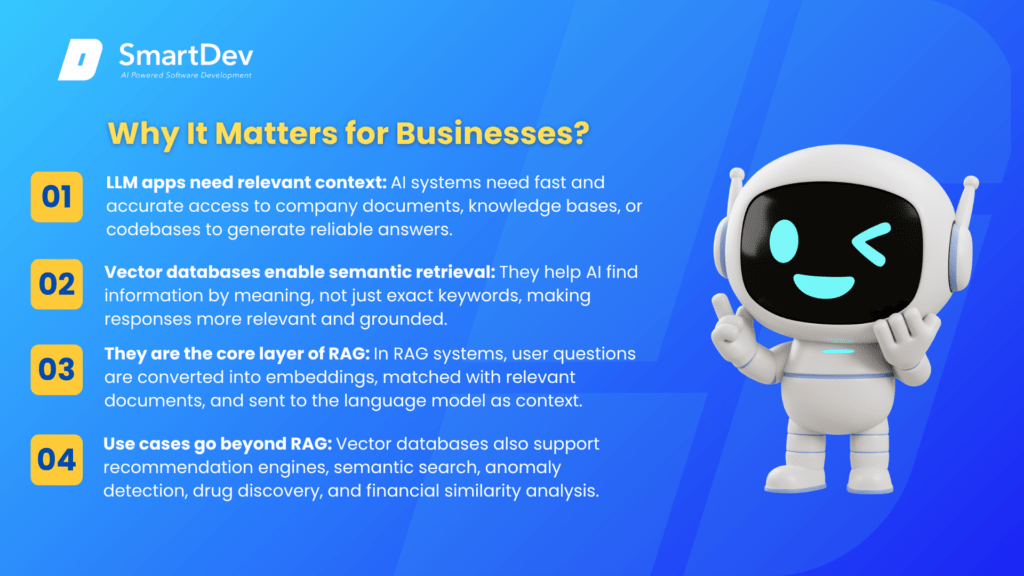
AI applications built on large language models require fast, accurate retrieval of relevant context to generate useful, grounded responses. Without a vector database, an AI system has no reliable way to search a large document repository, knowledge base, or codebase for the specific context it needs to answer a question correctly.
This is why Retrieval-Augmented Generation (RAG) systems, the dominant architecture for enterprise AI in 2026, depend on vector databases as their core retrieval layer. When an employee asks an AI assistant a question about company policy, the system converts the question into an embedding, searches the vector database for the most semantically relevant policy documents, and sends those documents as context to the language model. The result is a grounded, accurate answer rather than a hallucinated one.
Beyond RAG, vector databases power enterprise recommendation engines, semantic search within document management systems, anomaly detection in security monitoring, and similarity matching in drug discovery and financial analysis. Any application that needs to find things by meaning rather than by exact specification benefits from vector database architecture.
Where Is It Used?
Vector databases appear across virtually every industry that has adopted enterprise AI. In financial services, they power fraud detection systems that match new transaction patterns against historical examples of fraudulent behavior stored as embeddings, catching novel fraud variants that rule-based systems miss. In e-commerce, they enable recommendation engines and semantic product search that understands what a customer is looking for even when their search query does not match product titles exactly.
In healthcare, vector databases support clinical decision support systems where patient records are encoded as embeddings and searched for similar cases that inform diagnosis and treatment recommendations. Pharmaceutical companies use them to find molecular compounds with similar structural properties to a promising candidate drug, accelerating early-stage research. In legal and compliance functions, they enable AI tools to search contracts and regulatory documents by concept, identifying relevant provisions across thousands of documents in seconds.
IT outsourcing providers who build enterprise AI systems for clients increasingly include vector database management as a core component of their service offering. The selection, configuration, scaling, and ongoing maintenance of vector database infrastructure is a specialized capability that many client organizations choose to outsource as part of a broader AI infrastructure managed service.
How Does a Vector Database Work?
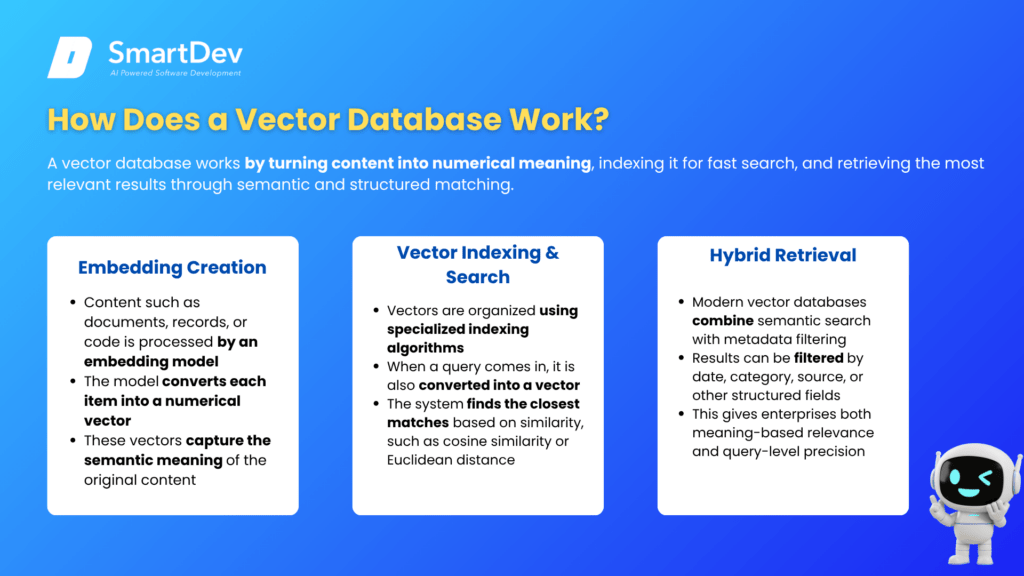
The process begins with an embedding model, which is an AI model trained specifically to convert content into meaningful numerical representations. When documents, records, or code files are ingested into a vector database, the embedding model processes each piece of content and produces a vector of typically hundreds or thousands of numerical dimensions that encodes its semantic meaning.
These vectors are indexed using specialized algorithms such as HNSW (Hierarchical Navigable Small Worlds) or IVF (Inverted File Index) that organize vectors in space for fast approximate nearest-neighbor search. When a query arrives, it is converted into a vector using the same embedding model, and the index is searched to return the stored vectors most similar to the query, typically measured by cosine similarity or Euclidean distance.
Modern vector databases combine vector similarity search with traditional metadata filtering, allowing queries that find semantically similar documents filtered by date, category, or source. This hybrid approach, combining dense semantic retrieval with sparse structured filtering, represents the state of the art for enterprise AI retrieval systems in 2026 and delivers both the relevance of semantic search and the precision of structured queries.
Other Related Terms:
- Embeddings are the numerical vector representations of content produced by an embedding model. The quality and dimensionality of embeddings directly determine how accurately a vector database can match semantically similar content.
- Retrieval-Augmented Generation (RAG) is the AI architecture that combines a vector database retrieval step with a language model generation step, producing responses grounded in specific retrieved documents rather than relying solely on the model’s training data.
- Prompt Engineering is the practice of designing clear instructions that guide AI models to produce useful, accurate outputs. When paired with a vector database, prompts can retrieve relevant knowledge before the AI responds.