Zu lang; nicht gelesen:
- Prompt engineering is the practice of crafting precise instructions for AI tools to produce accurate, consistent, and useful outputs for your business.
- Organizations with structured prompt engineering programs report 40 to 60 percent improvements in AI output quality compared to ad-hoc approaches.
- For businesses using AI in operations, prompt engineering is a critical capability that determines how much real value AI tools deliver.
Prompt engineering has become one of the most valuable skills in enterprise AI adoption. As businesses invest in AI tools, the quality of what they get out depends heavily on how well they communicate with those tools. This guide covers what prompt engineering is, why it matters for business leaders, how it works, and what it costs to build this capability.
What is Prompt Engineering?
Prompt engineering is the systematic practice of designing, refining, and structuring the inputs, called prompts, given to AI tools in order to produce more accurate, consistent, and useful outputs. Rather than typing a vague question and hoping for a good answer, prompt engineering applies a disciplined approach to how instructions are written, how context is provided, and how constraints are communicated to an AI system. It applies to any AI tool that accepts natural language input, including large language models used for content generation, code writing, customer support, data analysis, and business reporting. At the enterprise level, prompt engineering becomes a formal capability, involving the creation of reusable prompt templates, documented standards, and governance processes to ensure AI outputs are reliable enough for business use.
Warum ist das für Unternehmen wichtig?
Most businesses that deploy AI tools and are disappointed with the results are experiencing a prompt engineering problem, not an AI limitation. The same AI tool can produce dramatically different outcomes depending on how instructions are structured.
- Improve AI output quality by 40 to 60 percent through structured prompt design, according to organizations with formal prompt engineering programs.
- Reduce review cycles and the time spent correcting or rewriting AI-generated content, saving hours per week per team.
- Increase consistency across AI-assisted tasks by using standardized prompt templates that any team member can apply without specialized AI knowledge.
- Protect brand integrity and compliance by embedding required constraints, tone guidelines, and accuracy standards directly into prompts.
For example, a marketing team at a mid-sized enterprise was generating AI content that required heavy editing. After working with a prompt engineering specialist to create structured templates with clear role definitions, format requirements, and content boundaries, their editing time dropped by 60 percent and the content required far fewer revision cycles.
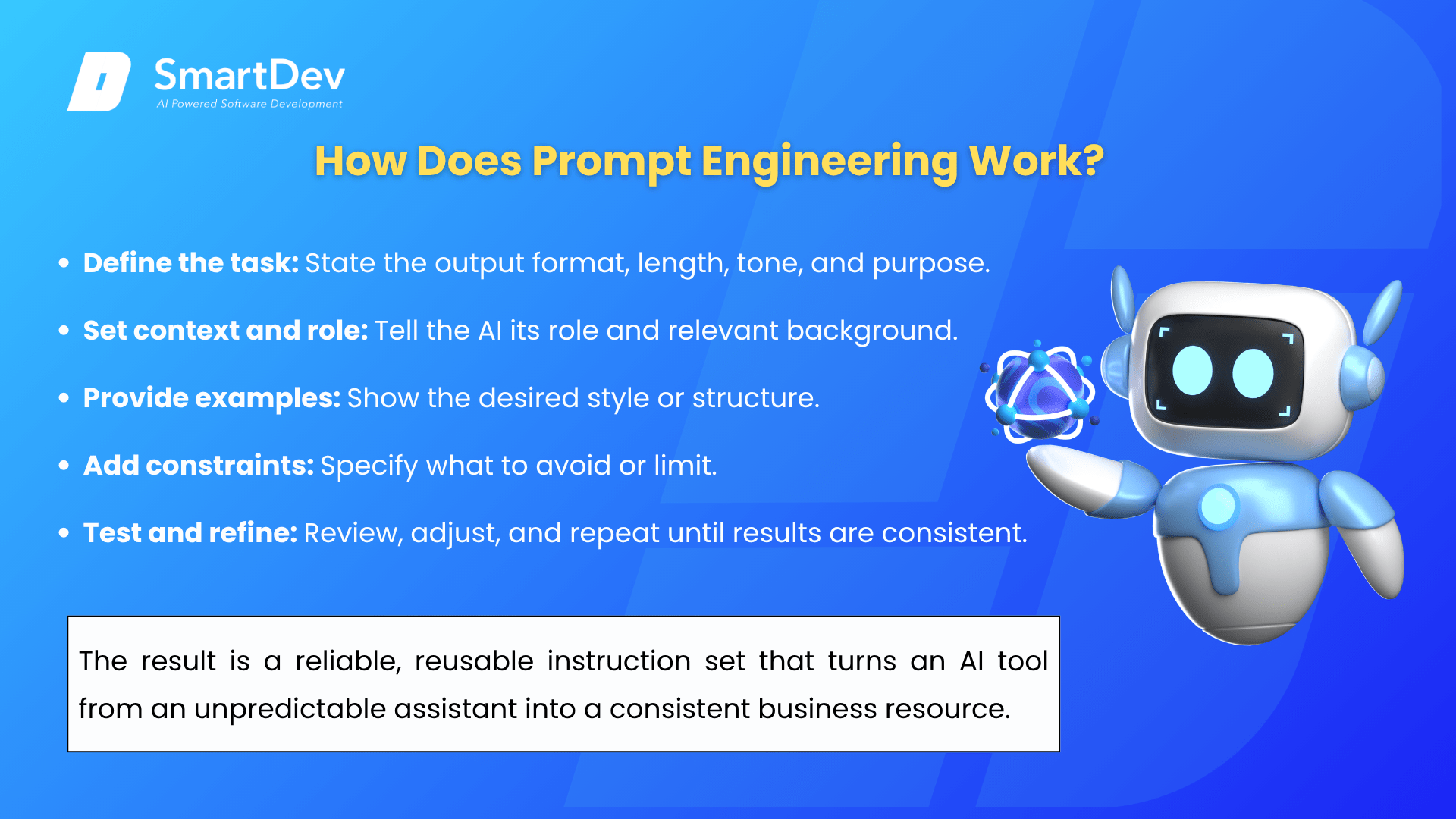
How Does Prompt Engineering Work?
- Define the task: Clearly identify what the AI needs to produce, including the format, length, tone, and purpose of the output.
- Set context and role: Tell the AI what role to play and what background information is relevant, for example, “You are a business analyst summarizing a financial report for a non-technical executive.”
- Provide examples: Include one or more examples of the desired output format so the AI can match the expected style and structure.
- Add constraints: Specify what to avoid, such as technical jargon, specific topics, or output length limits, to prevent common failure modes.
- Test and refine: Run the prompt, evaluate the output, adjust wording, and repeat until the prompt consistently produces acceptable results across different inputs.
The result is a reliable, reusable instruction set that turns an AI tool from an unpredictable assistant into a consistent business resource.
How Much Does Prompt Engineering Cost?
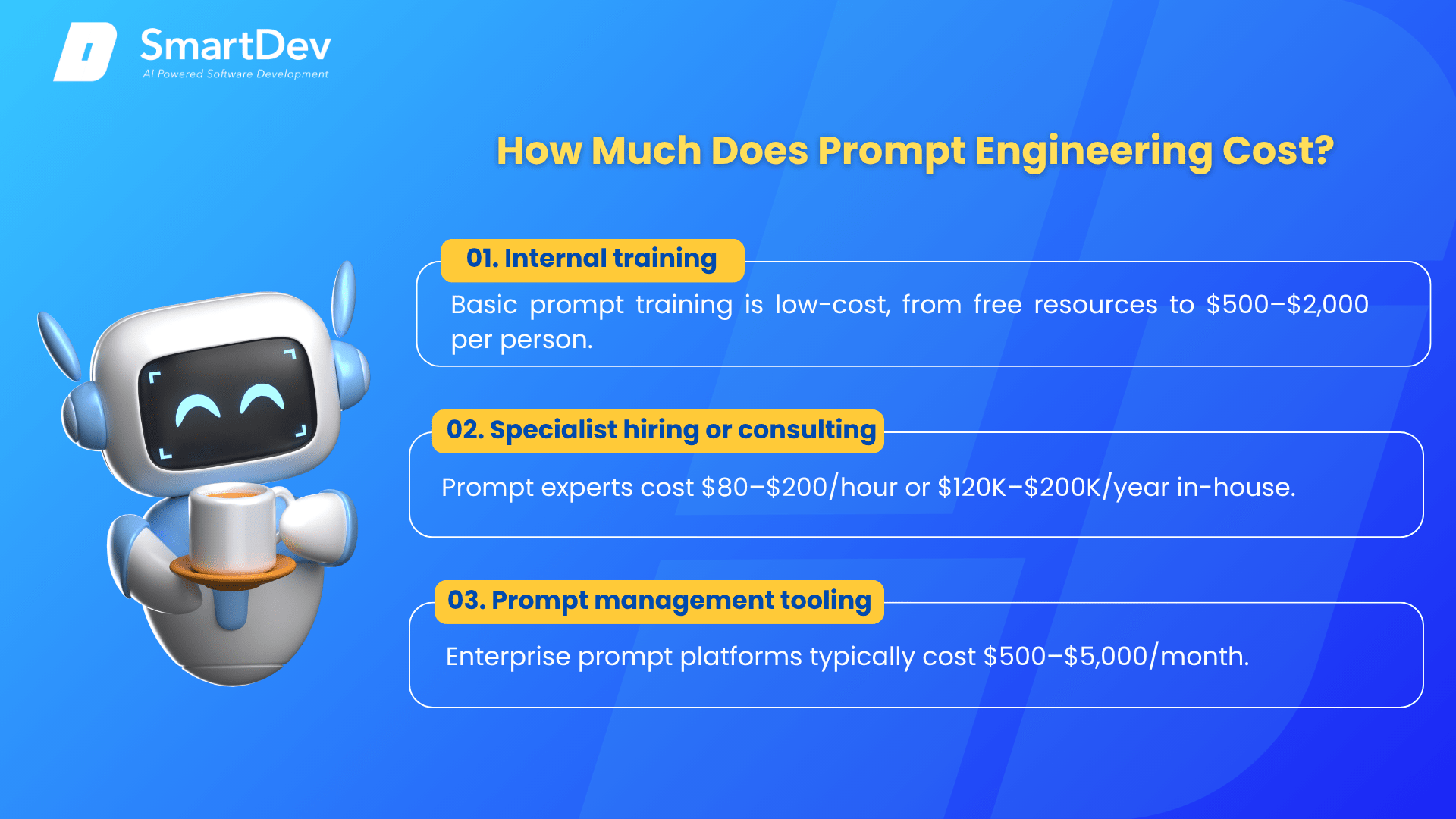
Building prompt engineering capability in an enterprise involves both direct and indirect costs:
- Internal training: Teaching existing staff basic prompt engineering skills costs relatively little, with structured courses ranging from free resources to $500 to $2,000 per person for professional training programs.
- Specialist hiring or consulting: Dedicated prompt engineers or AI consultants who design and manage enterprise prompt libraries charge $80 to $200 per hour, or $120,000 to $200,000 annually for in-house specialists.
- Prompt management tooling: Enterprise platforms for storing, versioning, and deploying prompt templates range from $500 to $5,000 per month depending on team size and features.
Compared to the cost of underperforming AI tools and the staff time spent correcting inconsistent AI outputs, prompt engineering investment typically delivers measurable returns within the first few months of implementation.
Weitere verwandte Begriffe
- Probabilistic Output: The characteristic of AI systems where responses vary based on statistical probability, making prompt engineering essential for achieving consistent and reliable results.
- Agentic Engineering: refers to the design and implementation of AI systems that act as autonomous agents capable of pursuing goals with limited human intervention. These agents can reason, make decisions, execute actions, and continuously improve based on feedback and changing conditions.
- AI Context Window: The amount of information an AI system can temporarily remember and process during a conversation or task, including prompts, instructions, documents, and previous messages.