
Kurz zusammengefasst
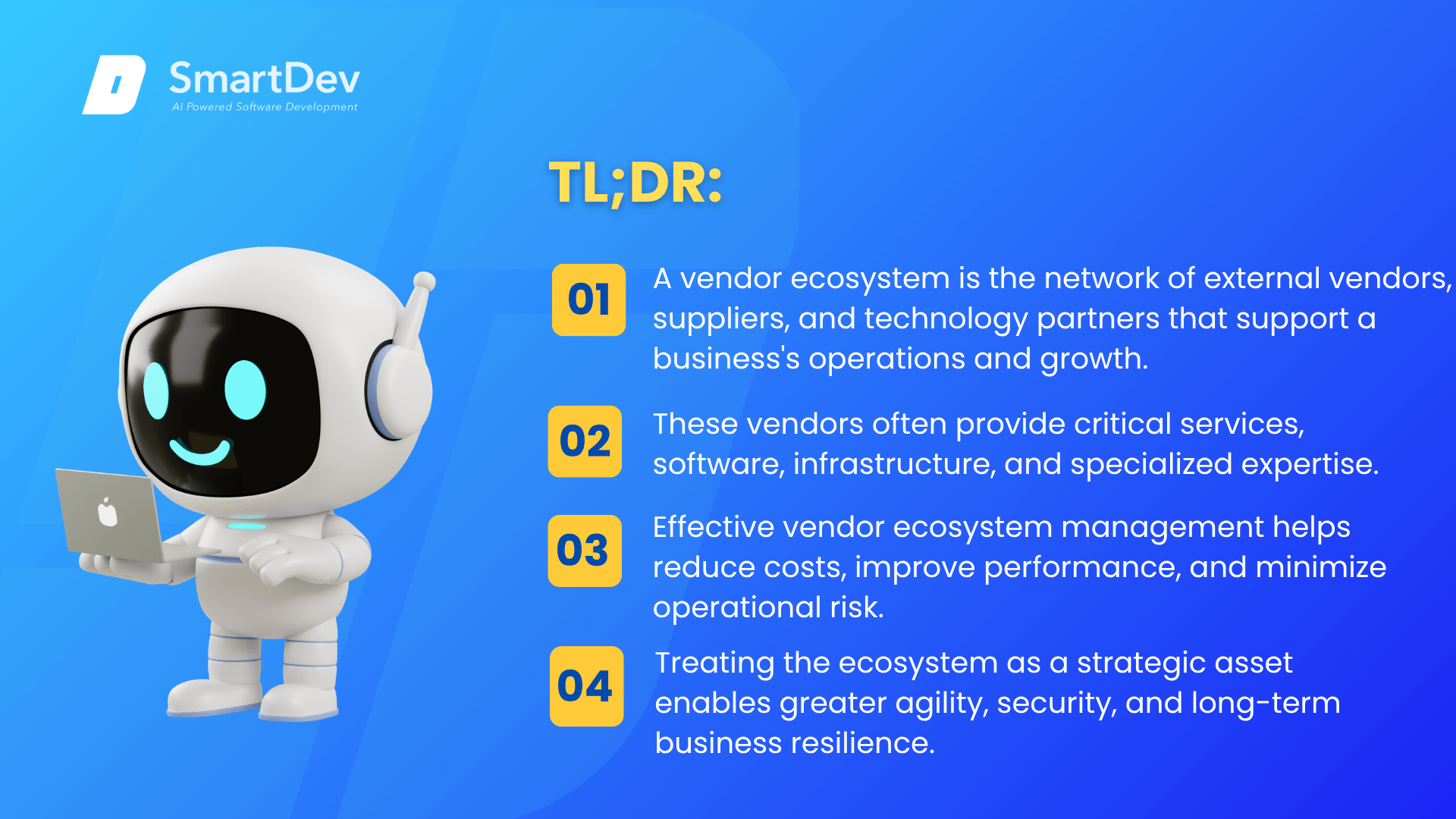
- A vendor ecosystem is the full network of external service providers, software suppliers, and technology partners a business relies on to operate.
- For most enterprises, external vendors represent 40–60% of total operating spend and deliver the majority of mission-critical services.
- Managing your vendor ecosystem strategically reduces cost, risk, and operational complexity across your entire technology supply chain.
A vendor ecosystem is the interconnected network of third-party providers, platforms, and partners that a business depends on to deliver its products and operations. In enterprise IT, this network can span dozens or hundreds of relationships. Managing it well is one of the most overlooked levers for reducing cost and operational risk. This article explains what a vendor ecosystem is, how it works, and who is responsible for it.
What is a Vendor Ecosystem?

A vendor ecosystem is the total set of external organizations a business relies on to deliver its technology capabilities, including IT service providers, software vendors, cloud infrastructure suppliers, systems integrators, managed service providers, and outsourcing partners. Each vendor in the ecosystem contributes a specific capability, and together they form the operational infrastructure that enables the business to function. In large enterprises, this ecosystem can include hundreds of active vendor relationships across different business units, geographies, and technology stacks. The term “ecosystem” reflects the fact that these relationships are not isolated — vendors often integrate with each other, share data, and depend on each other’s performance. A failure or change in one vendor relationship can cascade across the entire network. Managing the vendor ecosystem means understanding these interdependencies and governing them with appropriate oversight, contracts, and performance standards.
Warum ist das für Unternehmen wichtig?
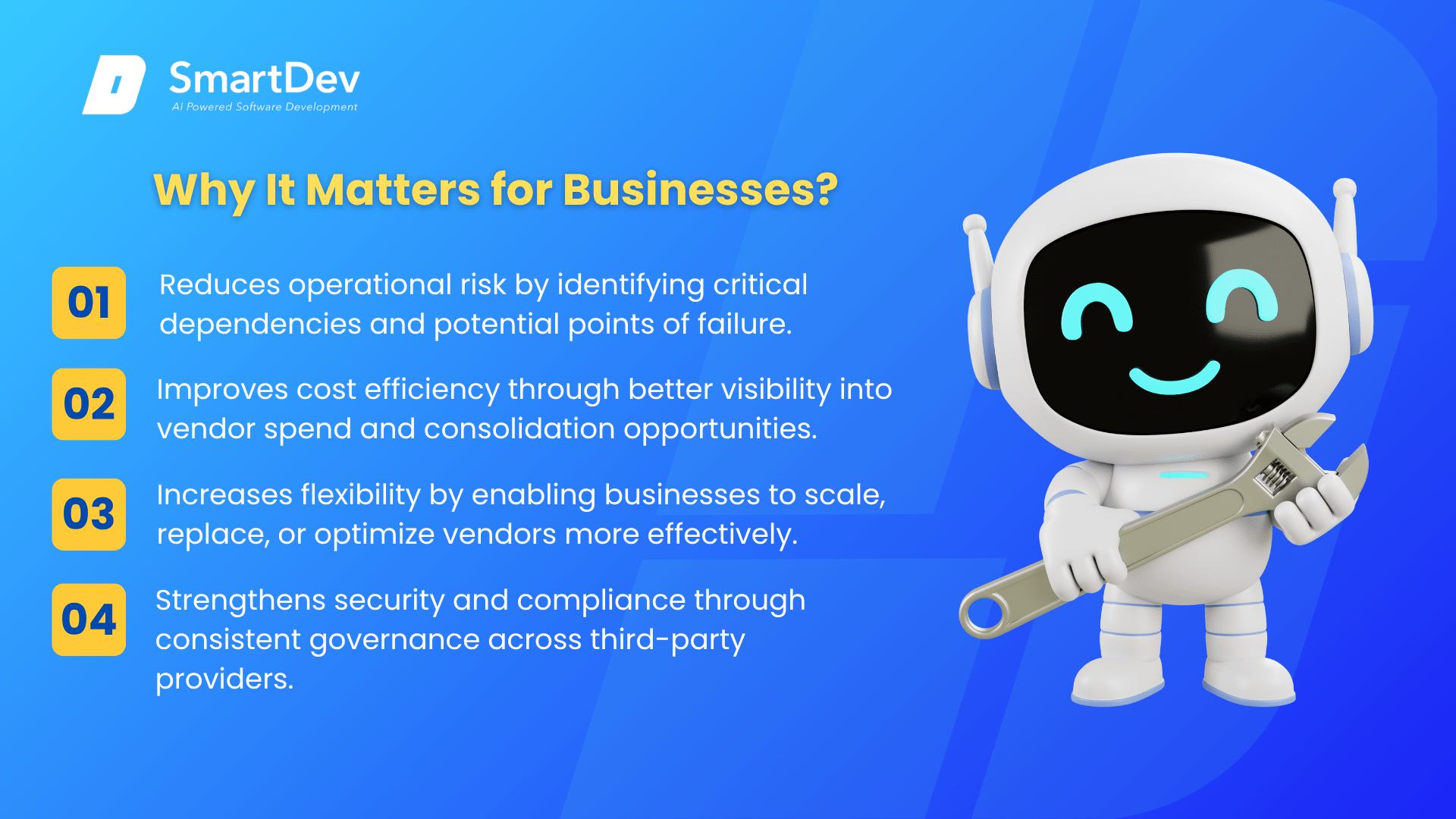
Most organizations underestimate the complexity and strategic importance of their vendor ecosystem until something goes wrong. A poorly governed ecosystem creates cost overruns, security vulnerabilities, and service disruptions.
- Reduce operational risk by identifying and managing single points of failure and vendor concentration risks across the ecosystem.
- Improve cost control through consolidated visibility into vendor spend, contract duplication, and renegotiation opportunities.
- Increase agility by understanding which vendors can be swapped, scaled, or upgraded without disrupting critical operations.
- Protect security and compliance by enforcing consistent data handling, access controls, and regulatory standards across all third parties.
For example, a healthcare company discovered through a vendor ecosystem audit that three separate business units were paying different vendors for essentially the same data analytics service. Consolidating to a single strategic vendor reduced annual spend by 28% and improved data consistency across the organization. The audit also revealed two vendors with outdated security certifications, which were remediated before they became a compliance liability.
How Does It Work?
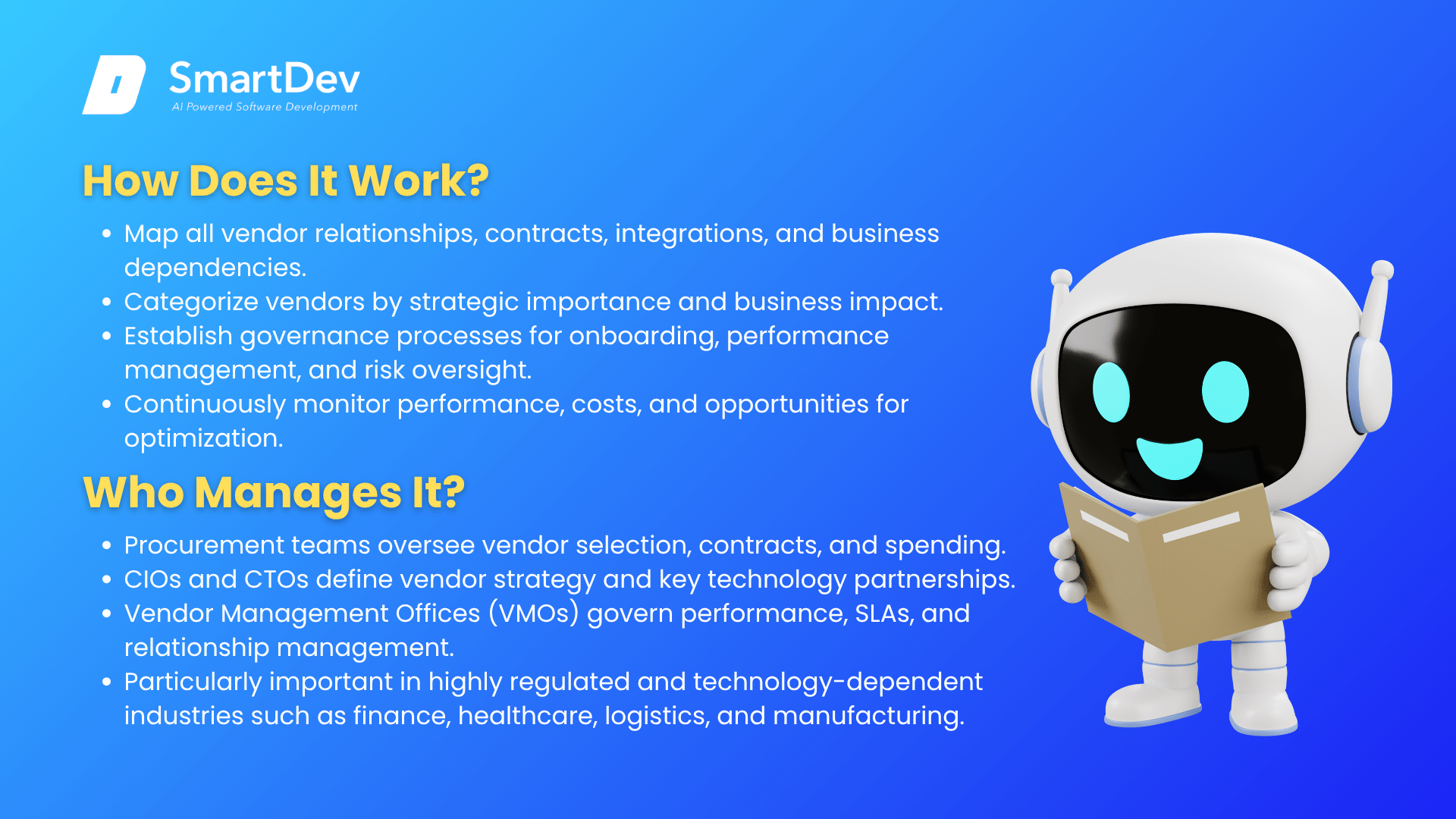
- Mapping — The business creates a complete inventory of all active vendor relationships, including contract terms, spend, integration points, and the business functions each vendor supports.
- Tiering — Vendors are categorized by strategic importance: tier-one strategic partners, tier-two preferred suppliers, and tier-three commodity providers, each with different governance requirements.
- Governance setup — Policies are established for vendor onboarding, performance monitoring, contract management, and offboarding.
- Performance monitoring — Each vendor is tracked against defined KPIs and SLAs, with regular reviews for strategic-tier vendors.
- Optimierung — The ecosystem is continuously reviewed for redundancy, consolidation opportunities, and emerging risks or gaps.
The result is a vendor ecosystem that operates as a managed, strategic asset rather than an uncoordinated collection of contracts.
Who Manages the Vendor Ecosystem?
Vendor ecosystem management sits at the intersection of IT, procurement, and operations leadership:
- Chief Procurement Officers (CPOs) and IT procurement teams manage contracts, spend, and supplier selection across the ecosystem.
- CTOs and CIOs set the strategic direction, deciding which vendor relationships are elevated to partner status and which are commoditized.
- Vendor Management Offices (VMOs) in large enterprises handle day-to-day relationship governance, SLA tracking, and escalation management.
Industries with the most complex vendor ecosystems include financial services, healthcare, logistics, and manufacturing, where regulatory requirements, system interdependencies, and geographic scale all drive high vendor counts. In these sectors, vendor ecosystem management is a dedicated discipline with its own tools, frameworks, and specialist teams.
Weitere verwandte Begriffe
- Vendor Management: The operational discipline of overseeing individual vendor relationships within the broader ecosystem, covering contracts, performance, and risk.
- Data Encryption: The process of converting readable data (plaintext) into an encoded format (ciphertext) using mathematical algorithms, ensuring that only authorized users with the correct decryption key can access the original information.
- Strategische Technologiepartnerschaft: The highest-value tier within a vendor ecosystem, where a provider is treated as a co-invested partner rather than a transactional supplier.