TL;DR:
- AI in investment management operates across five workflow domains: research and idea generation, portfolio construction, trading and execution, risk and compliance, and client service. Each has different value potential, data requirements, and control needs.
- The highest-value applications in production today are NLP for research synthesis, ML for portfolio optimization and stress testing, algorithmic execution support, and compliance surveillance. Generative AI for knowledge work is scaling rapidly but requires human review on all consequential outputs.
- Prioritize use cases using three criteria: business value (is there a measurable outcome?), data readiness (is clean, labeled data accessible?), and regulatory and model risk (what controls are required before deployment?).
- Human judgment is not replaced by AI in investment management. Investment thesis validation, fiduciary accountability, suitability determination, and AML escalation decisions remain human responsibilities.
- Governance is a deployment prerequisite, not a post-launch task. Model validation, explainability, audit trails, and decision-right assignment must be designed before go-live.
- ROI requires a defined baseline. Set specific pre-deployment metrics — research cycle time, false alert rate, error rate — before measuring outcomes. Benchmark claims without baselines are not evidence.
- Start narrow. A scoped 8–12 week pilot on a single workflow produces a clear result. An organization-wide AI initiative without defined success criteria produces ambiguous ones.
Introduction
Investment management firms operate under compounding pressures: research volume that outpaces analyst capacity, market speed that outpaces manual response, regulatory complexity that demands documentation at scale, and clients who expect personalized service across portfolios of any size.
AI addresses specific, bounded versions of each problem. It does not address all of them at once, and it does not replace the judgment of experienced investment professionals. Understanding the distinction — between where AI augments decision-making and where human accountability remains non-negotiable — is the starting point for any credible AI strategy in this sector.
This guide covers the investment lifecycle from research to client reporting, maps AI capabilities to the workflows where they are most productive, provides a framework for prioritizing use cases, and explains what governance and measurement foundations must be in place before scaling. It is written for investment and operations leaders evaluating AI adoption, not for readers already convinced that AI is transformative.
For the broader context of AI applications across financial services, see SmartDev’s AI in Finance guide.
1. AI in Investment Management Today
AI in investment management refers to the application of machine learning, natural language processing, and generative AI systems to support or automate research, portfolio construction, trading, risk monitoring, compliance, and client-service workflows. The key word is “support”: current AI systems improve analyst capacity and decision-support quality. They do not autonomously replace investment judgment in consequential decisions.
What AI Means in an Investment-Management Context
Three capability types operate across investment workflows today, and they differ materially in what they do and what controls they require:
| Capability | Core function | Investment application | Primary control requirement |
|---|---|---|---|
| Machine learning (ML) | Pattern recognition and prediction from labeled data | Credit risk, portfolio optimization, anomaly detection in trading, AML alert prioritization | Model validation, performance monitoring, drift detection |
| Generative AI (GenAI) | Synthesis and generation from unstructured inputs | Research summarization, regulatory report drafting, client communication | Human review before use; hallucination risk in factual claims |
| Agentic AI | Multi-step task orchestration with conditional logic | Compliance workflow automation, data retrieval pipelines, onboarding | Approval gates at consequential steps; escalation protocols |
Treating these as interchangeable is a common planning error. A compliance surveillance system is an ML application with explicit audit requirements. A research summary tool is a GenAI application where analyst review is the control. An agentic system that initiates client communications requires a different governance design entirely.
Where AI Fits Across the Investment Lifecycle
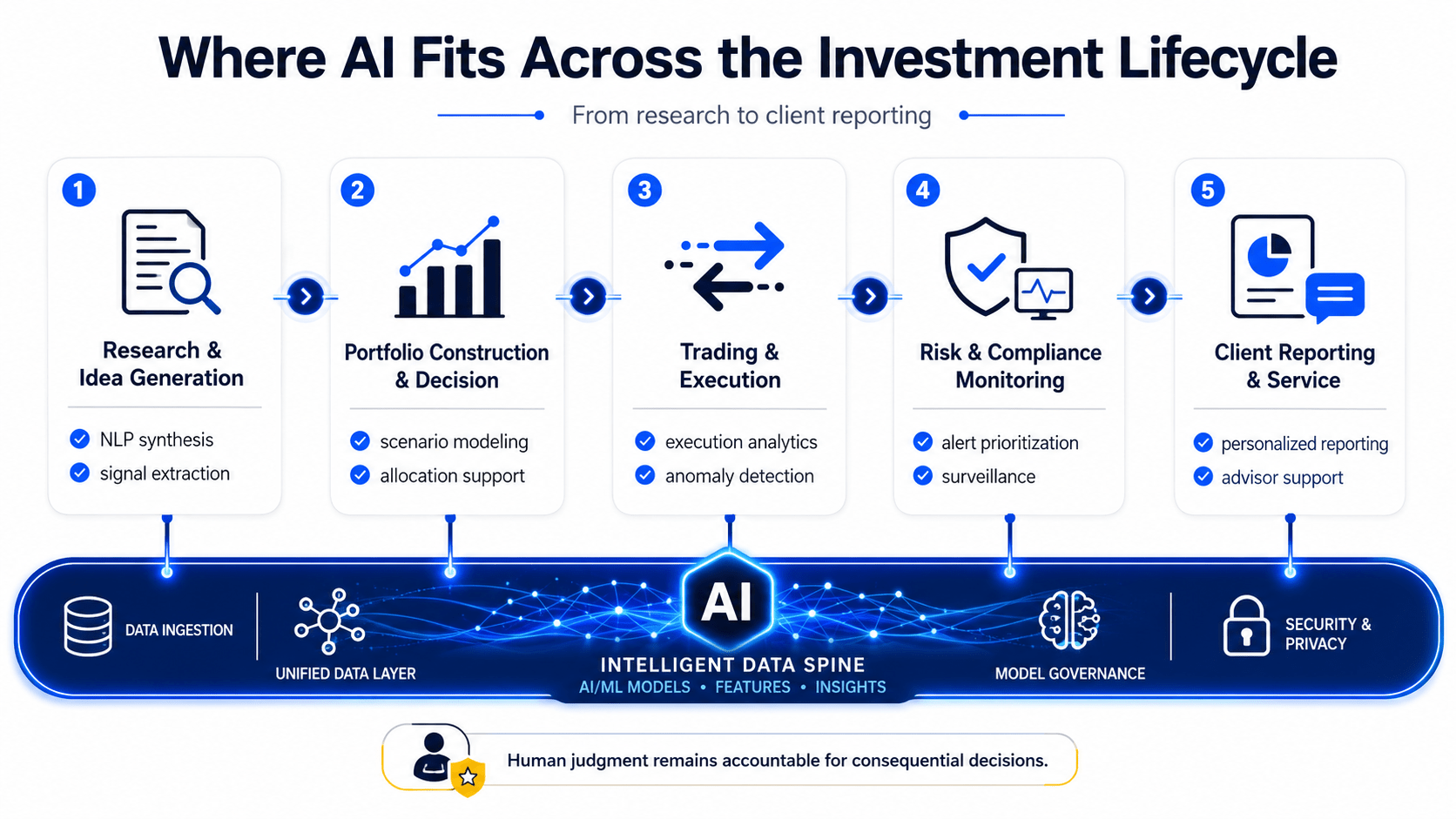
AI applications map to five stages of the investment lifecycle:
Research and idea generation → NLP extracts signals from filings, earnings transcripts, news, and alternative data. Analysts review and validate findings before incorporating them into a thesis.
Portfolio construction and risk → ML models support asset allocation decisions, scenario modeling, and stress testing. Portfolio constraints, mandates, and suitability requirements remain human-defined.
Trading and execution → Algorithmic systems improve execution quality, reduce market impact, and detect anomalies in real time. High-autonomy execution requires circuit breakers and defined position limits.
Operations, compliance, and reporting → ML monitors communications and transactions; GenAI supports regulatory report drafting. Human sign-off is required on all compliance escalations and filed reports.
Client service and distribution → AI generates personalized portfolio summaries and supports advisor workflows. Fiduciary responsibility and suitability determinations remain with qualified advisors.
The Shift from Isolated Tools to AI-Enabled Workflows
Earlier AI deployments in investment management were point solutions: a sentiment tool here, a compliance alert system there. The current shift is toward workflow integration — AI systems that connect across research, portfolio, and operations functions via shared data infrastructure and APIs.
This shift creates efficiency gains but also amplifies dependency on data quality. A workflow where AI outputs at stage two feed into AI inputs at stage three will compound data errors, not cancel them. Data governance is not an IT consideration; it is a workflow design requirement.
A 2024 Mercer survey of 150 asset managers found that 91% are either currently using or planning to use AI in asset-class research and portfolio construction, with 54% already in active deployment. This adoption rate reflects real institutional investment, but it does not tell us how many of those deployments have production-grade governance in place.
2. Business Value, Limits, and Prioritization
The business case for AI in investment management must be grounded in specific workflow outcomes, not sector-level claims. “AI improves decision-making” is not a business case. “NLP-assisted earnings call analysis reduces research cycle time from 4 days to 6 hours per company, enabling coverage of 40% more names with the same analyst headcount” is a business case.
The Business Outcomes AI Can Improve
| Outcome domain | AI contribution | Measurement approach |
|---|---|---|
| Research speed and coverage | NLP reduces document synthesis time | Research cycle time per name; analyst output volume |
| Portfolio and risk intelligence | ML expands scenario analysis depth | Scenario coverage breadth; stress test frequency; portfolio drawdown |
| Operating efficiency | Automation reduces manual hours in compliance and reporting | Hours per process; error rate; cost per compliance function |
| Client service scalability | AI-generated reports and personalized insights | Reports generated per advisor; client satisfaction; onboarding time |
| Alert quality | ML-based alert prioritization reduces false positives | Alert-to-investigation ratio; confirmed positive rate |
Where AI Should Augment — Not Replace — Human Judgment
The boundary between AI augmentation and AI decision-making is not a philosophical position; it is a regulatory and fiduciary one.
Human accountability is non-negotiable in four contexts:
- Investment thesis validation — AI can surface signals and synthesize information. The decision to act on that information is an investment judgment for which a portfolio manager is accountable.
- Suitability and advice — Recommending an investment to a client based on their individual circumstances requires qualified human determination in most jurisdictions.
- AML escalation and filing — Suspicious Activity Reports require human sign-off before filing in all major regulatory jurisdictions.
- Consequential model override — When a model output contradicts human judgment, the override decision and its rationale must be documented and owned by a named individual.
AI systems that blur these boundaries without explicit governance create regulatory exposure. Higher automation does not equal higher value when the reduction in human oversight creates accountability gaps.
A Framework for Prioritizing AI Use Cases
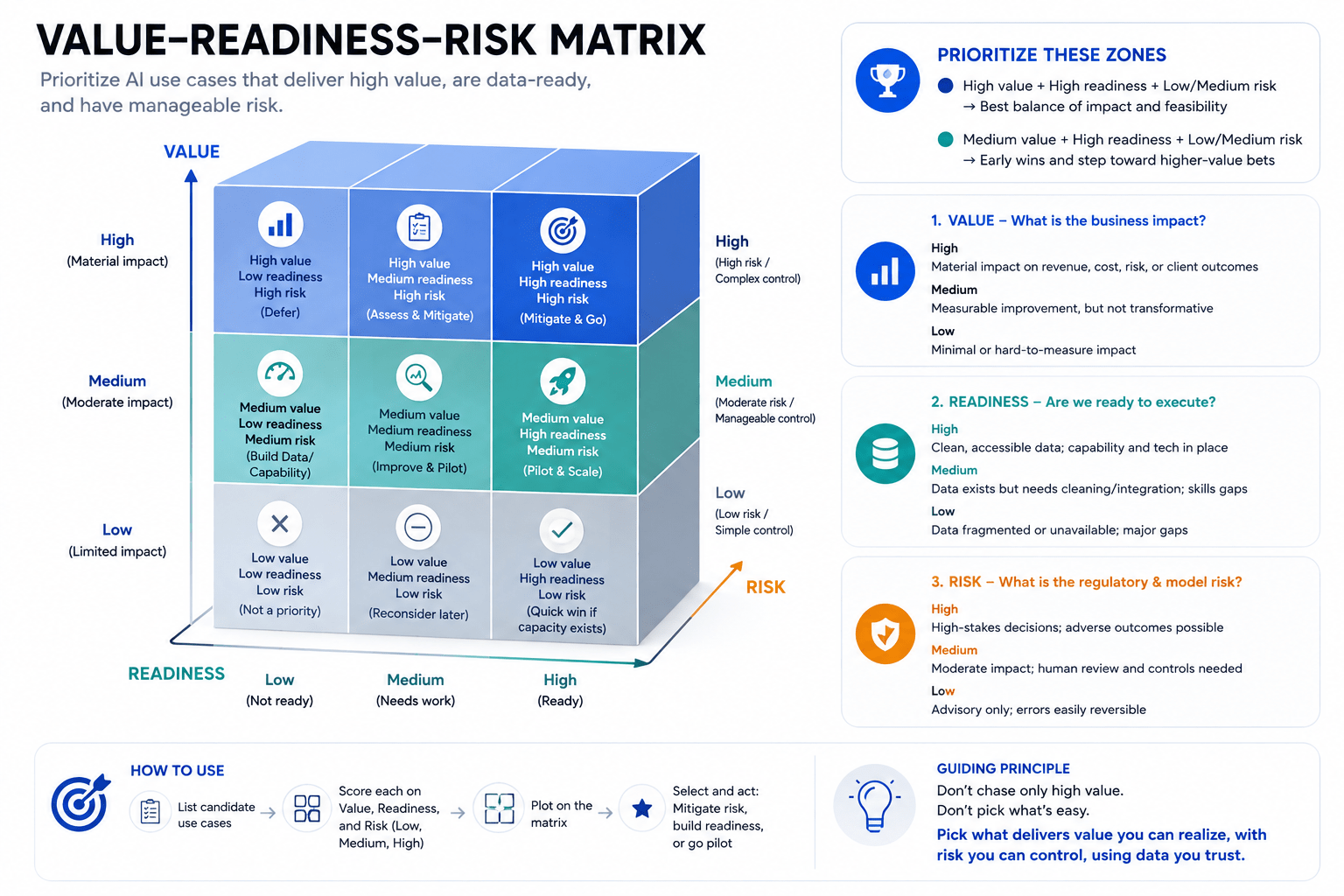
Use the Value–Readiness–Risk framework to score and rank candidate use cases before committing resources.
Value–Readiness–Risk Prioritization Matrix
| Dimension | Score 1 | Score 2 | Score 3 |
|---|---|---|---|
| Business value | Unclear outcome; no measurable metric | Defined outcome; moderate business impact | Outcome tied to a material revenue, cost, or risk metric with a clear baseline |
| Data readiness | Data fragmented, inconsistent, or inaccessible | Data exists; requires significant cleaning or normalization | Clean, labeled, accessible data in sufficient volume for model training and validation |
| Regulatory and model risk | High-stakes autonomous decisions; significant explainability requirements | Moderate exposure; some documentation required | Low-stakes, advisory only; easily reversible; no adverse-action implications |
Score each use case. Prioritize those with high value, high readiness, and manageable risk. For high-value, low-readiness candidates, invest in the data infrastructure first. Do not attempt to compensate for poor data readiness with a more complex model.
For implementation scoping support, SmartDev’s AI Proof of Concept services help investment firms validate use cases with defined success criteria before committing to full build.
3. Core AI Use Cases Across Investment Management
The six use-case domains below represent the most operationally grounded AI applications in investment management. Each section states the problem, the AI approach, the workflow integration point, the human role, the required control, and a realistic limitation.
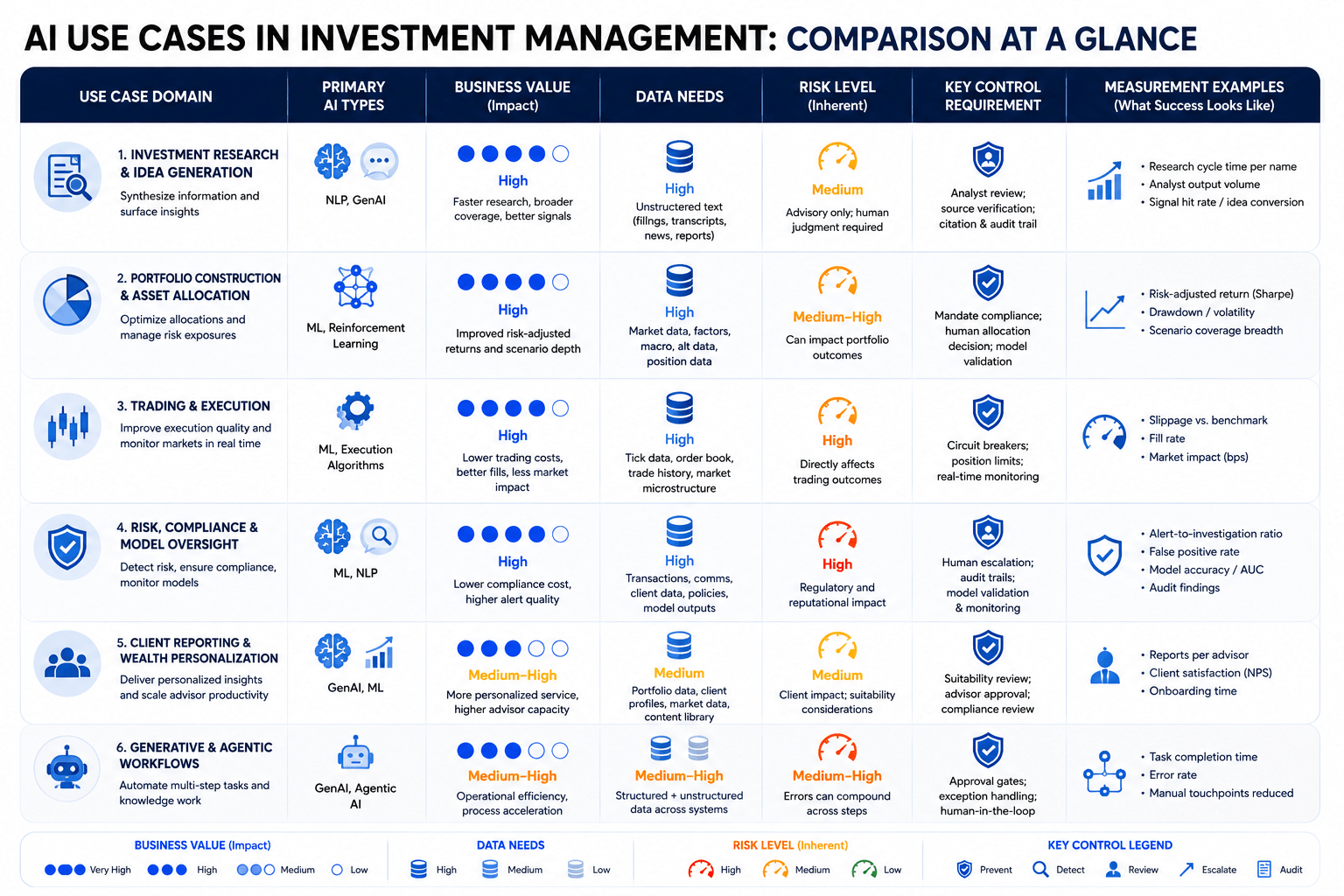
Use-Case Summary Table
| Use case | Primary AI type | Value metric | Key control | Limitation |
|---|---|---|---|---|
| Investment research and idea generation | NLP, GenAI | Research cycle time; analyst output | Analyst review; source verification | Cannot validate investment thesis |
| Portfolio construction and asset allocation | ML, reinforcement learning | Risk-adjusted return; drawdown | Mandate compliance check; human allocation decision | No guarantee of alpha |
| Trading and execution | ML, execution algorithms | Execution quality (slippage, fill rate) | Circuit breakers; position limits | Market impact; model failure during volatility |
| Risk, compliance, and model oversight | ML, NLP | Alert accuracy; false positive rate; audit trail | Human escalation on all filings | Model drift; adversarial data |
| Client reporting and wealth personalization | GenAI, ML | Report turnaround time; advisor capacity | Suitability review; fiduciary compliance | Cannot substitute for regulated advice |
| Generative and agentic AI in workflows | GenAI, agentic systems | Task completion time; error rate | Approval gates; human-in-the-loop | Compounding errors in multi-step chains |
3.1 AI for Investment Research and Idea Generation
AI accelerates the discovery and synthesis of investment-relevant information. It does not independently validate an investment thesis or replace analyst judgment.
NLP systems process earnings call transcripts, regulatory filings, analyst reports, and news feeds to extract sentiment, entity relationships, and emerging themes. Retrieval-augmented generation (RAG) systems allow analysts to query large document corpora and receive cited responses — a significant productivity tool for coverage-intensive research functions.
AllianceBernstein deployed an NLP platform to analyze healthcare sector legislation and policy documents. Research cycle time for regulatory impact assessments decreased from weeks to hours, enabling faster positioning around sector-specific policy events.
Workflow: AI retrieves and synthesizes → analyst reviews and verifies sources → analyst incorporates into thesis → investment committee decision.
Limitation: GenAI systems can produce plausible-sounding but factually incorrect summaries. Source verification is a required step, not an optional one. For document intelligence capabilities applicable to research workflows, see SmartDev’s AI Automation: Document & Data Processing resource.
3.2 AI for Portfolio Construction and Dynamic Asset Allocation
AI expands the analytical depth of portfolio construction — more scenarios, more variables, faster rebalancing — but does not remove the need for mandate compliance review or human allocation decisions.
ML models, including mean-variance optimization extensions and reinforcement learning systems, analyze historical return correlations, macroeconomic signals, and real-time market data to generate allocation recommendations. BlackRock’s Aladdin platform — used by BlackRock and by other institutions that license it — simulates stress scenarios and risk exposures at the portfolio level, supporting rebalancing decisions during volatility.
Man Group’s AHL division uses neural networks and reinforcement learning to dynamically adjust portfolio strategies across asset classes. The firm has publicly documented that these systems operate within defined mandate constraints, with human portfolio managers retaining final allocation authority.
Comparison of approaches:
| Approach | Inputs | Strengths | Governance requirement |
|---|---|---|---|
| Traditional optimization (MVO) | Historical returns, covariance matrix | Transparent; well-understood | Standard validation |
| ML-assisted optimization | Expanded factor set; real-time data | Captures non-linear relationships | Model validation; explainability documentation |
| Reinforcement learning | Market state; reward function | Dynamic adaptation | Approval gates; performance bounds; extensive backtesting |
Limitation: AI portfolio models do not guarantee alpha or lower risk. Reinforcement learning systems can optimize for a reward function that performs well in training environments but fails during out-of-distribution market conditions. SmartDev’s ML model training services support proper backtesting and validation frameworks.
3.3 AI for Trading, Execution, and Market Monitoring
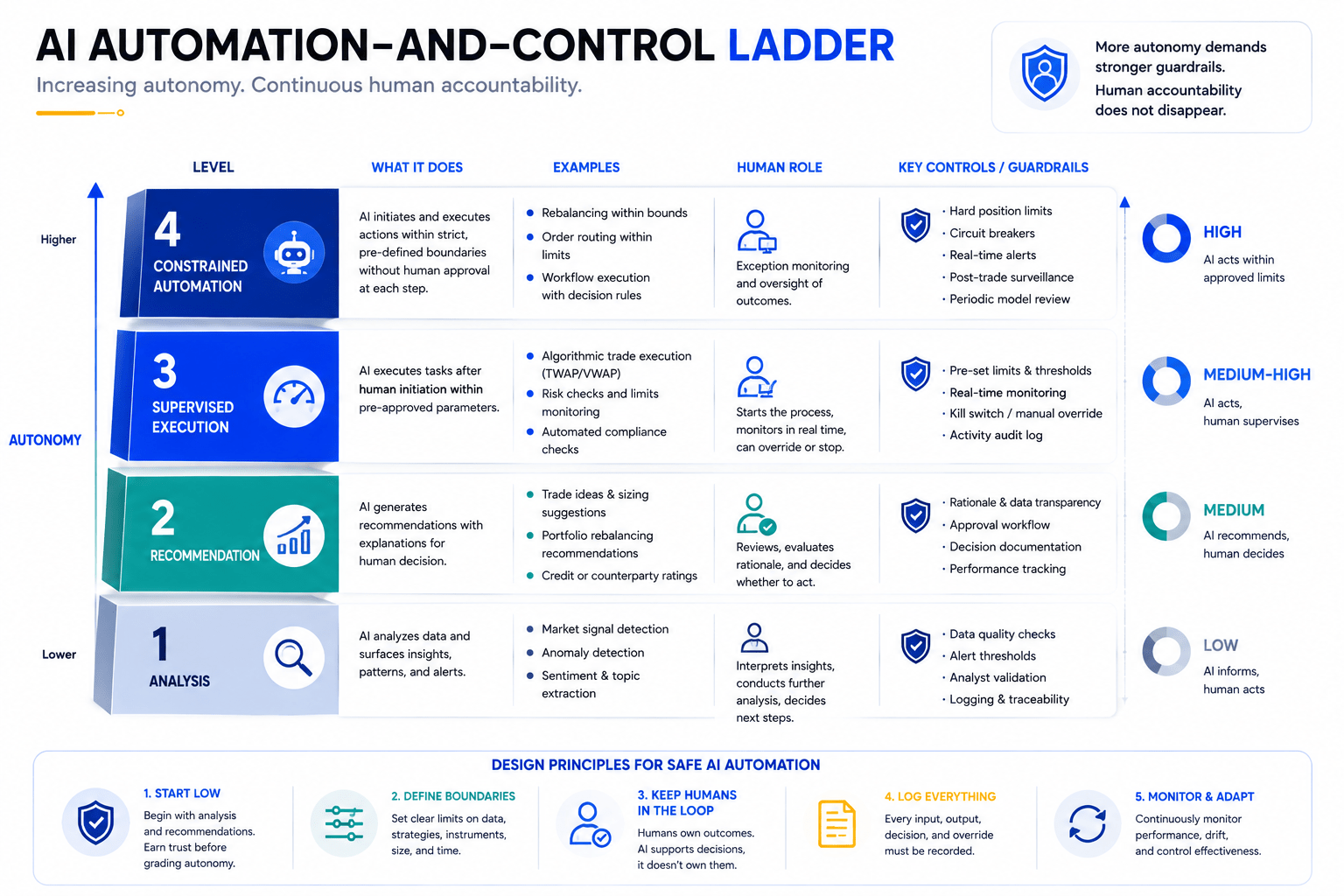
AI in trading operates on a spectrum from analytical support to constrained automation. Higher autonomy requires stricter controls, not just better models.
AI automation-and-control ladder for trading:
| Level | Description | Human role | Required control |
|---|---|---|---|
| Analysis | AI identifies potential opportunities and signals | Analyst reviews and decides | Audit log of signals |
| Recommendation | AI generates trade recommendations with supporting rationale | Trader reviews, approves, and executes | Approval workflow; documented rationale |
| Supervised execution | AI executes within pre-approved parameters after human initiation | Trader monitors; override available | Position limits; alert thresholds |
| Constrained automation | AI initiates and executes within strict pre-defined bounds | Exception monitoring | Circuit breakers; hard position limits; compliance review |
Renaissance Technologies is the most frequently cited example of AI-driven systematic trading. The firm’s Medallion Fund has generated exceptional long-term returns, though specific methodology details are proprietary. What is documented is that the firm employs rigorous quantitative validation and maintains strict risk controls on all automated positions.
For execution quality monitoring: AI anomaly detection flags unusual patterns in order flow, pricing, and execution data in real time. This application is lower-risk than autonomous trading and delivers clear operational value with well-defined governance (alert review by a compliance or trading desk team).
3.4 AI for Risk, Compliance, and Model Oversight
AI can materially improve risk signal quality and compliance efficiency. Decision rights, audit trails, validation, and exception management are mandatory controls — not optional enhancements.
Governance control map for investment-management AI:
| Layer | What it covers | Who owns it |
|---|---|---|
| Data | Lineage, quality, access controls, bias in training data | Data governance / IT |
| Model | Validation, performance benchmarks, drift monitoring | Risk / quantitative team |
| Workflow | Integration points, alert thresholds, escalation paths | Operations / compliance |
| Human review | Defined review roles, override authority, documentation | Portfolio managers / compliance officers |
| Audit | Logs, timestamps, decision rationale records | Compliance / legal |
Goldman Sachs uses ML to monitor employee communications and flag potential policy or trading conduct breaches, as documented in Emerj research on Goldman’s AI applications. The system generates alerts that trained compliance analysts review. AI identifies; humans decide on escalation.
On explainability: Regulators in the EU, UK, and US increasingly expect investment managers to explain how algorithmic systems influence portfolio decisions. SHAP (SHapley Additive Explanations) and LIME (Local Interpretable Model-agnostic Explanations) are practical tools for generating model explanations that can be reviewed and documented. This is especially important for any application that influences client-facing outcomes.
Model monitoring is a production requirement, not a deployment milestone. Performance should be tracked against holdout data on a defined schedule (monthly at minimum for high-frequency applications). Retraining triggers should be defined before launch, not after drift is observed.
3.5 AI for Client Reporting and Wealth-Management Personalization
AI can produce personalized reports, automate routine client communications, and support advisor workflows at scale. It cannot substitute for fiduciary responsibility, regulated investment advice, or suitability determination.
GenAI systems generate draft portfolio summaries, performance commentary, and client updates from structured portfolio data. This capability reduces report production time materially and allows advisors to serve larger books without proportional headcount growth. UBS has deployed its AI assistant “Red” across over 30,000 employees to support client onboarding, document drafting, and internal knowledge queries, generating over one million AI-assisted interactions monthly.
Client-service control matrix:
| Task | AI role | Sensitivity | Human review required |
|---|---|---|---|
| Portfolio performance summary | Generates draft from structured data | Low | Advisor review before sending |
| Personalized market commentary | Synthesizes research into client-tailored format | Medium | Compliance and advisor review |
| Rebalancing recommendation | Suggests allocation changes | High | Advisor approval; suitability check |
| Onboarding documentation | Populates forms from client-provided data | High | Compliance and advisor validation |
| Regulated investment advice | Not appropriate for AI-only output | Very high | Qualified advisor required |
Robo-advisors such as Betterment provide automated portfolio management to retail clients, using optimization algorithms and client-provided risk profiles. As of publicly available reporting, Betterment manages over $45 billion in assets. The critical design element is that the system operates within explicitly defined, regulator-reviewed investment mandates — automation does not equal unregulated action.
3.6 Generative and Agentic AI in Investment Workflows
GenAI generates and synthesizes content from existing information. Agentic AI plans and executes multi-step tasks. Both require grounded data, defined controls, and clear escalation paths before use in regulated investment workflows.
| Type | What it does | Investment application | Key constraint |
|---|---|---|---|
| GenAI assistant | Generates text, summaries, structured output | Research summaries, report drafts, client communications | Hallucination risk; human review required |
| AI agent | Plans and executes bounded multi-step tasks | Data collection and normalization, compliance workflow routing | Approval gates at consequential steps; failure handling |
| Autonomous workflow | Executes full end-to-end process with minimal oversight | Not recommended for regulated investment decisions | Requires extensive validation; escalation and override design |
BlackRock’s “Asimov” system operates as an AI agent integrated into the Aladdin platform. It retrieves and synthesizes information from internal documents, regulatory updates, and market news, then delivers contextualized alerts and portfolio risk updates to portfolio managers. Portfolio managers receive the output; they make the decision. This human-in-the-loop design is the appropriate pattern for AI agents in regulated investment management.
Safe deployment spectrum for agentic AI in investment workflows:
- Information retrieval and synthesis (low risk; broad applicability)
- Alert generation and routing for human review (low-moderate risk; requires audit trail)
- Report drafting with human review before delivery (moderate risk; standard control)
- Workflow orchestration with defined approval gates (moderate-high risk; requires detailed governance design)
- Autonomous consequential action without human review (not recommended for regulated activities)
For context on agentic AI system design, see SmartDev’s AI development services.
4. Evidence From Practice: Case Studies and Examples
Case studies are useful only when the problem, workflow, control environment, outcome metric, and limitations are stated clearly. The examples below are drawn from primary company sources and credible institutional research. Where specific performance claims could not be verified to a primary source, they have not been included.
How to Evaluate a Reported AI Success Story
Before applying a case study to your own planning, check these four questions:
| Question | Why it matters |
|---|---|
| Is the source primary (company disclosure, annual report, investor filing) or secondary (vendor claim, press release)? | Vendor claims lack independent verification |
| Is there a stated baseline and measurement period? | Without a baseline, an outcome claim is not measurable |
| What was the human oversight structure? | Success in a well-controlled environment may not transfer to less-governed deployments |
| Is the use case and data environment transferable to your firm? | Scale, data quality, and technology infrastructure differ materially across institutions |
Research and Investment-Intelligence Examples
AllianceBernstein — Regulatory Research Acceleration Problem: Multi-week research cycles limited timely positioning around legislative and policy events. AI approach: NLP-based platform for scanning and summarizing regulatory texts and policy documents. Control: Analyst review of AI-generated summaries before incorporation into investment theses. Outcome: Research cycle time for regulatory impact analysis reduced significantly, with analysts reporting materially faster positioning capability. Transferable lesson: High-document-volume research functions where analyst synthesis is the bottleneck are strong NLP candidates.
Minotaur Capital — Market Intelligence Workflow Problem: Volume of daily financial content exceeded analyst processing capacity. AI approach: AI platform “Taurient” processes approximately 35,000 articles per week using NLP and sentiment analysis to surface themes and signals. Control: Human portfolio managers vet all AI-generated signals before trade or allocation decisions. Outcome: The Minotaur Global Opportunities Fund reported a 23.5% year-to-date return against the MSCI ACWI benchmark of 17.4%, along with a 60% reduction in research cycle time. Note: This outcome reflects the firm’s stated results; independent verification of attribution to the AI system specifically is not available.
Portfolio, Risk, and Trading Examples
BlackRock — Asimov AI Agent for Portfolio Insight Problem: Portfolio managers needed faster synthesis of internal data, regulatory updates, and market news to support real-time decisions. AI approach: Asimov, an AI agent embedded in the Aladdin platform, retrieves and synthesizes contextual information across sources. Control: Output is delivered as decision support; portfolio managers retain authority over all portfolio actions. Outcome: Improved decision-making speed and situational awareness on portfolio risk and geopolitical developments, per BlackRock public commentary on AI investing. Transferable lesson: AI agents in investment workflows should be designed as co-pilots, not autopilots.
Man Group — ML-Driven Portfolio Strategies Problem: Dynamic market conditions required faster portfolio strategy adaptation than static models could deliver. AI approach: AHL division uses neural networks and reinforcement learning to adjust portfolio strategies across asset classes. Control: Models operate within defined mandate constraints; human portfolio managers retain final allocation authority. Outcome: Multi-year performance trend that, according to CNBC reporting on Man Group’s ML transition, demonstrated competitive returns at lower relative volatility. Transferable lesson: RL-based portfolio systems require extensive backtesting across market regimes, not just recent data.
Operations, Compliance, and Client-Service Examples
Goldman Sachs — Communications Compliance Monitoring Problem: Manual review of employee communications for policy compliance was insufficient at scale. AI approach: ML models monitor communication logs and flag patterns associated with potential trading conduct or ethical policy violations. Control: All flagged items are reviewed by trained compliance analysts; AI identifies, humans escalate. Outcome: Faster risk identification and documented cost savings in legal and compliance operations.
UBS — AI-Assisted Wealth Management Problem: Administrative workload limited advisor capacity for high-value client engagement. AI approach: “Red” AI assistant supports 30,000+ employees with onboarding, documentation, and internal knowledge queries. Control: Advisor review on all client-facing outputs; fiduciary decisions remain with qualified advisors. Outcome: Over one million AI-assisted interactions monthly; reported improvements in client onboarding speed and advisor capacity.
5. Foundations for Responsible AI Adoption
Successful AI adoption in investment management depends on five foundations: data quality and governance, accountability and decision rights, model risk controls, security and privacy, and an appropriate delivery model. These are prerequisites for scaling, not items to address after deployment.
Responsible-AI Readiness Checklist
Data quality, lineage, and access controls
☐ Data sources are documented with lineage records
☐ Data quality standards are defined and enforced (completeness, consistency, recency)
☐ Access controls restrict model training data to authorized use
☐ Bias testing has been conducted on training data, particularly for any application affecting clients
Governance, accountability, and decision rights
☐ A named owner is assigned to each AI system (business owner and technical owner)
☐ Decision rights are documented: what the model decides, recommends, or automates, and what remains a human decision
☐ Escalation paths are defined for exception handling and model failures
☐ Audit trails record model inputs, outputs, human review actions, and timestamps
Model risk, explainability, and validation
☐ Models are validated against holdout data before production deployment
☐ Performance benchmarks are defined and monitored on a schedule
☐ Drift detection is in place with defined retraining triggers
☐ Explainability tools are implemented for any model influencing client or regulatory outcomes
Security, privacy, and third-party risk
☐ AI systems handling sensitive data comply with applicable privacy regulations (GDPR, relevant sector requirements)
☐ Third-party AI vendor contracts include data access rights, model documentation requirements, and performance SLAs
☐ Cybersecurity assessment has been conducted on AI infrastructure and API integrations
Talent, operating model, and change management
☐ Investment professionals are trained on model logic, limitations, and override protocols
☐ Cross-functional ownership includes business, data, compliance, and technical roles
☐ Change management plan addresses workflow transition and adoption measurement
Build, Buy, or Partner: Evaluating the Delivery Model
| Approach | Suitable when | Key risk | When not to choose |
|---|---|---|---|
| Build | Proprietary data or strategy is the differentiator; internal talent exists | High cost; long time-to-value; maintenance burden | Capability is widely available commercially; no proprietary advantage |
| Buy | Commercial platforms provide sufficient capability; speed matters | Vendor dependency; limited customization; data exposure | Core data or strategy must not leave the firm |
| Partner | Domain expertise is needed; faster delivery with governance alignment | Knowledge transfer dependency | Long-term maintenance without internal capability development |
SmartDev’s AI & Machine Learning services support all three models across investment management use cases, with particular experience in integration-heavy environments where legacy system connectivity is a constraint.
6. Implementation Roadmap for Investment Firms
AI implementation in investment management follows a defined six-stage sequence. Each stage has an entry criterion, an exit criterion, and defined ownership. Skipping stages accelerates failures, not timelines.
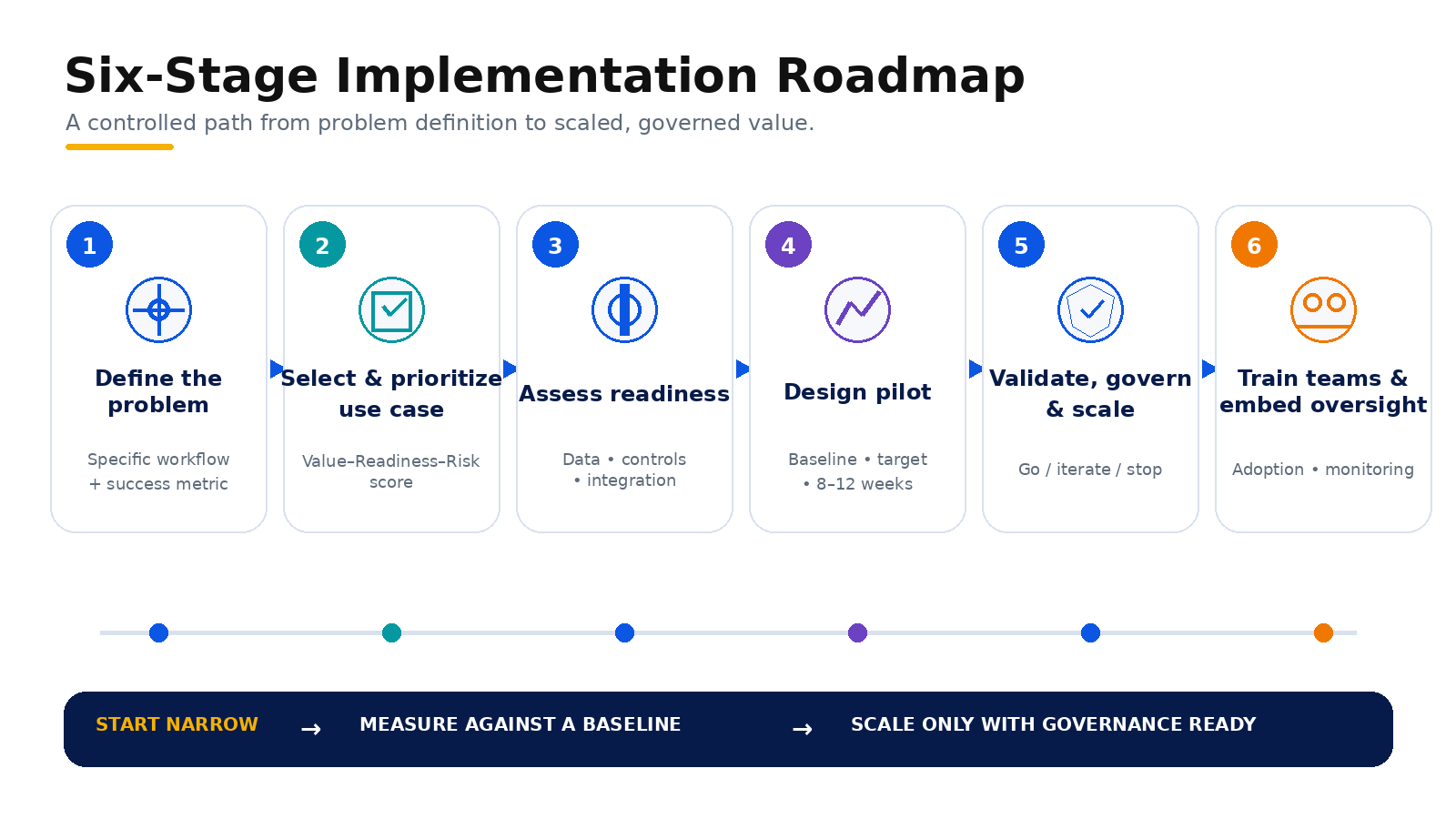
Six-Stage Implementation Roadmap
Stage 1: Define the Investment or Operating Problem
Entry criterion: A business team has identified a specific workflow bottleneck or decision-quality gap. Actions: State the problem in operational terms. Define the metric that would change if the problem were solved. Assign a business owner. Exit criterion: Problem statement is specific, measurable, and has a named owner. Risk: Vague problem statements produce vague solutions.
Stage 2: Select and Prioritize a Use Case
Entry criterion: Multiple candidate use cases exist; resources constrain simultaneous pursuit. Actions: Apply the Value–Readiness–Risk framework (Section 2). Score and rank candidates. Select the highest-scoring use case with the most defined success metrics. Exit criterion: One use case selected with documented score rationale. Risk: Choosing the most technically interesting use case rather than the most operationally ready one.
Stage 3: Assess Data, Controls, and Integration Readiness
Entry criterion: Use case is selected. Actions: Audit data availability, quality, and accessibility. Map required integrations with existing platforms. Define governance requirements: who reviews model outputs? What decisions remain human? What audit trail is needed? Exit criterion: Data gaps documented and resolution plan in place; governance design complete. Risk: Discovering data problems after model development has begun.
Stage 4: Design the Pilot and Measurement Plan
Entry criterion: Data and governance design are confirmed. Actions: Scope the pilot narrowly — one product line, one data domain, one team. Define the baseline metric. Set the success threshold. Define the timeline (8–12 weeks). Assign a cross-functional pilot team. Exit criterion: Pilot scope, baseline, success criteria, and timeline are documented and agreed. Risk: Undefined success criteria make pilot evaluation subjective.
Stage 5: Validate, Govern, and Scale
Entry criterion: Pilot is complete with documented results. Actions: Compare outcomes against baseline and success threshold. Review governance and control performance during the pilot. If the pilot passes: design production deployment. If it fails: identify root cause — data, model, integration, or adoption — and determine whether to redesign or discontinue. Exit criterion: Clear pass/fail decision with documented rationale. Scale criteria: Pilot result meets or exceeds success threshold; governance is production-ready; training is complete; monitoring plan is in place. Risk: Scaling a pilot that “almost worked” without addressing root cause.
Stage 6: Train Teams and Embed Human Oversight
Entry criterion: Production deployment is approved. Actions: Train investment professionals on model logic, output interpretation, and override protocols. Train compliance and risk teams on monitoring responsibilities. Define the review cadence for model performance. Exit criterion: All defined roles are trained; monitoring schedule is active. Risk: Deploying capable AI to teams that do not understand its limitations.
7. Measuring ROI and Managing Adoption Risk
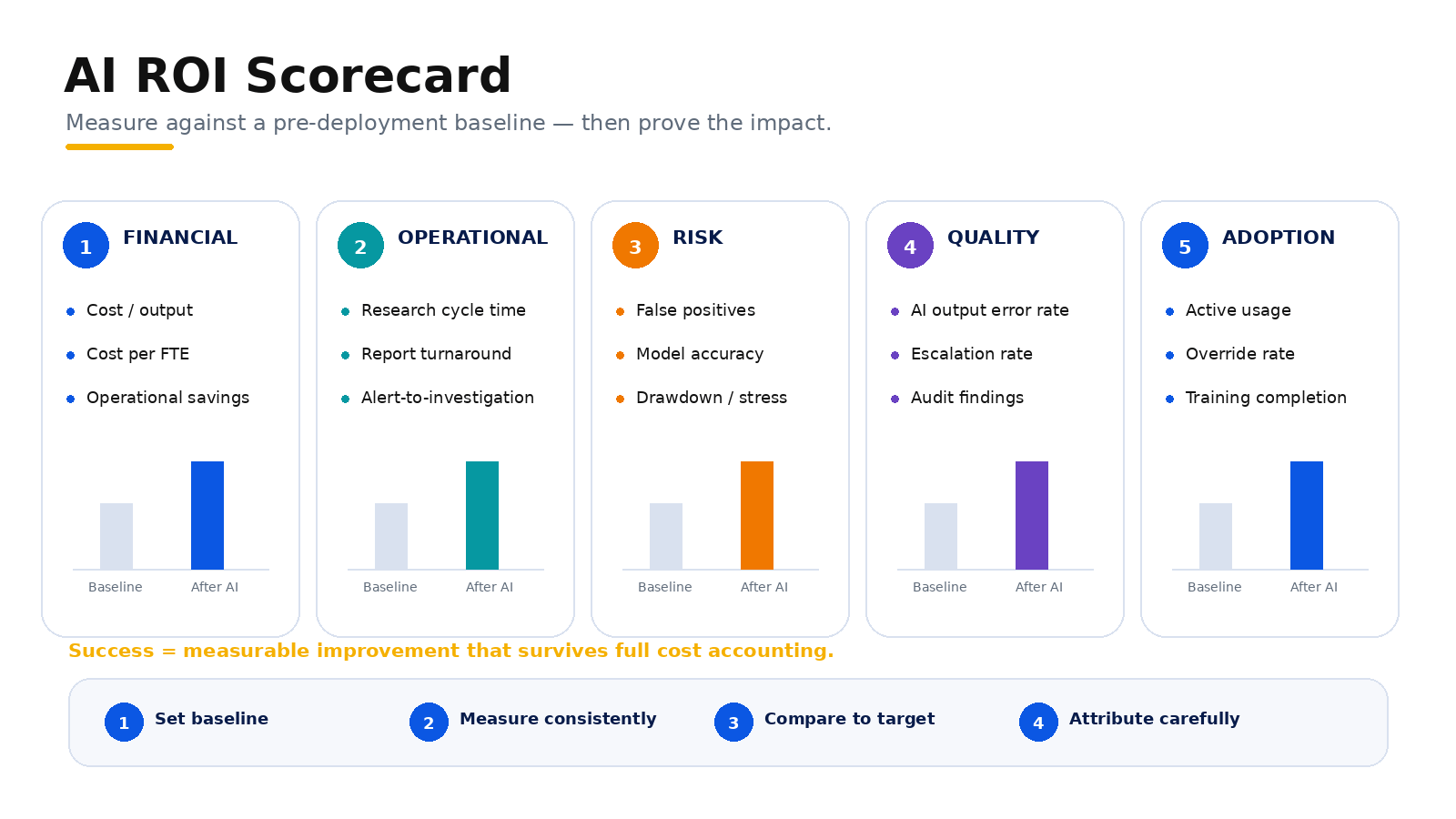
AI ROI in investment management is measured against a defined pre-deployment baseline. A result requires a baseline, an intervention, a cost accounting, and a measured outcome. Anything less is an assertion, not evidence.
AI ROI Scorecard
| Metric category | Example metrics | Baseline source | Measurement interval |
|---|---|---|---|
| Financial | Cost per research output; compliance cost per FTE; operational cost reduction | Pre-deployment operational cost data | Quarterly |
| Operational | Research cycle time; report generation time; alert-to-investigation ratio | Pre-deployment process timing | Monthly |
| Risk | False positive rate; model accuracy on holdout data; portfolio drawdown during stress events | Pre-deployment performance metrics | Monthly / event-driven |
| Quality | Error rate on AI-generated outputs; escalation rate | Pre-deployment error audit | Monthly |
| Adoption | User engagement with AI outputs; override rate; training completion | Baseline at launch | Monthly for first 6 months |
Establish Baselines and Attribution
Attribution in investment management is genuinely difficult. A portfolio return improvement following AI deployment may reflect the AI contribution, market conditions, or both. The strongest attribution method: use a controlled comparison where possible — same strategy applied with and without AI assistance across comparable portfolios or time periods. Where this is not operationally feasible, document assumptions and state uncertainty.
A 2024 Bain & Company survey found that financial institutions adopting generative AI reported an average 20% productivity gain in research, compliance, and operations functions. Apply this benchmark cautiously: it represents an average across organizations with mature data infrastructure. Your baseline may differ.
Common Failure Modes and How to Detect Them Early
| Failure mode | Early warning signal | Response |
|---|---|---|
| Fragmented or poor-quality data | High error rate in early model outputs; inconsistent training results | Pause development; audit and remediate data before continuing |
| Unclear ownership and weak controls | No named reviewer for AI outputs; audit trail gaps | Assign owners before deployment; do not go live without defined review roles |
| Overreliance on model outputs | Low override rate despite known model limitations; analysts not reviewing outputs | Retrain team on model limitations; add review checkpoints |
| Pilot projects that cannot scale | Pilot success depends on manual data preparation that cannot be automated | Design for production data infrastructure from the start |
| Unmeasured or unverified value claims | No baseline defined before deployment; ROI claimed without measurement | Set baselines as a go/no-go criterion for Stage 4 |
8. What Comes Next: AI Trends to Monitor
The most useful framework for evaluating AI trends in investment management is a three-horizon view: what is established and in production, what is scaling now, and what to monitor for near-term adoption.
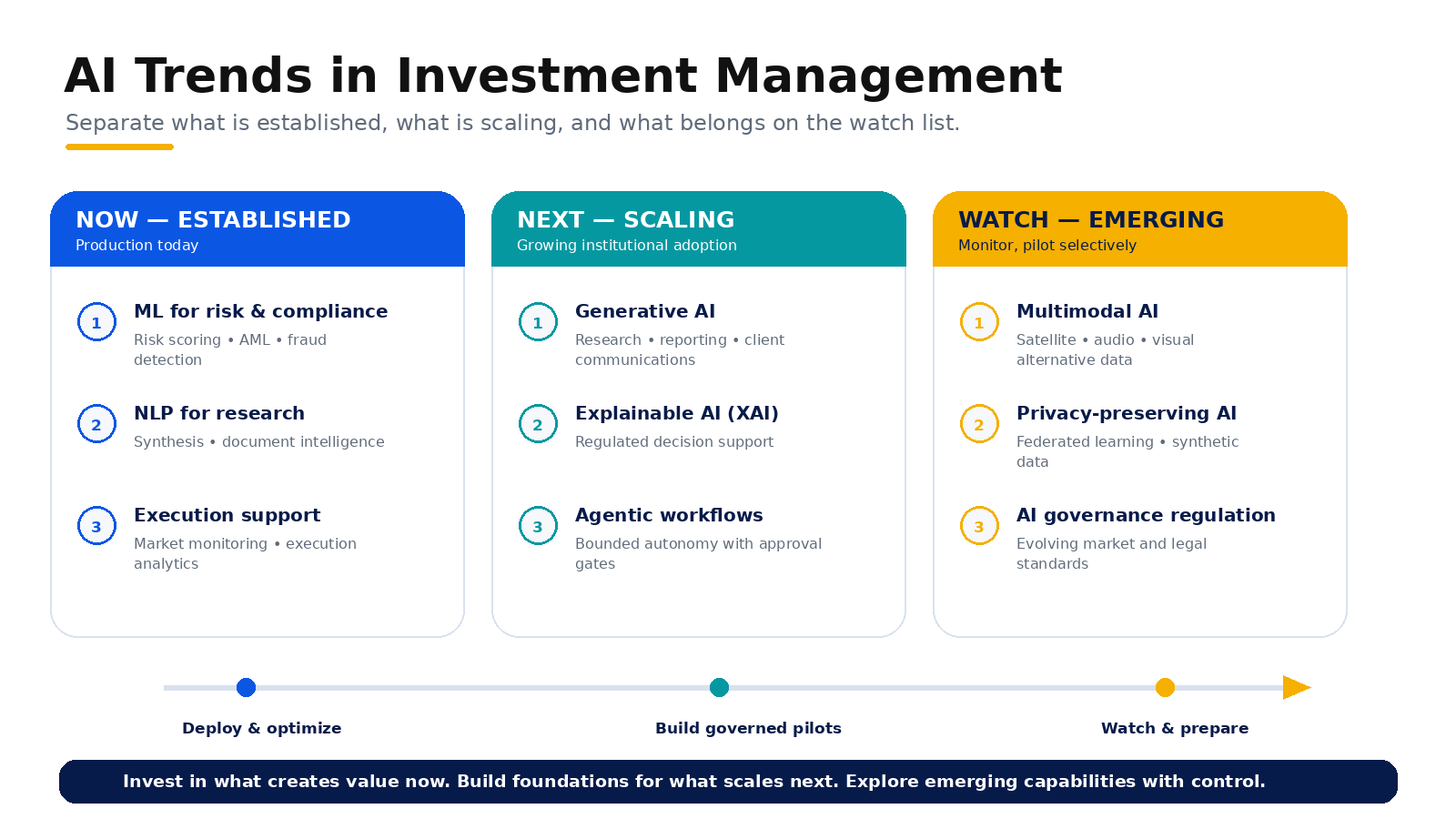
Three-Horizon Trend Map
| Horizon | Capability | Current status | Primary constraint |
|---|---|---|---|
| Now — established | ML for risk scoring, AML surveillance, fraud detection | Production at major institutions | Data quality; model drift management |
| Now — established | NLP for research synthesis and document intelligence | Scaling broadly | Source verification discipline |
| Now — established | Algorithmic execution support | Standard at large firms | Regulation; circuit breaker design |
| Next — scaling | GenAI for research, reporting, and client communication | Rapid institutional adoption | Hallucination risk; review workflow design |
| Next — scaling | Explainable AI (XAI) for regulated decision support | Growing regulatory expectation | Integration with existing model architecture |
| Next — scaling | Agentic workflows with bounded autonomy | Early production deployments | Approval gate design; compounding error risk |
| Watch — emerging | Multimodal AI for alternative data (satellite, audio, visual) | Active research; limited production | Data pipeline complexity; cost |
| Watch — emerging | Privacy-preserving AI (federated learning, synthetic data) | Experimental | Technical complexity; regulatory clarity |
| Watch — emerging | AI governance regulation | Active regulatory development in EU, UK, US | Jurisdiction-specific; timeline uncertain |
Agentic AI and Controlled Workflow Autonomy
Agentic systems that can autonomously retrieve data, route tasks, and trigger defined actions are moving into production in investment management — primarily in operations and compliance workflows where the consequence of an error is recoverable. Portfolio and client-facing applications require more conservative design: approval gates, hard action limits, and exception escalation must be designed in before deployment, not added after.
Emerging Regulation, Governance Expectations, and Market Standards
The EU AI Act’s risk classification framework, the UK FCA’s guidance on AI governance, and the SEC’s emerging scrutiny of algorithmic trading and model-driven advice are all active regulatory developments. Investment managers should monitor these not as compliance burdens to be managed reactively, but as design inputs that determine which AI architectures will be defensible in the near term.
Establish internal AI governance policies before regulatory requirements force a retroactive audit. The governance design described in Section 5 is consistent with the direction of regulatory expectations in all major investment management jurisdictions.
FAQ
What are the highest-value AI use cases in investment management?
The highest-value applications in current production are: NLP for research synthesis and signal extraction, ML-based portfolio optimization and stress testing, algorithmic execution support, compliance surveillance and alert prioritization, and document intelligence for onboarding and reporting. These use cases share a common trait: a measurable workflow problem, sufficient labeled data, and a defined human review step. For a full framework on prioritization, see Section 2.
Can AI replace portfolio managers or investment analysts?
No. AI augments investment management workflows; it does not replace investment judgment, fiduciary accountability, or the qualitative reasoning that experienced analysts and portfolio managers apply in novel market conditions. AI systems that generate research signals still require analyst validation. AI systems that generate portfolio recommendations still require portfolio manager approval. AI systems used in client-facing contexts still require suitability determination by a qualified advisor.
How should firms measure AI ROI?
Define a baseline metric before deployment. Document the full cost of implementation, ongoing operation, governance, and change management. Measure the same metric after a defined post-launch period. Compare. Attribution is difficult in investment performance; use controlled comparisons where possible and state assumptions where they are not. Avoid claiming ROI based on anecdote or directional improvement without a measured baseline. The ROI scorecard in Section 7 provides a structured starting point.
What data and governance foundations are required?
Before scaling any AI deployment in investment management, five foundations must be in place: clean, lineage-documented data with access controls; named ownership and documented decision rights; model validation and drift monitoring; security and privacy controls appropriate to the data involved; and trained, cross-functional teams who understand model limitations and escalation protocols. Governance is not a post-launch consideration. It is a deployment prerequisite.
What is the difference between generative AI and agentic AI in investment workflows?
Generative AI takes inputs (documents, data, queries) and produces outputs (summaries, drafts, responses). A research assistant that reads earnings call transcripts and produces a synthesized briefing is a GenAI application. Agentic AI can plan and execute multi-step tasks autonomously — retrieving data, processing it, and routing outputs or triggering actions across connected systems. An agent that monitors regulatory filings, extracts relevant information, routes it to the affected portfolio team, and logs the action in a compliance system is an agentic application. Both require human oversight; agentic systems require more carefully designed approval gates because errors can compound across steps.
Conclusion
The investment management firms that extract durable value from AI are those that start with a defined operational problem, audit their data before selecting a model, design governance before going to pilot, and measure outcomes against a real baseline.
The temptation is to move quickly to capability — to deploy a language model, run a sentiment analysis, or automate a workflow — before the foundations are ready. This produces pilots that cannot scale, governance gaps that create regulatory exposure, and ROI claims that cannot be substantiated.
The framework in this article is not a checklist for checking boxes. It is a decision sequence: identify the problem, score the use case, assess your readiness, design the controls, pilot narrowly, validate, and scale with full measurement in place. Investment management is an industry where accountability is legally defined and operationally real. AI does not change that. It changes what is possible within that accountability structure.
The highest-value near-term actions: apply the Value–Readiness–Risk matrix to your candidate use cases, audit your data against the readiness criteria in Section 5, and design your governance structure before you select a model.
Next Steps: Assessing an AI Opportunity in Investment Management
Your next action depends on where you are in the adoption process.
If you are identifying use cases: Apply the Value–Readiness–Risk framework in Section 2 to your candidate list. Score each on business value, data readiness, and regulatory risk. Start with the highest-scoring use case that has a measurable baseline.
If you are designing a pilot: Review the six-stage implementation roadmap in Section 6. Define your baseline, success criteria, and governance structure before writing a model specification.
If you are ready to build or partner: SmartDev works with investment management organizations across the full AI lifecycle — from use case scoping and data readiness assessment to model development, governance design, and production monitoring.