
Artificial intelligence is rapidly transforming the tourism industry by enabling hyper-personalized travel experiences, predictive pricing strategies, and automated customer service. AI allows travel brands to analyze large volumes of customer data in real time, helping them deliver tailored recommendations that align with traveler preferences, budget, and behavioral patterns. From intelligent booking engines to AI-powered customer support, technology is reshaping how travel companies attract, convert, and retain customers in an increasingly competitive digital landscape.
As global travel demand becomes more dynamic and customer expectations continue to rise, tourism businesses are turning to AI to improve operational efficiency, optimize pricing models, and enhance customer engagement. Airlines, hotels, online travel agencies, and destination management organizations are investing in machine learning, natural language processing, and generative AI to streamline processes and improve decision-making. Companies that successfully integrate AI into their digital strategy gain measurable advantages in cost reduction, revenue growth, and customer satisfaction.
What is AI and Why Does It Matter in Tourism
Definition of AI and Core Technologies
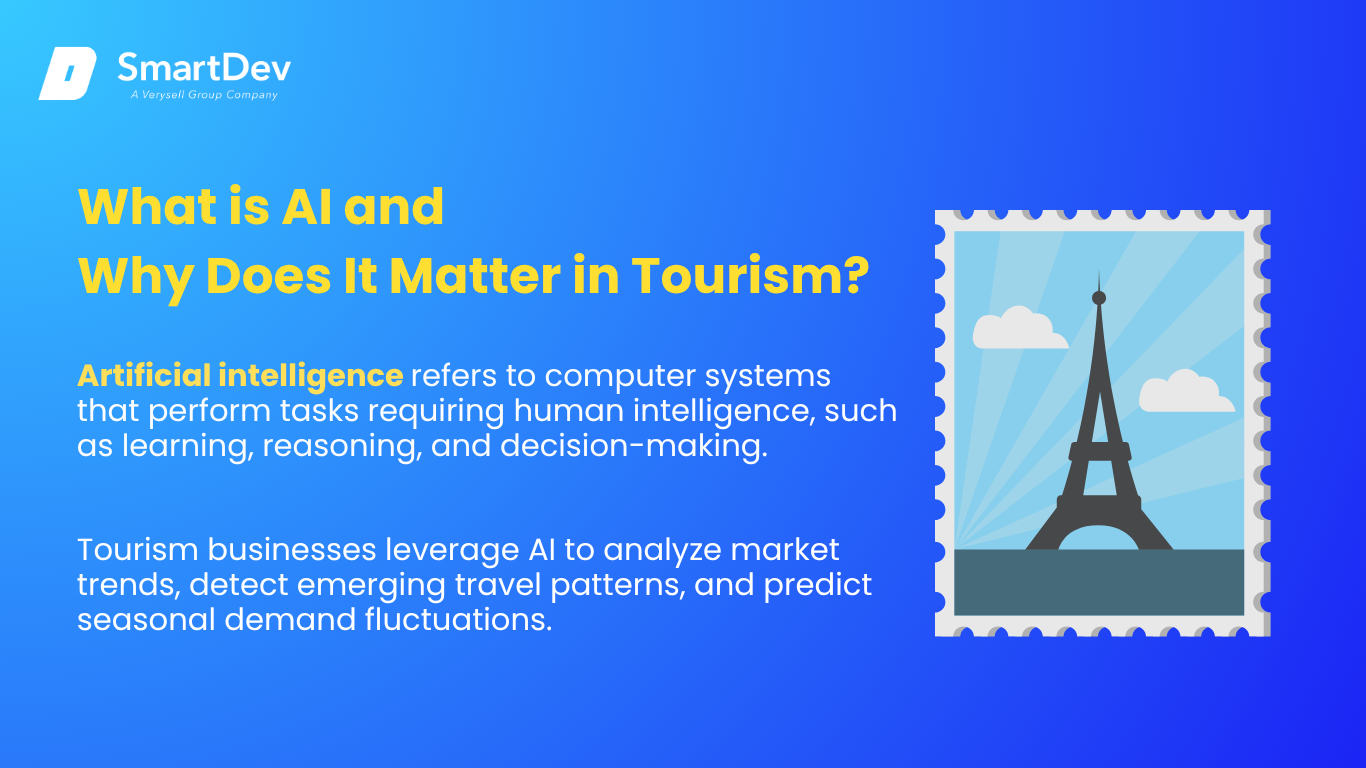 Artificial intelligence refers to computer systems capable of performing tasks that typically require human intelligence. These tasks include decision-making, language understanding, pattern recognition, and predictive analytics. Core technologies enabling AI in tourism include:
- Machine learning for predictive recommendations
- Natural language processing for chatbots and translation tools
- Computer vision for identity verification and security
- Generative AI for itinerary creation and customer communication
Machine learning algorithms analyze vast datasets such as traveler behavior, booking history, and search patterns. These insights allow travel platforms to predict customer preferences and improve conversion rates.
Natural language processing enables AI chatbots to communicate naturally with travelers, reducing response times and improving satisfaction. Computer vision technology supports facial recognition for airport security and automated hotel check-ins.
Generative AI introduces advanced capabilities such as automated travel planning, content creation, and real-time customer support.
The Growing Role of AI in Tourism Transformation
The tourism industry increasingly relies on data-driven decision-making to remain competitive. AI supports this transformation by improving operational efficiency and enabling personalized services at scale.
According to EY research, approximately 60% of Asia-Pacific travelers already use AI tools to research destinations and book travel, demonstrating the growing reliance on intelligent travel platforms.
AI is also helping companies automate repetitive processes, optimize marketing strategies, and improve customer service interactions. Intelligent automation allows travel providers to reduce operational costs while delivering consistent service quality.
Tourism businesses leverage AI to analyze market trends, detect emerging travel patterns, and predict seasonal demand fluctuations.
Key Statistics Highlighting AI Adoption in Tourism
Several data points illustrate the rapid growth of AI adoption across the tourism sector:
- The global AI tourism market was valued at 3,373 million USD in 2024 and is projected to reach 13,868.8 million USD by 2030, growing at a CAGR of 26.7%
- 40% of global travelers already use AI tools for trip planning, while 62% are willing to adopt AI-assisted travel planning in the future
- 63% of hotel companies deploy AI to improve revenue management strategies
- 91% of tourism organizations are already piloting or using AI technologies
These statistics indicate that AI adoption is no longer experimental but becoming a core competitive requirement.
Business Benefits of AI in Tourism
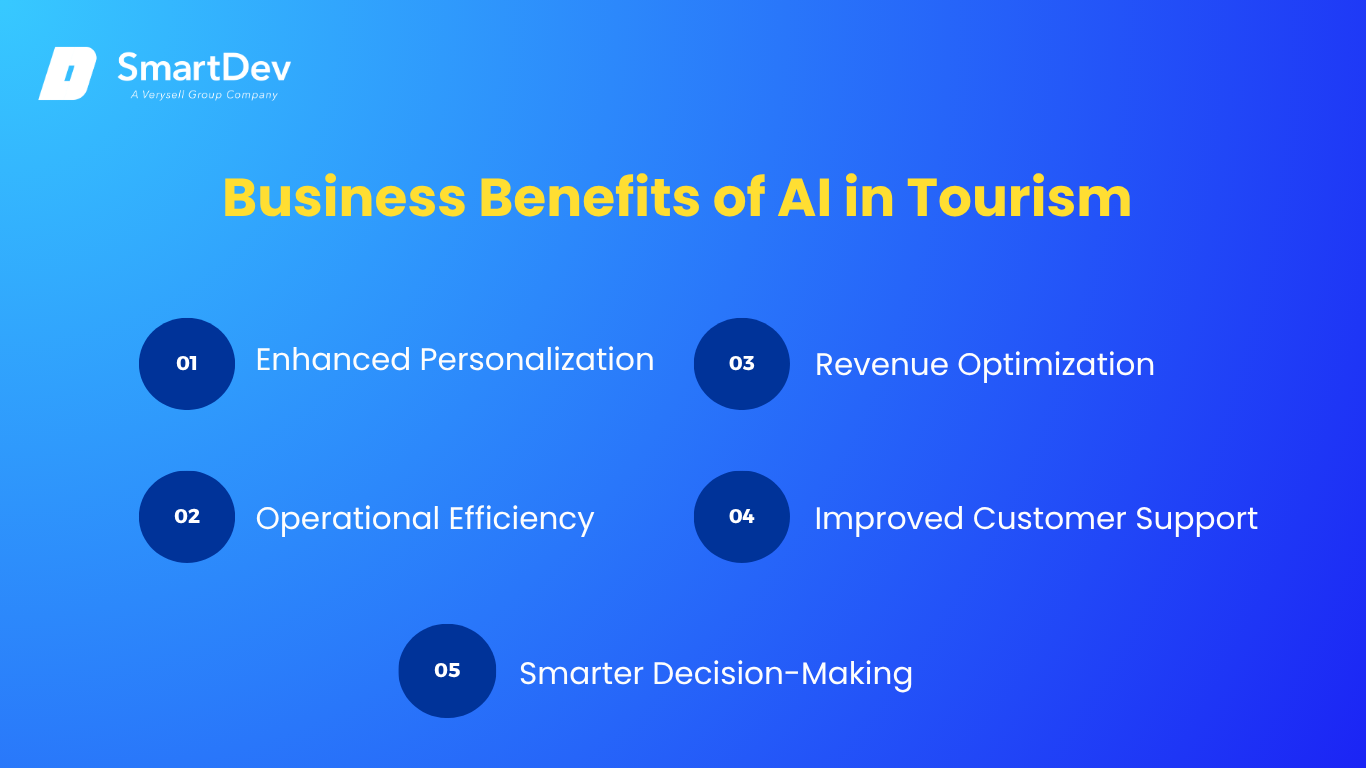
 1. Enhanced Personalization
 1. Enhanced Personalization
AI enables tourism companies to deliver highly personalized recommendations based on traveler preferences, search history, behavioral patterns, and contextual data such as location and budget. AI-powered platforms can recommend destinations, hotels, activities, and travel routes tailored to individual users, creating more relevant travel experiences that align with customer expectations.
Personalization improves customer satisfaction and increases booking conversion rates because travelers receive options that match their interests. According to Kantar research, 40% of global travelers already use AI tools for trip planning and 62% are willing to rely on AI-assisted travel planning in the future, demonstrating the growing importance of personalized travel experiences.
2. Operational Efficiency
Automation powered by AI reduces manual tasks such as booking management, itinerary planning, and customer communication. Intelligent automation helps travel companies streamline workflows, reduce human error, and manage large volumes of customer interactions more efficiently.
According to PwC Strategy& insights, 85% of tourism organizations report measurable improvements in cost savings and operational efficiency through AI adoption. Automation allows companies to scale operations without significantly increasing staffing costs.
3. Revenue Optimization
AI supports dynamic pricing strategies by analyzing market demand, competitor pricing, booking patterns, and seasonal trends. Revenue management systems powered by AI can automatically adjust prices to maximize occupancy rates and improve profit margins.
According to EY analysis, 63% of hotel companies use AI to improve revenue management performance. Predictive analytics also enhances demand forecasting accuracy, allowing travel companies to optimize inventory allocation and reduce revenue loss.
4. Improved Customer Support
AI-powered chatbots and virtual assistants provide 24/7 customer support, reducing response times and improving service accessibility. AI assistants can answer frequently asked questions, assist with bookings, and provide real-time travel updates.
AI also enables multilingual communication, allowing travel companies to serve global customers more effectively. According to VASS research, AI-driven automation improves response efficiency and enhances customer satisfaction across digital travel platforms.
5. Smarter Decision-Making
AI analytics tools help tourism companies analyze large datasets and generate insights that support strategic decision-making. Travel providers can identify emerging travel trends, evaluate marketing performance, and adjust pricing strategies based on real-time insights.
According to Kantar insights, AI-driven data analysis improves targeting accuracy and marketing ROI. Data-driven decision-making enables tourism organizations to respond faster to market changes and maintain competitive advantages.
Challenges Facing AI Adoption in Tourism
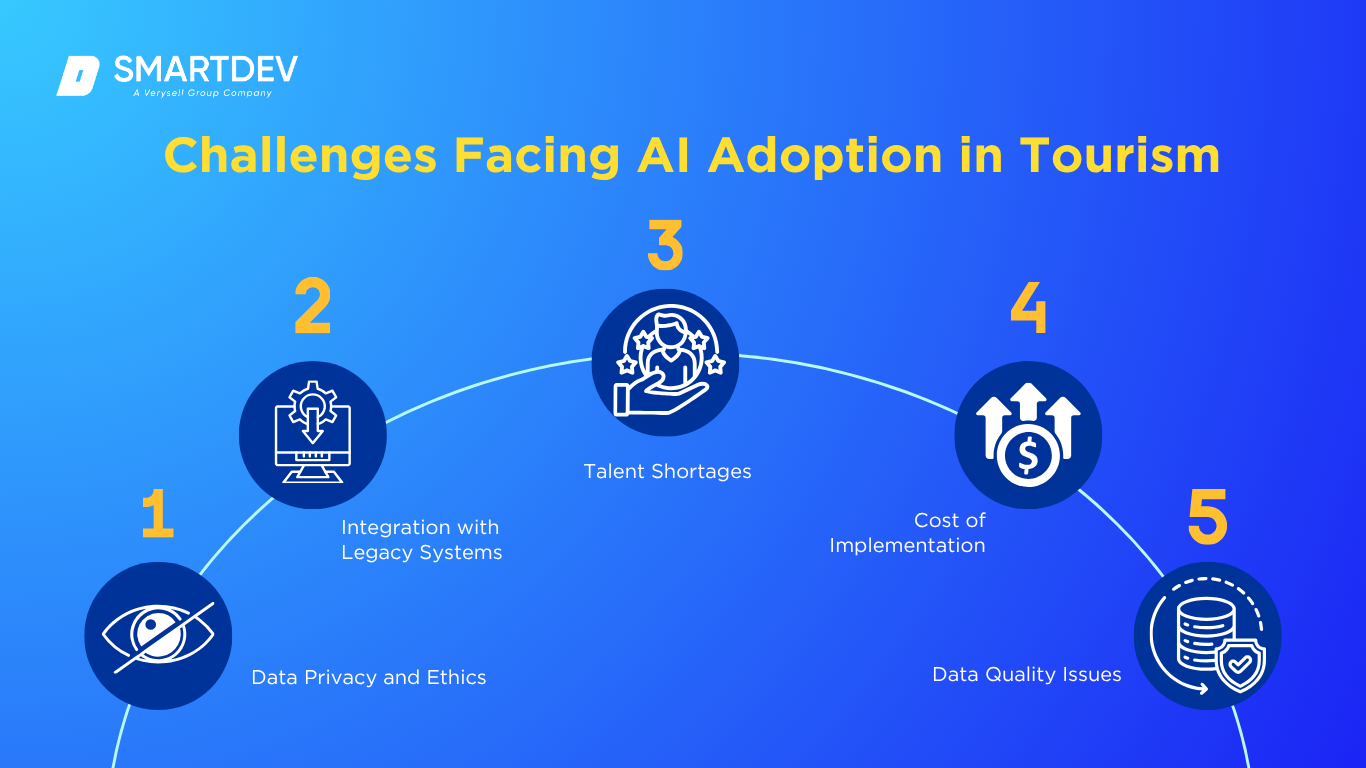
1. Data Privacy and Ethics
 1. Data Privacy and Ethics
Tourism companies collect large volumes of customer data, including booking behavior, payment information, travel preferences, and location history. This data enables personalized recommendations and predictive analytics, but also raises concerns related to privacy protection and regulatory compliance. Companies must comply with global data regulations while maintaining transparency in how customer data is collected, stored, and used.
According to PwC Strategy& research, 64% of tourism organizations identify data protection and privacy risks as a key barrier to AI adoption. Travel businesses must implement strong governance frameworks, ethical AI policies, and secure data management systems to build trust with customers and regulators.
2. Integration with Legacy Systems
Many tourism organizations still rely on legacy technology infrastructure that was not designed to support advanced AI capabilities. Older booking systems, customer databases, and operational platforms may lack the flexibility needed to integrate machine learning tools or real-time analytics systems. This creates technical limitations when companies attempt to scale AI initiatives across multiple departments.
According to EY insights on AI transformation, outdated IT architecture is one of the most common barriers preventing organizations from fully adopting AI solutions. Companies often need to modernize cloud infrastructure, update APIs, and improve data integration processes before implementing AI successfully.
3. Talent Shortages
AI adoption requires skilled professionals such as data scientists, machine learning engineers, and AI strategists. However, many tourism companies face challenges recruiting and retaining talent with the necessary technical expertise. The shortage of AI professionals slows implementation timelines and increases dependency on external technology vendors.
According to PwC Strategy& analysis, 73% of organizations report difficulties finding employees with AI-related skills. Companies must invest in workforce training, partnerships with technology providers, and internal upskilling programs to address talent gaps.
4. Cost of Implementation
Implementing AI solutions requires significant investment in infrastructure, software platforms, data engineering, and employee training. Costs may include cloud computing services, AI software licenses, cybersecurity systems, and consulting support. Small and mid-sized tourism companies may find it challenging to allocate sufficient resources for large-scale AI deployment.
According to VASS research on AI adoption, organizations must carefully evaluate expected ROI before investing in AI technologies. Companies often begin with pilot projects to validate business value before expanding implementation across operations.
5. Data Quality Issues
AI systems depend on high-quality, structured data to generate accurate predictions and insights. Inconsistent or incomplete data can lead to unreliable forecasting results and reduced performance of AI models. Tourism companies often collect data from multiple sources such as booking engines, CRM systems, and third-party platforms, making data standardization a complex process.
According to Kantar insights on AI-driven decision-making, data quality significantly impacts the effectiveness of AI-powered personalization and predictive analytics. Organizations must invest in data governance frameworks, data cleaning processes, and integration tools to ensure reliable AI outcomes.
Specific Applications of AI in Tourism
AI-powered Trip Planning
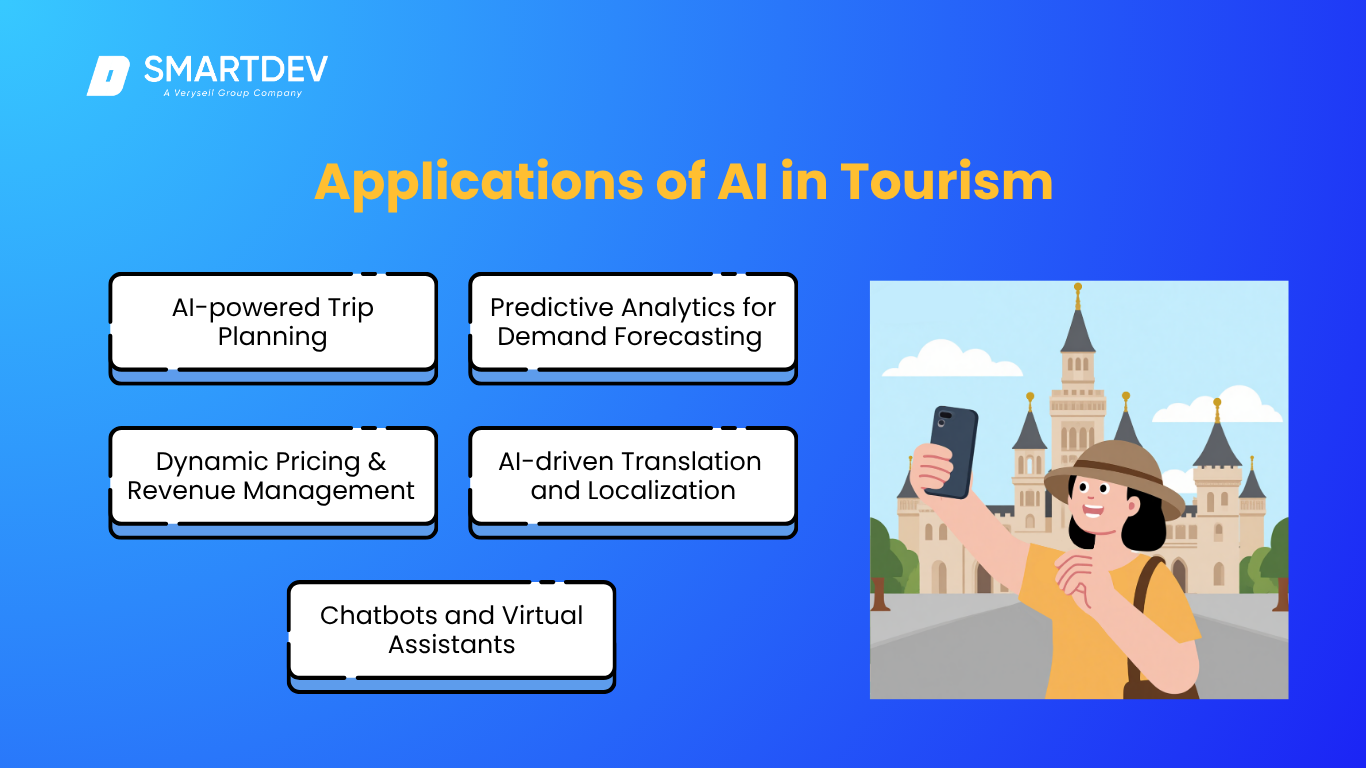 AI-powered Trip Planning
AI-powered trip planning tools analyze traveler preferences, search behavior, historical bookings, and contextual data to automatically generate optimized itineraries. These tools consider multiple variables such as budget, travel duration, preferred activities, weather forecasts, and seasonal demand to create highly relevant travel recommendations. Instead of manually comparing hundreds of options, travelers can receive curated suggestions within seconds.
Travel platforms increasingly use generative AI to recommend destinations, accommodations, restaurants, and experiences tailored to individual users. According to Kantar research, 40% of travelers already use AI tools for trip planning, demonstrating strong demand for intelligent travel assistance. Personalized trip planning improves user satisfaction while increasing conversion rates for travel platforms.
Dynamic Pricing and Revenue Management
AI revenue management systems analyze booking patterns, competitor pricing, seasonal demand fluctuations, and macroeconomic indicators to adjust prices dynamically. Machine learning models continuously monitor market conditions and automatically optimize prices for flights, hotels, and travel packages to maximize occupancy rates and revenue performance.
Hotels and airlines rely on predictive analytics to forecast demand and manage inventory more effectively. According to EY insights, 63% of hotel companies already use AI to improve revenue management strategies. Dynamic pricing allows tourism companies to remain competitive while protecting profit margins in highly volatile travel markets.
Chatbots and Virtual Assistants
AI chatbots provide instant responses to customer inquiries and assist travelers throughout the booking journey. Virtual assistants can answer frequently asked questions, suggest destinations, modify reservations, and provide real-time updates regarding flight schedules or booking confirmations. These tools improve customer experience by providing continuous support without requiring human intervention.
Natural language processing enables chatbots to understand conversational language and respond accurately to complex customer requests. According to VASS industry analysis, AI-powered customer service significantly reduces response times and improves customer satisfaction. Chatbots also help travel companies manage high volumes of inquiries during peak seasons.
Predictive Analytics for Demand Forecasting
Predictive analytics helps tourism companies forecast demand trends and optimize inventory allocation across flights, hotels, and tour packages. AI models analyze historical booking data, customer demographics, market trends, weather conditions, and economic indicators to generate accurate demand forecasts.
Accurate forecasting enables travel providers to adjust pricing strategies, allocate resources efficiently, and minimize revenue loss caused by underbooking or overbooking. According to PwC Strategy& research, AI-driven forecasting improves decision-making accuracy and operational planning across the tourism ecosystem.
AI-driven Translation and Localization
Natural language processing allows travel platforms to offer multilingual support and real-time translation capabilities. AI translation tools enable international travelers to access travel information, communicate with service providers, and navigate unfamiliar environments more easily. Language barriers are reduced, allowing tourism companies to expand into global markets.
Real-time translation improves customer experience by providing instant communication across languages in booking systems, travel apps, and customer support platforms. According to Kantar insights, AI-driven localization enhances accessibility and improves engagement among international travelers. AI translation also helps tourism companies deliver culturally relevant content tailored to regional audiences.
Need Expert Help Turning Ideas Into Scalable Products?
Partner with SmartDev to accelerate your software development journey — from MVPs to enterprise systems.
Book a free consultation with our tech experts today.
Let’s Build TogetherReal-World Case Studies
Below are four real-world examples demonstrating how AI is transforming operations, customer experience, and revenue optimization across the tourism industry.
1. United Airlines: AI for Operational Efficiency and Customer Communication
 According to EY research, United Airlines uses AI to predict flight delays, optimize routes, and provide real-time updates to passengers. Machine learning models analyze weather patterns, aircraft performance data, and airport congestion to identify potential disruptions before they occur.
By proactively notifying travelers about delays, gate changes, or rebooking options, AI improves customer satisfaction and reduces operational stress. AI also helps airlines optimize crew scheduling and fuel usage, improving both efficiency and cost control.
2. Booking.com: AI-powered Personalization Engine
 Booking.com uses AI algorithms to analyze user behavior, search history, and booking preferences to provide personalized accommodation recommendations. AI recommendation engines continuously learn from customer interactions to improve search relevance and conversion rates.
According to Kantar insights, personalization is one of the most influential factors affecting booking decisions. AI-driven personalization enables travel platforms to display tailored offers, increasing user engagement and improving booking performance.
3. Expedia: AI Chatbots for Customer Support Automation
 Expedia uses AI-powered virtual assistants to provide 24/7 customer support for booking management, cancellations, and travel information. Natural language processing enables chatbots to understand customer intent and provide accurate responses in real time.
According to VASS research, AI chatbots significantly reduce response times and operational workload for customer service teams. Automated support improves customer satisfaction while allowing human agents to focus on complex inquiries.
4. Hilton Hotels: AI-driven Guest Experience Optimization
 Hilton uses AI technology to personalize guest experiences and optimize hotel operations. AI tools analyze guest preferences, booking history, and feedback data to recommend room upgrades, dining options, and personalized services.
According to PwC Strategy& insights, AI-powered personalization improves customer loyalty and increases lifetime value. Smart hotel technologies powered by AI also enhance operational efficiency through predictive maintenance and automated resource management.
AI-Driven Innovations Transforming Tourism
Emerging Technologies in AI for Tourism
Several emerging AI technologies are reshaping how tourism companies operate and deliver customer experiences. Generative AI enables automated creation of travel itineraries, marketing content, and destination recommendations, allowing companies to scale personalization efficiently. Computer vision supports identity verification in airports and hotels, enabling faster and more secure check-in processes, while IoT-powered smart hotel rooms automatically adjust lighting and temperature based on guest preferences.
AI-powered voice assistants simplify trip planning by allowing travelers to search and book services using conversational language. Predictive analytics further enhances operational planning by forecasting demand and optimizing pricing strategies. According to PwC Strategy& insights, 89% of tourism organizations plan to prioritize generative AI adoption within the next two years, highlighting strong momentum for AI innovation.
AI’s Role in Sustainability Efforts
AI helps tourism companies improve sustainability by optimizing resource usage and reducing environmental impact. Predictive analytics supports efficient transportation planning, helping airlines reduce fuel consumption and minimize carbon emissions. AI also helps manage overtourism by recommending alternative destinations and distributing visitor traffic more evenly.
AI-powered platforms can recommend eco-friendly hotels, low-emission transportation options, and responsible travel activities. According to Kantar research, 79% of travelers believe AI can help improve travel planning efficiency and support more sustainable tourism experiences. These capabilities allow tourism companies to balance business growth with environmental responsibility.
How to Implement AI in Tourism
Step 1. Assessing Readiness for AI Adoption
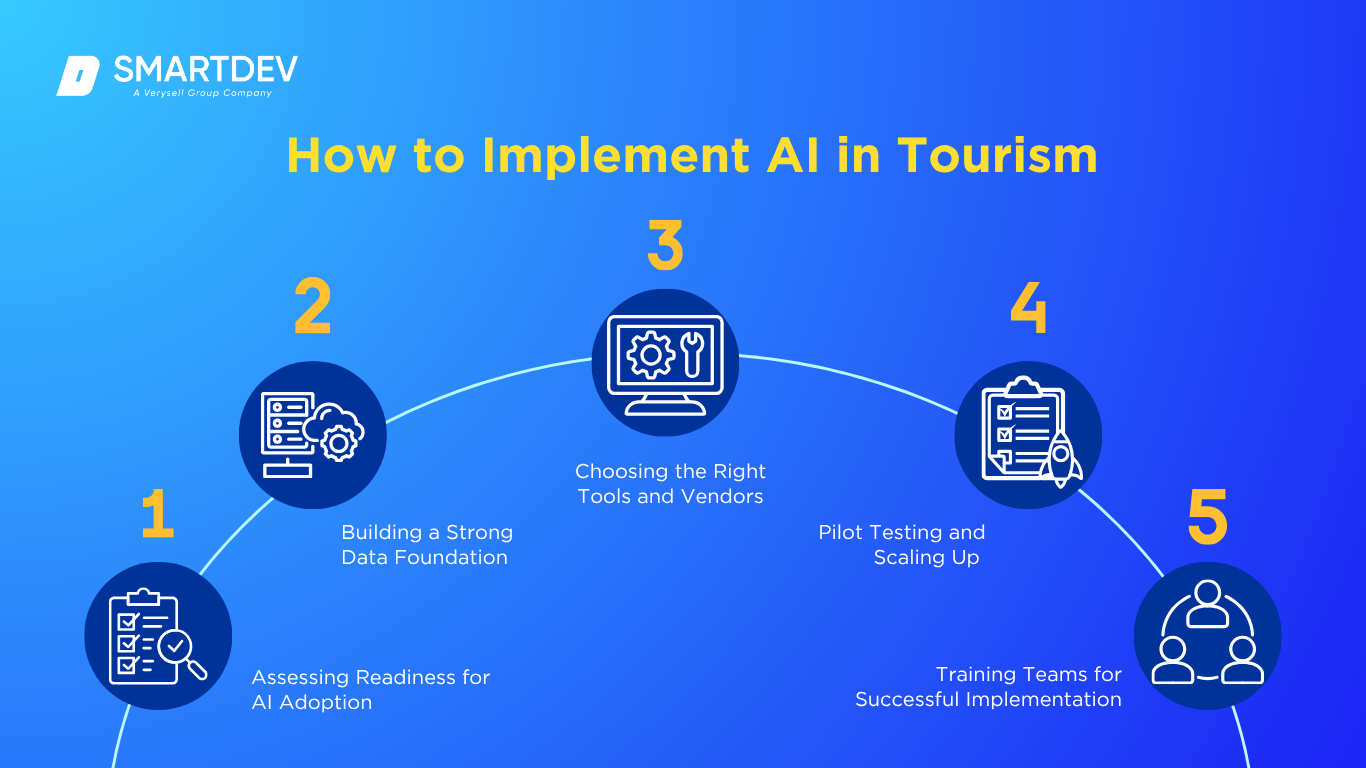 Step 1. Assessing Readiness for AI Adoption
Tourism organizations should begin by evaluating their current level of digital maturity, including existing software systems, analytics capabilities, and data availability. Companies need to determine whether their booking engines, CRM platforms, and operational tools can support AI integration. This step helps businesses understand whether infrastructure upgrades or cloud migration are required before implementing AI solutions.
Assessing readiness also involves evaluating internal capabilities such as technical expertise, data management practices, and strategic alignment. Identifying skill gaps early allows organizations to plan recruitment or employee training programs. A structured readiness assessment reduces implementation risks and ensures AI investments align with long-term business objectives.
Step 2. Building a Strong Data Foundation
High-quality data is essential for successful AI adoption in tourism. Companies must ensure consistent data collection across multiple touchpoints, including websites, mobile apps, booking systems, and customer service channels. Clean and structured datasets enable AI systems to generate accurate predictions and personalized recommendations.
Data governance frameworks help ensure data accuracy, security, and accessibility. Tourism organizations should standardize data formats and integrate multiple data sources into centralized platforms such as cloud-based data warehouses. A strong data foundation improves the performance of AI models and supports more reliable decision-making.
Step 3. Choosing the Right Tools and Vendors
Selecting the appropriate AI tools depends on business goals, operational needs, and budget constraints. Tourism companies should identify priority use cases such as chatbot automation, recommendation engines, demand forecasting, or dynamic pricing systems. Choosing tools aligned with strategic objectives ensures higher ROI and faster implementation success.
Organizations should evaluate AI vendors based on scalability, integration capabilities, and industry experience. Cloud-based AI platforms often provide flexibility and allow companies to expand AI functionality over time. Working with experienced vendors can accelerate implementation and reduce technical complexity.
Step 4. Pilot Testing and Scaling Up
Pilot testing allows tourism companies to validate AI solutions on a small scale before full deployment. Organizations can test AI applications in specific departments such as customer service or marketing to measure performance improvements and identify potential challenges. Pilot programs help reduce risk and provide insights into expected ROI.
Once pilot results demonstrate measurable value, companies can gradually scale AI adoption across business operations. A phased rollout approach allows teams to adjust processes and optimize system performance. Scaling gradually ensures smoother integration and improves adoption success rates.
Step 5. Training Teams for Successful Implementation
Employee training is critical to ensuring successful AI adoption. Tourism companies must provide training programs that help employees understand how to use AI tools, interpret analytics insights, and manage automated workflows. Building internal AI knowledge improves collaboration between technical teams and business units.
Organizations should encourage continuous learning through workshops, certifications, and hands-on training programs. Upskilling employees ensures long-term sustainability of AI initiatives and enables teams to fully leverage AI capabilities to improve customer experience and operational efficiency.
Measuring the ROI of AI in Tourism
Key Metrics to Track Success
 Key Metrics to Track Success
Measuring the return on investment of AI in tourism requires tracking performance indicators that reflect both financial impact and operational improvement. Key metrics include conversion rates, customer satisfaction scores, operational efficiency gains, revenue growth, and cost reduction. For example, AI-powered recommendation engines often increase booking conversion rates by presenting more relevant travel options, while automation tools reduce manual workload and improve productivity.
Tourism companies also measure improvements in customer experience through Net Promoter Score (NPS), response time reduction, and personalization effectiveness. According to PwC Strategy& insights, 85% of organizations report measurable cost savings after implementing AI technologies. Tracking performance consistently allows companies to evaluate whether AI initiatives deliver tangible business value.
Case Studies Demonstrating ROI
Many tourism companies have reported measurable ROI after implementing AI solutions across marketing, customer service, and pricing strategies. AI-driven personalization improves customer engagement by recommending relevant destinations, accommodations, and travel packages based on user behavior. This increases click-through rates and booking conversion performance.
Companies implementing AI chatbots also experience significant cost savings by reducing the workload of customer service teams. Automated chatbots can resolve common inquiries instantly, allowing human agents to focus on more complex customer needs. According to VASS industry research, automation improves operational efficiency while maintaining high customer satisfaction levels.
Common Pitfalls and How to Avoid Them
Despite strong ROI potential, many tourism companies face challenges when implementing AI without clear strategy or data readiness. Poor data quality can lead to inaccurate predictions, reducing the effectiveness of recommendation engines and demand forecasting models. Inconsistent data formats across booking platforms and CRM systems can also create integration challenges.
Organizations should define clear business objectives before implementing AI solutions and ensure consistent data governance practices. Regular performance monitoring helps identify gaps and optimize AI performance over time. By aligning AI initiatives with measurable KPIs, tourism companies can maximize ROI and minimize implementation risks.
Future Trends of AI in Tourism
 AI adoption in tourism is expected to accelerate significantly over the next decade as travel companies continue investing in automation, predictive analytics, and generative AI technologies. The global AI tourism market is projected to grow at a CAGR of 26.7% between 2025 and 2030, reflecting strong demand for intelligent tools that enhance customer experience and operational performance (PwC Strategy& insights).
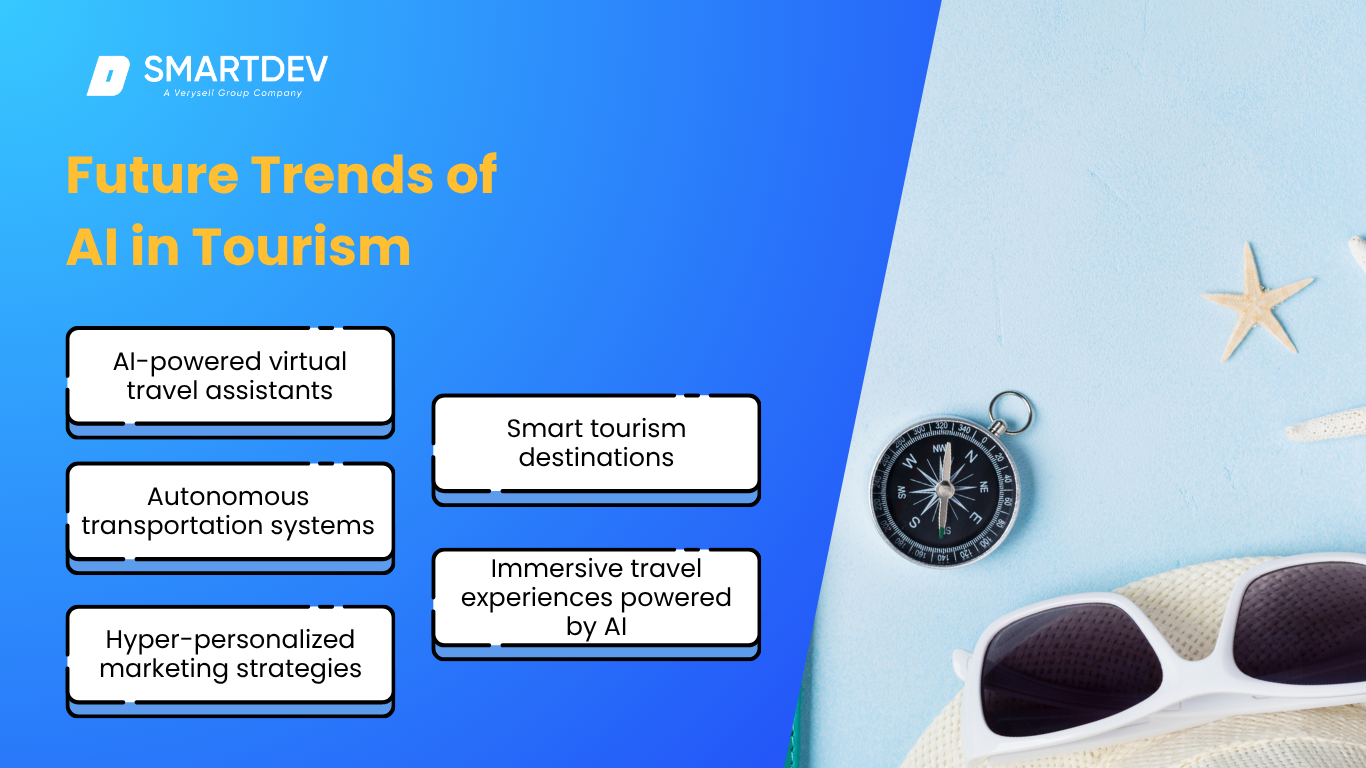
Key future trends shaping AI in tourism include:
- AI-powered virtual travel assistants
Intelligent assistants will help travelers plan trips, compare destinations, and manage bookings through natural conversations.
- Autonomous transportation systems
Self-driving airport shuttles and AI-assisted navigation technologies will improve efficiency and reduce operational costs.
- Smart tourism destinations
AI and IoT technologies will help cities manage visitor flows, reduce overcrowding, and optimize tourism infrastructure.
- Immersive travel experiences powered by AI
Virtual reality previews, AI-generated travel simulations, and augmented reality tours will enhance travel planning and engagement.
- Hyper-personalized marketing strategies
AI will analyze real-time customer data to deliver tailored promotions, improving conversion rates and customer loyalty.
Companies that adopt AI early will gain competitive advantages in customer experience, operational efficiency, and long-term innovation capabilities.
Conclusion
Artificial intelligence is transforming the tourism industry by enabling more personalized travel experiences, improving operational efficiency, and supporting data-driven decision-making. From AI-powered trip planning and predictive pricing to chatbots and demand forecasting, AI technologies are helping travel companies deliver faster, smarter, and more relevant services to modern travelers.
As customer expectations continue to evolve, tourism businesses must leverage AI to remain competitive in a rapidly digitizing market. Companies that invest in strong data foundations, scalable AI tools, and workforce training will be better positioned to unlock measurable ROI and long-term growth. By adopting AI strategically, travel organizations can improve customer satisfaction, optimize resources, and create more innovative travel experiences.
Businesses that act early will gain a competitive advantage through enhanced personalization, improved efficiency, and stronger customer loyalty. AI is not just a technological trend but a strategic capability that will define the future of tourism.