
Every client’s engagement produces the same raw material: notes, documents, spreadsheets, and requirements. AI workflow automation turns that raw material into accurate, on-time deliverables without adding headcount.
TL, DR:
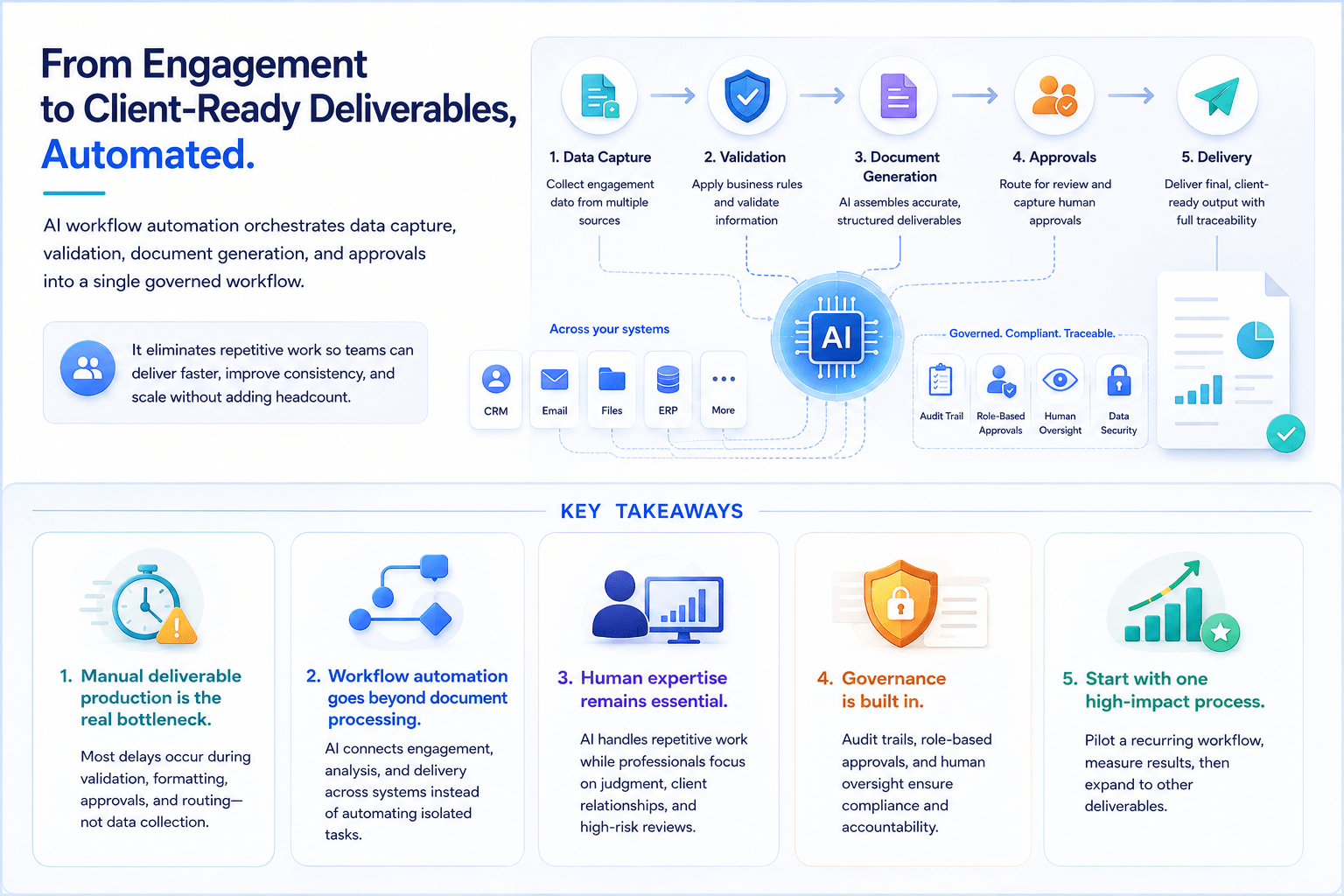
Every client’s engagement generates valuable information, but transforming that information into accurate, client-ready deliverables remains a manual, time-consuming process for many organizations. AI workflow automation bridges this gap by orchestrating data capture, validation, document generation, and approvals into a single governed workflow. Rather than replacing professional expertise, it eliminates repetitive work so teams can deliver faster, improve consistency, and scale without adding headcount.
Key takeaways:
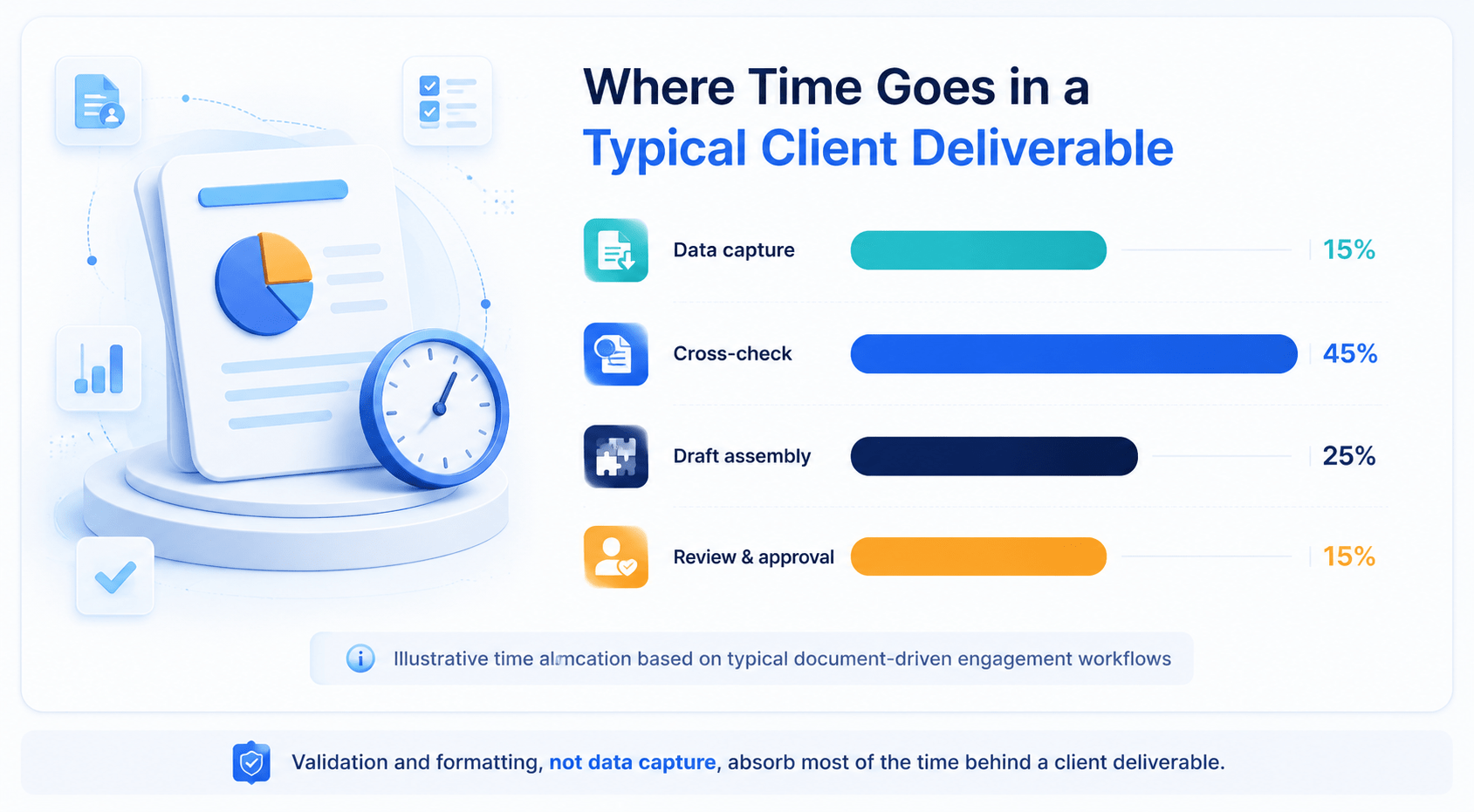
- Manual deliverable production is the real bottleneck. Most delays occur during validation, formatting, approvals, and routing, not data collection.
- Workflow automation goes beyond document processing. AI connects engagement, analysis, and delivery across systems instead of automating isolated tasks.
- Human expertise remains essential. AI handles repetitive work while professionals focus on judgment, client relationships, and high-risk reviews.
- Governance is built in. Audit trails, role-based approvals, and human oversight ensure compliance and accountability throughout the workflow.
- Start with one high-impact process. Pilot a recurring workflow such as proposal generation, invoice processing, or compliance reporting, then expand based on measurable results.
Introduction
A client’s engagement rarely fails because a team misses a deadline outright. It fails in smaller ways: a report goes out with an outdated figure; a proposal misses a compliance clause, or an invoice of reconciliation takes three extra days. Each gap chips away at trust long before anyone calls it a failed engagement.
Most firms already collect the data they need. The real constraint sits between collecting information and turning it into something a client can act on. Intelligent document processing improved how organizations capture data from contracts, invoices, and forms, yet capture was never the hardest part. Validating that data, routing it to the right reviewer, and assembling it into a polished deliverable still consumes the bulk of a team’s time.
This article walks through why that gap opens up, how AI workflow automation closes it, and what a client-facing team can expect once engagement data flows automatically into finished, audit-ready deliverables.
Why Client Deliverables Become a Bottleneck
The Hidden Cost of Manual Deliverable Production
Employees spend a striking share of the workweek on manual, repetitive tasks rather than client-facing judgment work. Recent workplace research found that manual, repetitive activities consume roughly a quarter of the average work week, and client deliverable production sits squarely inside that category. Analysts copy figures between spreadsheets, chase colleagues for sign-off, and reformat the same tables for every new report.
None of that copying and chasing creates client value. It simply moves information from one place to another; one careful click at a time.
Rising Client Expectations Are Outpacing Legacy Processes
Clients now expect faster answers because they use AI tools themselves. Firms that automate administrative work can reduce operating costs and shorten turnaround times on client deliverables, according to industry analysis of consulting workflows. When a competitor delivers a proposal in two days instead of two weeks, slowly becomes a genuine competitive disadvantage rather than a minor inconvenience.
Legacy IDP tools only cover part of this picture. As SmartDev has explored in detail elsewhere, document extraction was never designed to manage the approvals, exceptions, and system updates that follow it. That gap is exactly where deliverable timelines stretch.
The Real Cost of Slow Deliverables in Professional Services
Slow deliverables carry a price tag that rarely shows up on a project budget line. A 2024 Deloitte report found that 71% of organizations already use generative AI in at least one business function, citing faster data processing and deeper client insight as the main draw. Firms that still assemble reports and proposals by hand are competing against peers who no longer carry that overhead.
The gap widens further once pricing enters the picture. Consulting and advisory firms that automate proposal work can save senior staff dozens of billable hours per engagement, freeing that time for the strategic conversation clients to pay a premium. Slow, manual assembly does not just cost time; it quietly caps how many engagements a team can carry at once.
Why Legacy Tools Cannot Close the Gap Alone
Many firms already own document management systems, CRM platforms, and spreadsheet templates. None of these tools were built to reason across a full engagement the way a workflow automation layer can. A CRM stores contact history; it does not check whether a proposal clause matches a client’s actual compliance requirements. That reasoning step is precisely what keeps falling back onto a person’s desk.
Mapping the Engagement-to-Insight Lifecycle
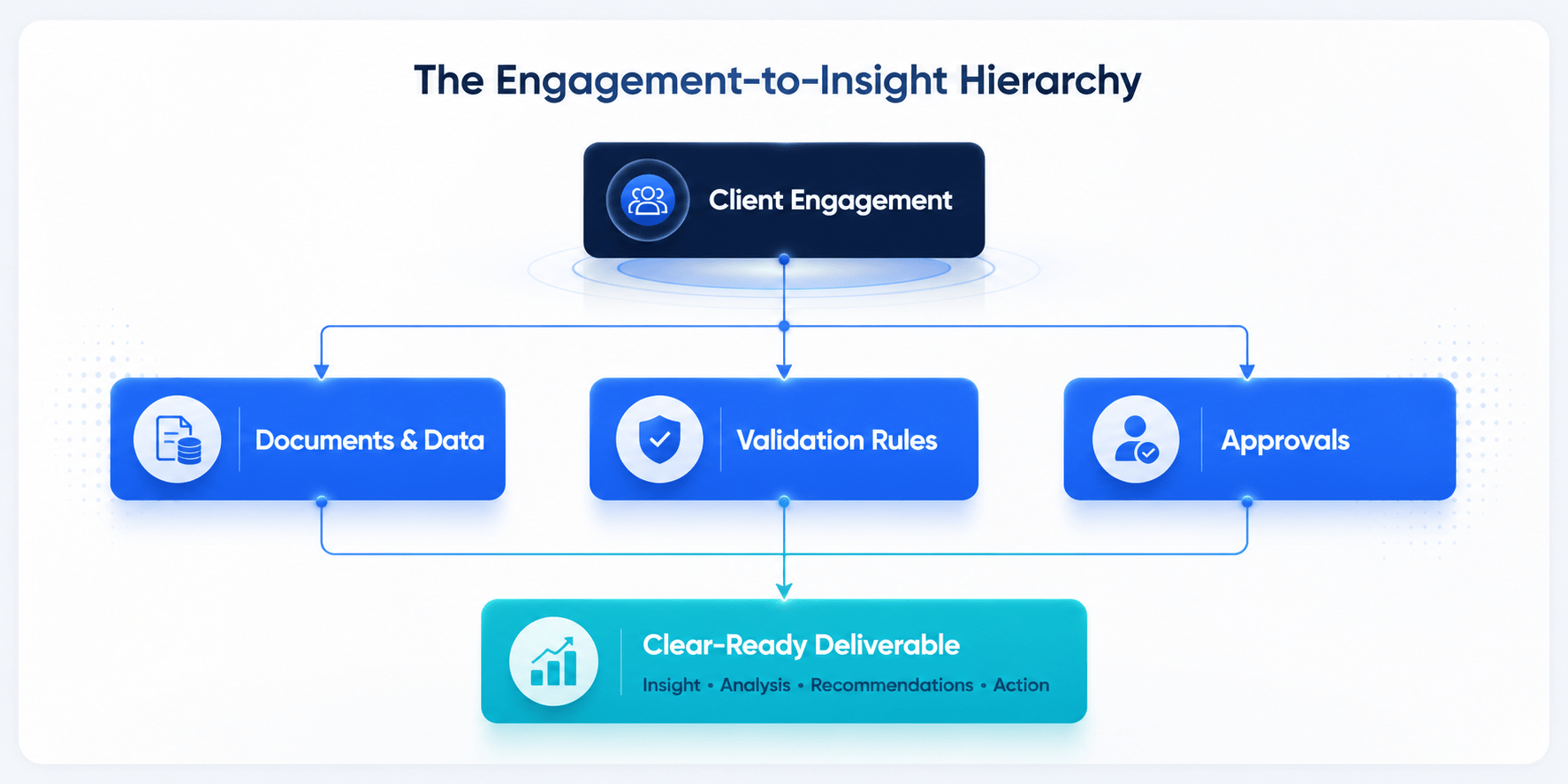
Every client deliverable moves through the same three stages, whether the output is a compliance report, a tender proposal, or an invoice of reconciliation. Naming these stages makes it easier to see exactly where automation adds the most value.
Engagement: Capturing Requirements and Client Context
The engagement stage gathers raw inputs: emails, tender documents, financial records, and meeting notes. Teams often store this information across disconnected tools, which forces someone to manually track the latest version before work can even begin.
Analysis: Turning Raw Data into Structured Understanding
Analysis takes that raw material and checks it against internal rules, historical records, and compliance requirements. This is where errors either get caught or slip through, and it is also where most manual hours disappear into spreadsheets and side-by-side document comparisons.
Insight: Producing the Deliverable Clients Actually Use
Insight is the finished product: a formatted report, an approved proposal, or a reconciled invoice ready for a client’s inbox. Clients judge a firm almost entirely on this final stage, even though most of the effort happens earlier in the process.
Why Naming the Stages Matters Before Automating Anything
Teams that jump straight into buying an AI tool often automate the wrong stage first. Mapping engagement, analysis, and insight separately shows exactly where manual effort piles up, which turns automation into a targeted fix rather than a generic technology purchase.
Where AI Workflow Automation Fits into Each Stage
Automating Intake and Requirement Mapping
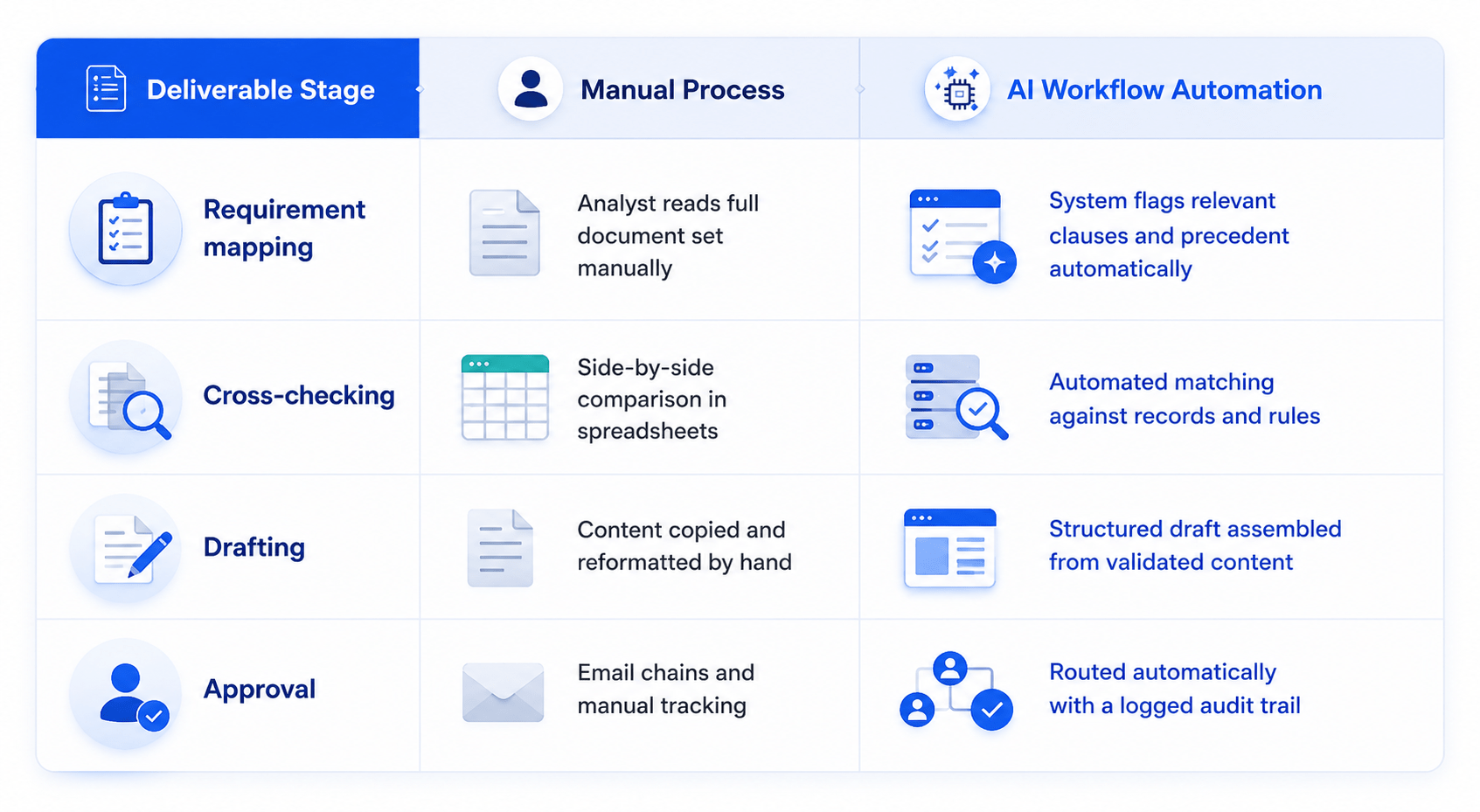
AI workflow automation platforms monitor inboxes, cloud storage, and enterprise systems continuously, so a new document triggers processing immediately instead of waiting for someone to notice it. Traditional optical character recognition only reads the text; workflow automation decides what to do with it next. This removes the delay between a document’s arrival and the start of real work.
Automating Validation, Cross-Referencing, and Exception Handling
Once information enters the workflow, AI can cross-reference it against purchase orders, past proposals, or compliance rules far faster than a manual reviewer. No AI model reaches perfect accuracy, so the goal is not to remove humans entirely; it is to route only genuine exceptions to a person while the system clears routine checks on its own.
Automating Formatting, Assembly, and Production-Ready Output
The final mile, formatting tables, aligning diagrams, and assembling a document that looks client-ready, often eats more time than analysts expect. Generative AI development now handles much of this formatting work automatically, producing structured drafts that a reviewer can approve rather than rebuilding from scratch.
The time employees spend reviewing and correcting probabilistic AI output carries a real cost. Firms that rebuild their delivery workflows around AI, rather than layering it on top of existing systems, capture the largest efficiency gains, according to recent analysis of professional services AI adoption.
Keeping Human Review Where It Matters Most
Not every output deserves the same level of scrutiny. High-risk deliverables, such as compliance filings or audit findings, should still pass through senior review with formal sign-off, while lower-risk drafts, like internal status updates, can rely on automated checks alone. Calibrating review effort to actual risk keeps quality high without dragging every document through the same slow approval chain.
Organizations that invest properly in change management see the payoff. Firms that invest 15 to 20% of their AI budget in change management report meaningfully higher adoption rates than firms that skip this step, which suggests the technology itself is rarely the limiting factor. MLOps practices also help here, keeping models monitored and retrained as business rules evolve rather than left to drift quietly out of date.
The Solution: How SmartDev and NORA Streamline Client Deliverables
SmartDev built NORA, its AI adoption accelerator, specifically to close the gap between engagement data and finished deliverables. Rather than automating a single step, NORA connects intake, validation, drafting, and approval into one governed workflow, so a document moves from a client’s inbox to a reviewer’s desk without passing through five separate manual handoffs along the way.
Most tools on the market solve one narrow piece of this puzzle. A document scanner extracts text. A CRM stores contact history. A template library holds past proposals. NORA sits above all three, reading context across systems and deciding what should happen next, which is precisely the layer that traditional software was never built to provide.
Continuous Monitoring Across Engagement Touchpoints
NORA watches emails, shared drives, and connected business systems for new engagement activity and starts the right workflow the moment something arrives, instead of waiting for manual triage. A tender notice, a signed contract, or an inbound compliance request all trigger the same proactive response, so nothing sits unopened in a shared inbox for days.
AI-Powered Understanding and Cross-System Validation
Beyond basic OCR, NORA analyzes relationships between documents and existing business data, catching mismatches between a tender document and a company’s own compliance records before a human ever opens the file. This contextual check is what separates a workflow layer from a simple extraction tool: NORA does not just read a number; it confirms whether that number makes sense against everything else the business already knows.
End-to-End Orchestration from Draft to Delivery
Once validation clears, NORA assembles the deliverable, routes it for the right sign-off, and updates downstream systems automatically. Teams stop copying data between tools and start reviewing finished drafts instead. An account manager who used to spend a full day assembling a proposal now spends that same day refining the strategy behind it.
How Account Managers and Analysts Experience the Change Day to Day
In practice, the shift feels less like adopting new software and more like removing a layer of friction that has always been there. A finance analyst opens a reconciliation task to find the purchase order already matched and flagged clean, rather than starting from a blank spreadsheet. A proposal writer opens a draft that already reuses the right boilerplate from a previous winning bid, rather than searching through old files for a starting point. The work that remains is judgment work: deciding what to say to the client, not chasing down what the document should contain.
Built for Compliance-Heavy Engagements
Every automated action leaves an audit trail. That matters for regulated industries such as BFSI and fintech, where a missing approval record can create real compliance exposure, not just an administrative headache. NORA supports role-based access, human-in-the-loop approvals, and compliance-ready documentation, so teams can automate confidently without losing the oversight regulators and clients expect.
Real Results, Real Impact
Real-World Proof: Tender Documents to Winning Proposals
A Singapore-based IT services provider came to SmartDev with a familiar problem: account managers struggled to map tender requirements accurately, and proposal preparation stretched on for days because content had to be rebuilt from scratch every cycle.
The challenge. Proposal templates rarely matched incoming tender documentation, which forced account managers to gather, organize, and cross-check supporting files manually. Getting a proposal into production-ready shape, with aligned diagrams and tables, added further delay before submission.
The outcome. NORA now combines live tender documents with knowledge from past proposals, helping account managers assess bid eligibility and reuse proven content with far less manual research. New team members also ramp up faster because NORA surfaces relevant precedent automatically instead of requiring months of tribal knowledge.
Read the full breakdown in SmartDev’s tender interpretation case study, and see a related example in the AI-powered invoice processing case study, where the same workflow-automation approach shortened finance reconciliation cycles. A similar pattern shows up in talent operations: SmartDev’s CV parsing case study describes how automated screening cut the manual review time recruiters previously spent per candidate deliverable.
Industries Where This Matters Most
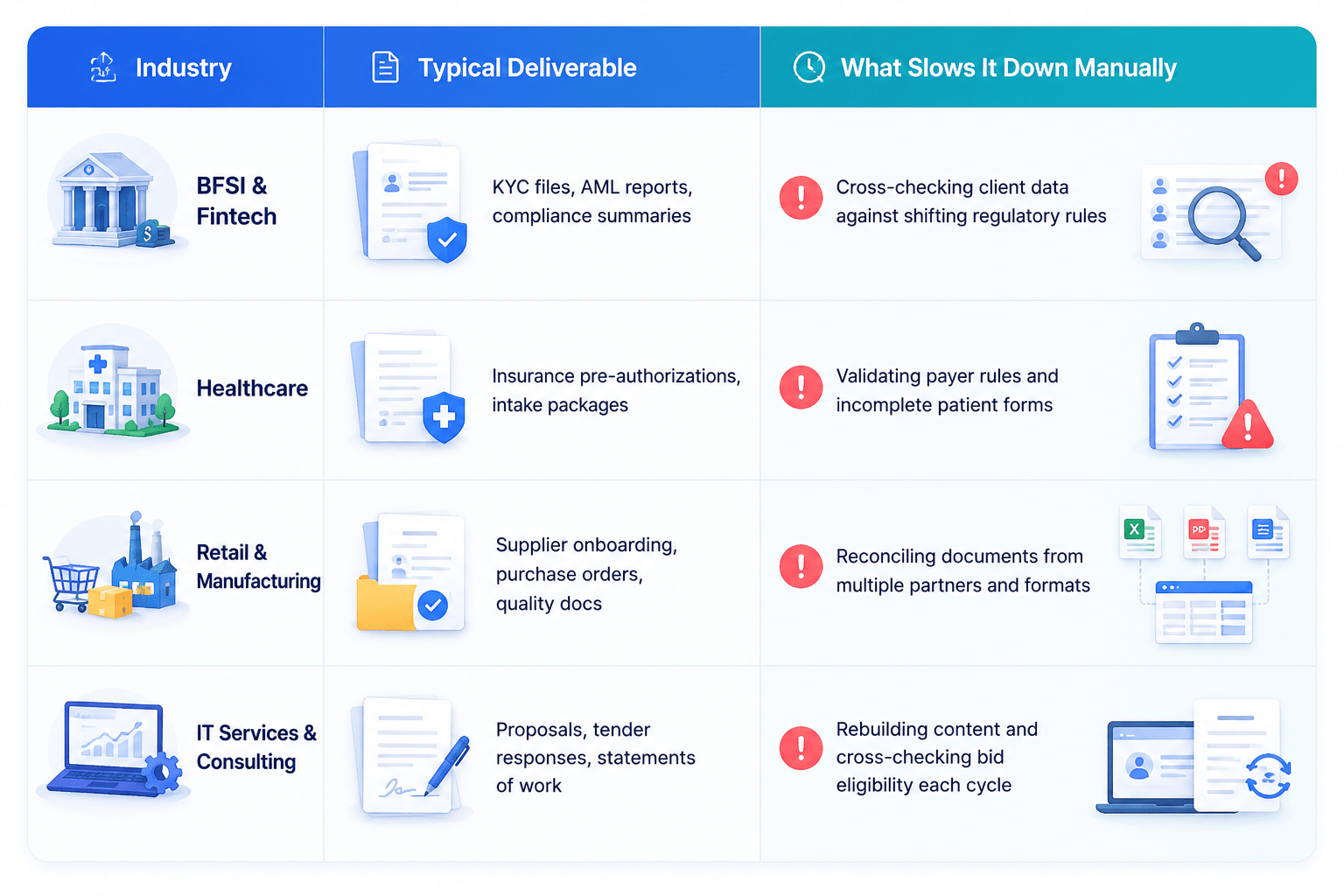
AI workflow automation delivers the biggest impact wherever client deliverables are frequent, document-heavy, and tied to strict deadlines. The pattern repeats across sectors, but the specific deliverable, the compliance stakes, and the cost of delay all shift depending on the industry. Understanding those differences helps a team decide which workflow to automate first, rather than copying a generic rollout plan that ignores their own risk profile.
BFSI and fintech
Banks, insurers, and fintech platforms produce a steady stream of compliance-driven deliverables: KYC files, AML screening reports, sanctions checks, and regulatory change summaries. Each one has to be accurate, timestamped, and traceable back to a specific rule or regulator update, which makes manual assembly both slow and risky. SmartDev’s BFSI and fintech practice applies the same NORA workflow described in this article to monitor regulatory sources continuously, cross-check client records against current rules, and route only genuine exceptions to a compliance officer. That shift matters because a missed clause in a KYC file is not just a delay; it is a potential regulatory finding. Compliance teams typically start here first, since the audit trail NORA generates doubles as evidence during a regulator review, not just an internal record.
Healthcare and medical services
Patient intake forms, insurance pre-authorizations, and provider correspondence pile up quickly in healthcare organizations, and every one of these documents sits on the path to a patient receiving care or reimbursement. A claim stuck in manual review for an extra week is not merely an operational metric; it can delay treatment or push a patient into a billing dispute. AI workflow automation here focuses on validating insurance details against payer rules and flagging incomplete intake forms before they reach a clinician’s queue, so staff spend their time on patient-facing decisions rather than paperwork triage. Because patient data carries its own privacy obligations, healthcare rollouts tend to lean more heavily on the human-in-the-loop review step described later in this article, rather than full straight-through automation.
Retail, ecommerce, and manufacturing
Vendor contracts, supplier onboarding packages, purchase orders, and quality documentation follow the same engagement-to-insight pattern in retail and ecommerce and manufacturing. A single supplier onboarding deliverable might combine a compliance certificate, a pricing sheet, and a signed contract clause, each sourced from a different partner and format. Automating the cross-check between these documents means goods can move through a supply chain on schedule instead of waiting on a manual paperwork reconciliation that has nothing to do with the physical product itself. Procurement teams in these sectors often see the fastest payback, since a single onboarding workflow tends to repeat hundreds of times a year across different suppliers.
IT services and technology consulting. Proposal development, tender responses, and statements of work are the core client deliverables for IT services and consulting firms, and they carry a direct revenue impact: a slow or inaccurate proposal can cost a firm the bid entirely. This is the exact problem the tender interpretation case study above addresses, where NORA cross-references live tender requirements against a firm’s own proposal history to speed up drafting without sacrificing accuracy on eligibility criteria. Firms in this category also benefit from reusing the same workflow across adjacent deliverables, such as statements of work and change requests, since the underlying validation logic barely changes between them.
Choosing where to start
Across all four sectors, the deciding factor is rarely industry alone; it is deliverable volume combined with compliance exposure. A team producing a handful of low-risk reports a month gains less from automation than one producing dozens of high-stakes deliverables a week. Mapping both dimensions before committing a budget keeps the first pilot focused on the workflow most likely to prove quickly.
Measuring the Impact: What Changes When Deliverables Move from Manual to Automated
Firms that treat this shift as a genuine rebuild, not a bolt-on tool, tend to see the strongest results. McKinsey has found that most AI initiatives stall after the pilot phase when organizations lack a scaling plan or clear ownership. Thomson Reuters research on professional services found that generative AI’s role in core workflows is projected to jump sharply between 2025 and 2026, and firms moving fastest report faster project turnaround with fewer dropped handoffs. SmartDev’s own client work reflects the same pattern: the gains come from connecting stages, not from automating any single step in isolation.
Getting Started: A Practical Path to AI Workflow Automation for Client Deliverables
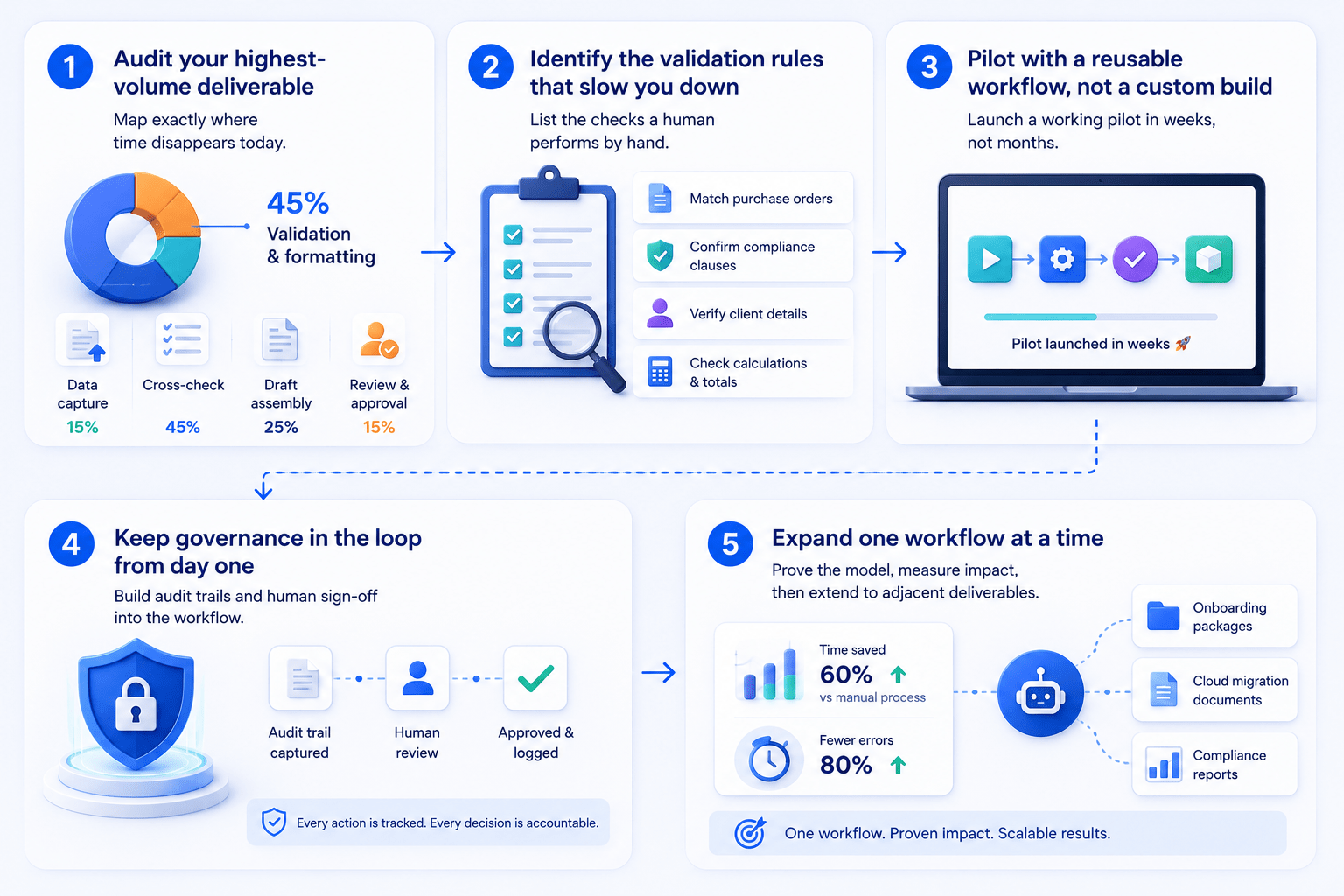
Moving from manual to automated deliverable production works best as a staged rollout rather than a single big-bang launch. The steps below reflect the sequence SmartDev typically walks through with a new client, starting narrow and expanding once the first workflow proves its value.
Step 1: Audit your highest-volume deliverable
Pick the single deliverable your team produces most often, whether that is a proposal, invoice reconciliation, or compliance report, and time the current process end to end. Note exactly where a document sits waiting for someone to notice it, where it gets re-keyed into another system, and where it waits on a signature. This audit alone usually surfaces two or three delays nobody had named out loud before.
Step 2: Identify the validation rules that slow you down
List every check a human currently performs by hand, from matching a purchase order to a contract, to confirming a compliance clause against the latest regulation. Rank these checks by how often they catch a real error versus how often they simply confirm nothing is wrong; the highest-friction, highest-value checks are the best first candidates for automation, since they free up the most reviewer time for the least risk.
Step 3: Pilot with a reusable workflow, not a custom build
AI consulting teams that lean on pre-built workflow components, rather than commissioning a fully bespoke system, can launch a working pilot in roughly 6 to 8 weeks instead of the 6 to 12 months a custom build typically requires. Keep the pilot scoped to one deliverable type and one team, so results stay easy to measure and easy to explain to stakeholders who have not seen the system in action yet.
Step 4: Keep governance in the loop from day one
Build audit trails, role-based access, and human sign-off into the workflow from the very first version, rather than retrofitting them later once the system is already handling live client data. This matters most for any deliverable that touches regulated industries or client-sensitive data, where a missing approval record can turn a minor process gap into a genuine compliance finding.
Step 5: Expand one workflow at a time
Resist the urge to automate every deliverable at once, even after the first pilot succeeds. Measure the time saved on the initial workflow, document what worked and what needed adjustment, then extend the same reasoning layer to adjacent deliverables such as onboarding packages or cloud migration documentation, where similar validation and formatting bottlenecks tend to repeat. This step-by-step expansion keeps each rollout grounded in evidence from the last one instead of assumptions about what should work next.
Teams that follow this sequence typically reach a defensible business case within one quarter, well before they commit budget to a firm-wide rollout. The goal at every stage is the same: prove that removing manual validation and formatting work actually shortens the path from client engagement to a finished deliverable, then repeat that proof on the next workflow in line.
Conclusion
Client deliverables rarely slow down because a team lacks information. They slow down because validating, formatting, and routing that information still runs through manual hands at every stage. AI workflow automation closes that gap by connecting engagement, analysis, and insight into a single governed process.
SmartDev built NORA around exactly this problem, and the results show up in real client work across proposal development, invoice processing, and compliance reporting. If your team is ready to move from manual deliverable production to automated, audit-ready output, our engineers can map a pilot around your specific workflow.
Ready to automate your service delivery workflows? Contact us to explore how NORA can streamline your operations and deliver measurable business impact.
Frequently Asked Questions
What is the difference between client engagement data and client deliverables?
Engagement data is the raw material a team collects during a project: emails, meeting notes, tender documents, financial records, and client requirements. A deliverable is the finished, validated output a client reads and acts on, such as a proposal, report, or compliance file. AI workflow automation closes the gap between the two by validating, structuring, and assembling that raw material automatically.
Does AI workflow automation replace the professionals who prepare client deliverables?
No. AI workflow automation removes repetitive validation, formatting, and cross-referencing work, so account managers and analysts can spend their time on judgment calls, client relationships, and quality review. Human sign-off remains part of the workflow, particularly for high-risk deliverables.
How long does it take to implement an AI workflow automation solution like NORA?
SmartDev builds NORA around reusable AI workflows and pre-built integrations, which allows teams to deploy a first working AI assistant in roughly 6 to 8 weeks rather than the 6 to 12 months typical of custom AI builds.
Which teams benefit most from automating client deliverables?
Any team that produces recurring, document-heavy deliverables benefits: proposal and bid teams, finance and compliance groups, customer success teams, and IT services providers preparing reports, tenders, invoices, or audit packages for clients.