
Zu lang; nicht gelesen:
- AI-to-human handoff — also called agent-to-human handoff — transfers a customer conversation from an AI system to live human agent when the AI cannot resolve the issue.
- Effective handoffs preserve full conversation context so customers never have to repeat themselves.
- Businesses that optimize this process see higher customer satisfaction scores and lower support costs simultaneously.
 Customer service teams are deploying AI agents to handle routine inquiries at scale. But no AI handles every situation perfectly. Agent-to-human handoff is the mechanism that bridges the gap, transferring a conversation from an AI system to a human agent at exactly the right moment, with all context intact.
What is AI Agent-to-Human Handoff?
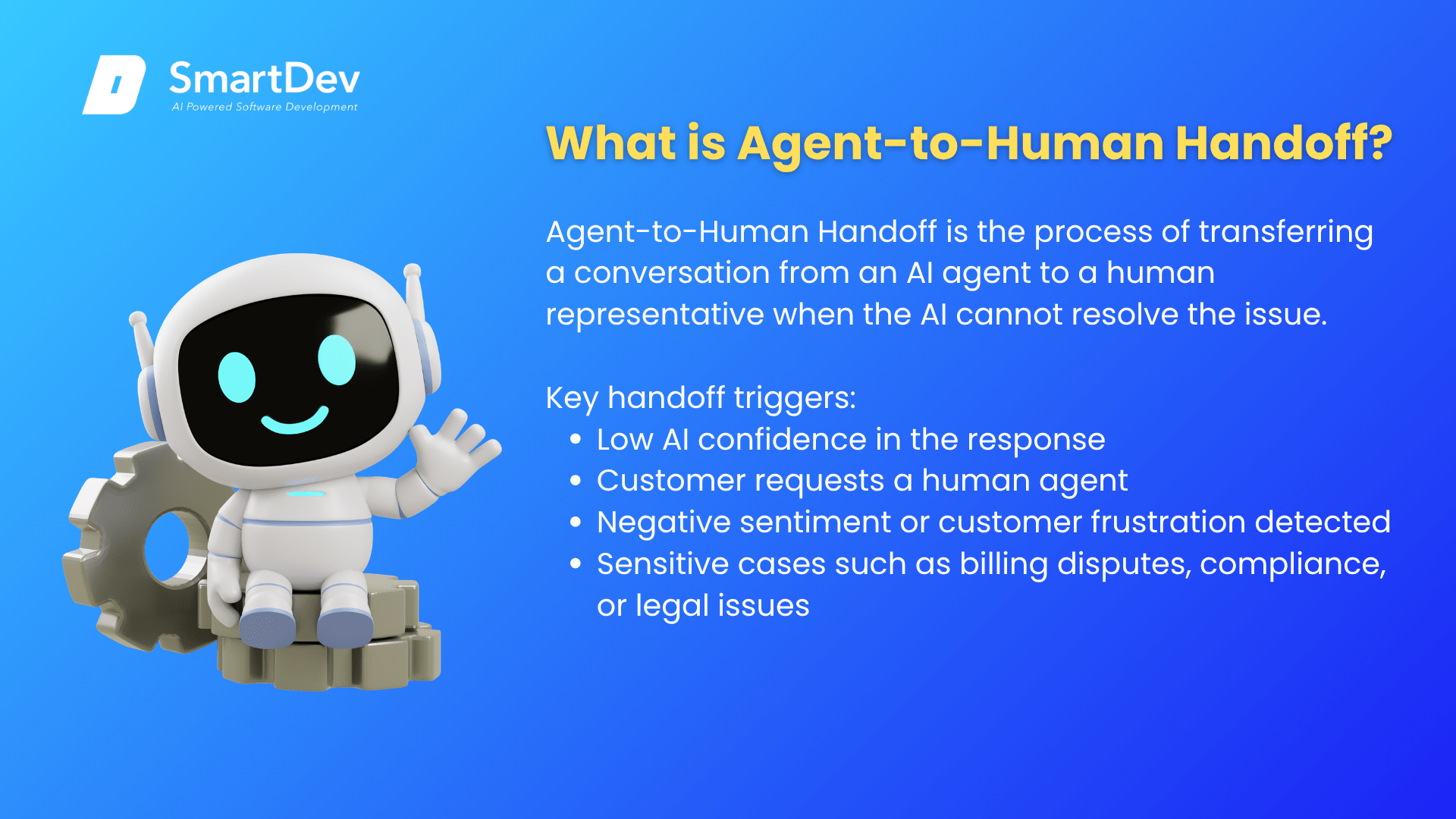
Agent-to-human handoff (also called AI-to-human escalation) is the process by which a conversation managed by an AI agent is transferred to a live human representative. The transfer happens when the AI detects that it cannot resolve the customer’s issue, when the customer explicitly requests a human, or when the situation carries emotional or legal complexity that requires human judgment. In a well-designed system, the handoff is seamless. The human agent receives the full conversation history, customer profile, detected sentiment, and relevant account data before engaging with the customer. From the customer’s perspective, the experience flows naturally without the frustration of repeating information already shared with the AI.
Modern AI platforms support multiple handoff triggers. Confidence thresholds activate when the AI’s certainty about a response falls below a defined level, typically between 60 and 70 percent. Sentiment detection routes conversations when the system identifies frustration or distress in the customer’s messages. Keyword detection picks up phrases such as “let me speak to a person” or “this is urgent.” Rule-based routing directs specific issue categories, such as billing disputes or legal matters, straight to specialized human agents regardless of how the conversation began.
Warum ist das für Unternehmen wichtig?
The business case for optimizing agent-to-human handoff is direct and measurable. Poor handoffs damage customer trust. When a customer must repeat their problem to a human agent after already explaining it to a chatbot, satisfaction drops sharply. Research consistently identifies unresolved escalations and disjointed transitions as leading drivers of customer churn across industries.
An optimized handoff strategy lets businesses capture the cost efficiency of AI automation without sacrificing service quality. AI handles the high volume of routine inquiries, reducing the number of conversations that require human intervention. When escalation does occur, the human agent works with full context, enabling faster resolution and higher first-contact resolution rates.
In 2026, 95 percent of customer service leaders plan to retain human agents as a permanent part of their operating model, adopting a philosophy best described as “digital first, but not digital only.” The competitive advantage no longer belongs to the organizations with the most automation. It belongs to those who execute the transition between AI and human most effectively.
Effective handoff management also reduces agent burnout. Human agents who receive properly contextualized escalations spend less time gathering information and more time on genuine problem-solving. This improves both performance and staff retention, which matters in an industry with historically high turnover rates. 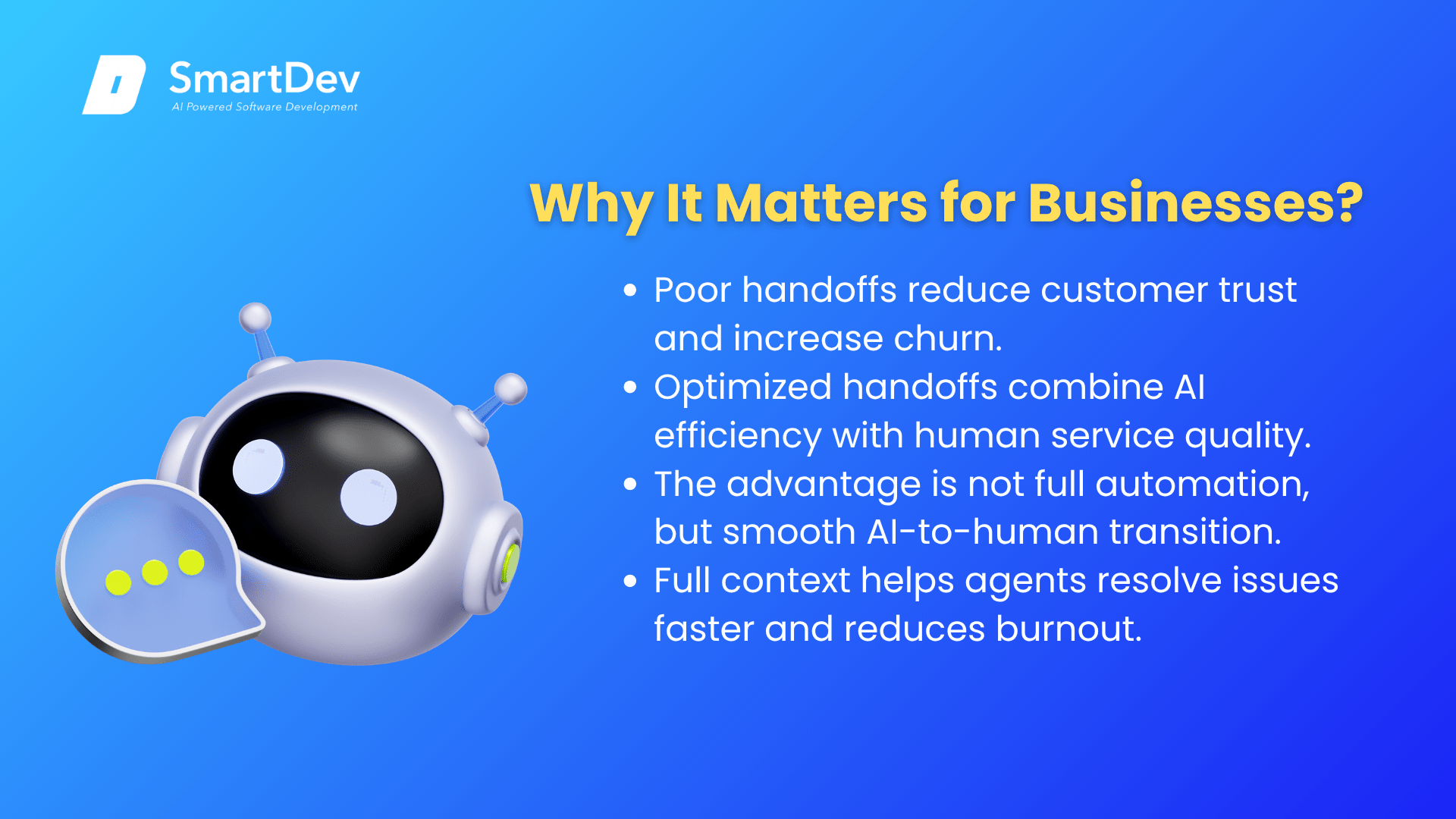
Who Uses Agent-to-Human Handoff?
Any organization operating a customer-facing AI agent needs a handoff strategy. The use case spans industries and business sizes.
Financial services firms deploy handoff systems to escalate fraud alerts and account disputes to compliance-trained agents who have authority to take remedial action. Healthcare providers use it to route sensitive patient inquiries to staff with access to medical records and the credentials to advise appropriately. E-commerce companies rely on it to handle refund exceptions and high-value order issues that fall outside what the AI is authorized to resolve independently. The stakeholders who own this capability include contact center managers, customer experience directors, and IT leaders responsible for the underlying AI platform. In larger organizations, a dedicated conversational AI team manages configuration, trigger tuning, and performance monitoring on an ongoing basis. For smaller businesses using out-of-the-box AI support tools, handoff configuration is often handled in collaboration with the software vendor’s onboarding team.
How Does Agent-to-Human Handoff Work?
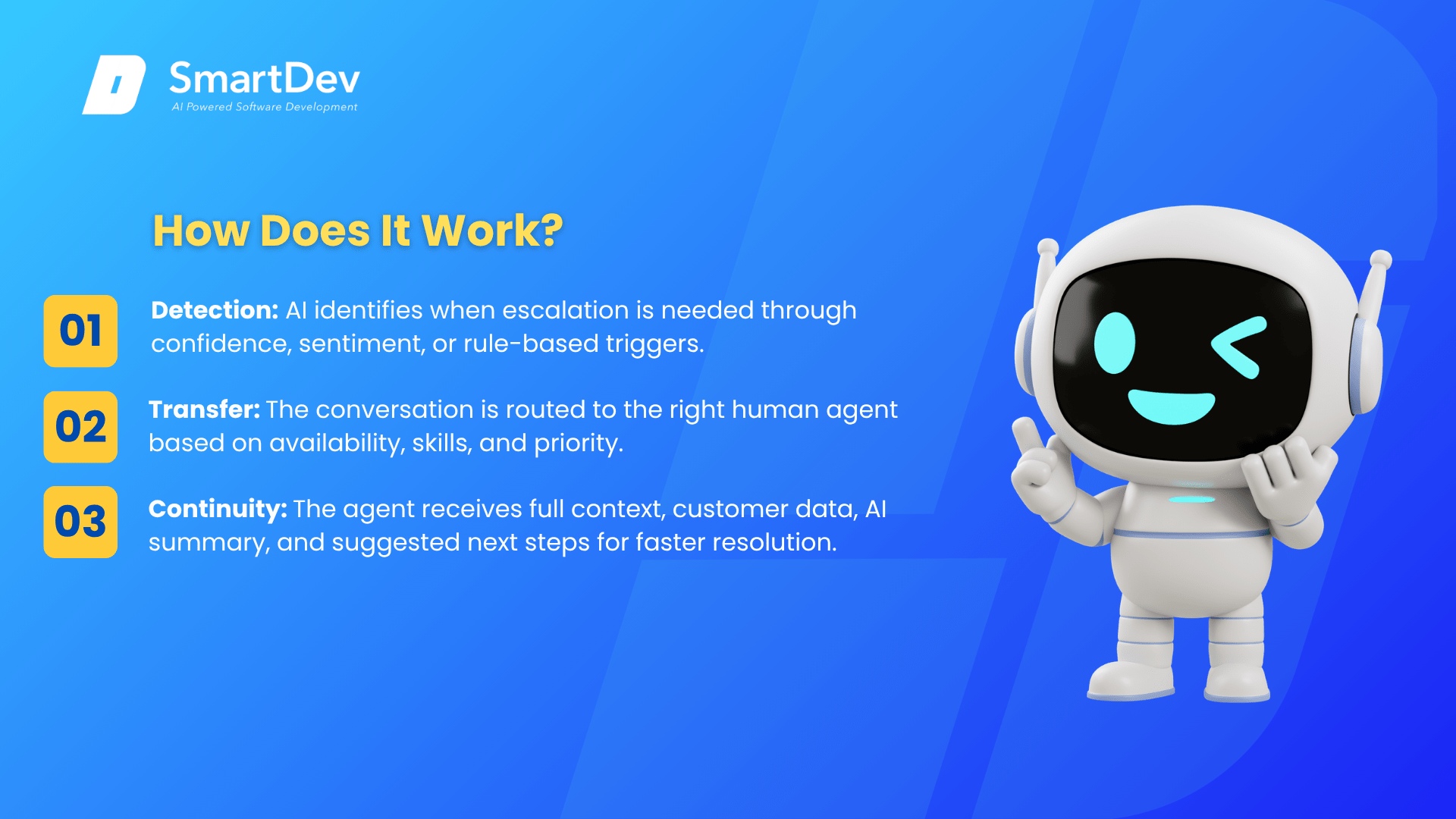
The mechanics of a well-executed handoff involve three stages: detection, transfer, and continuity.
Detection: The AI continuously evaluates incoming messages against a configured set of escalation rules. These may be confidence-based, where the model assesses its own certainty before responding; sentiment-based, where natural language processing identifies negative emotional signals in real time; or rule-based, where defined keywords or issue types trigger escalation automatically.
Transfer: Once an escalation condition is met, the platform routes the conversation to an available human agent in the appropriate queue. Real-time routing logic factors in agent availability, skill specialization, and case priority to minimize wait time and increase the likelihood of resolution on first contact.
Continuity: The human agent receives a pre-populated workspace showing the full conversation transcript, customer data from the CRM, the AI’s summary of the identified issue, and, in advanced deployments, a set of suggested next steps. Some platforms keep the AI active in a co-pilot mode, surfacing recommended responses for the human agent to review and approve in real time.
Weitere verwandte Begriffe
Sitzplatzverwaltung: Bench management refers to the process of managing IT professionals who are between project assignments within an outsourcing organization. Effective bench management reduces idle time, controls costs, and ensures skilled talent is available and ready to deploy when new projects begin.
Zugriffskontrolle: Access control determines who can view, use, or modify specific systems, data, and resources within an organization. It is a critical security layer in IT outsourcing, protecting sensitive business data from unauthorized access by external teams.
Oversight Layer: An oversight layer is the governance component in an AI system that monitors, controls, and audits AI behavior in real time. Without it, AI systems can make unchecked decisions that expose your business to compliance failures, financial loss, and reputational damage.