Zu lang; nicht gelesen:
- AI Adopters are organizations that have integrated AI tools into core business operations to drive measurable results.
- Early AI adoption gives businesses a competitive edge through improved efficiency, faster decisions, and cost savings.
- Successful adoption requires a clear strategy, the right technology partners, and a workforce ready to work alongside AI.
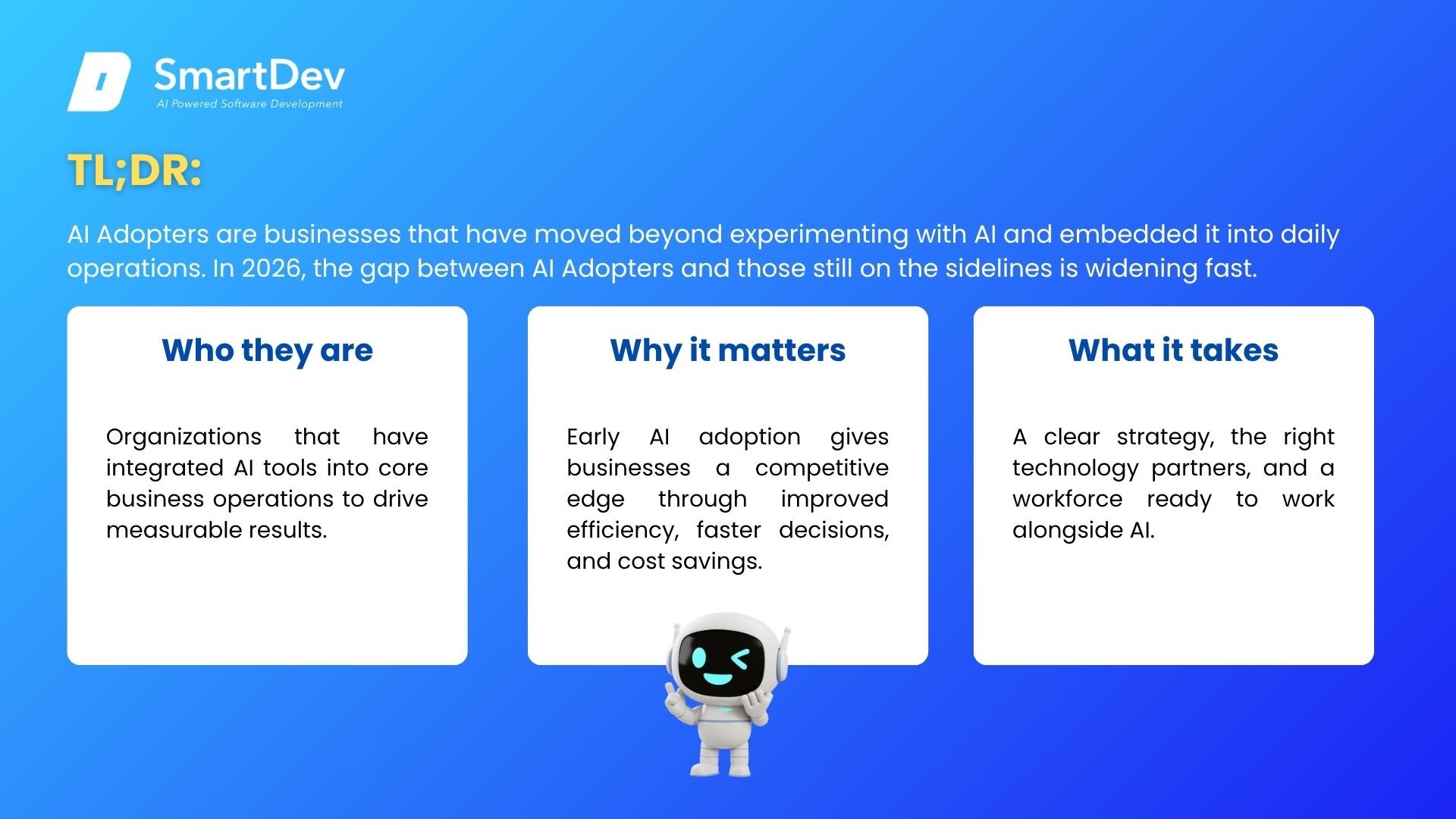
AI Adopters are businesses that have moved beyond experimenting with artificial intelligence and embedded it into daily operations. In 2026, the gap between AI Adopters and those still on the sidelines is widening fast. This article explains what AI Adopters are, why it matters for your business, and how to determine if your organization is ready to join their ranks.
What is AI Adopters?
AI Adopters are organizations that have successfully integrated artificial intelligence into their core business workflows, using AI to automate tasks, support decision-making, and improve operational efficiency at scale. The term spans businesses of all sizes, from small firms using AI-powered chatbots to large enterprises deploying machine learning models across multiple departments.
AI adoption exists on a spectrum. At one end, early adopters embed AI deeply into their products and services. At the other, late adopters are still testing basic use cases. Most businesses today fall somewhere in the middle, piloting AI tools in one or two departments while broader integration remains a work in progress.
Common categories of AI adoption include:
- Process automation: Using AI to handle repetitive, rule-based tasks such as invoice processing or data entry.
- Decision support: AI models that surface insights from large datasets to guide business decisions.
- Customer engagement: AI-powered chatbots, recommendation engines, and personalized marketing tools.
- Prädiktive Analytik: Forecasting demand, detecting fraud, or identifying operational bottlenecks before they occur.
Warum ist das für Unternehmen wichtig?
The difference between AI Adopters and non-adopters is no longer just a technology gap. It is a competitive gap. Organizations that have embraced AI are operating faster, smarter, and at lower cost than those relying on manual processes.
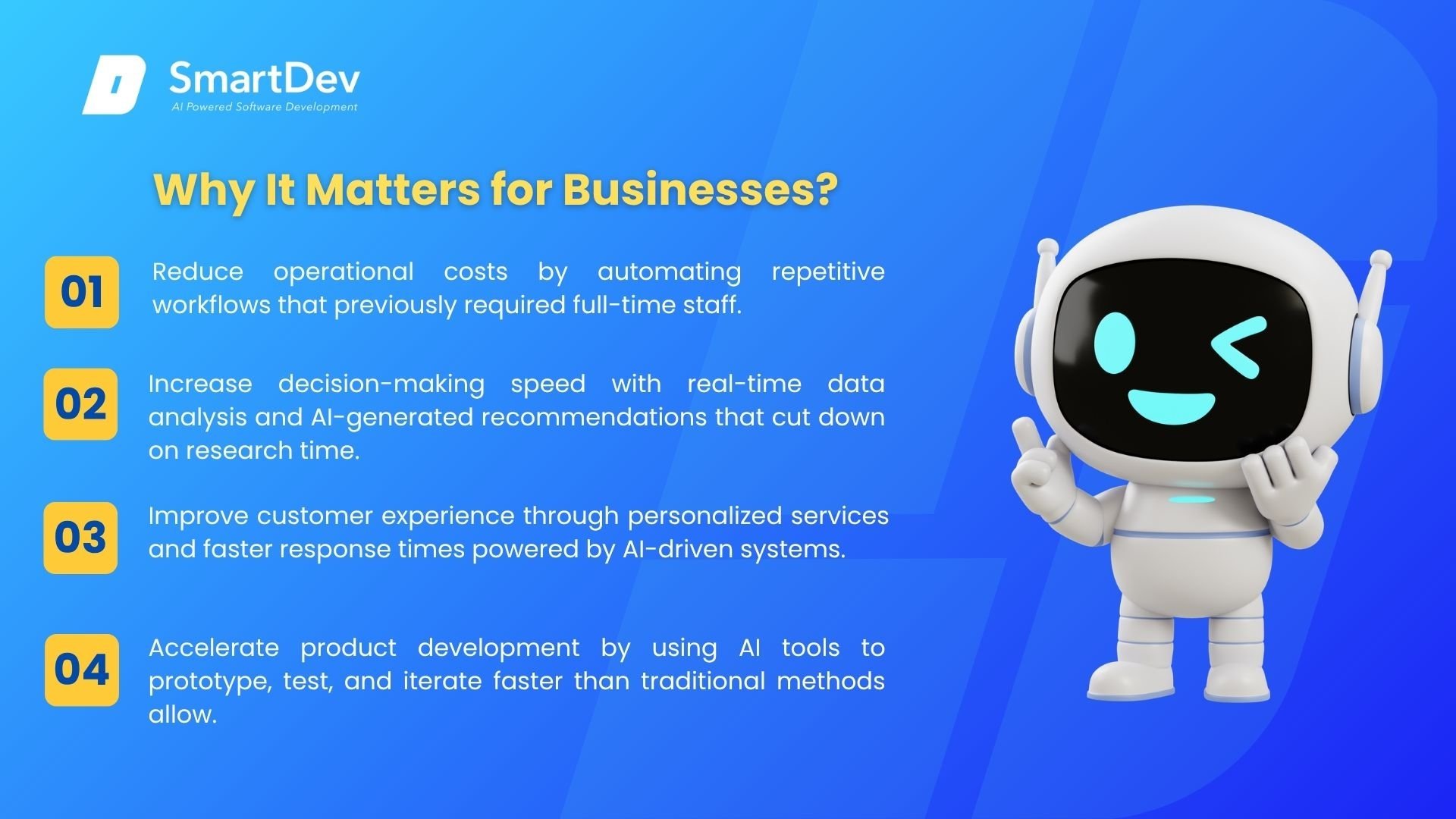
- Reduce operational costs by automating repetitive workflows that previously required full-time staff.
- Increase decision-making speed with real-time data analysis and AI-generated recommendations that cut down on research time.
- Improve customer experience through personalized services and faster response times powered by AI-driven systems.
- Accelerate product development by using AI tools to prototype, test, and iterate faster than traditional methods allow.
For example, a mid-sized logistics company that became an AI Adopter in route optimization reduced fuel costs by 18% within the first year. The same system cut average delivery time by 12%, improving customer satisfaction scores significantly. These are the kinds of compound gains that move AI adoption from an IT project to a board-level priority.
According to Deloitte’s 2026 State of AI in the Enterprise report, organizations with mature AI adoption programs are achieving 2.5 times the ROI compared to companies still in early experimentation phases.
Who Are AI Adopters?
AI Adopters span virtually every industry, but adoption rates are highest in sectors where data is abundant and operational efficiency is critical.
The most active AI Adopter industries in 2026 include:
- Financial services: Banks and insurance firms use AI for fraud detection, risk modeling, and automated customer onboarding.
- Gesundheitspflege: Hospitals and pharma companies deploy AI for diagnostic imaging, drug discovery, and patient management.
- Retail and e-commerce: AI powers personalized recommendations, inventory forecasting, and dynamic pricing engines.
- Herstellung: Smart factories use AI for predictive maintenance, quality control, and supply chain optimization.
Within organizations, the buyers and champions of AI adoption are typically C-level executives, IT Directors, and Chief Digital Officers. These decision-makers evaluate AI tools on ROI potential, integration complexity, vendor reliability, and data security standards. Increasingly, AI adoption decisions also involve HR and operations leaders who need to plan for how AI will change workforce roles.
When Should Your Business Become an AI Adopter?
The right time to invest in AI adoption depends on your business readiness, not just market pressure. Here are the key trigger scenarios:
- Your team is overwhelmed by repetitive tasks that consume time without adding strategic value.
- You are sitting on large volumes of data that your current tools cannot analyze at speed.
- Competitors are gaining ground using AI to serve customers faster, cheaper, or more personally than you can.
- You are scaling rapidly and need to grow output without proportionally growing headcount.
There are also situations where immediate adoption may not be the right move. If your core data infrastructure is fragmented or unreliable, deploying AI tools on top of poor data will produce poor results. Similarly, if your team lacks the training or change management support to work alongside AI, adoption will stall regardless of the technology investment.
A phased approach works best for most organizations. Start with a contained, high-impact use case, prove ROI, then expand from there.
Weitere verwandte Begriffe
- Einführung von KI: The process by which an organization moves from experimenting with AI to embedding it meaningfully in day-to-day operations. AI Adoption is the journey that produces an AI Adopter, covering the strategy, tooling, and organizational change required to make AI a permanent part of how a business runs.
- AI Readiness: An assessment of how prepared an organization is to adopt and scale AI across its operations, covering people, processes, data, and infrastructure. AI Readiness determines where on the adoption spectrum a business currently sits and what gaps need to be addressed before it can operate as a mature AI Adopter.
- AI Enterprise Roadmap: A structured plan that maps out how an organization will move from its current state to full AI integration across its operations. For an organization working toward becoming an AI Adopter, the Enterprise Roadmap is the practical blueprint that translates intent into sequenced, measurable steps.