Kurz zusammengefasst
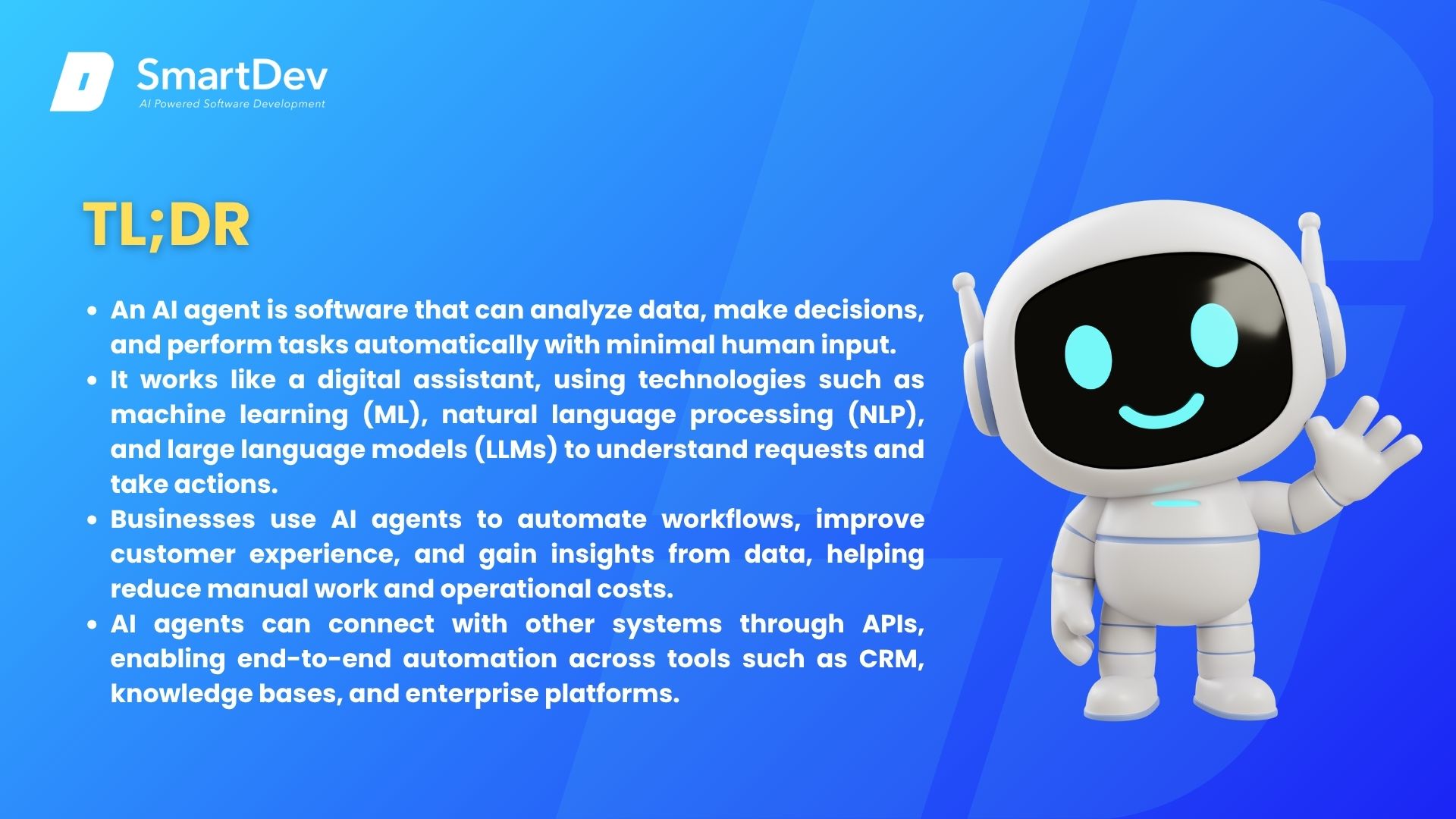
- An AI agent is software that can analyze data, make decisions, and perform tasks automatically with minimal human input.
- It works like a digital assistant, using technologies such as machine learning (ML), natural language processing (NLP), and large language models (LLMs) to understand requests and take actions.
- Businesses use AI agents to automate workflows, improve customer experience, and gain insights from data, helping reduce manual work and operational costs.
- AI agents can connect with other systems through APIs, enabling end-to-end automation across tools such as CRM, knowledge bases, and enterprise platforms.

What Is AI Agent?
An AI agent is a software system that uses artificial intelligence to analyze data, make decisions, and perform tasks automatically to achieve a specific goal. Unlike traditional software that follows fixed rules, AI agents can learn from patterns and adapt to different situations.
In simple terms, an AI agent works like a digital assistant or automated decision-maker. It receives information, processes it using AI, and takes action with minimal human involvement.
Examples of AI agents include:
- Customer service chatbots that answer questions
- Recommendation systems that suggest products
- Fraud detection tools that monitor financial transactions
AI agents typically use technologies such as machine learning (ML), natural language processing (NLP), and large language models (LLMs) to understand requests, analyze information, and perform multi-step tasks.
They can also connect with other systems through APIs or databases, allowing them to retrieve data, trigger workflows, and automate processes across platforms. This makes AI agents a key component of modern intelligent automation.
Why AI Agent Matters for Businesses?
AI agents are becoming popular because they help businesses work faster, reduce costs, and improve customer experience.
1. Automate complex tasks
AI agents go beyond simple rule-based automation. They can analyze data, understand context, and make decisions. For example, an AI agent can review support requests, categorize them, and generate responses automatically.
2. Improve customer experience
AI-powered assistants provide instant answers, personalized recommendations, and 24/7 support, helping customers solve problems quickly.
3. Enable data-driven decisions
AI agents can process large amounts of data, detect patterns, and generate insights that help businesses make better strategic decisions.
4. Support business scalability
As companies grow, AI agents help manage increasing workloads without significantly increasing operational costs.
Because of these advantages, AI agents are widely used in customer support, IT operations, marketing automation, finance, and enterprise knowledge management.
Who Uses AI Agents?
Many industries are adopting AI agents to automate workflows and improve operational efficiency.
Technology companies and SaaS platforms use AI agents to enhance their products. Examples include AI-powered coding assistants, intelligent search systems, and automated helpdesk solutions.
Financial services and fintech companies rely on AI agents for fraud detection, risk analysis, automated trading, and customer service automation. These systems can analyze large volumes of financial data in real time.
E-commerce and retail companies use AI agents to personalize shopping experiences. AI-powered recommendation engines analyze customer behavior and suggest products that match individual preferences.
Healthcare organizations are beginning to deploy AI agents to assist with administrative tasks such as patient scheduling, documentation, and medical data analysis.
Large enterprises also use AI agents internally. These systems help employees access company knowledge, automate workflows, and streamline IT service management processes.
Across industries, AI agents help organizations reduce manual work and improve the speed and accuracy of decision-making.
When Should Businesses Implement AI Agent?
- Handling high volumes of customer inquiries – automate FAQs, guide users through support processes, and reduce workload for service teams.
- Analyzing large datasets quickly – monitor transactions, track performance, and detect unusual patterns in real time.
- Automating internal workflows – process documents, manage internal requests, and support IT troubleshooting.
- Supporting digital transformation – connect cloud systems, data platforms, and AI tools to automate workflows across the organization.
How AI Agent Works
- Collect data – The AI agent gathers input from sources such as user queries, databases, system logs, or connected applications.
- Process information – AI models like machine learning (ML) and natural language processing (NLP) analyze the data and determine the best response or action.
- Take action – The agent performs tasks such as answering questions, generating recommendations, triggering workflows, or updating records automatically.
- Connect with other systems – AI agents often integrate with tools like CRM platforms, knowledge bases, or messaging apps through APIs to retrieve data and automate processes.
- Collaborate with other agents – In advanced setups, multiple AI agents can work together to handle complex tasks and improve decision-making.
Other Related Terms
Understanding the concept of AI agents becomes easier when exploring several related technologies.
Künstliche Intelligenz (KI)
Artificial intelligence refers to the broader field of computer science focused on creating machines that can perform tasks requiring human intelligence, such as reasoning, learning, and problem-solving.
Maschinelles Lernen (ML)
Machine learning is a subset of AI that allows systems to learn from data and improve performance over time without explicit programming.
Große Sprachmodelle (LLMs)
Large language models are AI systems trained on large datasets to understand and generate human language. Many AI agents use LLMs to communicate with users.
Intelligente Automatisierung
Intelligent automation combines artificial intelligence with workflow automation tools to automate complex business processes.
Verarbeitung natürlicher Sprache (NLP)
Natural language processing enables computers to understand and interpret human language. NLP is commonly used in chatbots and AI assistants.