
Zu lang; nicht gelesen:
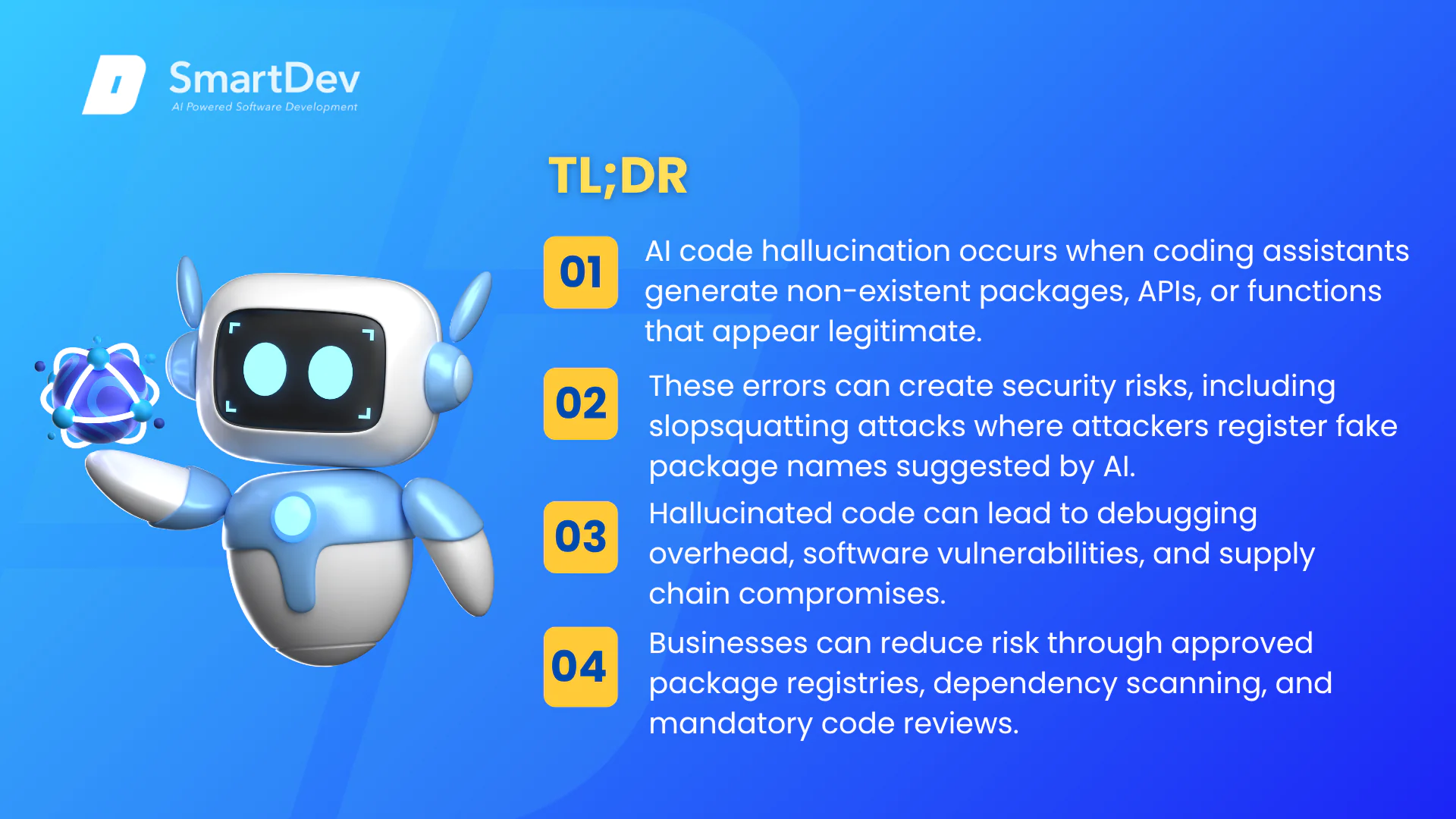
- AI code hallucination happens when AI coding tools generate plausible but non-existent code elements such as fake package names, false APIs, or fabricated function signatures.
- Attackers exploit this through slopsquatting, registering the fake package names AI tools suggest and loading them with malware.
- IT managers can reduce this risk by over 95% with approved package registries, automated dependency scanning, and mandatory developer review policies.
AI coding tools like GitHub Copilot and Claude Code have transformed development speed across software teams. But they come with a hidden risk: they sometimes recommend code that references packages, libraries, or APIs that do not exist. This article explains what AI code hallucination is, why it creates real security threats, and what your team can do to stay protected.
What is AI Code Hallucination?
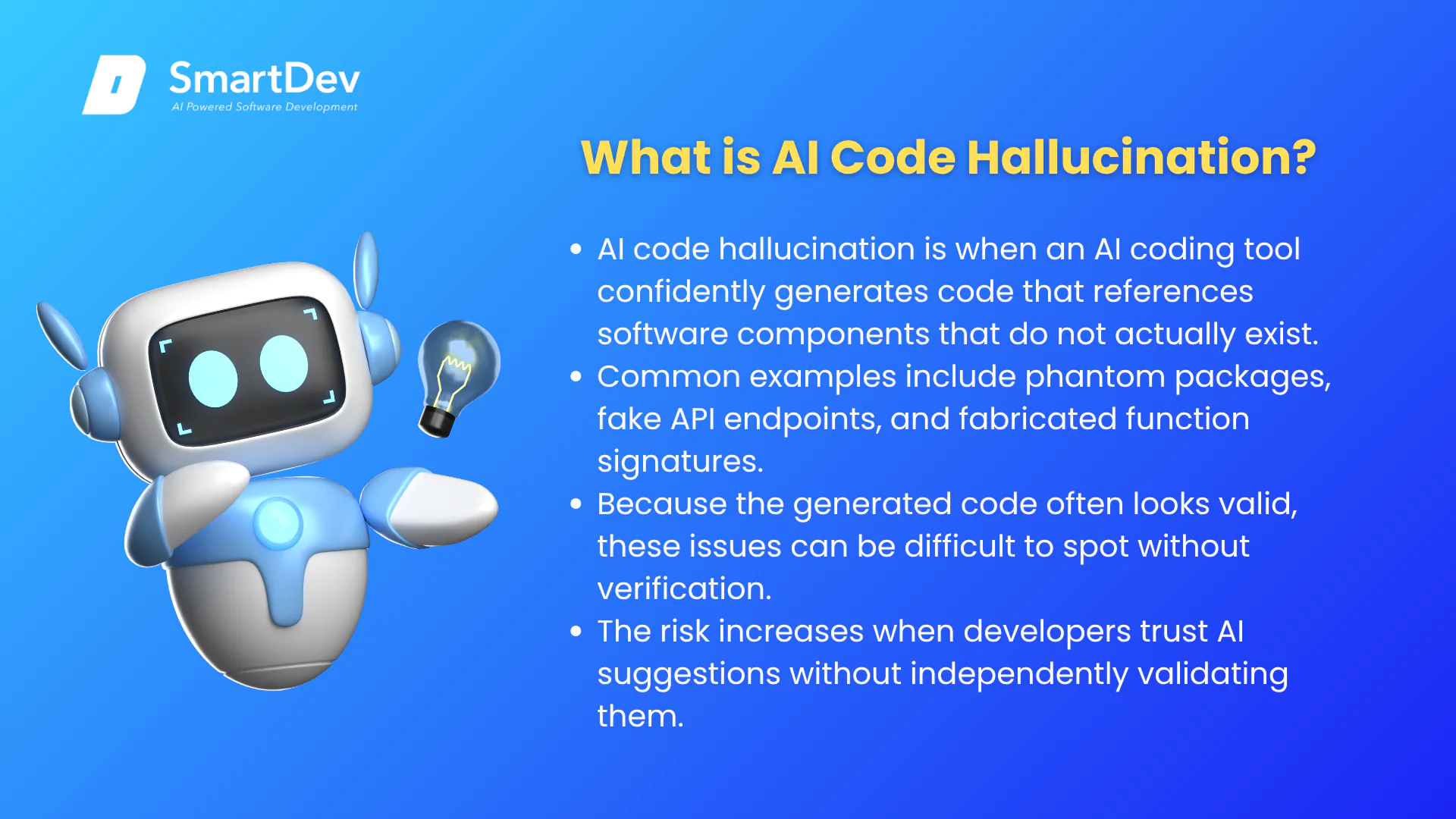
AI code hallucination occurs when an AI coding assistant generates code that includes references to software packages, functions, or APIs that do not actually exist. The term borrows from the broader concept of AI hallucination, where a model produces confident but incorrect information. In code, this takes a specific and dangerous form: the AI recommends an import statement for a library that sounds real and follows correct naming conventions, but has never been published to any registry.
Types of AI code hallucination include:
- Phantom packages: Non-existent libraries or modules suggested as real dependencies in code imports.
- Fake API endpoints: Invented REST or GraphQL endpoints that do not exist in the referenced service.
- Fabricated function signatures: Incorrect method names or parameters for real libraries, producing runtime errors that are difficult to diagnose.
This is not a rare edge case. Research estimates that AI coding assistants hallucinate package names in 5% to 20% of suggestions, depending on the tool and programming language in use.
Warum ist das für Unternehmen wichtig?
The business risk of AI code hallucination goes far beyond developer frustration with broken builds.
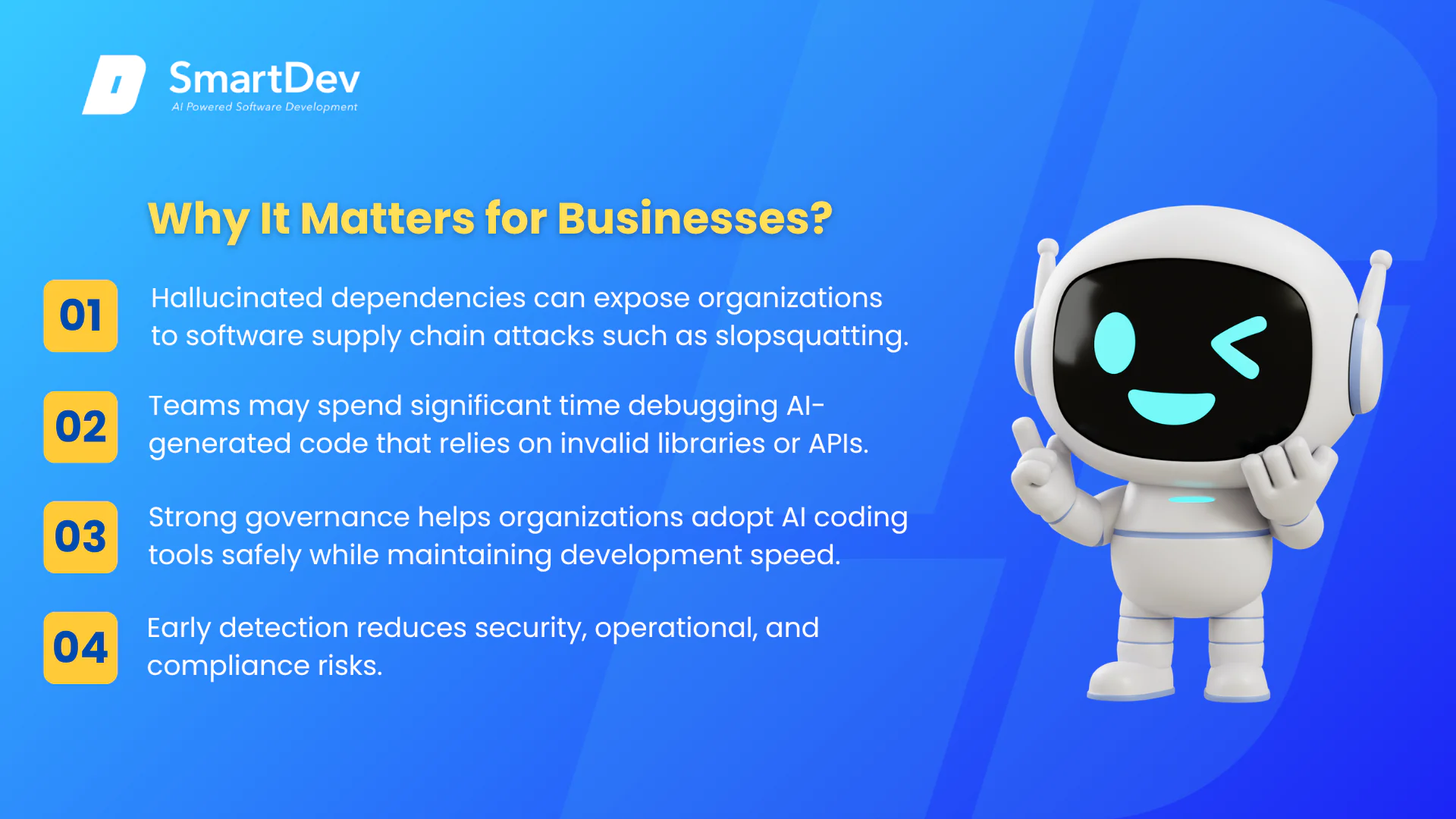
- Schützen your software supply chain from slopsquatting, a class of supply chain attack where hackers register the fake package names that AI tools commonly suggest, delivering malware to any developer who installs them.
- Reduzieren the hidden cost of debugging AI-generated code, which consumes 20 to 30% of AI-assisted development time at organizations without structured review policies.
- Increase development team accountability by establishing clear policies around when AI-generated code must be reviewed before it is merged into production.
- Beschleunigen safe adoption of AI coding tools by giving your team a governance framework that captures the speed benefits while controlling the security risk.
For example, a software consultancy running AI-assisted development without a review policy discovered a hallucinated package name in production code during a routine audit. The package name had been registered by an unknown third party. No malicious payload was present in that instance, but the incident triggered a full security review and a new mandatory policy requiring sign-off on every AI-suggested dependency before installation.
How Does AI Code Hallucination Work?
AI code hallucination follows a predictable pattern that makes it hard to detect without the right controls in place:
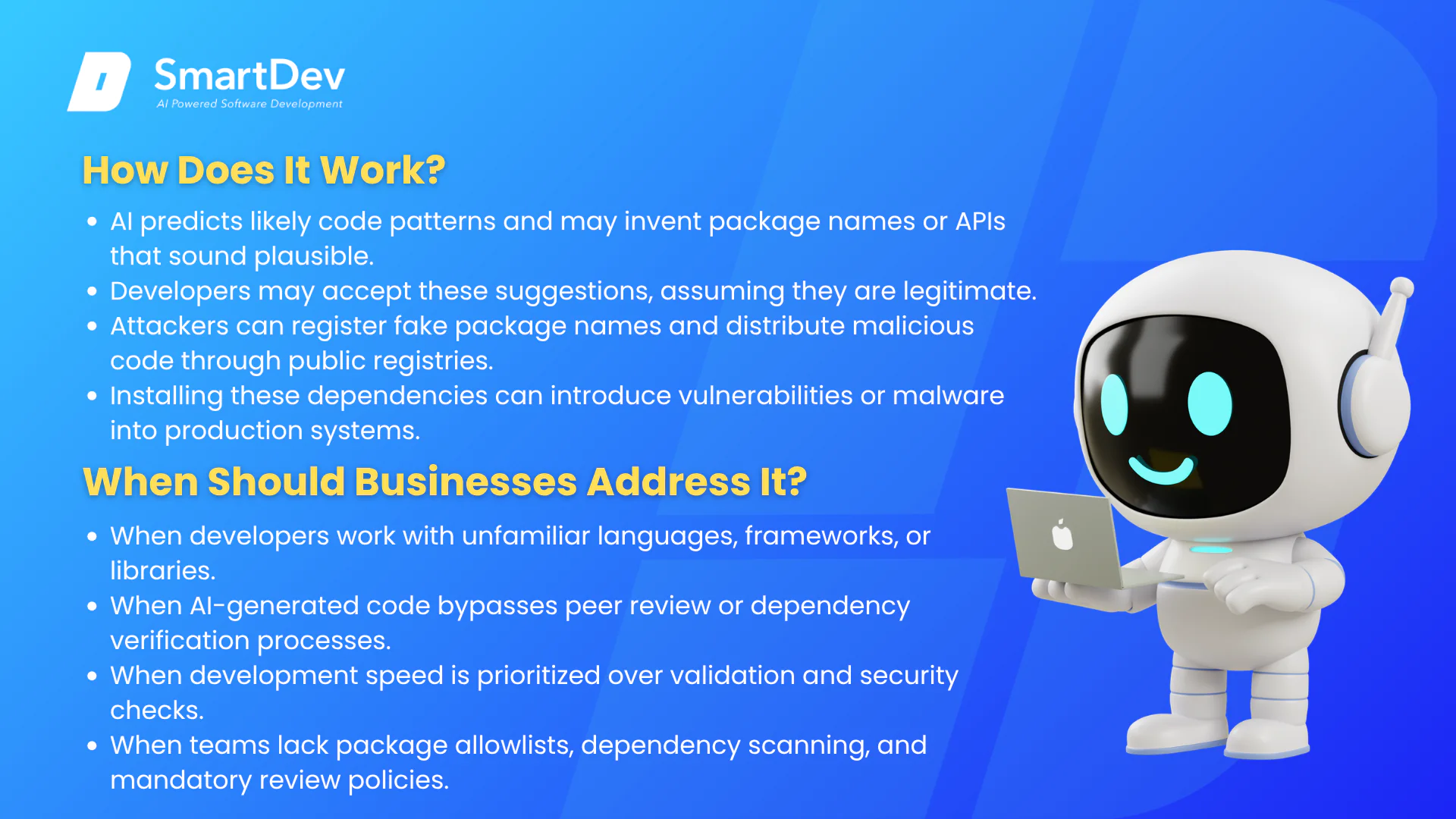
- Pattern generation. The AI coding tool generates code by predicting the most statistically likely next token based on its training data. It has seen patterns like import libraryname millions of times, so it generates them confidently, even when the specific library name does not exist in any public registry.
- The hallucinated suggestion. The AI produces a plausible-sounding package name such as dataframe-utils-pro or auth-helpers-next, following the naming conventions of real packages in that ecosystem. The suggestion appears legitimate to a developer unfamiliar with every available library.
- Exploitation via slopsquatting. Attackers monitor AI-generated code samples and community discussions to identify commonly hallucinated package names. They then register those names on public package registries such as npm or PyPI and publish packages containing malware or data exfiltration tools.
- Compromise. A developer installs the hallucinated package, inadvertently introducing a backdoor or vulnerability directly into the production codebase, with no phishing or social engineering required.
The result is a new class of supply chain attack that exploits developer trust in AI tools rather than human error or social engineering.
When Is the Risk Highest?
AI code hallucination risk peaks in specific situations your team should recognize:
- Developers use AI tools to work in unfamiliar languages or frameworks where they cannot easily spot an implausible package name.
- AI-generated code is merged without a peer review step, bypassing the human check that would catch suspicious dependencies.
- Development timelines are tight and speed takes priority over scrutiny, increasing the likelihood of installing a dependency without verification.
- Junior developers treat AI output as authoritative rather than as a starting point that requires independent confirmation.
Risk is lower when your team implements:
- Pre-approved package allowlists that block installation of packages not on a vetted registry.
- Automated dependency scanning tools integrated into the CI/CD pipeline to flag newly registered or suspicious packages.
- Mandatory code review policies that require human sign-off on every AI-suggested dependency before it enters the build.
Organizations that implement all three controls report reducing slopsquatting exposure by over 95% without significantly impacting development velocity.
Weitere verwandte Begriffe
- Autonomous Coding: A software development approach in which an AI system independently plans, writes, and validates code without requiring step-by-step human direction. Autonomous Coding is the methodology that AI Coding Agents put into practice. Where the coding agent is the tool, autonomous coding describes the mode of working it enables, specifically the shift from human-directed completion to goal-directed, self-correcting execution.
- AI-assisted Engineering: A development practice in which AI tools support engineers by handling specific tasks such as code generation, review, and documentation while the human developer retains overall direction and judgment. AI-assisted Engineering is the broader category that AI Coding Agents sit within, at its most autonomous end. Understanding the spectrum from AI assistance to full agent autonomy helps teams decide which level of AI involvement suits a given task.
- Human-in-the-Loop: A design pattern that requires a human reviewer to validate or approve an AI output before it is acted upon. It is one of the most common guardrail mechanisms for high-risk decisions, specifically for cases where automated output validation alone is not sufficient to meet compliance or quality thresholds.
- AI Grounding is the practice of connecting AI model outputs to verified, real-world data sources to improve accuracy and reliability. It is the most direct mitigation for AI code hallucination — by anchoring code generation to actual documentation, APIs, and validated references, grounding reduces the likelihood of AI producing plausible-looking but incorrect code.
- Deterministic Output is the ability of an AI system to produce consistent, predictable results given the same input. AI code hallucination is the primary obstacle to achieving deterministic output in code generation — understanding when and why hallucinations occur is the first step toward building AI-assisted development workflows that produce reliable, repeatable results.