Zu lang; nicht gelesen:
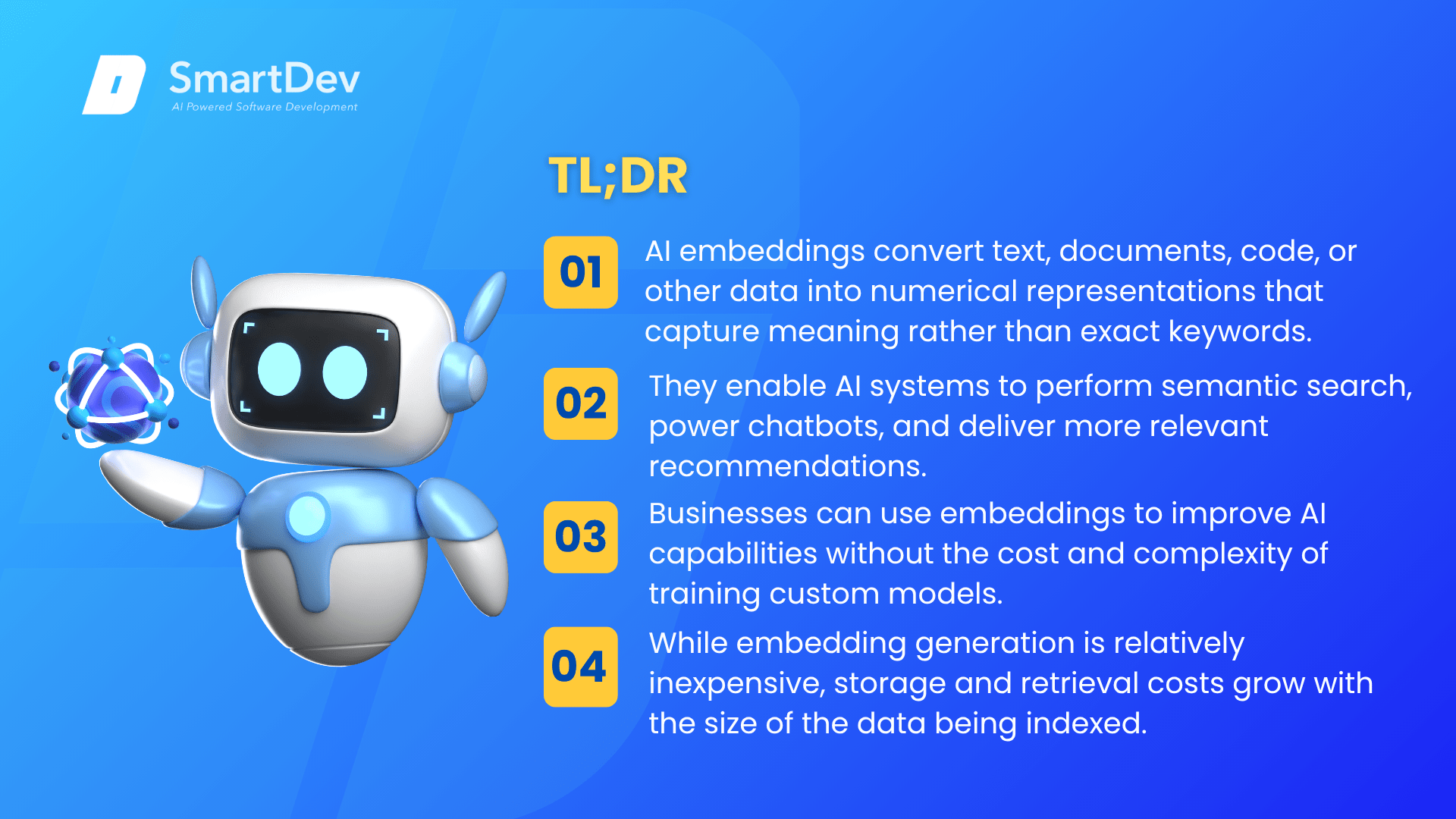
- AI embedding converts your business data into searchable number patterns, so AI can find relevant content by meaning, not just keywords.
- Businesses use embeddings to power smarter search, chatbots, and recommendation engines without costly model training.
- Embedding generation is cheap, but vector storage costs scale with data volume, so plan your infrastructure early.
AI embedding is the technology behind most modern AI features your team already relies on. When your AI search tool surfaces the right document, or your chatbot understands what a customer actually means, embeddings are at work. This article explains what AI embedding is, why it matters for your business, and how much it costs to implement.
What is AI Embedding?
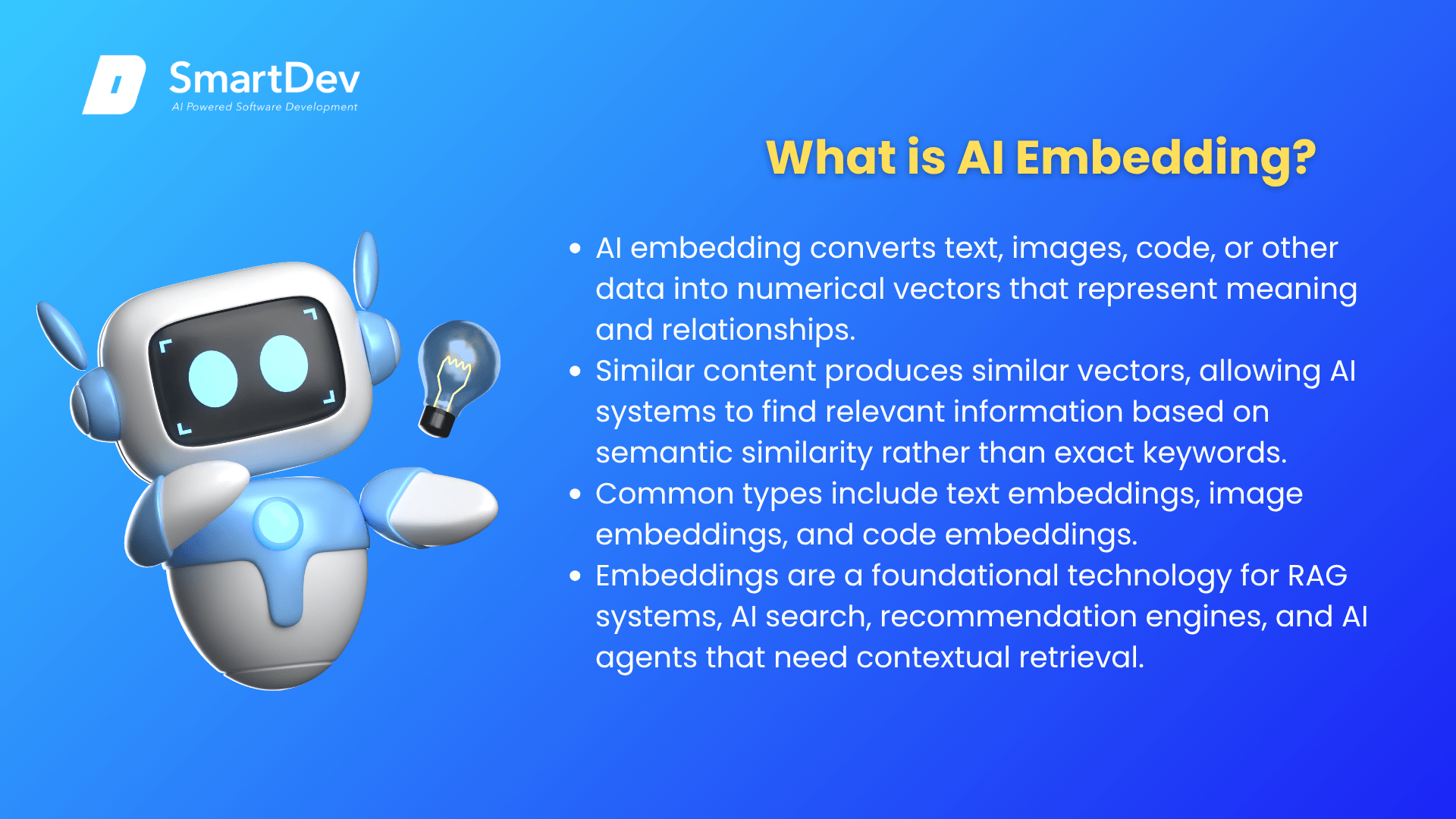
AI embedding is a technique that converts text, images, or other data into numerical vectors, lists of numbers that capture meaning and relationships. Similar content produces similar vectors, which allows AI systems to find semantically related information rather than relying on keyword matches. For example, a query for “employee leave policy” can surface documents that discuss “vacation days” and “PTO rules” even if those exact phrases never appear together.
Common types of embeddings include text embeddings (for documents, emails, support tickets), image embeddings (for product photos or visual search), and code embeddings (for searching software repositories). Embeddings are the core technology behind RAG (Retrieval-Augmented Generation) systems, recommendation engines, and AI agents that need to retrieve relevant context quickly.
Warum ist das für Unternehmen wichtig?
Most enterprise data is unstructured. Emails, contracts, meeting notes, and support tickets hold critical information that traditional keyword search misses entirely. Embedding technology changes that.
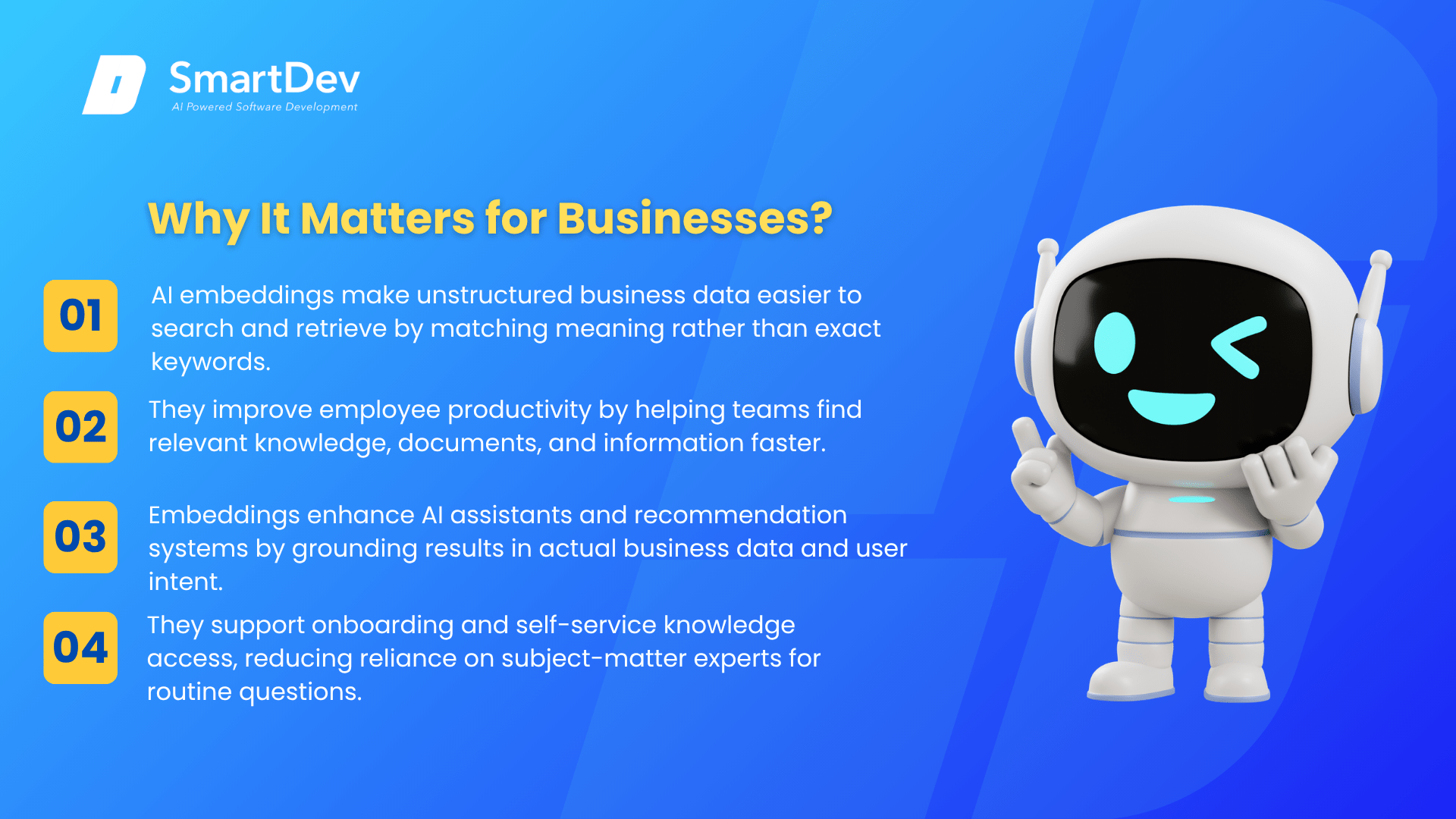
- Reduzieren the time employees spend hunting for internal knowledge by connecting search queries to meaning, not just word matching.
- Increase customer satisfaction by powering recommendation engines that surface the right product, policy, or answer at the right moment.
- Verbessern AI assistant accuracy by grounding responses in your actual business data rather than generic model training.
- Beschleunigen onboarding by making internal documentation instantly searchable, reducing the burden on senior staff for routine questions.
For example, a mid-sized financial services firm implemented AI embeddings in their internal knowledge base. Employees could ask natural language questions about policy and get relevant answers without contacting HR. The result was a 35% drop in routine HR support tickets within 90 days of deployment.
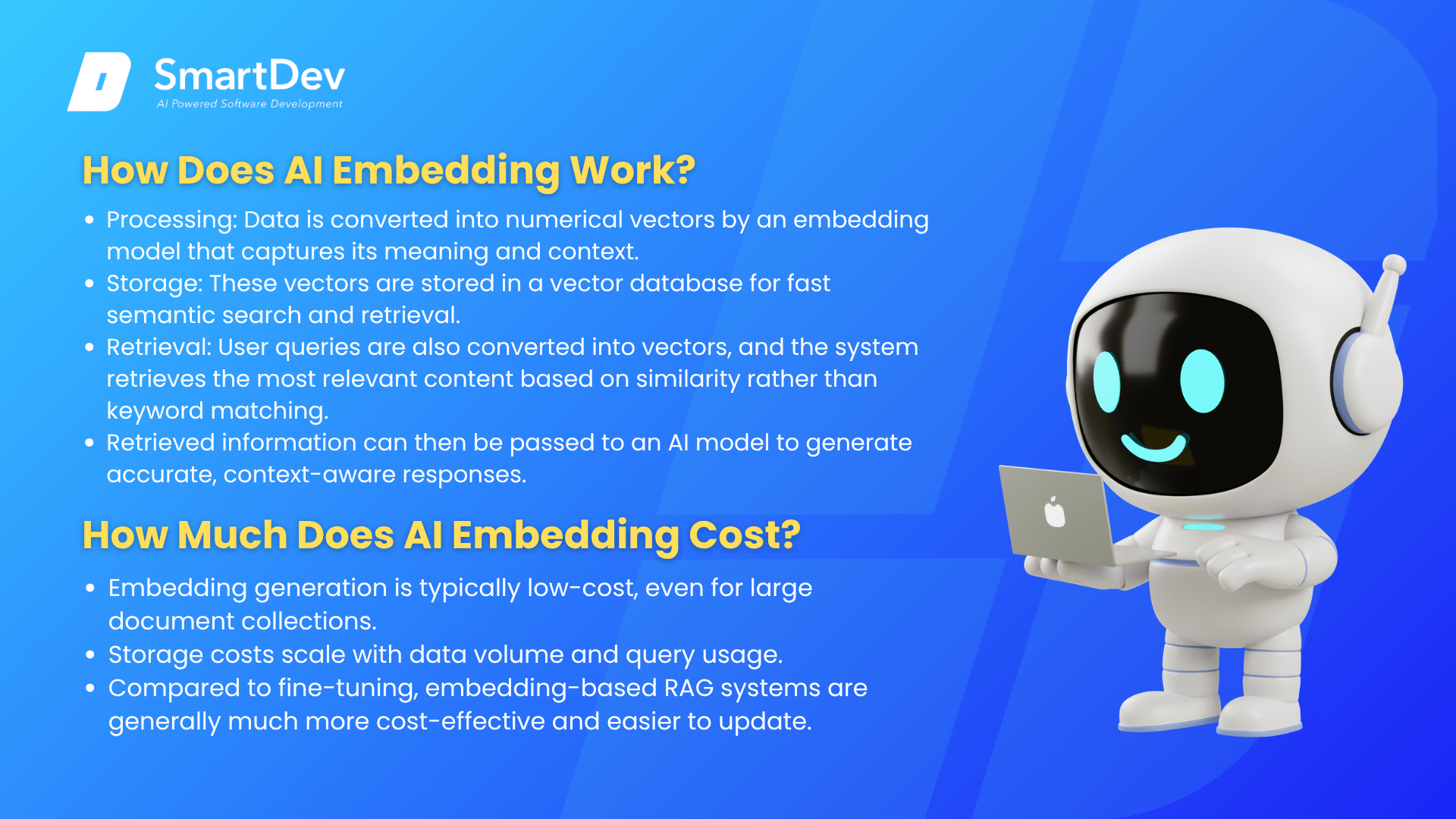
How Does AI Embedding Work?
AI embedding works in three stages:
- Processing. Your data is split into chunks and passed through an embedding model, such as OpenAI’s text-embedding-3 or Google’s Vertex AI embeddings. The model reads the content and outputs a vector of typically 1,536 to 3,072 numbers representing its meaning.
- Storage. Vectors are stored in a vector database such as Pinecone, Weaviate, or the open-source pgvector extension for PostgreSQL. When new documents are added, they go through the same process and are indexed automatically.
- Retrieval. When a user submits a query, it is also converted to a vector. The system finds the stored vectors most mathematically similar to the query and retrieves the matching documents. Those documents are then passed to a language model, which uses them to generate an accurate, contextual response.
The result is an AI system that understands your business content and surfaces what users need, even when their phrasing differs from how the original document was written.
How Much Does AI Embedding Cost?
Embedding costs come in two parts: generation and storage.
Generation is inexpensive. OpenAI charges $0.02 per million tokens for its standard embedding model. Embedding a library of 10,000 business documents typically costs under $5 in generation fees. Similar pricing applies across Google, Cohere, and Mistral, with open-source models available for teams running their own infrastructure.
Storage is where costs grow. Managed vector databases such as Pinecone start at $70 to $200 per month for small deployments, scaling to $1,000 or more per month for enterprise workloads with millions of vectors. Self-hosted options like pgvector reduce the monthly bill but add 40 or more hours of DevOps overhead each month.
Three factors drive your total cost: data volume, update frequency, and query volume. Compared to fine-tuning a custom model, a RAG architecture built on embeddings costs roughly 90% less and can be updated instantly when your data changes, with no retraining required.
Weitere verwandte Begriffe
- KI-Governance: A structured set of policies, roles, and processes that an organization uses to approve, monitor, and retire AI systems. AI guardrails are the technical enforcement layer within an AI governance framework, translating its policies into concrete operational controls that act on inputs and outputs in real time.
- Probabilistic Output: The characteristic of AI systems where responses vary based on statistical probability, making prompt engineering essential for achieving consistent and reliable results.
- Human-in-the-Loop: A design pattern that requires a human reviewer to validate or approve an AI output before it is acted upon. It is one of the most common guardrail mechanisms for high-risk decisions, specifically for cases where automated output validation alone is not sufficient to meet compliance or quality thresholds.
- AI Grounding is the practice of anchoring AI outputs to verified, real-world data sources to ensure accuracy and reduce hallucinations. Embeddings are the technical foundation that makes grounding possible — by converting enterprise knowledge bases, documents, and structured data into vectors, embeddings enable AI systems to retrieve and ground their responses in factual, domain-specific information rather than relying solely on what was learned during training.
- Long-Term Coherence is an AI system’s ability to maintain consistent reasoning, context, and goal alignment across extended multi-step tasks and conversations. AI embeddings directly address one of the core causes of coherence failure — context degradation over time — by enabling retrieval-augmented generation (RAG), where the AI continuously pulls relevant, up-to-date information from a vector database instead of depending on a finite context window that decays.