

Zu lang; nicht gelesen:
- AI Model Deployment is the process of taking a trained machine learning model out of a development environment and making it available in a live system where it can process real data and generate outputs.
- Only around 48% of AI models ever reach production, making deployment one of the most significant bottlenecks in enterprise AI programs.
- Reliable deployment requires engineering infrastructure, monitoring systems, and governance processes that keep models performing accurately as data and business conditions change over time.
Training an AI model is only half the work. The other half is getting that model into production and keeping it performing reliably once it is there. AI model deployment is where most enterprise AI initiatives either succeed or stall, making it one of the highest-impact capabilities any organization can develop or source from a specialist partner.
What is AI Model Deployment?
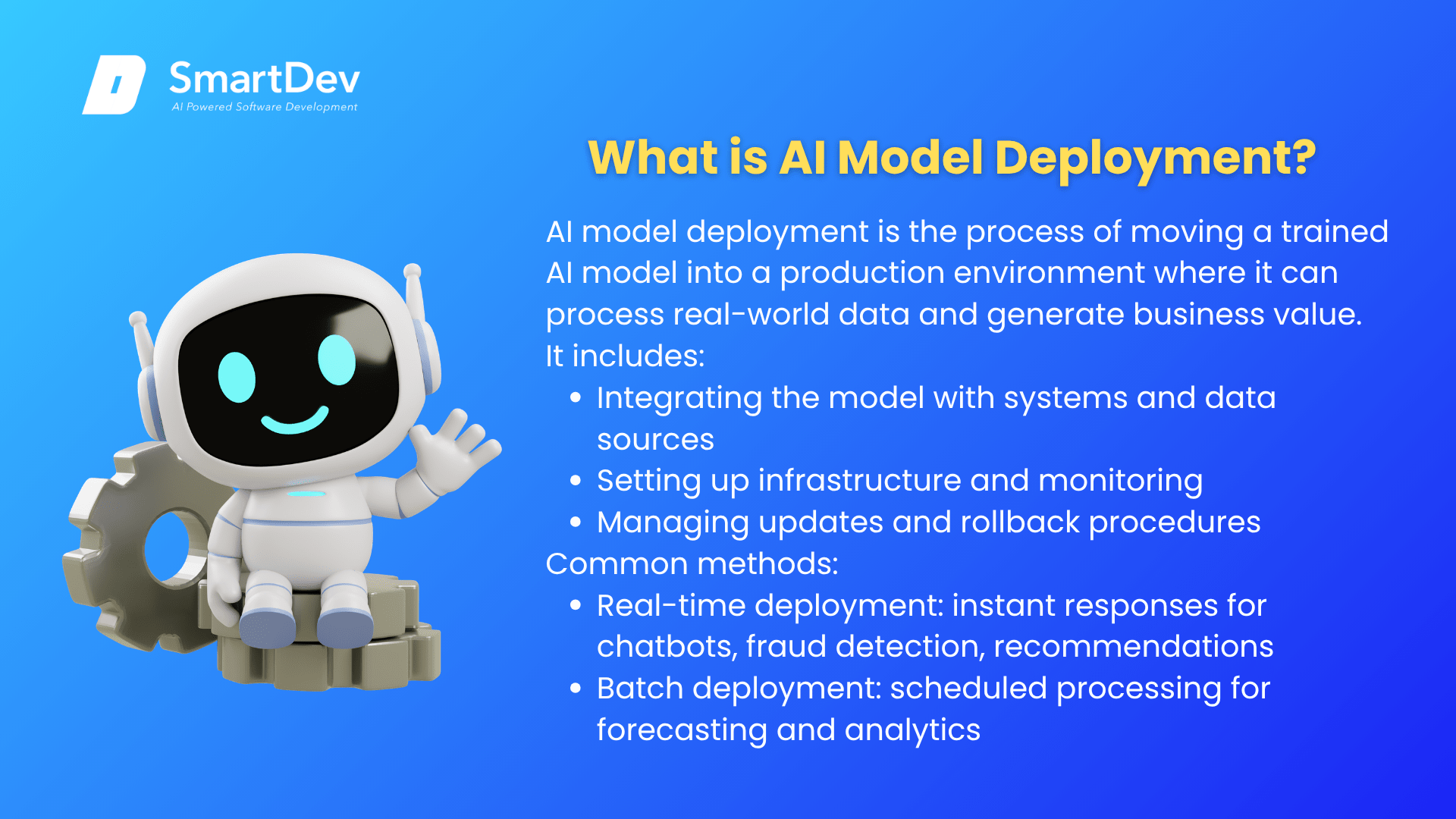
AI model deployment integrates trained machine learning models into production environments where they process real-world inputs and generate business value. Before deployment, models only exist within controlled development or testing environments that limit practical business applications and scalability. After deployment, models operate inside live business systems that process transactions, generate predictions, and support organizational decisions continuously. Deployed models respond to customer requests and business demands at the operational speed and scale organizations require for growth.
Deployment involves more than a single technical action because teams must manage multiple interconnected operational and infrastructure responsibilities simultaneously. Engineering teams package trained models into production-ready formats that business systems can deploy and execute efficiently across environments. Teams connect models with required data sources and APIs that enable continuous processing and accurate real-time decision-making capabilities. Infrastructure teams configure hosting environments that support reliable model serving, scalability, performance optimization, and operational system stability consistently. Organizations also establish monitoring systems that track model accuracy, latency, reliability, and long-term operational performance over deployment lifecycles. Teams create rollback procedures that allow organizations to restore previous model versions whenever operational failures or unexpected issues emerge.
Deployment methods vary according to business objectives, technical requirements, and the operational demands associated with different organizational use cases. Real-time deployment processes individual requests immediately and returns outputs instantly for applications requiring continuous responsive decision-making capabilities. Organizations commonly use real-time deployment for fraud detection, customer service chatbots, and personalized product recommendation systems today. Batch deployment processes large data volumes according to scheduled intervals and stores outputs for later operational or analytical use. Organizations frequently apply batch deployment methods in financial forecasting, healthcare risk scoring, and demand planning across enterprise operations.
Warum ist das für Unternehmen wichtig?
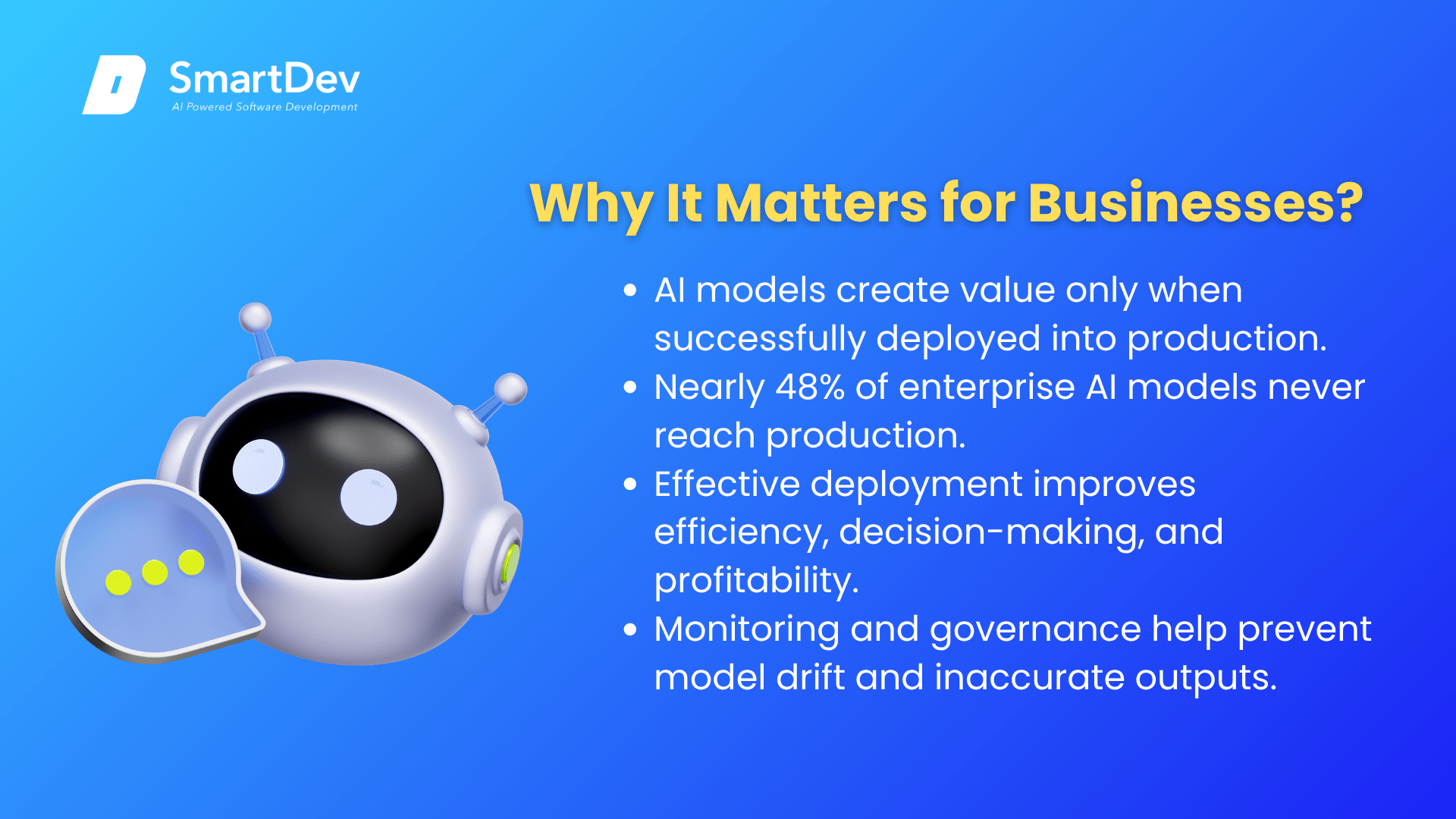
AI model deployment matters because models that never reach production fail to generate measurable business value for organizations. Research shows that enterprises fail to deploy approximately 48% of developed AI models into actual production environments successfully. Organizations waste data science investments, engineering resources, and strategic focus when deployment failures prevent models from reaching production. Deployment gaps usually emerge because development teams build models without considering practical production environment requirements and operational constraints.
Organizations that deploy and maintain machine learning models effectively gain compounding competitive advantages through continuous operational improvements over time. Industry data shows that companies using production-level machine learning improve profit margins by three to fifteen percent consistently. Companies achieve these gains through improved decision-making, faster operational processes, and reduced errors across critical business activities daily. These benefits only emerge when organizations deploy models using reliable systems, continuous monitoring practices, and consistent performance improvements.
For executives and IT managers, AI model deployment also represents a critical governance and organizational accountability responsibility today. Deployed models influence decisions affecting customers, employees, business partners, and other stakeholders across multiple operational and strategic processes. When model drift reduces performance because underlying data changes, organizations may produce inaccurate pricing or biased recommendations. Poorly monitored models may also weaken fraud detection systems, creating financial risks and compliance concerns for affected organizations globally. Governance frameworks help organizations monitor, audit, and manage deployed models while protecting business performance and regulatory compliance standards.
How AI Model Deployment Works?
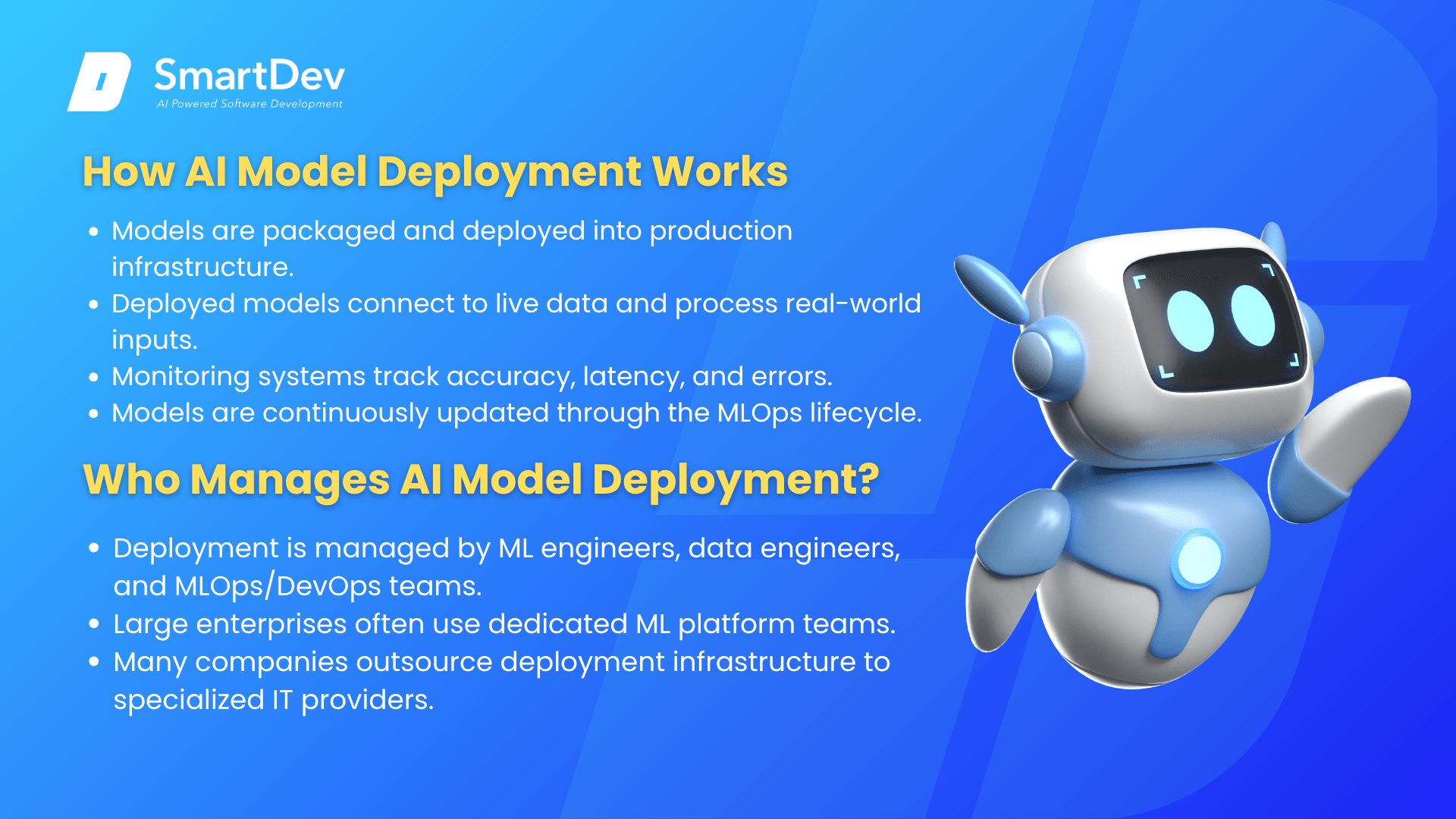
The deployment process begins after engineers train, validate, and approve a model for production use. Engineering teams package the model into deployable artifacts using containerization tools that ensure portability across infrastructure environments. Teams then deploy the packaged model onto cloud-based, on-premises, or embedded serving infrastructures for operational use.
After deployment, the model connects to live data streams or databases and processes inputs based on previous training. Monitoring tools continuously track prediction accuracy, latency, error rates, and data distribution across the deployed environment. When monitoring systems detect performance degradation, teams investigate data shifts, business changes, or deficiencies requiring retraining. Teams repeat deployment, monitoring, retraining, and redeployment throughout the MLOps lifecycle to maintain reliable model performance consistently. MLOps applies software engineering discipline to AI model management through formal release processes, version control, and change management.
Who Manages AI Model Deployment?
AI model deployment sits at the intersection of data science and engineering, requiring collaboration between machine learning engineers, data engineers, platform engineers, and DevOps or MLOps specialists. In smaller organizations, a single team may handle all of these responsibilities. In larger enterprises, dedicated ML platform teams own the deployment infrastructure while data science teams focus on model development and business teams define the performance requirements models must meet.
Many organizations partner with IT outsourcing providers to manage AI model deployment and the MLOps infrastructure that supports it. This is particularly common in companies that have strong data science capabilities but lack the platform engineering expertise needed to build and maintain reliable production AI systems. Outsourcing the deployment and operations layer allows data science teams to focus on model quality and improvement while specialists handle the infrastructure that keeps models running reliably in production.
Weitere verwandte Begriffe
- Agent Orchestration: Coordinates multiple AI agents, tools, models, and workflows to complete a shared task. Deployment makes the model available; orchestration decides how that model is triggered, connected, and used in real workflows.
- Production-Grade AI Development: The practice of building AI systems with the reliability, security, and scalability standards required for live business use, forming the foundation from which successful model deployment is achieved.
- AI Strategy: The organizational plan that determines which AI models are built and deployed, setting the business context and success criteria that model deployment teams work toward.