
Kurz zusammengefasst
- Backlog grooming is the regular process of reviewing, prioritizing, and clarifying tasks in your team’s product backlog before sprint planning.
- Without it, development teams waste time on unclear, outdated, or misaligned work items, slowing delivery and increasing costs.
- For businesses using outsourced development teams, a well-groomed backlog is essential for keeping remote teams aligned and productive.
Backlog grooming keeps software projects on track by ensuring every task in the team’s to-do list is clear, prioritized, and ready to build. Without it, sprint planning becomes a chaotic debate. This article explains what backlog grooming is, why it matters for your business, and when to use it.
What is Backlog Grooming?
Backlog grooming, also called backlog refinement, is the ongoing process of reviewing, updating, and prioritizing the items in a product backlog. The product backlog is a ranked list of features, fixes, and tasks a software development team intends to build.
During a grooming session, the product owner and development team examine backlog items together. Vague or oversized tasks are broken into smaller, well-defined pieces. Items that no longer reflect business priorities are removed. Effort estimates are added or updated so the team understands the complexity of each task before committing to work in the next sprint.
The official term “backlog refinement” has largely replaced “grooming” in agile circles, but both refer to the same practice. Common types of items reviewed during grooming include:
- User stories (feature requests written from the user’s perspective)
- Bug reports and defect tickets
- Technical debt items and infrastructure improvements
- Research spikes (short, time-boxed investigations into uncertain requirements)
Warum ist das für Unternehmen wichtig?
A bloated, poorly organized backlog slows everything down. Teams spend sprint planning time arguing about requirements instead of selecting work. Deadlines slip. Costs climb. Stakeholders lose confidence in the team’s delivery ability.
Regular backlog grooming addresses this directly. Key business benefits include:
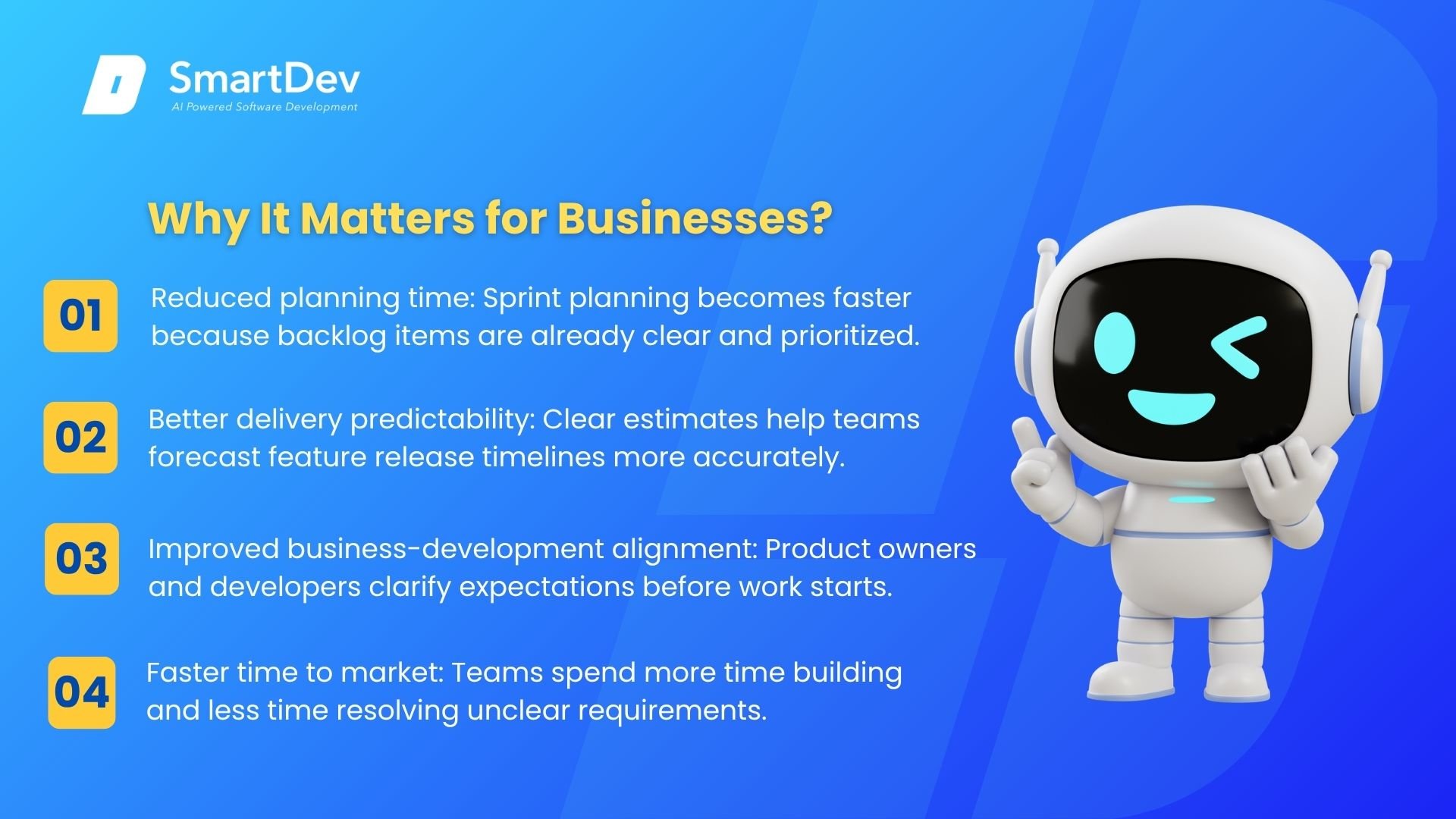
- Reduce planning time: A groomed backlog turns sprint planning into a focused selection process, not a requirements session. Teams spend minutes choosing work, not hours clarifying it.
- Increase delivery predictability: Well-estimated, clearly defined items make it far easier to forecast when features will ship, giving business stakeholders reliable timelines.
- Improve alignment between business and development: Grooming sessions bring product owners and developers together, closing the gap between business intent and technical execution before work begins.
- Accelerate time to market: Teams that groom regularly spend more time building and less time clarifying, directly speeding up feature delivery across the board.
For example, a mid-sized e-commerce company working with an outsourced development team in Vietnam found their sprint velocity was inconsistent and hard to forecast. After introducing bi-weekly 90-minute grooming sessions with their product owner and offshore team, sprint commitment accuracy improved noticeably and feature delivery became more predictable within three months.
How Does Backlog Grooming Work?
Backlog grooming follows a structured process that most agile teams run once or twice per sprint:
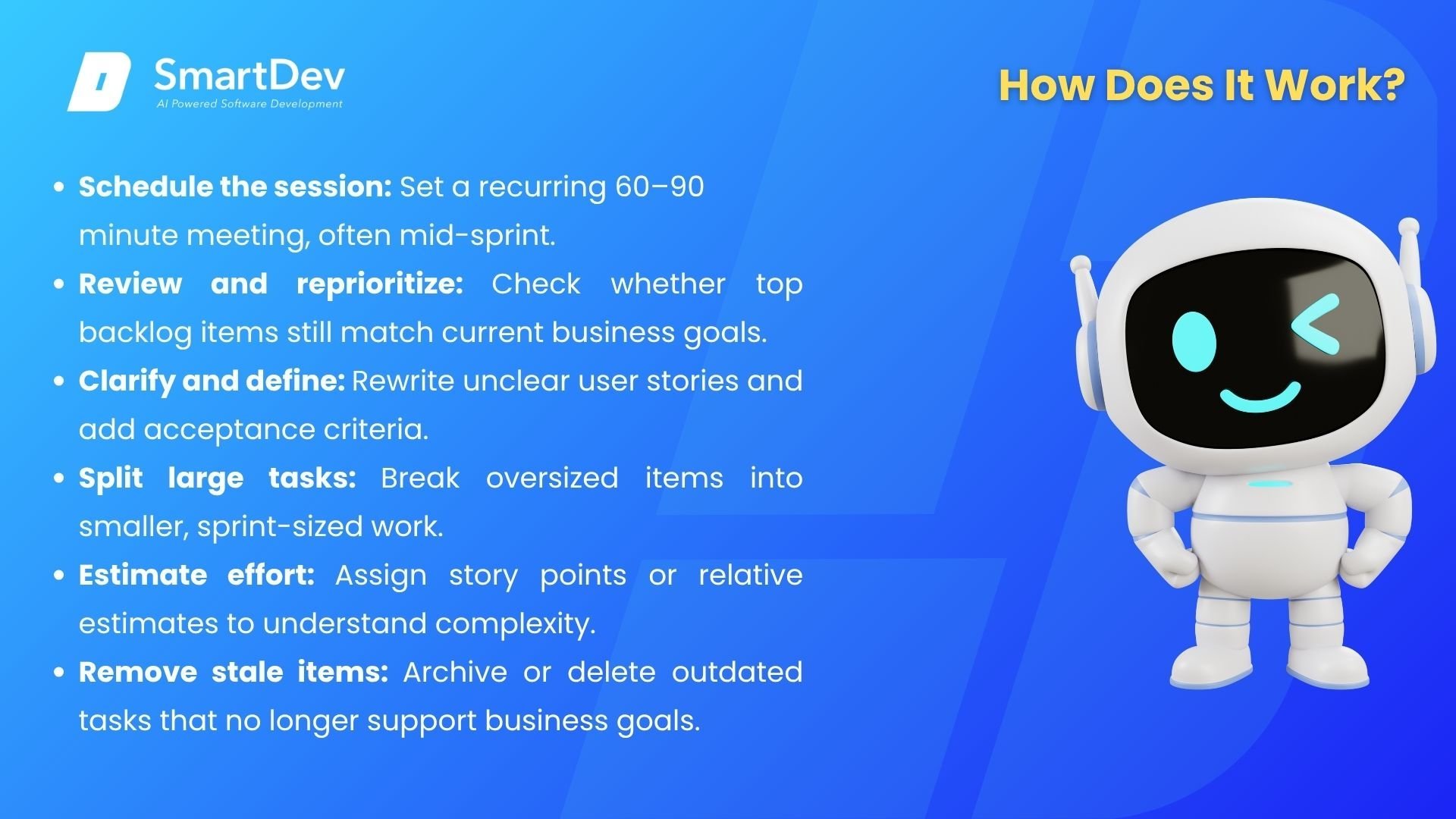
- Schedule the session: The product owner or scrum master books a recurring meeting, typically 60 to 90 minutes, attended by the product owner, development team, and relevant stakeholders. Sessions are usually held mid-sprint to prepare for the next one.
- Review and reprioritize: The team works through the backlog from the top, confirming that the highest-priority items still reflect current business goals. Items are reordered as priorities shift.
- Clarify and define: Vague user stories are rewritten with clear acceptance criteria so the team knows exactly when a task is complete. Large items are split into smaller, sprint-sized tasks that can be completed within a single iteration.
- Estimate effort: The team assigns story points or relative effort estimates to refined items. This shared estimation process surfaces technical risks and closes assumption gaps between developers and stakeholders.
- Remove stale items: Tasks that no longer align with business goals are archived or deleted, keeping the backlog focused and navigable. The result is a prioritized, well-defined backlog that feeds smoothly into sprint planning without debate or confusion about what needs to be built.
When to Use Backlog Grooming?
Backlog grooming is valuable in any agile software project, but it becomes especially critical in certain situations:
- Your sprint planning sessions run long: If planning consistently takes more than one hour, the backlog is not ready. Grooming is the fix.
- You are working with an outsourced or distributed team: Remote teams need extra clarity on requirements. Regular grooming sessions reduce back-and-forth communication across time zones and prevent misunderstandings from derailing sprints.
- Business priorities shift frequently: Regular grooming keeps the backlog in sync with evolving strategy so developers are always working on the highest-value items.
- New team members or stakeholders join the project: A grooming session orients newcomers to the backlog and the reasoning behind current priorities.
When NOT to groom:
- Do not conduct grooming without the product owner present. Prioritization decisions require someone with direct business authority and context.
- Avoid deep-refining items that are many sprints away. Requirements often change, and over-investing in distant backlog items wastes effort that could go toward near-term delivery.
Weitere verwandte Begriffe
Sprint Planning: The agile ceremony where a development team selects items from the groomed backlog and commits to completing them within a fixed sprint period, typically one to four weeks.
User Story: A short, plain-language description of a feature written from the end user’s perspective, used to define backlog items in a way both business and development teams can understand and act on.
Scrum Framework: An agile framework that structures software development into sprints and ceremonies, including backlog refinement, sprint planning, and retrospectives, to deliver working software incrementally and predictably.