Zu lang; nicht gelesen:
- A business requirement is a documented statement of what an organization needs a system, process, or solution to achieve in order to meet a business objective.
- In IT outsourcing, clearly defined business requirements are the foundation of successful project delivery and vendor alignment.
- Vague or incomplete requirements are one of the most common causes of project delays, cost overruns, and mismatched deliverables.

Every technology project begins with a need. Translating that need into precise, structured documentation is what separates successful delivery from costly rework. Business requirements form the contract between what a business wants to achieve and what a development team builds. In an outsourcing context, where teams may be distributed across time zones and cultures, this documentation becomes even more critical.
What is a Business Requirement?
A business requirement is a high-level statement that describes what an organization needs a system, product, or process to accomplish in order to achieve a specific business goal. It defines the “what” of a project, not the “how.” Business requirements capture stakeholder expectations and organizational objectives in a form that can guide technical design and development decisions.
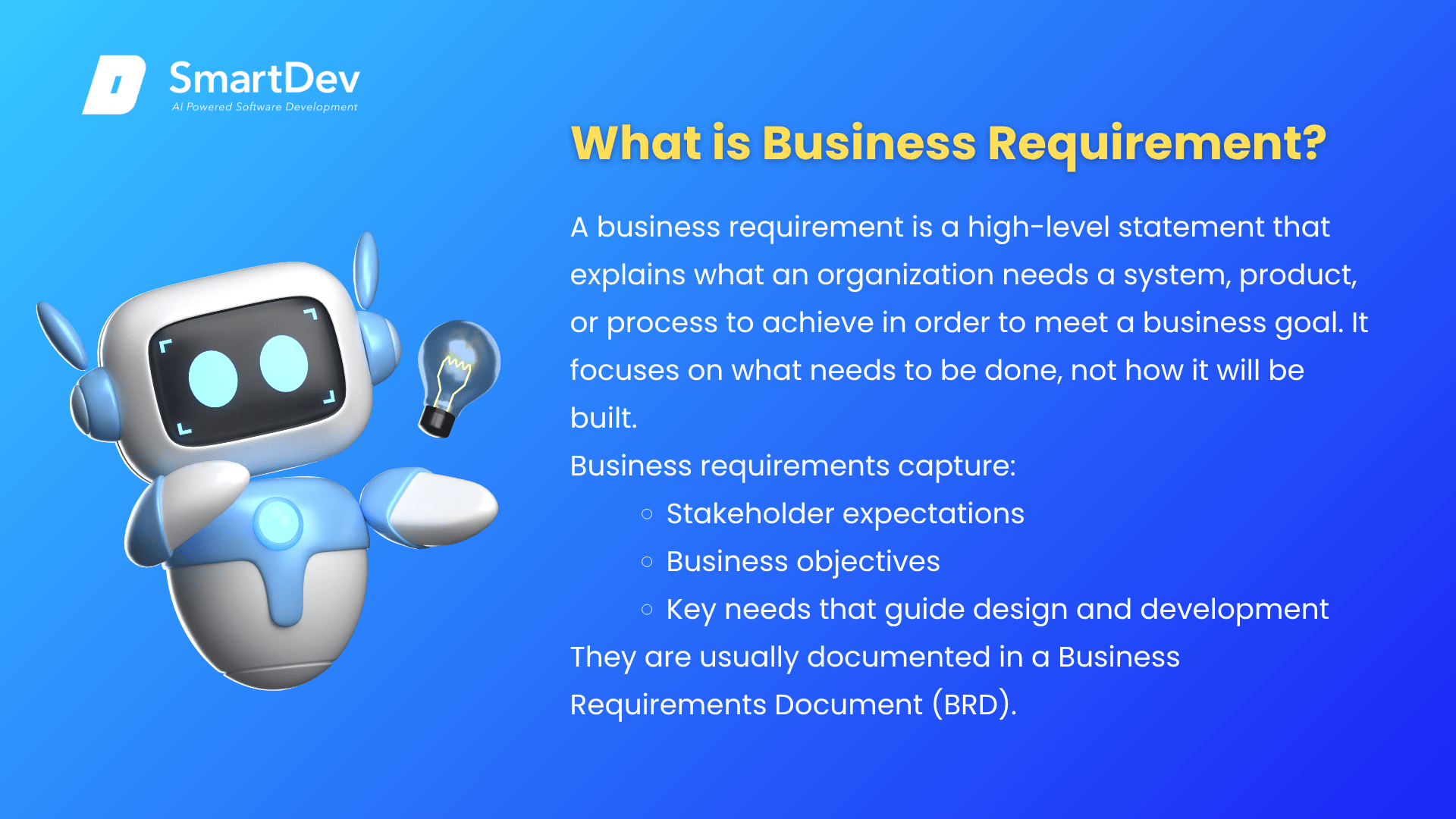
Business requirements are typically documented in a Business Requirements Document (BRD), which serves as the primary reference for all project stakeholders throughout the delivery lifecycle. A well-written BRD includes the business context and objectives, a description of the current state and identified gaps, the desired future state, functional and non-functional requirements, constraints and assumptions, and success criteria.
Requirements are generally categorized into several types. Functional requirements describe specific behaviors or functions the system must perform, such as allowing users to submit an order online. Non-functional requirements address system qualities such as performance, security, scalability, and availability. Business rules define the logic and policies that govern how the system should operate. Regulatory requirements capture compliance obligations that must be reflected in the solution design.
In IT outsourcing, business requirements serve as the primary communication bridge between the client organization, which understands the business problem, and the vendor team, which will engineer the solution. The quality of this documentation directly determines the accuracy and completeness of what gets built.
Warum ist das für Unternehmen wichtig?
Clear business requirements are foundational to successful IT outsourcing outcomes. When requirements are well-defined, vendor teams can estimate effort accurately, design appropriate solutions, and deliver work that meets expectations without repeated rounds of revision. When requirements are ambiguous or incomplete, the cost and timeline impact can be significant.
For C-level executives, business requirements represent the alignment between technology investment and business strategy. A requirement that is not tied to a measurable business outcome risks driving development effort that does not produce tangible value. Senior leaders who participate in or sponsor the requirements process help ensure that what gets built supports organizational priorities rather than drifting into technical complexity for its own sake.
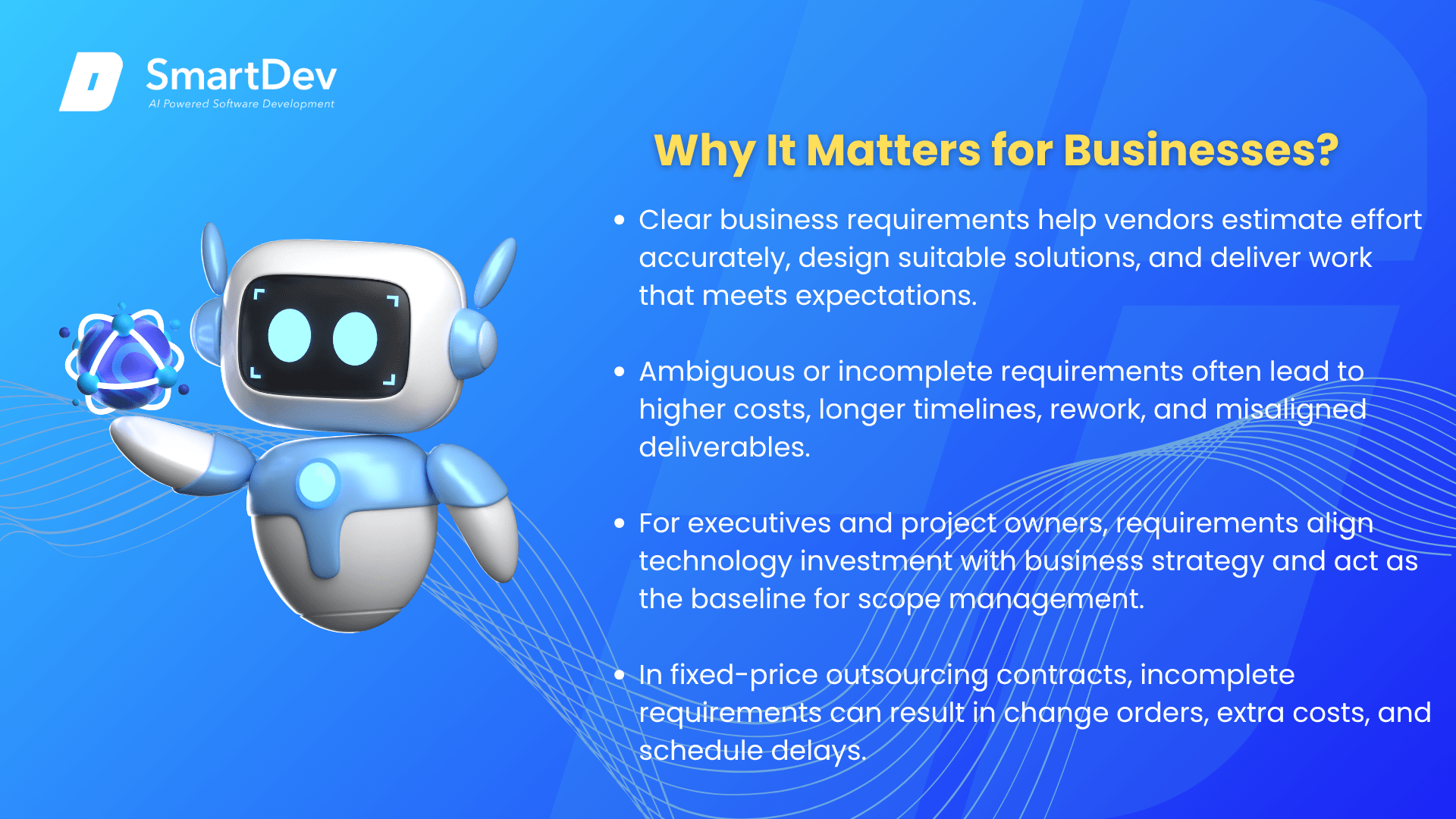 For IT managers and project owners, business requirements are the baseline against which scope is managed. Change requests that arise during delivery can be evaluated against the original requirements to determine whether they represent agreed scope or new additions that require contract amendments and revised timelines. This protects both the client and the vendor from scope creep, one of the most frequent contributors to project failure.
In fixed-price outsourcing contracts, the completeness of business requirements at the time of contracting is especially critical. Vendors price and scope fixed-price work based on documented requirements. Gaps or changes discovered after the contract is signed typically result in change orders, additional cost, and schedule delays.
Who Defines Business Requirements?
Business requirements are defined through a collaborative process involving multiple stakeholders. Business analysts (BAs) are typically the primary facilitators of requirements gathering. They conduct stakeholder interviews, workshop sessions, and process reviews to elicit and document requirements in a structured format.
On the client side, key contributors include functional business owners who understand the operational problem being solved, subject matter experts who can speak to specific workflow and data needs, IT architects who can identify technical constraints and integration requirements, compliance and legal teams who surface regulatory obligations, and executive sponsors who define strategic priorities and success criteria.
On the vendor side, solution architects and technical leads review business requirements to assess feasibility, identify risks, and raise clarifying questions. In agile delivery models, product owners translate business requirements into user stories that can be prioritized and estimated within sprint cycles.
Requirements ownership typically rests with the client organization. While the vendor may assist in drafting or refining the BRD, the client is ultimately accountable for ensuring that requirements accurately reflect the business need. Formal sign-off on the BRD by designated client stakeholders is a standard governance step before development work begins.
How Are Business Requirements Defined?
The requirements definition process follows a structured lifecycle. It begins with stakeholder identification, where all parties who have a stake in the solution are mapped and engaged. This is followed by requirements elicitation, using methods such as interviews, workshops, surveys, observation, and analysis of existing systems and documentation.
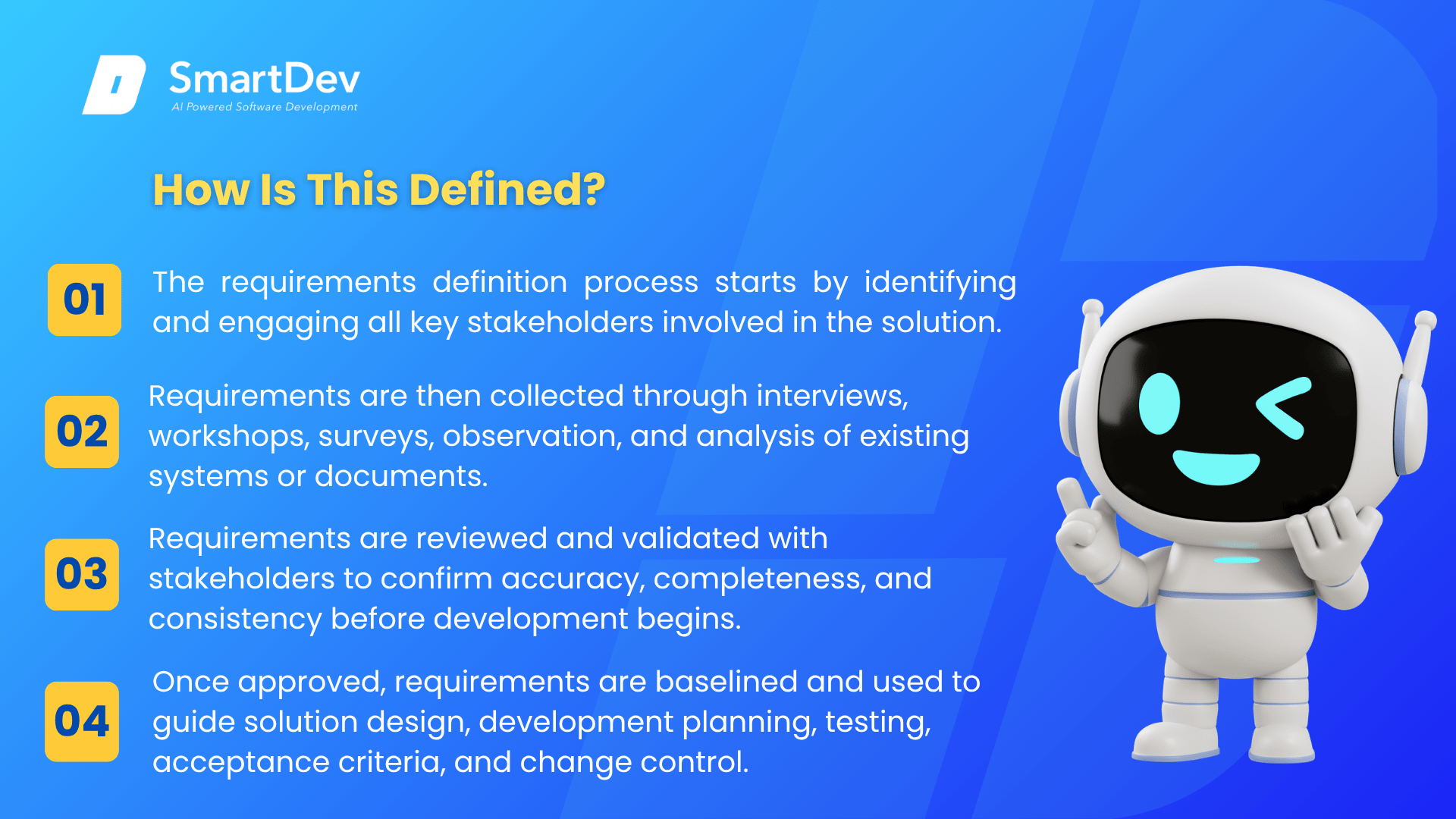 Elicited requirements are then documented in a structured format, reviewed for completeness and consistency, and validated with stakeholders to confirm accuracy. Validation is a critical step where stakeholders confirm that the documented requirements correctly represent their needs before development begins. Any gaps or conflicts identified during validation are resolved before the BRD is finalized.
Once approved, requirements are baselined and used to drive all subsequent project decisions, including solution design, development planning, testing strategy, and acceptance criteria. Changes to baselined requirements are managed through a formal change control process that assesses impact on scope, cost, and timeline before any modification is approved.
In agile outsourcing engagements, requirements are typically managed as a living product backlog rather than a static document. Business requirements are broken into epics and user stories that are refined iteratively as the project progresses, allowing for greater flexibility while maintaining traceability to the original business objectives.
Weitere verwandte Begriffe
Functional Specification: A detailed document that describes how a system should behave in response to specific inputs and conditions. Functional specifications translate business requirements into technical design criteria that development teams can implement directly.
Business Model: A business model explains how a company creates value, serves customers, and makes money. Business requirements define what a system or process must do to support that business model.
Stakeholder Management: The process of identifying, engaging, and communicating with individuals who have an interest in or influence over a project. Effective stakeholder management is essential during requirements gathering to ensure all perspectives are captured and that sign-off reflects genuine consensus.