
Zu lang; nicht gelesen:
- A data strategy is a long-term plan that defines how an organization collects, manages, governs, and uses data to achieve specific business outcomes.
- Without a data strategy, organizations end up with fragmented data silos, inconsistent reporting, and limited ability to trust or act on the data they hold.
- A successful data strategy requires alignment across leadership, technology, and business teams, not just an IT project plan.
Data is one of the most frequently cited strategic assets in modern business. Yet the majority of organizations struggle to extract consistent value from the data they collect. The reason is rarely a lack of data. It is almost always the absence of a coherent plan for how that data should be managed, shared, and used. That plan is called a data strategy.

What is Daten Strategy?

A data strategy is a long-term, enterprise-wide plan that defines the technology, processes, people, and governance frameworks an organization needs to manage its data assets effectively and use them to achieve business goals. It is not a list of analytics tools to implement or a data governance policy document in isolation. It is the overarching framework that connects all of these elements into a coherent, coordinated approach.
A complete data strategy addresses several interconnected domains. Data collection defines what data is gathered, from which sources, and at what frequency. Data management covers how data is stored, organized, and maintained over time. Data governance sets the standards for data quality, access controls, ownership, and compliance. Data analytics defines how data is analyzed and made available to decision-makers. And data security addresses how the organization protects its data assets from breaches and unauthorized access.
The strategy also defines how these domains connect to specific business objectives. A data strategy that exists independently of business priorities tends to become a technology exercise rather than a value-creation initiative. The most effective strategies are built by asking which business decisions would improve if leaders had better data, and then working backward to define what data capabilities are required.
Warum ist das für Unternehmen wichtig?
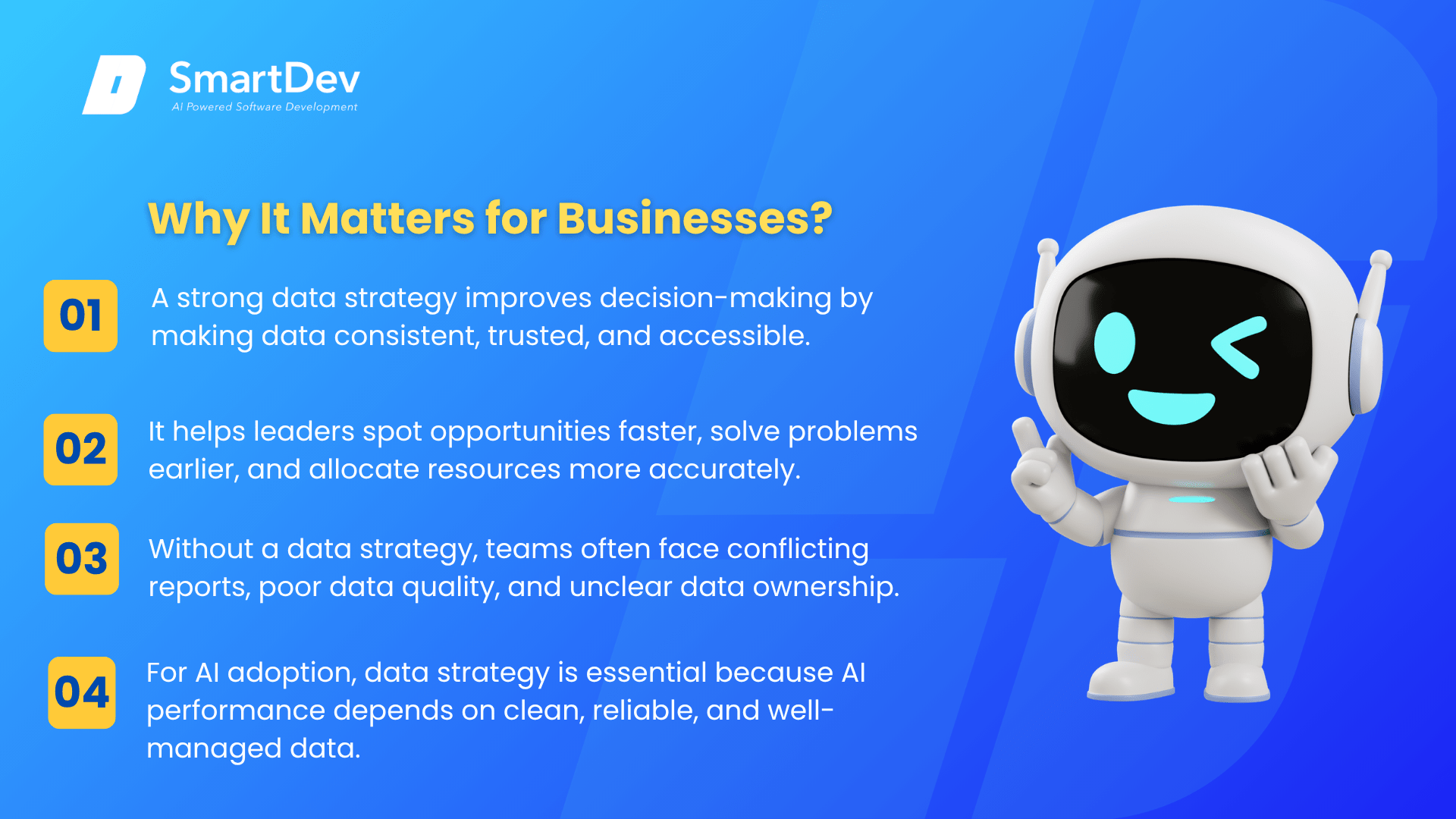
A well-executed data strategy gives organizations a structural advantage in decision-making. When data is managed consistently, trusted across departments, and accessible to the people who need it, the quality and speed of decisions improves across every business function. Leaders can identify market opportunities earlier, respond to operational problems faster, and allocate resources more precisely.
The absence of a data strategy has measurable costs. Organizations without one routinely encounter conflicting reports from different departments because each team uses its own data definitions and sources. AI and analytics initiatives stall because the data they depend on is incomplete or unreliable. Compliance risk increases because no one has clear ownership of where sensitive data resides or how it is being used.
In the context of AI adoption, a data strategy has become a prerequisite rather than a nice-to-have. AI models are only as good as the data they train on. Organizations that invest in a data strategy before pursuing AI initiatives consistently achieve better model performance, faster deployment timelines, and more sustainable results than those that attempt to build AI on top of disorganized data foundations.
Who Is Responsible for Data Strategy?
Responsibility for a data strategy is shared across leadership, though it requires clear executive ownership to succeed. In organizations with dedicated data leadership, the Chief Data Officer typically leads strategy development and is accountable for its execution. In organizations without this role, ownership often sits with the Chief Technology Officer or Chief Information Officer, in close collaboration with senior business unit leaders.
What makes data strategy ownership distinctive is that it cannot function as a purely technical responsibility. Business unit leaders must be active participants because the strategy must reflect their data needs and operating realities. Legal and compliance teams must be involved to ensure governance frameworks meet regulatory requirements. Finance must weigh in on investment prioritization. HR may need to address data literacy and workforce planning implications.
At the operational level, data engineers, data analysts, and data governance specialists translate the strategy into practice. They build the pipelines, maintain the quality standards, and operate the platforms that the strategy depends on. The most effective organizations treat data strategy as a living document with defined ownership at every level, from executive sponsorship through to day-to-day operational accountability.
When Should an Organization Develop a Data Strategy?
The honest answer is: before it is urgently needed. Organizations that wait until a specific crisis, such as a failed AI project, a regulatory audit, or a merger integration, forces the issue typically find that building a data strategy under pressure is significantly more difficult and expensive than doing so proactively.
There are several clear signals that a data strategy is overdue. These include persistent disagreements between teams about basic metrics, repeated failures to deliver analytics projects on time, AI initiatives that stall at the data preparation stage, growing compliance obligations around data residency or privacy, and increasing data volumes that existing tools and processes cannot handle reliably.
The right time to begin is when an organization is setting or refreshing its broader business strategy, since data and business strategy should be developed together. It is also appropriate when a major technology investment, such as a cloud migration or an ERP upgrade, is planned, because these initiatives create natural opportunities to build better data foundations without disrupting existing operations.
Weitere verwandte Begriffe
- Data Infrastructure: The technology systems and platforms that a data strategy depends on to store, move, and process organizational data.
- Data Engineering Capability: The organizational function responsible for building and maintaining the pipelines and systems that the data strategy relies on to deliver data reliably.
- KI-Strategie: The enterprise plan for how AI will create business value, which is closely linked to data strategy since high-quality data is the foundation of every AI initiative.