Kurz zusammengefasst
- A governance framework is a structured set of policies, roles, and processes that defines how decisions are made and accountability is maintained across an organization’s IT operations.
- It aligns technology investments with business strategy, manages risk, and ensures regulatory compliance, making it essential for organizations with complex IT environments.
- In IT outsourcing, a governance framework defines how the client and vendor collaborate, escalate issues, and measure performance, making it a critical factor in outsourcing success.
Governance frameworks are what separate organizations that manage IT strategically from those that manage it reactively. Without a framework, technology decisions get made in silos, risks go unmanaged, and no one is accountable when systems fail or compliance obligations are missed. This article explains what governance frameworks are, who needs them, and how to implement one effectively.
What is a Governance Framework?
A governance framework is a structured system of policies, roles, responsibilities, and processes that guides how an organization makes decisions about its technology, manages associated risks, and remains accountable for the outcomes of those decisions.
In IT, governance frameworks define:
- Decision rights: Who has the authority to approve technology investments, vendor selection, architecture changes, and security policies
- Accountability structures: Who is responsible for the performance and compliance of each system, service, or IT process
- Policies and standards: The rules the organization follows for data management, security, procurement, development, and operations
- Performance management: The metrics and review processes used to evaluate whether IT is delivering value and meeting service level commitments
Common IT governance frameworks include COBIT (Control Objectives for Information and Related Technologies), ITIL (Information Technology Infrastructure Library), ISO/IEC 38500, and TOGAF. Organizations typically adapt one or more of these frameworks rather than creating entirely custom governance structures.
Warum ist das für Unternehmen wichtig?
Without a governance framework, technology decisions are driven by whoever has the most influence in a given moment rather than by what best serves the business. This leads to duplicated systems, security gaps, compliance failures, and IT spending that cannot be justified against business outcomes.
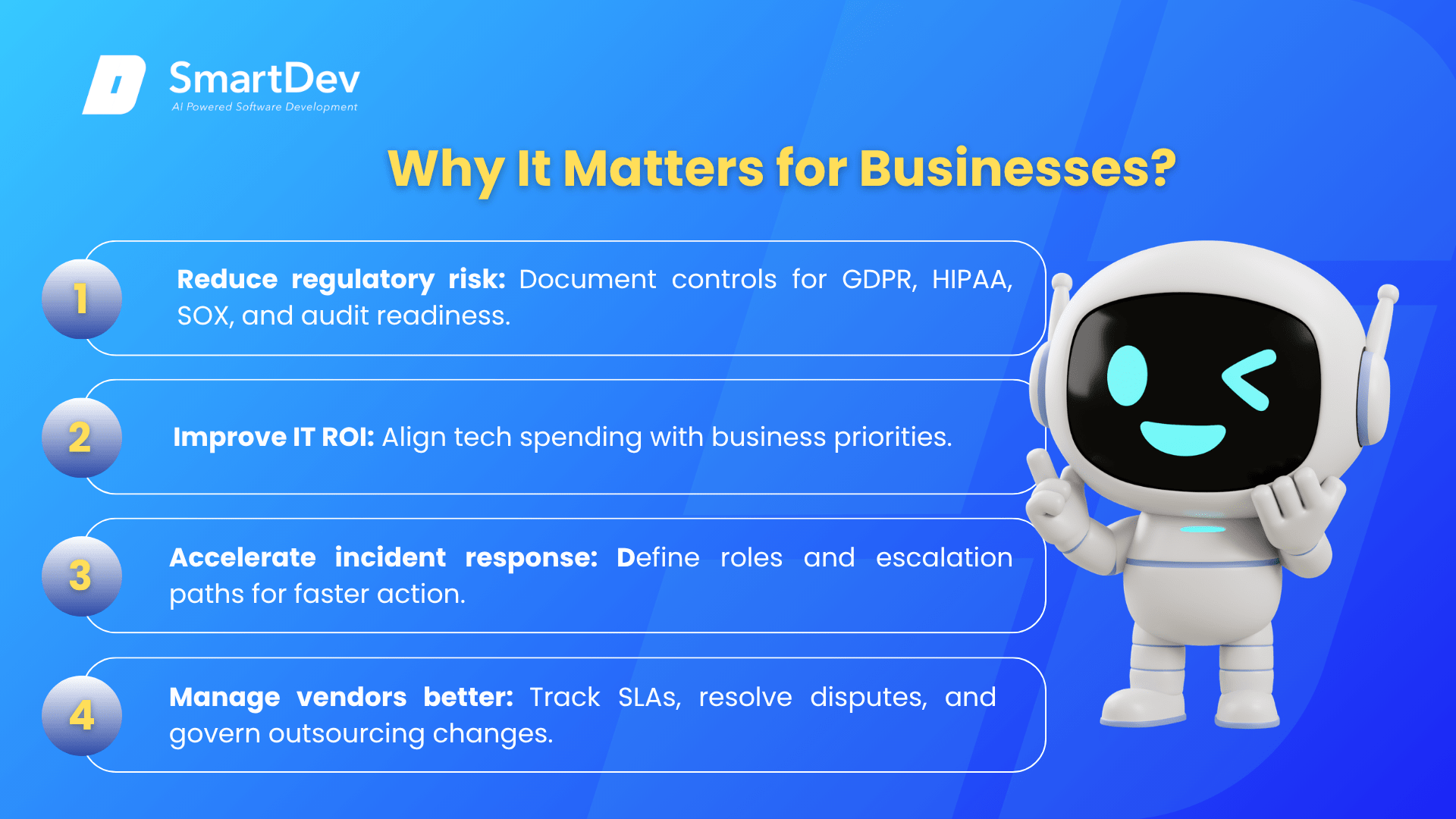
- Reduce regulatory risk: Organizations operating under GDPR, HIPAA, SOX, or industry-specific regulations require documented governance structures to demonstrate compliance during audits and to systematically enforce required controls.
- Improve IT investment returns: Governance frameworks align technology spending with strategic priorities, preventing investment in systems that do not advance business goals and enabling prioritization of resources across competing demands.
- Accelerate incident response: Clearly defined roles and escalation paths in a governance framework mean that when problems occur, the right people respond quickly rather than waiting for ad hoc escalation that loses critical time.
- Manage outsourcing relationships: IT governance frameworks define the oversight structure for vendor relationships, specifying how SLA performance is monitored, how disputes are resolved, and how strategic changes to the engagement are approved.
For example, a financial services company with 12 software vendors and no formal governance structure was failing regulatory audits because no one could demonstrate who was responsible for data security across vendor-managed systems. After implementing a governance framework aligned with COBIT, the organization passed its next audit, reduced vendor-related security incidents by 40%, and cut the time to approve new vendor engagements from 6 months to 8 weeks through streamlined decision processes.
Who Uses Governance Frameworks?
Governance frameworks are used most extensively in organizations where technology decisions have significant business, regulatory, or financial consequences:
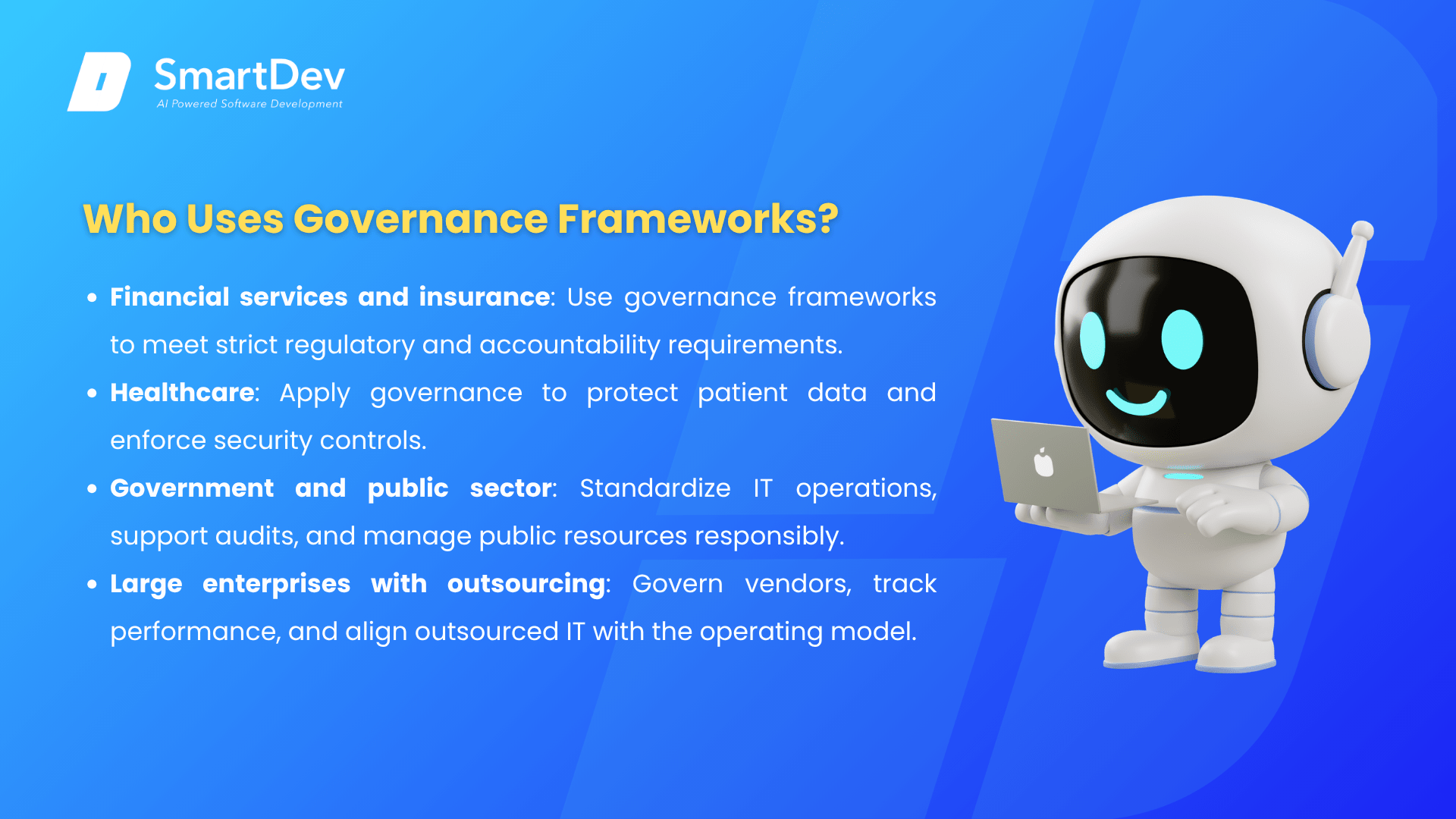
- Financial services and insurance: Banks, insurers, and payment processors operate under strict regulatory requirements that mandate documented governance structures. IT governance frameworks provide the accountability trail that regulators expect.
- Gesundheitspflege: Health systems managing patient data under HIPAA and similar regulations use governance frameworks to ensure data security controls are consistently applied across complex IT environments spanning clinical, administrative, and partner systems.
- Government and public sector: Public organizations use frameworks such as COBIT and ITIL to standardize IT operations across departments, enable audit readiness, and demonstrate responsible stewardship of public resources.
- Large enterprises with IT outsourcing programs: Companies managing multiple outsourcing relationships across development, infrastructure, and support need governance structures that define how each vendor is measured, managed, and integrated into the overall IT operating model.
Within organizations, governance frameworks are typically owned by the CIO or CTO, with governance committees including business unit leaders, risk officers, and legal counsel to ensure alignment across all stakeholder interests.
How Does a Governance Framework Work?
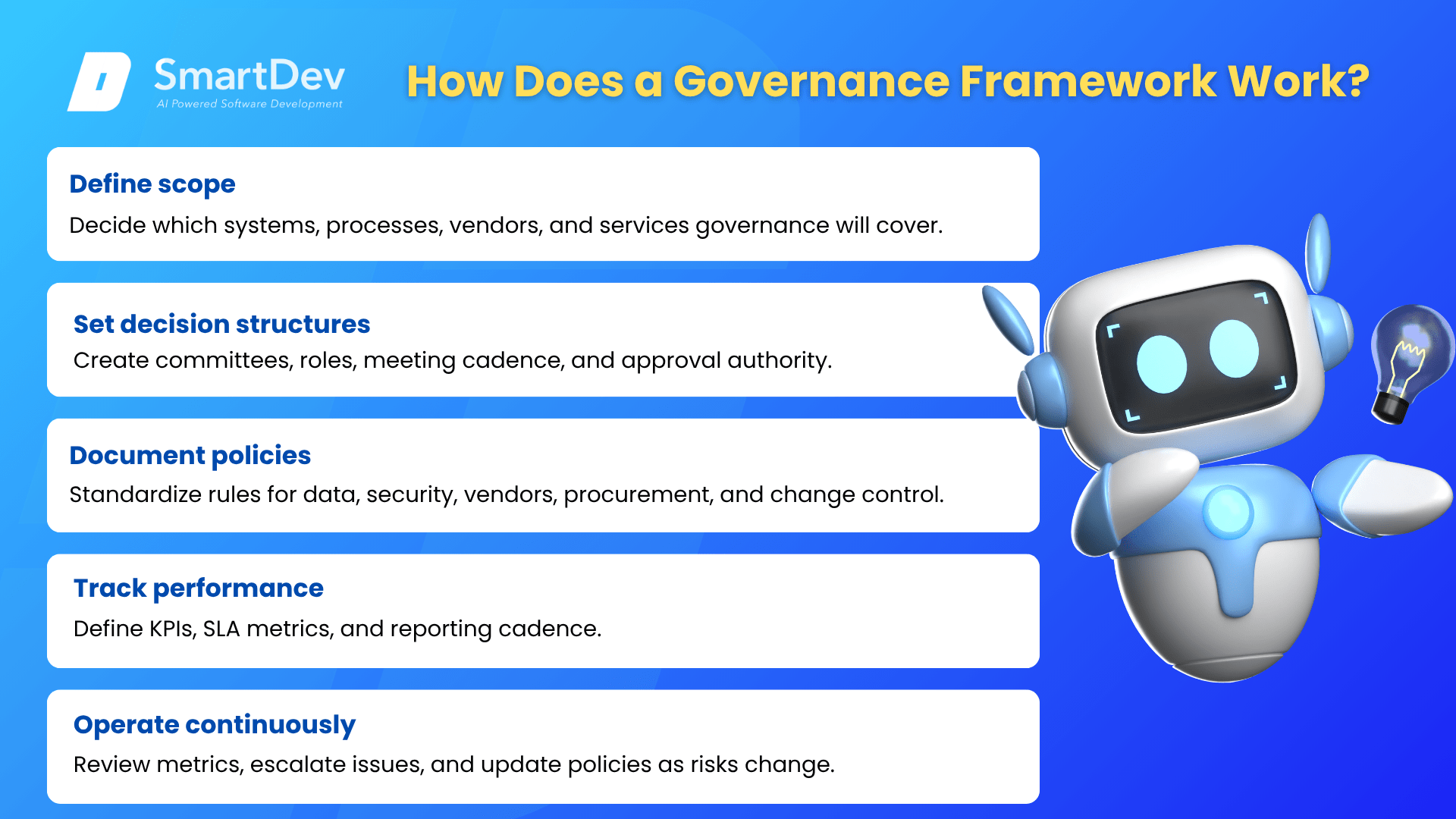
- Define the governance scope: Identify which decisions, systems, and processes the framework will cover. For outsourcing governance specifically, define which vendor relationships and service categories fall within the framework’s authority.
- Establish decision-making structures: Create governance bodies such as an IT Steering Committee for strategic decisions and a Change Advisory Board for operational changes, with clear membership, meeting cadence, and decision authority for each.
- Document policies and standards: Write the policies the organization will follow for key areas: data management, security, vendor management, procurement, and change control. Make these accessible, version-controlled, and reviewed at defined intervals.
- Define performance metrics: Establish the KPIs and SLA metrics used to evaluate IT performance and vendor delivery, and the reporting cadence through which these are reviewed by governance bodies.
- Operate and improve: Run governance meetings, review metrics, escalate issues, and update policies as the business and its risk environment change. Governance is a continuous operating discipline, not a one-time document exercise.
The result is an organization where technology decisions are made consistently, accountability is clear, and compliance obligations are met as a natural output of the operating model rather than through expensive reactive remediation.
Weitere verwandte Begriffe
- Escalation Management: The systematic process of elevating unresolved issues, incidents, or decisions through a predefined chain of authority or expertise when they cannot be addressed effectively at the level where they first arose.
- Service Level Agreement (SLA): A contractual commitment defining vendor performance standards, monitored and enforced through the vendor governance processes defined within the IT governance framework.
- Integration Testing: A type of software testing where individual modules, services, or components are combined and tested as a group to ensure they function correctly together.