Kurz zusammengefasst
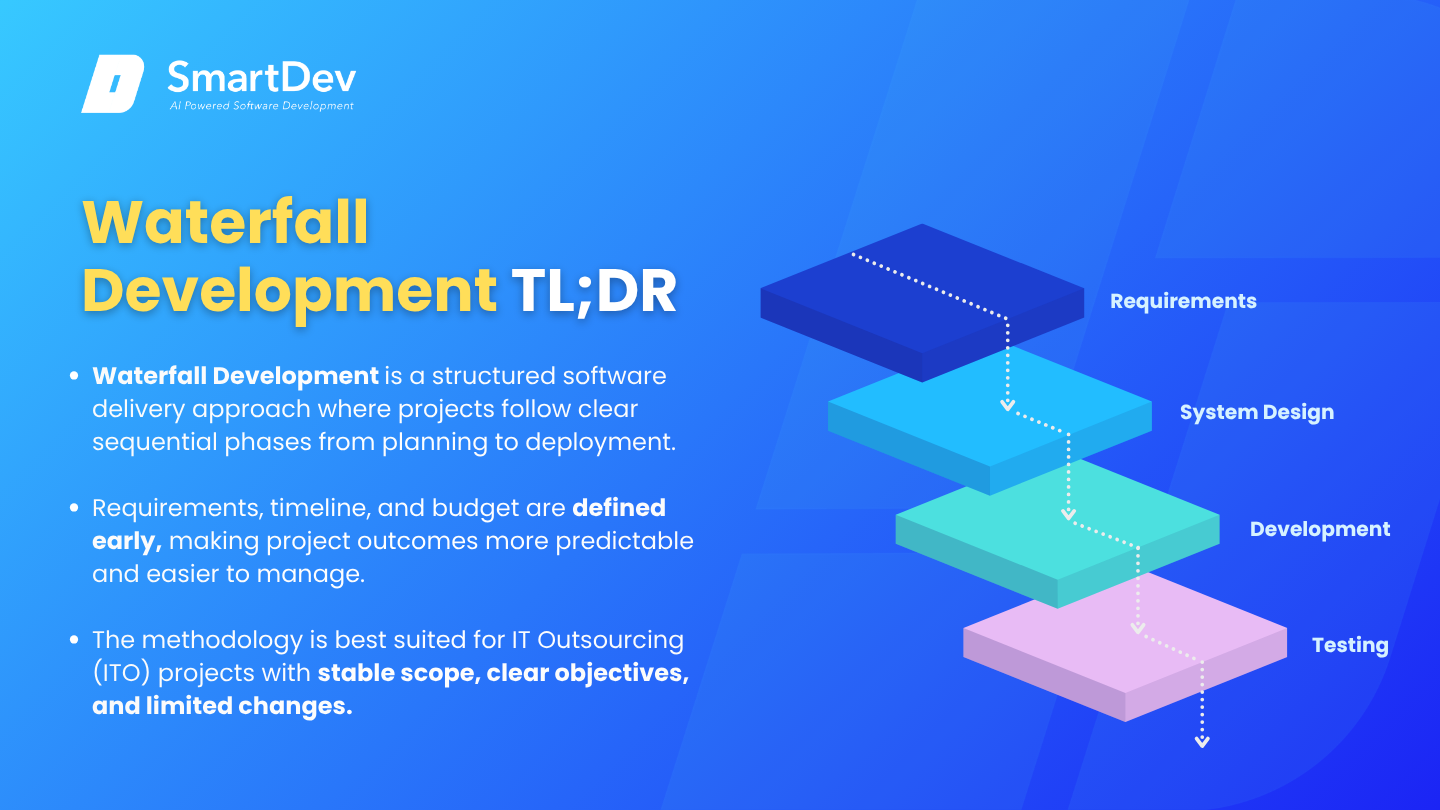
Waterfall Development is a linear software development Methodik where projects progress through sequential phases such as requirements, design, development, testing, and deployment. In IT Outsourcing (ITO), the Waterfall model is widely used when requirements are clearly defined, scope is fixed, and businesses need predictable timelines, costs, and deliverables.
What Is Waterfall Development?
Waterfall Development (also known as the Waterfall model) is a structured approach to the Software Development Lifecycle (SDLC) where each project phase is completed before the next begins. The methodology follows a logical flow from planning to delivery, ensuring each stage has defined outputs and approval checkpoints.
The typical Waterfall development process includes requirements analysis, system design, implementation, testing, deployment, and maintenance. Because each phase depends on the completion of the previous stage, the model prioritizes detailed planning and documentation early in the project lifecycle.
In ITO environments, Waterfall Development helps align business stakeholders and outsourcing vendors around clearly defined project scope, technical specifications, and expected outcomes. This reduces ambiguity and creates a structured delivery framework that supports long-term planning and resource allocation.
Compared to iterative methodologies, the Waterfall model emphasizes predictability, making it particularly useful for enterprise systems, legacy modernization, and projects with stable requirements.
Why Waterfall Development Matters for Businesses?
For organizations outsourcing software development, the Waterfall methodology provides a reliable structure for managing scope, cost, and delivery timelines.
Key business advantages of Waterfall Development include:
1. Verbesserte Projektplanung und Klarheit
2. Verbesserte Kommunikation und Zusammenarbeit
3. Fortschritt verfolgen und Pläne anpassen
4. Erleichtert die Entscheidungsfindung
By offering a structured view of the project, a roadmap helps decision-makers evaluate potential risks and bottlenecks. It can guide decisions about resource allocation, timelines, and scope adjustments, ensuring that all decisions align with the project’s ultimate goals.
How Does Waterfall Development Work?
Der Waterfall SDLC model divides software delivery into structured phases that follow a logical sequence.
1. Requirements Analysis
Project stakeholders define business goals, functional requirements, technical constraints, and expected deliverables. This phase etabliert the foundation for the entire project.
2. System Design
Based on approved requirements, technical teams design system architecture, database structures, integrations, and workflows needed to build the solution.
3. Entwicklung
Software engineers implement the solution according to the design specifications and documented requirements.
4. Testing
Quality assurance teams verify that the software meets defined requirements and performs reliably across different conditions.
5. Deployment
The completed solution is released to the production environment or delivered to end users.
6. Wartung
After deployment, the system is überwacht and updated to ensure performance, security, and long-term usability.
When Should Businesses Use Waterfall Development?
Waterfall Development is most effective when project scope and requirements can be clearly defined before development begins.
Businesses typically choose the Waterfall model when:
- Requirements are stable and unlikely to change significantly
- The project scope can be fully documented early in the planning phase
- Budget and timeline must be determined in advance
- Regulatory compliance requires structured documentation and approvals
- Stakeholders prefer milestone-based project tracking
- Vendor deliverables must be contractually defined
- System integrations and dependencies are predictable
Common applications include enterprise software development, government platforms, financial systems, healthcare applications, infrastructure software, and large-scale digital transformation initiatives.
Waterfall is particularly suitable for ITO engagements where clear scope alignment supports efficient vendor collaboration and predictable delivery outcomes.
Waterfall Development vs. Agile Development
| Aspekt | Waterfall Development | Agile Entwicklung |
| Ansatz | Linear, step-by-step process | Iterative, cycle-based process |
| Requirements | Defined at the beginning | Evolve during the project |
| Flexibilität | Low | Hoch |
| Lieferung | One complete release | Multiple smaller releases |
| Client Involvement | At key milestones | Continuous collaboration |
| Planning | Detailed upfront planning | Adaptive planning |
| Best Fit | Stable scope, clear goals | Changing needs, evolving ideas |
Weitere verwandte Begriffe
1. Scrum Framework
A popular Agile framework that organizes development into short, time-boxed iterations called sprints. Scrum promotes frequent feedback, cross-functional collaboration, and ongoing refinement, offering a flexible alternative to the linear structure of Waterfall Development.
2. Agile Development
An iterative software development approach that focuses on continuous feedback, flexibility, and incremental delivery. Agile Development contrasts with Waterfall Development by allowing requirements and solutions to evolve throughout the project lifecycle.
3. Agile Methodik
Agile Methodik ist ein flexibler, iterativer Ansatz im Projektmanagement, der inkrementellen Fortschritt, regelmäßiges Feedback und Anpassung betont. Er konzentriert sich auf die Lieferung kleiner, überschaubarer Arbeitsblöcke und die kontinuierliche Verfeinerung des Projekts auf der Grundlage von Echtzeit-Input.