
Introduction
Many organizations invest heavily in artificial intelligence yet struggle to turn those investments into real business outcomes. The issue is rarely a lack of ambition or technology. More often, it is a lack of readiness.
An AI Readiness Assessment helps organizations understand whether their data, systems, and technical foundations are capable of supporting AI initiatives in production. Instead of starting with model development, readiness assessment focuses on preparation. It ensures AI efforts are grounded in reality, aligned with business goals, and designed to scale.
SmartDev addresses this challenge with a structured three-week assessment that evaluates AI, data, and system readiness in a clear and practical way. This approach allows organizations to identify risks early, prioritize the right use cases, and move forward with confidence.
What Is an AI Readiness Assessment?
An AI Readiness Assessment is a structured evaluation of an organization’s capability to design, deploy, and operate AI solutions successfully. Its purpose is not to build AI, but to determine whether building AI makes sense and what must be prepared beforehand.
A proper AI readiness assessment answers four fundamental questions:
- Is there a real business problem where AI can deliver measurable value?
- Is the data sufficient, reliable, and accessible for AI use cases?
- Can existing systems integrate with and support AI workloads?
- Are infrastructure, tools, and teams ready to run AI in production?
Unlike a traditional IT Readiness Assessment, which focuses on infrastructure stability and security, AI readiness takes a broader and more strategic view. It connects business strategy, data maturity, system architecture, and technical execution into a single evaluation.
Organizations typically need an AI Readiness Assessment when:
- Moving from AI experiments to enterprise-scale deployment
- Scaling multiple AI use cases across departments
- Modernizing data platforms and legacy systems
- Planning significant investment in AI or advanced analytics
Why AI Projects Fail Without Readiness
Many AI initiatives fail before they deliver value, even when the technology itself works. Industry data shows that organizational readiness is the dominant failure factor.
According to Gartner, up to 85 percent of AI projects fail to deliver expected business value, largely due to poor data quality, lack of governance, and insufficient operational readiness. This indicates that failure rarely comes from the AI models themselves, but from the environments in which they are deployed.
This happens because organizations underestimate the complexity of deploying AI in real-world environments.
Common failure patterns include:
- AI models trained on incomplete or inconsistent data
- Legacy systems that cannot support real-time data pipelines
- Lack of governance around data usage and model decisions
- No operational ownership once models move to production
- Misalignment between business expectations and technical reality
Without an AI Readiness Assessment, these risks often surface too late. Projects stall, costs increase, and stakeholder confidence erodes. Readiness assessment shifts risk discovery to the beginning, when it is still inexpensive and manageable.
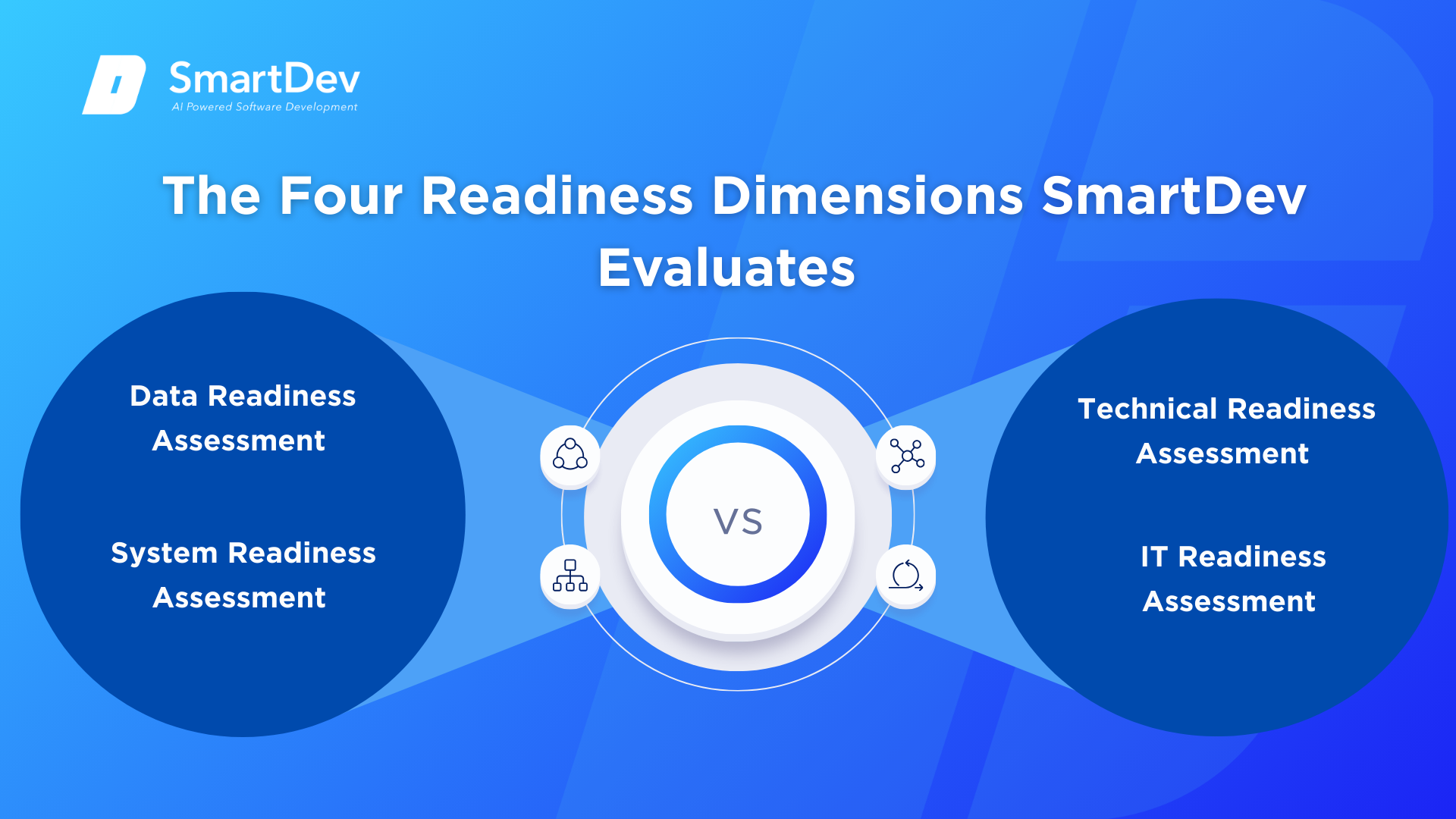
The Four Readiness Dimensions SmartDev Evaluates
Data Readiness Assessment
The Data Readiness Assessment determines whether an organization’s data can realistically support AI use cases.
SmartDev evaluates:
- Availability of relevant data across business domains
- Data quality, consistency, and completeness
- Historical data depth required for training models
- Data labeling and annotation processes
- Data governance, ownership, and access control
This assessment identifies data gaps, quality issues, and governance risks that could undermine AI accuracy or trustworthiness. If data readiness is low, remediation steps are defined before any AI development begins.
System Readiness Assessment
The System Readiness Assessment examines how existing systems interact with AI solutions.
Key evaluation areas include:
- Legacy system constraints and modernization needs
- Integration complexity between systems and data sources
- Real-time versus batch processing capabilities
- Scalability and performance limitations under AI workloads
Many systems were not designed for continuous data ingestion or AI inference. This assessment clarifies what system changes are required to support AI reliably.
Technical Readiness Assessment
The Technical Readiness Assessment focuses on the engineering and operational capability to run AI in production.
SmartDev assesses:
- Infrastructure readiness. Cloud, on-premise, or hybrid
- AI and data tooling maturity
- MLOps practices for deployment, monitoring, and retraining
- Model lifecycle management
- Security, auditability, and access management
This dimension ensures AI solutions can be maintained, monitored, and improved over time rather than remaining experimental.
IT Readiness Assessment
The IT Readiness Assessment provides a foundational view of enterprise IT capability.
It covers:
- Infrastructure stability and reliability
- Network performance and availability
- Security posture and compliance requirements
- Operational support, monitoring, and incident response
Strong IT readiness ensures AI workloads are built on a secure and stable operational foundation.
Ready to turn your product vision into a validated roadmap in just 3 weeks—before you burn through your development budget?
SmartDev's 3-week product discovery process replaces guesswork with strategic clarity. We identify risks early, align your team, and deliver a validated roadmap that accelerates your path to market.
De-risk your product launch, avoid costly pivots, and move into development with confidence.
Schedule Your Discovery Sprint TodaySmartDev’s 3-Week AI Readiness Assessment Approach
Week 1. AI Feasibility Study and Business Alignment
Week 1 ensures that AI initiatives are grounded in real business priorities. SmartDev works closely with business leaders and technical stakeholders to align AI opportunities with strategic objectives, organizational constraints, and measurable success criteria. This alignment reduces the risk of pursuing AI projects that lack impact or internal support.
During this phase, potential AI use cases are identified across relevant business functions and evaluated based on their expected value and strategic relevance. Each use case is then assessed for feasibility, focusing on the factors that most commonly determine success:
- Availability and quality of data needed to train and operate AI models
- Technical complexity and integration effort with existing systems
- Regulatory, security, and operational constraints

At the end of Week 1, SmartDev delivers a prioritized portfolio of AI initiatives that balances business impact, feasibility, risk, and time-to-value.
Week 2. Data and System Readiness Assessment
Week 2 focuses on whether the organization’s data and systems can realistically support AI development and deployment. SmartDev evaluates existing data assets to determine whether they are accurate, complete, well-governed, and compliant with privacy and security requirements. This step helps identify issues that could undermine AI performance or trust.
In parallel, SmartDev reviews the organization’s system landscape, including core platforms, integration patterns, and scalability constraints. The assessment highlights gaps, risks, and dependencies that may limit AI adoption if not addressed.
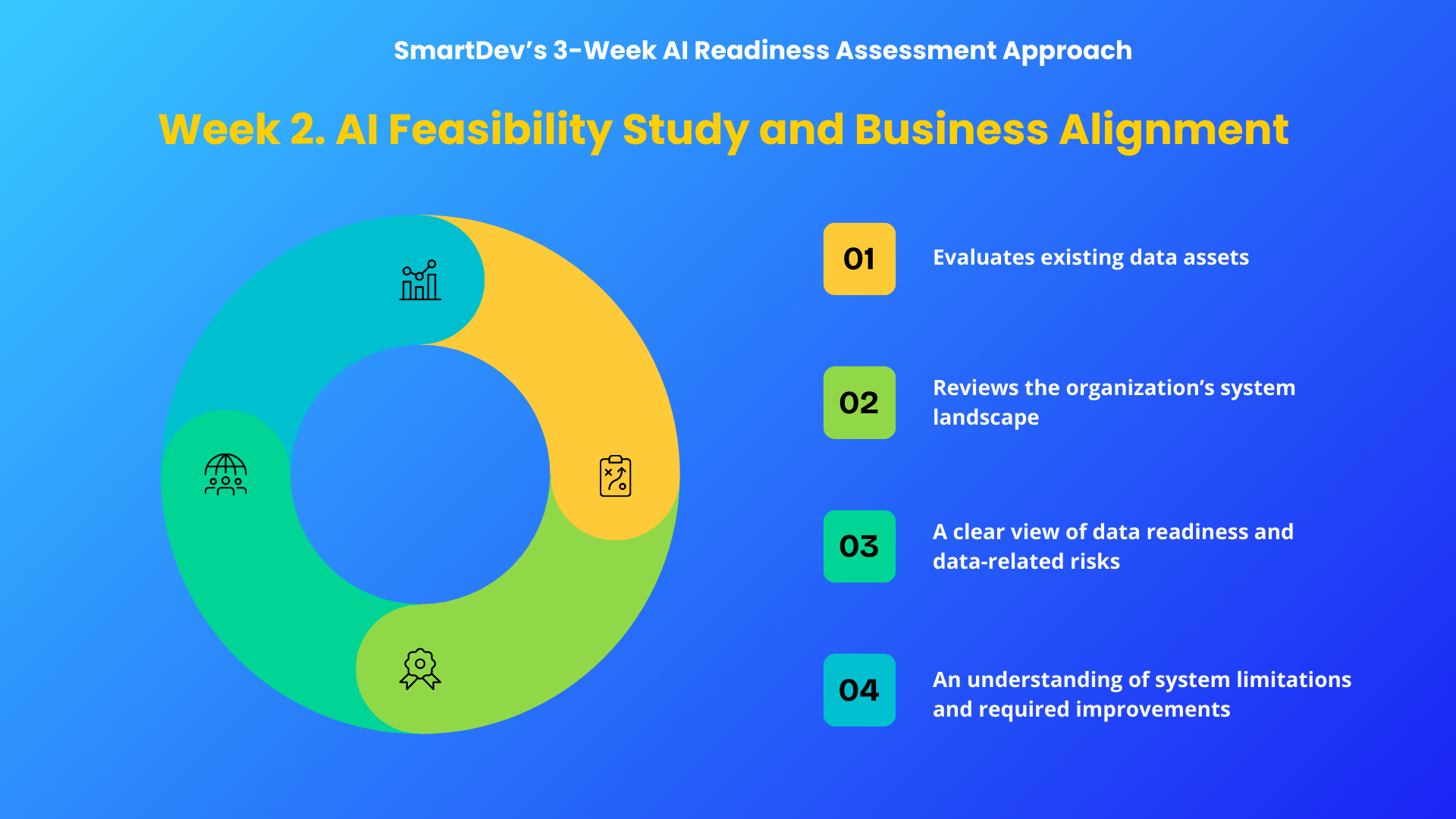
Key outcomes of this phase include:
- A clear view of data readiness and data-related risks
- An understanding of system limitations and required improvements
These insights clarify what changes are needed to create a reliable foundation for AI.
Week 3. Technical Readiness Assessment and AI Roadmap
In Week 3, SmartDev assesses the organization’s ability to deploy and operate AI solutions in production environments. This includes reviewing infrastructure options, AI and machine learning tooling, MLOps practices, and operational support models. The goal is to ensure AI initiatives can scale and be maintained over time.
SmartDev also evaluates organizational readiness, including skill gaps, ownership models, and monitoring requirements. These factors are critical for sustaining AI performance and managing risk after deployment.
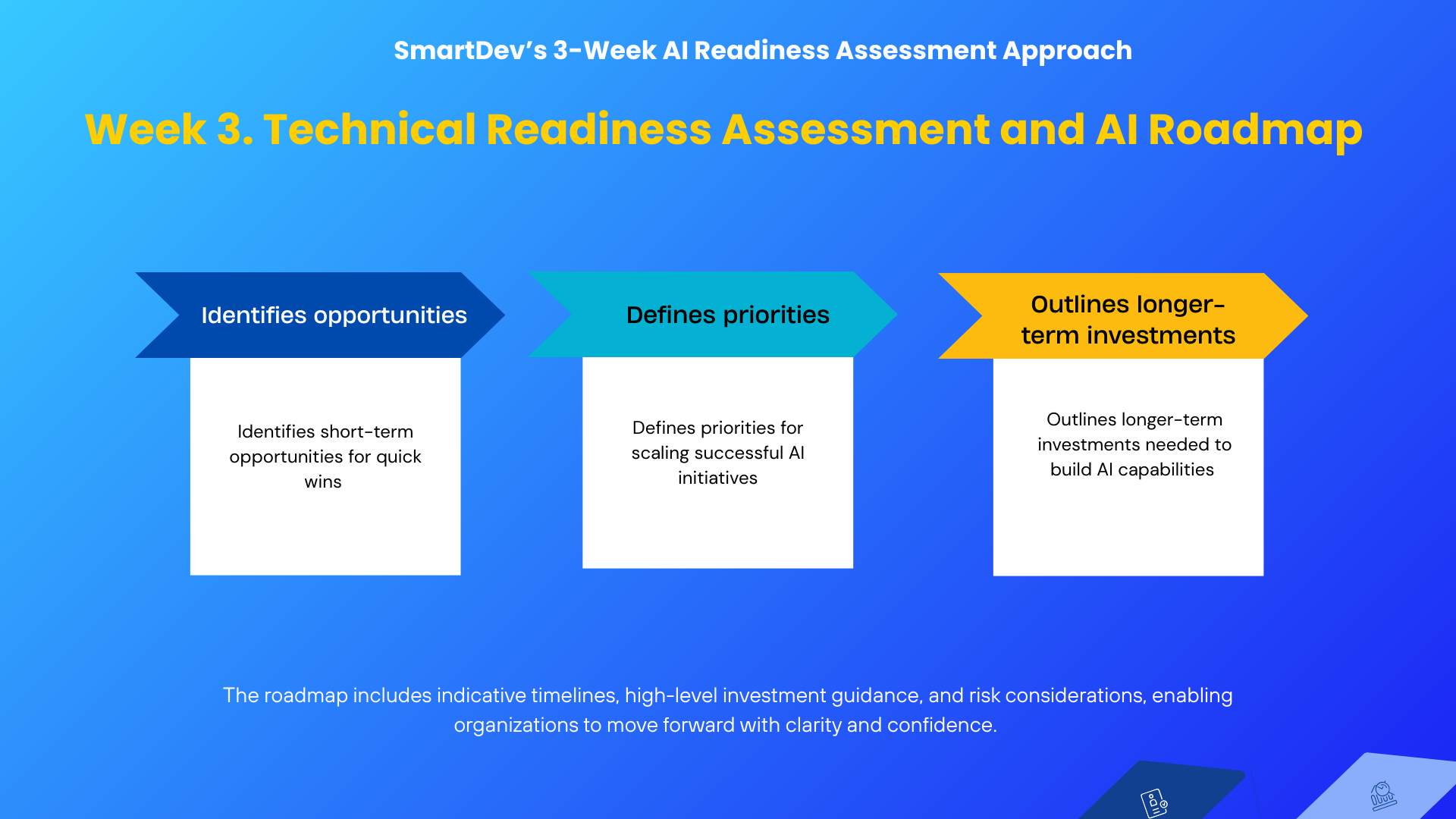
All findings from the three weeks are consolidated into a phased AI roadmap that:
- Identifies short-term opportunities for quick wins
- Defines priorities for scaling successful AI initiatives
- Outlines longer-term investments needed to build AI capabilities
The roadmap includes indicative timelines, high-level investment guidance, and risk considerations, enabling organizations to move forward with clarity and confidence.
What Organizations Gain After 3 Weeks
After three weeks, organizations gain a clear and practical foundation to move forward with AI. They establish a defined AI readiness baseline through a consolidated view of business, data, system, and technical readiness, allowing leaders to understand exactly where the organization stands today. At the same time, AI use cases are validated and prioritized into a focused portfolio ranked by business value, feasibility, and risk, ensuring effort is directed toward initiatives that matter most.
Critical data and system gaps become visible, including issues related to data quality, governance, system integration, and infrastructure constraints that must be addressed before scaling. These insights feed into an actionable AI roadmap that outlines what to build first, what to prepare next, and how to scale AI responsibly over time. With high-level visibility into cost, effort, and risk, leadership can make informed investment decisions with greater confidence. Together, these outcomes reduce uncertainty and enable organizations to move from AI exploration to execution in a controlled and deliberate way.
Conclusion
AI success depends on preparation. A structured AI Readiness Assessment helps organizations clearly understand their current state, identify critical gaps, and define a realistic path forward. By combining Data Readiness Assessment, System Readiness Assessment, Technical Readiness Assessment, AI Feasibility Study, and IT Readiness Assessment into a focused three-week engagement, SmartDev enables organizations to move from AI ambition to execution with clarity, confidence, and control.
Interested in understanding what a focused three-week discovery could unlock for your AI initiatives. Contact SmartDev to explore how this approach fits your organization and learn more about how to get started. Read more at Explore the 3-week discovery with SmartDev