
Introduction
Most organizations already know that AI adoption for your business can improve productivity, accelerate decision-making, and reduce operational pressure. Learn more about AI adoption for your business. The harder question is no longer whether to use AI, but how to choose the right implementation model: buying standalone AI tools, building custom AI workflows, or working with a partner to embed AI into real business operations.
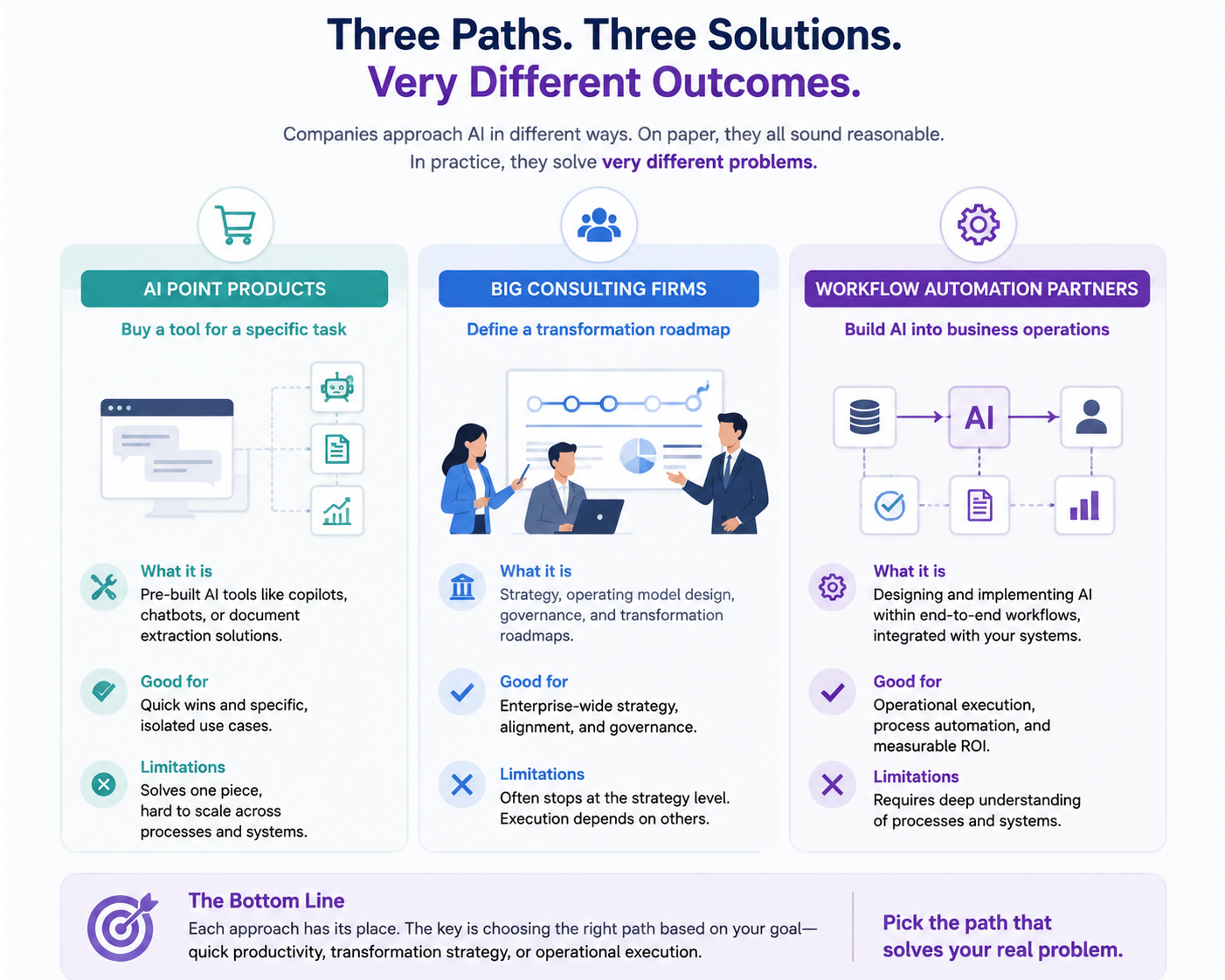
This is where many companies get stuck. Some buy AI point products such as copilots, chatbots, or document extraction tools. Some hire large consulting firms to define a transformation roadmap. Others work with workflow automation partners that build AI directly into business operations. On paper, all three approaches sound reasonable. In practice, they solve very different problems.
The difference matters because enterprise AI is moving from experimentation into production. McKinsey’s 2025 State of AI report found that 88% of organizations now use AI in at least one business function, but most companies are still in experimentation or pilot stages rather than scaling AI across the enterprise. The same report also noted that only 39% of respondents report EBIT impact at the enterprise level, which shows the gap between AI usage and real business return.
AI Point Products: Fast to Adopt, Easy to Outgrow
AI point products are usually the easiest place to start. They are designed to solve one narrow problem quickly, such as customer support responses, meeting notes, email drafting, invoice extraction, or employee search. They are attractive because they are simple to test, easy to budget for, and often require limited technical work at the beginning.
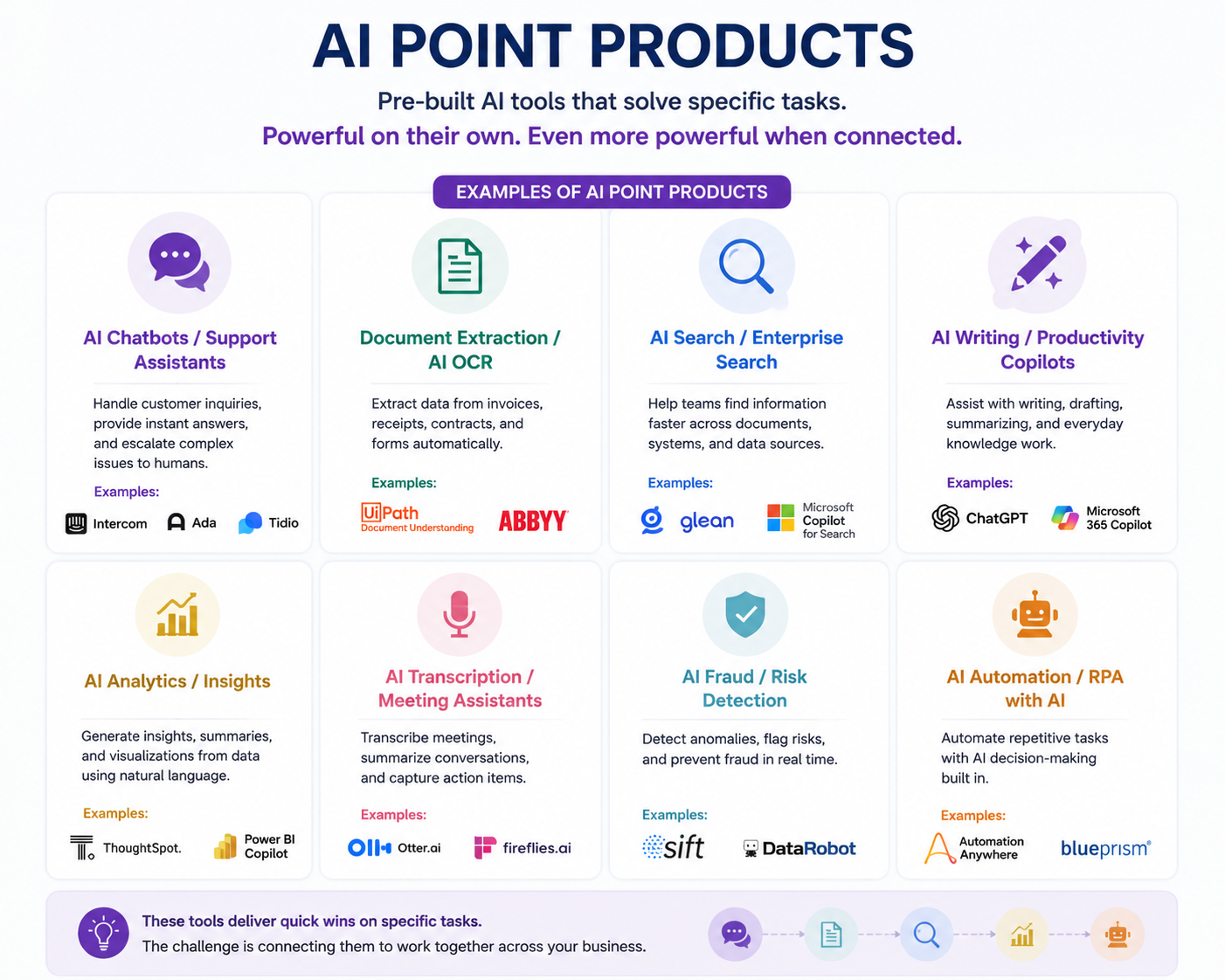
For early AI experimentation, this model works well. A team can quickly prove that AI can reduce manual effort in a specific task. A finance team may use an OCR solution to extract invoice fields. A customer service team may use a chatbot to answer frequent questions. A sales team may use a copilot to summarize calls or draft follow-ups.
Limitations of Point Products
The limitation appears when the business tries to scale beyond the task. Most point products are not built to orchestrate full operational workflows. They may solve one step, but they rarely connect every step before and after it. This creates what many enterprises quietly experience as AI sprawl: too many tools, too many disconnected outputs, and not enough operational change.
There’s a surplus of AI tools in many organizations: over 28% of enterprises are now using more than 10 different AI applications. However, despite the growing number of tools, 70% of companies have yet to go beyond basic integration with their AI systems (Zapier’s survey data). A company may have AI for support, AI for documents, AI for search, and AI for productivity, but the underlying processes may still depend on humans copying information between systems, checking exceptions manually, or chasing approvals through email. At that point, the organization has more AI tools, but not necessarily more automation. Read more about AI tools for businesses here.
When to Use AI Point Products
This is why point products are best suited for simple, contained use cases. They are useful when the workflow is narrow, the integration requirement is low, and the goal is productivity improvement rather than operational transformation. Once the business requires cross-system automation, compliance logic, exception handling, or measurable process-level ROI, the point of product model usually starts to hit its ceiling.
Big Consultancy: Strong for Strategy, Heavy for Execution
Big consultancy firms occupy the opposite end of the spectrum. They are often brought in when the problem is not just technical, but organizational. A large enterprise may need to define an AI strategy, redesign its operating model, align leadership, establish governance, assess risk, and prioritize use cases across departments.
This role is valuable, especially for banks, insurers, healthcare organizations, and multinational companies where AI adoption touches compliance, people, processes, and technology architecture at the same time. For these organizations, jumping straight into implementation without strategic alignment can create serious risk.
Challenges of Big Consultancy Firms
The challenge is that strategy and execution are not the same thing. Many consulting-led AI initiatives produce strong roadmaps, polished frameworks, and governance recommendations, but still struggle to deliver production workflow automation quickly. The business may understand what should change, but the operational workflow remains unchanged. Learn more about AI consulting strategies here.
This is where the consulting model can become too heavy for companies that need measurable impact within one or two quarters. It is often expensive, senior stakeholder driven, and optimized for transformation planning rather than rapid workflow deployment. For mid-market companies, growth-stage technology businesses, or enterprise departments with a specific operational bottleneck, a full consulting engagement may be more than they need.
The question, then, is not whether consulting firms are useful. They are. The better question is whether the company needs enterprise-wide transformation planning or a working AI workflow that solves a defined operational problem.
Workflow Automation Partners: The Middle Ground Enterprises Are Moving Toward
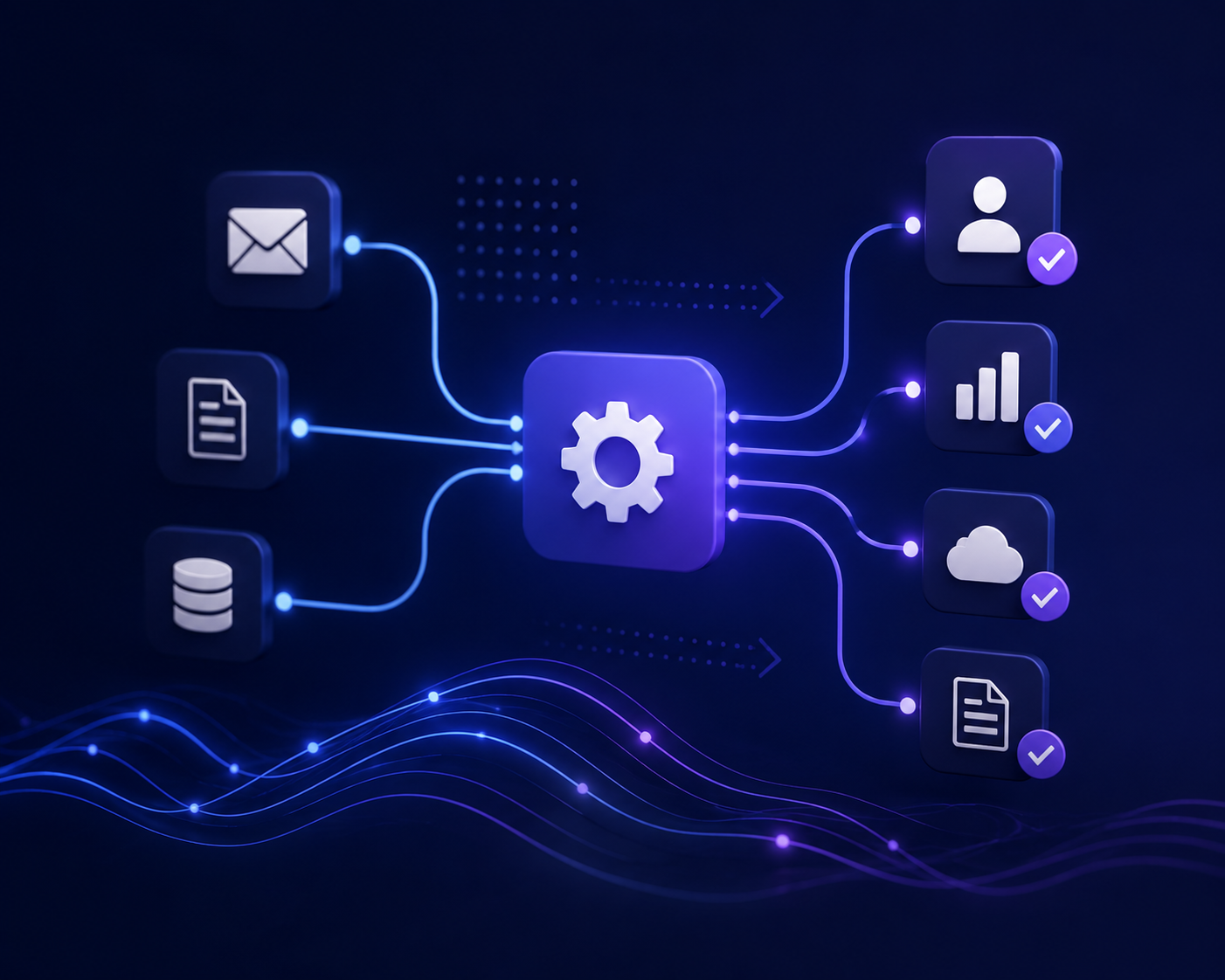
Workflow automation partners sit between these two extremes. They are more implementation-focused than big consultancy firms and more customizable than AI point products. Their value lies in helping businesses turn AI from a standalone tool into an operational capability.
What Makes Workflow Automation Partners Different?
A strong workflow automation partner does not begin by asking, “Which AI model should we use?” The better starting point is, “Which workflow is creating cost, delay, risk, or manual overload?” From there, the solution is designed around the business process, not around the tool.
This approach matters because enterprise automation rarely fails at the model layer. It fails when AI is not connected to the systems, rules, approvals, exceptions, and human roles that make the process work in real life. Workflow automation partners solve this by combining AI models, data extraction, business logic, system integration, human-in-the-loop review, monitoring, and continuous optimization.
The Benefit of Workflow Automation
The benefit is practical. Businesses can start with a high-volume workflow, prove ROI, and then expand automation layer by layer. Instead of buying a generic AI tool and forcing the business to adapt around it, the workflow is designed around the company’s operating reality. Discover more benefits of workflow automation here
This is also where SmartDev positions NORA differently from both traditional consulting and isolated AI products. NORA is not designed as another generic AI application. It is an AI adoption accelerator that helps SmartDev build workflow-specific AI solutions faster by using reusable skills across data understanding, reasoning, execution, and autonomous monitoring. SmartDev’s broader AI-powered software development approach also emphasizes measurable delivery impact, including faster product launches, reduced manual QA effort, and improved productivity across development workflows.
Where NORA Fits: From AI Tool to AI Skill Stack
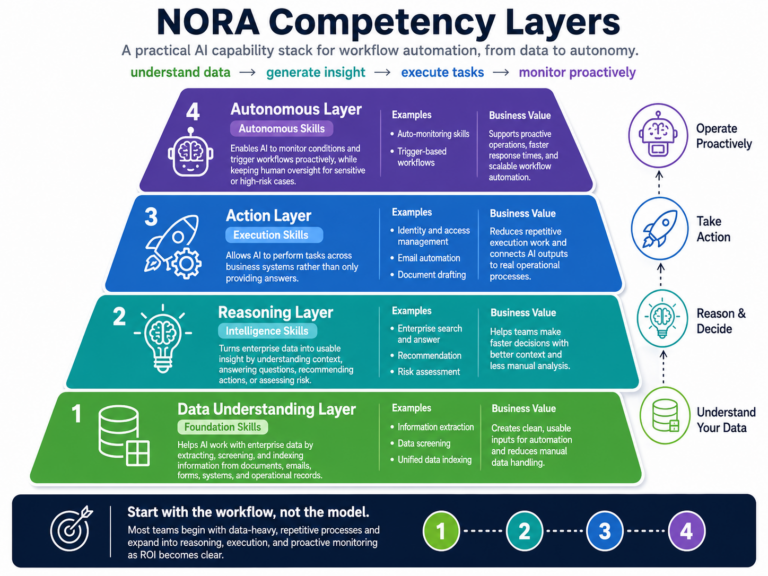
The easiest way to understand NORA is not as a chatbot or a single AI agent, but as a stack of AI skills that can be assembled into enterprise workflows. This matters because most business processes do not require one large AI system. They require multiple smaller capabilities working together.
The following is NORA Competency Layers, showcasing its capability and application within a business.
This layered model is important because it creates a realistic AI adoption path. Most companies should not start with full autonomy. They should start with data-heavy, repetitive workflows where ROI can be measured clearly, then expand into reasoning, execution, and proactive monitoring over time.
Why NORA Is Especially Relevant for BFSI and Enterprise Operations
BFSI is one of the clearest examples of why workflow automation needs more than an AI point product. Financial institutions do not simply need AI to read documents or answer questions. They need AI systems that can support compliance, auditability, approval logic, risk review, and secure data handling. Learn more about how AI can be implemented in BFSI in here
A basic document extraction tool may help a finance team read an invoice. But in a real financial workflow, the business also needs to verify the invoice against purchase orders, detect mismatches, route exceptions, update accounting systems, and preserve a record of what happened. The value is not in extraction alone. The value is in the workflow.
NORA fits this environment because it can be applied as a modular workflow layer. In lending, it can support document intake, financial data extraction, ratio analysis, risk scoring, and human validation. In compliance, it can help screen records, identify anomalies, and route issues for review. In finance operations, it can automate invoice verification, exception handling, and ERP updates.
The advantage is not that NORA replaces financial experts. It is that NORA removes repetitive bottlenecks around them. In regulated industries, that distinction matters. The winning model is not humanless automation. It is human-supervised automation that improves speed, consistency, and traceability.
Conclusion: Enterprise AI Is No Longer About the Tool
The real enterprise AI question is no longer, “Which AI tool should we buy?” A better question is, “Which operating model will help us turn AI into measurable business performance?” A point product may work for quick productivity gains. A consultancy may help with board-level strategy. But when the challenge is workflow complexity, operational execution, and measurable ROI, businesses need a partner that can connect AI to real work. This is where workflow automation partners and accelerator models like NORA become especially relevant.
Ready to take your AI adoption to the next level?
At SmartDev, we specialize in helping businesses like yours seamlessly integrate NORA into your workflows for real, measurable AI-driven results.
If you’re looking to move beyond isolated AI tools and build an AI-powered operational infrastructure, contact us today. Let us show you how NORA can transform your business operations and drive meaningful ROI.