

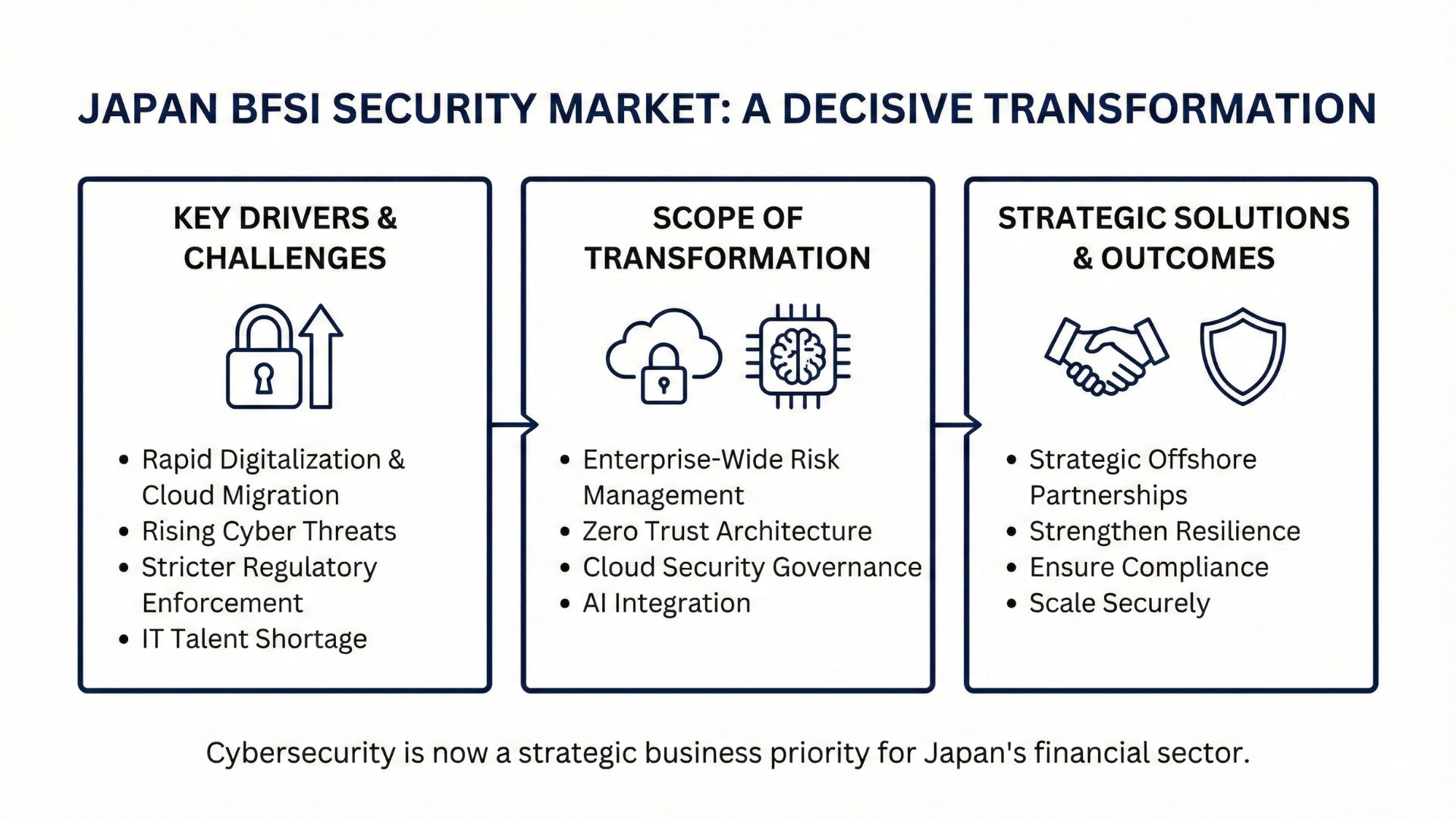
The Japan BFSI security market (Banking, Financial Services, and Insurance) has entered a decisive phase of transformation. Rapid digitalization, rising cyber threats, stricter regulatory enforcement, and a growing IT talent shortage are reshaping how financial institutions approach cybersecurity. In today’s digital economy, the Japan BFSI security market extends far beyond traditional firewalls and antivirus tools. It now encompasses enterprise-wide risk management, Zero Trust architecture, disaster recovery resilience, cloud security governance, and the integration of Artificial Intelligence (AI) into core banking and financial platforms.
For CIOs, CISOs, and executive leaders across Japan’s banking and insurance sector, cybersecurity is no longer a back-office IT function. It is a strategic business priority. As regional banks, securities firms, and insurers accelerate cloud migration and digital transformation initiatives, their attack surface expands significantly. At the same time, Japan faces a persistent shortage of cybersecurity professionals, creating operational strain and increasing reliance on specialized external security partners.
This in-depth analysis of the Japan BFSI security market examines key market drivers, regulatory compliance requirements, and technical implementation challenges. It also highlights how strategic offshore software development and security engineering partnerships tailored for the Japanese financial sector can help institutions strengthen resilience, ensure compliance, and scale securely in an increasingly complex threat landscape.
Market Size and Growth Dynamics of the Japan BFSI Security Market
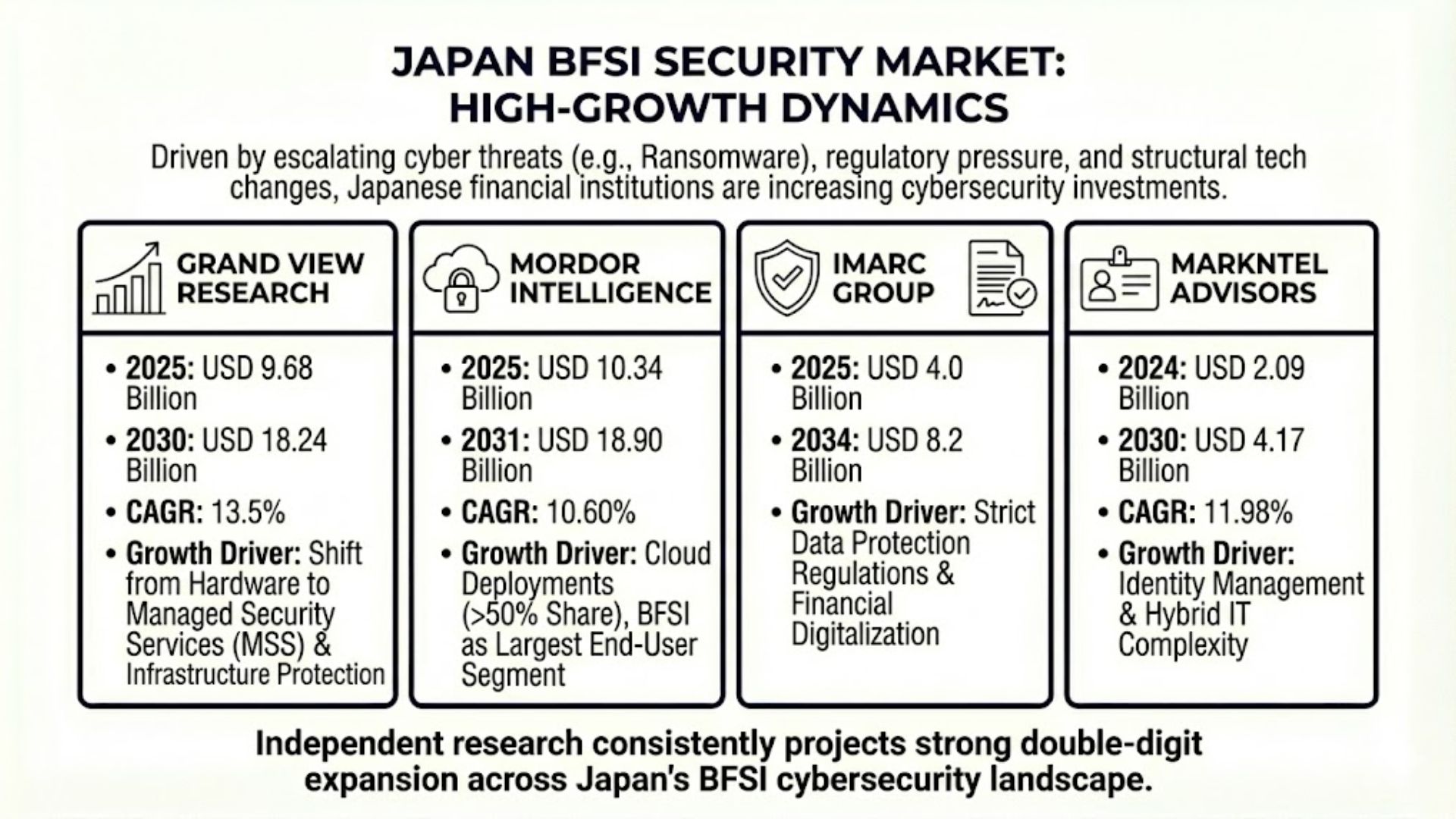
The Japan BFSI security market is entering a sustained high-growth cycle, driven by escalating cyber threats, regulatory pressure, and structural changes in financial technology architecture. Traditionally conservative in core system upgrades, Japanese financial institutions are now significantly increasing cybersecurity investments to protect critical financial infrastructure.
Ransomware remains the most persistent security threat in Japan, ranking as the country’s top information security risk for more than a decade. At the same time, agile fintech competitors are accelerating innovation cycles, forcing incumbent banks and insurers to modernize both customer-facing platforms and backend security frameworks.
Independent research firms consistently project strong double-digit expansion across Japan’s cybersecurity landscape:
- Grand View Research estimates the market will grow from USD 9.68 billion in 2025 to USD 18.24 billion by 2030, reflecting a 13.5% CAGR. Growth is shifting from hardware dominance toward Managed Security Services (MSS) and infrastructure protection.
- Mordor Intelligence values the market at USD 10.34 billion in 2025, forecasting USD 18.90 billion by 2031 (10.60% CAGR). Cloud deployments already represent more than half of market share, with BFSI as the largest end-user segment.
- IMARC Group projects expansion from USD 4.0 billion in 2025 to USD 8.2 billion by 2034, driven largely by strict data protection regulations and financial digitalization.
- MarkNtel Advisors highlights growth from USD 2.09 billion in 2024 to USD 4.17 billion by 2030 (11.98% CAGR), emphasizing identity management and hybrid IT complexity as key growth drivers.
Cloud Acceleration and Architectural Transformation
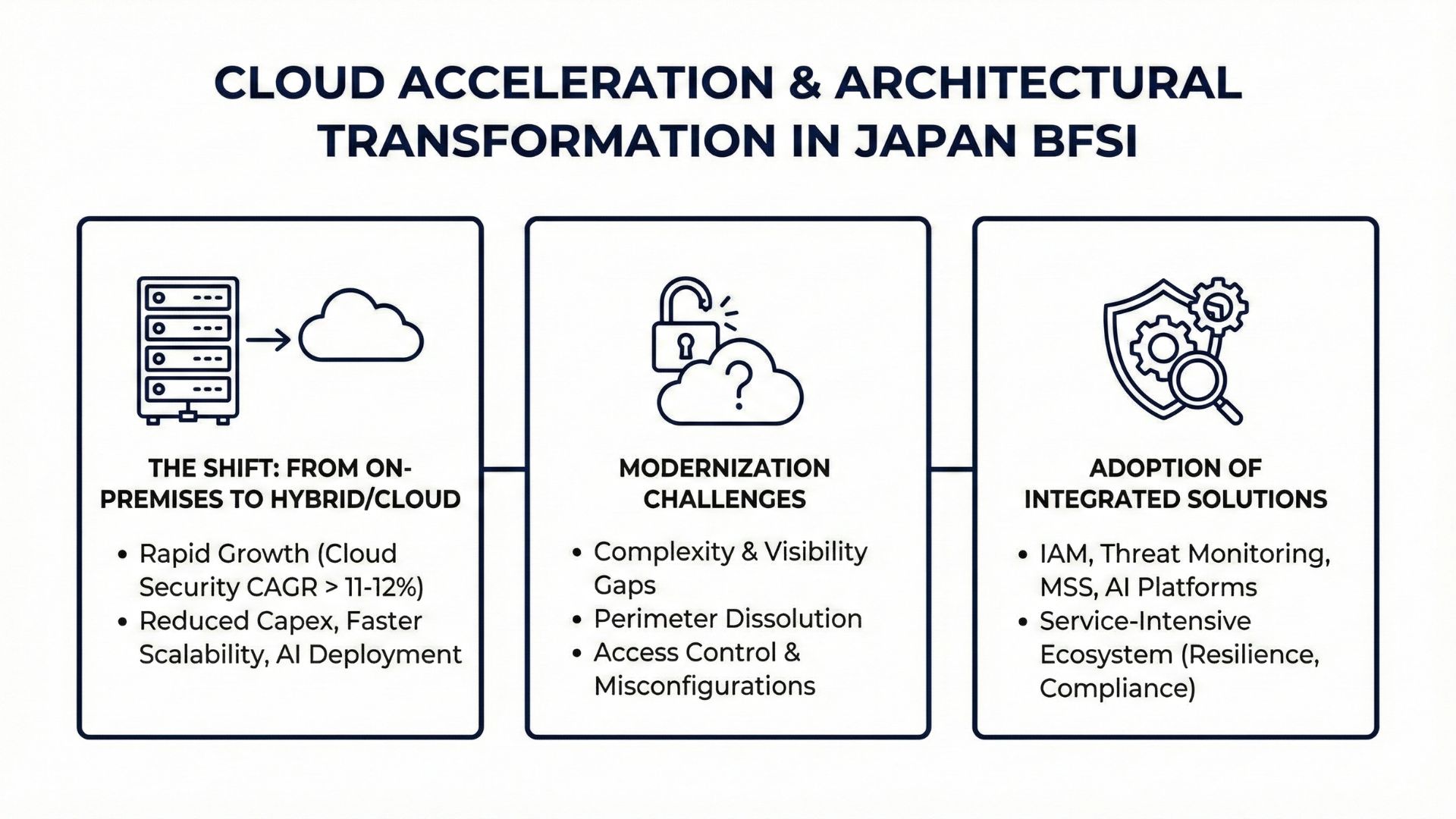
A major structural shift within the Japan BFSI security market is the transition from closed, on-premises legacy environments to hybrid and cloud-enabled infrastructures. While on-premises systems are expected to maintain a meaningful share, particularly for core transaction processing and surveillance systems—cloud-based security solutions are expanding at the fastest rate, with projected CAGR exceeding 11–12%.
Public and hybrid cloud models allow banks and insurers to reduce upfront capital expenditure, scale digital banking services rapidly, and deploy AI-driven fraud detection systems more efficiently. However, this modernization introduces significant complexity.
Hybrid environments dissolve traditional security perimeters. Visibility gaps emerge between on-prem and cloud assets. Maintaining least-privilege access control becomes operationally demanding. Misconfigurations in cloud environments create new vulnerabilities that adversaries actively exploit.
As a result, Japanese financial institutions are increasing adoption of:
- Hardware-based authentication mechanisms
- Advanced identity and access management (IAM) systems
- Continuous threat monitoring and real-time analytics
- Managed Security Services (MSS) for 24/7 oversight
- AI-powered detection and response platforms
This evolution reshapes the Japan BFSI security market into a service-intensive ecosystem. Institutions no longer require standalone security tools; they require integrated solutions supported by ongoing consulting, implementation expertise, regulatory alignment, and long-term operational maintenance.
In short, cybersecurity in Japan’s BFSI sector is no longer about purchasing software licenses. It is about building resilient, continuously monitored, and compliance-ready security architectures capable of defending an increasingly digitized financial system.
The Complex Regulatory Web: FSA, FISC, and APPI Compliance in the Japan BFSI Security Market
Operating in the Japan BFSI security market means navigating one of the world’s most demanding regulatory ecosystems. Financial institutions cannot adopt new technologies without ensuring full alignment with supervisory, technical, and data protection mandates. Any modernization initiative, whether cloud migration, AI deployment, or outsourcing, must first pass through strict compliance filters designed to safeguard financial stability and consumer trust.
Financial Services Agency (FSA): Governance and Resilience First
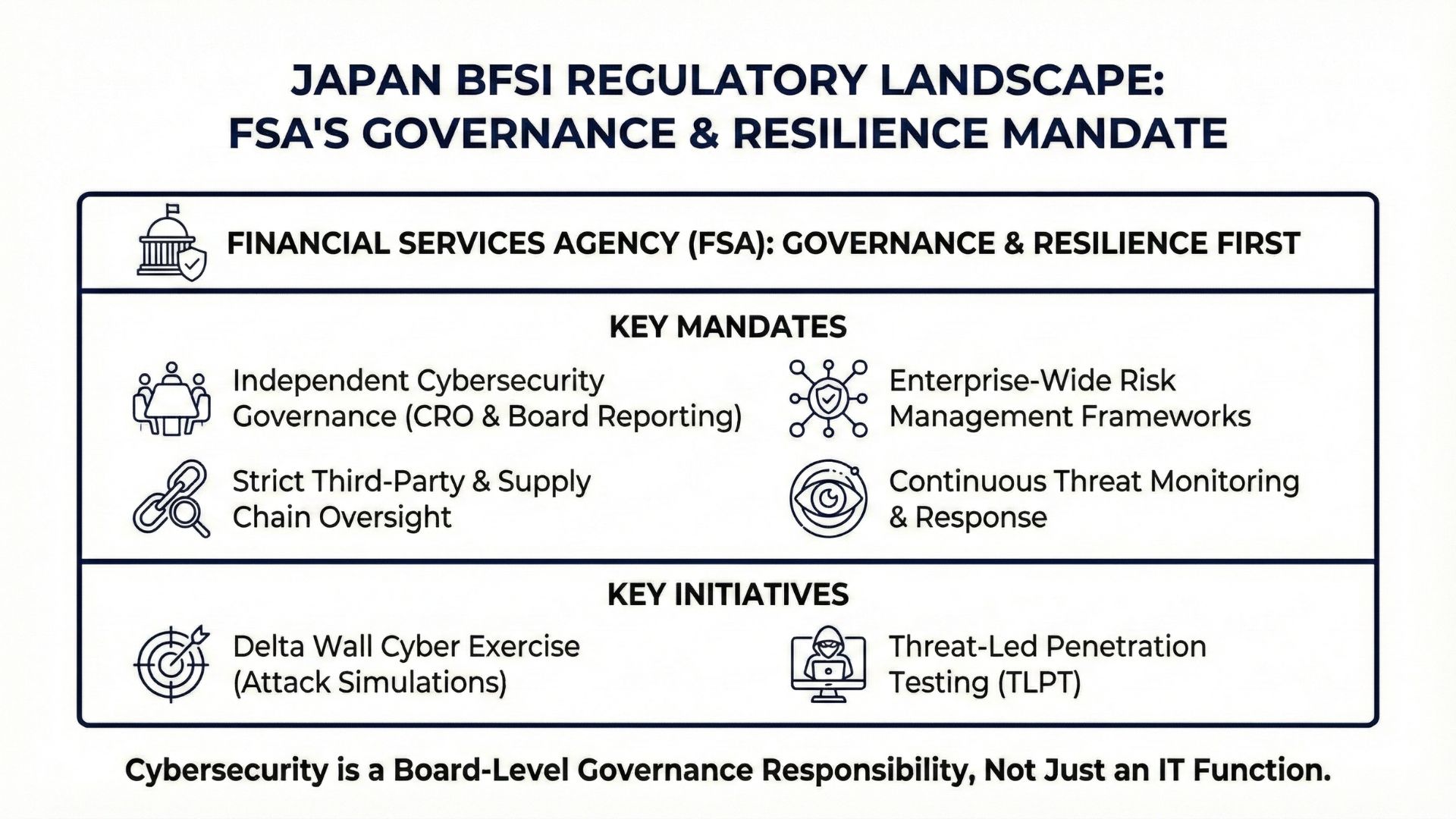
The Financial Services Agency (FSA) serves as Japan’s primary regulator for banking, securities, and insurance. In recent years, it has shifted from checklist-based supervision toward operational resilience testing and real-world scenario validation.
Through its “Guidelines on Cybersecurity for the Financial Sector,” which received its latest major regulatory update in October 2024 , the FSA requires:
- Independent cybersecurity governance reporting to the CRO and board
- Enterprise-wide risk management frameworks
- Strict third-party and supply chain oversight
- Continuous threat monitoring and response readiness
A flagship initiative is the annual Delta Wall cyber exercise, where financial institutions undergo coordinated attack simulations targeting ransomware, supply chain compromise, and systemic disruptions. The FSA also promotes Threat-Led Penetration Testing (TLPT), encouraging institutions to simulate real attack scenarios against live systems to evaluate detection and response capabilities.
In the Japan BFSI security market, cybersecurity is treated as a board-level governance responsibility not merely an IT control function.
Case Law & Enforcement Actions: In the Japan BFSI security market, cybersecurity is treated as a board-level governance responsibility, not merely an IT control function. The FSA’s enforcement teeth are sharp. Following a massive $308 million cryptocurrency hack in May 2024, the FSA issued a severe business improvement order against DMM Bitcoin in September 2024 due to inadequate risk management and vendor oversight.
This strict regulatory action ultimately forced the exchange to transfer its assets and plan for a complete business shutdown by March 2025. Similarly, Mizuho Bank was hit with a strict business improvement order in November 2021 after a series of eight systemic IT failures over several months, mandating direct board-level accountability and a sweeping overhaul of its digital infrastructure management.
FISC Security Guidelines (Version 13 – March 2025)
While the FSA sets supervisory direction, the Center for Financial Industry Information Systems (FISC) defines the technical execution standards. FISC guidelines are widely regarded as the de facto operational benchmark for financial institutions. During FSA inspections, alignment with FISC controls is closely scrutinized.
The March 2025 release of Version 13 of the FISC Security Guidelines introduced expanded requirements across:
- IT governance and board accountability
- Risk-based security management
- IT outsourcing contract standards and vendor due diligence
- Business continuity and disaster recovery planning
- Cloud adoption controls and secure data lifecycle management
The influence of FISC is substantial. Major global cloud providers have published detailed control-mapping documentation to demonstrate compliance with Version 13. International certifications such as ISO/IEC 27001, ISO/IEC 27017 (Cloud Security), and ISO/IEC 27018 (Cloud Privacy) are often considered baseline requirements to support regulatory acceptance.
APPI: Data Protection and Cross-Border Risk
Data governance adds another layer of complexity. Japan’s Act on the Protection of Personal Information (APPI) regulates how organizations collect, process, store, and transfer personal data.
Under APPI, financial institutions must implement robust safeguards to prevent unauthorized access and data leakage. Crucially, Articles 24 and 25 impose strict supervisory obligations when personal data is entrusted to third-party vendors. The delegating institution remains legally accountable for ensuring vendors apply “necessary and appropriate supervision.”
Cross-border data transfers are tightly regulated. Data may only be transferred overseas if the receiving jurisdiction provides equivalent protection standards or if contractual safeguards and user consent mechanisms meet Japanese legal requirements.
Looking toward the future, the PPC’s latest triennial review—with its “Next Steps” published in January 2025—is paving the way for the introduction of an administrative monetary penalty system and injunctive relief measures expected to be enacted around 2026 to 2027.
Case Law & Enforcement Actions: The regulatory risks of non-compliance with APPI are severe. In 2024, the high-profile LINE Yahoo data breach resulted in stringent administrative guidance from both the PPC and the Ministry of Internal Affairs and Communications (MIC), heavily scrutinizing inadequate cybersecurity measures related to third-party vendor management.
Furthermore, the landmark 2019 Recruit Career (Rikunavi) case—where the PPC penalized the unauthorized sale of student web browsing and cookie data to dozens of corporate clients—established a strict legal precedent regarding algorithmic profiling, user consent, and third-party data sharing responsibilities.
Ready to modernize your BFSI systems and accelerate digital transformation?
SmartDev helps banks, insurers, and fintech companies build secure, scalable platforms powered by cloud, AI, and automation.
Turn strategy into production-ready solutions with a trusted BFSI technology partner.
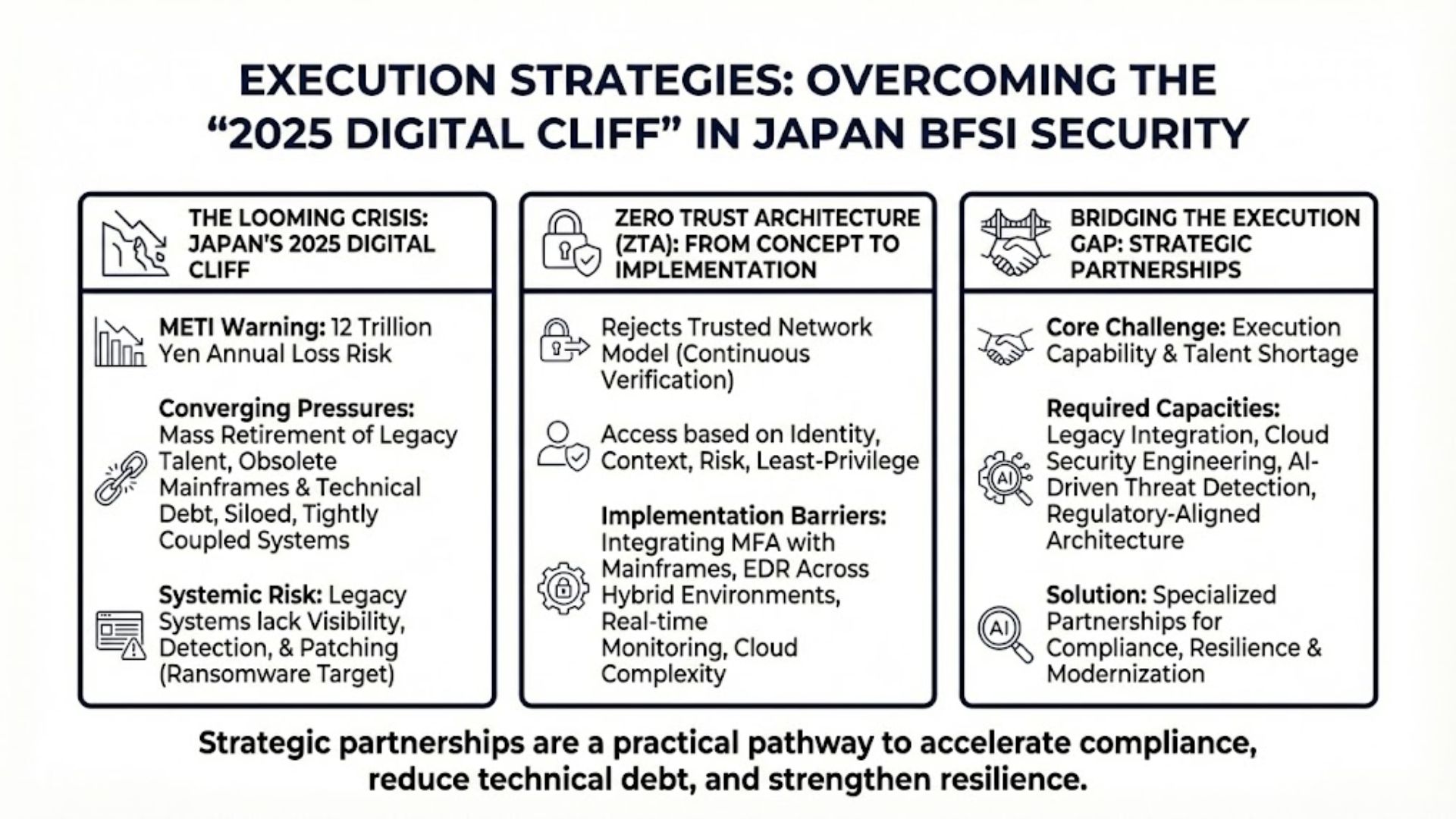
Talk to a BFSI ExpertExecution Strategies: Overcoming the “2025 Digital Cliff” in the Japan BFSI Security Market
Regulation defines the compliance baseline, but execution defines survival. Within the Japan BFSI security market, financial institutions are confronting a structural transformation challenge: modernizing deeply embedded legacy systems while maintaining operational stability, regulatory compliance, and cyber resilience.
The Looming Crisis: Japan’s 2025 Digital Cliff
The urgency behind cybersecurity and modernization efforts is closely tied to the “2025 Digital Cliff,” a structural risk first highlighted by the Ministry of Economy, Trade and Industry (METI) in 2018.
METI warned that failure to modernize aging IT systems could result in annual economic losses of up to 12 trillion yen beginning in 2025. The warning reflects three converging pressures:
- Mass retirement of experienced legacy system engineers
- Obsolescence of highly customized mainframe architectures
- Accumulated technical debt from decades of siloed system development
In Japan’s banking sector, many core systems operate as tightly coupled “black boxes,” making integration, patching, and real-time monitoring extremely difficult. Compounding the issue, enterprise software platforms such as SAP Business Suite 7 are approaching end-of-maintenance timelines, forcing institutions to confront large-scale migration decisions.
At the same time, Japan faces a projected shortage of approximately 430,000 IT professionals. This talent gap directly impacts the Japan BFSI security market, where specialized cybersecurity and cloud engineering skills are already scarce.
For banks and insurers, the Digital Cliff is not merely an IT modernization problem. It is a systemic risk exposure. Legacy systems lack visibility, real-time threat detection, and automated patch management—precisely the vulnerabilities that sophisticated ransomware groups exploit.
Zero Trust Architecture (ZTA): From Concept to Implementation
To address these risks, regulators including the Bank of Japan (BOJ) and the Financial Services Agency (FSA) have encouraged financial institutions to adopt Zero Trust Architecture (ZTA).
Zero Trust fundamentally rejects the traditional “trusted internal network” model. Instead, it requires continuous verification of every user, device, workload, and transaction—regardless of network location. Access is granted based on identity, context, risk signals, and least-privilege principles.
However, implementing ZTA within Japanese regional banks presents substantial execution barriers:
- Integrating modern Multi-Factor Authentication (MFA) systems with decades-old mainframes
- Deploying Endpoint Detection and Response (EDR) tools across hybrid IT environments
- Maintaining least-privilege access across on-premises and multi-cloud infrastructures
- Achieving real-time monitoring without disrupting mission-critical banking operations
Hybrid cloud environments further complicate enforcement. Identity orchestration, policy synchronization, and context-aware authorization engines require advanced engineering expertise that many institutions struggle to recruit domestically.
Bridging the Execution Gap
The core challenge in the Japan BFSI security market is not awareness. It is capability. Institutions understand the regulatory mandates and architectural principles. What they lack is scalable execution capacity.
Bridging the Digital Cliff and implementing Zero Trust at enterprise scale demands:
- Deep legacy system integration expertise
- Advanced cloud security engineering
- Continuous threat detection and AI-driven analytics
- Regulatory-aligned architecture design
- Long-term managed security operations
Given the domestic talent shortage, many financial institutions are reassessing traditional staffing models. Strategic partnerships—particularly those with specialized security engineering and cloud modernization capabilities—are emerging as a practical pathway to accelerate compliance, reduce technical debt, and strengthen resilience without overwhelming internal teams.
The Strategic Solution: Offshore Software Development to Vietnam
Confronted with the 2025 Digital Cliff and a projected shortage of hundreds of thousands of IT professionals, leaders in the Japan BFSI security market are increasingly recognizing that domestic hiring alone cannot resolve the engineering capacity gap. Large-scale modernization, Zero Trust implementation, cloud migration, and regulatory compliance demand sustained technical execution—something that internal teams often cannot scale quickly enough.
As a result, offshore IT outsourcing has shifted from a cost-saving tactic to a strategic resilience strategy. While Japan historically partnered with India or China, Vietnam has emerged as a high-value engineering destination, particularly for financial services modernization and cybersecurity initiatives.
Cost Efficiency with Engineering Depth
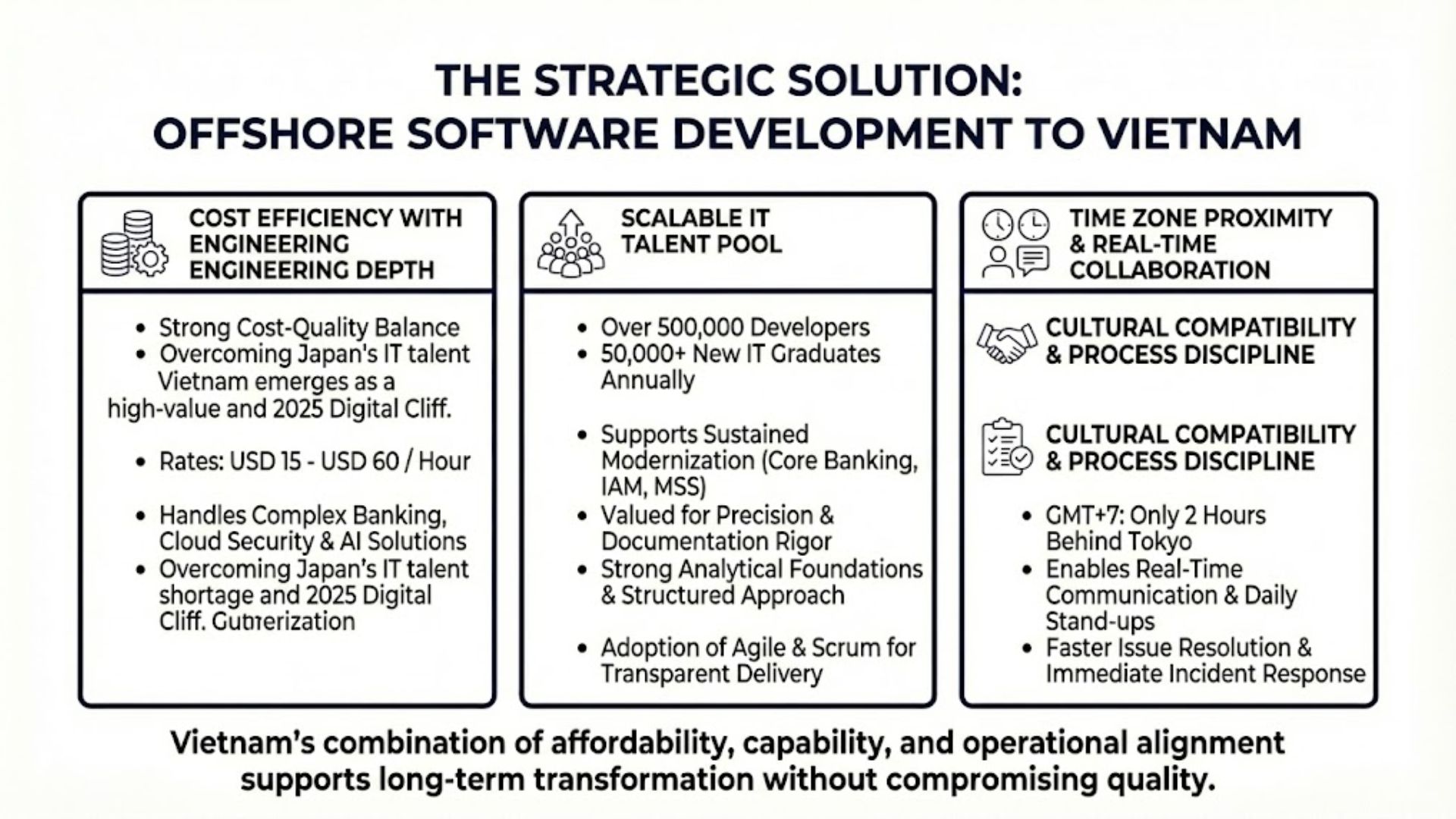
Vietnam offers a strong balance between cost optimization and technical quality. Development rates typically range from USD 15 to USD 60 per hour—significantly lower than domestic Japanese, US, or many European markets—while maintaining competitive technical standards.
However, cost advantage alone does not define Vietnam’s appeal. The country emphasizes strong STEM education and engineering fundamentals, producing developers capable of handling complex banking systems, cloud security architecture, and AI-driven threat detection solutions. For institutions in the Japan BFSI security market, this combination of affordability and capability supports long-term transformation without compromising quality.
Scalable IT Talent Pool
Vietnam’s technology workforce exceeds 500,000 developers, with approximately 50,000 new IT graduates entering the market annually. This scale is critical for large BFSI programs that require sustained multi-year modernization efforts, including:
- Core banking system upgrades
- Cloud security implementation
- Identity and access management integration
- Managed security operations support
For Japanese financial institutions facing domestic labor shortages, Vietnam provides access to a scalable engineering pipeline aligned with global standards.
Cultural Compatibility and Process Discipline
Japanese enterprises value precision, documentation rigor, and quality assurance discipline. Vietnamese engineering teams are widely recognized for strong analytical foundations, structured development approaches, and high attention to detail, attributes particularly important in regulated BFSI environments.
Moreover, Vietnamese firms have deeply adopted Agile and Scrum methodologies, enabling structured sprint cycles, transparent reporting, and predictable delivery timelines. This operational discipline aligns well with Japanese governance frameworks and compliance expectations within the Japan BFSI security market.
Time Zone Proximity and Real-Time Collaboration
Operating in GMT+7, Vietnam is only two hours behind Tokyo. This minimal time difference enables:
- Real-time communication
- Coordinated daily stand-ups
- Faster issue resolution
- Immediate response during security incidents
For BFSI security operations, where delays can translate into financial and reputational risk—time zone alignment is a significant operational advantage.
Why SmartDev is the Ultimate “Japan Market Focus” Partner
In a sea of Southeast Asian outsourcing vendors, financial institutions must select a partner capable of passing the grueling compliance audits of the FSA, FISC, and APPI. This is where SmartDev separates itself from generic IT providers, establishing a clear strategic focus as a trusted partner for the Japanese market.
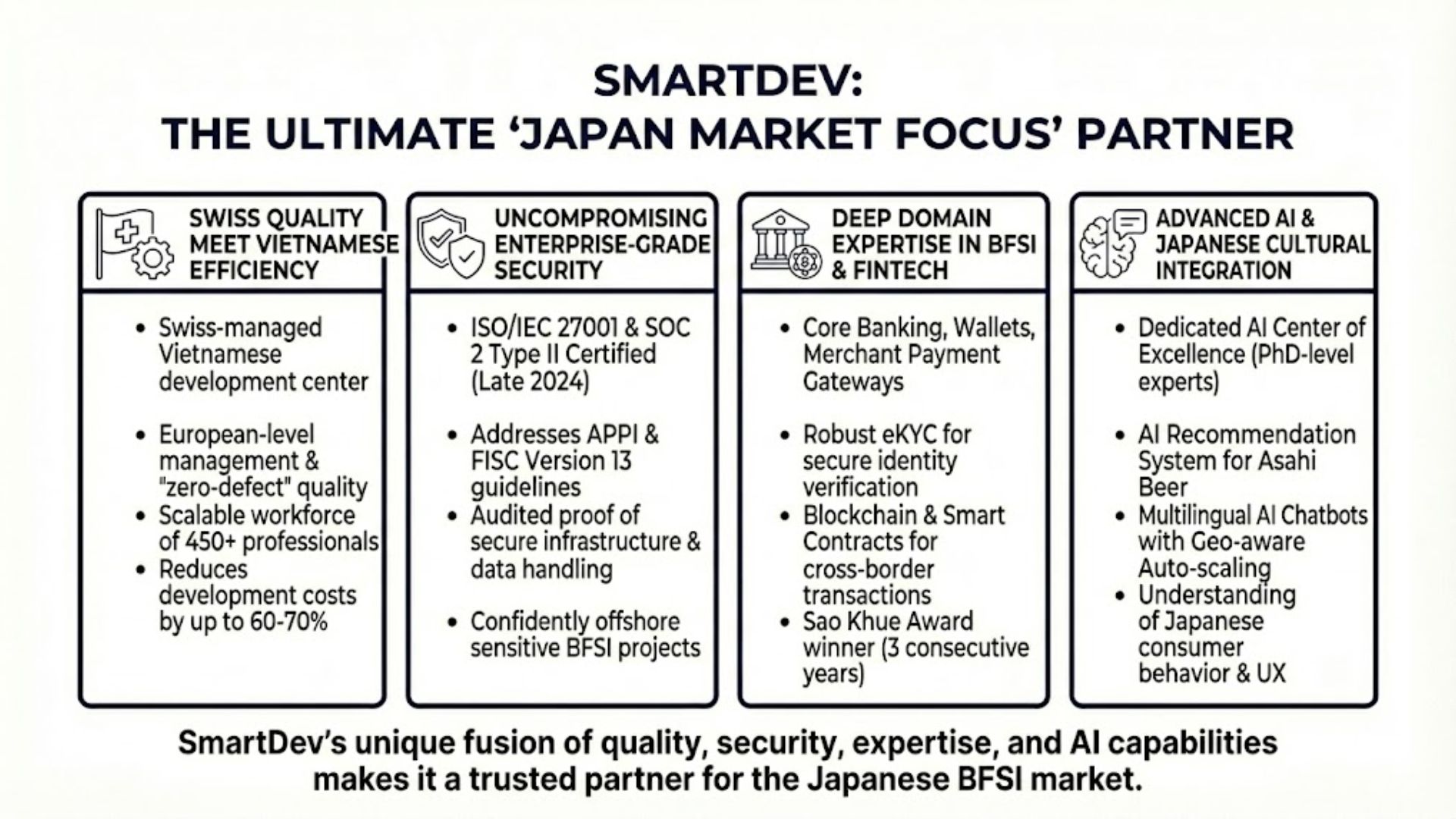
SmartDev provides a unique fusion of Swiss management quality, enterprise-grade security, deep financial domain expertise, and advanced AI capabilities.
Swiss Quality Standards Meets Vietnamese Engineering Efficiency
SmartDev is not a standard offshore agency. Founded in 2014 by Swiss entrepreneurs and acquired by the Swiss-based Verysell Group in 2020, SmartDev is uniquely positioned as a “Swiss-managed Vietnamese development center”. For risk-averse Japanese financial institutions, this DNA is a massive differentiator.
Clients receive European-level management standards, transparent communication, and a “zero-defect” quality mentality, executed efficiently by a scalable workforce of over 450 professionals across high-tech delivery centers in Da Nang and Hanoi. This model effectively reduces development costs by up to 60-70% while guaranteeing enterprise-grade output.
Uncompromising Enterprise-Grade Security (ISO 27001 & SOC 2 Type II)
To directly address the strict requirements of Japan’s APPI regulations and the newly updated FISC Version 13 guidelines, SmartDev has heavily invested in global security compliance. SmartDev holds the prestigious ISO/IEC 27001 certification and, importantly, achieved SOC 2 Type II compliance in late 2024.
Dual certification of this caliber is exceedingly rare among offshore vendors. It provides Japanese banks with independent, third-party audited proof that SmartDev’s infrastructure, data handling protocols, and internal risk management systems maintain real-time, continuous security. This allows Japanese CISOs to confidently offshore sensitive BFSI projects without violating FSA supply chain mandates or APPI cross-border data transfer laws.
Deep Domain Expertise in BFSI and Fintech Innovation
SmartDev cut its teeth building complex platforms for the Fintech sector, originally designing systems for Swiss credit card issuers and major airline subsidiaries. Their domain expertise spans the entire financial ecosystem:
- Core Banking & Wallets: Developing secure mobile banking apps, comprehensive digital wallets, and merchant payment gateways.
- Security & Compliance Tech: Integrating robust eKYC (Electronic Know Your Customer) solutions to streamline identity verification securely.
- Blockchain & Decentralized Finance: Building immutable ledger systems for transparent cross-border transactions and Smart Contracts.
Our technological excellence has been validated by winning the prestigious Sao Khue Award for three consecutive years (including a triple win in April 2025), cementing their status as a leader in digital service innovation.
Advanced AI Capabilities and Japanese Cultural Integration
Finally, SmartDev is actively helping clients leap over the 2025 Digital Cliff by leveraging Artificial Intelligence. In 2023, SmartDev launched a dedicated AI Center of Excellence, deploying PhD-level experts to build scalable ML solutions, predictive analytics, and automated testing environments.
Their ability to execute complex, culturally nuanced projects for the Japanese market is proven. A prime example is SmartDev’s successful development of an AI Recommendation and Matching System for Asahi Beer, one of Japan’s most iconic corporate brands. Developing this system required not only deep technical integration with local third-party APIs but also an intrinsic understanding of Japanese consumer behavior, UX expectations, and language nuances. Furthermore, SmartDev excels in deploying multilingual AI chatbots engineered with geo-aware auto-scaling to seamlessly handle the computational complexities of the Japanese language.
By successfully navigating these linguistic and cultural barriers to deliver ROI-driven platforms, SmartDev proves it possesses the precise organizational maturity required to serve the highest tiers of the Japanese corporate ecosystem.
Case Studies: Proven Success with Japanese Enterprises
SmartDev’s ability to execute complex, culturally nuanced projects for the Japanese market is validated through concrete success stories:
- AI Recommendation System for Asahi Beer: SmartDev successfully developed a highly sophisticated for Asahi Beer, one of Japan’s most iconic corporate brands. This project required deep technical integration with local third-party APIs and high-load data processing to enhance their digital operations and brewing efficiency. More importantly, it demanded an intrinsic understanding of Japanese consumer behavior, UI/UX expectations, and language nuances.
- Geo-Aware Multilingual AI Chatbots: Addressing the computational complexities of the Japanese language, SmartDev excels in deploying multilingual AI chatbots equipped with geo-aware auto-scaling. This allows Japanese enterprises to handle peak customer support volumes across websites and mobile apps seamlessly, respecting cultural context and tone.
- High-Security Financial Deployments: Adapting their success from “Building Financial Futures” and “Securing User Transactions,” SmartDev integrates enterprise-grade transaction security and strict compliance controls directly into platforms, which is perfectly attuned to the meticulous demands of the Japanese BFSI sector.
By successfully navigating these linguistic and cultural barriers to deliver ROI-driven platforms, SmartDev has established a track record of proven success, possessing the precise organizational maturity required to serve the highest tiers of the Japanese corporate ecosystem.
Conclusion
The Japan BFSI security market is undergoing a painful but necessary evolution. The compounding pressures of the 2025 Digital Cliff, severe IT talent shortages, and hyper-strict regulatory mandates from the FSA, FISC, and APPI mean that Japanese financial institutions can no longer rely on patching legacy mainframes. Transitioning to a secure, Zero Trust cloud architecture is mandatory for survival.
However, bridging the execution gap requires a strategic outsourcing partnership. Vietnam has proven itself as the optimal destination for this transition, offering high-quality STEM talent and operational cost efficiency. Within this vibrant ecosystem, SmartDev stands as the definitive choice for Japanese enterprises.
By merging Swiss management precision with Vietnamese engineering agility, fortified by SOC 2 Type II and ISO 27001 certifications, deep Fintech roots, and proven success delivering AI solutions to major Japanese brands, SmartDev represents the safest, most innovative bridge over the digital cliff. For Japanese BFSI leaders looking to secure their digital future, SmartDev is not just an outsourcing vendor; they are a strategic extension of your secure enterprise architecture.