

The South Korea BFSI security market is expanding rapidly as South Korea accelerates digital transformation across banking and financial services. According to Grand View Research, the country’s banking system software segment is projected to grow steadily, driven by cloud adoption and modernization of legacy infrastructure. At the same time, Market Research Future highlights strong momentum in digital banking, fueled by mobile first consumer behavior and fintech innovation. As financial institutions digitize operations, cybersecurity becomes a core investment priority rather than a back office function.
This rapid digitalization also increases exposure to cyber threats. Regulatory frameworks such as the Personal Information Protection Act and the Electronic Financial Transactions Act impose strict compliance obligations on financial institutions. Industry analysis from Ken Research shows that open finance and API driven ecosystems are expanding, creating more interconnected systems that require advanced protection. Meanwhile, blockchain adoption in BFSI, as reported by IMARC Group, is adding new infrastructure layers that demand secure integration.
Together, these factors are driving sustained investment in AI based fraud detection, security automation, and regulatory compliant software development. For global technology providers targeting the Korean market, the South Korea BFSI security market represents a high growth opportunity supported by digital expansion, regulatory enforcement, and increasing demand for resilient financial infrastructure.

Market Overview of the South Korea BFSI Security Market
The South Korea BFSI security market is expanding in parallel with the country’s accelerating digital banking transformation, open finance expansion, and blockchain innovation. As financial institutions modernize core infrastructure and increase API connectivity, cybersecurity spending is rising proportionally. Growth in banking software, digital platforms, and emerging technologies is directly reinforcing long term demand for advanced fraud detection, identity management, encryption systems, and regulatory compliant security architecture.
1. Size and Growth Forecast of the Banking System Software Market
The foundation of the South Korea BFSI security market lies in core banking modernization. According to Grand View Research, South Korea’s banking system software market generated USD 979.3 million in 2023 and is projected to reach USD 1,495.3 million by 2030, growing at a 6.2% CAGR from 2024 to 2030. This expansion reflects strong investment in digital core systems, cloud deployment, and analytics integration. Each modernization initiative increases the need for secure APIs, encryption frameworks, identity access management, and continuous monitoring solutions.
In parallel, the country’s digital banking ecosystem continues to scale. Market Research Future reports sustained growth in South Korea’s digital banking market, driven by mobile penetration and rising adoption of online financial services. As transaction volumes increase, banks must strengthen real time fraud detection and threat intelligence capabilities, further accelerating the South Korea BFSI security market.
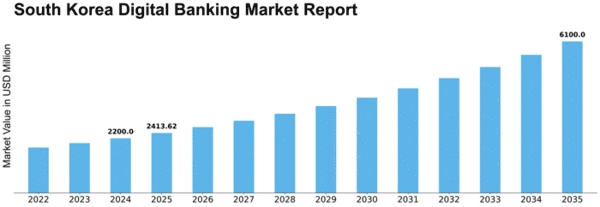
Source: South Korea Digital Banking Market Report – Garvit Vyas
2. Digital Banking Expansion and Open Finance Evolution
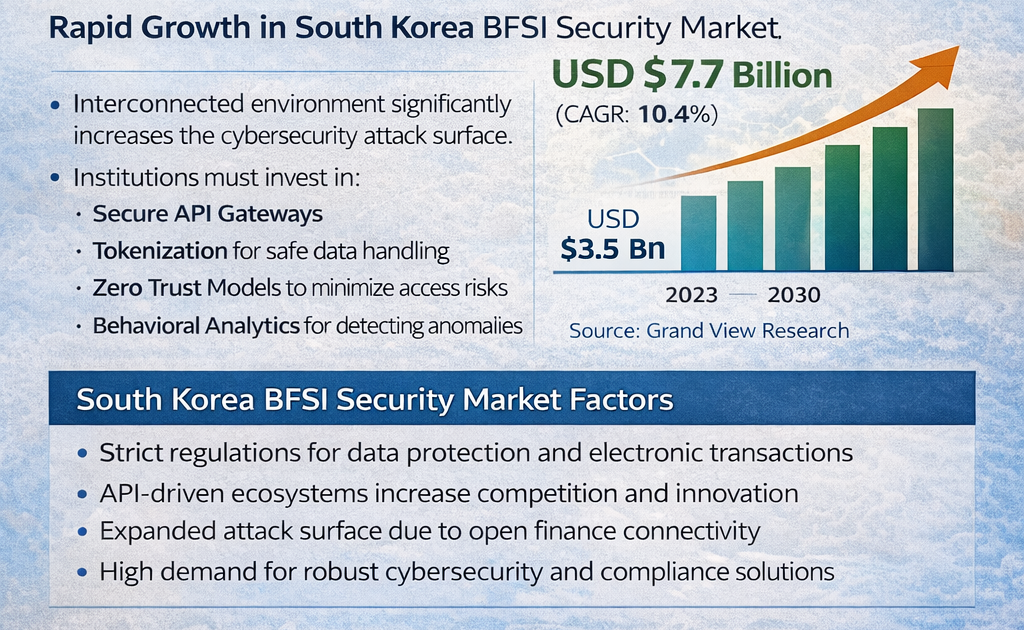
South Korea’s digital banking and open finance landscape is valued at approximately USD 3.5 billion, according to Ken Research. Regulatory support for API driven ecosystems has enabled third party providers to access banking data with customer consent, increasing competition and innovation. However, this interconnected environment significantly expands the cybersecurity attack surface.
Additionally, the open banking segment is projected to grow rapidly in the coming years, as highlighted by Grand View Research. As APIs become central to service delivery, institutions must invest in secure API gateways, tokenization, zero trust models, and behavioral analytics. These developments directly reinforce structural growth within the South Korea BFSI security market.
3. Blockchain and AI Adoption in South Korea’s BFSI Sector
Emerging technologies are further reshaping the South Korea BFSI security market. According to IMARC Group, the South Korea blockchain in BFSI market is projected to grow from USD 56.1 million in 2025 to USD 1,246.8 million by 2034, reflecting a strong ~39% CAGR. Blockchain is being adopted for digital identity, cross border payments, and smart contract execution, but integration requires secure key management, endpoint protection, and compliance monitoring.
At the same time, AI and machine learning are transforming fraud detection and risk management. Insights from SmartDev’s AI in BFSI guide highlight how AI driven analytics enhance anomaly detection and operational efficiency. However, AI deployment introduces risks related to model governance and adversarial manipulation, increasing demand for secure AI lifecycle management within the South Korea BFSI security market.
4. Security Investment Trends Across Banks, Fintech, and Insurtech
Security investment in South Korea’s financial sector is shifting toward automation and intelligent protection. Banks are allocating higher budgets to centralized security operations centers, zero trust architecture, and AI powered monitoring platforms. Fintech firms prioritize API security and DevSecOps integration to support rapid innovation cycles while maintaining compliance.
As explained in SmartDev’s BFSI security automation analysis, AI driven security orchestration improves threat detection speed and reduces operational overhead. Furthermore, best practices for automated security testing in BFSI demonstrate how continuous vulnerability assessment reduces exposure during digital product releases. These trends collectively reinforce sustained expansion in the South Korea BFSI security market.
5. Key Market Segments Within the South Korea BFSI Security Market
The South Korea BFSI security market consists of several high growth segments aligned with digital transformation priorities:
- Core banking and payment security solutions
- Identity and access management platforms
- Fraud detection and anti money laundering systems
- Cloud security and data protection services
- Blockchain infrastructure security
- AI driven threat intelligence and analytics
As regulatory oversight tightens and digital financial ecosystems become more interconnected, demand across these segments is expected to remain strong. The combination of market growth, regulatory enforcement, and emerging technology adoption positions the South Korea BFSI security market as a long term strategic opportunity for technology providers targeting Korea’s financial sector.
Regulatory Framework Governing BFSI Security in South Korea
The regulatory environment is one of the most decisive forces shaping the South Korea BFSI security market. South Korea maintains a highly structured financial supervision system, with strict data protection rules and cybersecurity mandates that directly impact banks, insurers, fintech firms, and foreign IT vendors. Any company entering the Korean BFSI ecosystem must understand how regulatory enforcement, licensing requirements, and data governance standards influence technology architecture and security design.

1. Financial Supervisory Service (FSS) and FSC Compliance Requirements
Financial institutions in South Korea are regulated primarily by the Financial Services Commission and supervised by the Financial Supervisory Service. These authorities oversee prudential regulation, risk management standards, IT governance, and cybersecurity obligations across banking and financial services.
According to the regulatory overview published by Chambers and Partners, financial institutions must implement comprehensive internal control systems, risk monitoring frameworks, and reporting mechanisms. IT systems handling financial transactions must meet strict operational resilience and audit standards.
The British Chamber of Commerce in Korea further outlines how foreign financial and technology firms operating in Korea must align with local licensing and supervisory expectations. For the South Korea BFSI security market, this means cybersecurity solutions must support compliance reporting, logging transparency, and real time incident tracking to meet regulator expectations.
2. Personal Information Protection Act (PIPA) and Data Localization
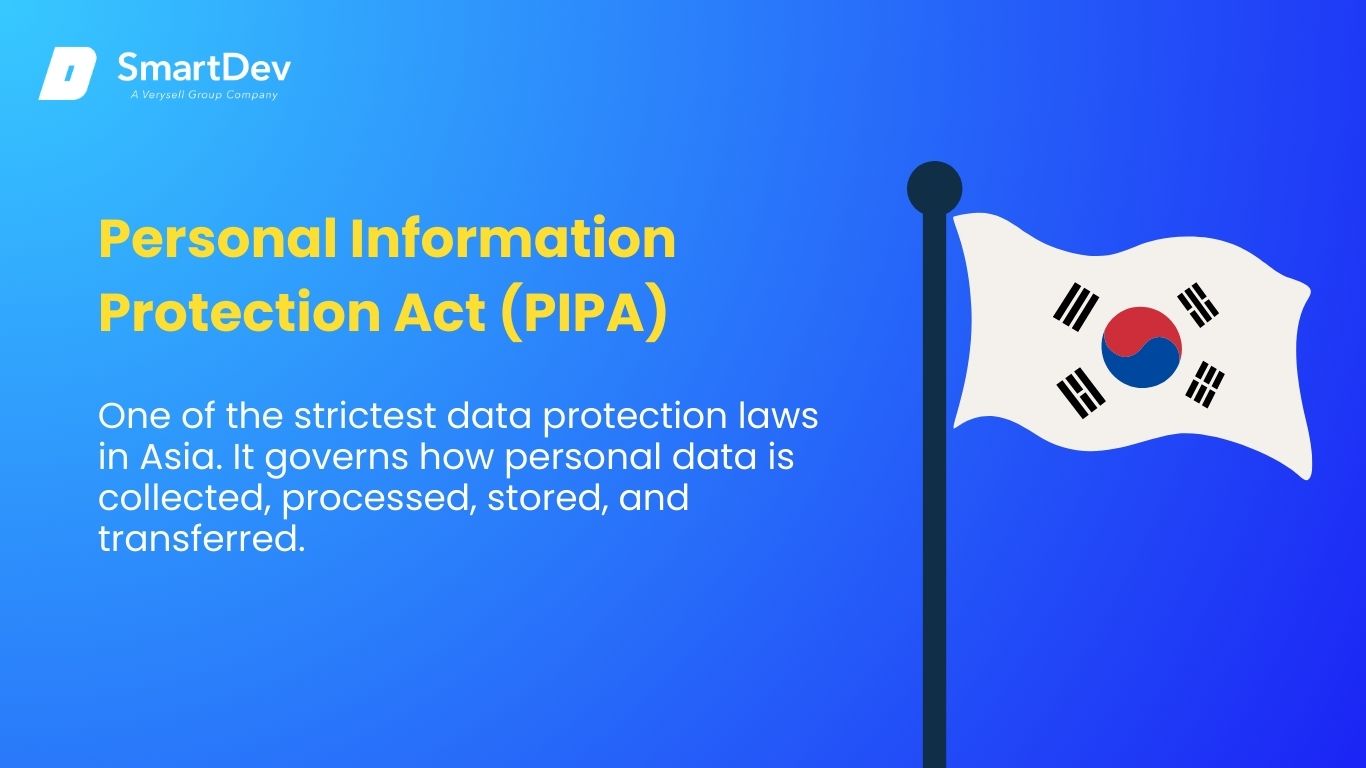
The Personal Information Protection Act, commonly referred to as PIPA, is one of the strictest data protection laws in Asia. It governs how personal data is collected, processed, stored, and transferred. Financial institutions handling customer financial data face particularly high compliance thresholds.
A detailed legal comparison published in Chambers Practice Guides explains that organizations must obtain explicit consent for data processing, implement encryption for sensitive financial information, and notify authorities promptly in the event of data breaches. Cross border data transfers are also tightly regulated, requiring safeguards and contractual controls.
For the South Korea BFSI security market, PIPA compliance increases demand for data loss prevention systems, encryption technologies, access control mechanisms, and secure cloud storage frameworks. Data localization expectations further complicate infrastructure planning for multinational firms.
3. Electronic Financial Transactions Act and Cybersecurity Mandates
The Electronic Financial Transactions Act establishes specific security obligations for electronic payments, online banking, and digital transaction platforms. Financial institutions must implement technical safeguards to prevent hacking, fraud, and unauthorized system access.
Legal analysis from Lexology highlights that financial companies are required to deploy robust authentication systems, encryption standards, and monitoring protocols. Institutions may face liability if security negligence results in customer losses.
These statutory obligations directly expand the scope of the South Korea BFSI security market, particularly in areas such as fraud detection systems, secure payment gateways, transaction monitoring engines, and cybersecurity auditing platforms.
4. Cloud and Outsourcing Regulations for Foreign IT Vendors
Cloud computing and IT outsourcing are permitted in South Korea’s financial sector, but they are heavily regulated. Financial institutions must conduct risk assessments before outsourcing core functions and must ensure service providers comply with local supervisory standards.
According to Chambers and Partners, outsourcing arrangements require contractual safeguards, regulatory reporting, and ongoing oversight. Foreign IT vendors providing security or software development services must demonstrate operational resilience and compliance alignment.
For global firms targeting the South Korea BFSI security market, this creates both a barrier and an opportunity. Vendors that can integrate regulatory compliant architecture, audit readiness, and data protection controls into their offerings are better positioned to secure long term partnerships with Korean banks and insurers.
5. Open Banking and API Security Regulations
South Korea’s open banking initiative enables licensed third party providers to access financial data via standardized APIs. While this encourages innovation and competition, it significantly increases cybersecurity risk exposure.
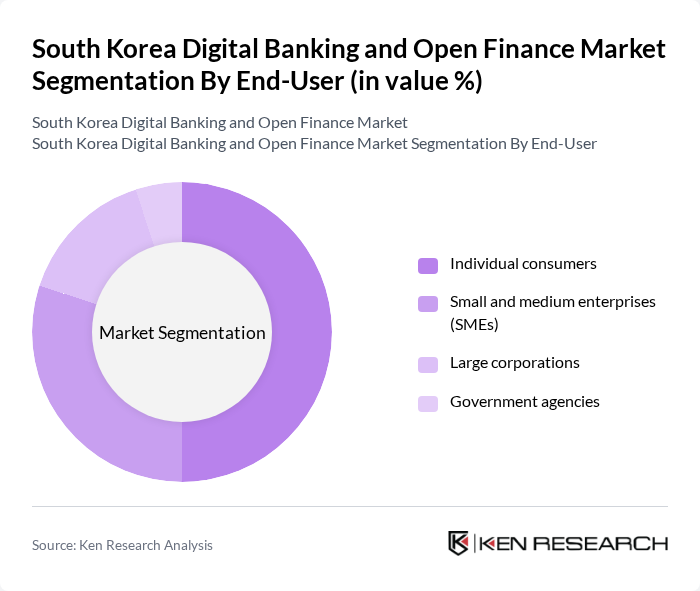
The regulatory framework requires strong API authentication, encryption, and transaction level monitoring. As discussed in the Ken Research analysis of South Korea’s digital banking and open finance market, open finance expansion is reshaping service delivery models across the sector.
Within the South Korea BFSI security market, API security solutions, identity federation systems, and real time anomaly detection tools are becoming mandatory infrastructure components rather than optional enhancements.
6. Legal Risks and Compliance Challenges for Global Firms
Global firms entering South Korea’s financial ecosystem face multiple compliance challenges. These include strict breach notification timelines, personal data protection requirements, cross border transfer restrictions, and regulatory reporting obligations. Non compliance can result in financial penalties, operational restrictions, and reputational damage.
The regulatory landscape described in Chambers Practice Guides emphasizes the importance of proactive compliance governance and localized legal expertise.
For international technology providers, success in the South Korea BFSI security market depends on embedding regulatory intelligence into product design, adopting secure by design principles, and aligning cybersecurity frameworks with Korean supervisory expectations. Compliance is not simply a legal requirement. It is a competitive differentiator in one of Asia’s most advanced and tightly regulated financial markets.
Explore how SmartDev partners with financial institutions in the South Korea BFSI security market through focused AI strategy sprints that validate priority use cases and define secure, compliant roadmaps.
SmartDev helps Korean BFSI organizations assess AI fraud detection and security automation feasibility, reducing risk before major investment decisions.
Discover how SmartDev accelerates secure AI deployment in the South Korea BFSI security market, reducing time to market and compliance risk.
Talk to Our ExpertsTechnology Trends Transforming the South Korea BFSI Security Market
Technological innovation is fundamentally reshaping the South Korea BFSI security market, as financial institutions balance rapid digital expansion with stringent regulatory and cybersecurity demands. South Korea’s advanced digital infrastructure, high mobile penetration, and proactive fintech ecosystem have accelerated adoption of AI, blockchain, cloud computing, and API driven architectures. However, each technological leap increases system complexity and expands the cyber threat landscape. As a result, security architecture is evolving from perimeter defense toward intelligent, automated, and compliance aligned protection frameworks embedded directly into financial systems.
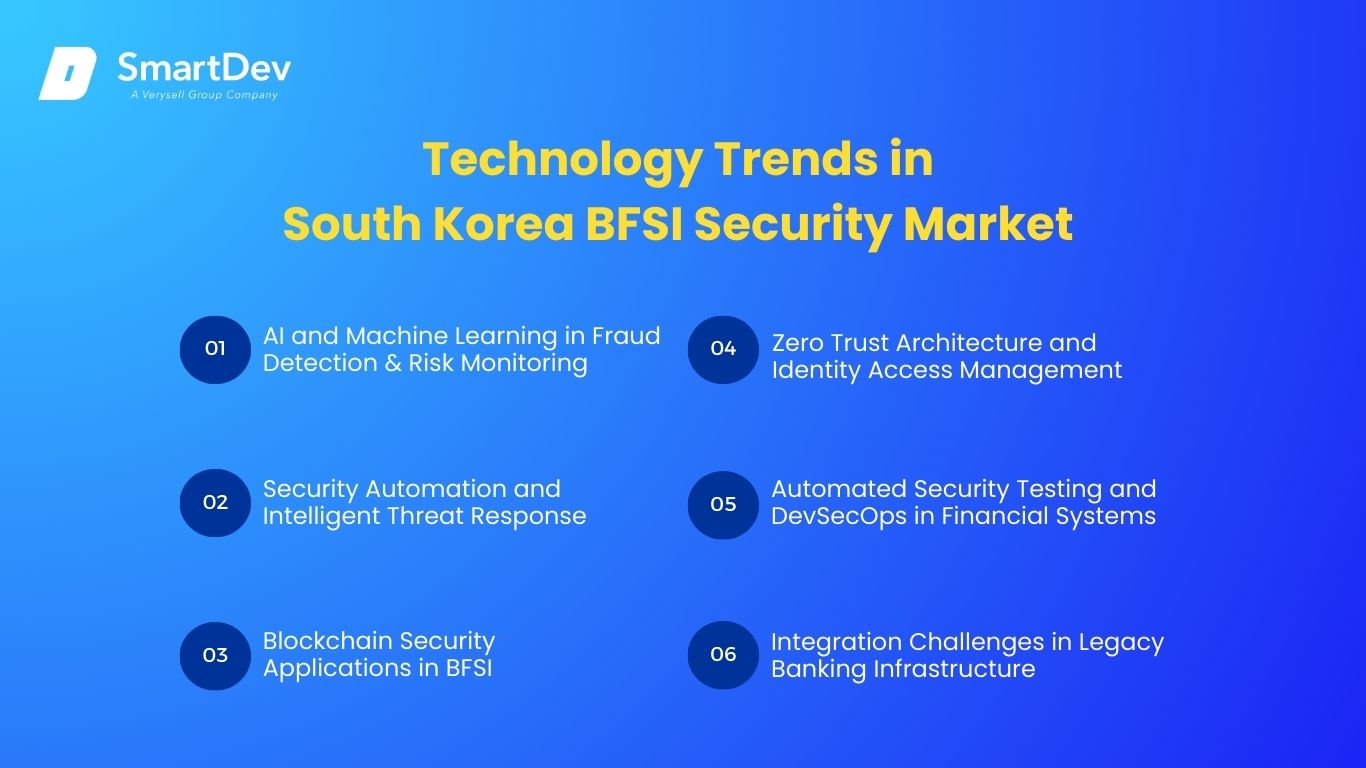
1. AI and Machine Learning in Fraud Detection and Risk Monitoring
Artificial intelligence and machine learning have become core technologies in fraud detection and enterprise risk monitoring across Korean banks and fintech companies. Traditional rule based systems struggle to detect sophisticated fraud patterns, especially as transaction volumes increase through digital banking channels. AI models analyze behavioral biometrics, transaction histories, device fingerprints, and geolocation signals to identify anomalies in real time.
The rapid growth of digital banking, highlighted by Market Research Future, reinforces the necessity of scalable AI monitoring systems. As more consumers rely on mobile apps and online financial platforms, the attack surface expands significantly. AI driven detection engines reduce false positives while improving detection speed, enabling security teams to respond before fraud losses escalate.
Additionally, insights from SmartDev’s AI in BFSI guide emphasize that AI systems can continuously learn from evolving threat patterns. However, model governance, adversarial attacks, and data poisoning risks introduce new security considerations. Protecting AI models themselves is now part of the broader South Korea BFSI security market, requiring secure training pipelines and encrypted data environments.
2. Security Automation and Intelligent Threat Response
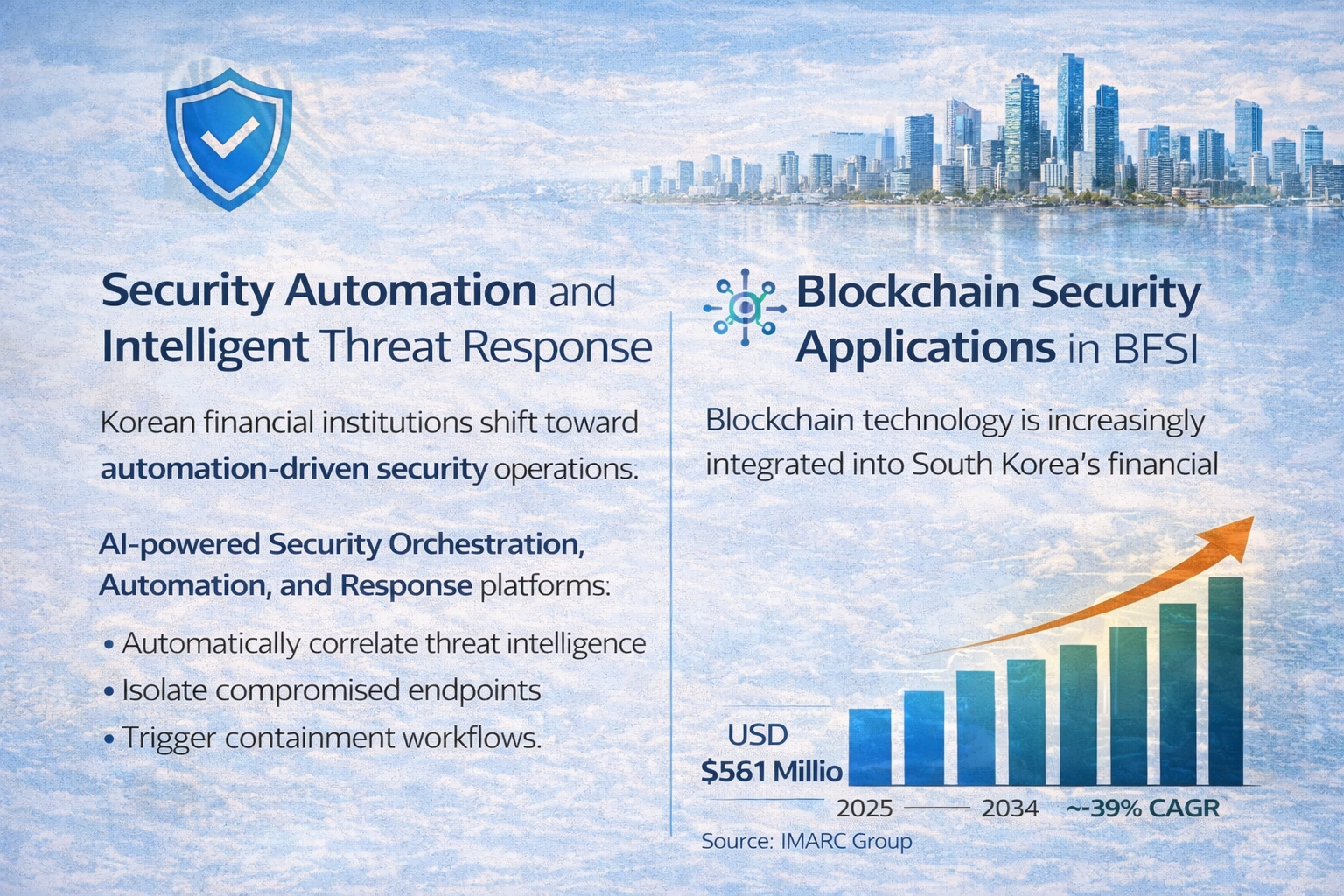
As cyber threats become more frequent and complex, Korean financial institutions are shifting toward automation driven security operations. Manual incident response models cannot scale effectively with expanding digital ecosystems. AI powered Security Orchestration, Automation, and Response platforms allow institutions to automatically correlate threat intelligence, isolate compromised endpoints, and trigger containment workflows.
According to SmartDev’s BFSI security automation analysis, intelligent automation significantly reduces response time and operational overhead. Automation also improves consistency in regulatory reporting and audit logging, which is essential under Korea’s strict financial supervision environment.
The expansion of core banking systems, projected to reach USD 1,495.3 million by 2030 as reported by Grand View Research, further increases system complexity. As infrastructure grows, automated security frameworks become essential to maintain resilience within the South Korea BFSI security market. Automation is no longer optional. It is foundational to scalable cybersecurity operations.
3. Blockchain Security Applications in BFSI
Blockchain technology is increasingly integrated into South Korea’s financial services sector for digital identity, cross border settlements, and smart contract automation. The blockchain in BFSI market is projected to grow from USD 56.1 million in 2025 to USD 1,246.8 million by 2034, reflecting approximately 39% CAGR, according to IMARC Group. This rapid growth demonstrates institutional confidence in distributed ledger technologies.
While blockchain enhances data immutability and transparency, it introduces distinct cybersecurity risks. Private key management, smart contract coding vulnerabilities, consensus protocol weaknesses, and integration gaps with legacy systems all present potential attack vectors. Security in blockchain environments extends beyond encryption. It requires continuous auditing, secure wallet management, and strong governance policies.
As Korean financial institutions expand blockchain pilots into production environments, demand for blockchain specific cybersecurity tools increases. This directly strengthens the technological sophistication of the South Korea BFSI security market, particularly in cryptographic protection and transaction validation controls.
4. Zero Trust Architecture and Identity Access Management
The traditional perimeter based security model is increasingly inadequate in open banking ecosystems. South Korea’s digital finance sector relies heavily on API integrations and third party service providers, increasing identity related vulnerabilities. As noted in Ken Research’s digital banking and open finance analysis, API driven financial connectivity continues to expand rapidly.
Zero Trust Architecture addresses this risk by verifying every access request regardless of network location. Identity and Access Management systems enforce multi factor authentication, biometric verification, role based access controls, and contextual risk evaluation. Instead of assuming trust within internal networks, every device and user must be authenticated continuously.
In the South Korea BFSI security market, zero trust frameworks are becoming standard practice, especially for cloud based deployments and hybrid infrastructures. These systems not only reduce insider threat risk but also align with regulatory compliance expectations under Korean financial supervision authorities.

5. Automated Security Testing and DevSecOps in Financial Systems
As financial institutions accelerate digital product development, integrating security into the software development lifecycle becomes essential. DevSecOps embeds security testing into every stage of application development, reducing vulnerabilities before deployment.
According to SmartDev’s automated security testing guide, continuous code scanning, automated penetration testing, and vulnerability assessment significantly reduce breach risk. Automated compliance checks also help institutions meet regulatory standards efficiently.
The rapid expansion of digital banking platforms, supported by industry forecasts from Grand View Research, increases the frequency of application updates and feature releases. Without DevSecOps, security gaps can emerge quickly. Therefore, DevSecOps adoption is a critical enabler of secure innovation within the South Korea BFSI security market.
6. Integration Challenges in Legacy Banking Infrastructure
Despite rapid modernization, many Korean banks still operate legacy core systems that were not originally designed for cloud native integration or AI deployment. Integrating new technologies into older infrastructure introduces operational and security complexity.
Legacy systems may lack standardized APIs, centralized monitoring, and built in encryption. When blockchain modules, AI engines, or cloud services are layered onto these environments, compatibility issues can create hidden vulnerabilities. Migration to hybrid or multi cloud architectures further increases configuration risk.
Although the banking system software market continues to expand steadily, as reported by Grand View Research, full transformation requires carefully managed integration strategies. Successfully modernizing legacy infrastructure while maintaining regulatory compliance and operational continuity remains one of the most significant challenges shaping the future of the South Korea BFSI security market.
Competitive Landscape and Partnership Ecosystem
South Korea’s BFSI tech arena is competitive and relationship driven. Large banks and insurers typically rely on a small set of trusted prime contractors for core modernization and security programs, while digital only banks and fintechs push faster cycles and partner with specialist vendors. This dynamic shapes procurement. It also defines how foreign security providers should position themselves in the South Korea BFSI security market.
Local IT Conglomerates and System Integrators
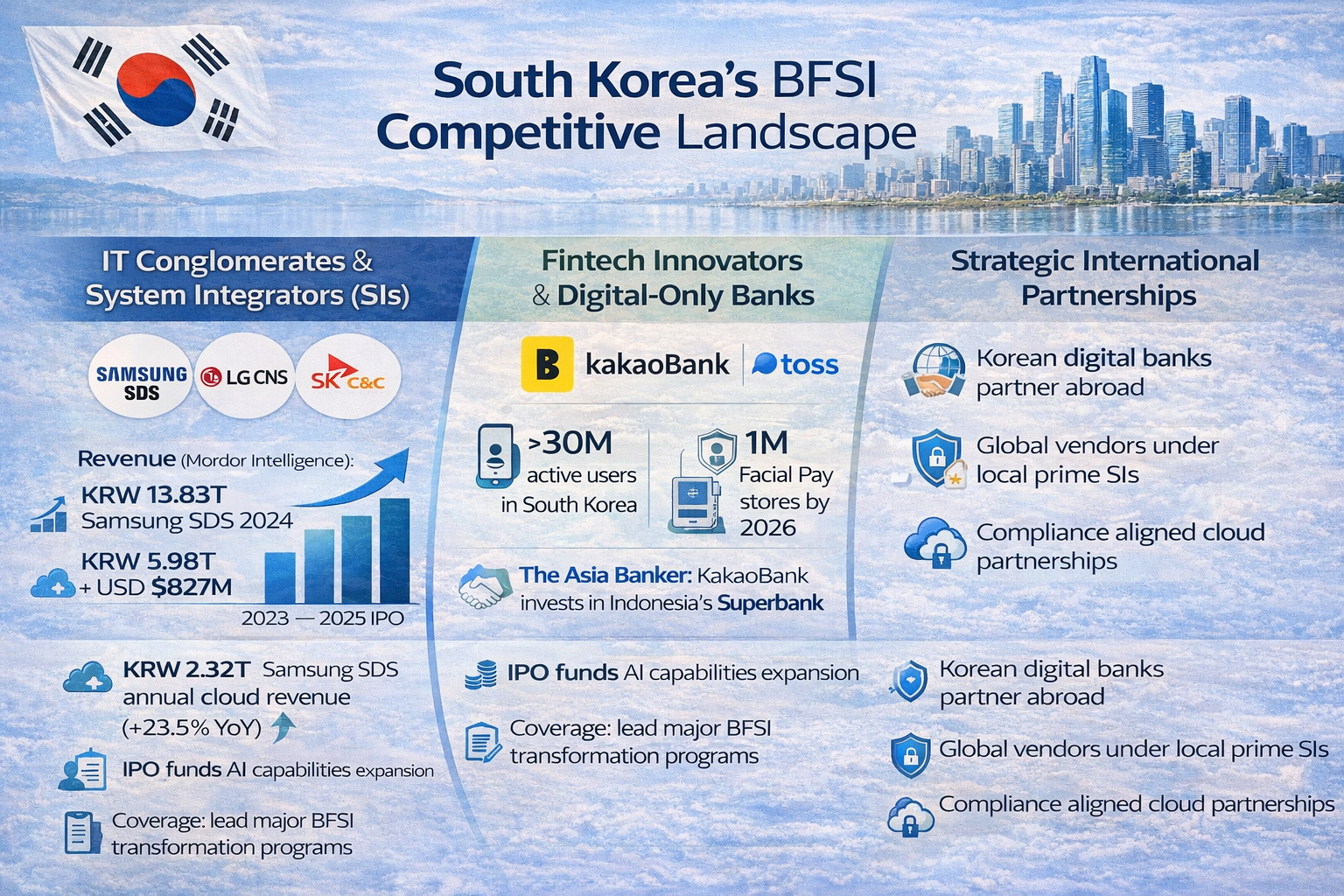
The market is anchored by domestic IT conglomerates and large system integrators (SIs) that dominate major financial transformation programs. Industry coverage frequently cites Samsung SDS, LG CNS, and SK C&C (and affiliates) as leading players serving enterprise and public sector clients, including BFSI. Recent market reporting notes the scale advantages of these incumbents. For example, Mordor Intelligence reports Samsung SDS 2024 revenue of KRW 13.83 trillion, with cloud contributing KRW 2.32 trillion and growing 23.5% year over year. The same source reports LG CNS posted KRW 5.98 trillion and raised USD 827 million in its 2025 IPO to fund expansion, including AI capabilities.
These firms win deals because they can deliver end to end programs. They handle legacy integration, regulatory documentation, security architecture, and multi vendor coordination. Coverage of SI competition in financial software highlights how Korea’s large IT service providers compete to lead banking and insurance modernization programs. The Korea Times describes local competition among major IT service providers for financial sector work, reflecting how concentrated the prime contractor layer can be.
Fintech Innovators and Digital-Only Banks
On the demand side, digital only banks and fintech “super apps” are major innovation engines and security buyers. KakaoBank is often cited as South Korea’s first internet only bank, with a platform centric operating model. EY outlines how KakaoBank was built as a mobile first bank, emphasizing a product and platform approach that typically increases reliance on cloud, API ecosystems, and continuous security engineering.
For fintech scale, Toss is a key reference point. Reuters reports Toss has attracted over 30 million users in South Korea and is planning international expansion. Scale like this drives demand for fraud detection, identity security, and resilient transaction monitoring. Meanwhile, consumer facing innovation like biometric payments also has security implications. The Korea Times reports Toss plans to expand pay by face services to 1 million stores by 2026, and notes the solution uses multiple security layers.
Role of Strategic International Partnerships
International partnerships often take three forms. First is co innovation and overseas expansion, where Korean digital banks partner abroad. For example, The Asian Banker reports KakaoBank’s strategic partnership with Indonesia’s Superbank, including KakaoBank acquiring a 10% stake. Second is specialist technology partnerships, where global vendors provide niche security capabilities under a local prime SI. Third is cloud ecosystem alignment, where banks work with hyperscalers and security partners, subject to local compliance constraints.
Market Entry Barriers for Foreign Security Providers
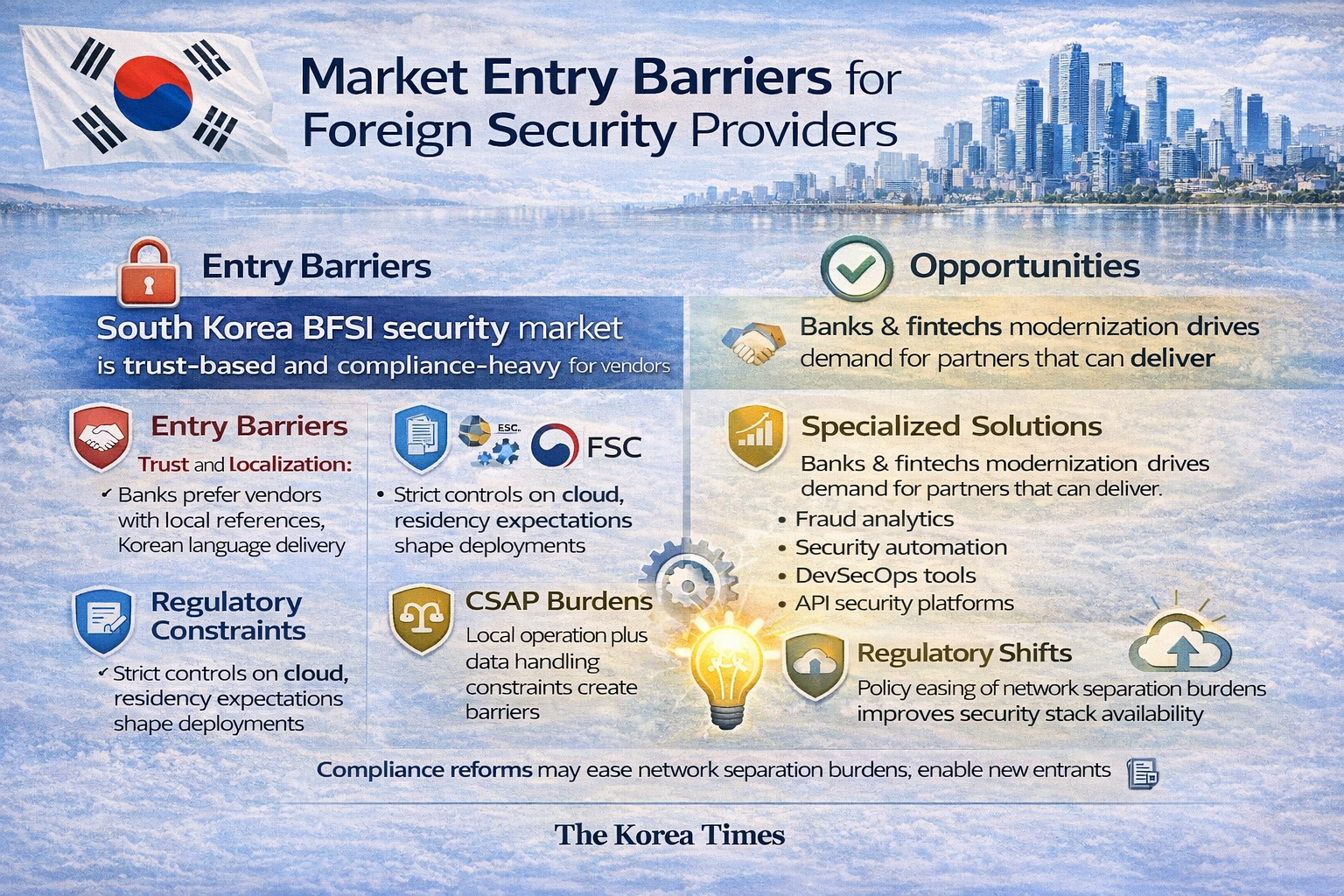
Entry barriers are real in the South Korea BFSI security market. Procurement is trust based and audit heavy. Banks often prefer vendors with proven local references, Korean language delivery, and an ability to pass detailed security reviews. Regulatory and compliance constraints also influence architecture choices, especially around cloud. The Financial Services Commission has published updates on improving regulations for cloud computing and network separation in the financial sector, reflecting how policy requirements shape feasible deployments.
In addition, public sector adjacent requirements can indirectly affect vendor operations. ITIF discusses CSAP related constraints, including local operational and data handling conditions that can create compliance burdens for foreign providers. Even when BFSI projects are not strictly public sector, similar expectations around residency, auditability, and operational control can appear in bank RFPs.
Opportunities for Technology Outsourcing and Co-Innovation
Despite barriers, opportunities are substantial. Banks and fintechs are modernizing faster, and they need specialized security engineering that local primes may not always scale quickly enough. This creates demand for partners that can deliver. Examples include AI driven fraud analytics, security automation, DevSecOps tooling, automated security testing, and secure API platforms. Another strong route is “co innovation under a local SI” where a foreign provider supplies reusable accelerators and domain expertise while the Korean prime manages governance and stakeholder alignment.
Finally, regulatory shifts can create windows for new entrants. Recent policy discussions about easing certain network separation burdens for internal cloud use can accelerate cloud based modernization and expand the addressable scope for modern security stacks. The Korea Times reports on such reforms, which can lower compliance friction and speed adoption of secure cloud tooling.
 Why Firms Should Choose SmartDev to Enter the South Korea BFSI Security Market
 Why Firms Should Choose SmartDev to Enter the South Korea BFSI Security Market
Successfully entering the South Korea BFSI security market requires more than technical capability. It demands regulatory awareness, local collaboration, deep domain expertise, and scalable engineering execution. SmartDev positions itself as a strategic technology partner that bridges international best practices with Korea’s fast evolving financial ecosystem. With proven experience in AI, cybersecurity automation, and BFSI software engineering, SmartDev enables financial institutions and technology firms to expand securely and compliantly into the Korean market.

1. SmartDev’s Strategic Presence and Collaboration in South Korea
SmartDev has demonstrated long term commitment to the Korean market through direct engagement and strategic collaboration initiatives. As highlighted in SmartDev in South Korea: Driving Innovation Through Strategic Collaboration, the company actively builds partnerships with Korean enterprises to support digital transformation and innovation programs.
Additionally, SmartDev’s strategic visit to South Korea reinforces its hands on market approach. Rather than operating as a remote outsourcing vendor, SmartDev focuses on relationship driven engagement, aligning solutions with local business priorities and regulatory expectations. This local commitment strengthens trust, which is critical in the highly regulated South Korea BFSI security market.
2. Deep Expertise in AI, Machine Learning, and BFSI Security Automation
AI and automation are becoming foundational in fraud detection, risk analytics, and cybersecurity operations across Korean financial institutions. SmartDev brings strong capabilities in these areas, supported by industry focused research and applied engineering expertise.
SmartDev’s insights in AI in BFSI: Complete Technology Guide for Financial Leaders outline how AI driven models enhance fraud detection accuracy and operational efficiency. Further analysis in AI and Machine Learning in BFSI Market emphasizes scalable machine learning frameworks tailored to financial services.
Beyond analytics, SmartDev supports intelligent protection strategies through BFSI security automation solutions. These automation frameworks enable real time threat detection, incident response orchestration, and cost efficient security scaling. This expertise directly aligns with the technical demands of the South Korea BFSI security market, where digital expansion must be matched by intelligent defense.
3. Regulatory-Aware Development Approach
South Korea’s BFSI sector operates under strict supervision, including data protection and electronic transaction regulations. SmartDev integrates compliance considerations directly into its development lifecycle. Security by design, encryption standards, audit logging, and risk assessment frameworks are embedded early in project architecture rather than added post deployment.
This regulatory aware approach reduces compliance risk for financial institutions entering or expanding within the South Korea BFSI security market. By aligning software engineering with local supervisory expectations, SmartDev supports smoother approval processes and stronger operational resilience.
4. Secure Software Engineering and Automated Security Testing Capabilities
Rapid product development must not compromise security. SmartDev integrates DevSecOps principles and continuous validation practices into BFSI projects. As detailed in Best Practices for Automated Security Testing in BFSI, automated code scanning, vulnerability assessments, and penetration testing help identify risks before deployment.
This secure software engineering methodology ensures financial platforms remain protected throughout continuous delivery cycles. For institutions competing in Korea’s highly digital environment, this capability strengthens reliability and compliance within the South Korea BFSI security market.
5. End-to-End BFSI Digital Transformation Support
SmartDev provides end to end digital transformation support, covering system architecture, AI integration, cybersecurity automation, and cloud enablement. Rather than offering isolated services, SmartDev delivers integrated solutions that align business objectives with secure technical execution.
From modernizing core banking platforms to implementing AI driven fraud detection engines, SmartDev supports financial institutions at every stage of transformation. This holistic approach is especially valuable in the South Korea BFSI security market, where modernization, compliance, and innovation must advance simultaneously.
5. Long-Term Value Creation for Korean Financial Institutions
Ultimately, entering or expanding within the South Korea BFSI security market requires a long term strategic partner. SmartDev focuses on sustainable value creation through scalable architecture, cost efficient engineering, and continuous innovation support.
By combining AI expertise, security automation capabilities, regulatory alignment, and local market collaboration, SmartDev enables Korean financial institutions to enhance competitiveness while maintaining strong cybersecurity posture. For firms seeking to navigate South Korea’s advanced yet tightly regulated financial ecosystem, SmartDev represents a technology partner capable of delivering both innovation and resilience.
Strategic Recommendations for Entering the South Korea BFSI Security Market
Entering the South Korea BFSI security market requires a structured, compliance driven, and partnership oriented strategy. South Korea’s financial ecosystem is technologically advanced but tightly regulated, with high expectations around operational resilience, data protection, and vendor reliability. International firms must align innovation with regulatory readiness and cultural understanding to compete effectively.
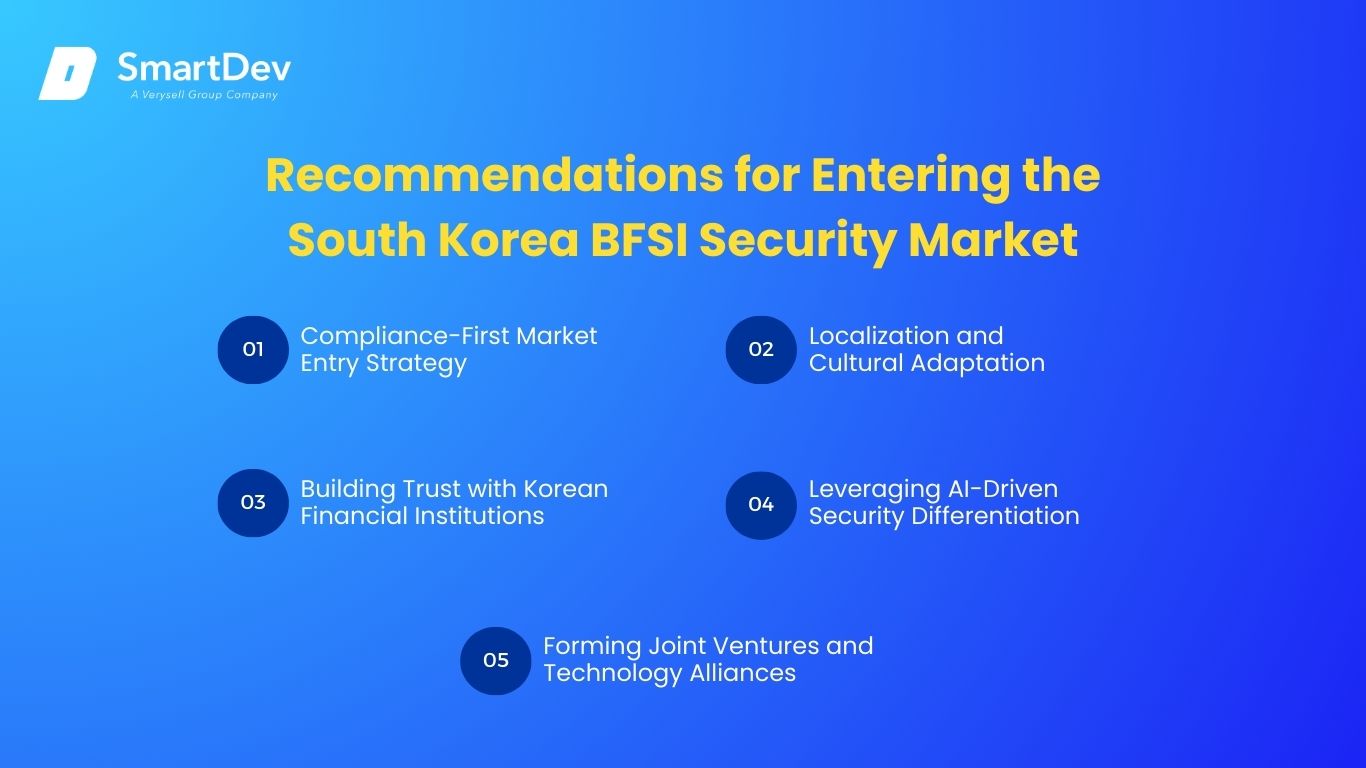
1. Compliance-First Market Entry Strategy
Regulatory alignment should be the foundation of any market entry plan. South Korea enforces strict oversight through financial authorities, particularly in areas such as personal data protection, electronic transactions, and cloud outsourcing. Companies must design products and services with built in encryption, audit logging, incident reporting capabilities, and risk management frameworks.
A compliance first approach reduces approval delays and increases credibility with procurement teams. It also positions vendors as long term strategic partners rather than short term technology suppliers. In the South Korea BFSI security market, regulatory readiness is not optional. It is a prerequisite for participation.
2. Localization and Cultural Adaptation
Localization extends beyond language translation. Korean financial institutions expect localized documentation, Korean speaking technical support, and strong understanding of domestic regulatory nuances. Decision making processes can be hierarchical and relationship driven, which requires patience and consistent engagement.
Technical localization is equally important. Solutions should support local encryption standards, authentication practices, and integration with domestic financial platforms. Firms that adapt their operating model to local expectations are more likely to gain traction in the competitive South Korea BFSI security market.
3. Building Trust with Korean Financial Institutions
Trust is central to procurement decisions in South Korea’s BFSI sector. Financial institutions prioritize vendors with strong references, proven security track records, and transparent governance structures. Demonstrating certifications, case studies, and compliance audit results strengthens credibility.
Long term engagement strategies such as pilot programs, proof of concept deployments, and co development initiatives help reduce perceived risk. In the South Korea BFSI security market, trust often determines whether a vendor is invited into larger transformation programs led by system integrators or financial groups.
4. Leveraging AI-Driven Security Differentiation
AI driven security capabilities can provide competitive differentiation. Korean banks and fintech companies are increasingly investing in fraud detection automation, anomaly detection, and predictive risk analytics. Vendors that offer explainable AI models, real time monitoring tools, and scalable automation frameworks can address both efficiency and compliance goals.
However, AI solutions must include governance controls and secure data handling mechanisms. Differentiation in the South Korea BFSI security market depends not only on advanced algorithms but also on responsible and secure deployment.
5. Forming Joint Ventures and Technology Alliances
Strategic partnerships with local system integrators, fintech firms, or consulting companies can accelerate market entry. Joint ventures provide local credibility, regulatory familiarity, and access to established client networks. Technology alliances also enable co innovation tailored to Korean financial requirements.
In a market characterized by strong domestic players and strict oversight, collaboration often outperforms independent entry. Firms that build alliances and align with local ecosystems significantly improve their chances of long term success in the South Korea BFSI security market.
Conclusion
The South Korea BFSI security market stands at the intersection of rapid digital innovation and rigorous regulatory oversight. As banking system software expands, open finance ecosystems mature, and AI driven platforms scale across retail and corporate finance, cybersecurity has become a strategic investment priority rather than a technical afterthought.
Regulatory frameworks such as data protection laws and electronic financial transaction mandates further reinforce the need for secure architecture, automated monitoring, and compliance aligned development. For technology providers, South Korea offers high growth potential, but only for those prepared to combine technical excellence with regulatory precision and localized engagement.
Success in this market requires a long term vision. Firms must adopt a compliance first approach, invest in AI driven security differentiation, and build strong partnerships with local institutions and system integrators. The opportunity is significant. However, credibility, trust, and secure by design engineering will ultimately determine competitive advantage in the South Korea BFSI security market.
If your organization is planning to enter or expand within the South Korea BFSI security market, partner with SmartDev to accelerate secure, compliant, and scalable growth. Contact SmartDev today to explore how AI driven security solutions and regulatory aware development can position your business for long term success in Korea’s dynamic financial ecosystem.