TL;DR:
- AI infrastructure spans physical compute (GPUs, TPUs, custom silicon), data centers, networking, cloud platforms, and the software layers that manage training, inference, and data pipelines.
- Value accrues unevenly across the stack — semiconductor leaders and hyperscale operators currently capture the most margin, but the shift from training to inference is redistributing where returns concentrate.
- Capital requirements are enormous and upfront — new data center campuses can cost $1B–$5B+ before generating revenue; ROI timelines of 7–12 years are common.
- The three biggest risks are power constraints (permitting and grid capacity), hardware obsolescence (GPU generations turn over every 2 years), and geopolitical exposure (export controls, supply chain concentration).
- Evaluation requires a due-diligence checklist covering demand quality, power and land rights, unit economics, technology lifecycle, and execution capability.
- The next phase shifts from large-scale model training toward inference at scale, edge deployment, and energy-efficient specialized hardware — changing which infrastructure categories lead.
Introduction
Artificial intelligence is no longer a technology story — it is an infrastructure story.
The computing clusters, data centers, fiber interconnects, and power grids that underpin modern AI represent one of the largest capital deployment cycles in history. Institutional investors — from sovereign wealth funds to private equity — are treating AI infrastructure as a distinct asset class with return profiles comparable to traditional infrastructure like toll roads or utilities.
Yet for many investors and enterprise decision-makers, the landscape remains opaque. What exactly counts as AI infrastructure? Where does value accrue in the stack? How do you evaluate an opportunity rigorously — beyond the hype? What are the real risks, and how do you size them?
This guide answers those questions in full. It is structured for readers who want both strategic orientation and practical frameworks: executives allocating capital, investment professionals building sector theses, and technology leaders planning enterprise AI strategy.
1. What AI Infrastructure Investment Means
Defining AI Infrastructure and the Investment Opportunity
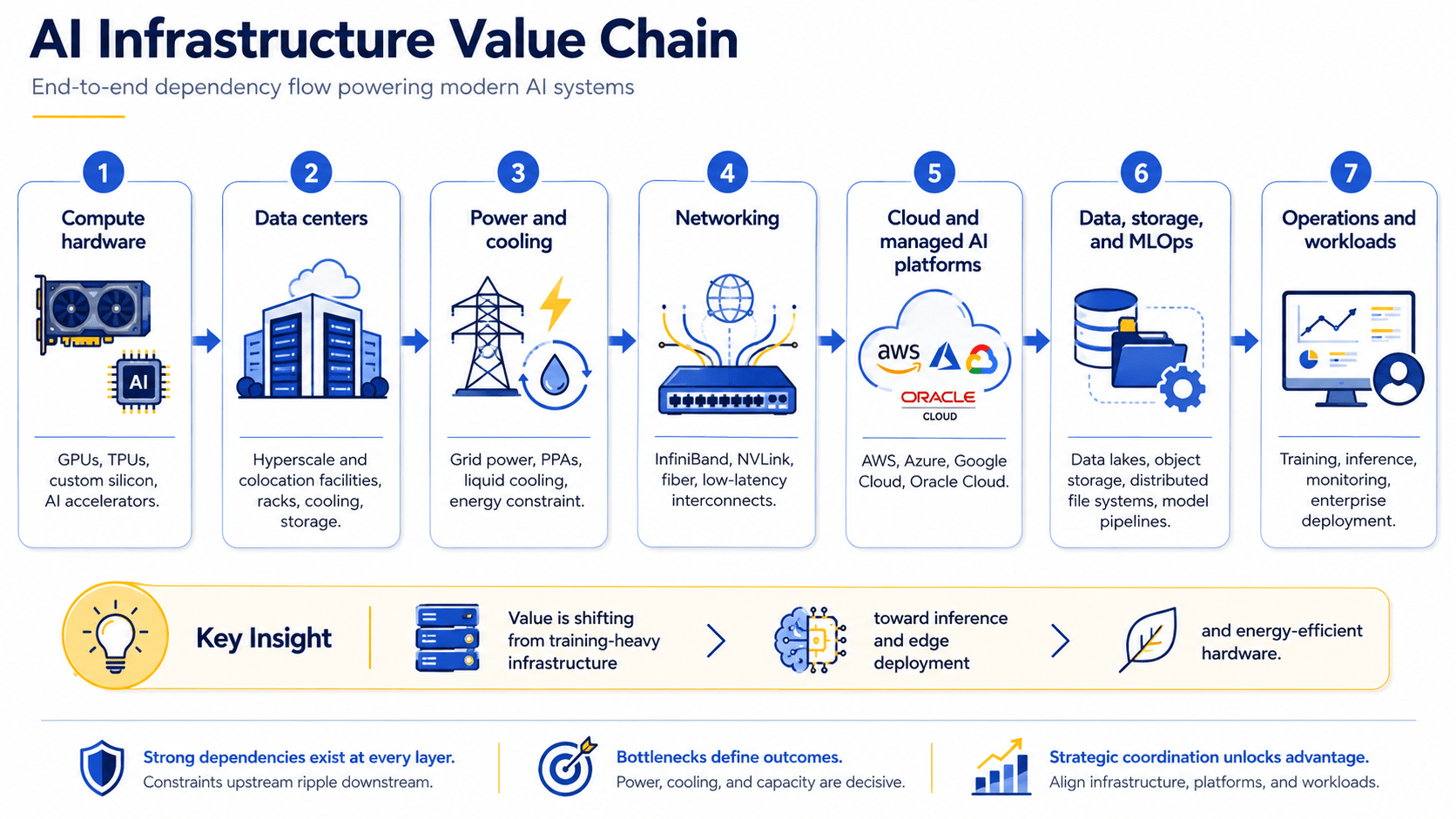
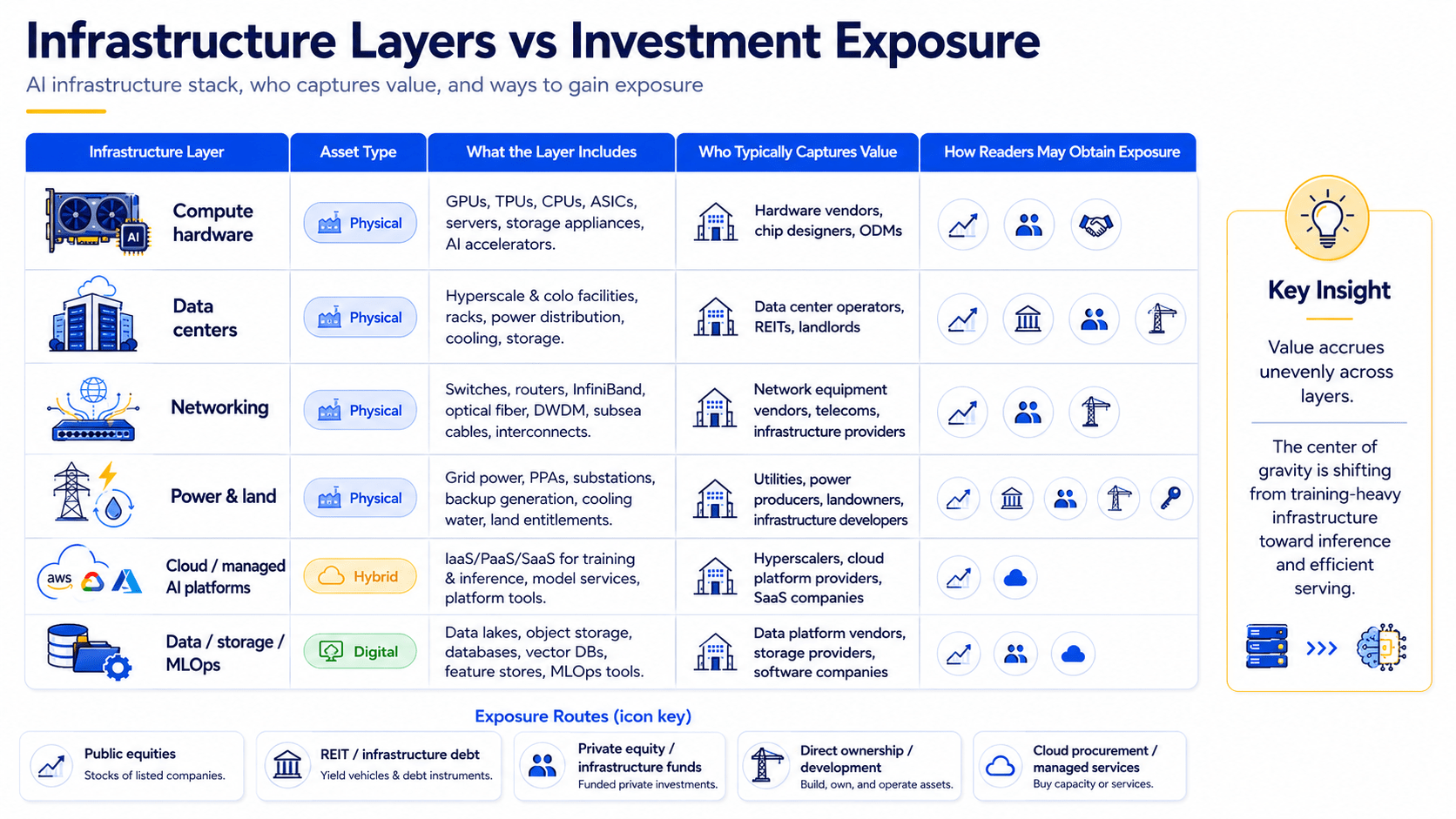
AI infrastructure is the aggregate of physical and digital resources required to build, train, deploy, and operate AI systems at scale. It includes:
- Compute hardware: GPUs, TPUs, and custom AI accelerators that execute the mathematical operations underlying AI models.
- Data centers: Facilities housing servers, storage, power systems, and cooling, ranging from hyperscale campuses to edge nodes.
- Networking: High-bandwidth interconnects, fiber links, and low-latency switching that allow distributed AI workloads to communicate.
- Cloud and managed AI platforms: Software-defined infrastructure delivered as a service by providers such as AWS, Google Cloud, Microsoft Azure, and Oracle Cloud.
- Data and storage systems: Distributed file systems, object storage, data lakes, and MLOps pipelines that manage the data lifecycle for AI.
The investment opportunity is the deployment of capital into any of these layers — through direct ownership, equity, debt, or contracted services — in anticipation of returns driven by AI adoption.
What distinguishes AI infrastructure from prior infrastructure investment cycles (telecommunications buildout, cloud transition) is the combination of capital intensity, technology velocity, and demand concentration. A single hyperscale AI data center campus can consume more than 1 GW of power and cost $5B+ to build. Hardware generations turn over every 18–24 months. And a handful of hyperscalers and frontier AI labs currently drive the majority of demand. This creates both exceptional opportunity and exceptional risk.
Why AI Workloads Are Reshaping Infrastructure Demand
Traditional enterprise IT was designed for transactional processing: relatively modest, predictable compute loads running business applications. AI workloads are categorically different. Training a large language model requires sustained operation of tens of thousands of GPUs for weeks or months, consuming power measured in megawatts and generating heat that challenges conventional cooling systems.
Inference — running a trained model to serve user requests — introduces a different pressure: massive parallelism at low latency, at global scale, continuously. A single consumer AI assistant might field hundreds of millions of queries per day, each requiring real-time compute. This is qualitatively unlike anything that preceded it in enterprise IT.
The result is a structural mismatch between existing infrastructure supply and AI-driven demand. Legacy data centers are undersized for GPU density, underpowered relative to AI load profiles, and insufficiently networked for the bandwidth AI training requires. This mismatch is the investment thesis.
How AI Infrastructure Differs From Traditional IT Infrastructure
| Dimension | Traditional IT Infrastructure | AI Infrastructure |
|---|---|---|
| Primary workload | Transactional, moderate compute | Parallel matrix operations, extreme compute |
| Core hardware | General-purpose CPUs | GPUs, TPUs, custom accelerators |
| Power density per rack | 5–15 kW | 40–120+ kW |
| Networking requirements | Standard Ethernet | InfiniBand, NVLink, 400G/800G |
| Data volumes | GBs to TBs per workload | PBs per training run |
| Refresh cycle | 5–7 years | 2–3 years |
| Capital cost | Moderate, incremental | Very high, front-loaded |
The practical implications for investors: AI infrastructure demands larger upfront commitments, shorter depreciation cycles, and deeper technical due diligence than traditional IT infrastructure investment.
The Economic Case: Capacity, Productivity, and Capital Intensity
The economic logic for AI infrastructure investment rests on three pillars.
Capacity shortage drives pricing power. Demand for GPU compute has materially outstripped supply since 2023. Lead times for H100 and H200 clusters extended to 6–12 months at peak. This scarcity allowed cloud providers to charge $2–$8 per GPU-hour for AI compute, yielding strong margins for infrastructure operators.
Productivity gains justify spending. Enterprise adopters are achieving measurable ROI from AI deployment — code generation tools reducing engineering time by 20–40%, AI-assisted document processing cutting manual review costs by half or more. These productivity gains sustain demand for the compute needed to run AI systems, even as upfront infrastructure costs are high. For a detailed look at calculating returns on AI projects, see SmartDev’s AI ROI framework.
Capital intensity creates barriers to entry. The scale required to build competitive AI data centers — multi-gigawatt power contracts, multi-billion-dollar construction programs, scarce land near fiber and grid interconnects — limits competition. Established operators with locked-in power agreements and existing customer relationships have significant structural advantages. This is the characteristic that attracts institutional infrastructure investors seeking durable return profiles.
2. The AI Infrastructure Investment Value Chain
Compute: GPUs, TPUs, Custom Silicon, and AI Accelerators
Compute is the foundational layer of the AI infrastructure stack and currently the most capital-intensive segment per dollar of AI workload processed.
GPUs remain the dominant AI compute platform. NVIDIA’s data center GPU lineup — including the H100, H200, and the Blackwell B100/B200 series — commands roughly 80% market share in AI training workloads. Their combination of high memory bandwidth, CUDA software ecosystem, and established supply chain relationships with cloud providers makes displacement difficult in the near term.
TPUs (Tensor Processing Units), developed by Google, represent a significant alternative for specific workloads. Google’s internal AI training runs heavily on TPUs, and Google Cloud’s TPU pods are available to external customers. TPUs offer competitive efficiency for transformer-based model training at scale.
Custom silicon is the fastest-growing segment. AWS (Trainium for training, Inferentia for inference), Microsoft (Maia), Meta (MTIA), and Apple (Neural Engine) have all developed proprietary AI accelerators. The rationale: at sufficient scale, custom chips designed for specific model architectures deliver better cost-per-inference than general-purpose GPUs. This trend will intensify as AI moves from training-dominated spending to inference-dominated spending.
AI FPGAs and ASICs serve lower-volume, latency-sensitive inference use cases. Startups including Cerebras Systems (wafer-scale processors), Graphcore (IPUs), Groq (deterministic LPUs), and Tenstorrent are challenging the NVIDIA/Google duopoly with architectures optimized for specific workload classes.
Investment implication: Compute hardware is the highest-margin, highest-risk layer. NVIDIA’s current position is durable in the 2–3 year horizon but faces genuine competition at the 5-year horizon from custom silicon at scale. Diversification across compute vendors is prudent.
Data Centers: Hyperscale, Colocation, Edge, Power, and Cooling
AI data centers differ from traditional facilities in ways that matter for investors.
Power density is the defining constraint. A standard 2019-era data center rack consumed 7–10 kW. An H100 GPU rack consumes 30–40 kW. An H200 or Blackwell rack can exceed 70–120 kW. This means AI data centers require 4–10x the power infrastructure per square foot of traditional facilities, driving up both capital costs and operating expenses.
Cooling is the corollary challenge. Air cooling is approaching physical limits for high-density AI racks. The industry is shifting to direct liquid cooling (DLC), rear-door heat exchangers, and full immersion cooling. Investment in cooling technology companies and in retrofit capabilities for existing facilities is growing.
Hyperscale facilities — campuses of 100MW to 1GW+ operated by hyperscalers or specialized wholesale data center operators — handle the majority of large-model training and cloud AI serving. The global hyperscale data center market is projected to grow from approximately $320 billion in 2023 to over $1.4 trillion by 2029.
Colocation operators (Equinix, Digital Realty, CyrusOne) provide facilities, power, and connectivity to enterprise tenants who want AI compute without building their own campuses. The colocation segment is growing rapidly as enterprises scale AI workloads faster than they can build internal capacity.
Edge data centers — smaller facilities located close to end users, industrial sites, or 5G base stations — enable latency-sensitive AI inference. Autonomous vehicle systems, industrial robotics, real-time language processing, and healthcare diagnostics all benefit from AI compute at the edge. The edge data center market is growing at approximately 10% annually.
Power procurement has become the single largest bottleneck in AI data center development. Available grid capacity in major data center markets (Northern Virginia, Phoenix, Dublin, Singapore) is constrained. Developers are increasingly pursuing power purchase agreements (PPAs) for renewable energy, direct utility partnerships, and in some cases on-site generation (natural gas, nuclear SMRs in emerging planning). Investors evaluating AI data center opportunities must assess power availability before any other factor.
Networking: High-Bandwidth Interconnects, Fiber, and Low-Latency Systems
AI training at scale is as much a networking problem as a compute problem. Training a large model across thousands of GPUs requires continuous all-reduce communication operations — each GPU must exchange gradient updates with thousands of others at every training step. Network latency and bandwidth directly determine training throughput efficiency.
InfiniBand (NVIDIA/Mellanox) and RoCE (RDMA over Converged Ethernet) are the dominant fabrics for AI cluster interconnect. HDR and NDR InfiniBand (200Gbps and 400Gbps respectively) are standard in frontier AI training clusters.
NVLink and NVSwitch provide GPU-to-GPU connectivity within a single server node and across nodes in NVLink-based systems, enabling memory pooling and higher bandwidth than PCIe-based GPU communication.
Front-end networking — connecting data center buildings, connecting to internet exchange points, and backhaul to cloud regions — relies on high-capacity fiber. Investment in fiber infrastructure supporting data center campuses has accelerated significantly.
5G and edge connectivity enable AI inference at distributed edge locations. For enterprise and industrial AI applications, private 5G networks provide the low-latency, high-reliability connectivity that Wi-Fi cannot guarantee.
Cloud and Managed AI Platforms
Cloud providers are simultaneously infrastructure operators and AI infrastructure investors — they spend tens of billions annually building the data centers, network, and custom silicon that they then offer to customers.
For enterprise buyers, cloud AI platforms provide access to GPU compute, model hosting, inference APIs, MLOps tooling, and pre-built AI services without the capital expenditure of self-owned infrastructure. AWS, Google Cloud, Azure, and Oracle Cloud are the four dominant platforms at scale.
For investors, cloud providers offer indirect exposure to AI infrastructure growth through public equities — with the advantage of diversification across cloud use cases, but with valuations that already reflect significant AI growth expectations.
For a deeper look at how enterprises are leveraging cloud AI platforms to build applications, see SmartDev’s AI development services.
Data, Storage, Model Training, Inference, and MLOps Operations
The data and operations layer is increasingly central to AI infrastructure value. Training large models requires petabytes of curated, preprocessed data stored in systems capable of streaming it to GPU clusters at training throughput speeds. Object storage (S3-compatible), parallel file systems (GPFS, Lustre, WEKA), and high-speed NVMe-based storage tiers all play roles.
MLOps platforms — tooling for experiment tracking, model versioning, dataset management, deployment pipelines, and monitoring — have become infrastructure in the operational sense: organizations cannot reliably train and deploy models at scale without them. MLflow, Weights & Biases, Kubeflow, and managed equivalents from cloud providers are widely deployed.
Inference infrastructure deserves separate attention. As AI moves from primarily research and training to primarily production and serving, inference optimization — model quantization, distillation, batching strategies, dedicated inference chips — becomes the key cost lever. The cost of serving inference requests has dropped dramatically (roughly 100x over three years for comparable capability), but demand has grown faster than cost has fallen. To understand the full cost structure across the AI development lifecycle, SmartDev’s AI development cost guide provides a detailed breakdown.
Where Value Accrues Across the Stack
Not all infrastructure layers are equally attractive from an investment return perspective. A simplified value-accrual map:
| Layer | Current margin profile | Key risk | Near-term trend |
|---|---|---|---|
| AI accelerators (NVIDIA) | Very high | Custom silicon displacement | Sustained dominance, 2–3yr |
| Hyperscale cloud (AWS, Azure, GCP) | High | Commoditization of compute | Margin compression over time |
| Wholesale data center operators | Moderate–high | Power scarcity limits growth | Strong near-term, rate-sensitive |
| Colocation providers | Moderate | Enterprise price sensitivity | Demand growth solid |
| Networking (Arista, Mellanox) | Moderate–high | Vendor concentration | Growing with AI cluster demand |
| Edge infrastructure | Low–moderate | Fragmented, immature | Growing, long-term opportunity |
| MLOps / inference software | High (SaaS-like) | Competition | Consolidating toward leaders |
The key structural shift underway: as AI moves from training-dominated workloads to inference-at-scale, value will migrate from GPU cluster operators toward inference-optimized hardware (custom silicon, ASICs), efficient serving platforms, and edge infrastructure.
3. AI Infrastructure Market Structure and Key Participants
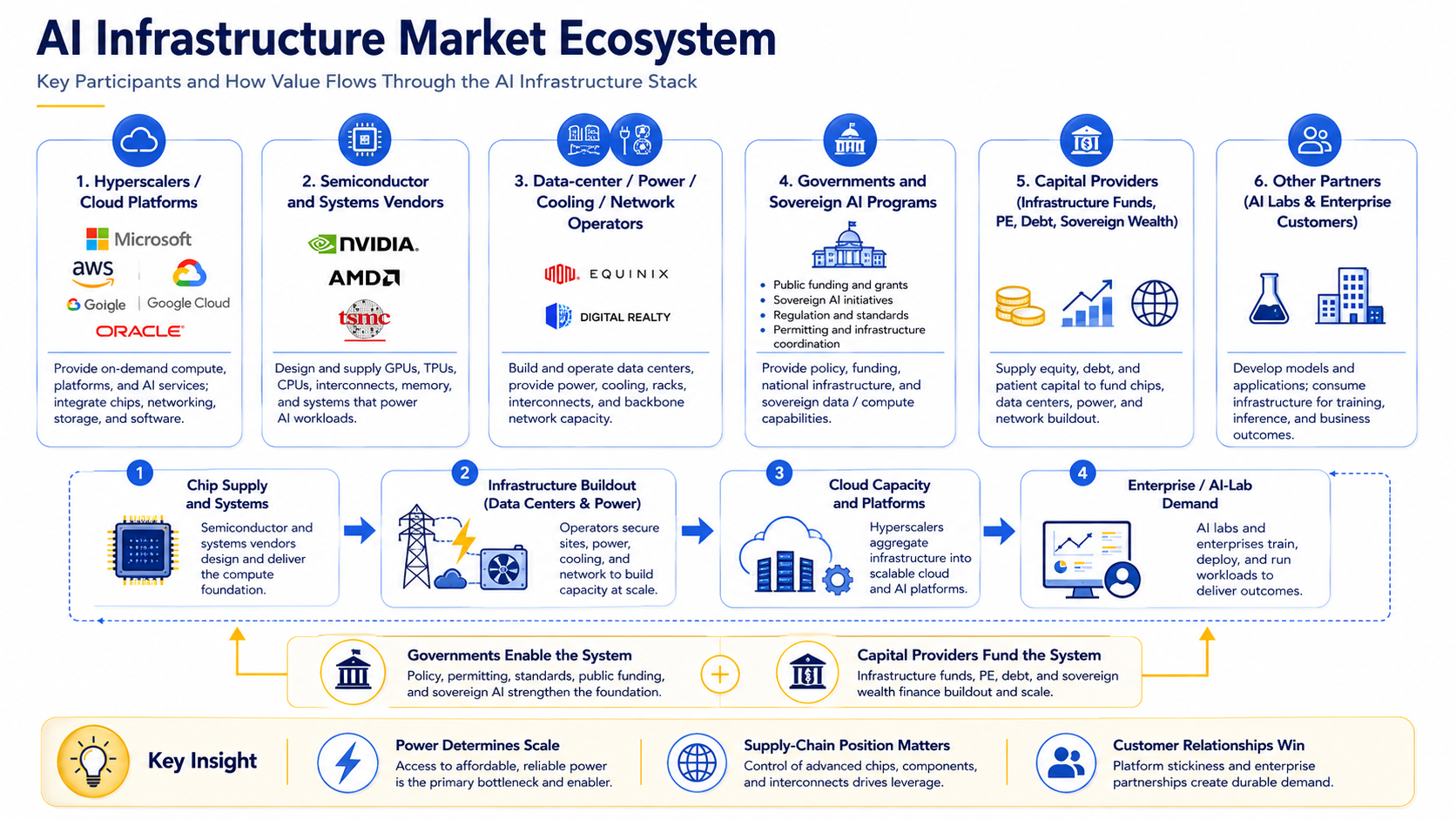
Hyperscalers and Cloud Platforms
The four dominant hyperscalers — Microsoft Azure, Amazon Web Services, Google Cloud, and Oracle Cloud — collectively represent the largest AI infrastructure investors globally. Their 2025 capital expenditure commitments reflect the scale of AI buildout:
- Microsoft guided approximately $80 billion in capital expenditure for fiscal 2025, a substantial proportion allocated to AI data centers. Microsoft’s deep partnership with OpenAI has made Azure the preferred cloud for frontier AI model development.
- Amazon (AWS) continues to lead in overall cloud revenue and is investing aggressively in custom AI silicon (Trainium 2, Inferentia 3) while expanding data center capacity across North America, Europe, and Asia-Pacific.
- Alphabet (Google) combines proprietary TPU infrastructure for internal AI model training with Google Cloud’s external AI platform business. Google’s capital expenditure guidance for recent periods has approached $75 billion, predominantly AI-infrastructure-directed.
- Oracle Cloud has positioned itself as the partner of choice for AI companies requiring dedicated GPU cluster capacity outside the three dominant hyperscalers. Its partnership with NVIDIA on OCI Superclusters and its role in the Stargate consortium represent a significant repositioning toward AI infrastructure.
Semiconductor and Systems Providers
NVIDIA occupies an extraordinary position: a single company supplies the compute backbone for the majority of global AI training. Its H100 and H200 GPUs are the de facto standard for frontier model training; its CUDA software ecosystem creates deep switching costs. The company’s data center revenue grew from approximately $15 billion in FY2023 to over $47 billion in FY2024. The Blackwell architecture (B100, B200, GB200) represents the next major hardware generation.
AMD is NVIDIA’s primary GPU competitor, with its MI300X accelerator gaining traction for large-scale inference workloads where its large unified memory pool offers advantages. AMD’s AI accelerator roadmap is advancing, though its software ecosystem (ROCm) remains less mature than CUDA.
Intel is attempting to rebuild its AI accelerator business through the Gaudi 3 product line and through its foundry services business, which is critical for manufacturing future custom AI chips at advanced nodes.
TSMC is the world’s most critical chokepoint in AI hardware supply — it manufactures the most advanced chips for NVIDIA, AMD, Apple, and others. Its capacity at 3nm and 2nm nodes is fully subscribed through the mid-2020s. TSMC’s supply chain position makes it one of the most consequential companies in the AI infrastructure ecosystem.
Systems integrators — Supermicro, Dell, HP Enterprise — assemble GPU servers, storage systems, and networking into deployable configurations that data centers procure. They operate on thin margins but benefit from volume growth.
Data-Center, Power, Cooling, and Network Operators
A distinct and growing category of AI infrastructure participants operates the physical layer below the hyperscalers.
Wholesale data center operators (Digital Realty, Equinix, Iron Mountain, NTT, Vantage Data Centers) build and operate large facilities leased to cloud providers and enterprises. Their value proposition is scale, power procurement expertise, and global footprint.
Power and energy infrastructure is increasingly recognized as the binding constraint in AI data center growth. Utility companies, independent power producers, and energy storage developers are critical participants. The nuclear power renaissance — driven partly by AI data center demand — has brought Microsoft (Three Mile Island), Google, and Amazon into nuclear PPAs.
Cooling technology providers — Vertiv, Schneider Electric, Alfa Laval, CoolIT Systems — supply the liquid cooling infrastructure that AI-dense facilities require. This segment is growing rapidly as air cooling approaches its limits.
Network operators building dark fiber, subsea cables, and data center interconnect (DCI) capacity are benefiting from AI-driven bandwidth demand growth. Zayo, Lumen, and subsea cable consortia are relevant players.
Governments, Sovereign Programs, and Public-Private Partnerships
Governments globally have concluded that AI infrastructure is strategic national infrastructure — analogous to electrical grids or transportation networks — and are acting accordingly.
United States: The CHIPS and Science Act allocated approximately $52 billion to domestic semiconductor manufacturing and research. The Stargate initiative — a consortium including SoftBank, Oracle, and OpenAI — announced plans for up to $500 billion in U.S.-based AI infrastructure investment over four years. Federal agencies including DOE national labs are building AI supercomputing capacity for scientific research.
European Union: The EU AI Act (fully effective 2024–2026) establishes the world’s first comprehensive AI regulatory framework, creating compliance requirements that shape infrastructure design. On investment, the EU has committed €50 billion in public funds toward AI, including support for AI “gigafactories” — large-scale compute facilities accessible to European researchers and companies. EuroHPC’s supercomputing program provides AI-accessible HPC capacity across member states.
China: China’s government has articulated an explicit national goal of AI leadership by 2030 and is deploying public capital at scale to achieve it. Over 40 AI industrial parks have been built; a new 1 trillion yuan (~$138 billion) government-backed technology fund is targeting AI and semiconductor infrastructure. Domestic GPU companies (Biren Technology, Cambricon, Huawei’s Ascend) are receiving substantial government support to reduce dependence on NVIDIA, amid ongoing U.S. export controls on advanced AI chips to China.
Sovereign AI programs — where national governments build AI compute capacity to ensure digital sovereignty — are emerging in UAE (G42, Falcon models), Saudi Arabia, France, India, and Japan. These programs represent a growing pool of non-US, non-China AI infrastructure capital.
Private Capital, Infrastructure Funds, and Emerging Providers
The scale and return profile of AI data centers has attracted traditional infrastructure investors who historically focused on utilities, toll roads, and airports.
Blackstone acquired AirTrunk (Asia-Pacific data center operator) for approximately $24 billion AUD, a landmark transaction demonstrating institutional appetite for AI infrastructure assets.
Global AI Infrastructure Investment Partnership (GAIIP), backed by BlackRock, Global Infrastructure Partners, Microsoft, and MGX, is targeting $80–100 billion in AI data center and energy infrastructure commitments.
DigitalBridge and KKR have built significant data center investment practices, recognizing the asset class characteristics: long-term contracted revenue, power-secured capacity, and essential infrastructure demand.
Emerging providers — such as CoreWeave, Lambda Labs, and Together AI — offer specialized GPU cloud services to AI companies that lack hyperscaler relationships or want dedicated capacity. CoreWeave’s valuation exceeded $19 billion by early 2024, reflecting investor enthusiasm for GPU-as-a-service business models.
4. AI Infrastructure Investment Trends and Market Catalysts
AI Compute Demand and Capacity Expansion
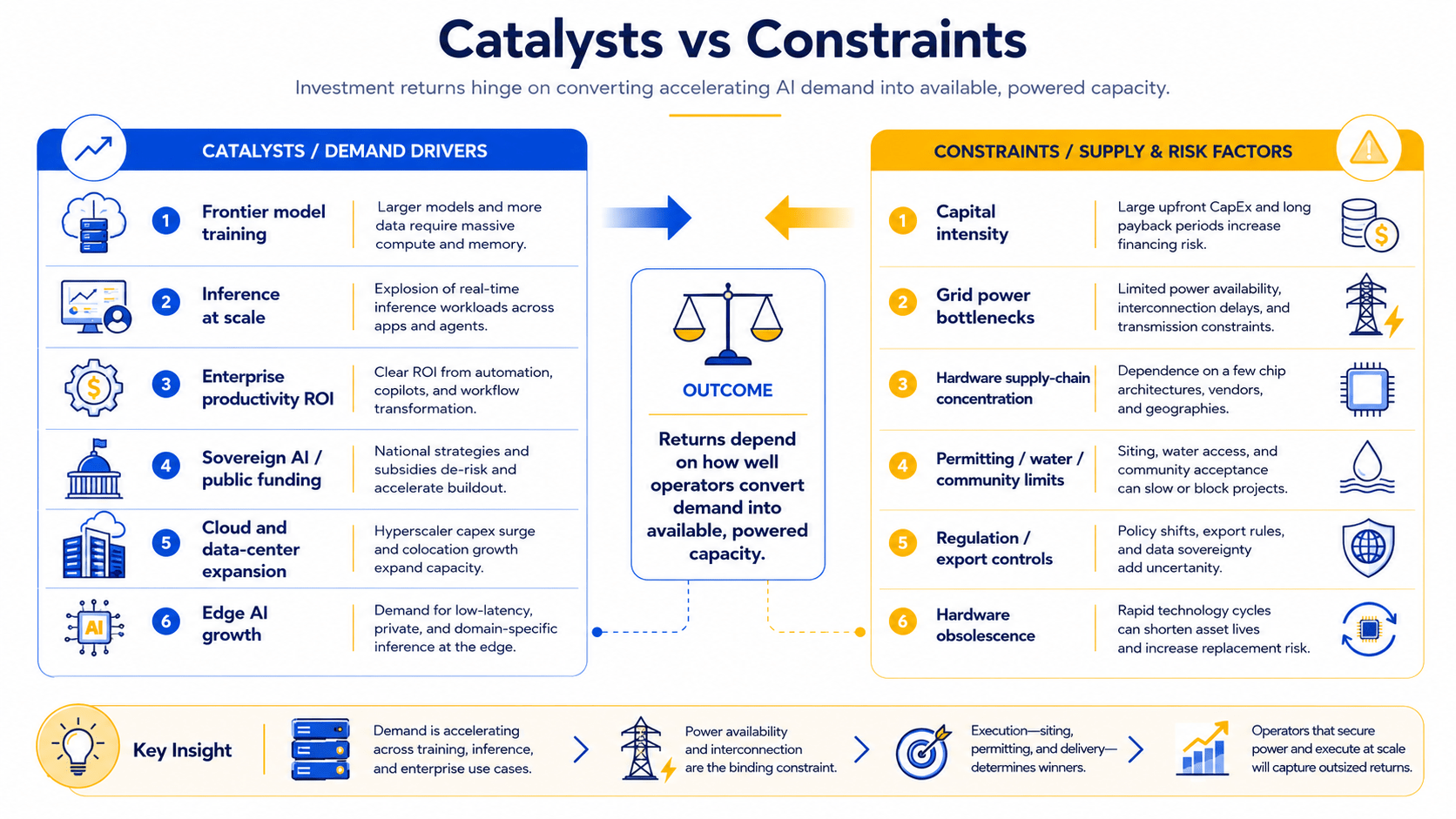
The fundamental driver of AI infrastructure investment is a demand signal with few historical precedents: frontier AI model training costs have grown roughly 4x per year since 2019, driven by scaling laws that reward larger models trained on more data with proportionally better performance. GPT-4-class models required compute clusters with thousands of H100s running for months; next-generation frontier models may require 10x the compute.
Simultaneously, inference demand is growing even faster. As AI applications embed into products used by hundreds of millions of users — coding assistants, customer service agents, search, content generation — inference compute demand is growing exponentially. By 2026, industry analysts expect inference to represent the majority of AI compute spend, reversing the historical dominance of training.
This dual driver — training at frontier scale, inference at massive scale — is sustaining extraordinary data center expansion programs with no near-term saturation in sight.
Data-Center Buildout, Grid Capacity, and Energy Constraints
Data center construction is constrained less by capital availability than by physical resource scarcity: available land with adequate grid interconnection, water rights for cooling, permitting timelines, and skilled construction labor.
In the United States, data center development has become so significant that utility commissions in Virginia, Texas, and Georgia are revising load growth forecasts upward by 50–100% relative to 2022 projections — driven almost entirely by AI data centers. Grid interconnection queues (the backlog of new power connections awaiting utility approval) in key markets extend 3–5 years.
This creates a durable advantage for infrastructure operators who have already secured power agreements: their capacity cannot be rapidly replicated. New entrants face 4–6 year development timelines just to build a campus.
Sustainability is increasingly relevant. Data centers are projected to consume 3–4% of global electricity by 2030, up from roughly 1% in 2020. Hyperscalers face both regulatory pressure and corporate sustainability commitments that require renewable energy sourcing. This is driving nuclear PPAs, large-scale wind and solar contracts, and investment in grid storage.
Training Versus Inference Demand
The training/inference dynamic is the most important structural shift in AI infrastructure economics over the next three years.
Training is concentrated among a small number of frontier labs and hyperscalers. It requires massive, interconnected GPU clusters, high-memory-bandwidth chips, and sustained power over weeks-to-months timescales. NVIDIA dominates this segment.
Inference is distributed across millions of applications, at all scales from edge devices to data centers. It rewards different architectural tradeoffs: lower latency per token, lower cost per query, optimized for specific model sizes. Custom silicon (AWS Inferentia, Google TPU v5, NVIDIA H100 with TensorRT optimization) competes more effectively here.
The transition toward inference dominance has implications for which infrastructure participants benefit most:
- Data centers serving inference workloads at modest scale (enterprise, regional) become more relevant.
- Custom silicon vendors gain share against NVIDIA.
- Inference optimization software (quantization, distillation, speculative decoding) becomes a value-creation lever.
- Edge infrastructure — where inference runs closest to users — gains investment attention.
Capital Spending, Partnerships, and Infrastructure Financing
The financing architecture of AI infrastructure is evolving. Traditional corporate balance sheet investment (hyperscalers funding their own data centers) is being supplemented by:
- Sale-leaseback arrangements: Hyperscalers sell completed data center assets to infrastructure funds and lease them back, recycling capital.
- Joint ventures: Cloud providers partner with real estate developers, utility companies, or sovereign funds to co-develop facilities.
- Infrastructure debt: Data center assets with long-term contracted revenue (10–15 year hyperscaler leases) are attractive to infrastructure debt investors at yields competitive with utility bonds.
- AI infrastructure REITs: Equinix and Digital Realty operate as REITs, offering public-market access to data center cash flows.
The Stargate consortium is a prominent example of private-sector capital pooling at the scale previously reserved for public infrastructure.
Regionalization, Supply Chains, and Sovereign AI
U.S. export controls on advanced AI semiconductors (A100, H100, and equivalent chips) have bifurcated the global AI infrastructure market. China is effectively excluded from purchasing leading-edge AI accelerators from NVIDIA, AMD, or Intel, driving domestic alternatives (Huawei Ascend, Biren) and limiting China’s near-term frontier AI training capacity.
Beyond U.S.-China dynamics, many countries are building sovereign AI infrastructure to avoid dependence on foreign cloud providers for national AI capabilities. UAE’s investment in G42 and its own compute programs, France’s commitment to national AI compute through GENCI, India’s national AI mission with $1.2B for public AI compute — these represent a structural regionalization of AI infrastructure investment.
For investors, regionalization creates both opportunity (new markets, new partners, government co-investment) and risk (jurisdiction-specific regulatory environments, political risk, less liquidity).
5. Ways to Invest in AI Infrastructure
Direct Investment in Compute, Data Centers, and Physical Infrastructure
Direct investment provides the closest exposure to AI infrastructure economics but requires the most capital and operational expertise.
Data center development: Acquiring land, securing power, and constructing AI-optimized data center campuses. Typical development costs for hyperscale AI campuses run $500M–$5B+ depending on size and location. Returns depend on occupancy, power cost, and lease pricing.
GPU cluster ownership: Purchasing GPU hardware and operating it as a compute service (cloud or dedicated). CoreWeave’s model — acquire H100 clusters, offer GPU-as-a-service to AI companies — demonstrated the viability of this approach, though capital intensity and hardware depreciation create significant balance sheet risk.
Power and land acquisition: Securing grid-connected land in advance of data center development has become a distinct investment strategy, as the scarcity of permitted, powered sites commands significant premiums.
For enterprises seeking to leverage AI infrastructure without owning it, SmartDev’s AI consulting services can help design the right infrastructure strategy for your scale and budget.
Public-Market Exposure: Semiconductors, Cloud, Data Centers, and Networking
Public equity markets provide the most accessible and liquid form of AI infrastructure exposure.
Semiconductor companies: NVIDIA (GPUs), AMD (CPUs and AI accelerators), Broadcom (networking ASICs, custom AI chips for Google/Apple), Marvell (custom silicon), and TSMC (foundry) are the core pure-play semiconductor exposures.
Cloud platforms: Microsoft, Alphabet, Amazon, and Oracle offer indirect AI infrastructure exposure bundled with broader cloud and software revenue. Valuations reflect AI growth expectations, limiting upside from pure infrastructure expansion.
Data center REITs: Equinix (EQIX) and Digital Realty (DLR) are the primary public data center REITs. They provide yield-plus-growth exposure with AI demand as a tailwind.
Networking equipment: Arista Networks and Cisco benefit from AI cluster networking demand; Vertiv and Schneider Electric from power/cooling infrastructure.
AI infrastructure ETFs: Several thematic ETFs now provide diversified exposure to the AI infrastructure stack, including semiconductor, data center, and networking components.
Private-Market Exposure: Venture Capital, Private Equity, and Infrastructure Funds
Private markets offer access to AI infrastructure opportunities before public listings and at segments of the stack not represented in public equities.
Venture capital: AI hardware startups (Cerebras, Groq, Tenstorrent), MLOps platforms, and AI-native cloud providers are raising at significant valuations but offer asymmetric upside. In 2024, AI startups attracted over $131 billion in VC investment globally, representing more than 50% of all VC deployed.
Private equity: PE firms are acquiring data center operators, networking companies, and AI-adjacent infrastructure businesses. Blackstone’s AirTrunk acquisition is the landmark transaction; more will follow as the asset class matures.
Infrastructure funds: Large infrastructure funds (Brookfield, KKR, DigitalBridge) are building AI data center portfolios with targeted returns of 12–18% IRR, consistent with other essential infrastructure assets.
Credit: Senior secured infrastructure debt backed by hyperscaler tenants offers lower returns (6–10%) but with utility-like credit profiles.
Cloud and Managed-Service Strategies for Enterprises
For enterprises not investing in AI infrastructure as a financial asset but building AI capabilities into their products, the right “investment” is in cloud and managed-service procurement. Key decisions:
- Single cloud vs. multi-cloud: Concentration in one cloud AI platform reduces complexity but creates dependency. Multi-cloud strategies provide negotiating leverage and resilience.
- Reserved vs. on-demand capacity: Committing to reserved GPU instance hours (1–3 year terms) reduces per-hour cost significantly versus on-demand pricing.
- Managed inference vs. self-hosted: For inference workloads, managed APIs (OpenAI, Anthropic, Google Gemini) offer simplicity; self-hosted models on cloud GPU instances offer cost efficiency at scale and control over model versions.
SmartDev’s MLOps services help enterprises build production-grade AI deployment pipelines that optimize infrastructure utilization across cloud environments.
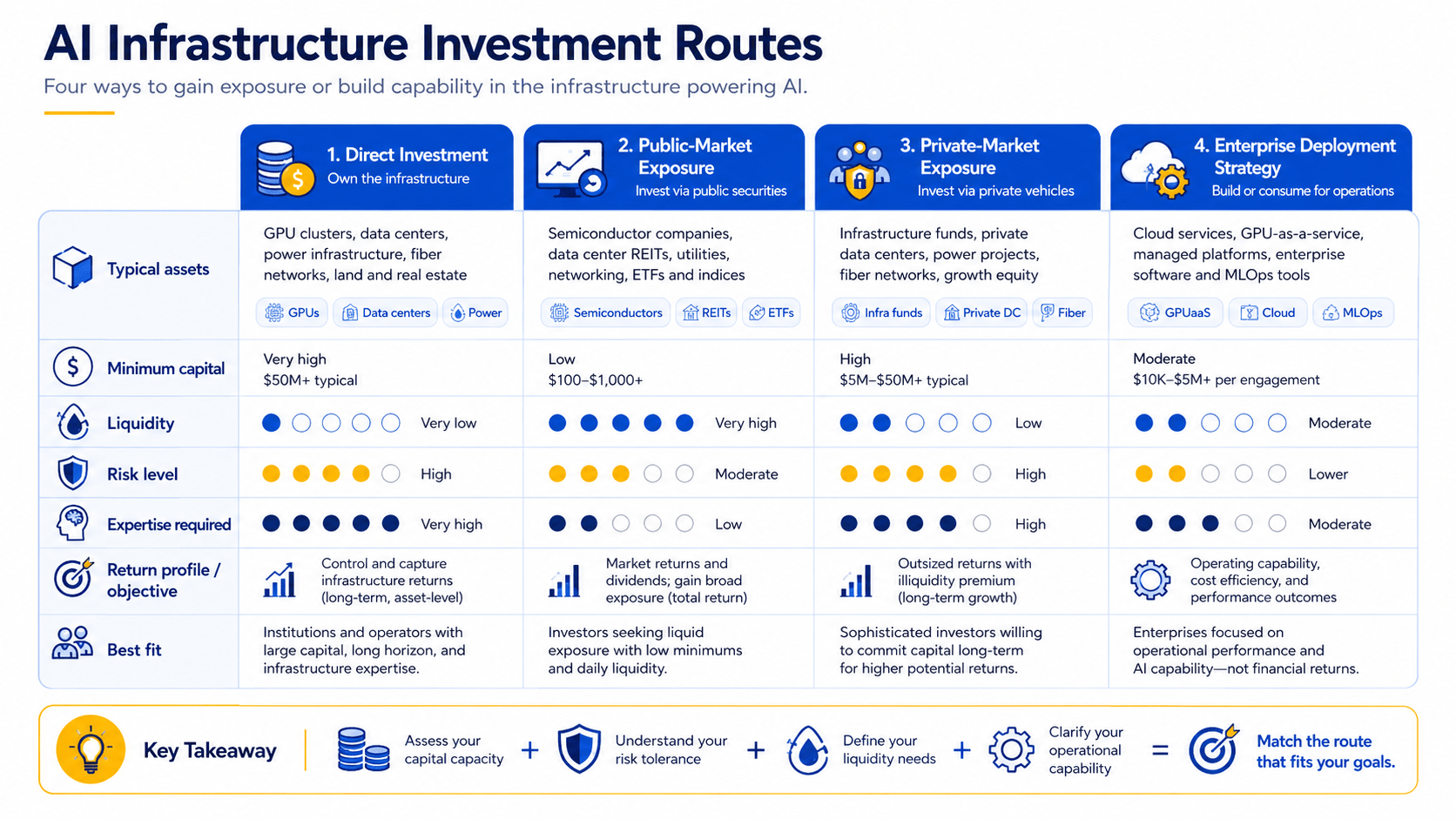
Choosing an Investment Route by Capital, Risk, Liquidity, and Expertise
| Route | Minimum capital | Risk level | Liquidity | Expertise required |
|---|---|---|---|---|
| Public equities (semiconductors, REITs) | Low ($1K+) | Moderate | High | Low–moderate |
| AI infrastructure ETFs | Low ($1K+) | Moderate | High | Low |
| Infrastructure debt | Medium ($1M+) | Low–moderate | Low | Moderate |
| PE/infrastructure funds | High ($10M+) | Moderate | Low | Low (delegated) |
| VC (AI hardware/software) | High ($1M+) | Very high | Very low | High |
| Direct data center development | Very high ($100M+) | High | Very low | Very high |
| GPU cluster ownership | High ($10M+) | High | Low | High |
6. How to Evaluate an AI Infrastructure Opportunity
Demand, Utilization, and Customer Concentration
The economics of AI infrastructure depend fundamentally on utilization. A GPU cluster running at 40% utilization versus 85% utilization has radically different unit economics — fixed costs (hardware, power, facilities) are spread across far fewer billable hours in the former case.
Key demand questions for due diligence:
- What percentage of capacity is contracted versus speculative? Long-term hyperscaler leases (10–15 years) de-risk underutilization; spot-market GPU clouds are far riskier.
- What is customer concentration? A data center with one hyperscaler tenant is exposed to renewal risk at lease expiration; diversified tenant bases provide more stable cash flows.
- What is the pipeline of demand? AI infrastructure in undersupplied markets (Southeast Asia, Middle East, parts of Europe) may enjoy years of demand backlog.
Power Availability, Land, Connectivity, and Build Timelines
Power is the scarcest resource in AI data center development. Due diligence must verify:
- Grid interconnection: Is there a signed interconnection agreement, or is the project in a queue that could take 2–5 years?
- Power contract terms: What is the price, term, and reliability of power supply? Exposure to spot energy markets creates operating cost volatility.
- Renewable energy sourcing: Given customer sustainability requirements and regulatory trends, what percentage of power is sourced from renewables?
- Water rights: Evaporative cooling systems consume significant water; in water-stressed regions, this is a real permitting and operational risk.
- Build timeline: What are the zoning, permitting, and construction timelines? A 48-month timeline from land acquisition to operations is common; delays destroy IRR.
Technology Lifecycle, Hardware Refresh, and Obsolescence Risk
AI hardware evolves faster than any comparable infrastructure category. The H100 launched in 2022; by 2025, newer architectures (Blackwell) offer substantially better performance per dollar. This creates unique challenges:
- Depreciation mismatch: Data centers typically depreciate buildings over 20–40 years, but the GPU hardware inside depreciates economically over 3–5 years. Financial models must reflect accelerated economic obsolescence.
- Customer willingness to pay for older generations: As new GPU architectures arrive, customers may demand access to newer hardware, leaving owners of older clusters with stranded assets.
- Mitigation strategies: Flexible lease structures that align hardware refresh with customer contract terms; avoid long-term leases that lock in specific GPU generations; maintain optionality to upgrade hardware within existing facilities.
Unit Economics: Capex, Operating Costs, Pricing, and Returns
A simplified unit economics framework for a GPU-as-a-service data center:
Revenue drivers:
- GPU-hours billed × utilization rate × price per GPU-hour
- Typical H100 cloud pricing: $2–$5/hour (reserved) to $6–$10/hour (on-demand)
Cost drivers:
- Hardware capex: ~$30,000–$35,000 per H100 GPU
- Facilities capex: $10–$20M per MW of data center capacity
- Power operating cost: $0.04–$0.12 per kWh × ~700W per H100
- Staffing, networking, software, maintenance
Target metrics:
- Data center PUE (Power Usage Effectiveness): target <1.3 for modern AI facilities
- Revenue per kW: $2,000–$5,000/month depending on market
- Target EBITDA margin: 40–55% for well-operated wholesale data centers
- Target IRR: 12–18% for infrastructure fund investments, 20%+ for development-stage projects
For broader financial modeling guidance relevant to AI-related capital investments, SmartDev’s data analytics services provide the analytical infrastructure enterprises need to support investment decisions.
Partnerships, Supply Chains, and Execution Capability
AI infrastructure development is operationally complex. Evaluating execution capability:
- Hardware supply relationships: Does the developer have allocation agreements with NVIDIA, AMD, or other GPU vendors? During periods of GPU scarcity (2023–2024), lack of vendor relationships was a fatal constraint.
- Construction and commissioning expertise: Hyperscale data center construction requires specialized contractors and commissioning expertise. Track record matters.
- Power utility relationships: Experienced developers have established relationships with regional utilities that accelerate permitting and interconnection.
- Hyperscaler customer relationships: The ability to sign anchor tenants before breaking ground de-risks development economics dramatically.
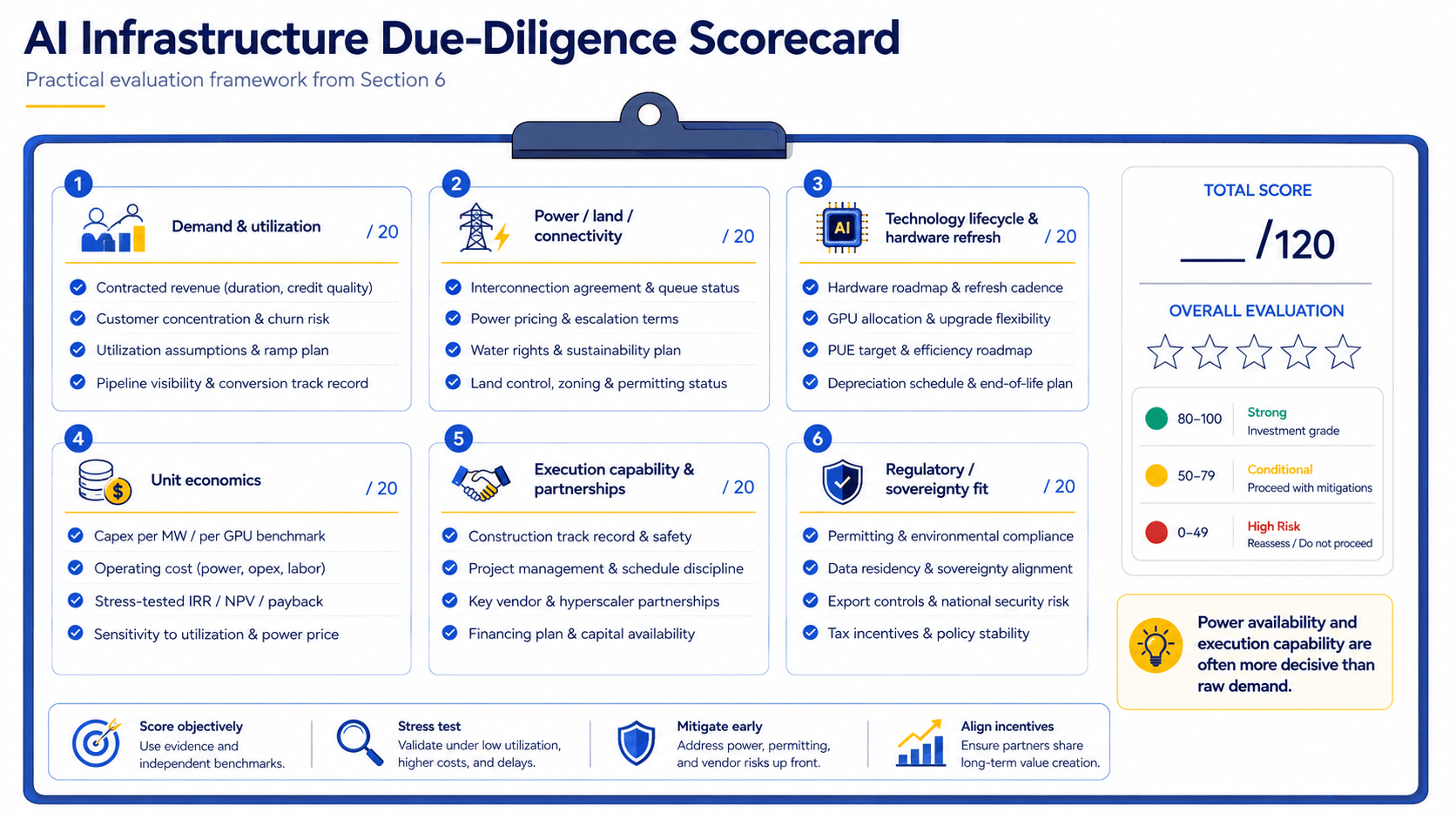
A Due-Diligence Checklist for Decision Makers
1. Site and Power
Signed grid interconnection agreement in hand (not queued)
Power price locked, term ≥ 10 years, supplier creditworthy
Renewable sourcing plan documented
Water rights secured (if evaporative cooling)
Zoning approved; permitting timeline defined
2. Demand and Revenue
Contracted revenue as % of total capacity (target >60% at opening)
Customer concentration: no single tenant >40% of revenue
Lease terms include hardware refresh provisions
Pricing benchmarked against comparable markets
3. Technology
Hardware generation current; refresh plan for 36-month cycles
Depreciation schedule reflects economic life, not accounting life
Network connectivity: redundant, adequate for AI training workloads
4. Financials
PUE target verified against cooling design
IRR model stress-tested for: 70% utilization, +20% power cost, 6-month delay
Exit comparables identified (buyer universe for asset at stabilization)
5. Execution
GPU supply allocations confirmed with vendor
Construction contractor has AI data center experience
Management team has operated comparable facilities
Regulatory risk assessment for data sovereignty and AI compliance
7. Risks and Constraints in AI Infrastructure Investment
High Capital Expenditure, Financing, and ROI Uncertainty
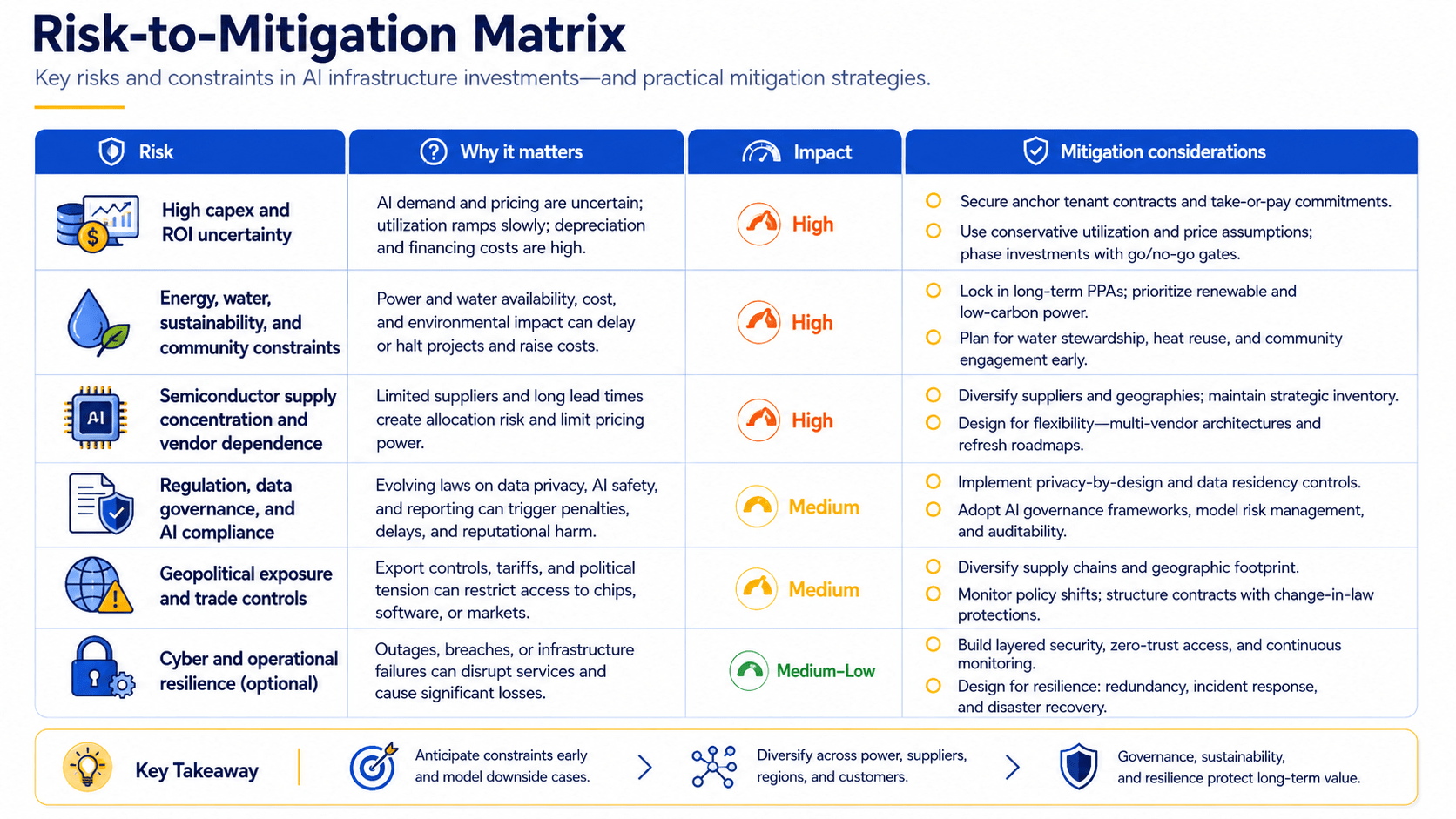
AI infrastructure requires capital at a scale and concentration that creates meaningful financial risk. A single hyperscale AI data center campus may require $1–$5 billion of investment before generating revenue. Construction timelines of 24–48 months mean substantial capital is deployed before any cash flow. And the revenue case depends on utilization rates, customer pricing, and hardware performance that are all uncertain at investment time.
ROI uncertainty is compounded by the rapidly changing AI landscape. An infrastructure designed for one generation of AI workloads may face materially different demand when operational. Financial models built on 2024 GPU pricing, utilization assumptions, and energy costs may be significantly wrong within 3–4 years.
Mitigation: anchor tenant contracts before construction; conservative utilization assumptions in base case; stress test for GPU pricing compression; maintain balance sheet flexibility for hardware refresh cycles.
Energy, Water, Sustainability, and Community Constraints
AI data centers are among the most energy-intensive facilities ever built. The power density of AI GPU racks, combined with projected growth in AI compute demand, has made data center power consumption a significant policy and community concern.
Regulatory risk: Several jurisdictions are implementing or considering restrictions on new data center permits based on energy and water consumption (Ireland, Netherlands, Singapore). Permitting delays and denials represent genuine project risk.
Community opposition: In multiple U.S. markets, local communities have opposed data center development on grounds of visual impact, traffic, water use, and grid strain. Opposition can delay or block projects.
Water consumption: Evaporative cooling for a 100MW data center can consume millions of gallons of water per day. In water-stressed markets, this creates both regulatory and reputational risk.
Carbon accountability: Hyperscaler customers increasingly require 24/7 carbon-free energy matching, not just annual renewable energy certificates. This constrains siting options to markets with abundant renewable generation.
Semiconductor Supply, Vendor Dependence, and Technology Concentration
The AI compute supply chain has an unusual concentration: NVIDIA supplies approximately 80% of AI training compute; TSMC fabricates the most advanced chips for NVIDIA, AMD, and Apple at advanced nodes; ASML supplies the EUV lithography equipment required for leading-edge chip manufacturing. These chokepoints create systemic supply chain risk.
GPU allocation delays materially impacted AI infrastructure projects throughout 2023–2024. Operators without direct allocation agreements faced 6–12 month waits, delaying revenue and damaging customer relationships.
Technology concentration also creates obsolescence risk: rapid advancement in GPU architectures can leave invested capital economically stranded if new hardware renders older clusters uncompetitive on price-performance.
Mitigation: maintain multi-vendor relationships where possible; engage directly with NVIDIA, AMD, and custom silicon vendors; structure hardware contracts to allow generation upgrades; build facilities capable of accommodating higher-density hardware generations.
Regulation, Data Governance, and AI Compliance
AI infrastructure intersects with an expanding body of data governance and AI regulation globally:
EU AI Act: Requires compliance infrastructure for AI systems in regulated categories; imposes obligations on cloud providers and data center operators whose infrastructure hosts high-risk AI systems.
GDPR and data residency requirements: EU personal data must remain within EU jurisdiction in many use cases; other jurisdictions (China, India, Russia, Brazil) impose similar data localization requirements. These requirements shape where AI infrastructure must be sited.
AI governance policies in the U.S.: Executive orders and emerging legislation are creating compliance obligations for AI systems used in specific sectors (finance, healthcare, defense). Infrastructure operators may need to implement access controls, audit capabilities, and security monitoring to serve regulated customers.
Export controls: U.S. export control regulations (EAR) restrict export of advanced AI chips to certain countries. Infrastructure operators with global footprints must implement compliance controls.
SmartDev’s AI consulting services include regulatory compliance assessment for AI infrastructure projects across multiple jurisdictions.
Geopolitical Exposure, Trade Controls, and Regional Risk
AI infrastructure has become a significant dimension of geopolitical competition. U.S. restrictions on exporting advanced AI chips to China represent the most consequential policy intervention in the technology sector in decades. They are bifurcating the global AI infrastructure market.
Beyond U.S.-China dynamics:
- Supply chain diversification: Countries are actively subsidizing domestic semiconductor manufacturing (CHIPS Act, EU Chips Act, India’s semiconductor program) to reduce single-source dependency on Taiwan.
- Taiwan risk: TSMC’s concentration of advanced chip manufacturing in Taiwan creates systemic geopolitical risk that investors and policymakers are increasingly pricing.
- Data sovereignty: AI infrastructure operators serving government or regulated enterprise customers face growing requirements to demonstrate that data and compute remain within national jurisdictions.
- Investment restrictions: Several countries restrict foreign ownership of AI infrastructure assets deemed strategically sensitive.
Investors with global AI infrastructure exposure should evaluate geopolitical risk as a portfolio-level consideration, not merely a country-by-country assessment.
8. Case Studies: What Current AI Infrastructure Investments Reveal
1. Hyperscaler Capacity Expansion and Cloud Monetization
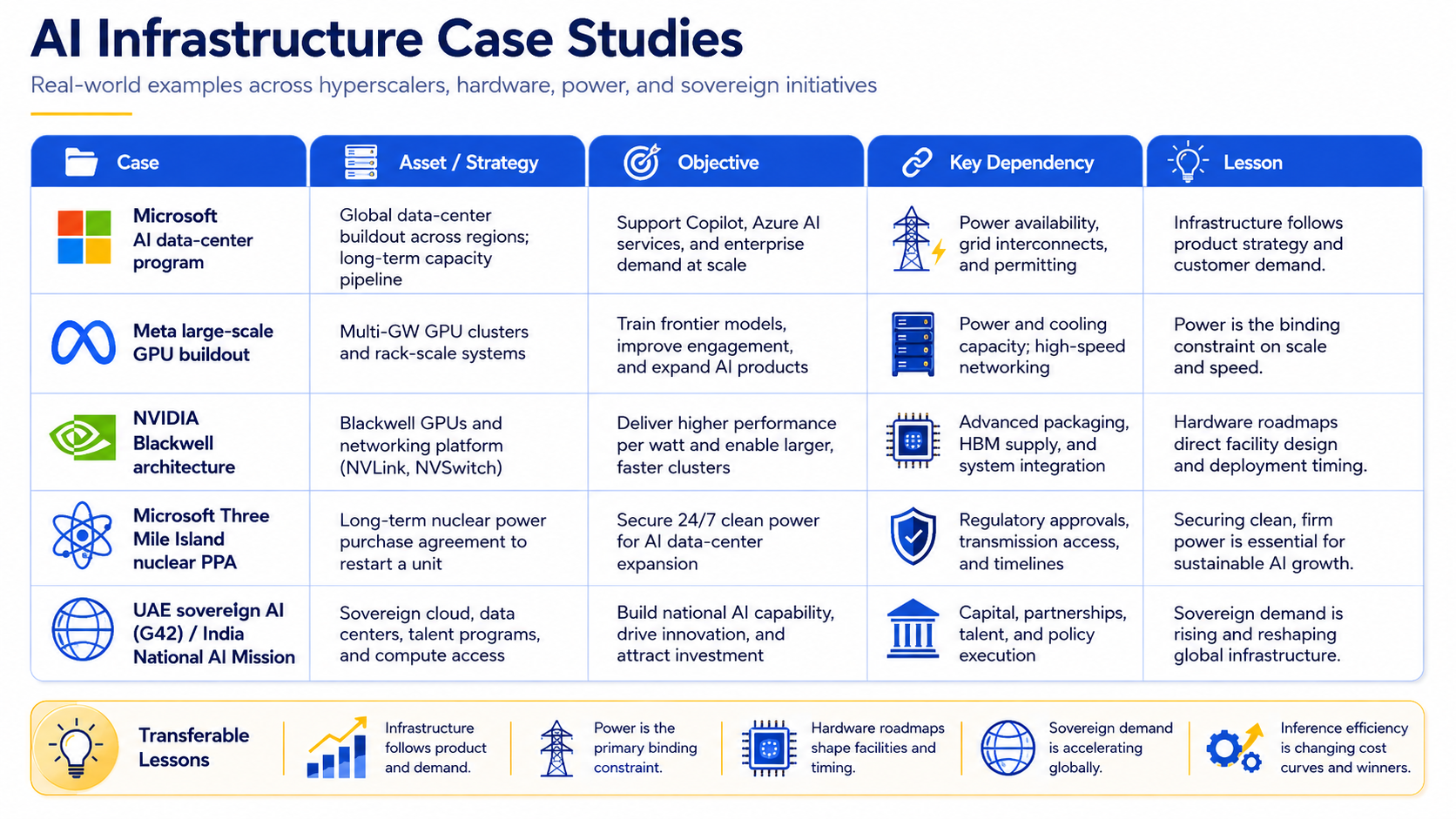
Microsoft’s $80B AI Data Center Program illustrates the integration of AI infrastructure investment with cloud monetization strategy. Microsoft’s capital expenditure commitment for FY2025 — approximately $80 billion — is predominantly directed at building AI-optimized Azure data centers globally. The investment thesis: AI cloud services (Azure OpenAI Service, Copilot, GitHub Copilot) generate high-margin recurring revenue that justifies the infrastructure investment.
The lesson: for hyperscalers, AI infrastructure investment is inseparable from product strategy. Investors evaluating hyperscaler equities should model both the infrastructure cost burden and the monetization pathway, which now runs through AI services rather than traditional cloud workloads.
Meta’s 1.3 Million GPU Investment represents a different model: a consumer internet company investing in proprietary AI infrastructure rather than cloud-renting. Meta CEO Mark Zuckerberg committed $60–65 billion in 2025 capital expenditure, building data centers that collectively house over 1.3 million GPUs. The strategic rationale: AI capabilities embedded in Meta’s products (content ranking, advertising targeting, AR/VR) are too central to competitive positioning to outsource. The lesson: at sufficient AI intensity, build vs. buy tilts toward build.
2. Semiconductor Leadership and Accelerator Supply
NVIDIA’s Market Position and Blackwell Architecture demonstrates how a single product generation can reshape infrastructure investment priorities. NVIDIA’s H100 GPU became so important to AI training that cloud providers pre-committed to billions of dollars of H100 procurement before delivery. The Blackwell B100/B200/GB200 architectures — offering 2.5x–5x better training performance than H100 — are now driving the next wave of data center investment to accommodate higher power densities.
The lesson: semiconductor technology roadmaps directly determine infrastructure investment priorities. Infrastructure investors must track hardware generations, not just market demand.
AMD’s Inference Opportunity illustrates the training/inference dynamic in semiconductor competition. While NVIDIA dominates training, AMD’s MI300X — with its 192GB unified HBM3 memory pool — has gained meaningful share in large-model inference workloads where memory capacity is the binding constraint. Microsoft Azure and Oracle Cloud have both deployed MI300X at scale for inference serving. The lesson: inference and training are different markets with potentially different winners.
3. Data-Center and Energy Partnerships
Microsoft’s Three Mile Island Nuclear PPA marked a turning point in AI data center energy strategy. Microsoft signed a 20-year power purchase agreement with Constellation Energy to restart a nuclear reactor at the Three Mile Island site in Pennsylvania, providing approximately 835 MW of carbon-free baseload power for Azure data centers.
The lesson: AI compute demand is reshaping energy markets. Data center operators who secure long-term clean power at scale gain both cost certainty and sustainability credentials that matter to hyperscaler customers.
Amazon’s $500M+ Data Center Campus Investments in Georgia, Indiana, and other U.S. states demonstrate how AI demand is distributing data center investment beyond traditional markets (Northern Virginia, Silicon Valley, Dallas). Power availability, land cost, and state tax incentives are driving geographic diversification. The lesson: data center geography is shifting; markets with available power and favorable policy are capturing outsized investment.
4. Public-Private and Sovereign AI Infrastructure Programs
UAE’s AI Infrastructure Investment through G42 and government-backed programs illustrates the sovereign AI playbook. The UAE government has invested in building national AI compute capacity, attracted frontier AI companies (including a partnership with Microsoft that included a $1.5B investment in G42), and positioned the country as a Middle East AI hub. The lesson: sovereign AI programs create new markets for AI infrastructure investment, with government as anchor customer and co-investor.
India’s National AI Mission allocated $1.25 billion to build public AI compute infrastructure and support domestic AI development. The program reflects a broader pattern: countries that lack domestic hyperscaler presence are building public AI infrastructure to avoid complete dependency on foreign cloud providers. The lesson: government AI infrastructure programs create partnership opportunities for experienced data center developers and technology providers.
5. Transferable Lessons From the Case Studies
- Infrastructure investment follows product strategy, not just demand signals. The most durable AI infrastructure investments are tied to specific product monetization pathways.
- Power is the binding constraint, not capital. Well-capitalized developers are constrained by grid capacity, not by access to funding.
- Hardware generation transitions require infrastructure flexibility. Data centers built for H100 density need to accommodate Blackwell and future architectures; building in headroom for higher power density is essential.
- Sovereign demand is a growing and underappreciated market. Government-backed AI programs represent substantial and stable demand that private infrastructure operators can serve.
- Inference growth is changing which infrastructure segments lead. Case studies from Microsoft, AMD, and cloud providers all reflect the inference transition underway.
9. Outlook: The Next Phase of AI Infrastructure Investment
The Shift From Model Training to Inference at Scale
The AI infrastructure investment thesis is undergoing a structural evolution. The 2020–2024 period was dominated by large-scale model training: enormous compute clusters, frontier lab spending, and GPU supply scarcity. The 2025–2030 period will be increasingly shaped by inference at scale.
This shift has specific infrastructure implications:
- Inference-optimized data centers — optimized for lower-latency, higher-throughput serving rather than sustained training — become more relevant.
- Custom inference silicon — AWS Inferentia, Google TPU, NVIDIA TensorRT-optimized deployments — gains share.
- Distributed inference — serving AI requests from multiple regional locations to reduce latency for global user bases — drives distributed data center investment.
- Cost per token as the key competitive metric — drives investment in model compression, quantization, and inference optimization software.
For enterprise AI applications, this transition is positive: inference costs have fallen dramatically and will continue to do so, making AI deployment more economical. For infrastructure investors, it means tracking which data center configurations and hardware types are positioned for inference workloads, not just training.
SmartDev’s generative AI development services help enterprises architect inference-optimized AI applications that take advantage of improving infrastructure economics.
Efficient Compute, Specialized Hardware, and Sustainable Data Centers
Three converging trends define the next generation of AI infrastructure:
Efficient compute: The realization that larger models are not always better models — that targeted fine-tuning of smaller models, retrieval-augmented generation, and architectural innovations (mixture of experts, state space models) can achieve comparable performance at dramatically lower compute cost — is shifting investment toward software efficiency, not just hardware scale.
Specialized hardware: As inference dominates, the economic case for workload-specific silicon strengthens. Neuromorphic chips, analog AI accelerators, and application-specific inference processors will find markets in specific domains (edge AI, IoT, automotive).
Sustainable data centers: Carbon-neutral or carbon-free AI infrastructure is transitioning from a marketing claim to a contractual requirement. Hyperscaler tenants increasingly require documented renewable energy sourcing; regulatory pressure in the EU and elsewhere adds compliance urgency. Investment in sustainable AI infrastructure — geothermal-powered facilities, nuclear PPAs, on-site solar plus storage — will outperform carbon-intensive alternatives over a 10-year horizon.
Edge AI, Distributed Infrastructure, and New Deployment Models
The emergence of capable AI models that run efficiently on edge devices — smartphones, laptops, industrial controllers — is creating a new infrastructure layer outside traditional data centers.
On-device AI inference (Apple Neural Engine, Qualcomm NPU, Samsung Exynos NPU) moves compute to the endpoint, reducing latency and data center load. Investment in edge AI chips within end-user devices is growing.
Distributed AI inference networks — CDN-like infrastructure for AI serving — are being developed by companies including Cloudflare, Fastly, and specialized AI edge providers to serve AI inference requests from hundreds of regional PoPs.
Industrial edge AI — AI inference running on-premises in factories, hospitals, and logistics facilities — requires ruggedized, power-efficient compute platforms and private network connectivity. SmartDev’s machine learning development services support enterprises deploying AI in edge environments.
Scenario Planning: Growth Catalysts and Downside Risks
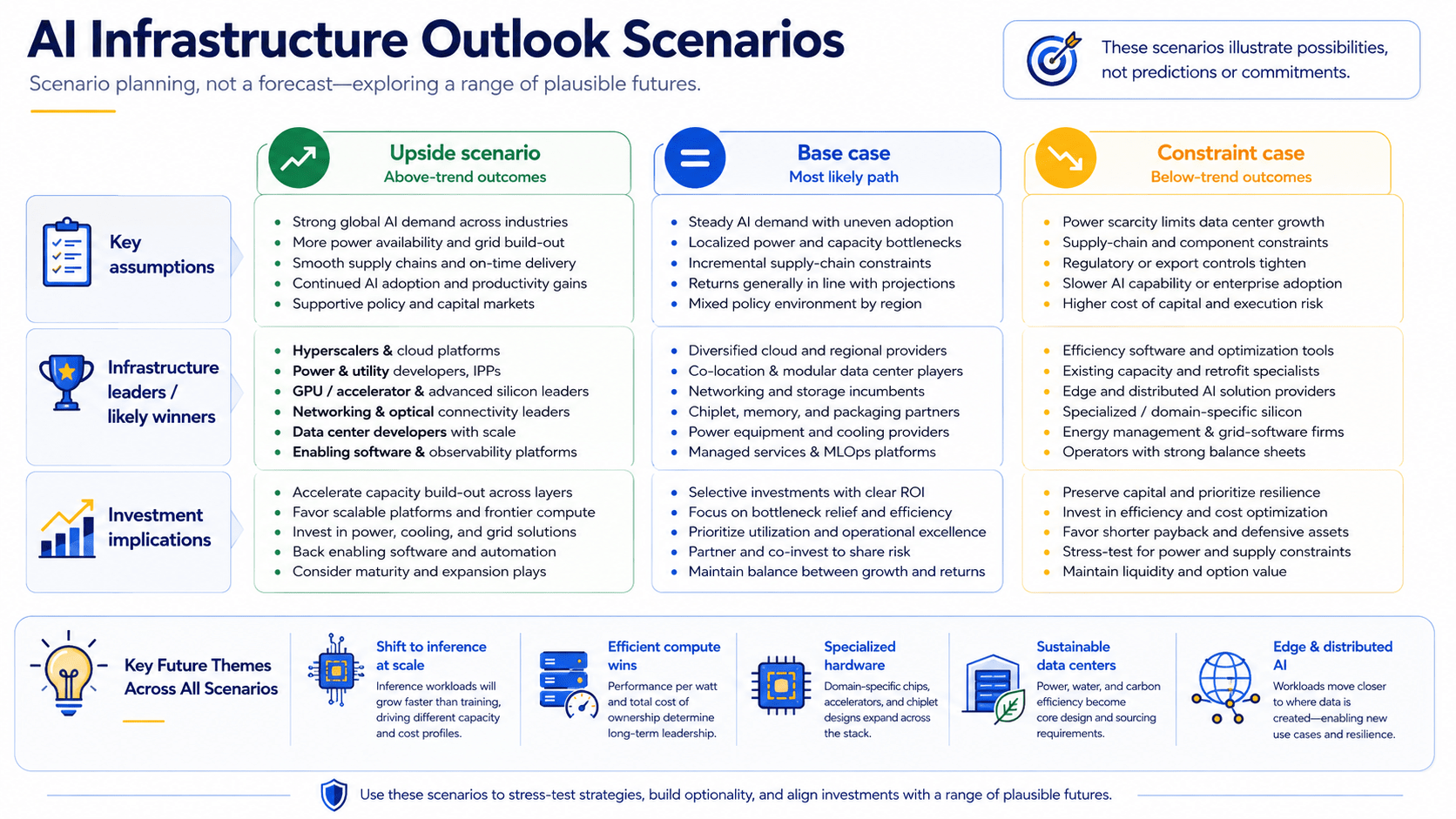
Bull case (probability ~35%): AI capabilities continue to scale predictably; enterprise adoption accelerates; sovereign AI programs drive sustained government demand; power constraints resolve through nuclear, grid expansion, and efficiency gains. AI infrastructure investment returns exceed projections; GPU cluster demand outstrips supply for 5+ more years.
Base case (probability ~45%): AI adoption grows steadily but unevenly; some segments (consumer AI, coding tools) scale rapidly while others (complex enterprise workflows) develop more slowly; power constraints create 2–3 year bottlenecks in specific markets; hardware costs fall as competition increases; infrastructure returns in line with projections (12–18% IRR for well-executed projects).
Bear case (probability ~20%): AI capability plateaus (scaling laws hit diminishing returns); major AI safety incident triggers regulatory crackdown; GPU pricing collapses as AMD/custom silicon gain share; data center overbuilding creates excess supply in key markets; infrastructure returns disappoint.
FAQ
What counts as AI infrastructure investment?
AI infrastructure investment encompasses any deployment of capital into the physical or digital resources that enable AI systems to be built, trained, deployed, or operated. This includes: GPU and AI accelerator hardware; data centers (land, power, buildings, cooling); networking equipment (high-bandwidth interconnects, fiber); cloud AI platforms; data storage and processing systems; and the software platforms (MLOps, inference serving) that manage AI workloads at scale.
It does not typically include the AI models themselves, AI-powered applications, or AI software companies (which are a separate investment category), though the boundaries are blurring as infrastructure vendors bundle software with hardware.
What infrastructure is needed to run and scale AI workloads?
Running AI at scale requires five layers working together:
- Compute: GPUs or equivalent AI accelerators with sufficient memory bandwidth and throughput for the workload size.
- Data center: Power capacity (typically 30–120 kW/rack for AI), advanced cooling, physical security.
- Networking: High-bandwidth, low-latency interconnects within clusters; reliable connectivity to users for inference serving.
- Storage: High-speed, scalable storage for training data and model checkpoints; lower-cost archive storage for inactive data.
- Software: Distributed training frameworks, inference serving platforms, MLOps tooling for model lifecycle management.
The specific requirements scale dramatically with model size: a small fine-tuned model can run on a single GPU; frontier model training requires clusters of 10,000–100,000+ GPUs.
What are the main ways to gain exposure to AI infrastructure?
Investors have access to AI infrastructure across a spectrum of capital requirements and risk profiles:
- Public equities: Semiconductor companies (NVIDIA, AMD, TSMC, Broadcom), cloud providers (Microsoft, Alphabet, Amazon), data center REITs (Equinix, Digital Realty), networking companies (Arista).
- AI infrastructure ETFs: Diversified public-market exposure to the sector.
- Infrastructure debt: Senior secured lending to creditworthy data center operators.
- PE/Infrastructure funds: Indirect exposure through funds investing in data center assets and AI-adjacent infrastructure.
- Venture capital: High-risk, high-return exposure to AI hardware startups, MLOps platforms, and GPU cloud services.
- Direct development or ownership: Data center development, GPU cluster ownership — requiring significant capital and expertise.
What are the biggest risks in AI infrastructure investment?
The five most significant risks, in order of near-term impact:
- Power and permitting: Grid interconnection constraints and regulatory permitting delays are the primary project execution risk.
- Hardware obsolescence: Rapid GPU generation transitions can strand capital in older compute generations.
- Customer concentration: Dependence on a small number of hyperscaler tenants creates renewal risk.
- Geopolitical exposure: Export controls, supply chain concentration in Taiwan/TSMC, and data sovereignty regulations create jurisdiction-specific risks.
- ROI uncertainty: AI adoption trajectories are uncertain; infrastructure built for one use case may face demand shortfalls if AI applications develop differently than projected.
Which metrics matter when evaluating an AI data-center or compute opportunity?
Core metrics for AI infrastructure due diligence:
- Power Usage Effectiveness (PUE): Ratio of total facility power to IT power; target <1.3 for modern AI facilities.
- Revenue per kW: Monthly revenue per kilowatt of IT load; benchmark against comparable markets.
- Utilization rate: Percentage of available GPU-hours generating revenue; target >75% for stabilized operations.
- Contracted revenue %: Share of capacity covered by long-term contracts; higher is safer.
- Time to power: Months from investment decision to operational power delivery; shorter timelines improve IRR.
- EBITDA margin: Operating profitability before depreciation; target 40–55% for wholesale operators.
- IRR: Project-level or fund-level return; target 12–18% for infrastructure-risk profile.
Conclusion
AI infrastructure investment is not a technology trend to monitor from a distance. It is an infrastructure buildout of historical scale, already underway, with capital commitments measured in hundreds of billions of dollars from the most sophisticated technology and financial institutions in the world.
The opportunity is real, durable, and large. So are the risks — power constraints, hardware obsolescence, geopolitical exposure, and ROI uncertainty each represent genuine challenges for investors and enterprise decision-makers who approach the category without sufficient rigor.
This guide has laid out the complete framework: what AI infrastructure is and how it differs from traditional IT; where value accrues across the stack; who the key participants are; what the investment trends signal; how to evaluate an opportunity; what risks to underwrite; and what the next phase of the market looks like.
The smartest AI infrastructure investors in 2025 are not simply betting on AI demand growing. They are identifying which specific infrastructure categories benefit from the training-to-inference transition, which geographies have power availability and policy support, which infrastructure operators have execution capability and customer relationships, and which financing structures match the long-duration, capital-intensive nature of the assets.
That level of rigor — applied to one of the most consequential investment categories of the decade — is the starting point.
Next Steps: Assessing Your AI Infrastructure Strategy
For investors:
- Map your current portfolio AI infrastructure exposure across public equities, private credit, and direct investments.
- Identify gaps relative to your target AI infrastructure allocation.
- Evaluate at least two AI infrastructure private market opportunities per year using the due-diligence checklist in Section 6.
- Engage directly with data center developers and GPU cloud operators to understand supply/demand dynamics in target markets.
For enterprise decision-makers:
- Audit your current AI infrastructure spending across cloud, on-premises, and managed services.
- Model the build vs. buy vs. partner calculus for your projected AI compute needs over 3 years.
- Engage your cloud providers on reserved capacity pricing for AI workloads — material cost savings are available.
- Assess regulatory risk in your data governance posture relative to EU AI Act, GDPR, and sectoral AI regulations.
SmartDev works with enterprises across industries to design, build, and operate AI infrastructure strategies that match capability requirements with cost and compliance constraints. Whether you are evaluating your first AI project or scaling a mature AI program, our AI development services and cloud solutions teams can help you move faster and with greater confidence. Contact SmartDev to start the conversation.
–
References
- IDC: Worldwide AI Infrastructure Spending Forecast, 2023–2027
- Meta Capital Expenditure and AI Infrastructure Commitment, 2025
- NVIDIA Data Center Revenue and Market Share, CNBC 2023
- Microsoft-OpenAI AI Supercomputer Partnership
- SoftBank and Oracle Cloud AI Partnership
- CHIPS and Science Act: Semiconductor and AI Infrastructure
- EU Digital Europe Programme and AI Investment
References:
- IDC: Worldwide AI Infrastructure Spending to Reach $154 Billion in 2027
- Meta’s $65 Billion AI Infrastructure Investment
- Nvidia’s Dominance in AI Chip Market
- Microsoft & OpenAI’s AI Supercomputer Partnership
- SoftBank and Oracle Cloud Partnership
- US CHIPS Act: Boosting Semiconductor and AI Infrastructure
- EU Digital Europe Programme
- China’s AI Development Plan and Semiconductor Strategy
- AWS Cloud Infrastructure for AI
- Quantum Computing’s Impact on AI Infrastructure