
TL; DR:
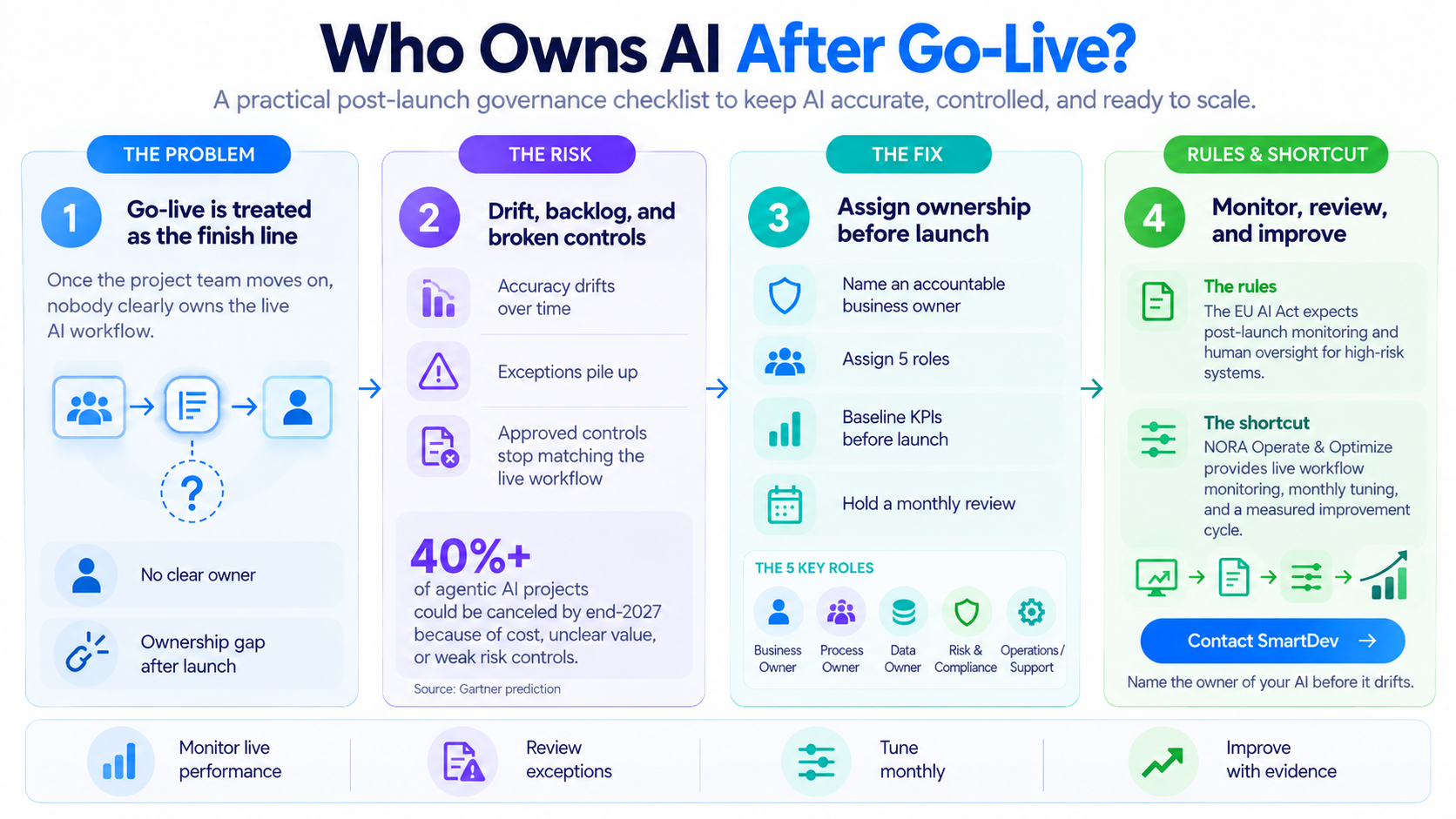
- The problem: Teams treat go-live as the finish line, so nobody clearly owns the AI once the project team moves on.
- The risk: Without an owner, accuracy drifts, exceptions pile up, and approved controls stop matching the live workflow.
- The evidence: Gartner predicts that over 40% of agentic AI projects will end by 2027 because of cost, unclear value, or weak risk controls.
- The fix: Name an accountable business owner, assign five roles, baseline your KPIs before launching, and hold a monthly review.
- The rules: The EU AI Act already expects post-launch monitoring and human oversight for high-risk systems.
- The shortcut: NORA Operate & Optimize gives one live workflow monitoring, monthly tuning, and a measured improvement cycle.
Introduction: The Launch Party Ends and the Real Work Starts
The handover nobody planned
Most AI projects end the same way. The team demos the pilot, the sponsor signs off, and everyone celebrates the launch before the project team moves on to the next initiative. Meanwhile, the AI keeps making decisions on live data every hour, and nobody clearly answers the results it produces.
SmartDev describes this moment well, because go-live hands over a working solution, yet what happens afterward decides reliability, cost, and trust. Therefore, the question of who owns the AI after launch deserves a deliberate answer before the launch date arrives. A scramble after the first incident costs far more, and it damages trust with customers, auditors, and your own staff.
Why this question matters now
Two independent sources show how often AI initiatives stall before they pay off, and the first comes from MIT. MIT NANDA’s July 2025 report found that 95% of organizations in its research saw no measurable return from generative AI, according to coverage in Virtualization Review. The authors drew 153 survey responses, 52 interviews, and more than 300 public initiatives, and the report itself labels its findings preliminary. For that reason, treat the headline number as a useful signal rather than a universal rate. Even so, the same coverage reports that only 5% of custom enterprise AI tools reached production, and it attributes the gap to brittle workflows, weak contextual learning, and poor alignment with daily operations.
Gartner adds a forward-looking warning in its June 2025 press release, which predicts that over 40% of agentic AI projects will end by the close of 2027. The analyst firm cites escalating costs, unclear business value, and inadequate risk controls as the causes. Notice that all three causes live in the operating phase as much as in the build phase. Cost escalates when nobody watches usage; value stays unclear when nobody tracks KPIs, and risk controls fail when nobody checks them after launch. Consequently, a clear ownership model targets exactly the factors that Gartner expects to sink into these projects.
What this article covers
This article answers the ownership question in six steps. First, it explains why go-live marks day one rather than the finish line, and next it shows what breaks when nobody owns the system. Then it defines five ownership roles and reviews what NIST and the EU AI Act expect after launch. After that, it lays out an ownership model that you can set up before go-live. Finally, it explains how SmartDev’s NORA AI Adoption Accelerator keeps a workflow owned after launch. For related reading, see SmartDev’s posts on AI observability and on build versus buy AI.
Takeaway: Launch is a handover, and handovers fail when nobody receives the baton. Decide who receives it before the launch date, not after the first incident.
Why Go-Live Is Day One, Not the Finish Line
Building is fast; running is expensive
Researchers at Google described this asymmetry in 2015, and the finding still holds. In their NeurIPS paper on hidden technical debt in machine learning systems, Sculley and colleagues argued that these systems are quick and cheap to build but costly to maintain over time. They warned that quick wins do not come free, because teams incur ongoing maintenance costs that compound quietly. The authors named specific risk factors, including data dependencies, hidden feedback loops, undeclared consumers, and changes in the external world. Modern generative AI adds further layers, such as prompts, retrieval sources, and model versions, and each layer creates another dependency that someone must watch.
Reality starts changing the moment you launch
A pilot runs a frozen snapshot of the world, but production does not. Customers change their behavior, suppliers change their document formats, upstream systems change their fields, and regulators update their expectations. Consequently, a model that passed testing in March may behave differently in September, even though nobody touched the code. SmartDev’s NORA page describes the pattern clearly: an unmaintained AI workflow rarely fails loudly, because accuracy degrades as real-world data shifts and exceptions accumulate unseen. That quiet failure mode explains why launch-day dashboards can look healthy while quality slips underneath them.
The ownership gap between build and run
Every AI project has two teams, even when the org chart shows only one. The build team designs, trains, integrates, and tests the system, while the run team keeps the process alive for years afterward. In many companies, the run team does not exist at launch, so the sponsor assumes IT will handle it, IT assumes the vendor will handle it, and the vendor’s contract ended at acceptance. The figure shows how the gap opens, with project attention peaking around the go-live and then falling sharply. Meanwhile, the operating owner’s role stays undefined, so drift, exception pile-up, and control decay begin without anyone watching.
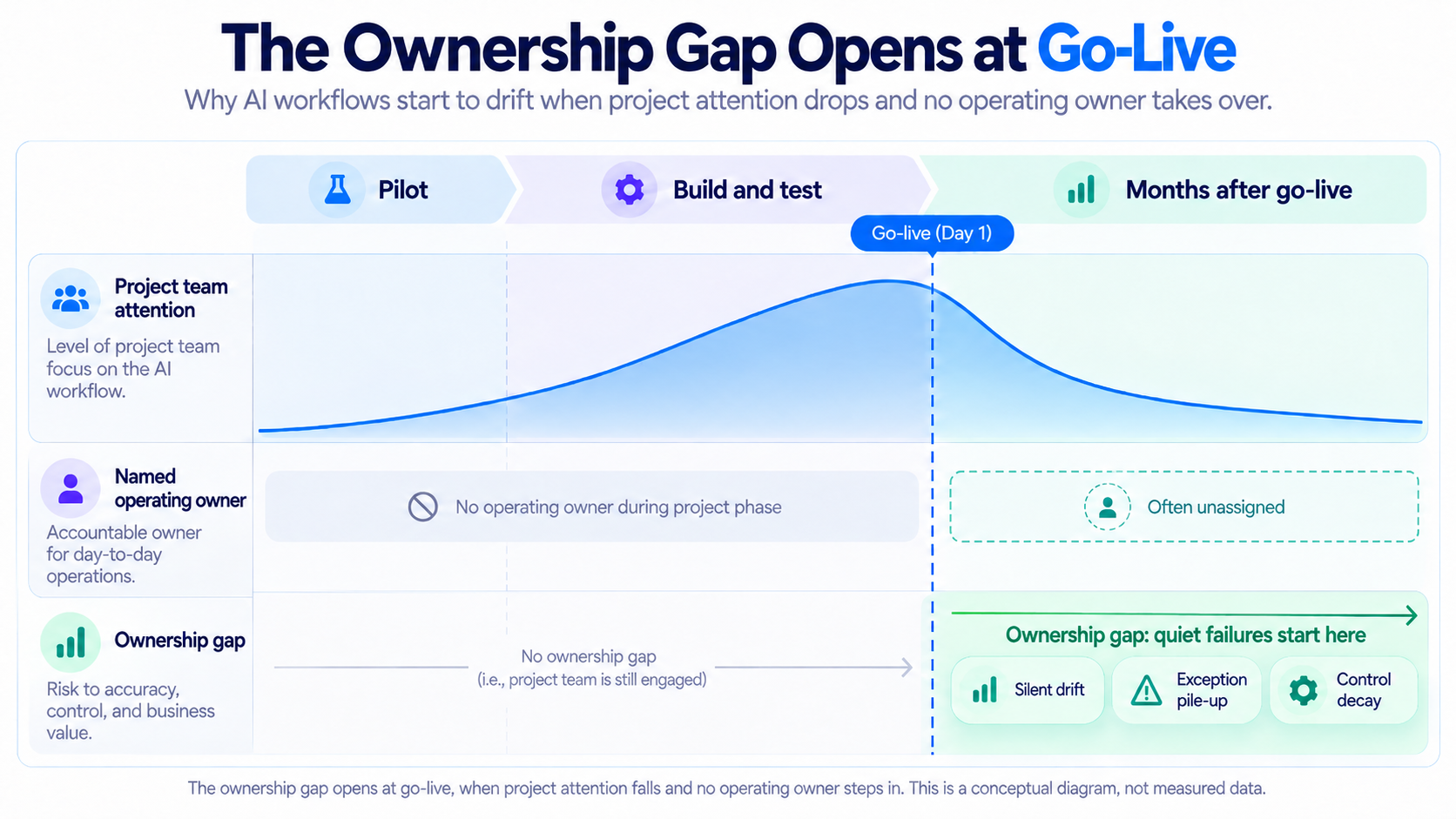
The riskiest period may begin after the system is considered successful. Once deployment is complete, attention shifts to new priorities while the AI continues operating under changing data, workflows, and conditions. Small deviations can therefore persist long before they become visible in incidents. The key risk is not a sudden system failure, but the gradual loss of attention needed to detect change early.
Why pilots hide the problem
Pilots succeed partly because they avoid the hard parts of production, since they run on curated data with enthusiastic users and close attention from the builders. Gartner notes that most agentic AI projects today are early-stage experiments or proofs of concept, and it warns that hype can blind organizations to the real cost and complexity of scaling. SmartDev’s NORA page makes a related point: the model is rarely the bottleneck. Instead, evaluation, integration, human-exception design, and operational ownership decide whether a pilot reaches production. Consequently, a successful pilot proves that the model can work, but it does not prove that anyone can run it.
Go-live starts the measurement period
Treat launch as the start of your measurement period rather than the end of your project, because the NORA page frames going live in exactly this way. From that moment, you compare real performance against the baseline you set before launching, so you need that baseline, a named owner, and a review of rhythm in place on day one. Without them, you cannot tell improvement from decline. SmartDev’s article on why you should modernize legacy workflows before you automate add a useful corollary: fix the process first, because AI automates whatever inefficiency already sits underneath it.
Takeaway: Building an AI system takes months, but running it takes years. Name the operating owner and the baseline KPIs before go-live, or the project’s success will quietly expire.
What Breaks When Nobody Owns the AI
Silent drift erodes accuracy
Drift rarely announces itself, because input data shifts a little each week, and output quality slips a little with it. Since no single day looks bad, nobody raises an alarm. Sculley and colleagues listed changes in the external world among the core risk factors for production of machine learning systems, and the point applies equally to language-model workflows. Moreover, drift hides inside averages: in an illustrative case, a workflow could look healthy overall while one document type or customer segment fails badly. Owners therefore need to track accuracy by segment, not only in aggregate. SmartDev’s article on AI observability explains why seeing a system run does not mean you catch its failures.
Exceptions pile up unnoticed
Every real workflow produces exceptions, such as unreadable scans, missing fields, conflicting records, and edge cases that nobody predicted. At launch, a handful of exceptions feels manageable, but after a few months the queue grows, and staff develop workarounds. Eventually, humans quietly redo the work that the AI should handle, and the promised savings disappear without a visible incident. The NORA page lists piling exceptions among the quiet failures of unmaintained AI. Therefore, treat the exception rate as a first-class metric, review it weekly, trace its causes, and feed the patterns back into the workflow design.
Approved controls stop matching reality
At go-live, your risk and compliance teams approve a specific design with certain data, certain rules, and certain human checkpoints. Over time, engineers adjust prompts, swap models, and add integrations, and each change looks small on its own. Yet together those changes can move the live workflow away from what the approvers signed off. The NORA page warns that the controls approved at go-live slowly stop matching what runs, until a customer, an auditor, or a regulator finds the gap first. Gartner similarly names inadequate risk controls as a driver of cancelled agentic projects. Therefore, tie every material to a documented review, and keep evidence of what ran, when, and why.
Costs creep without a budget owner
Run costs behave differently from build costs, because build costs sit in a project budget with a clear end date while run costs continue indefinitely. They include model usage, infrastructure, human review time, and ongoing tuning. When nobody owns the budget, usage grows without anyone asking whether the value still justifies the spend. Gartner cites escalating costs as one of the reasons it expects agentic AI projects to end. As a result, assign a named person to track unit cost per case, and compare it with the baseline from qualification, since cost per case reveals problems that total spend hides.
Trust collapses when someone else finds the gap
The worst outcome is not a failure itself, but someone outside your team is discovering the failure first. A customer notices a wrong decision; an auditor finds a control that no longer matches the documented process, or a regulator asks for logs that nobody kept. Each scenario converts a fixable operating issue into a trust problem. Moreover, trust erodes inside the company too, because staff who see errors with no clear escalation route stop relying on the system. Consequently, adoption falls and the business case weakens. An accountable owner turns these moments into routine corrections instead of crises.
Takeaway: Unowned AI fails quietly through drift, exception pile-up, control decay, and cost creep. Each failure costs little to fix early, and a great deal to explain late.
Who Should Own Your AI After Go-Live?
Why “IT owns it” fails
Many organizations default to a simple answer: IT owns it. That answer covers uptime, access, and infrastructure well, but it misses the harder question of whether the AI makes correct decisions for the business. IT cannot judge whether a KYC decision, a claim routing, or a policy interpretation is right, whereas subject experts can. SmartDev’s NORA FAQ draws the same line, because you own the domain truth, meaning business rules, process meaning, risk appetite, and sign-off. Therefore, ownership must split across several roles. One owner for everything does not work, but one accountable owner for the outcome does.
Five ownership roles every production AI needs
Production AI needs five roles with clear decision rights. The business owner holds the outcome, the domain expert holds the rules, and AI engineering holds the models and evaluation. IT, security, and operations hold the run environment, while compliance and risk hold the controls and the evidence. In small teams, one person may wear two hats, but even so, write down who holds each decision right. The figure below summarizes the five roles, what each one owns, and the decision each one makes.
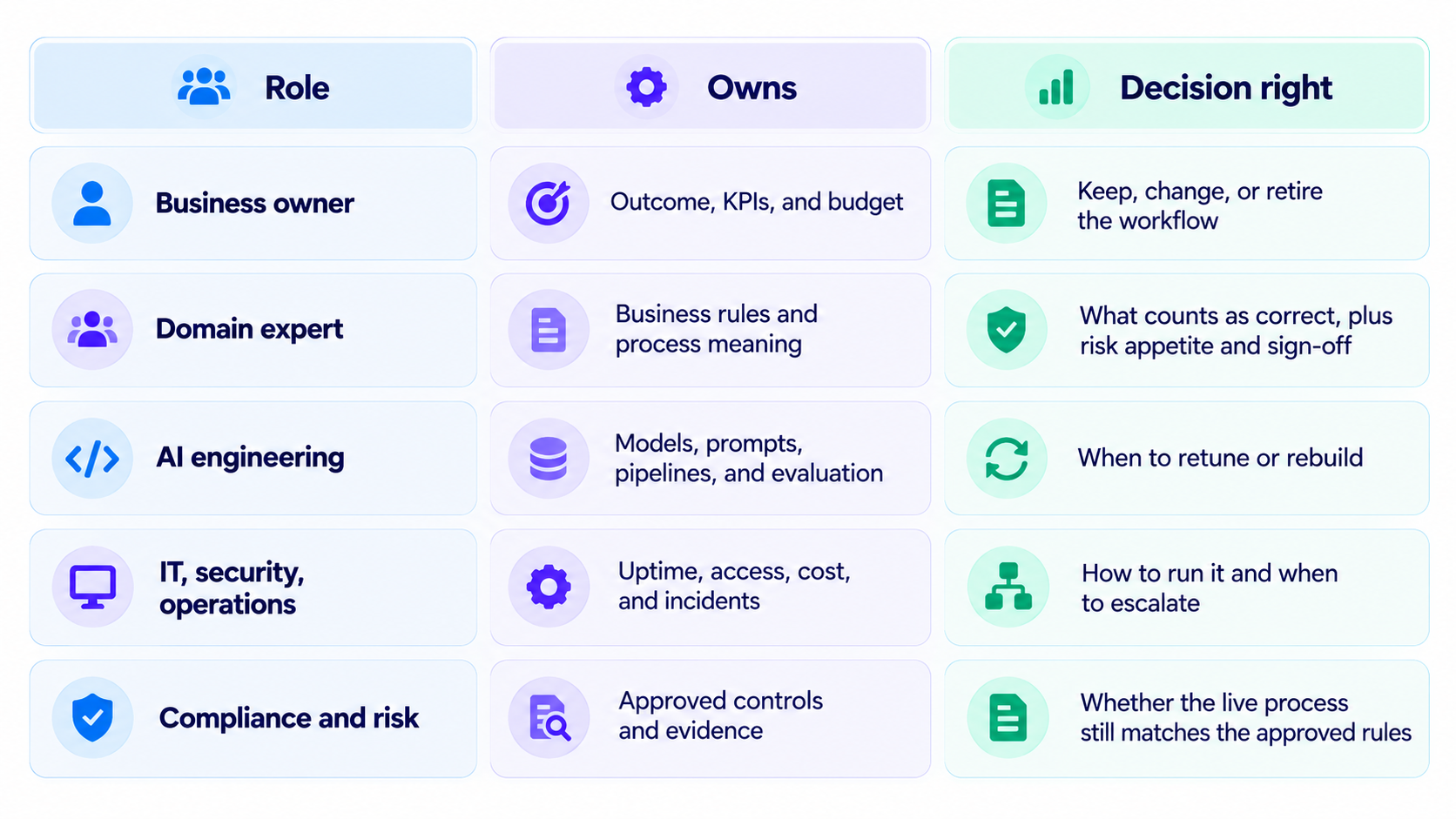
How to Use the Decision-Rights Matrix
Start with the decisions that could materially change the AI workflow. For each one, trace the decision to the role with the authority to make it.
Then test the boundaries between roles. Ask who decides when business rules change, model performance drops, costs increase, or compliance requirements shift. These moments expose unclear ownership more reliably than a static responsibility list.
Pay particular attention to decisions that cross functions. A model may need retuning for a technical reason, but the business owner may need to approve the resulting change. Mapping both sides prevents operational teams from making changes that carry business or compliance consequences without the right approval.
Use the matrix as a pre-launch check and revisit it whenever the workflow, risk profile, or operating model changes.
The business owner holds the outcome
The business owner answers one question: is this workflow still worth running? That person owns the KPIs, the budget, and the decision to keep, change, or retire from the workflow, so choose someone with real authority over the process rather than a project team member who will move on. In payments and fintech, a head of operations often suits the role, while in professional services and BPO, a service-line or delivery lead often suits it. The owner does not need to understand model internals. However, the owner must read the monthly KPI review and act on what it shows.
The domain expert holds the truth
AI cannot define “correct” on its own, so a senior reviewer, claims specialist, or compliance analyst must define what a correct decision looks like. That person writes the rules, labels the hard cases, and signs off on changes. Because their time is the scarcest resource in most programs, schedule it deliberately and reserve a fixed monthly slot for exception review. Moreover, protect the expert from becoming a permanent manual fallback. The goal is to convert their judgment into rules and evaluation sets, so the system improves, and their workload shrinks over time.
Engineering, security, and compliance hold the controls
Three technical and control roles complete the picture. AI engineering owns models, prompts, pipelines, and evaluation, and it decides when to retune or rebuild, while IT, security, and operations own uptime, access, cost, and incident response. Compliance and risk own the approved controls and the evidence that the live process still follows them. These roles must talk to each other on a schedule, not only during incidents. In regulated work, such as the workflows covered by NORA Compliance, the compliance role carries extra weight because every AI decision must stand up against a rule that your organization has already approved.
Takeaway: “IT owns it” covers uptime but not correctness. Assign five roles and keep one business owner accountable for the outcome.
What Regulators and Frameworks Already Expect
NIST AI RMF treats risk as a lifecycle duty
NIST published the AI Risk Management Framework 1.0 on January 26, 2023, as voluntary guidance for organizations that design, develop, deploy, or use AI. The framework organizes its core into four functions: Govern, Map, Measure, and Manage. According to the Cloud Security Alliance’s summary, Govern runs across the other three functions as a continuing requirement, while Manage allocates resources to risks that you have mapped and measured. Notice that none of the functions ends at launch. NIST later released a Generative AI Profile, NIST-AI-600-1, on July 26, 2024. Use the framework as a prompt for post-launch questions: who governs, what do you measure, and who acts?
EU AI Act Article 72 puts monitoring on providers
Article 72 of the EU AI Act requires providers of high-risk AI systems to establish and document a post-market monitoring system that matches the nature of the technology and its risks. The system must actively and systematically collect, document, and analyze performance data across the system’s lifetime. Providers then use that data to evaluate continuous compliance with the Act’s requirements. The monitoring system must follow a plan, and that plan becomes part of the technical documentation. In short, the law treats monitoring as part of the product rather than an optional extra.
EU AI Act Article 26 puts oversight on deployers
Article 26 shifts the focus to organizations that use high-risk systems. Deployers must take suitable technical and organizational measures to use each system according to its instructions, and they must assign human oversight to people who have the competence, training, authority, and support to do the job. They must also monitor the system’s operation based on the instructions for use. This matters for ownership because the law names a role rather than a tool. Someone with real authority must watch the system and act on what they see.
Providers and deployers must share what they see
The two articles connect, because Article 26 tells deployers to inform providers, where relevant, in line with Article 72. In practice, the deployer’s operating data feeds the provider’s monitoring system. Therefore, your ownership model should include an explicit feedback channel that answers who logs incidents, who tells the vendor, and how fast. If you buy an AI system, ask the vendor how it collects deployer feedback. If you build one for your own use, you may carry both sets of duties, so check your position with legal counsel.
What this means if your system is not high-risk
These duties apply to high-risk systems as the Act defines them, so check out classification first with legal counsel, and remember that this article offers general information rather than legal advice. Even outside the Act’s scope, the underlying logic still helps, because customers and auditors can ask the same questions about who watches the AI and what happens when it arrives. The NIST framework offers a voluntary structure for answering them. Consequently, post-launch monitoring and named human oversight make a sound default for any production of AI workflow, regardless of classification.
Takeaway: Both NIST and the EU AI Act assume that someone watches AI after launch. Treat that expectation as a design requirement, not a compliance afterthought.
How to Build an Ownership Model Before Launch
Name the accountable owner before go-live
Start with a simple rule: no go-live without a named owner. Put the name on the launch checklist next to the security review and give the owner budget authority and daily proximity to the process. Document what the owner can decide alone and what needs escalation. Moreover, name a deputy so that an absence does not stall decisions. If you cannot name an owner, delay the launch, because an AI without an owner is a liability that has not yet produced its first incident.
Baseline your KPIs before you automate
You cannot improve what you never measured, so record how the workflow performs today before design begins, including cycle time, error rate, rework, cost per case, and exception volume. SmartDev’s NORA process builds this step into workflow qualification, which confirms that the problem is measurable and recurring and baselines the KPIs before anyone designs a solution. Follow the same discipline even if you work without NORA. After launch, compare live results against that baseline every month. Otherwise, you will argue about whether the AI helps using opinions instead of numbers.
Design the exception path with humans in it
Decide in advance what happens when the AI is unsure, wrong, or silent by defining confidence thresholds, routing rules, response times, and the person who receives each type of exception. Then track how often humans override the AI and why, because override patterns show where the system needs better rules or better data. NORA’s Path B redesigns the operating model around AI, deterministic logic, and the people who still need to stay in the loop. Apply the same thinking to any workflow: use AI where it helps, rules where they suffice, and humans where judgment matters.
Set a monthly review cadence
A steady rhythm beats heroic effort, so hold a monthly review with the five roles and keep it short and structured. Review accuracy by segment, exception rate, cost per case, and open control issues, and then decide what to tune, what to escalate, and what to retire. Record each decision so that auditors and successors can follow your reasoning. The loop below shows a recommended loop of monitoring, reviewing against the baseline, tuning, and reporting. Adjust the frequency to your volume and risk but never let the cadence lapse.
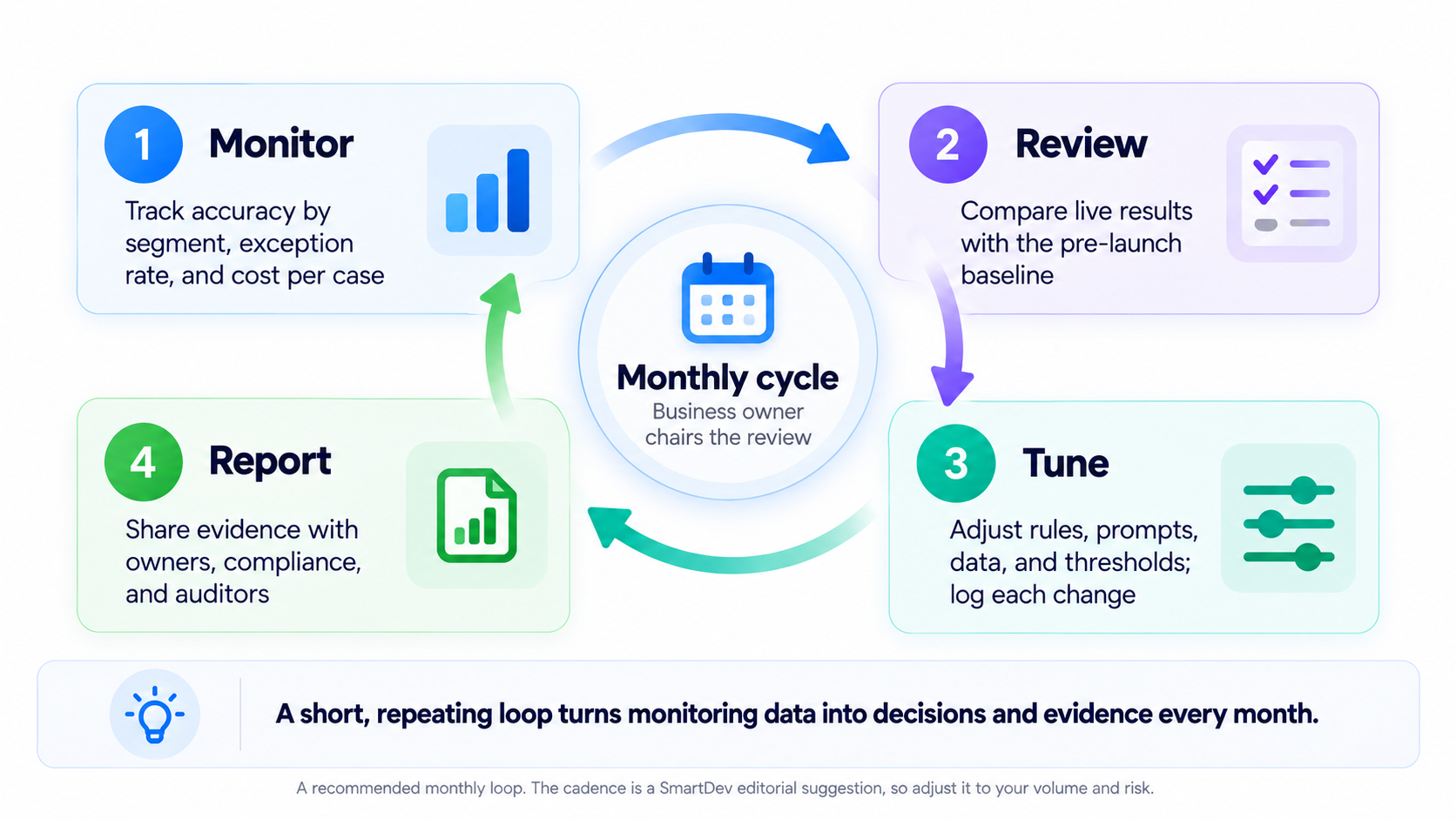
How to Use the Monthly Monitoring Loop
Follow the four steps to turn AI performance data into ongoing improvements and auditable decisions.
- Step 1: Monitor: Track accuracy by segment, exception rates, and cost per case. Flag deviations from acceptable thresholds early.
- Step 2: Review: Compare live performance against the pre-launch baseline. Identify where results have changed and investigate possible causes.
- Step 3: Tune: Adjust rules, prompts, data, or thresholds based on the findings. Document each change so its impact can be evaluated.
- Step 4: Report: Share performance trends, corrective actions, and supporting evidence with business owners, compliance teams, and auditors.
The business owner should chair the monthly review and ensure findings lead to clear decisions. Adjust the review frequency to match the workflow’s risk level and volume.
Decide who runs it: your team, a partner, or a mix
Running AI needs skills that many teams do not keep in-house, such as evaluation design, model monitoring, and integration maintenance. You have three options: build an internal run team, hire a partner, or combine both. SmartDev’s article on build versus buy AI examines the wider decision before you choose a solution, and SmartDev also publishes an AI Delivery Blueprint white paper and an AI Adoption & ITO Glossary. Whatever you choose, keep the business owner and the domain expert inside your company. You can outsource operations, but you cannot outsource accountability for the outcome.
Takeaway: Five habits build ownership: a named owner, baseline KPIs, a designed exception path, a monthly review, and a clear decision on who runs the system.
How NORA Keeps Ownership Alive After Go-Live
What NORA is and who it serves
NORA is SmartDev’s AI Adoption Accelerator, and it turns stuck AI pilots and manual workflows into reliable production operations that connect to your systems, your rules, and your people. NORA works across three solution families: Compliance, Document Processing, and Software Delivery, and each family reuses workflow assets and accelerators inside one engagement model rather than selling separate products.
NORA Compliance, for instance, targets workflows where an AI decision must hold up against a rule your organization already approved, such as KYC file completeness or transaction-exception review. Document Processing handles invoices, contracts, claims, and onboarding files. Software Delivery speeds up engineering, QA, and incident work while keeping it traceable.
Two ways in: Path A and Path B
NORA starts from where you are. Path A fits teams that already have a pilot, such as a proof of concept, an internal agent, or a Copilot workflow, and NORA first assesses production readiness across integration, data, security, evaluation, control, and ownership. Path B fits teams with a defined, recurring workflow, a named owner, and a measurable cost, but no AI yet, so NORA qualifies that workflow first and baselines the KPIs. Both paths then converge on the same later stages: deployment, Operate & Optimize, and scale. The next figure maps the stages, and the table beneath it lists SmartDev’s typical durations.
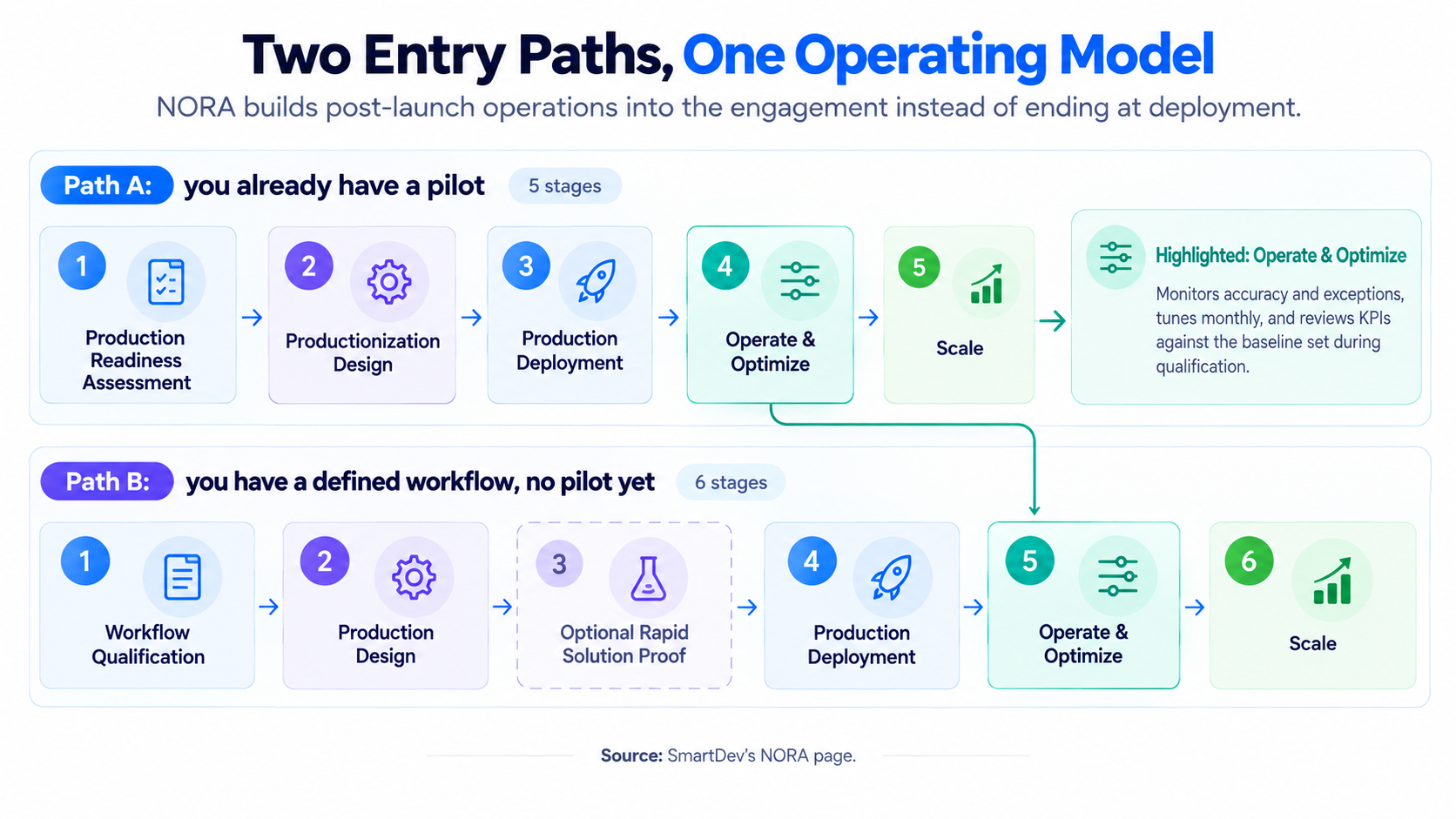
The key difference between the two paths is what must be validated before production. An existing pilot needs evidence that it can operate reliably under production conditions. A workflow without a pilot needs a clear business case and baseline against which future performance can be measured. This distinction determines the starting point, but both paths must establish ongoing performance monitoring and accountability after deployment.
Typical NORA engagement stages and durations, as SmartDev publishes them:
| Stage | What you get | Typical duration |
| Workflow Qualification & Production Design | A qualified workflow, baseline KPIs, a target operating design, and a clear build, redesign, or do-not-build decision | 1–3 weeks |
| Optional Rapid Solution Proof | An answer to one specific technical uncertainty | 2–5 days |
| Production Deployment | One bounded, AI-enabled workflow live in your environment with agreed controls | 6–10 weeks |
| Operate & Optimize | Quality, exceptions, cost, and controls managed on an ongoing basis, with regular KPI review | Ongoing (12-month default) |
| Ownership (scale) | The proven pattern replicated to adjacent workflows or business units where the economics work | 3–9 months |
SmartDev scopes fees per engagement and shares them during Workflow Qualification, so the NORA page does not publish prices.
Operate & Optimize: the owner you do not have to hire
Operate & Optimize answers this article’s central question directly. After go-live, NORA monitors accuracy and exception rates, tunes the workflow monthly as volumes and edge cases evolve, and reviews KPIs against the baseline set during qualification. SmartDev’s stated goal is for the workflow to keep earning the value that its builders designed it to deliver, instead of just staying switched on. The default engagement runs 12 months, and it gives the workflow a named operating function and a measurable improvement cycle, which are exactly the two things that unowned AI lacks. It also manages controls and cost alongside quality and exceptions.
Workflow-scoped versus system-scoped operation
SmartDev draws a clear line between two operating services. NORA Operate & Optimize is workflow-scoped, so it keeps one deployed AI workflow performing, whereas SmartDev Managed AI Services is system-scoped, so it keeps a broader productionized AI system running. According to the NORA FAQ, SmartDev will always tell you which one applies. This distinction matters for ownership planning, because a single claims-triage workflow needs a workflow owner and a tuning cycle, while a portfolio of connected AI components needs system-level monitoring and incident handling. Map your situation honestly before you choose and ask for the scope in writing.
What you own, what SmartDev owns, and the proof so far
NORA does not replace your domain experts. You keep the domain truth, meaning business rules, process meaning, risk appetite, and sign-off, while SmartDev owns turning that truth into a working, evidenced, production operation. This split fits the five-role model above, because your business owner and domain expert keep the outcome and the rules while NORA supplies the engineering and operating discipline around them. If your engagement later needs software engineering, SmartDev’s AI-native software development offers a separate entry point, and the two services run independently.
SmartDev reports results from its AI workflow engagements on the NORA page. In an eight-month insurance KYC and compliance project in Singapore, SmartDev reports 60% faster KYC validation, 75% less manual document handling, and 40% fewer review inconsistencies. In an ongoing climate-finance governance project, it reports 60% faster policy analysis and review and 45% lower manual governance workload. Treat these as vendor-reported results and ask for details that match your context. Read the full stories in the KYC case study and the climate-finance case study. You can also browse all case studies, a governed AI platform example, and the white paper on NORA in AI workflow automation for risk and compliance.
Takeaway: NORA treats go-live as a stage, not an ending. Operate & Optimize gives one workflow monitoring, monthly tuning, and KPI review, while you keep the domain truth.
FAQ: Owning AI After Launch
Who should own an AI system after go-live?
A named business owner should hold accountability for the outcome. Four supporting roles hold the rest: a domain expert for the rules, AI engineering for models and evaluation, IT and security for the run environment, and compliance and risk for controls and evidence. You can outsource operations, but accountability for the outcome stays with the business.
Does the EU AI Act require monitoring after launch?
For high-risk AI systems, yes. Article 72 requires providers to run a documented post-market monitoring system, and Article 26 requires deployers to assign competent human oversight and monitor operation. Classification decides whether these duties apply to you, so confirm it with legal counsel.
How does NORA Operate & Optimize differ from SmartDev Managed AI Services?
NORA Operate & Optimize is workflow-scoped and keeps one deployed AI workflow performing. SmartDev Managed AI Services is system-scoped and keeps a broader productionized AI system running. SmartDev says it will always tell you which one applies.
Can we start with NORA if we have no AI pilot yet?
Yes. Path B starts with a defined, recurring workflow with a named owner. NORA first qualifies the workflow, confirms it is measurable and worth automating, and baselines the KPIs before designing anything.
Conclusion: Name the Owner Before You Name the Launch Date
Go-live is not the finish line. It marks the start of ongoing responsibility for model performance, exceptions, controls, and costs. Before launching, name an accountable business owner, clarify decision rights across all five roles, establish KPI baselines, and define a regular review cycle. Over the next 30 days, assign an owner and deputy to every AI workflow, document baseline metrics, establish exception-handling procedures, and hold the first review to turn findings into action. These foundations are far easier to establish before deployment than to reconstruct after problems emerge.
Ready to build an AI workflow that stays accountable after go-live?
SmartDev helps businesses move AI workflows from initial validation into production and ongoing optimization. Whether you already have a pilot or are preparing a workflow for AI adoption, contact SmartDev to discuss your next steps. You can also explore NORA, SmartDev’s AI Adoption Accelerator, or read more on AI and automation compliance in fintech and the SmartDev blog.