

Twelve months ago, enterprises split roughly evenly between building and buying AI. Today, 76% of AI use cases are bought. This guide unpacks why the market flipped, when building still wins, and how to avoid the costly mistakes hiding on both sides of the decision.
TL; DR
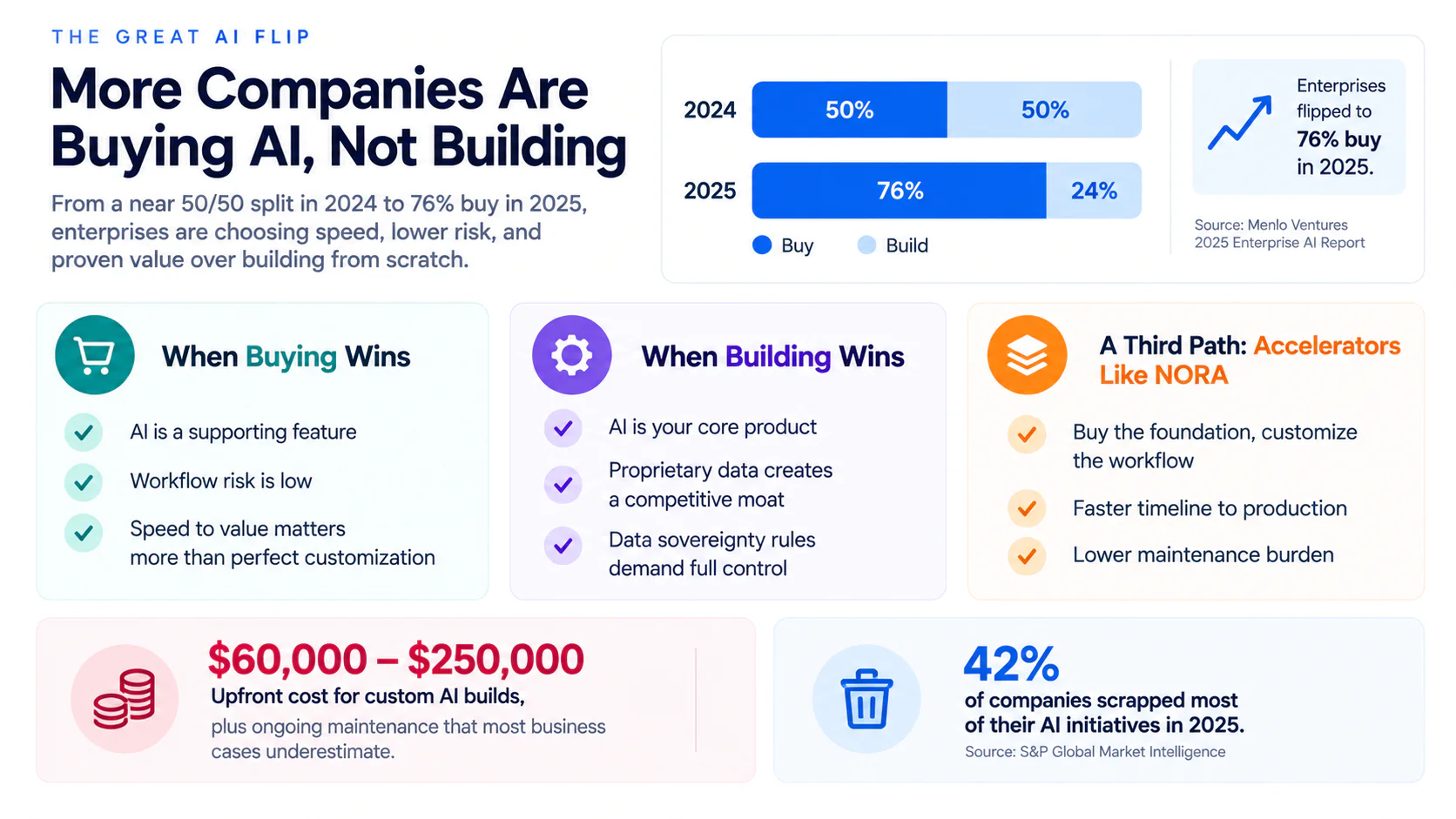
- Enterprises flipped from a near 50/50 build-buy split in 2024 to 76% buy, 24% build in 2025, according to Menlo Ventures’ 2025 enterprise AI report.
- Buying wins when AI is a supporting feature; workflow risk is low, and speed to value matters more than perfect customization.
- Building still wins when AI is your core product, when proprietary data creates a real competitive moat, or when data sovereignty rules demand full control.
- Custom AI builds run $60,000 to $250,000 upfront plus ongoing maintenance that most business cases underestimate, while 42% of companies scrapped most of their AI initiatives in 2025, according to S&P Global Market Intelligence.
- A third path exists: accelerator platforms like NORA buy the foundation and customize the workflow, cutting both the build timeline and the maintenance burden.
Introduction
A year ago, many enterprise AI leaders assumed building was the safer long-term bet: full control, no vendor lock-in, and a system shaped around internal workflows. That assumption did not survive 2025. Menlo Ventures’ third annual enterprise AI report found that the build-to-buy ratio completely reversed within twelve months. The mix shifted from 47% built and 53% purchased in 2024 to just 24% built and 76% purchased in 2025. That is not a gradual trend. It is a market correction driven by hundreds of expensive, unfinished internal builds.
This guide breaks the decision into its real components. We look at when buying genuinely serves your enterprise better and when building still makes strategic sense despite the shift. We also examine what total cost of ownership actually includes once you count what most business cases leave out. SmartDev’s NORA AI Adoption Accelerator offers a third path between the two extremes.
We also connect this choice to the governance framework covered in our companion piece on moving AI from pilot to controlled production. Build vs buy is really the first fork on that same road. If any terminology below is unfamiliar, SmartDev’s AI Adoption & ITO Glossary is a handy companion reference.
1. The Build vs Buy Landscape Has Flipped in Enterprise AI
Understanding why the market moved so quickly matters more than memorizing the new ratio. The shift reveals which assumptions about custom AI development turned out to be wrong. Those lessons should shape your decision more than the headline percentage does.
From 47/53 to 24/76 in Twelve Months
In 2024, enterprises split their AI investments almost evenly. Internal builds accounted for 47%, while purchased solutions represented 53%. By 2025, that balance had shifted sharply to 24% built and 76% purchased, based on Menlo Ventures’ analysis. Menlo Ventures’ 2025 State of Generative AI in the Enterprise report
Enterprise generative AI spending also tripled during the same period, reaching roughly $37 billion in 2025. That figure compares with $11.5 billion in 2024. Menlo Ventures’ enterprise AI spending data The shift therefore happened alongside rapid growth in overall AI investment. Enterprises were not simply reducing internal development. They were increasingly directing new spending toward ready-made AI solutions.
Why the Market Moved So Fast
Three forces helped drive the reversal. First, purchased AI solutions began reaching production faster than internal builds. Menlo Ventures found that 47% of AI deals reached production, compared with 25% for traditional SaaS. Menlo Ventures’ production conversion data
Independent research pointed to a similar pattern. MIT’s NANDA research on enterprise AI implementation MIT’s NANDA initiative found that specialized vendor tools and partnerships succeeded roughly 67% of the time. Purely internal builds succeeded about one-third of the time. These results gave enterprise leaders stronger evidence for choosing external solutions when speed and execution mattered.
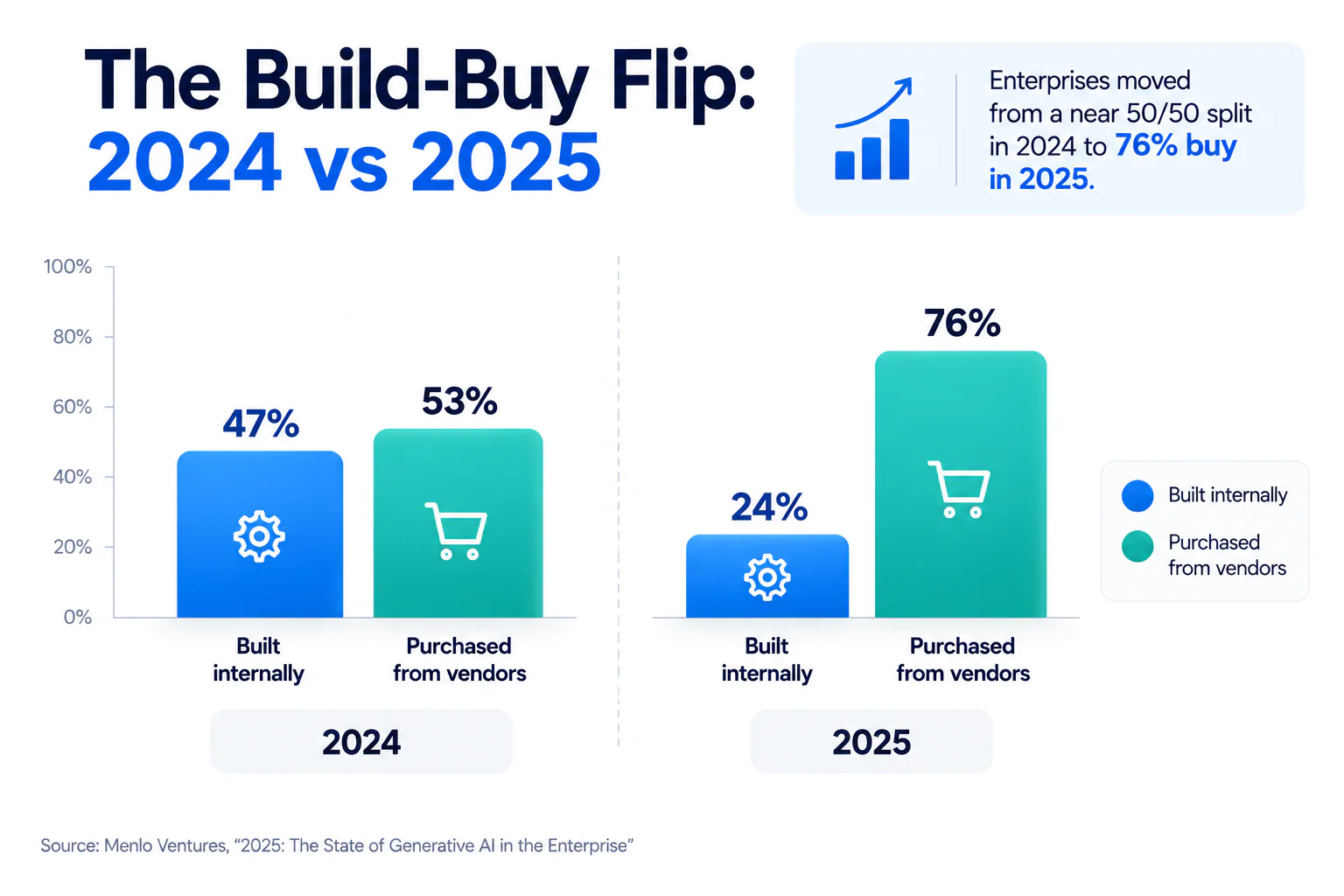
Enterprise AI adoption has shifted rapidly toward external solutions. In 2024, internal builds accounted for 47% of use cases, compared with 53% purchased. By 2025, purchased solutions had risen to 76%, while internal builds fell to 24%. This more-than-three-to-one ratio suggests that enterprises increasingly prioritize speed, specialized expertise, and proven solutions. Building every capability in-house is becoming harder to justify when mature alternatives already exist.
The Hidden Cost of “We’ll Build It Ourselves”
Many 2024 build decisions were driven by optimism rather than a complete cost model. Teams budgeted for the initial development sprint but often underestimated ongoing costs. These included retraining, monitoring, and fixing systems as real-world data changed. S&P Global Market Intelligence’s 2025 survey of over 1,000 enterprises found that 42% had abandoned most of their AI initiatives that year. This was up sharply from 17% in 2024, with cost overruns cited as a leading factor. The finding helps explain why more enterprises are shifting toward vendor solutions with more predictable costs.
When the Old Advice No Longer Applies
Conventional software wisdom held that custom-built systems age better because they fit the business precisely. That logic weakens for AI because AI capabilities evolve faster than most internal roadmaps. A model fine-tuned for your team eighteen months ago may already lag behind current vendor offerings. Vendors can adopt newer foundation models faster than most internal teams can rebuild their systems. Buying effectively rents access to that pace of improvement instead of trying to match it internally.
What This Shift Means for Your Decision
None of this means building is now wrong. It means the burden of proof has shifted. A 2023 business case could treat building as the safer default. A 2026 business case must justify that choice against a market favoring external solutions. The next two sections identify the signals that justify building and those that do not.
Takeaway: The build-buy ratio flipped from nearly even to 76% buy within a single year. Higher deployment success and lower failure exposure helped drive that shift. Treat Build as the option requiring specific justification, not the safe default.
2. When Buying an AI Solution Is the Right Call
Buying is not a compromise or a lesser choice. For many enterprise use cases, it is simply the more practical option. These five signals point toward a vendor solution.
The Capability Is a Commodity, not a Differentiator
Transcription, translation, optical character recognition, and basic sentiment analysis have mature solutions across multiple vendors. Rebuilding these capabilities internally consumes engineering resources without creating meaningful differentiation. Competitors can access many of the same underlying technologies. If a function does not depend on proprietary processes or data, buying can free internal teams to focus on what sets the business apart.
Workflow Risk Is Low
Before committing to Build, ask a simple question: if this AI output is wrong, what actually breaks? If a user loses twenty seconds, the impact may be minimal. The same applies when a human reviews the output before it reaches a customer. In such cases, a vendor’s general-purpose accuracy may be sufficient. Custom engineering becomes more valuable when errors carry meaningful financial, legal, or safety consequences. As the cost of failure rises, so does the value of greater control.
You Need to Validate Demand Before Committing
When internal demand remains uncertain, buying can test the business case within weeks rather than months. A scoped proof of concept, similar to SmartDev’s own AI proof of concept engagements, can validate demand before major investment. This reduces the risk of committing six figures to a custom build before the use case has proven its value.
Domain Logic Is Standard Across the Industry
If good output does not depend on proprietary rules, a vendor may already solve the problem effectively. Generic customer support triage, document summarization, and routine data extraction often fit this pattern. Specialized firms offering generative AI development services can integrate proven third-party tools faster than an internal team could build from scratch. Internal engineering resources can then focus on capabilities that genuinely differentiate the business.
Speed to Value Matters More Than Perfect Fit
In competitive markets, an 80% solution delivered in six weeks can outperform a 100% solution delivered in eight months. Buying creates an immediate speed advantage and brings the use case into real-world testing sooner. Once the use case proves its value, enterprises can add customization or integrations. They can also move toward a hybrid model if requirements become more complex. Real usage reveals which requirements actually matter. This reduces the risk of building features that look necessary on paper but deliver little value.
Takeaway: Buy when the capability is a commodity, workflow risk is low, or demand remains uncertain. The same applies when domain logic is standard or speed matters more than perfect customization.
3. When Building Custom AI Actually Wins
The 24% of use cases still built in-house are not built out of nostalgia. They represent scenarios where the additional cost and risk can create enough strategic value to justify ownership.
AI Is the Product, not a Feature
If your company sells the AI capability itself, buying a vendor model can limit differentiation. Competitors may access similar capabilities from the same provider. Teams offering dedicated machine learning development services can support this scenario, where the model itself represents valuable intellectual property. A strong data analytics services foundation also matters. Proprietary models still depend on reliable, well-structured data to deliver a meaningful advantage.
Proprietary Data Creates a Defensible Moat
Some organizations hold datasets that competitors cannot easily replicate or purchase. A custom model trained on that data can turn information advantages into product advantages. Vendor models may offer broad capabilities, but they cannot automatically access proprietary manufacturing sensor logs or underwriting histories. Building allows organizations to design models around those unique data assets. That advantage can be difficult to reproduce through a standard vendor subscription.
Regulatory or Data Sovereignty Requirements Demand Full Control
Some regulatory environments restrict where sensitive data can be stored, processed, or transferred. These requirements can make certain vendor architectures difficult to adopt. Under the EU AI Act’s obligations for deployers of high-risk systems, organizations face requirements around risk management, human oversight, monitoring, and documentation. Building internally can provide greater visibility into system architecture and data flows. However, ownership alone does not guarantee compliance. Organizations still need appropriate controls, documentation, testing, and oversight.
The Use Case Is Core to Competitive Advantage
Some capabilities sit close to a company’s competitive strategy. In these cases, dependence on an external vendor can create strategic vulnerability. A vendor could change pricing, alter its product, or discontinue a critical feature. Switching may then become expensive or operationally disruptive. When the capability directly supports market position, that risk can outweigh the higher upfront cost of building. Ownership becomes a strategic investment rather than simply an engineering choice.
You Have the Talent and Timeline to Sustain It
Building only makes sense when the organization can sustain the system after launch. That means staffing for monitoring, model updates, infrastructure, and ongoing optimization. Gartner predicts that over 40% of agentic AI projects will be canceled by the end of 2027. Understaffed teams can struggle to maintain AI systems as requirements and models evolve. Before building, confirm committed resources beyond the launch phase. The real test is whether the organization can support the system through years two and three.
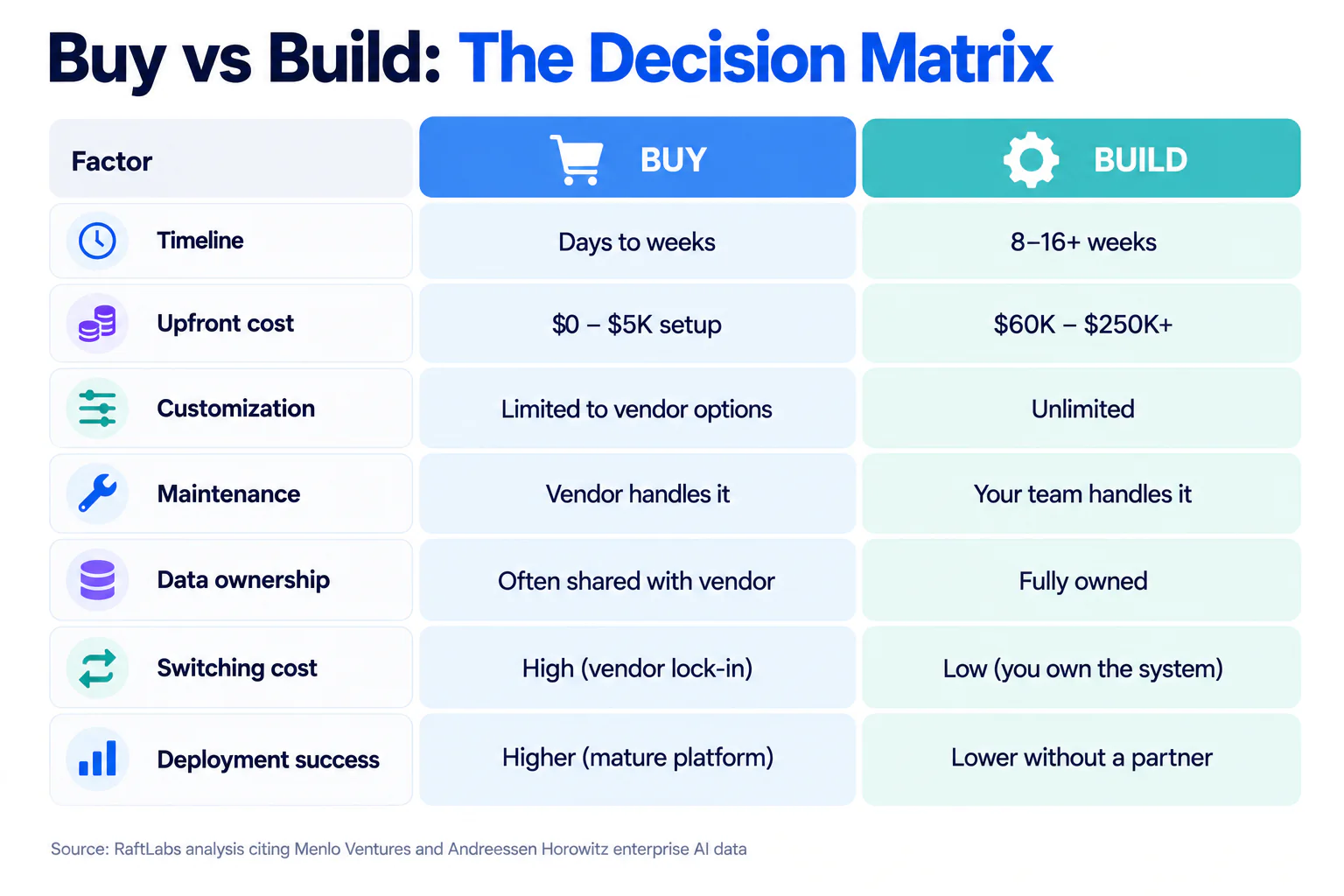
The matrix compares Buy and Build across seven practical criteria: timeline, upfront cost, customization, maintenance, data ownership, switching cost, and deployment success. Together, these criteria expose where each approach creates value and where it introduces constraints.
How to Use the Buy vs. Build Matrix
Use the matrix to identify which trade-offs matter most for your specific use case. Do not treat every criterion as equally important. Start with the two or three constraints that would be hardest to compromise on.
Then assess how each option performs against those priorities. A major advantage in one area should not automatically outweigh a critical weakness elsewhere. For example, faster deployment may matter less when strict data ownership is non-negotiable.
Look for the overall pattern rather than a single winning criterion. A clear advantage on one side usually points toward a stronger fit. When neither side clearly wins, a hybrid approach may offer a better balance than forcing a binary decision.
Takeaway: Build when AI creates differentiation, requires greater control, or depends on proprietary assets. Otherwise, buying is often the stronger starting point.
4. The Total Cost of Ownership Nobody Puts in the Business Case
Most build-vs-buy comparisons stop at the initial price tag. That is exactly where they go wrong. A complete total cost of ownership view can change the calculus for both options. In many cases, the difference becomes larger over time.
Upfront Cost Is Only the First Line Item
A custom AI build typically costs $60,000 to $250,000 upfront, according to RaftLabs’ analysis of enterprise AI engagements. That figure covers only the initial development investment. Data preparation, system integration, and accuracy tuning can add significant costs before production begins. Buying usually requires far less upfront investment. However, the comparison remains incomplete without accounting for usage-based fees as adoption grows.
The Maintenance Burden AI Adds That Traditional Software Doesn’t
AI systems require a different maintenance model from traditional software. Real-world data can drift away from training assumptions. Model providers can also deprecate older versions or change their capabilities. Without continuous monitoring, accuracy can decline without obvious warning. Maintenance therefore includes accuracy monitoring, usage and cost tracking, retraining, and investigation of unexpected outputs.
Custom builds absorb these responsibilities internally. Some organizations may use DevOps as a Service to manage deployment, monitoring, and infrastructure more systematically. Vendor platforms distribute many of these costs across their customer base. This can help explain why purchased solutions may deliver lower total costs despite recurring subscription or usage fees.
Talent Cost and Retention Risk
Retaining specialized machine learning engineers requires a dedicated budget. It also puts organizations in direct competition for a limited talent pool. If a key engineer leaves eighteen months into the system’s lifecycle, the organization can face a costly knowledge gap. A vendor relationship can reduce this concentration risk by providing access to a broader specialist team.
Vendor Lock-In vs Build Lock-In
Buying trades one form of lock-in for another. Vendor contracts, data formats, and integrations can create switching costs when you later move platforms. Building creates its own form of dependency. After investing six figures and months of engineering effort, abandoning a custom system can become difficult even when better alternatives emerge.
Neither approach eliminates lock-in completely. A realistic TCO analysis should account for both forms of dependency. It should also consider the cost of changing course when business requirements or technology change.
Modeling TCO Over Three Years, Not One
A one-year comparison can favor buying because the upfront build cost dominates the period. A three-year model can reveal a different cost pattern as usage and maintenance accumulate. Vendor fees may rise with adoption, while a mature custom build can reduce marginal costs across additional use cases. The right answer depends on your expected scale and future use cases. A scoped AI consulting engagement can help model those variables before you commit to either approach.
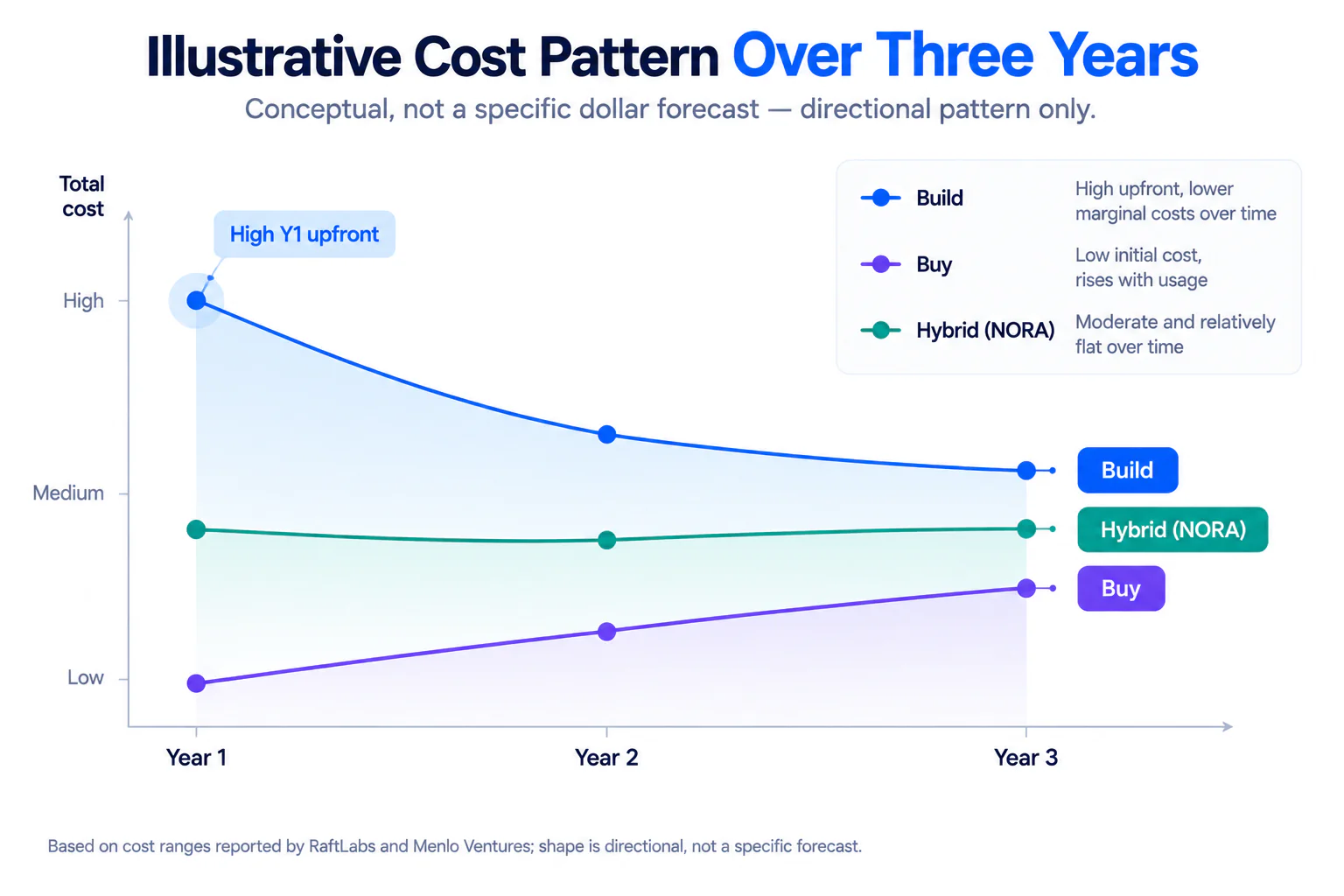
The chart highlights a key trade-off: Buy minimizes early investment, Build requires more capital upfront, and Hybrid aims for a more predictable cost profile. The Hybrid model can therefore offer a practical middle ground for organizations seeking control without absorbing the full burden of an internal build.
Use this pattern as a planning lens, not a financial forecast. The actual curve will depend on usage volume, integration complexity, customization needs, and how many workflows the organization adds over time.
Takeaway: A full total cost of ownership view includes maintenance, talent retention, and lock-in risk on both sides, not just the upfront price. Model the comparison over three years, not one, since the winner often changes once maintenance and scaling costs are included.
5. How NORA Fits into the Build vs Buy Decision
The build-buy framework can make AI investment look like a binary choice. In practice, many enterprises need something between the two extremes. NORA, SmartDev’s AI Adoption Accelerator, addresses this middle ground. Its hybrid model combines a proven foundation with workflow-level customization.
NORA as the Third Option: Buy the Foundation, Customize the Workflow
NORA provides a pre-built data layer and reasoning engine for enterprise AI workflows. These are among the most expensive and complex components to develop from scratch. Clients then customize the execution logic around their specific workflows and requirements.
This approach reuses infrastructure that has already been developed and tested. The same foundation is covered in our guide to moving AI from pilot to production. Reusing this layer can reduce development time and upfront engineering effort. At the same time, customization avoids the constraints of a rigid, one-size-fits-all product.
What You Still Own Even When You “Buy” NORA
Choosing NORA does not mean giving up the ownership decisions that matter. Clients still define data access policies and set confidence thresholds for human review. They also retain sign-off authority before new use cases enter production. SmartDev’s engineers manage the infrastructure and day-to-day operations. This reflects the ownership boundary established in the governance framework. Clients therefore gain faster deployment while retaining control over critical business and governance decisions.
Case Study: Compliance Screening Bought, Not Built, in Weeks
A financial services client needed transaction screening against sanctions lists. However, it lacked the data science capacity and eighteen-month runway required for a custom build. Rather than building from scratch, the client deployed NORA’s compliance screening capability. The capability was configured around the client’s own risk rules within the existing foundation layer. In production, this reduced false positives by up to 99%. The case shows how a hybrid approach can tailor AI workflows without requiring a fully custom system.
When NORA Recommends You Build Instead
SmartDev does not position NORA as the answer to every AI decision. When a use case depends on proprietary modeling logic, a custom approach may create greater strategic value. SmartDev’s AI consulting team can assess whether that level of ownership is justified. In such cases, the team can scope a custom software development engagement instead. The decision framework in Section 6 reflects the approach SmartDev’s solution architects use during discovery.
The Build-Buy-Hybrid Spectrum
Build and Buy are better understood as points on a spectrum than as fixed choices. The real decision is how much of the AI stack your organization needs to own.
Some organizations may outsource most of the stack and retain only governance. Others may build proprietary layers around an external foundation. NORA sits between these approaches by separating reusable infrastructure from business-specific workflow logic.
This creates a more flexible path to AI adoption. Organizations can increase ownership when strategic value or control requirements justify it. They can also keep standardized components external when building them internally adds little value.
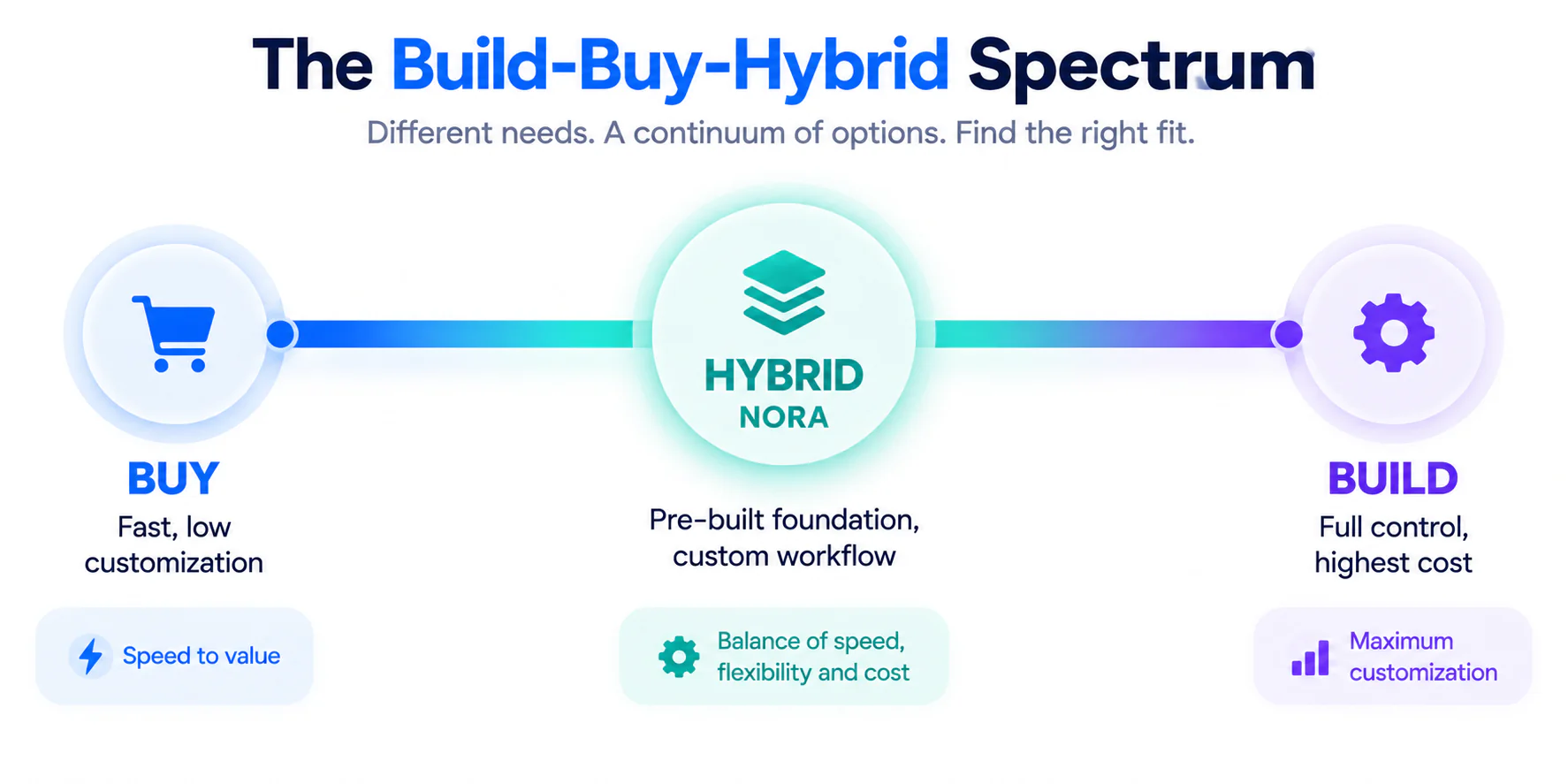
The real advantage of this spectrum is that it shifts the decision from choosing a model to allocating ownership strategically. Teams can retain control over business-critical layers while externalizing standardized components that do not create meaningful differentiation.
This also allows the approach to evolve as the use case matures. An organization can start with more external support, then bring selected capabilities in-house when scale, risk, or strategic value justifies greater ownership.
Takeaway: NORA occupies the middle of the build-buy spectrum. Clients buy the foundation layer and customize only the workflow on top. This keeps critical ownership decisions internally while reducing both cost and timeline compared with a pure custom build.
6. A Practical Decision Framework for Your Next AI Investment
Turning everything above into a repeatable process keeps the decision from becoming a one-off debate every time a new use case appears. This framework works whether the eventual answer is buy, build, or a hybrid model like NORA.
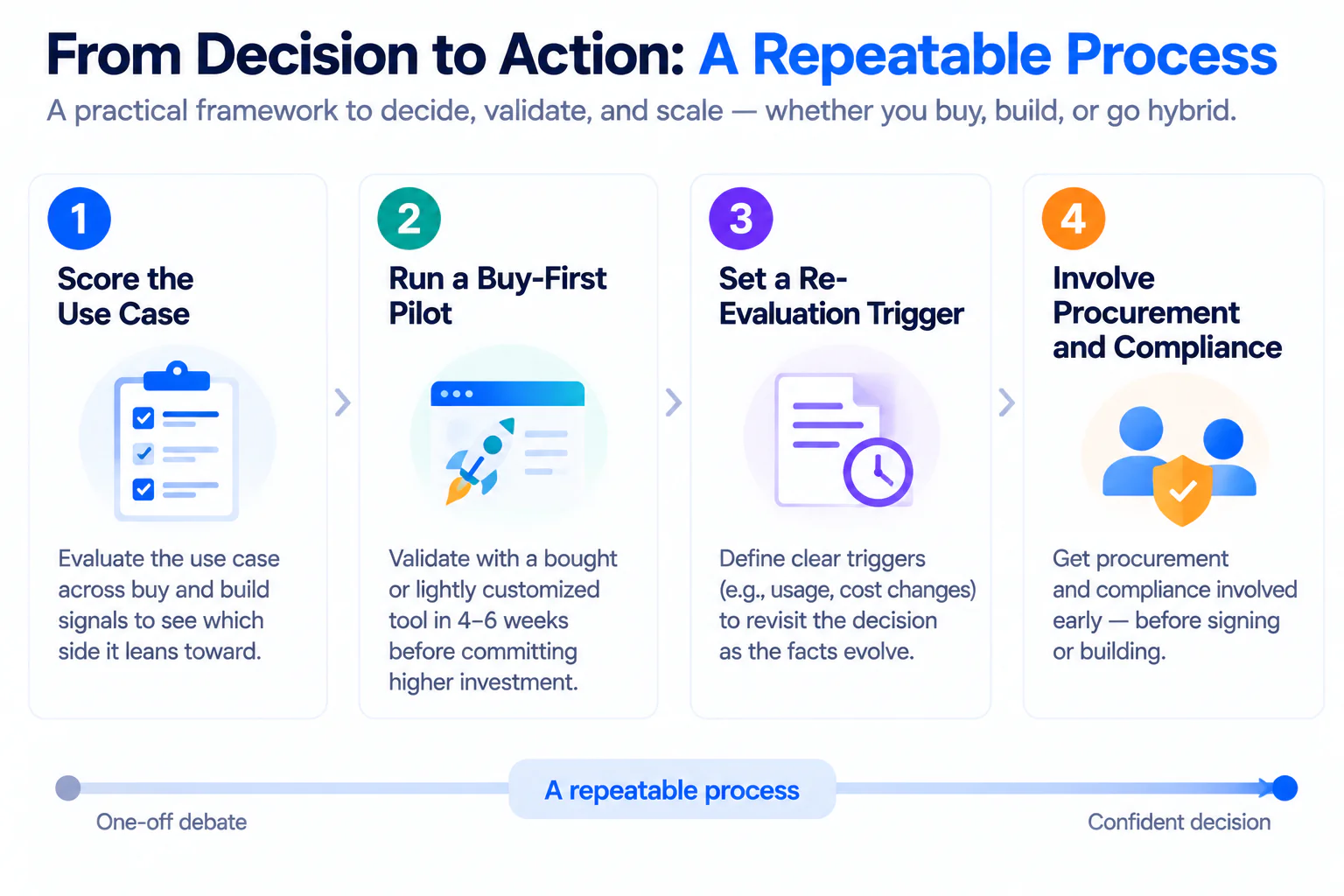
Step 1: Score the Use Case Against Five Signals
Walk through the five Buy signals from Section 2 and the five Build signals from Section 3. Score the use case against each signal.
A use case that strongly favors Build may justify the higher investment. This is especially true when it involves proprietary data, regulatory control, and strategic importance. Conversely, a use case that strongly favors Buy rarely justifies a custom build, even if the technology is technically appealing to the engineering team.
Step 2: Run a Time-Boxed Buy-First Pilot
Even when the long-term answer appears to be Build, validate the use case with a bought or lightly customized tool first. Keep the pilot within a strict four-to-six-week window. This “prove fast, build later” approach tests real demand before committing a six-figure budget to a custom system. It can prevent teams from investing heavily in a solution that users may not ultimately need.
Step 3: Set a Re-Evaluation Trigger, not a Permanent Decision
Build vs buy is not a decision you make once. Set a specific trigger, such as usage crossing a defined threshold, or a vendor’s pricing model changing materially; that automatically prompts a re-evaluation. S&P Global’s finding that companies scrapped 46% of AI proofs of concept suggests that many of these projects were locked into an initial decision long after the facts on the ground had changed.
Step 4: Involve Procurement and Compliance Early
Whichever path you choose, loop in procurement and compliance before signing anything or writing the first line of code, not after. A vendor’s contract needs security and data residency review before signature, and a custom build needs a data governance plan before the first line of training data gets ingested. Our IT Outsourcing Due Diligence Checklist covers the specific questions worth asking a vendor before committing to either path.
Common Mistakes That Sink Both Paths
Three mistakes recur regardless of which path an enterprise chooses. Teams skip the total cost of ownership modeling from Section 4 and get surprised by year-two costs. Teams treat the decision as permanent instead of setting up the re-evaluation trigger from Step 3. And teams let engineering enthusiasm for building drive the decision instead of the five signals from Section 3, building capabilities that a vendor could have delivered faster and cheaper. Avoiding these three mistakes matters more than getting the initial buy-or-build call perfectly right.
Takeaway: Score each use case against the key Buy and Build signals. Validate the choice through a time-boxed pilot before committing to a custom build. Set a clear re-evaluation trigger as needed to evolve. Involve procurement and compliance from day one to avoid costly changes later.
Frequently Asked Questions
What percentage of enterprises now buy AI instead of building it?
Menlo Ventures’ 2025 State of Generative AI in the Enterprise report found that 76% of enterprise AI use cases are now purchased rather than built internally. This marks a complete reversal from 2024, when 47% were built and 53% were purchased.
When does it make sense to build a custom AI solution instead of buying one?
Build when AI is your core product rather than a supporting feature. Build when proprietary data creates a genuine competitive moat or when data sovereignty and regulation demand full control. It also makes sense when the use case is central to your competitive advantage and vendor dependency creates strategic risk.
What is the real cost difference between building and buying AI?
Buying typically costs $0 to $5,000 in setup, followed by usage-based fees. Custom builds can require $60,000 to $250,000 in upfront development, plus ongoing infrastructure, monitoring, and retraining costs. These longer-term costs are often underestimated in business cases, according to analysis from RaftLabs citing Menlo Ventures data.
How does NORA fit into a build vs buy decision?
NORA, SmartDev’s AI Adoption Accelerator, sits between pure buy and pure build. It gives clients a pre-built foundation and reasoning layer while still customizing the execution logic to their specific workflow, which shortens time to value without the maintenance burden of a fully custom system.
What is the biggest mistake companies make in the build vs buy AI decision?
The most common mistake is treating the decision as permanent and made once. S&P Global Market Intelligence found that companies scrapped an average of 46% of AI proofs of concept before production, often because the original build-or-buy choice was never revisited as the use case and data matured.
Conclusion
Enterprise AI no longer has a default answer to the build-vs-buy question. Menlo Ventures’ data makes that clear: 76% of enterprises now buy rather than build. Faster deployment, higher success rates, and lower total cost often make mature platforms the practical choice. Yet the 24% that still build are not necessarily making a mistake. Proprietary data, regulatory control, or genuine competitive differentiation can justify the higher investment.
A permanent, company-wide policy is rarely the right approach. Score each use case against the signals in this guide and model the full three-year cost. Consider a hybrid accelerator like NORA when you need buying speed with greater customization. Keep the decision reversible and revisit it as the use case matures. Most importantly, retain the governance ownership outlined in our companion guide on pilot-to-production controls, regardless of where you land on the spectrum.
Not Sure Whether to Build or Buy Your Next AI Solution?
Tell us more about the use case, your data, and your compliance requirements. SmartDev’s team will score it against the framework in this article and map out whether buying, building, or a NORA-powered hybrid gets you to production fastest, with a scoped recommendation in days.