
TL;DR
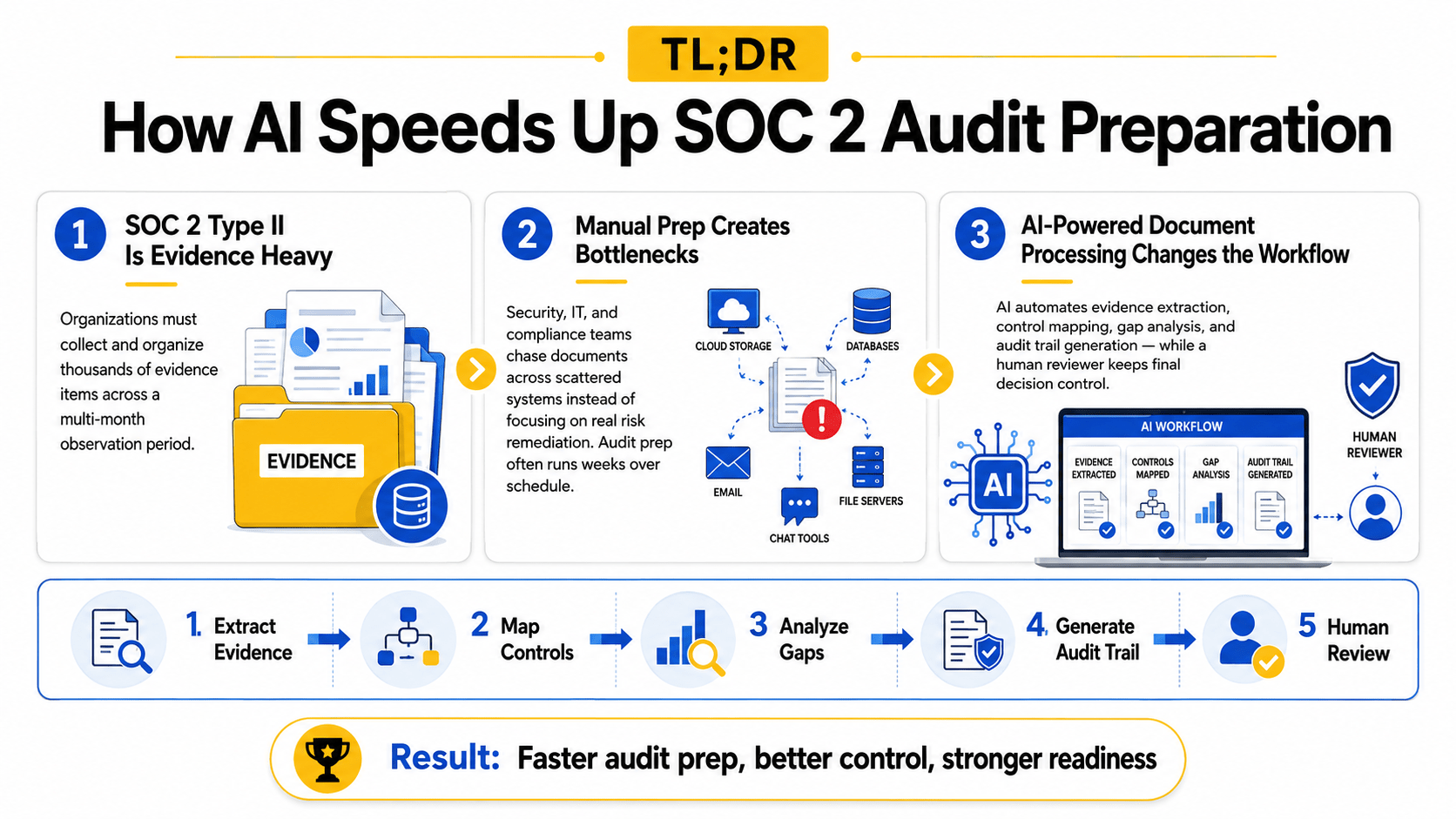
- SOC 2 audits — especially Type II reports — require organizations to collect and organize thousands of evidence items across a multi-month observation period, and most teams still do this by hand.
- Manual evidence gathering forces security, compliance, and IT staff to chase documents across scattered systems instead of focusing on risk remediation, which is why audit timelines routinely slip and enterprise deals stall waiting on a report.
- AI SOC 2 audit prep automates evidence extraction, control mapping, gap analysis, and audit trail generation, helping organizations cut review time dramatically while keeping a human reviewer accountable for every final decision.
Introduction
Every organization that has been through a SOC 2 audit knows the pattern. Weeks before the auditor’s kickoff call, someone on the security or compliance team starts a spreadsheet. Slack threads get combed for approval screenshots. Old tickets get reopened to prove an access review actually happened. By the time fieldwork begins, the “audit” has already consumed a month of the team’s attention — and the actual examination hasn’t even started.

This is rarely a failure of governance or control design; in most organizations, the underlying security posture is already sound. The real constraint is operational. SOC 2 Type II attestation requires an organization to demonstrate, with evidence, that every control operated consistently across an observation period that typically runs from three to twelve months. In practical terms, that means thousands of individual evidence items must be collected, version-controlled, and matched to the right control before an auditor ever reviews a single one. Most of that work is still manual: exporting logs, screenshotting configurations, and refiling documents into formats auditors will ask to see again.
As companies pursue multiple frameworks at once — SOC 2 alongside ISO 27001, HIPAA, or customer-specific security questionnaires — the evidence burden multiplies rather than adds. Increasingly, the organizations that get through audits with the least disruption to the business are the ones that have moved AI SOC 2 audit prep into their standard workflow automation stack, rather than treating evidence collection as a once-a-year fire drill.
The Real Business Cost of SOC 2 Audit Prep
1. Type I vs. Type II: Why the Evidence Burden Multiplies
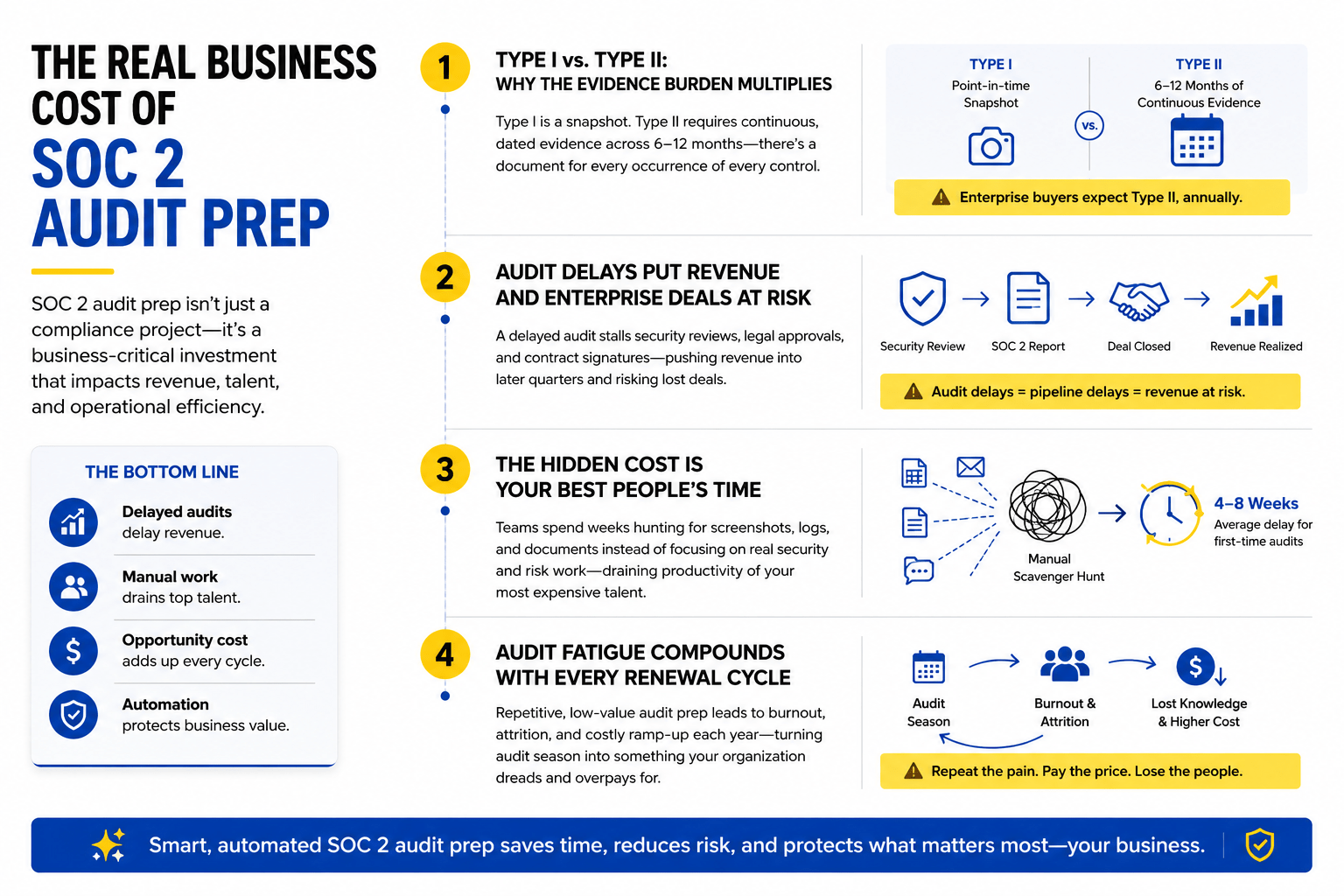
Not all SOC 2 reports carry the same evidence load, and the difference matters for how a business should plan its audit prep. A Type I report only requires point-in-time evidence — a snapshot proving controls are designed correctly on the day of the audit. Type II is a fundamentally different commitment: auditors expect continuous, dated evidence proving each control operated as designed across the full observation window, typically six to twelve months. That is not one document per control; it is a document for every occurrence of that control during the period.
Most enterprise buyers no longer accept a Type I report as sufficient proof of a vendor’s security posture — they require Type II, and increasingly they require it on an annual, uninterrupted basis. That shifts the evidence-collection problem from a one-time project into a permanent operating cost, one that scales with every additional Trust Services Criterion (Availability, Confidentiality, Processing Integrity, Privacy) a company adds to satisfy customer or contractual requirements.
For finance and operations leaders, this distinction is worth internalizing early: budgeting and staffing for a Type I audit and budgeting for a rolling Type II program are two different exercises. Companies that plan for the latter as if it were the former are the ones most likely to blow through both their timeline and their audit budget.
2. Audit Delays Put Revenue and Enterprise Deals at Risk
For most B2B and SaaS companies, a SOC 2 report is not just a compliance artifact — it is a sales enablement document. Enterprise procurement and security review teams routinely gate contract signature on receipt of a current SOC 2 report, which means a delayed audit does not just cost the compliance team’s time; it stalls the sales pipeline and pushes revenue recognition into a later quarter.
This dynamic turns audit prep into a business-critical dependency rather than a back-office task. When evidence collection slips because a document could not be located in time, the consequence is not an internal deadline missed quietly — it is a deal desk waiting on legal, a renewal at risk, or a competitor with a cleaner compliance story winning the account instead.
Executive sponsors increasingly recognize this and are the ones pushing for AI SOC 2 audit prep, not because it is a nice-to-have efficiency gain, but because the cost of a slipped audit shows up directly on the revenue line, not just the compliance budget.
3. The Hidden Cost Is Your Best People’s Time
Ask any compliance lead where the audit-prep hours actually go, and the answer is rarely “assessing risk.” It is finding the right screenshot, re-exporting a log that expired, or chasing an engineer who approved a change six months ago and no longer remembers the ticket number. Scattered evidence across spreadsheets, shared drives, and email threads is one of the most common causes of audit delay, and it turns a technical exercise into an administrative scavenger hunt.
This administrative load falls on the people a company can least afford to distract — senior security engineers and compliance leads who are pulled off roadmap-critical work to produce yesterday’s proof of a control everyone already knows works. Reframed in business terms, this is not “extra work”; it is a direct, recurring drag on the productivity of some of the most expensive talent in the organization.
Auditors are not asking teams to invent new controls during fieldwork. They are asking teams to prove, with evidence, that the controls already in place actually ran. When that proof takes weeks to assemble instead of minutes to retrieve, the audit timeline stretches — and first-time SOC 2 audits routinely slip four to eight weeks past their original target date for exactly this reason.
4. Audit Fatigue Compounds With Every Renewal Cycle
Beyond timelines and opportunity cost, there is a quieter but equally real business risk: attrition. Security and compliance staff are routinely asked to layer audit-prep work on top of their regular responsibilities, with no reduction in either. Over a multi-month observation period, that means repeatedly stopping high-value work to answer the same category of request — “can you send proof of X from last quarter” — again and again.
This repetitive, low-judgment work erodes retention in a way that is easy to underestimate until a key compliance hire leaves mid-cycle, taking institutional knowledge of the evidence trail with them. Skilled engineers and compliance officers did not join a company to become document archivists, and the more of their week audit prep consumes, the more likely they are to look elsewhere.
Left unaddressed, this pattern compounds every renewal cycle, with each audit season becoming a period the organization quietly dreads and budgets extra contractor spend to survive, rather than a routine, predictable checkpoint. That dread is itself a signal that the process — not the people running it — needs to change.
Why Traditional Audit Prep Models Struggle to Scale
1. Manual Document Review Creates Bottlenecks
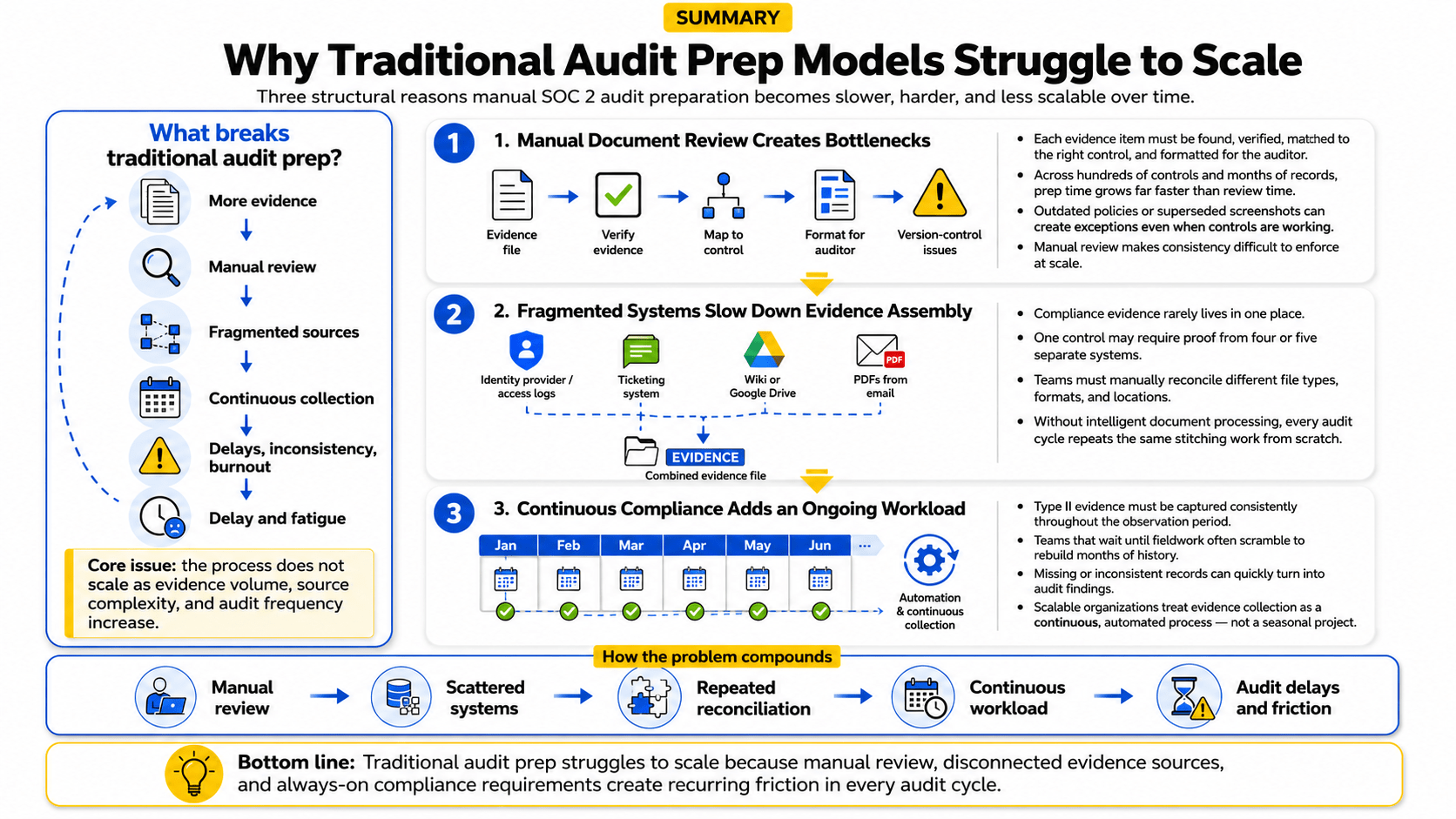
A typical piece of SOC 2 evidence has to be located, verified as current, matched to the correct control, and then formatted the way the auditor expects to see it. Multiply that by the hundreds of controls in scope and the months of the observation period, and even a well-organized team spends far more time preparing evidence than actually reviewing it for accuracy.
This is compounded by version control problems: an outdated policy document or a superseded screenshot submitted as evidence can trigger an audit exception even when the underlying control is sound. Inconsistent evidence submissions caused by weak version control remain one of the most preventable sources of audit friction, yet manual processes make consistency difficult to enforce at scale.
2. Fragmented Systems Slow Down Evidence Assembly
Compliance evidence rarely lives in one place. Access logs sit in the identity provider, change records live in the ticketing system, policy documents are stored in a wiki or Google Drive, and vendor attestations arrive as PDFs over email. Pulling a single control’s worth of proof together often means logging into four or five different systems and manually reconciling formats.
This fragmentation is precisely the kind of problem that intelligent document processing was built to solve — extracting and structuring information scattered across disconnected sources so teams no longer have to manually stitch it together. Without that layer, every audit cycle repeats the same reconciliation work from scratch, regardless of how well the previous audit went.
3. Continuous Compliance Adds an Ongoing Workload
Because Type II evidence has to be gathered consistently across the entire observation period, audit prep is not a single event — it is a background task that never fully stops. Teams that only think about evidence collection in the weeks before fieldwork inevitably scramble to reconstruct months of history, often with gaps that become audit findings.
The organizations that avoid this scramble treat evidence collection as a continuous, automated process rather than a seasonal project, which is a meaningfully different operating model from how most compliance teams are still staffed and structured today.
Why AI SOC 2 Audit Prep Is Emerging as the Solution
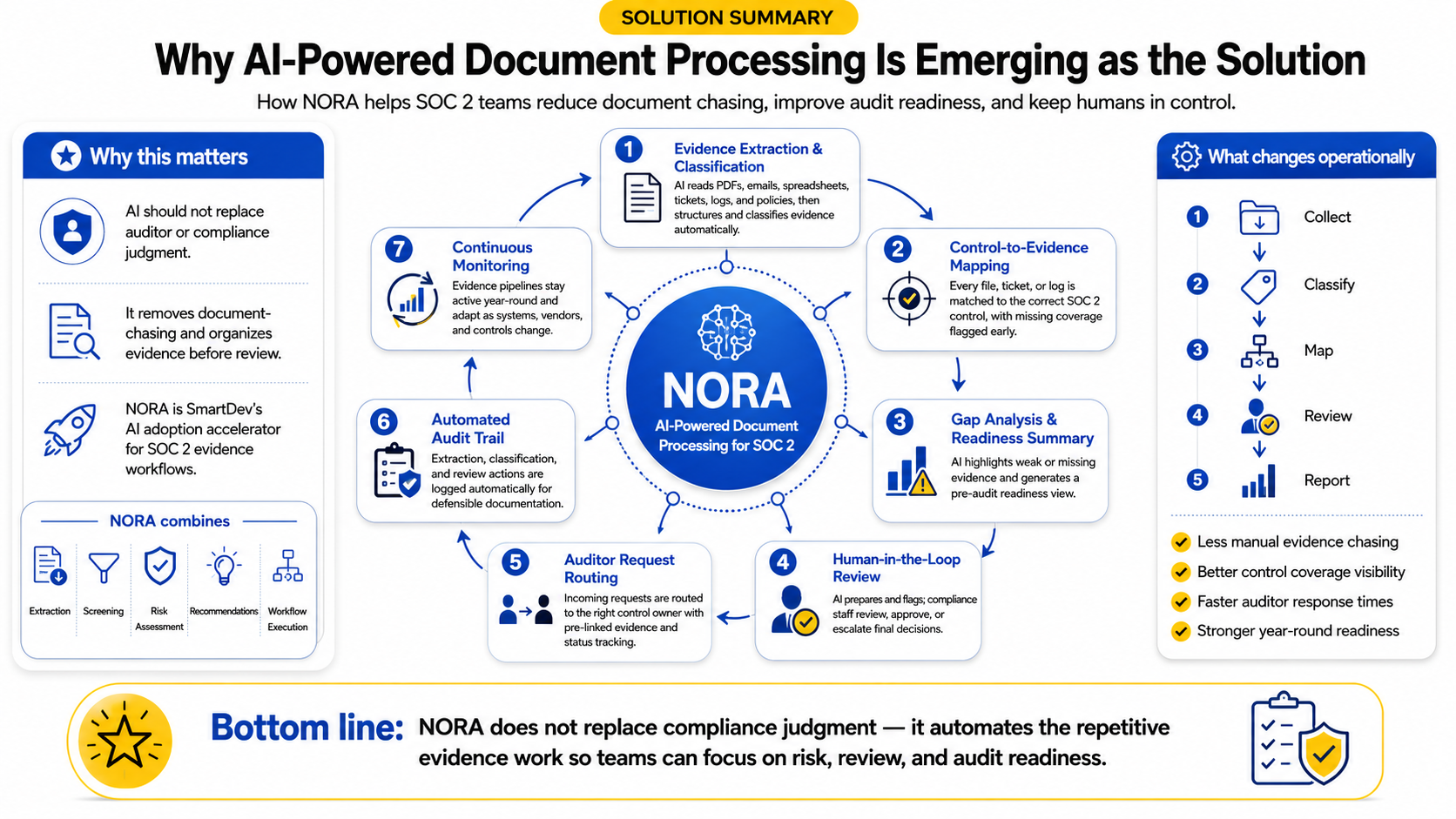
The goal of AI in SOC 2 audit prep is not to replace the auditor or the compliance officer’s judgment — it is to remove the document-chasing work that consumes their time before judgment can even happen. This is where AI-powered document processing becomes practical: not as a generic chatbot layered on top of a compliance platform, but as an operational layer that reads, classifies, and organizes evidence automatically, then routes it to the people who need to review it.
NORA is SmartDev’s AI adoption accelerator, built to help organizations deploy AI-powered workflow automation without building every component from scratch. Rather than functioning as a standalone GRC tool, NORA provides a reusable set of AI capabilities for document and data processing that can be configured specifically for SOC 2 evidence collection, control mapping, and audit readiness reporting.
At its core, NORA combines information extraction, data screening, risk assessment, recommendation, and workflow execution into a single operational framework, so audit-prep teams are not left assembling separate tools for OCR, classification, and case routing on their own.
1. Automated Evidence Extraction and Classification
SOC 2 evidence usually lives across too many systems: identity platforms, ticketing tools, cloud consoles, HR systems, contract folders, and policy repositories. Without automation, teams have to export screenshots, download logs, rename files, label documents, and manually place them into the right audit folders.
NORA reduces that manual workload by pulling relevant evidence directly from source systems as it is generated. It can read documents, logs, tickets, reports, and policy files using OCR and natural language processing, then classify each item by evidence type, control area, owner, and audit period. This matters most for Type II audits, where auditors do not only want to know that a control exists; they want proof that it operated consistently across the observation window.
For example, when a quarterly access review is completed, NORA can recognize the document, timestamp it, and file it under the correct control immediately. Over a twelve-month Type II audit period, this prevents evidence collection from becoming a painful end-of-year scramble.
2. Intelligent Control-to-Evidence Mapping
Collecting evidence is only half the problem. The more difficult part is proving that each piece of evidence supports the right control. In many SOC 2 programs, teams still manage this through spreadsheets, folders, naming conventions, and manual cross-referencing. That approach breaks quickly as the scope expands from Security to Availability, Confidentiality, Processing Integrity, or Privacy. More controls mean more evidence, more owners, more exceptions, and more room for misclassification.
That real-time visibility is a similar accuracy gain to what SmartDev has delivered when applying AI to improve document interpretation and content accuracy in other document-heavy enterprise workflows, and it replaces what used to be a manual cross-referencing exercise performed only once or twice before fieldwork.
NORA applies consistent control-mapping logic across every captured artifact. It links each document, log, ticket, approval record, or policy file to the specific control it supports. Instead of asking a compliance lead to manually decide whether a Jira ticket supports change management, incident response, or system operations, NORA reads the context and maps the artifact to the most relevant control area.
3. AI-Assisted Gap Analysis and Audit Readiness Summaries
SOC 2 evidence libraries can become huge, especially for Type II reports. A single control may involve multiple months of tickets, reviews, logs, approvals, screenshots, policies, and exceptions. Even when the evidence exists, reviewers still have to determine whether it is complete, consistent, dated correctly, and strong enough to satisfy the audit requirement. That review process consumes senior compliance time — the most expensive kind of time.
NORA’s reasoning layer reviews the evidence set and identifies weak points before fieldwork begins. It can detect missing sign-offs, incomplete review records, inconsistent dates, evidence outside the observation window, mismatched control owners, duplicated files, unsupported claims, and controls that rely too heavily on outdated documentation.
Instead of giving teams a raw folder of files, NORA produces a readiness summary. It shows which controls are strong, which need attention, and which issues should be handled first. This turns audit preparation into a risk-based review process, not a manual treasure hunt.
4. Human-in-the-Loop Review and Sign-off
None of this replaces the compliance officer’s judgment, and it should not. Compliance decisions remain a human responsibility, particularly the final call on whether a control genuinely satisfies the intent of a Trust Services Criterion, not just its letter. A system can classify evidence, detect gaps, and recommend next actions, but a compliance officer must decide whether the evidence truly satisfies the intent of the control.
NORA is built around a human-in-the-loop model. The AI handles high-volume work: extraction, classification, mapping, anomaly detection, routing, and summary generation. The compliance team handles judgment: approving evidence, resolving exceptions, escalating unclear cases, and confirming whether a control meets the audit requirement. This structure gives teams the speed of automation without surrendering accountability to a black-box system.
This also improves governance. Every AI-generated classification or recommendation can move through a review workflow. Compliance leaders can decide which items require mandatory approval, which low-risk items can pass with sampling, and which exceptions require escalation.
5. Automated Auditor Request Routing and Workflow Execution
Fieldwork often exposes the weakness of manual audit prep. Auditors request clarification, missing files, additional samples, updated screenshots, explanations, or proof from a specific period. Each request creates a mini-workflow: identify the owner, find the evidence, verify the document, respond to the auditor, and track whether the item is closed. When teams manage this through email and spreadsheets, requests get duplicated, delayed, or lost.
This is the same underlying pattern that has already let SmartDev cut onboarding-pack processing from days to minutes in KYC document review, applied directly to auditor request management. The process becomes operational instead of reactive: every request moves through a controlled path until closure.
When a request comes in, the system can categorize it, match it to the relevant control, identify the accountable owner, attach existing evidence where available, and route the task to the right person. If the evidence already exists in the classified repository, NORA can surface it immediately. If evidence is missing, it creates a clear action item with ownership, deadline, status, and escalation rules.
6. Automated Audit Trail Generation
One of the most valuable side effects of automating evidence collection is that the audit trail builds itself. Instead of reconstructing a decision history after the fact, every extraction, classification, and review step is logged automatically as it happens, creating defensible, regulator-ready documentation as a natural output of the workflow rather than a separate, after-the-fact task.
NORA generates the audit trail as a natural by-product of the workflow. Every extraction, classification, control mapping, review, approval, escalation, and auditor response can be logged automatically. The system records the source, timestamp, action owner, review status, confidence level, and decision history. This creates a defensible record without asking the compliance team to reconstruct the story later.
The renewal benefit is significant. A first-year SOC 2 process often feels heavy because teams build the evidence structure from scratch. That means renewal preparation becomes a continuation of an existing process, not another annual fire drill.
7. Continuous Monitoring for Year-Round Readiness
SOC 2 readiness fails when companies treat audit prep as a seasonal project. Controls change throughout the year. Teams add new tools, rotate vendors, update cloud infrastructure, hire employees, revise policies, change approval flows, and introduce new customer requirements. If the evidence workflow does not evolve with the business, the audit program becomes outdated long before the next fieldwork period begins.
NORA’s managed service model supports ongoing monitoring and refinement of the evidence pipeline itself, so the workflow adapts as the environment changes rather than requiring a full rebuild before every renewal. This mirrors how intelligent document processing platforms are designed to keep improving accuracy over time rather than functioning as a one-time integration project.
For organizations pursuing annual SOC 2 Type II renewals, that shift is critical. The goal is not to survive the next audit. The goal is to make audit readiness part of daily operations.
Conclusion
SOC 2 audit fatigue is rarely a story about weak controls. Most organizations that struggle through their audits already have a reasonably sound security program in place — the real cost sits in the document work required to prove those controls operated consistently. That cost is not abstract: it shows up as delayed enterprise deals, burned-out engineers, and audit budgets that quietly balloon every renewal cycle.

Rather than restaffing for every audit season or accepting weeks of lost productivity as the cost of doing business, organizations can automatically extract and classify evidence as it is generated, map it to the right controls in real time and generate a defensible audit trail as a byproduct of the workflow. The compliance officer’s judgment stays firmly in the loop for every decision that matters — AI simply removes the document-chasing work that used to consume their time before that judgment could even happen.
With NORA, organizations can move SOC 2 audit prep from a dreaded, once-a-year fire drill to a continuous, defensible process that runs quietly in the background all year. For security, compliance, and finance leaders alike, that shift means faster report turnaround for sales, lower audit costs at renewal, and a team spending its time on the judgment calls only humans can make — instead of chasing down a document an AI could have found in seconds.