TL;DR:
- Rebuilding an SDLC around AI is not about adding AI tools to existing phases — it is about restructuring where rigor lives, who owns what, and how quality gets verified.
- The process changes are visible and trackable. The culture changes are harder and take longer.
- Most organizations underestimate both.
Introduction
When an engineering organization decides to rebuild its SDLC around AI, the first instinct is to treat it as a tooling migration. Swap the IDE. Add a code assistant. Wire in automated testing. Measure the productivity lift. Move on.
Six months in, the reality is more complicated.
The tools worked. But the process assumptions underneath them did not survive contact with production. Requirements got blurrier, not clearer. Review cycles got longer, not shorter. The accountability questions nobody asked at the start — who owns AI-generated output? what counts as passing quality for a function the model wrote? — became the daily friction that slowed everything down.
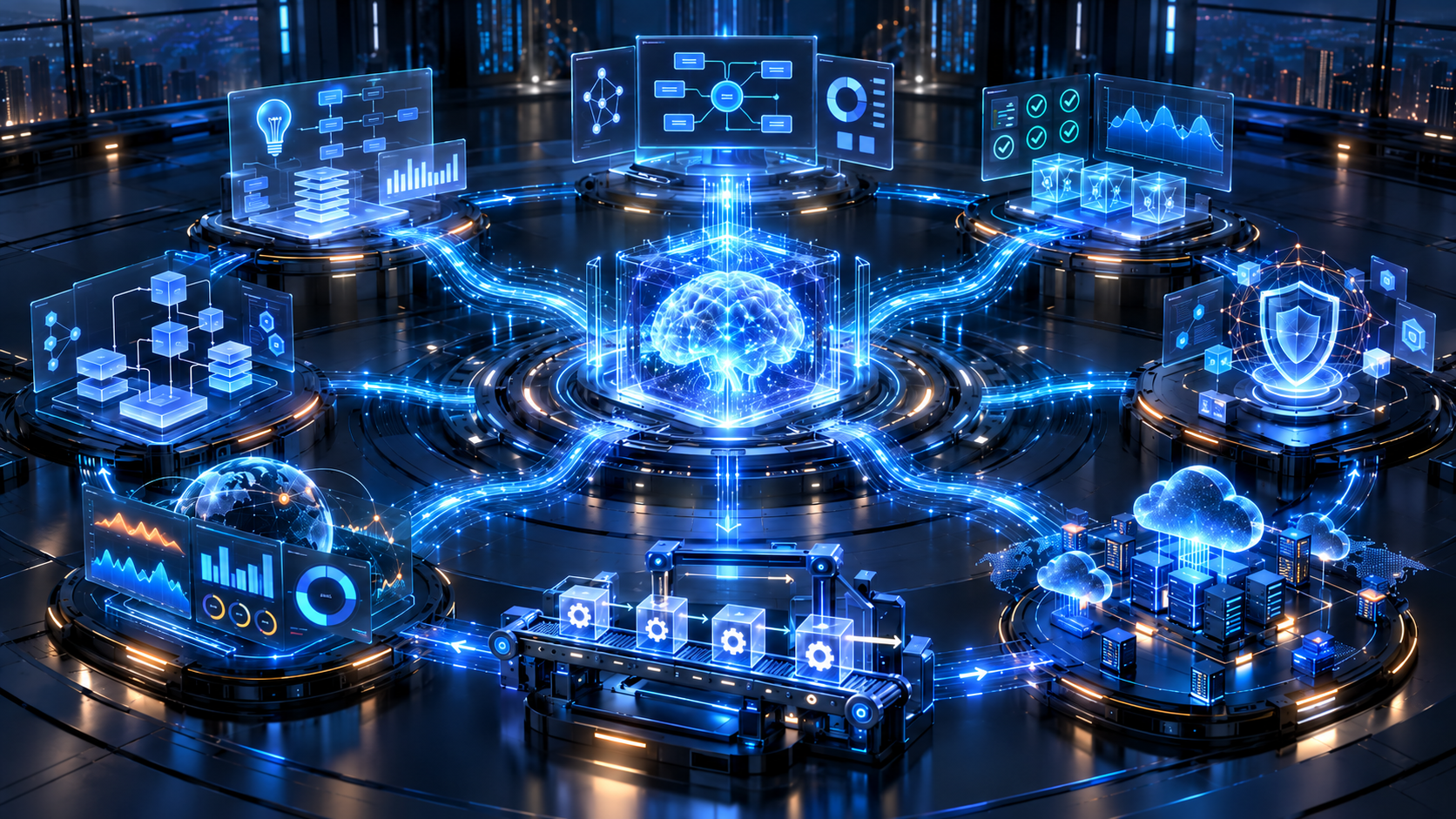
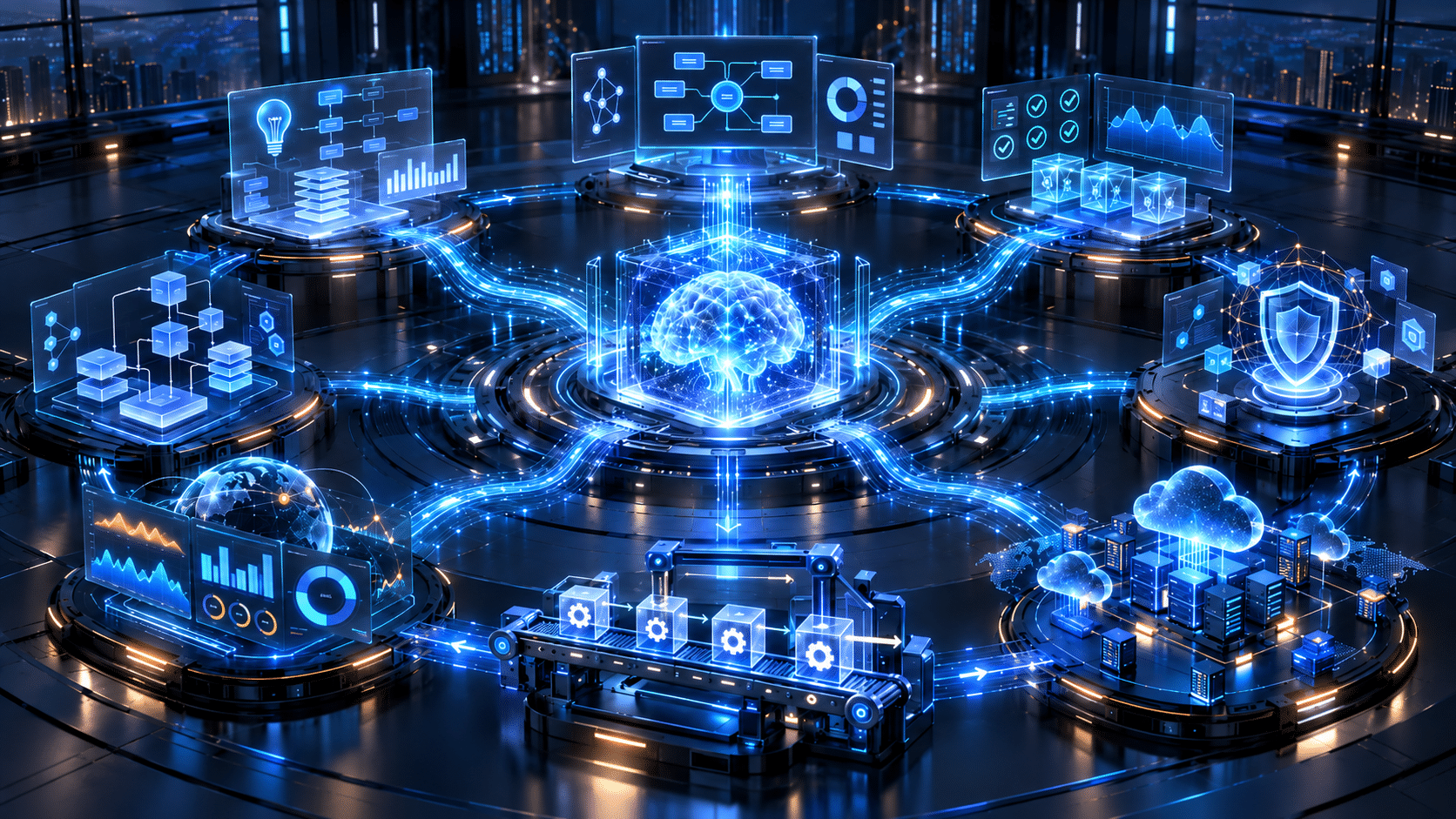
What actually changes when you rebuild an SDLC around AI is not the toolchain. It is the entire system of decisions, handoffs, and verification that the toolchain runs inside. The SDLC AI Radar 2026 from LTM describes it directly: “The SDLC is no longer a sequence of phases governed by human handoffs, and is becoming something more fluid: a living system of decisions, context flows, verification points, and feedback signals.”
This article maps what that transformation looks like in practice — phase by phase, role by role, and in the cultural fabric that either holds it together or causes it to stall.
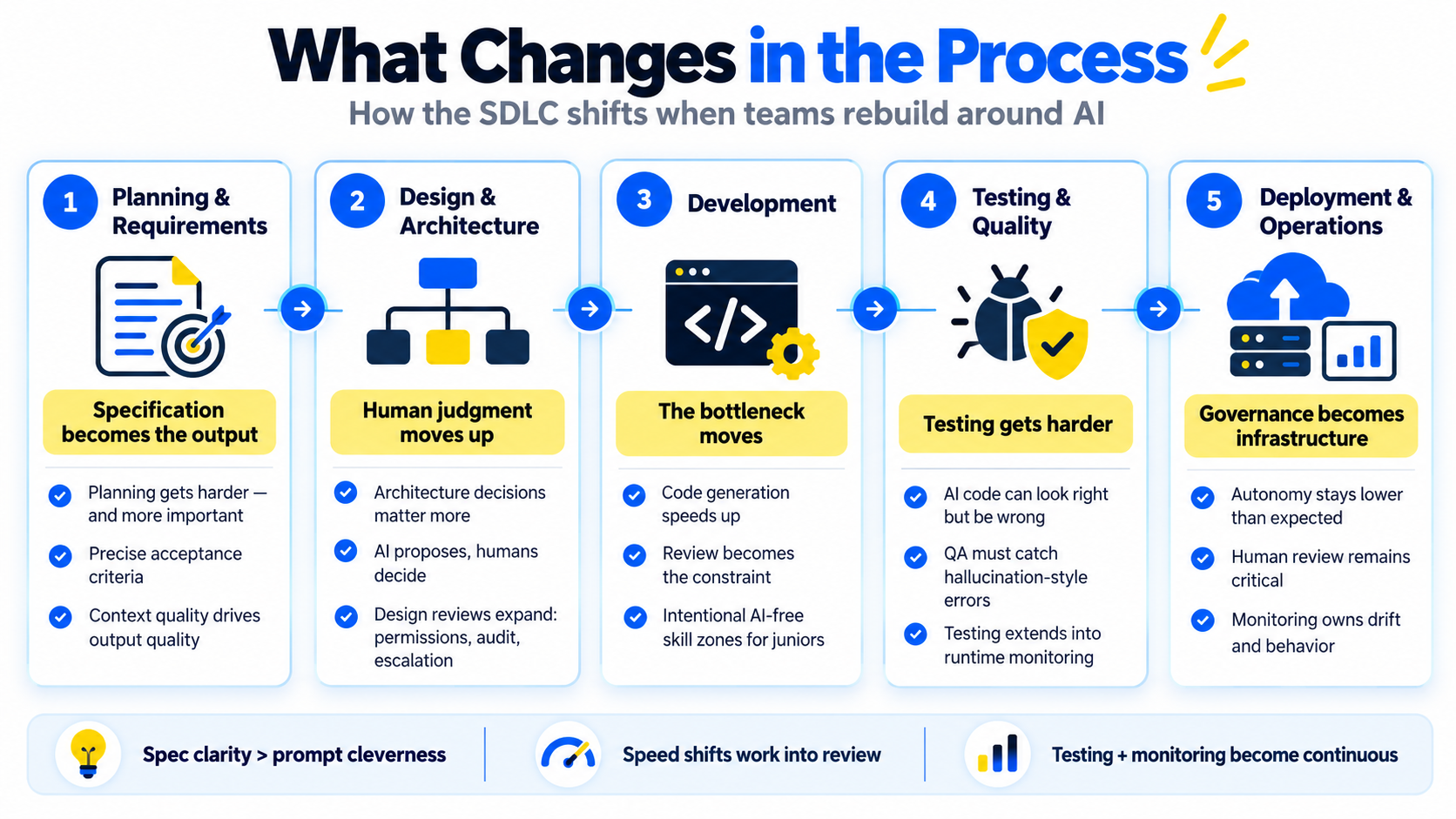
What Changes in the Process
Phase 1: Planning and Requirements — Where the Shift Starts
Specification becomes the primary engineering output
The most counterintuitive thing that happens when engineering teams adopt AI-assisted development is that planning gets harder and more important at the same time.
The assumption going in is that AI accelerates implementation — so teams can iterate faster and figure out the details as they go. What actually happens is the opposite.
AI agents producing code, tests, documentation, and architecture suggestions are only as useful as the specification they operate on. Vague requirements produce vague code. And AI-generated vague code is harder to review and debug than human-written vague code, because the author cannot explain their intent.
Teams that rebuild around AI successfully invest more time in requirements, not less. Acceptance criteria get more precise. Edge cases get documented upfront. The definition of “done” becomes a structured artifact rather than an informal agreement. LTM’s SDLC AI Radar identifies this directly: “The specification is becoming the new code — planning is the new coding.”
Context quality determines output quality
There is a direct relationship between the quality of context an AI agent receives and the quality of what it produces.
Agentic AI applied to codebases with poor documentation and inconsistent naming conventions produces proportionally poor output — syntactically plausible, structurally wrong.
Organizations that invest in codebase clarity before adopting AI-assisted development get dramatically better results. Those that adopt the tools and expect them to work around existing technical debt do not. This is one of the most consistent findings from teams that have gone through the process — and one of the least anticipated.
Phase 2: Design and Architecture — Human Judgment Moves Up
Architecture decisions become more consequential, not less
A common assumption before adopting AI development tools is that architecture decisions will become easier — that AI will propose the patterns and humans will review them.
In practice, architecture decisions become more consequential. They set the boundaries within which everything AI produces will operate.
AI agents can propose architecture patterns, identify affected services, and flag dependency risks across a codebase. What they cannot do is make judgment calls about organizational constraints, non-functional requirements, or downstream maintenance costs. Those calls require contextual knowledge that does not fit in a prompt. They also have to be made with more precision than before, because AI will faithfully implement whatever architectural direction it is given, at scale and speed.
The engineers who thrive here are the ones who can translate ambiguous business requirements into precise technical specifications. World Economic Forum research finds that developers are shifting toward “architecture, integration, and AI-enabled decision-making” — faster than most organizations’ hiring and training frameworks anticipated.
Design reviews expand in scope
Design reviews in an AI-augmented SDLC cover new territory. Beyond the traditional questions — is this the right architecture? does this meet the requirements? — teams now need to address questions that did not exist before.
What are the permission boundaries for each agent operating in this system? What decisions require deterministic logic rather than probabilistic AI output? Where are the audit checkpoints? What is the escalation path when an agent’s output falls below the confidence threshold?
These are not optional additions. They are design decisions that, if deferred, become production incidents. SmartDev’s AI workflow automation approach treats these boundaries as design primitives rather than governance add-ons applied after the fact.
Phase 3: Development — The Bottleneck Moves
Code generation is not the constraint anymore
The most visible change in the development phase is the acceleration of code generation. AI-assisted tools produce working code, unit tests, documentation, and change summaries significantly faster than developers writing from scratch. This is real and measurable.
What organizations discover quickly is that the bottleneck moves.
When code generation accelerates, review becomes the constraint. Research cited by Ciklum shows that pull request review time increased by 91% even as AI-assisted teams accelerated production velocity. More code is being produced — and reviewing it to a production standard requires more time, more expertise, and more structured criteria than reviewing code a teammate wrote.
This is the tradeoff that most pre-adoption productivity estimates miss entirely. Teams that plan for the review bottleneck — by investing in acceptance criteria, automated review tooling, and reviewer training — maintain their velocity gains. Teams that do not, hit the bottleneck and lose them.
Junior engineer development requires intentional design
One of the less-discussed consequences of AI-assisted development is the effect on junior engineers learning their craft.
When AI generates the boilerplate, the standard patterns, and the first-pass implementation, junior engineers lose the practice repetitions that build debugging intuition and architectural judgment.
The LTM SDLC AI Radar identifies “intentional AI-free skill zones” as an emerging practice — bounded tasks where AI assistance is deliberately withheld to preserve critical thinking development, particularly for engineers in their first two years. Organizations that do not design for this explicitly tend to discover the gap later. Junior engineers promoted to mid-level roles end up missing foundational judgment.
Phase 4: Testing and Quality — The Hardest Phase to Rebuild
What AI-generated code breaks in standard QA
Standard QA frameworks build on the assumption that the code author understood what they wrote.
AI-generated code has a different failure profile: syntactically clean, logically plausible at the surface level, and occasionally wrong in ways that only manifest under specific input conditions that neither the AI nor the reviewer anticipated.
Agentic AI teams consistently find that hallucination — syntactically correct but logically flawed code — can pass basic testing and reach production undetected. This is not a model quality failure. It is a testing framework failure: the tests were not designed to catch this class of error. SmartDev’s AI workflow validation framework addresses this explicitly, treating AI-generated outputs as probabilistic rather than deterministic and designing test coverage accordingly.
Testing expands downstream
Testing in an AI-augmented SDLC does not end at deployment.
Continuous monitoring, behavioral drift detection, and runtime oversight become part of what QA owns. At minimum, somebody needs to own them. The question of ownership is where most organizations struggle. QA teams built for pre-deployment testing are not always staffed or tooled for post-deployment behavioral monitoring.
The agent evaluation gap closes only when monitoring is treated as an extension of testing rather than a separate operations function. Organizations that rebuild this handoff explicitly tend to catch drift earlier and respond faster.
Phase 5: Deployment and Operations — Governance Becomes Infrastructure
Deployment autonomy is lower than teams expect
One consistent finding from organizations rebuilding their SDLC around AI: deployment autonomy is significantly lower in practice than in planning.
LTM’s research finds that approximately 73% of code changes still require human review — a significant “deployment autonomy gap” where AI capabilities exceed organizational comfort levels. This is not a technology limitation. It is a governance and trust calibration problem.
Teams have not yet established the evidence base that would justify expanding AI autonomy in specific, well-understood contexts. That evidence base includes the documented performance record, the acceptance criteria track, and the incident history. The path to higher deployment autonomy runs through more structured governance, not less. Compliance audit trail automation applied to development workflows builds exactly this evidence base.
Monitoring owns what testing used to
In a traditional SDLC, operations monitored uptime and performance. In an AI-augmented SDLC, operations also monitors behavioral consistency — whether the system is producing outputs that match the performance profile established at deployment, or whether something has changed.
AI model drift detection is not a QA activity or a data science project. It is an operational discipline that runs continuously as long as the system is in production.
Organizations that staff and tool for this from the start maintain reliable AI systems. Organizations that treat it as something to figure out later tend to discover they have a drift problem the same way they discover most production problems — through a user-facing failure.
What Changes in the Culture
Productivity Gets Redefined — and It Is Uncomfortable
The first cultural friction that emerges when a team rebuilds around AI is a conflict in productivity metrics.
Traditional metrics — lines of code written, tickets closed, velocity — spike when AI assists with code generation. But those metrics do not track review quality, output reliability, or downstream rework. A team writing twice as much code that requires 40% more review and produces 20% more production incidents is not more productive.
LTM’s research identifies the challenge directly: “the gap between perceived AI productivity and actual delivered value.” Outcome-oriented metrics — defect density, rework ratio, lead time to production — give a more accurate picture. Transitioning to those metrics requires buy-in from stakeholders who are used to the old ones. That conversation is political before it is technical.
Roles Shift Faster Than Job Descriptions
Approximately two-thirds of developers anticipate their roles will be fundamentally redefined by AI.
In practice, the skills that differentiated strong engineers — rapid implementation, deep familiarity with standard patterns, breadth of language coverage — matter less than they did. The skills that now differentiate are specification quality, system-level thinking, and evaluation judgment. Defining what “correct” means for an AI agent operating in a complex workflow matters more than it used to.
This shift is uncomfortable for engineers who built their careers on the first set of skills. Organizations that acknowledge this directly — and invest in reskilling rather than assuming it will happen organically — navigate the transition faster. Dev.to’s analysis notes that developers pioneering self-directed upskilling — hands-on experimentation rather than waiting for formal training — adapt significantly faster.
Cross-Functional AI Literacy Becomes Non-Negotiable
An SDLC rebuilt around AI requires product managers, QA leads, operations teams, and business stakeholders to have a working understanding of how AI systems behave. Not deep technical knowledge — enough to set realistic expectations, interpret output signals, and participate meaningfully in governance decisions.
Why cross-functional understanding matters
LTM’s research identifies “shared baseline AI understanding” across functions as a precondition for avoiding misalignment and unrealistic expectations. Organizations that treat AI literacy as an engineering concern consistently produce the same failure pattern: technically functional AI systems that are not trusted or used correctly by the non-engineering stakeholders they depend on.
Agentic AI rollouts require governance decisions — what requires human approval, what can proceed autonomously, what the escalation path looks like — that engineering alone cannot make. They require input from the business functions that own the workflows the agents operate in.
Governance Becomes an Engineering Outcome
The cultural shift that takes longest and matters most is the reframing of governance from a compliance activity to an engineering outcome.
In a traditional SDLC, governance lives in policy documents, review gates, and audit processes that operate alongside the development workflow. In an AI-augmented SDLC, teams embed governance directly into the system architecture — permission boundaries, confidence thresholds, audit trail production, escalation logic. It either exists by design or it does not exist at all.
Coderio’s analysis puts it directly: “Teams that define permission scopes, decision categories requiring human review, and audit requirements before scaling avoid costly rollbacks and incidents.” The organizations that treat this as a post-launch governance project consistently encounter the rollbacks and incidents that the others avoid.
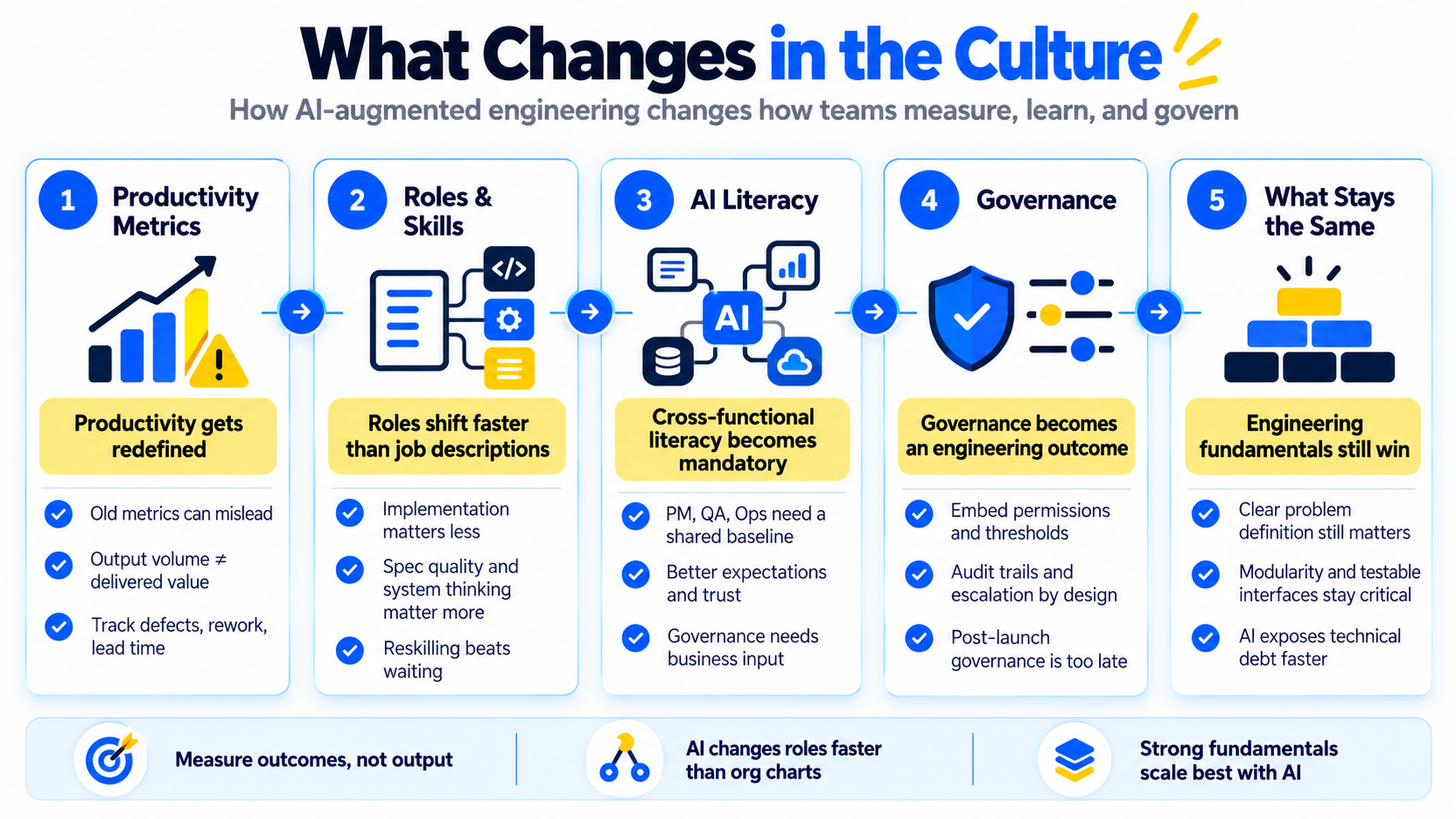
What Stays the Same (and Why That Matters)
Not everything changes.
The engineering fundamentals — clear problem definition, modular design, separation of concerns, testable interfaces — remain the foundation on which everything else runs. AI-generated code that violates these fundamentals is harder to maintain, harder to review, and harder to debug than human-written code that violates them. The AI will also produce more of it, faster.
The organizations that retain the most value from AI-assisted development are the ones that maintained engineering discipline before they adopted it. The technical debt that humans wrote at human speed becomes actively painful when AI generates code at AI speed.
Rebuilding the SDLC around AI is not a path around existing technical debt. It is a forcing function that surfaces it faster.
How NORA Supports Organizations Rebuilding Their SDLC
NORA, SmartDev’s AI Adoption Accelerator, is designed for organizations working through this transition — not as a product that replaces SDLC decisions, but as a managed deployment that builds the foundational capabilities that make AI-augmented workflows reliable.
Structuring the Data and Context Layer First
The most consistent finding from AI-augmented SDLC transitions is that context quality determines output quality.
NORA’s Foundation Data Skills — Information Extraction, Data Screening, and Unified Data Indexing — address this directly. Before any AI agent operates on an organization’s workflows, NORA structures the inputs: extracting content from unstructured sources, normalizing it against defined schemas, and indexing it in a format that agents can retrieve with precision.
This is the work that most organizations skip in their rush to deploy. It is also the work that most determines whether the agents they deploy are reliable or not. SmartDev’s pilot-to-production approach treats data readiness as a precondition for deployment, not a problem to solve afterward.
Escalation and Confidence Thresholds as Design Defaults
NORA workflows configure explicit confidence thresholds and escalation paths before any document is processed in production.
The Intelligence Skills layer produces confidence signals alongside every output. High-confidence outputs proceed through the workflow. Low-confidence outputs route to human review with the specific uncertainty documented.
This design means rising escalation rates are interpretable: they signal a change in input characteristics or a context gap — not a system failure. SmartDev’s validation framework establishes these thresholds during pre-deployment testing, so they reflect the actual performance profile of the workflow rather than guesswork.
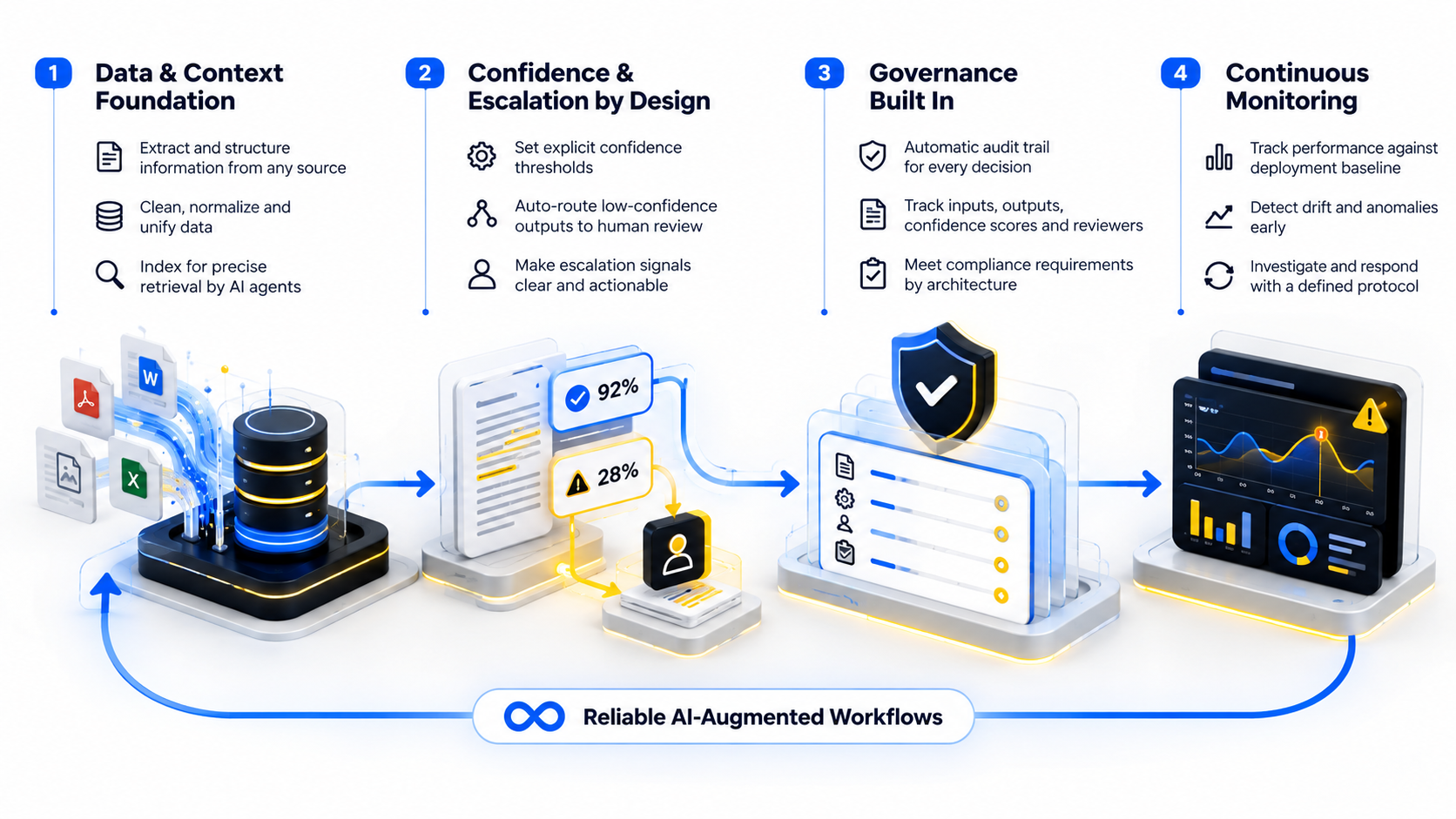
Governance Built Into the Deployment
Every NORA workflow produces an audit trail automatically — what was processed, what the confidence score was, what decision was made, whether a human reviewer was involved.
The managed service governance record maintains this trail, available for internal audit or compliance review without a separate documentation project.
For organizations operating under supply chain compliance automation requirements, ESG reporting obligations, or financial services oversight, this means the governance evidence exists continuously. Compliance audit trail requirements are satisfied by architecture, not by documentation retroactively applied to a system not designed to produce it.
Continuous Monitoring as Part of the Service
NORA’s managed service includes post-deployment monitoring against the baselines established during pre-deployment validation.
The SmartDev team tracks escalation rates, output confidence distributions, and step completion rates on a defined cadence. When a metric breaches a defined threshold, the team investigates and responds — without requiring the client to maintain their own AI operations function.
AI model drift detection runs continuously. When production performance diverges from the deployment baseline, the response follows a documented protocol rather than an ad-hoc investigation. Contact SmartDev to discuss how NORA can support your organization’s AI adoption roadmap.
Conclusion
Rebuilding an SDLC around AI changes more than the toolchain.
It changes where rigor lives — earlier and more explicitly than before. It changes who owns quality — across more functions and with more shared accountability than traditional engineering governance assumed. And it changes what “productive” means — in ways that take time to calibrate and require uncomfortable conversations about the metrics that have measured engineering performance for decades.
The organizations that navigate this well share a consistent pattern: they treat the process changes and the culture changes as equally important, they design governance into the architecture rather than adding it afterward, and they maintain engineering discipline even as AI accelerates the pace of everything around it.
The organizations that struggle tend to adopt the tools without rebuilding the system those tools run inside. The result is AI-generated code that arrives faster, costs more to review, and produces production incidents that were predictable from the design decisions made — or not made — at the start.
Explore more from SmartDev:
- The Agent Evaluation Gap: Why AI That Passes Testing Still Fails in Production
- Testing AI Workflow Automation: A Practical Validation Framework
- How Long Does Pilot-to-Production Actually Take? A Realistic Timeline
- Do You Need an AI Control Plane or Just Better AI Engineering?
- AI & Machine Learning Solutions