
TL;DR
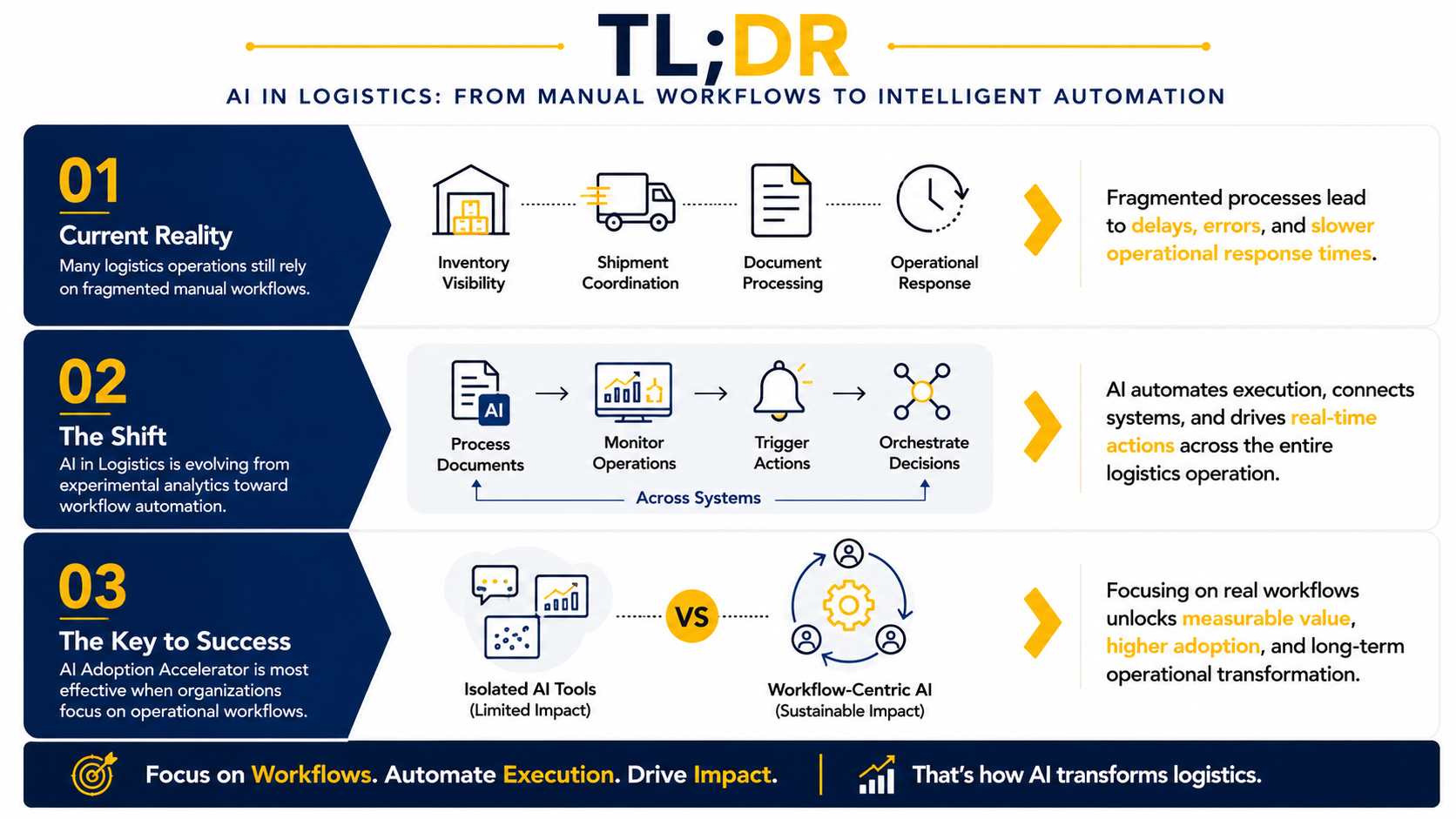
- Many logistics operations still rely on fragmented manual workflows that slow down inventory visibility, shipment coordination, document processing, and operational response times.
- AI in Logistics is shifting from experimental analytics toward workflow automation that can actively process documents, monitor operations, trigger actions, and orchestrate decisions across systems.
- AI Adoption Accelerator becomes significantly more effective when organizations focus on operational workflows instead of isolated AI tools.
Introduction
Global logistics operations are becoming increasingly complex. As supply chains expand across regions, carriers, warehouses, and fulfillment partners, operational teams are expected to process larger volumes of data while maintaining faster response times and tighter delivery windows.
At the same time, many logistics organizations still depend heavily on manual coordination across disconnected systems. Shipment updates are often managed through emails and spreadsheets. Warehouse teams manually monitor inventory conditions. Operations staff spend hours validating invoices, checking proof-of-delivery documents, and resolving exceptions between transportation systems, finance teams, and customer support functions.

This is why AI Adoption Accelerator in Logistics is a game-changer. However, the industry is no longer focusing solely on predictive analytics or experimental AI models. The real operational shift is happening through AI-powered workflow automation – systems capable of understanding operational data, automating repetitive processes, coordinating actions across platforms, and improving operational responsiveness in real time.
The Growing Operational Complexity inside Modern Logistics
Logistics has never been a simple industry, but today’s operating environment is becoming far more difficult to manage. Companies are no longer only moving goods from one point to another. They are coordinating warehouses, carriers, suppliers, customers, finance teams, compliance requirements, and digital systems at the same time. To understand why AI workflow automation is becoming essential, it is important to first look at where this complexity comes from.
1. Fragmented Systems Create Operational Blind Spots
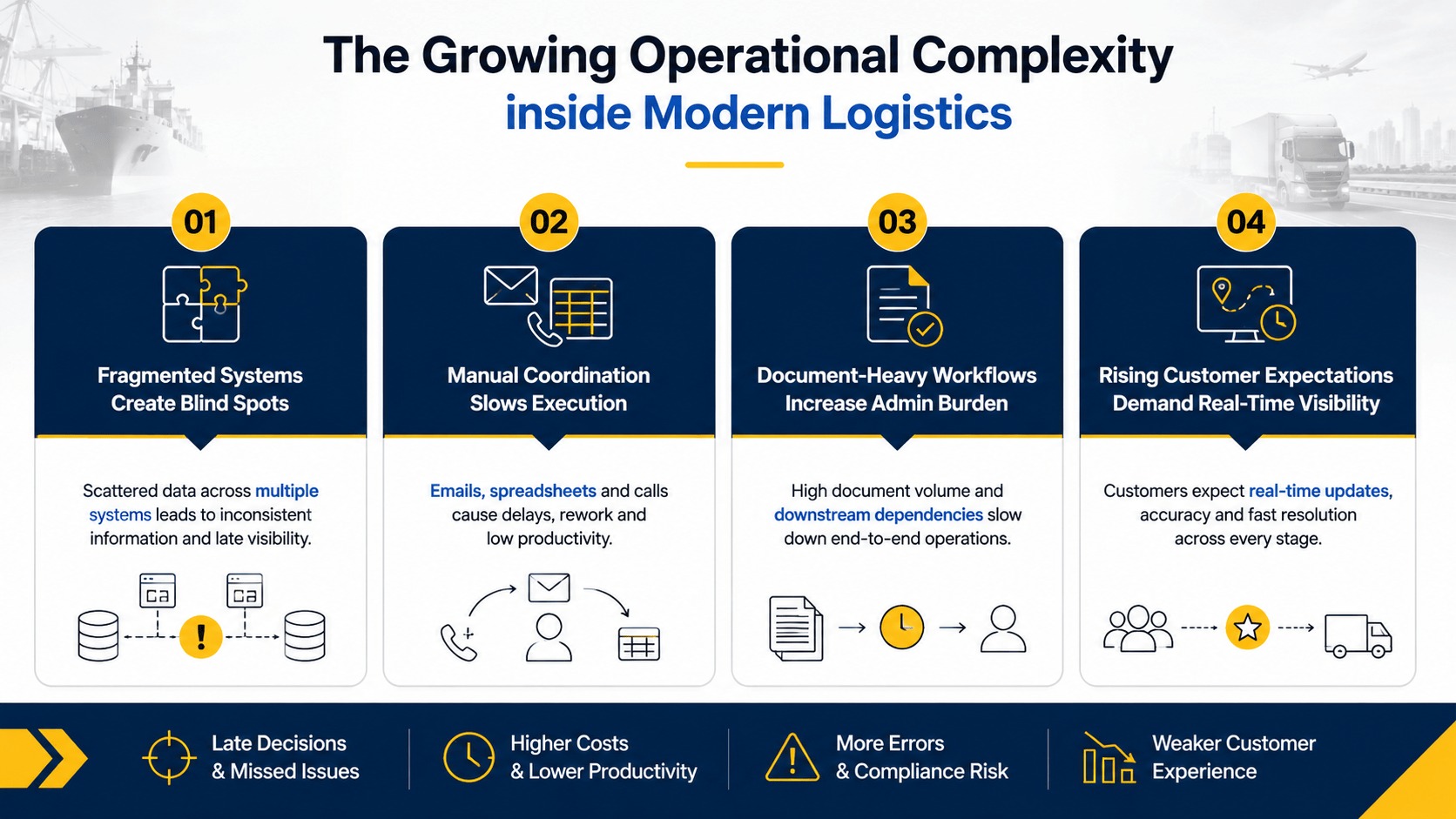
Modern logistics teams rarely operate from one unified system. Shipment data may sit in a transportation management system, inventory data in a warehouse management system, finance records in an ERP, and customer updates across email threads or ticketing platforms. Each system may work well on its own, but the overall workflow becomes fragmented when teams have to manually connect information across platforms.
This fragmentation creates operational blind spots. A delivery delay may appear in the carrier portal before the customer service team sees it. An inventory shortage may be visible in the warehouse but not reflected quickly enough in planning systems. As a result, teams react late, decisions are made with incomplete data, and small issues can escalate into larger operational disruptions.
2. Manual Coordination Slows Down Daily Execution
Logistics operations depend on fast coordination between warehouse teams, drivers, finance teams, carriers, and customer support. However, much of this coordination still happens through emails, spreadsheets, phone calls, and manual system updates. While these methods may work at a small scale, they become unreliable when delivery volumes increase.
Manual coordination creates unnecessary delays across the operation. Staff must chase updates, re-enter data, compare documents, verify delivery status, and follow up on exceptions. Over time, these repetitive tasks reduce productivity and prevent teams from focusing on higher-value work such as improving service quality, resolving strategic bottlenecks, and optimizing delivery performance.
3. Document-Heavy Workflows Increase Administrative Burden
Logistics remains a document-intensive industry. Bills of lading, proof-of-delivery records, invoices, customs forms, packing lists, and delivery confirmations all need to be collected, checked, stored, and shared across departments. When these documents are handled manually, processing becomes slow and error-prone.
The burden is not only about document volume. The bigger issue is that each document often triggers downstream actions. A proof-of-delivery file may unlock invoicing. An invoice may require matching against a purchase order. A customs document may need compliance review before goods can move forward. When document handling is delayed, entire operational workflows slow down with it.
4. Rising Customer Expectations Put Pressure on Visibility
Customers now expect logistics providers to deliver more than transportation. They expect real-time updates, accurate delivery information, fast issue resolution, and clear communication when disruptions occur. This puts pressure on logistics teams to maintain visibility across every stage of the supply chain.
Without connected systems and automated workflows, meeting these expectations becomes difficult. Customer support teams may not have immediate access to the latest delivery status, operations teams may struggle to detect problems early, and finance teams may wait for delivery confirmation before processing invoices. In this environment, visibility is no longer a nice-to-have capability. It becomes a core requirement for operational competitiveness.
Why Many AI Initiatives in Logistics Still Fail?
Despite growing interest in AI adoption, many logistics AI initiatives struggle to deliver long-term operational value. The problem is rarely that AI itself lacks potential. More often, the failure comes from how AI is planned, implemented, and managed inside real logistics environments.
Logistics operations are complex, high-volume, and deeply connected to daily execution. If AI is introduced as a standalone technology project without a clear operational purpose, it can quickly become disconnected from the workflows it was supposed to improve. This is exactly the gap that NORA – SmartDev’s AI Adoption Accelerator – is designed to solve. Rather than treating AI as a chatbot, NORA helps embed intelligent automation directly into operational workflows such as document processing, inventory monitoring, shipment coordination, and exception handling.
1. AI Projects Start Too Broad Without a Clear Workflow Focus
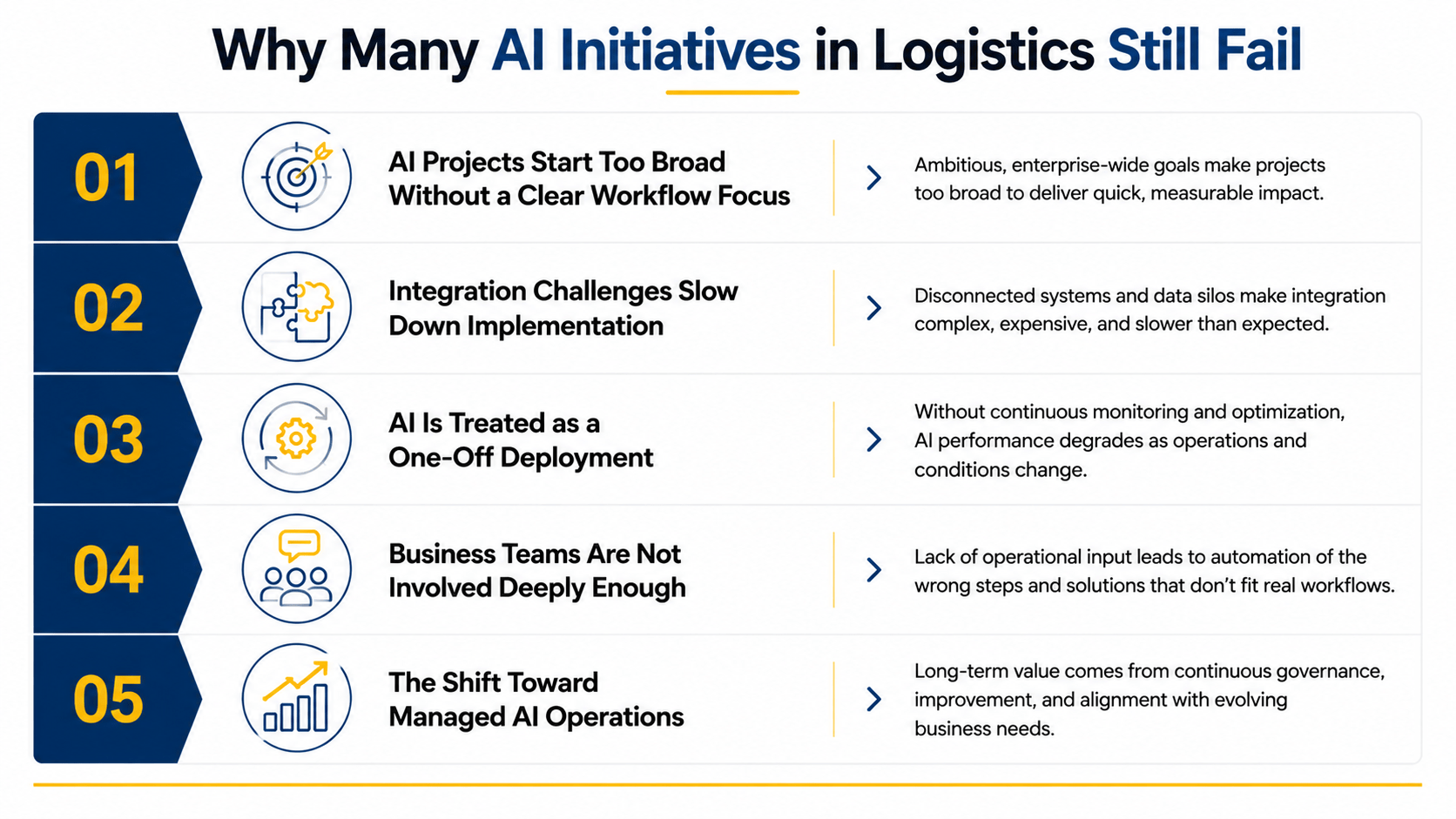
Many logistics organizations begin AI adoption with ambitious transformation goals. They may want to optimize the entire supply chain, automate all warehouse operations, improve forecasting, modernize customer communication, and reduce manual work at the same time. While ambition is understandable, this approach often makes the project too broad to deliver measurable results quickly.
AI initiatives become more effective when they start with one specific operational bottleneck. For example, automating proof-of-delivery validation, invoice matching, email triage, or inventory shortage detection gives teams a clearer success metric and a faster path to value. Without this workflow focus, AI can remain stuck in experimentation instead of becoming part of daily operations.
2. Integration Challenges Slow Down Implementation
Logistics environments are rarely clean or simple from a systems perspective. Data often sits across transportation management systems, warehouse management systems, ERP platforms, carrier portals, spreadsheets, and shared inboxes. Even when AI models perform well in isolation, they may fail to create business value if they cannot connect with the systems teams already use.
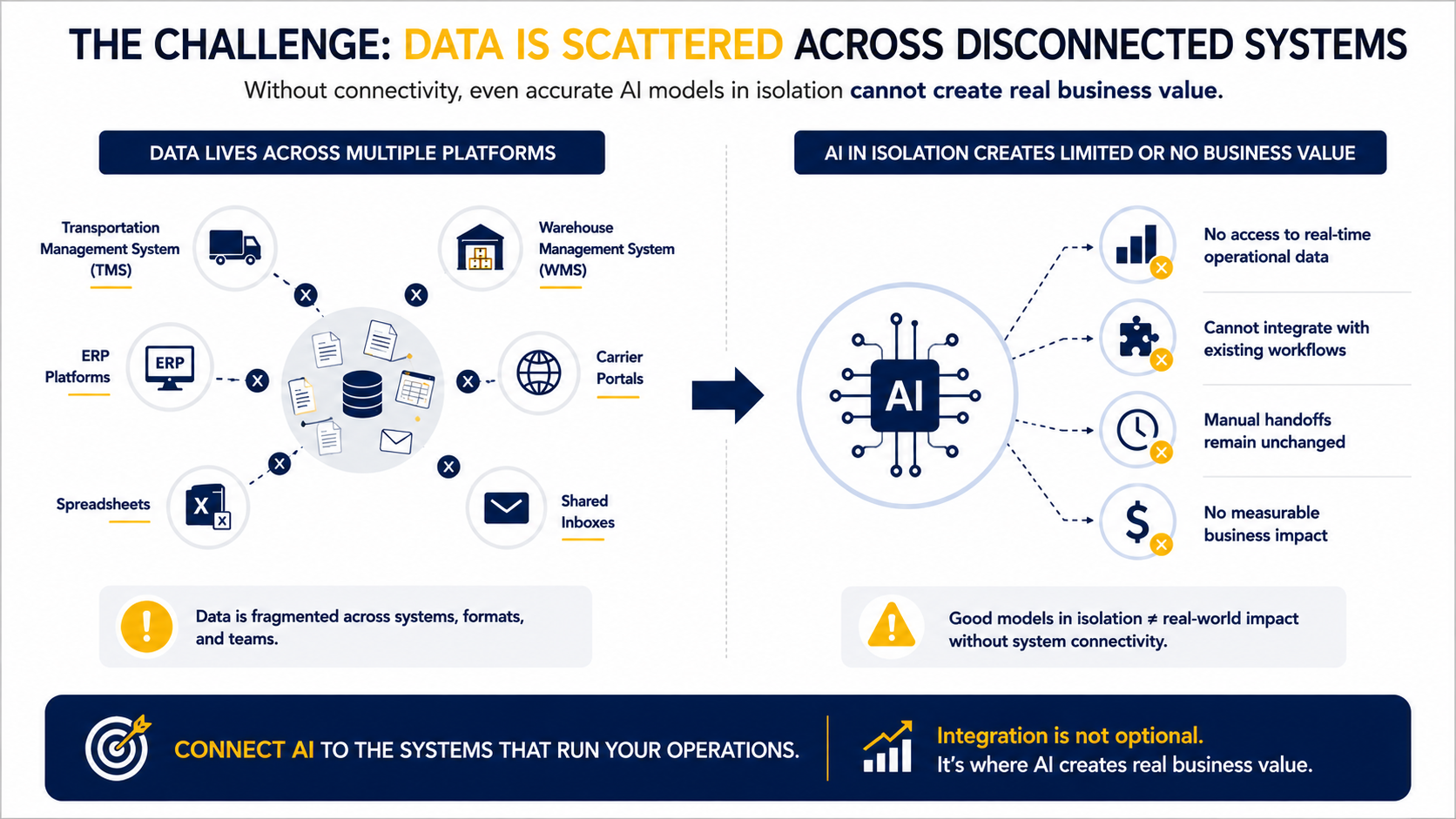
This is why many large-scale AI projects have become expensive and slow to deploy. The challenge is not only building the AI model, but also integrating it into operational workflows, data pipelines, approval processes, and exception-handling routines. When integration is underestimated, AI becomes another disconnected tool rather than an automation layer that improves execution.
3. AI Is Treated as a One-Off Deployment
Another common mistake is treating AI like traditional software that can be launched once and left alone. In logistics, operational conditions change constantly. Delivery volumes fluctuate, carrier performance shifts, inventory patterns evolve, document formats vary, and customer expectations continue to rise.
As these conditions change, AI systems need ongoing monitoring, retraining, and optimization. Without this continuous management, accuracy can degrade, false positives can accumulate, and operational teams may gradually lose trust in the system. For high-volume logistics operations, unmanaged AI can quickly shift from a productivity driver to an operational risk.
4. Business Teams Are Not Involved Deeply Enough
AI projects often fail when they are driven mainly by technology teams without enough input from the people who run daily logistics operations. Warehouse managers, finance teams, customer service teams, and operations staff understand where delays actually happen and which tasks consume the most time. They also know which steps require human judgment, which exceptions occur frequently, and which operational issues are difficult to capture through system data alone.
Without their involvement, AI systems may automate the wrong steps, miss important exceptions, or create workflows that do not match real operational behavior. Successful AI adoption requires both technical capability and operational knowledge. The best solutions are built around how teams actually work, not how workflows appear on a process diagram. In practice, this means business teams should be involved from problem definition and use case selection to testing, feedback, and continuous improvement.
5. The Shift Toward Managed AI Operations
These challenges explain why logistics companies are increasingly moving away from one-off AI deployments and toward managed AI operational models. AI needs to be implemented, monitored, improved, and governed continuously if it is expected to support real business workflows. A model that performs well during initial testing may become less reliable over time as data quality, shipment patterns, customer requirements, and regulatory conditions change.
For logistics organizations, this shift is especially important. When AI is embedded into document processing, inventory monitoring, shipment coordination, or compliance workflows, its performance directly affects operational speed and reliability. Long-term value comes not only from launching AI, but from keeping it accurate, useful, and aligned with changing business conditions. This is why managed AI operations are becoming essential for turning AI from a short-term experiment into a dependable part of logistics performance.
The Strategic Shift from Digital Logistics to Intelligent Workflow Automation
Logistics operations depend on a constant flow of documents, and each document often carries operational consequences. Invoices, proof-of-delivery records, shipping documents, customs forms, purchase orders, and logistics reports are not just administrative files. They determine whether goods can move, invoices can be approved, disputes can be resolved, and compliance requirements can be met.
In many logistics teams, these documents still require manual checking across emails, PDFs, spreadsheets, ERP systems, and customer records. This creates a slow and error-prone workflow where employees spend hours extracting data, validating fields, searching for missing information, and forwarding records to the right department. The larger the delivery volume, the more these small administrative tasks accumulate into serious operational bottlenecks.
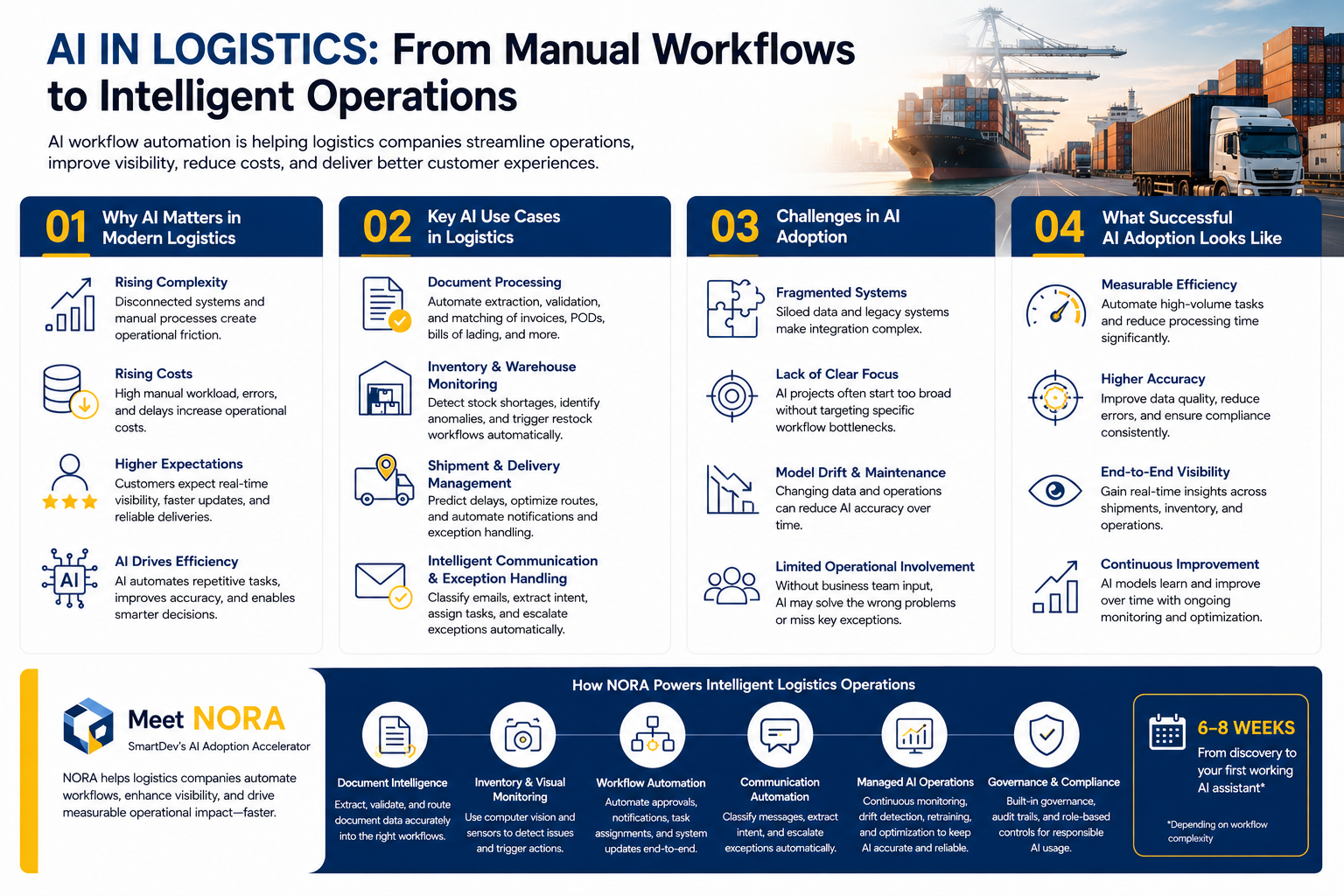
As an AI Workflow Automation, NORA helps automate this document layer by reading, extracting, validating, and routing operational information directly into the relevant workflow. Instead of relying on employees to manually compare every invoice, POD file, or shipping document, NORA can support a chain of activities with human-on-the-loop setting.
1. Improving Warehouse Visibility Through Intelligent Monitoring
Warehouse operations depend heavily on timely visibility. A stock shortage, misplaced item, incorrect inventory count, or delayed restocking action may seem small at first, but it can quickly affect fulfillment planning, delivery schedules, customer communication, and revenue recognition. The challenge is that many warehouses still rely on a mix of manual checks, delayed system updates, and reactive communication to identify operational issues.
Traditional monitoring tools may show what is happening, but they do not always trigger action. A dashboard can display inventory levels, and a camera can capture warehouse conditions, but employees still need to interpret the information, report the issue, create a ticket, and coordinate the next step. This creates a gap between visibility and execution.
NORA helps close this gap by connecting intelligent monitoring with workflow automation. Through computer vision and inventory monitoring workflows, NORA can support warehouse teams by turning operational signals into automated actions, including:
- Detecting empty shelves or visible stock shortages
- Identifying inventory anomalies from warehouse monitoring inputs
- Triggering alerts when predefined conditions are met
- Creating restock tickets in existing operational systems
- Escalating exceptions to the right team for review
2. Coordinating Communication and Exception Handling
Communication is one of the most underestimated sources of friction in logistics operations. Delivery exceptions, shipment updates, carrier emails, customer inquiries, internal escalations, and billing questions often flow through shared inboxes, chat groups, ticketing systems, and manual follow-up processes. When the volume grows, teams can easily lose time deciding what needs attention, who should handle it, and what action should happen next.
NORA in Logistics can automate this communication layer by reading incoming operational messages, identifying intent, extracting action items, and routing requests to the right workflow. It can classify carrier emails and customer requests, identify shipment references or missing information, assign tasks to the right team, draft routine responses, and escalate urgent exceptions based on predefined business rules. This helps logistics organizations move from reactive coordination to structured execution.
Instead of depending on people to manually read, interpret, forward, and follow up on every message, NORA acts as a workflow layer that keeps information moving across departments with greater consistency and speed.
3. Supporting Long-Term AI Operations, Not Just One-Time Deployment
A model that worked well during deployment may become less accurate as new document formats appear or operational data patterns shift. Over time, teams may begin to lose trust in the system, especially if it creates too many false positives, misses important exceptions, or requires more manual correction than expected.
NORA is designed around operational continuity rather than one-time implementation. Its managed AI service layer helps ensure that automation remains useful, accurate, and aligned with changing business conditions through capabilities such as:
- Continuous monitoring of AI performance
- Drift detection as data and workflows change
- Retraining when accuracy begins to decline
- Operational optimization to improve workflow efficiency
- Governance management for responsible AI usage
- Compliance-ready audit trails for traceability
According to SmartDev’s implementation model, organizations can typically move from discovery to a first working AI assistant within approximately 6–8 weeks, depending on workflow complexity. This makes NORA a practical path for logistics companies that want measurable automation outcomes without the long timelines, high costs, and operational risks of traditional AI transformation programs.
Conclusion
AI in logistics is evolving from experimental innovation into operational necessity. As supply chains become more complex and operational expectations continue rising, logistics organizations are under growing pressure to reduce manual coordination, improve visibility, accelerate workflows, and respond faster to operational disruptions.
However, long-term AI success depends less on deploying isolated AI tools and more on building intelligent operational workflows capable of integrating seamlessly across real business environments.
This is where AI-powered workflow automation platforms like NORA create measurable operational value. By combining document intelligence, workflow orchestration, inventory monitoring, operational automation, and managed AI governance into a unified framework, NORA helps logistics organizations accelerate AI adoption without the complexity and risk associated with traditional large-scale transformation programs.
If your organization is exploring how AI can reduce operational friction and modernize logistics workflows, connect with SmartDev to explore how NORA can support your AI transformation journey.