
Introduction
The rapid growth of digital banking, fintech platforms, and online insurance services has significantly transformed the banking, financial services, and insurance (BFSI) industry. Customers now expect seamless digital experiences through mobile banking apps, web portals, and integrated financial platforms that allow them to manage accounts, perform transactions, and access financial services anytime.
As financial institutions accelerate digital transformation, ensuring the reliability, security, and performance of these applications has become a critical priority. This is where BFSI app testing plays a vital role. By validating the functionality, security, and scalability of financial applications, testing ensures that digital financial services operate smoothly while protecting sensitive user data.
However, testing BFSI applications is far more complex than traditional software testing. Financial platforms must handle high transaction volumes, integrate with multiple backend systems, and comply with strict regulatory requirements. Any system failure can disrupt financial operations, cause financial loss, or damage customer trust. As a result, organizations must adopt advanced QA strategies that combine automation testing, security validation, performance testing, and compliance verification. This guide explores the key principles of BFSI app testing, the challenges of testing mobile and web financial applications, and the best practices organizations can use to deliver secure, high quality digital financial services.
 Understanding BFSI App Testing in Modern Financial Ecosystems
What Is BFSI App Testing
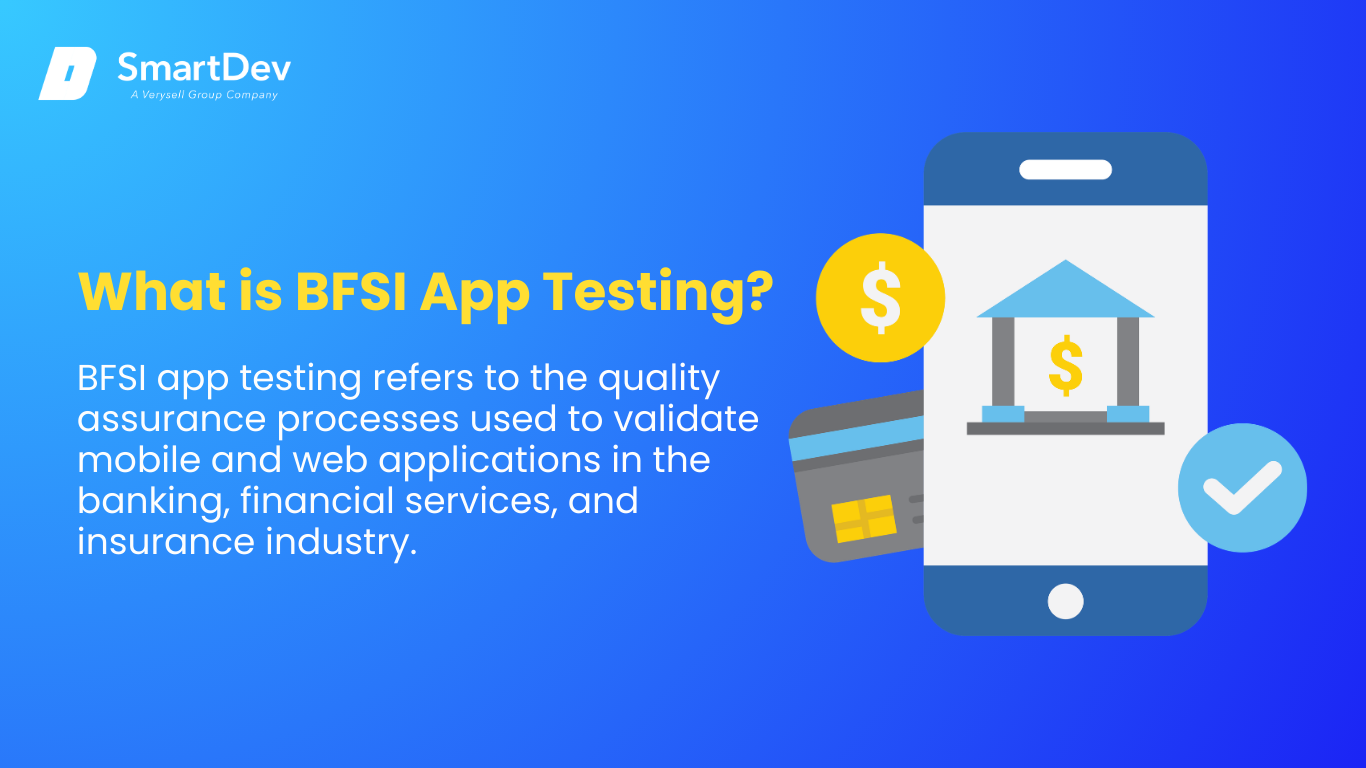 BFSI app testing refers to the quality assurance processes used to validate mobile and web applications in the banking, financial services, and insurance industry. These applications handle sensitive operations such as digital payments, account management, lending services, and insurance transactions. Because they directly process financial data and customer information, any system failure or security vulnerability can cause serious financial losses and damage customer trust.
BFSI app testing ensures that these applications function correctly, maintain data accuracy, and deliver a secure user experience. Organizations often rely on specialized testing strategies and frameworks described in modern BFSI testing methodologies and best practices to maintain system reliability.
Testing strategies usually combine functional testing, security assessments, automation testing, and performance validation. Many financial institutions are increasingly adopting automation testing in BFSI to scale quality assurance and accelerate release cycles. The goal is to ensure financial applications remain stable while supporting millions of users and complex financial operations.
The Architecture of Modern BFSI Applications
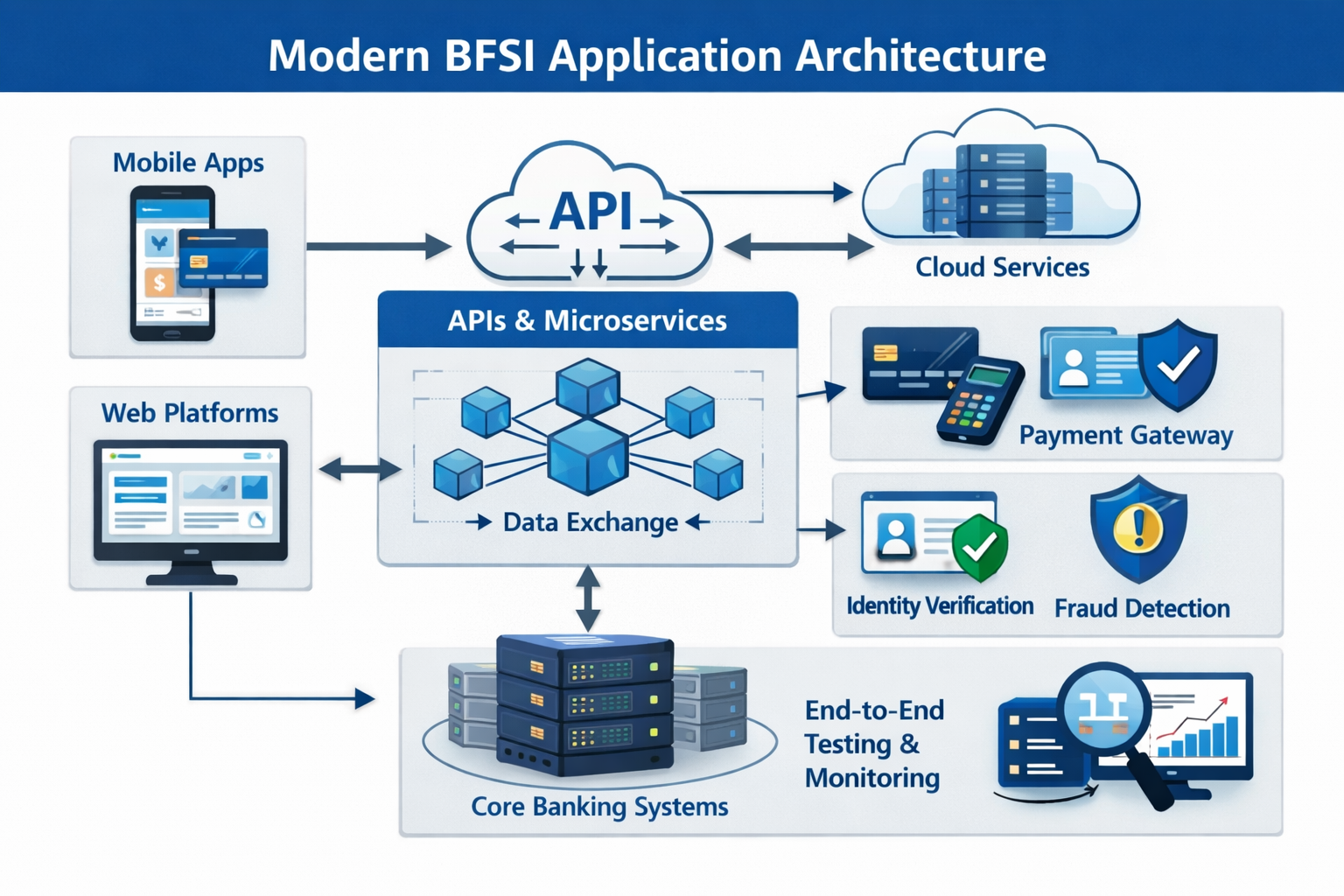 Modern BFSI applications are built using complex digital architectures that combine mobile apps, web platforms, backend banking systems, and cloud services. Financial institutions increasingly adopt microservices architectures to enable faster development and flexible scaling. These systems rely heavily on APIs to connect internal systems with external services such as payment gateways, identity verification platforms, and fraud detection tools. This interconnected ecosystem requires comprehensive QA processes similar to those used in modern mobile app quality assurance practices.
For example, an API failure may interrupt payment processing or prevent users from accessing account information. BFSI app testing must therefore validate both individual application components and the interactions between integrated services. Effective QA strategies often include end to end testing, integration validation, and platform monitoring to ensure seamless communication between services.
Testing strategies must simulate real world transaction scenarios, including high user volumes and peak financial activities. By evaluating the entire application architecture, QA teams can identify bottlenecks, integration failures, and data processing issues before they affect real users.
Why Financial Software Requires Specialized QA
Financial software requires specialized quality assurance because it operates in a high risk environment where errors can have immediate financial consequences. Unlike many consumer applications, BFSI platforms handle real money transactions and sensitive financial data. A single defect in payment processing or transaction validation can result in incorrect balances, failed transfers, or fraudulent activities. This is why organizations often partner with experienced providers when selecting a BFSI testing company to ensure financial systems meet strict quality requirements.
Security is another major reason why BFSI applications require advanced QA practices. Financial systems are frequent targets of cyberattacks, including data breaches, account takeover attempts, and payment fraud. In addition, BFSI platforms must deliver consistent reliability. Users expect digital banking services to work at any time without interruption. Specialized QA helps ensure financial applications remain stable even during high traffic events such as payroll processing, stock trading peaks, or promotional campaigns.
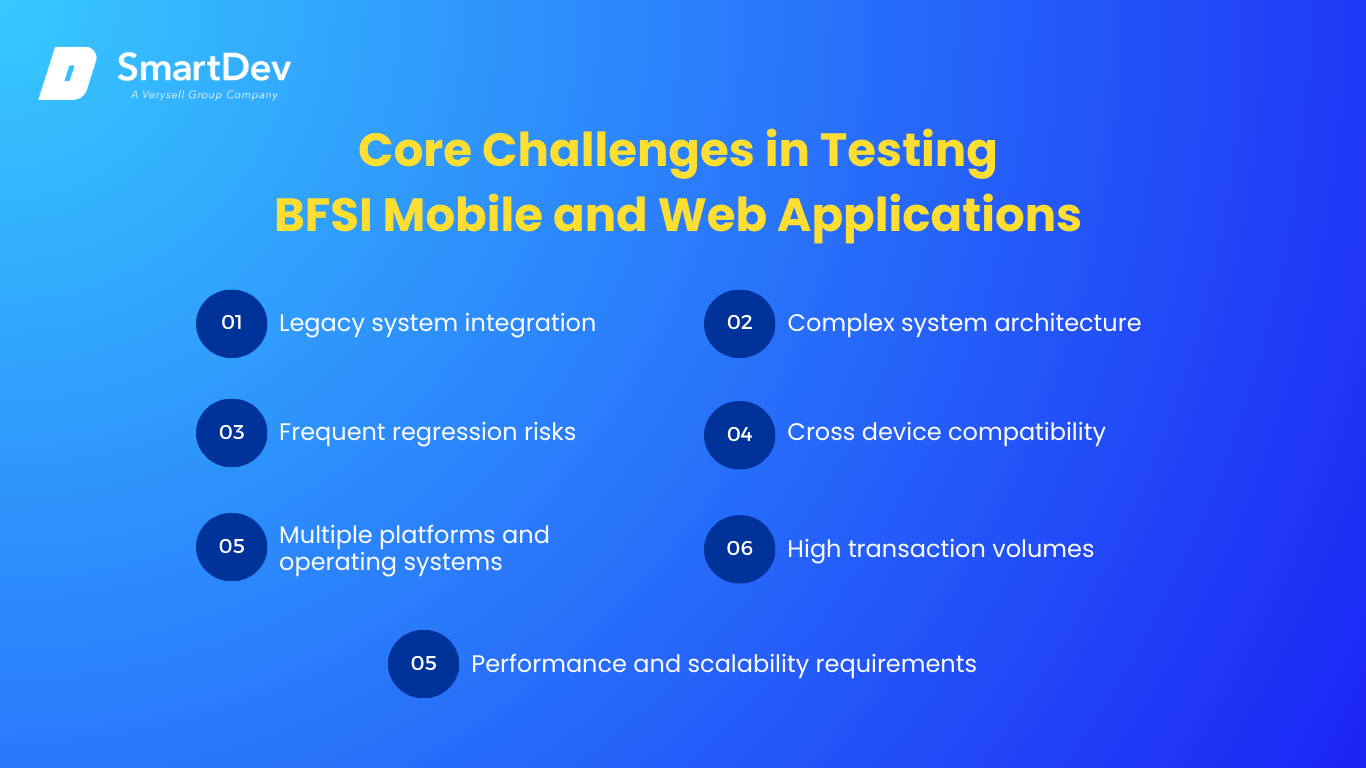
Core Challenges in Testing BFSI Mobile and Web Applications
-
Legacy system integration
Many financial platforms still rely on legacy banking systems that were not designed for modern mobile and cloud environments. -
Complex system architecture
BFSI applications often include APIs, microservices, and third party services that must interact reliably. -
Frequent regression risks
Updates to one module can affect other integrated systems, requiring continuous regression testing. -
Cross device compatibility
Mobile banking apps must work consistently across different devices, screen sizes, and hardware configurations. -
Multiple platforms and operating systems
Applications must be tested across Android, iOS, and various web browsers to ensure consistent functionality. -
High transaction volumes
Financial systems must handle large numbers of transactions simultaneously without delays or failures. -
Performance and scalability requirements
Platforms must remain stable during peak usage periods such as payroll processing or trading spikes.
 Legacy system integration
Key Compliance Requirements in BFSI Software Testing
Compliance plays a critical role in BFSI app testing because financial institutions operate under strict regulatory frameworks. Regulations such as PCI DSS, GDPR, and regional banking standards require organizations to protect financial data, maintain transaction transparency, and ensure secure digital operations. QA teams must validate that applications meet these regulatory requirements before they are released to production.
Testing for compliance includes validating encryption protocols, secure authentication methods, and data protection mechanisms. Financial institutions must also maintain detailed audit trails to track transactions and detect suspicious activities. QA teams therefore need to ensure that logging systems, monitoring tools, and reporting mechanisms function correctly.
By integrating compliance testing into the development lifecycle, organizations can reduce regulatory risks and avoid costly penalties. Proper BFSI app testing helps financial institutions maintain regulatory alignment while delivering secure and reliable digital financial services.
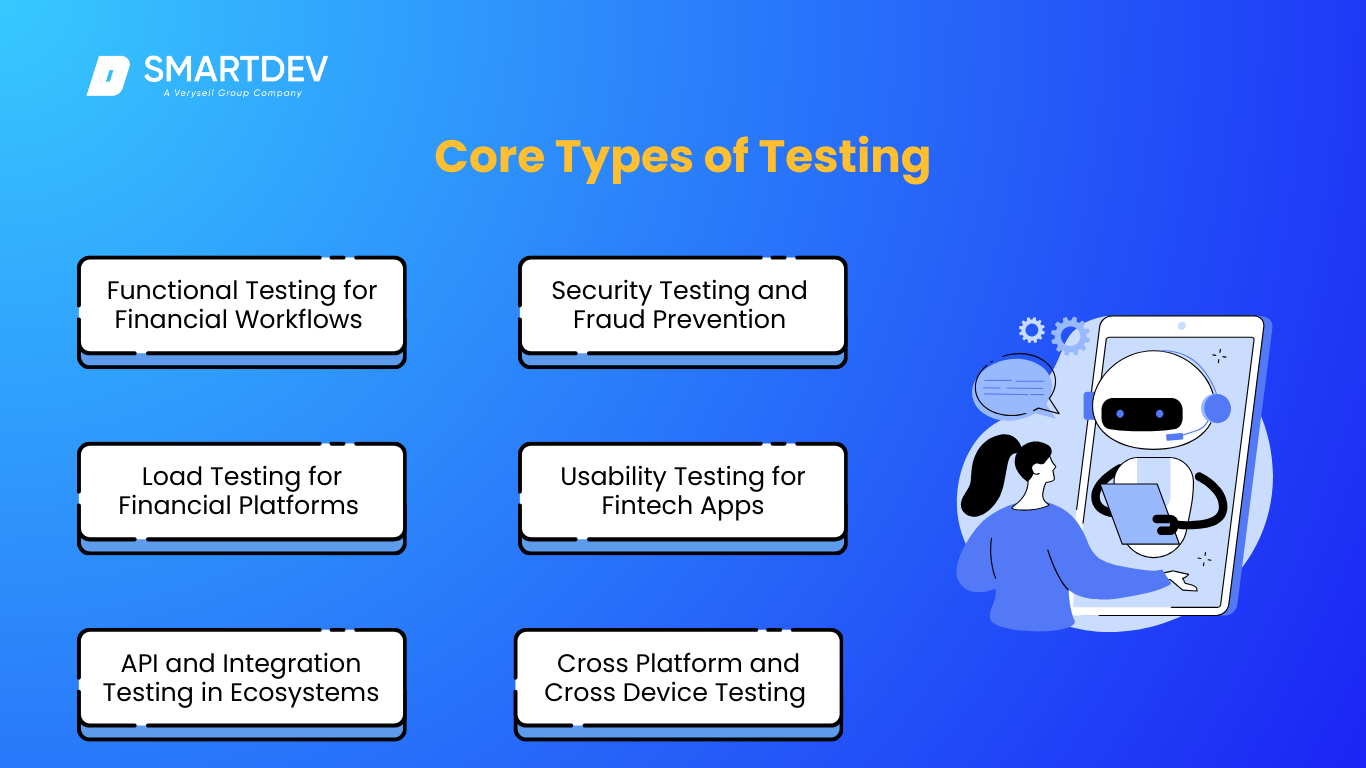
Core Types of Testing for BFSI Mobile and Web Applications
1. Functional Testing for Financial Workflows
 1. Functional Testing for Financial Workflows
Functional testing is one of the most critical components of BFSI app testing because financial applications must execute transactions accurately and consistently. This testing type verifies that every feature in the application behaves according to the defined business requirements. For BFSI platforms, this includes validating essential workflows such as account creation, fund transfers, payment processing, loan applications, insurance claims, and transaction history tracking.
Testing teams simulate real user scenarios to ensure each step in the financial workflow functions correctly. For example, a test case may verify whether a user can initiate a transfer, authenticate the transaction, and receive confirmation without errors. Functional testing also ensures that financial calculations, interest rates, transaction limits, and balance updates are processed accurately. As financial systems grow more complex, organizations often follow structured testing frameworks described in software testing methodologies and best practices for BFSI to ensure reliable functionality across the entire platform.
2. Security Testing and Fraud Prevention
Security testing plays a central role in BFSI app testing because financial platforms are frequent targets for cyberattacks. Banking and fintech applications store highly sensitive information including account details, personal identity data, and transaction records. Any vulnerability in the application could expose users to fraud, identity theft, or unauthorized access.
Security testing aims to identify potential vulnerabilities before attackers can exploit them. This includes penetration testing, authentication validation, data encryption verification, and access control testing. QA teams also evaluate whether the system properly handles session management, multi factor authentication, and secure data transmission. As financial services increasingly move online, many organizations integrate advanced testing strategies such as automation testing in BFSI to continuously monitor security risks and detect potential threats earlier in the development cycle.
3. Performance and Load Testing for Financial Platforms
Financial applications must support thousands or even millions of concurrent users while maintaining fast response times. Performance testing evaluates how well the application performs under different workloads and system conditions. In BFSI environments, even a short delay in transaction processing can negatively impact customer experience and operational efficiency.
Load testing simulates heavy user activity to determine whether the system can maintain stability during peak usage periods. Performance testing also measures key metrics such as system response time, throughput, and server resource utilization. Implementing comprehensive performance testing strategies helps organizations ensure their financial platforms remain scalable and reliable.
4. Usability Testing for Mobile Banking and Fintech Apps
 4. Usability Testing for Mobile Banking and Fintech Apps
Usability testing focuses on evaluating how easily users can interact with financial applications. With the growing adoption of mobile banking and fintech services, customers expect intuitive interfaces and seamless navigation across mobile and web platforms. A poorly designed interface can lead to user frustration, transaction errors, or abandoned financial processes.
During usability testing, QA teams observe how real users interact with the application to identify potential design issues. Testers evaluate navigation flows, accessibility features, transaction steps, and visual clarity across devices. Research on mobile application quality assurance practices highlights how improving usability directly enhances customer satisfaction and application adoption in digital banking environments.
5. API and Integration Testing in Financial Ecosystems
Modern BFSI applications rely heavily on APIs to connect with external services and internal financial systems. These integrations enable functionalities such as payment processing, credit verification, fraud detection, and third party financial services. API testing ensures that data exchanges between these systems occur accurately and securely.
Integration testing verifies whether different components of the financial ecosystem communicate correctly. Test cases may involve validating payment gateway responses, checking account data synchronization, or confirming that transaction data flows correctly between backend systems. Because BFSI platforms depend on multiple interconnected services, effective integration testing helps prevent system failures caused by broken APIs or incorrect data mapping.
6. Cross Platform and Cross Device Testing
Financial applications must deliver consistent experiences across multiple devices, operating systems, and browsers. Customers may access their banking services through smartphones, tablets, desktops, or web browsers. Cross platform testing ensures that the application functions properly regardless of the device or environment used.
QA teams test the application across different mobile operating systems, browser versions, screen sizes, and network conditions. This process helps identify compatibility issues that may affect performance or user experience. According to insights from mobile QA testing best practices, thorough cross device testing significantly improves application reliability and ensures that financial services remain accessible to a diverse range of users.
Core Testing Layers for BFSI Applications
1. Functional Testing for Financial Workflows
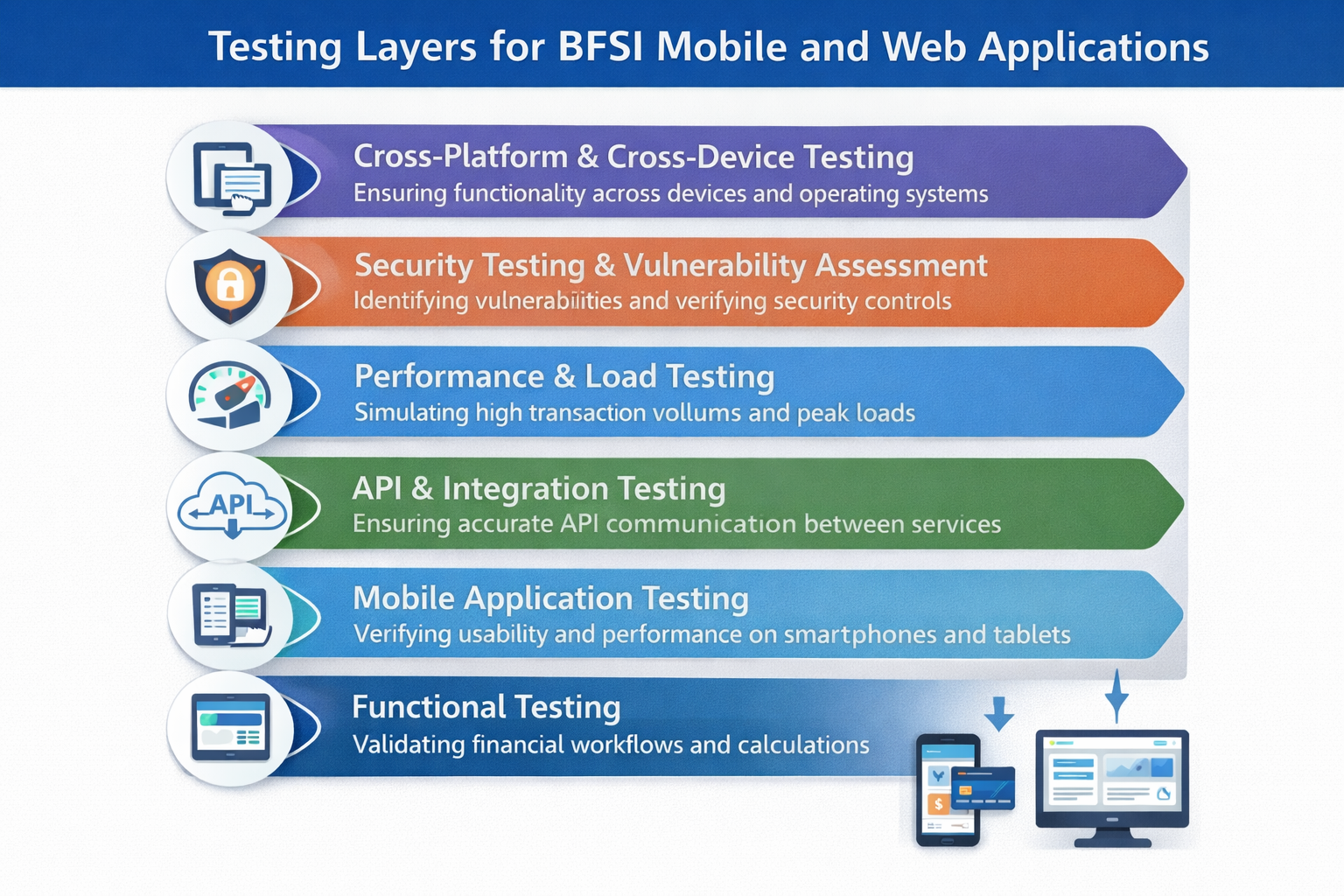 1. Functional Testing for Financial Workflows
Functional testing is a foundational layer in BFSI app testing because financial platforms rely on highly accurate business logic and transaction processing. Every function in a banking or fintech application must operate exactly as intended. This includes validating processes such as fund transfers, loan applications, payment processing, account updates, and transaction history tracking.
Testing teams simulate real user workflows to ensure that all financial operations work correctly across both mobile and web applications. For example, testers validate that a user can log in securely, initiate a transaction, confirm payment authentication, and receive the correct transaction record.
Functional testing also verifies financial calculations, including interest rates, transaction fees, and balance updates. Following structured QA frameworks such as those described in software testing methodologies and best practices for BFSI helps organizations improve defect detection early in development and maintain consistent application performance.
2. Security Testing and Vulnerability Assessment
Security testing is one of the most critical layers in BFSI app testing because financial platforms are frequent targets of cyber threats. Banking and fintech applications store highly sensitive information including account credentials, identity data, and financial transaction records. According to cybersecurity studies, financial services remain one of the most targeted industries globally, which makes security validation essential for maintaining customer trust.
Security testing evaluates authentication systems, encryption protocols, and access control mechanisms. QA teams perform vulnerability assessments, penetration testing, and secure data transmission checks to identify potential risks. Automation has also become an important component of security testing because it allows organizations to run continuous security validation across large financial systems. The adoption of intelligent automation tools helps accelerate testing cycles and improve system reliability, as discussed in automation testing in BFSI: accelerating quality at scale.
3. Performance and Load Testing for High Transaction Systems
Performance testing ensures that financial platforms can maintain stability and speed even under heavy workloads. BFSI applications frequently process thousands of transactions simultaneously, especially during peak periods such as payroll processing or high trading activity. Load testing simulates these real world scenarios to evaluate how systems behave under pressure.
Performance metrics typically include response time, system throughput, and resource utilization. Poor performance can quickly drive users away from financial applications. Research shows that 53 percent of mobile users abandon applications that take longer than three seconds to load, according to findings referenced in mobile app quality assurance research. This makes performance optimization a critical priority for financial institutions that depend on digital channels to deliver services.
4. API and Integration Testing in Financial Platforms
Modern financial ecosystems depend heavily on APIs to enable communication between internal banking systems and external services. APIs allow BFSI applications to integrate with payment gateways, fraud detection systems, identity verification services, and third party financial platforms. As digital banking expands, the number of integrated services within financial ecosystems continues to grow.
API testing validates that data exchanges between systems occur accurately and securely. QA teams verify API endpoints, response formats, authentication mechanisms, and data integrity across different services. Integration testing ensures that transactions flow correctly between systems and that financial data remains consistent across platforms. Effective API testing helps prevent system failures that could interrupt payment processing or disrupt financial operations.
5. Mobile Application Testing for Banking and Fintech
Mobile application testing ensures that banking and fintech apps function reliably across smartphones and tablets. With the rapid growth of digital banking adoption, mobile apps have become the primary channel for financial services in many regions. Customers now rely on mobile platforms to perform daily financial activities such as payments, transfers, and investment monitoring.
Testing teams must evaluate usability, performance, and security across a wide range of mobile devices. Quality assurance is essential because mobile environments vary widely in terms of device specifications, operating systems, and network conditions. Research indicates that improving app stability and usability can significantly increase customer retention and engagement, which is why organizations invest heavily in mobile QA practices like those discussed in five quick reasons to perform quality assurance on mobile applications.
6. Cross Platform and Cross Device Testing
Cross platform testing ensures that BFSI applications provide a consistent experience across multiple devices and operating systems. Users may access financial services through Android smartphones, iOS devices, web browsers, or tablets. Each platform introduces different technical requirements that must be validated through testing.
QA teams perform compatibility testing across various browsers, screen sizes, operating systems, and network conditions. This process helps identify platform specific bugs, performance issues, and interface inconsistencies before they impact users. Emerging technologies such as AI assisted testing are also improving the efficiency of cross platform validation. For example, AI powered QA solutions can reduce overall testing time by up to 50 percent, as highlighted in AI assisted QA reducing testing time by 50 percent.
By combining functional testing, security validation, performance analysis, and compatibility testing, BFSI organizations can maintain reliable digital platforms that support millions of users while ensuring secure and seamless financial services.
Explore how SmartDev partners with BFSI teams through a focused AI sprint to validate use cases, align stakeholders, and define a clear path forward before AI development begins.
SmartDev helps BFSI organizations clarify AI use cases and assess feasibility, enabling confident decisions and reducing risks before committing to AI development.
Learn how SmartDev accelerates AI initiatives, ensuring rapid deployment and reduced time to market.
Strengthen Your BFSI Security Testing with UsAutomation Testing in BFSI: Scaling Quality at Enterprise Level
As BFSI platforms grow more complex, relying solely on manual testing is no longer sufficient. Financial applications must support high transaction volumes, strict security requirements, and frequent feature updates across mobile and web platforms.
For CTOs and engineering leaders, test automation has become a strategic capability that enables faster releases while maintaining system reliability. By integrating automation into the QA lifecycle, development teams can continuously validate critical financial workflows and detect defects earlier in the development process.
Why Manual Testing Alone Cannot Support Modern BFSI Systems
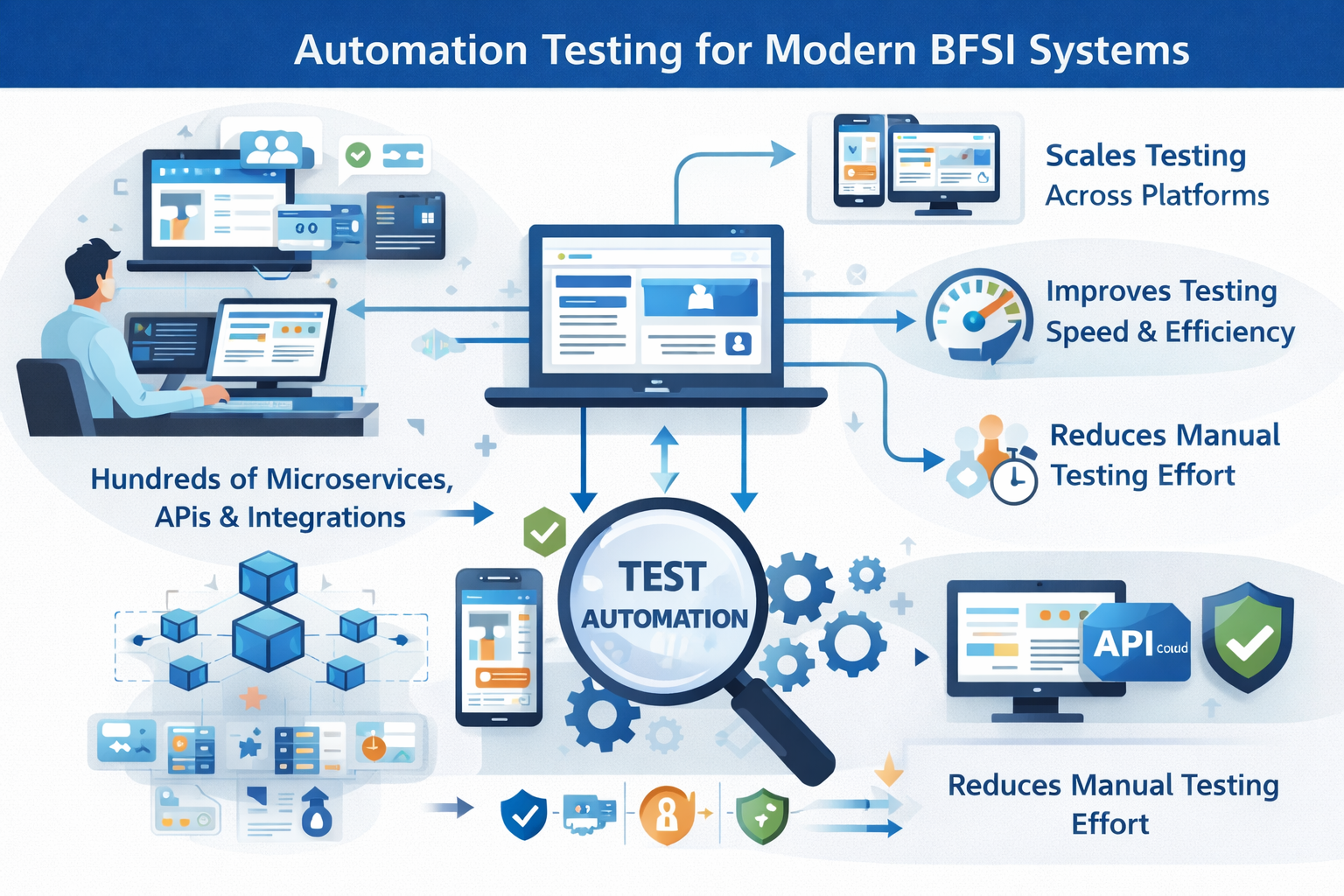 Why Manual Testing Alone Cannot Support Modern BFSI Systems
Manual testing remains useful for exploratory and usability testing, but it cannot scale to meet the demands of modern BFSI systems. Financial platforms often include hundreds of microservices, APIs, and integrations with external systems such as payment gateways and identity verification services. Testing all these components manually would require significant time and resources.
For engineering teams managing frequent releases, manual testing also slows down development cycles. Each new feature or update may introduce changes across multiple system layers. Automated test suites allow teams to validate core functionalities quickly and repeatedly without human intervention. This scalability is why many financial institutions adopt automation strategies such as those discussed in automation testing in BFSI to maintain quality while accelerating development.
Building Test Automation Frameworks for Financial Applications
A robust automation framework is essential for implementing scalable BFSI app testing. For CTOs and technical teams, the framework must support modular testing, reusable test scripts, and integration with development pipelines. Common frameworks combine tools for UI testing, API testing, and performance validation.
Test automation frameworks typically include components such as test case libraries, automated regression testing suites, reporting dashboards, and environment configuration tools. Modular architecture allows testing teams to reuse test scripts across multiple applications or services, which significantly reduces maintenance effort.
In BFSI environments, automation frameworks must also support secure data handling and compliance validation. Integrating automated security checks and financial transaction validation ensures that critical system components are continuously monitored throughout development.
Automation Testing for Mobile and Web Applications
Financial services increasingly rely on both mobile and web applications to deliver digital banking experiences. Automation testing helps engineering teams maintain consistency across these platforms while ensuring rapid release cycles.
Automated UI testing frameworks allow developers to validate key workflows such as login authentication, account balance checks, payment transfers, and transaction history updates. API automation testing is equally important because modern BFSI architectures rely heavily on microservices and external integrations.
By automating both UI and backend testing layers, teams can detect integration issues and functionality defects early in the development process. This approach also improves testing consistency across different browsers, operating systems, and mobile devices.
Continuous Testing in CI/CD Pipelines
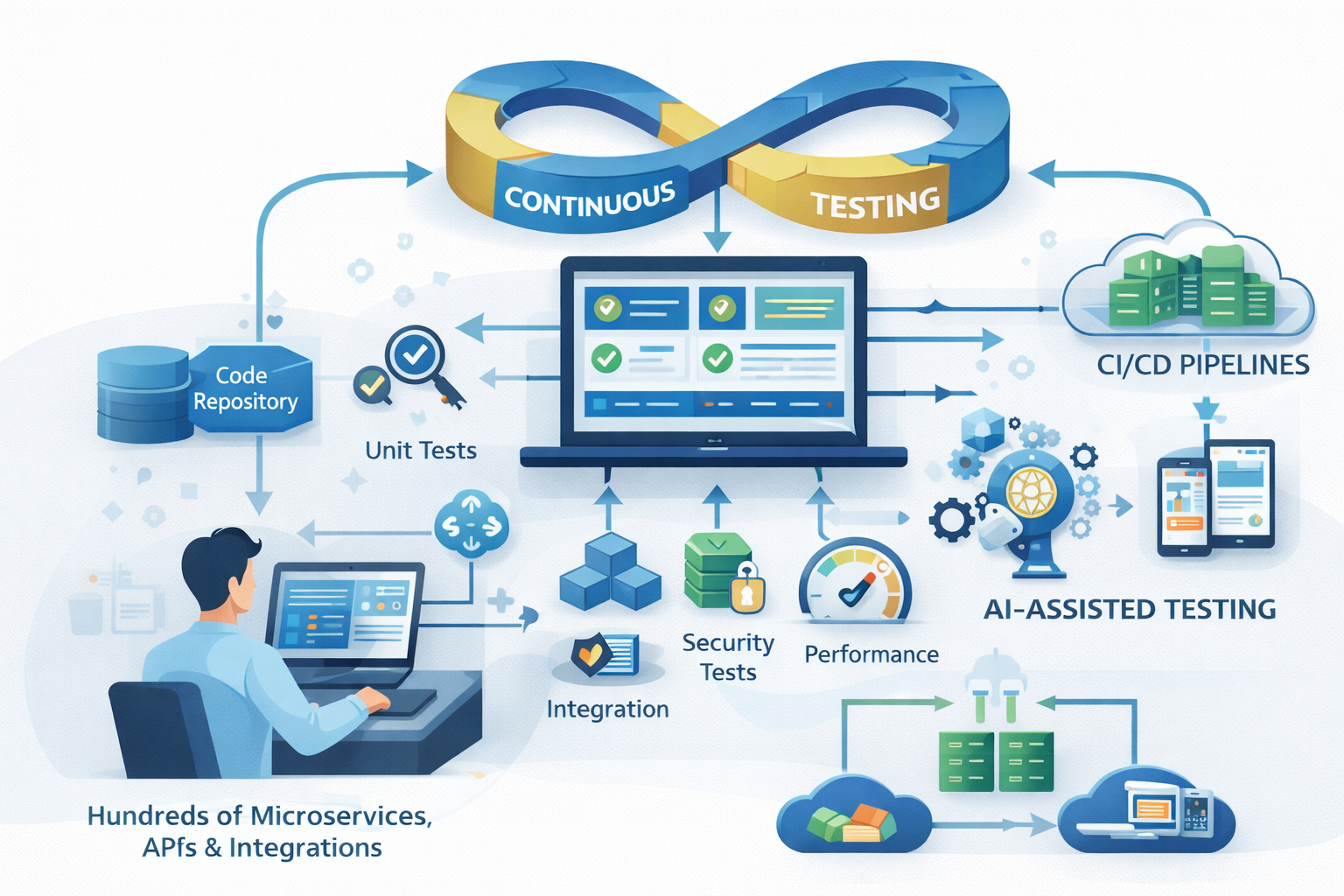
Continuous testing is a critical component of modern DevOps practices. For BFSI organizations, integrating automated tests directly into CI/CD pipelines allows development teams to validate every code change before deployment.
Whenever developers push new code to the repository, automated tests run immediately to verify system stability. These tests may include unit testing, integration testing, security validation, and performance checks. Continuous testing helps identify defects earlier, reducing the risk of releasing unstable financial applications.
Many organizations are also incorporating AI assisted testing capabilities into CI/CD pipelines. These tools can prioritize high risk test cases and detect anomalies in application behavior. According to insights from AI assisted QA reducing testing time by 50 percent, AI driven testing solutions can significantly improve testing efficiency while maintaining high coverage.
Reducing Testing Cycles While Increasing Coverage
One of the biggest advantages of automation testing is its ability to reduce testing time while increasing overall test coverage. Automated regression testing allows teams to run thousands of test cases in a fraction of the time required for manual testing.
For large BFSI systems, this capability is essential because financial platforms must be tested across multiple services, APIs, and user scenarios. Automation ensures that critical financial workflows remain stable even as new features are introduced.
From a CTO perspective, automation also improves development velocity and operational efficiency. Engineering teams can release updates faster without compromising software quality. By combining automation, CI/CD integration, and intelligent QA tools, BFSI organizations can scale their testing processes and support the rapid evolution of digital financial services.
Best Practices for Effective BFSI Application QA
 Best Practices for Effective BFSI Application QA
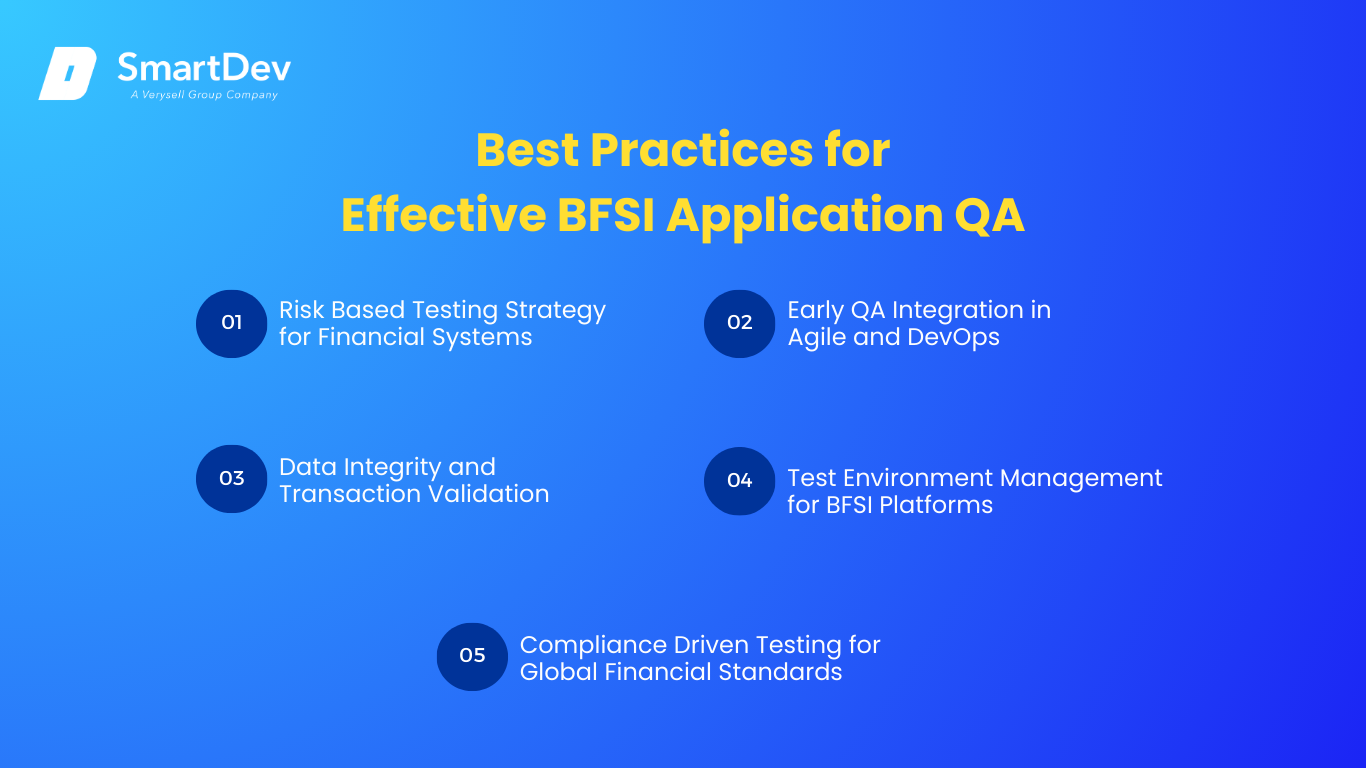
Testing financial applications requires a structured QA strategy because BFSI systems handle sensitive data, complex transactions, and strict regulatory requirements. Effective BFSI app testing focuses on prioritizing critical system components, integrating testing early in development, and ensuring accurate financial data processing. The following best practices help organizations maintain secure and reliable financial platforms.
1. Risk Based Testing Strategy for Financial Systems
Risk based testing prioritizes testing efforts based on the potential impact of system failures. In BFSI applications, features such as payment processing, authentication, and account balance calculations carry higher risks compared to less critical features. If these functions fail, the consequences can include financial loss, security incidents, or customer dissatisfaction.
QA teams therefore focus more resources on high risk components. These features typically undergo more intensive testing, including automation, security validation, and performance testing. Adopting structured testing strategies such as automation testing in BFSI helps organizations increase coverage while maintaining efficient testing cycles.
2. Early QA Integration in Agile and DevOps
Modern BFSI development teams integrate QA early in the software development lifecycle rather than waiting until the final stage. In Agile and DevOps environments, testers collaborate with developers during the design and development phases. This allows issues to be detected earlier, reducing the cost and time required to fix defects.
Automated tests are often integrated into CI/CD pipelines to validate each code update. Continuous testing helps ensure that new features do not introduce unexpected errors. Advanced solutions such as AI assisted QA can reduce testing time by up to 50 percent, allowing teams to release updates more frequently while maintaining quality.
3. Data Integrity and Transaction Validation
Data integrity is essential in BFSI applications because financial systems must process transactions accurately. QA teams verify that transaction records, account balances, and financial calculations remain consistent across the system. Even small data inconsistencies can lead to incorrect financial reporting or transaction disputes.
Testing teams validate database updates, transaction workflows, and system synchronization. They also test edge cases such as failed payments, network interruptions, and duplicate transactions to ensure the system handles these scenarios without compromising financial data accuracy.
4. Test Environment Management for BFSI Platforms
A well configured testing environment is necessary to accurately evaluate BFSI applications. Financial platforms often rely on multiple integrated systems, including payment gateways, cloud services, and legacy banking infrastructure. Testing environments must replicate these integrations to ensure reliable testing results.
Effective environment management includes maintaining staging systems, managing test data, and simulating real user interactions. Many organizations implement structured QA frameworks such as quality assurance solutions to manage testing environments and system integrations more efficiently.
5. Compliance Driven Testing for Global Financial Standards
Financial institutions must comply with strict regulations governing data protection and transaction security. Compliance testing ensures that BFSI applications follow standards such as PCI DSS, GDPR, and other financial regulations before release.
QA teams validate encryption mechanisms, authentication systems, and secure data handling processes. They also ensure that applications maintain accurate audit logs and transaction records for regulatory reporting. Organizations often work with specialized QA partners, as discussed in selecting the right BFSI testing company, to ensure compliance requirements are met effectively.
AI Driven QA for BFSI Applications
 AI Driven QA for BFSI Applications
Artificial intelligence is rapidly transforming how financial institutions approach software testing. As BFSI platforms become more complex, traditional testing approaches struggle to keep up with the scale of modern financial systems. AI driven QA introduces intelligent automation that can analyze large datasets, identify potential risks, and optimize testing strategies. For CTOs and engineering teams, AI powered testing tools enable faster validation cycles, improved defect detection, and more efficient management of large scale testing environments.
How AI Is Transforming Software Testing in BFSI
AI is changing the role of QA from reactive defect detection to proactive quality engineering. Instead of relying only on predefined test scripts, AI driven testing systems can analyze application behavior and automatically identify areas that require additional validation.
Machine learning algorithms can study historical testing data, user behavior patterns, and production incidents to prioritize high risk components of the system. This allows QA teams to focus testing efforts where failures are most likely to occur. Many financial organizations are adopting AI powered testing strategies similar to those discussed in AI assisted QA reducing testing time by 50 percent to improve both testing speed and coverage.
1. AI Assisted Test Case Generation and Maintenance
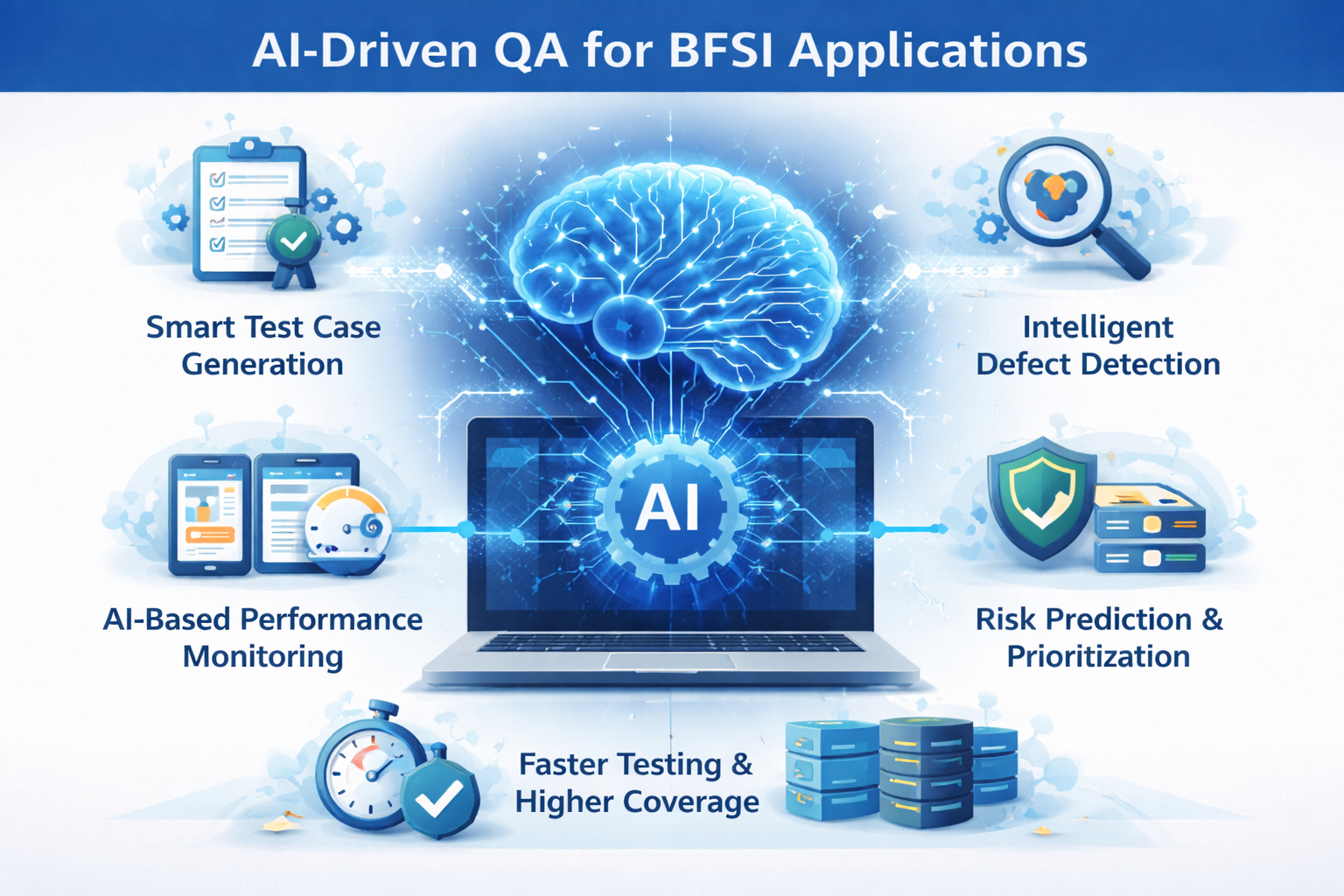 1. AI Assisted Test Case Generation and Maintenance
Creating and maintaining test cases for large BFSI systems can be extremely time consuming. As financial platforms evolve, test scripts must be constantly updated to reflect new features, interface changes, and integration updates. AI assisted testing tools help automate this process by generating test cases based on application behavior and system requirements.
AI can analyze application workflows and automatically generate test scenarios that simulate real user actions. For example, an AI system may detect new transaction flows in a banking application and create test cases to validate them. This reduces the manual effort required from QA engineers and ensures that testing coverage remains up to date as the application evolves.
2. Intelligent Defect Detection and Risk Prediction
One of the most valuable capabilities of AI driven QA is intelligent defect detection. AI models can analyze code changes, system logs, and historical bug data to identify patterns associated with software defects. By detecting these patterns early, QA teams can address potential issues before they reach production.
AI based risk prediction systems also help teams prioritize testing activities. Instead of executing all tests equally, AI can identify modules that have historically produced the highest defect rates. These modules can then receive additional testing attention.
This predictive approach improves testing efficiency and reduces the likelihood of critical failures in financial applications. For large BFSI systems with multiple microservices and integrations, AI driven defect detection provides significant operational advantages.
3. AI Based Mobile QA Metrics and Performance Monitoring
AI also plays an important role in monitoring application performance and user experience. AI powered analytics tools can track performance metrics across mobile and web applications to identify anomalies or performance degradation.
For example, AI systems can monitor metrics such as response time, crash rates, and transaction completion times across different devices. These insights help QA teams detect potential performance issues before they impact users. Advanced mobile testing analytics platforms use AI driven monitoring techniques similar to those described in AI driven mobile QA testing metrics to improve testing visibility and system performance.
Continuous performance monitoring is particularly important in BFSI environments where system stability directly affects customer trust and financial transactions.
5. Reducing Testing Time with AI Assisted QA
One of the most significant benefits of AI driven QA is the ability to reduce testing cycles while maintaining high test coverage. AI tools can automate repetitive testing tasks, prioritize critical test cases, and identify redundant tests that no longer provide value.
By intelligently selecting which tests to execute, AI systems can significantly reduce the time required to validate complex financial applications. In some implementations, AI assisted testing solutions have demonstrated the ability to reduce testing time by up to 50 percent, as highlighted in AI assisted QA reducing testing time by 50 percent.
For CTOs and engineering leaders, this efficiency translates directly into faster release cycles, improved system reliability, and reduced operational costs. AI driven QA therefore plays a key role in helping BFSI organizations scale their testing strategies as digital financial platforms continue to evolve.
Why Businesses Should Choose SmartDev for BFSI App Testing
As financial institutions accelerate digital transformation, ensuring the reliability, security, and scalability of their applications becomes a top priority. BFSI platforms must support complex transaction systems, strict regulatory requirements, and millions of users accessing services through mobile and web applications. Choosing the right QA partner is therefore critical for maintaining system stability and delivering high quality financial products. SmartDev provides specialized testing services designed to help BFSI organizations build secure and reliable digital platforms.
1. Deep BFSI Domain Expertise in Software Testing
 1. Deep BFSI Domain Expertise in Software Testing
SmartDev brings extensive experience in testing financial systems across banking, fintech, and insurance platforms. BFSI applications require specialized testing knowledge because they involve sensitive data, complex transaction flows, and strict compliance requirements.
With deep industry expertise, SmartDev understands the unique challenges involved in validating financial applications. Their testing strategies focus on ensuring transaction accuracy, protecting financial data, and maintaining system reliability under high workloads. Organizations seeking expert QA partners often evaluate providers using criteria outlined in how to select the right BFSI testing company to ensure strong industry experience.
2. Comprehensive QA Services for Mobile and Web Applications
Modern financial services rely on both mobile banking applications and web platforms to deliver digital experiences to customers. SmartDev provides end to end QA services designed to validate these platforms across multiple environments and devices.
Testing services cover functional testing, integration testing, performance validation, and security assessments. QA teams also perform extensive cross device testing to ensure mobile banking applications operate consistently across different operating systems and screen sizes. Organizations can explore the full range of capabilities through SmartDev quality assurance solutions, which are designed to support large scale digital platforms.
3. AI Powered Test Automation Capabilities
SmartDev integrates intelligent automation technologies to improve the speed and efficiency of BFSI testing processes. AI powered automation frameworks help development teams validate application functionality faster while maintaining high testing coverage.
Automation tools can execute regression testing, validate API integrations, and monitor system performance across large financial platforms. AI assisted QA techniques also help identify defects earlier in the development lifecycle and reduce the time required for test execution. These advanced capabilities are discussed in AI assisted QA reducing testing time, which highlights how intelligent testing solutions can accelerate QA processes.
4. Proven Testing Methodologies for Financial Systems
SmartDev applies structured testing methodologies designed specifically for BFSI environments. These methodologies include risk based testing, automated regression testing, and security validation processes that ensure critical financial workflows are thoroughly tested.
By implementing systematic QA frameworks, SmartDev helps organizations detect issues early and maintain system stability throughout the development lifecycle. Their approach to financial system testing aligns with best practices outlined in software testing methodologies and best practices for BFSI, ensuring reliable validation of complex financial platforms.
5. Scalable QA Teams for Enterprise BFSI Platforms
Enterprise BFSI platforms often require large testing teams capable of supporting continuous development and rapid feature releases. SmartDev provides scalable QA teams that can adapt to the evolving needs of financial institutions.
These teams work closely with internal development departments to integrate testing processes within Agile and DevOps environments. By embedding QA expertise directly into development workflows, SmartDev helps organizations maintain high testing coverage while accelerating delivery timelines.
6. Delivering Secure, High Performance Financial Applications
Security, performance, and reliability are essential requirements for BFSI applications. SmartDev focuses on delivering comprehensive testing solutions that ensure financial platforms remain secure and stable even under heavy transaction loads.
Through a combination of automation, security validation, and performance testing, SmartDev helps financial institutions maintain high quality digital services. Their experience in supporting enterprise technology initiatives is also reflected in broader capabilities described in why enterprises choose top AI development companies, highlighting how advanced technologies can enhance digital product quality.
By partnering with SmartDev, BFSI organizations gain access to specialized QA expertise, advanced automation capabilities, and scalable testing teams that support the delivery of secure and high performance financial applications.
Conclusion
Artificial intelligence and automation technologies are reshaping how QA teams manage testing processes. AI driven tools can analyze application behavior, prioritize high risk areas, and streamline testing cycles across mobile and web environments. These capabilities allow development teams to detect defects earlier and maintain higher levels of application stability. For financial institutions, adopting modern QA practices such as automation testing in BFSI is becoming essential for delivering secure and scalable digital financial services.
If your organization is looking to strengthen its financial application testing strategy, partnering with an experienced QA provider can make a significant difference. Explore how SmartDev’s quality assurance solutions can help your team deliver secure, high performance BFSI applications and scale your digital financial platforms with confidence.