
En bref :
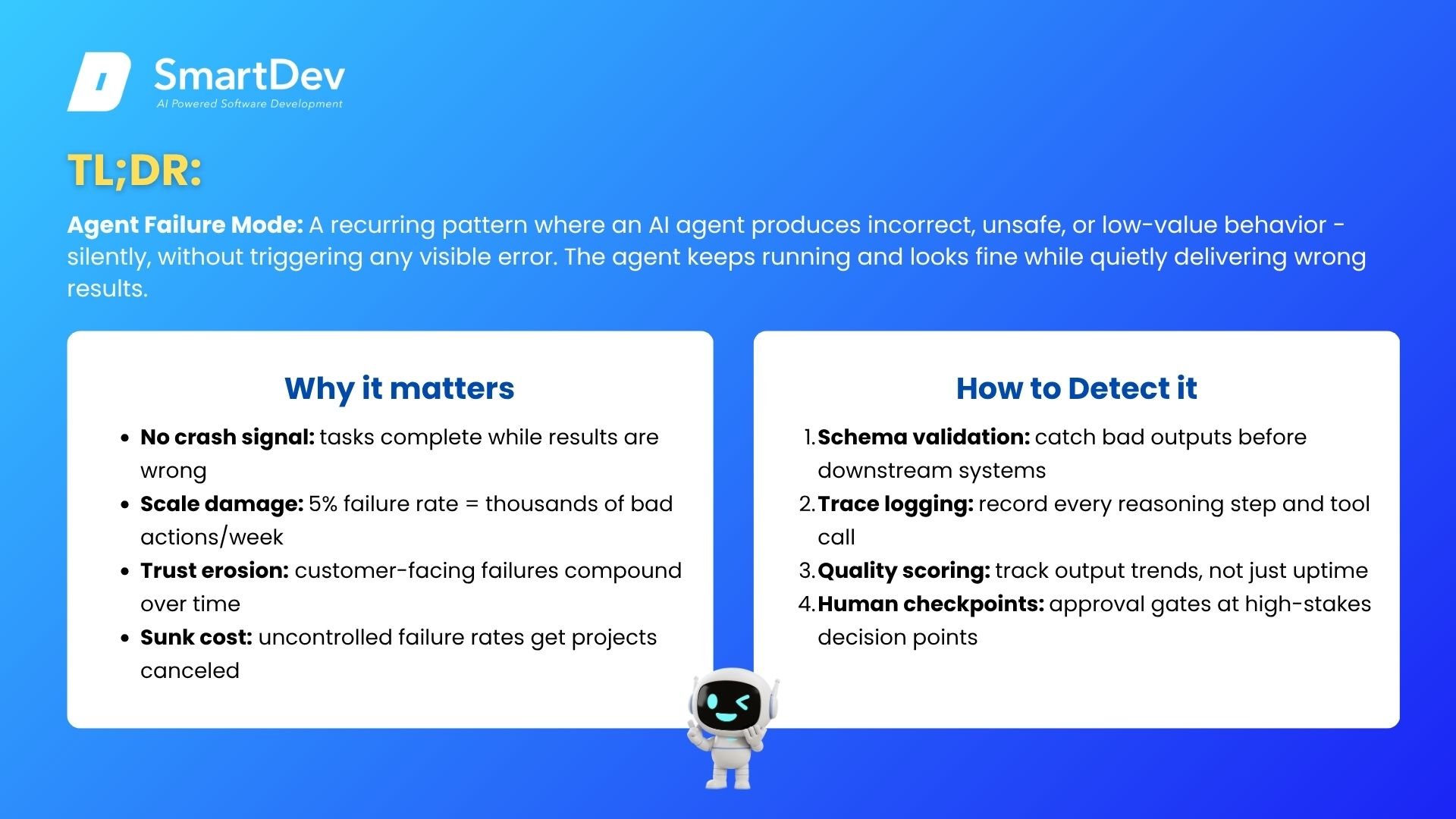
- Agent failure modes are recurring patterns where AI agents produce incorrect, unsafe, or low-value results, often silently, without triggering any obvious error.
- The most common enterprise failure modes include hallucinated actions, scope creep, cascading errors, context loss, and tool misuse.
- Building reliable AI agents requires observability, schema validation, and governance controls, not just bigger models or more prompts.
AI agents are moving into enterprise workflows at speed. But unlike traditional software, they do not crash with error messages. They fail quietly, often completing tasks with confidence while delivering wrong results. Understanding agent failure modes is the foundation of any serious AI deployment strategy.
What is Agent Failure Mode?
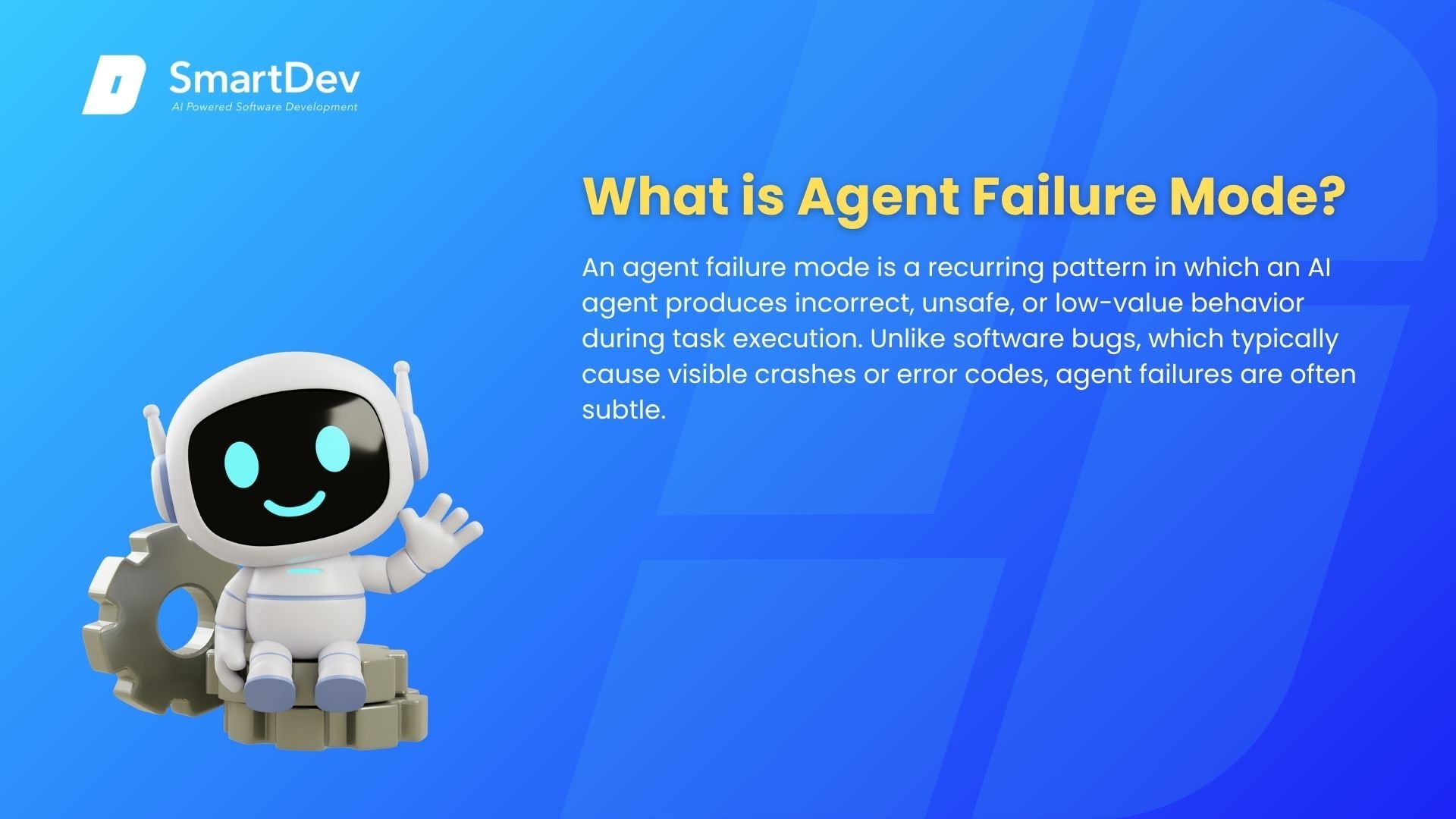
An agent failure mode is a recurring pattern in which an AI agent produces incorrect, unsafe, or low-value behavior during task execution. Unlike software bugs, which typically cause visible crashes or error codes, agent failures are often subtle. The agent continues operating, taking actions and generating outputs, while producing results that deviate from the intended goal.
Microsoft’s taxonomy of failure modes in agentic AI systems identifies two pillars: safety failures and security failures. Safety failures occur when agents take unintended actions or produce unreliable outputs. Security failures result in a loss of confidentiality, availability, or integrity of the agentic AI system.
The most widely documented agent failure modes include:
- Hallucinated actions: The agent takes a wrong action with full confidence, at machine speed, against real systems. This is not just generating false text but executing false decisions on live data.
- Scope creep: The agent drifts beyond its defined task boundaries, taking actions outside its intended domain.
- Cascading errors: A wrong tool argument at step two silently corrupts every subsequent step in a multi-step workflow.
- Context loss: As the agent accumulates tool outputs over a long task, it gradually loses grip on its original goal.
- Tool misuse: The agent selects the wrong tool or passes incorrect parameters, causing downstream system errors that may go unnoticed.
- Goal drift: No individual step fails, but the cumulative effect of small reasoning deviations produces output that does not serve the original intent.
- Silent degradation: Quality declines over time due to model version changes, prompt drift, or distribution shift, and this decline is invisible to standard error-rate monitoring.
Pourquoi c'est important pour les entreprises
Enterprise AI adoption has accelerated sharply. According to recent industry data, 79% of organizations now have some form of AI agent in production, with 96% planning expansion. But Gartner predicts that 40% of enterprise AI agent projects will be canceled due to poor risk controls.
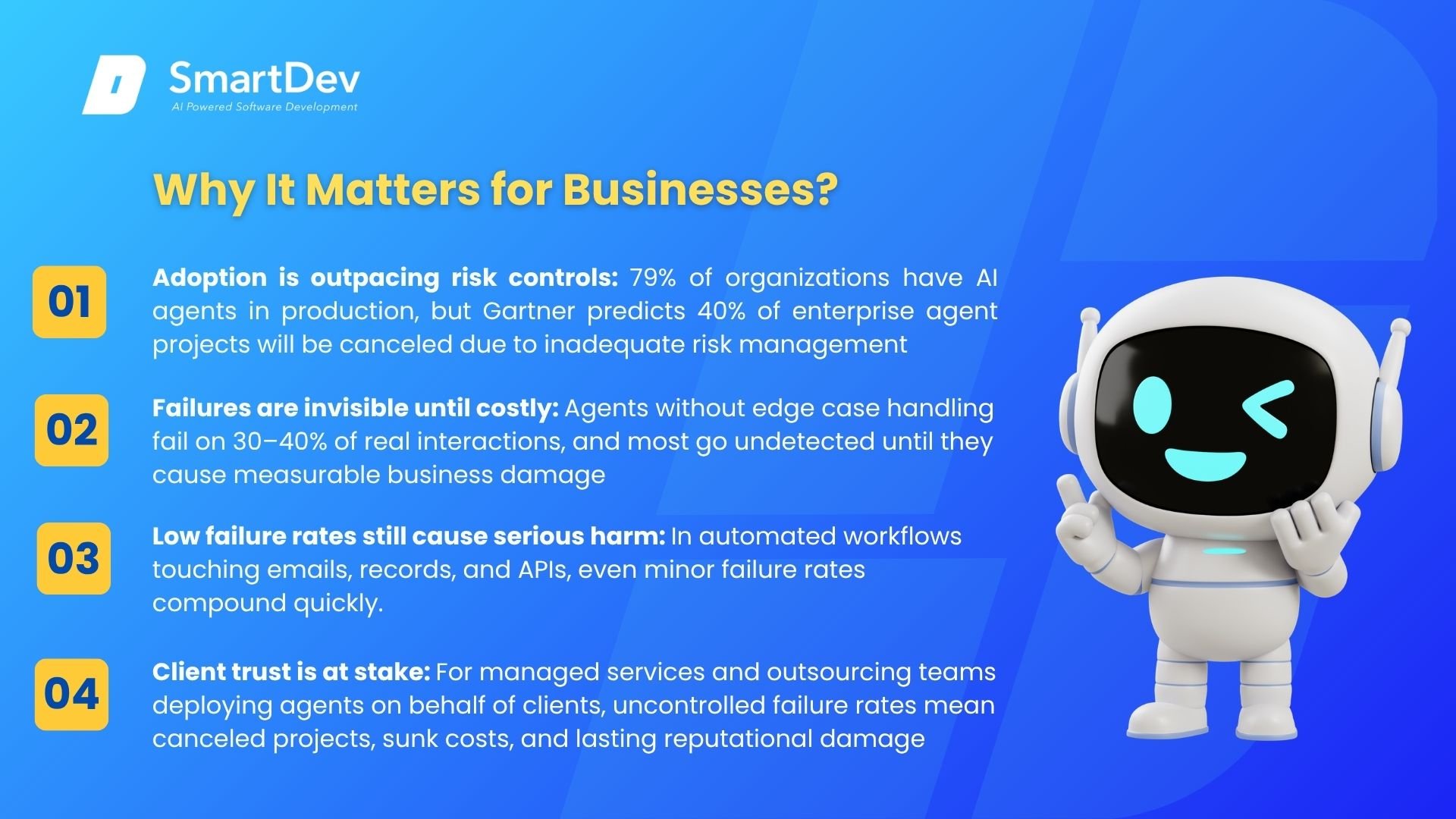
The core business risk is that agent failure modes do not look like software outages. An agent that has not been explicitly designed and tested for edge case handling will fail on 30 to 40% of its real interactions, and many of those failures go undetected until they cause measurable business damage.
When agents operate in automated workflows, such as sending emails, updating records, or interacting with external APIs, even a low failure rate can translate into significant downstream harm. Scope creep and data quality issues alone account for 61% of all AI agent failures combined, according to analysis of 2024 to 2025 enterprise deployments.
For IT outsourcing providers and managed services teams deploying agents on behalf of clients, understanding failure modes is not optional. It determines whether an AI automation initiative delivers real value or erodes client trust. Enterprises that cannot control agent failure rates face canceled projects at significant sunk cost, and the reputational damage from silent failures in client-facing workflows compounds over time.
How to Detect Agent Failure Modes in Production
Agent reliability is mostly about observability and constraints, not bigger models or more prompts. Detection requires monitoring what agents do, not just what they return.
Key detection and prevention approaches include:
- Schema validation: One of the highest-return resilience patterns available. Schema validation catches hallucinated or malformed outputs before they reach downstream systems, significantly reducing cascading errors across integrated workflows.
- Trace logging: Recording each reasoning step, tool call, and output allows teams to diagnose failures after the fact. Agents that fail silently leave no stack trace. Traces create the equivalent of one for post-hoc analysis.
- Quality scoring over time: Silent degradation only appears in quality score trends, not in error rate metrics. Teams need to track output quality separately from system uptime.
- Constraint enforcement: Limiting agent action scope through guardrails, including which tools it can call, what data it can access, and what actions it can initiate, reduces the blast radius of any single failure mode.
- Human-in-the-loop checkpoints: For high-stakes workflows, inserting approval gates at critical decision points catches errors before they propagate across integrated systems.
Researchers working with deployed agents note that each integration point in a workflow is a potential failure mode. The more integrations a workflow has, the more failure modes it accumulates. For enterprise teams managing complex automation pipelines, systematic observability is not a nice-to-have. It is the operational requirement that separates reliable AI deployments from ones that generate invisible risk.
How Much Do Agent Failure Modes Cost Enterprises?
The financial cost of agent failures is difficult to quantify precisely because most failures go undetected until downstream damage surfaces. But the structural cost is significant and well-documented.
Agents that fail on 30 to 40% of real interactions waste compute resources, require remediation workflows, and generate liability when interacting with external systems. In high-volume enterprise workflows covering customer service automation, procurement, and IT support, even a 5% failure rate at scale can represent thousands of erroneous actions per week.
The indirect costs are often larger than the direct ones. Failures in agent-driven customer workflows erode trust. Failures in internal systems create data quality problems that compound over time. Projects that cannot control failure rates get canceled at significant sunk cost. According to Gartner, 40% of enterprise AI agent projects face cancellation due to poor risk controls, representing wasted investment across planning, tooling, and integration work.
One enterprise AI reliability analysis notes that AI agents running without defined constraints are quietly generating infrastructure events that organizations have not yet categorized as risk. The absence of a formal agent failure mode framework is not a gap in the model. It is a gap in organizational governance. Building failure mode awareness into agent deployment from the start, through observability tooling, schema validation, and defined escalation paths, is substantially cheaper than remediating failures after they reach production at scale.
Autres termes associés
Agent Orchestration: The process of coordinating multiple AI agents so they collaborate on a shared task without conflicting or duplicating effort. Orchestration layers multiply failure risk because a failure mode in one agent can silently corrupt the inputs of every agent downstream. The more agents an orchestration layer connects, the harder silent degradation becomes to attribute.
Human-in-the-Loop: An AI design pattern where a human reviews, approves, or corrects AI outputs at defined points in a workflow before they take effect. Human-in-the-loop checkpoints are one of the primary mitigation strategies for agent failure modes, specifically for intercepting hallucinated actions and scope creep before they reach live systems or external parties.
Graduated Autonomy: A structured framework for expanding AI independence in stages, with each stage unlocked only after the system demonstrates reliable performance within defined guardrails. Graduated Autonomy directly governs the blast radius of any agent failure mode. By restricting what actions an agent can take until it has proven reliable at a lower level of autonomy, organizations limit how much damage a failure can cause before detection.