Key Takeaways:
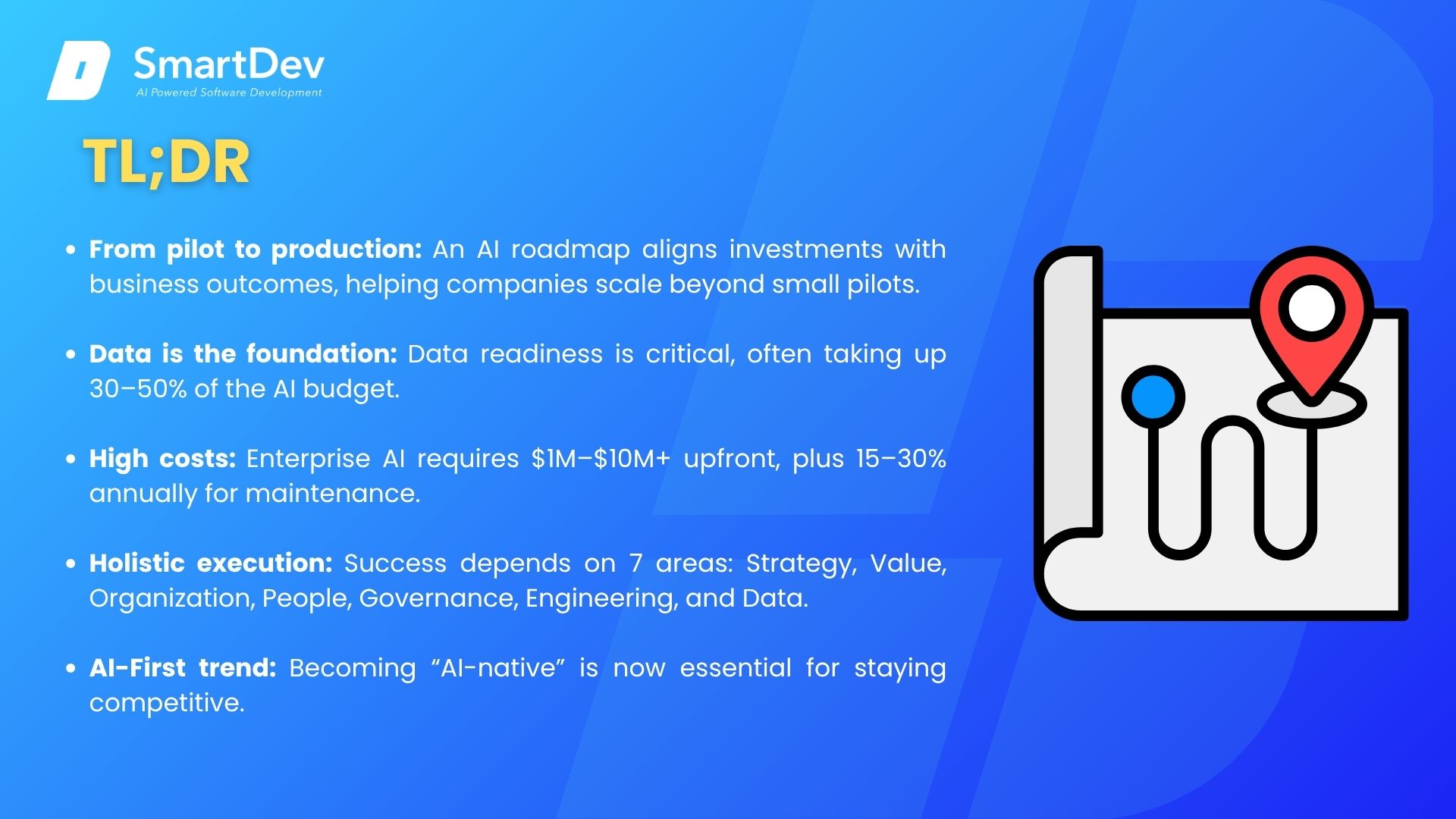
- Moving from pilots to production: First and foremost, an AI Enterprise Roadmap is a long-term strategic blueprint. It actively aligns AI investments with measurable business outcomes, moving organizations past isolated pilots to full-scale production capabilities.
- Data forms the core foundation: Consequently, data infrastructure readiness serves as a critical survival prerequisite. In fact, preparing, cleaning, and governing data usually consumes 30% to 50% of the entire AI budget.
- Massive capital and operational costs: Furthermore, deploying enterprise-grade AI is certainly not a simple, one-time software project. It actually demands an initial investment ranging from $1 million to over $10 million. Additionally, annual maintenance costs aggressively consume 15% to 30% of the initial build budget.
- Multidimensional execution framework: Moreover, a complete roadmap must comprehensively cover seven core workstreams: Strategy, Value, Organization, People, Governance, Engineering, and Data. Failing in any single stream inevitably leads to systemic collapse.
- “AI-First” shaping 2026 competitiveness: Ultimately, the “AI Native” model has become an undisputed survival standard. For example, major corporations globally are making AI their central strategic axis to drastically boost their digital autonomy and market dominance.
What is AI Enterprise Roadmap?
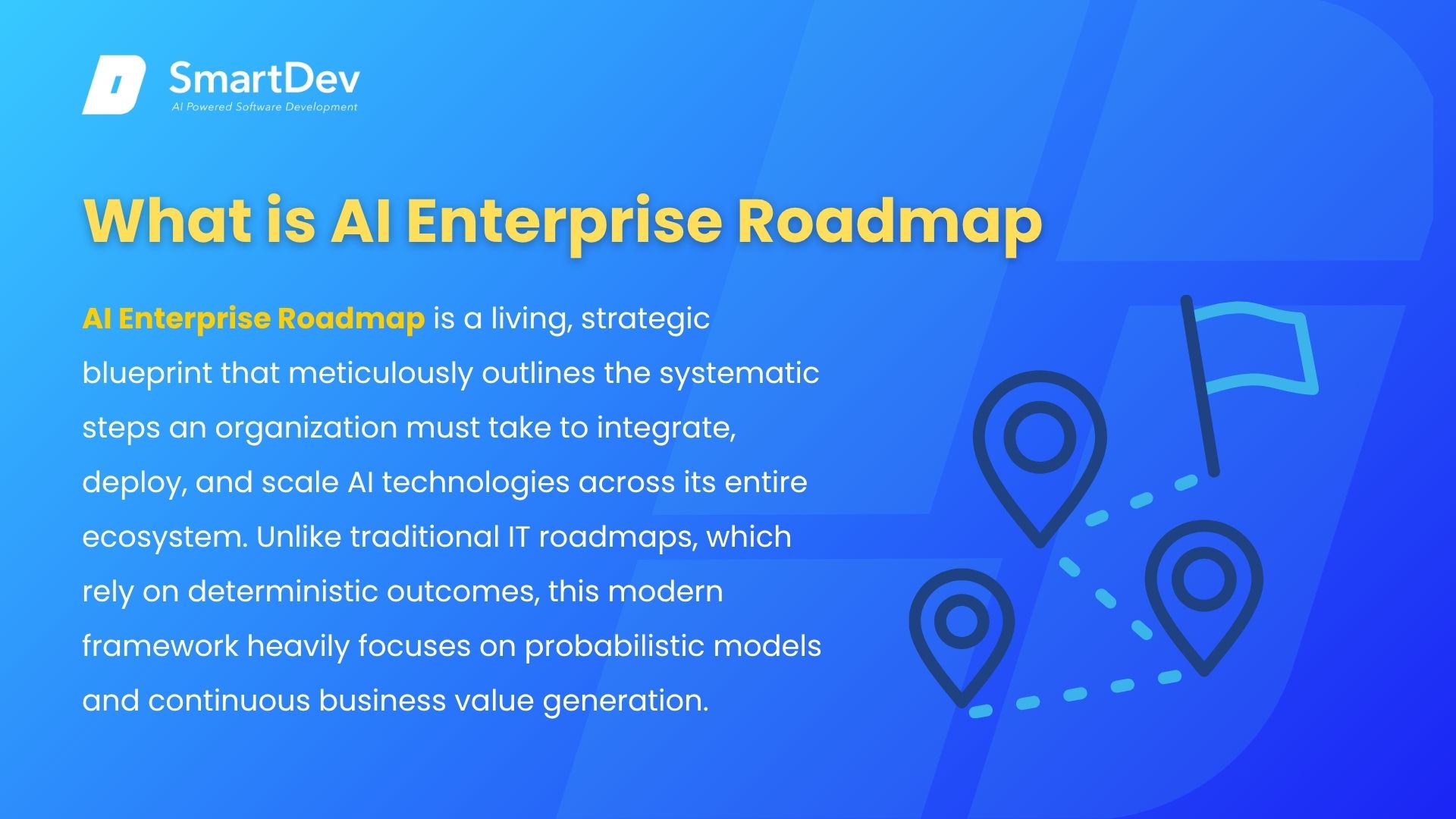
Clearly, an AI Enterprise Roadmap is a living, strategic blueprint that meticulously outlines the systematic steps an organization must take to integrate, deploy, and scale AI technologies across its entire ecosystem. Unlike traditional IT roadmaps, which rely on deterministic outcomes, this modern framework heavily focuses on probabilistic models and continuous business value generation.
Currently, although artificial intelligence attracts massive boardroom attention, only one in five AI initiatives actually achieves a positive return on investment (ROI). Often, the root cause of this alarming failure rate is not the technology itself. Instead, it directly stems from strategic misalignment, poor data quality, and entirely unclear performance indicators.
Therefore, to solve this pervasive issue, a comprehensive roadmap requires the simultaneous development of seven core Gartner workstreams :
First, AI Strategy clearly establishes the corporate vision and strictly prioritizes investments.
Second, AI Value intentionally shifts the organizational mindset from isolated pilots to continuous, product-centric value realization.
Third, AI Organization specifically focuses on evolving the corporate structure and forming dedicated Centers of Excellence.
Fourth, AI People and Culture actively addresses workforce planning, employee upskilling, and enterprise-wide change management.
Fifth, AI Governance proactively mitigates critical risks like algorithmic bias while establishing robust ethical guardrails.
Sixth, AI Engineering deliberately builds the technical foundation, incorporating advanced ModelOps and FinOps practices.
Finally, AI Data guarantees that high-quality, perfectly observable data is continuously available for complex algorithms.Consequently, an AI Enterprise Roadmap acts as the ultimate value orchestrator. It perfectly balances disruptive technological innovation with necessary operational stability.
Why It Matters for Businesses?
In today’s rapidly evolving digital economy of 2026, possessing an AI Enterprise Roadmap is no longer just a competitive option. Rather, it represents a strict baseline requirement for corporate survival.
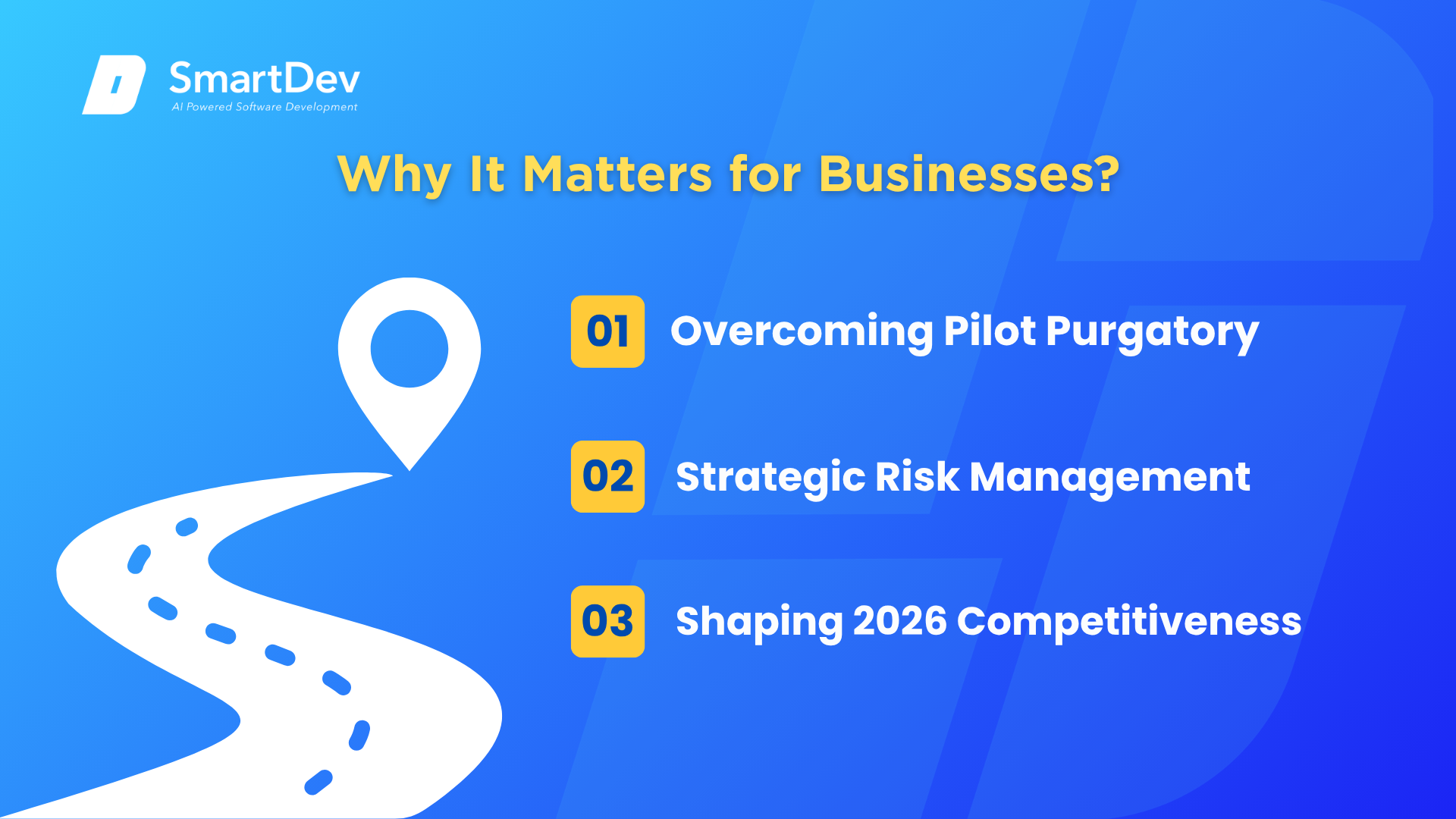
Overcoming Pilot Purgatory
Most importantly, this strategic roadmap helps organizations escape “pilot purgatory,” a frustrating state where models work flawlessly in labs but fail completely in real-world production. Because it enforces a strict prioritization framework, executive leaders only fund use cases that boast high ROI and feasible data requirements. As a result, companies directly translate raw investments into tangible operational efficiency.
Strategic Risk Management
Furthermore, generative AI introduces unprecedented enterprise risks regarding data privacy, copyright infringement, and factual hallucinations. Accordingly, a structured roadmap deliberately treats governance as a fundamental pillar. By aggressively implementing robust guardrails and transparency protocols, businesses successfully avoid severe legal penalties while actively building consumer trust. In fact, 68% of modern consumers are significantly more likely to trust companies that use AI transparently.
Shaping 2026 Competitiveness
Meanwhile, looking specifically at the 2026 economic landscape, AI is no longer just a mere support tool. Instead, it serves as the absolute core operational foundation. For instance, major corporations like FPT in Vietnam have boldly declared a massive transition to an “AI Native” model. Consequently, they are targeting extraordinary revenue goals—reaching 58,580 billion VND—by placing AI precisely at the heart of their daily operations.
Moreover, the strategic integration of cutting-edge technologies like Edge AI drastically reduces cloud bandwidth costs by 60% to 80%. Ultimately, without a well-defined roadmap, scaling these powerful innovations safely remains virtually impossible.
Who is Involved?
Naturally, transforming an AI Enterprise Roadmap from concept to reality requires a diverse, cross-functional human ecosystem. Specifically, even the most advanced technology will inevitably fail without proper human orchestration.
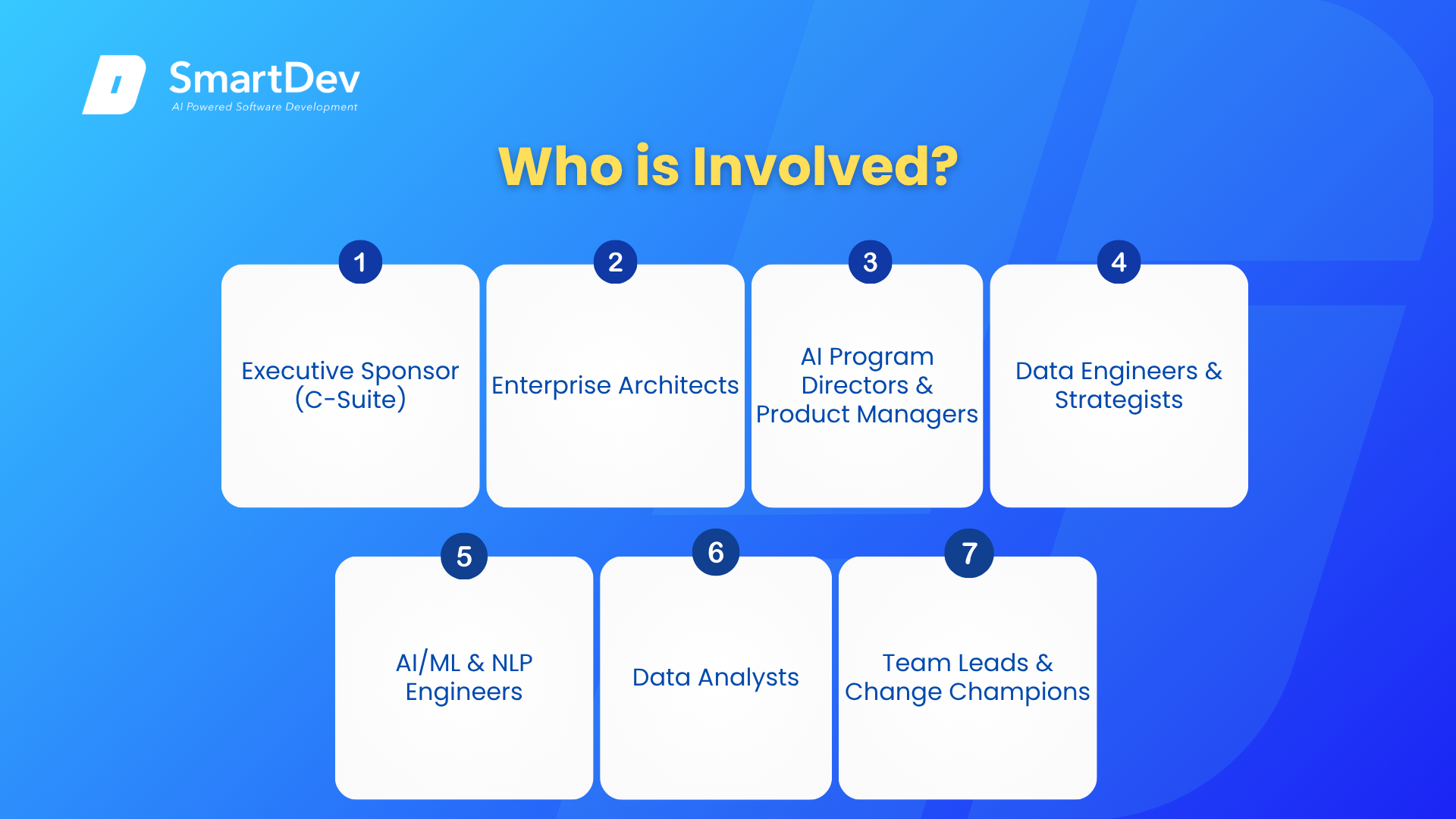
- Executive Sponsor (C-Suite): Primarily, these top-tier leaders (like the CEO or CIO) provide the macro vision and eagerly secure necessary budgets. Without their unwavering backing, ambitious AI initiatives quickly stall.
- Enterprise Architects: Next, these professionals act as critical strategic translators. They expertly use architectural frameworks to align new technology with business goals, ensuring the AI infrastructure scales effortlessly while avoiding technical debt.
- AI Program Directors & Product Managers: Meanwhile, these dedicated roles directly manage the actual daily rollout. Product managers precisely define success metrics and guarantee ethical compliance, beautifully bridging the gap between large language model (LLM) capabilities and genuine market needs.
- Data Engineers & Strategists: Because clean data is the absolute lifeblood of AI, these data professionals meticulously build the foundational pipelines. Specifically, data engineers actively clean and structure vast datasets, preventing AI projects from grinding to a disastrous halt.
- AI/ML & NLP Engineers: Consequently, these highly technical experts carefully design, train, and optimize the core machine learning algorithms. They boldly push complex models into live production environments.
- Data Analysts: Once teams deploy the models, analysts rigorously measure the exact ROI and optimize overall performance using extensive A/B testing.
- Team Leads & Change Champions: Finally, these empathetic individuals handle the complexities of organizational change management. They actively guide employees through new workflows, aggressively driving user adoption to ensure the enterprise actually utilizes the new tools.
How to Build and Execute the Roadmap?
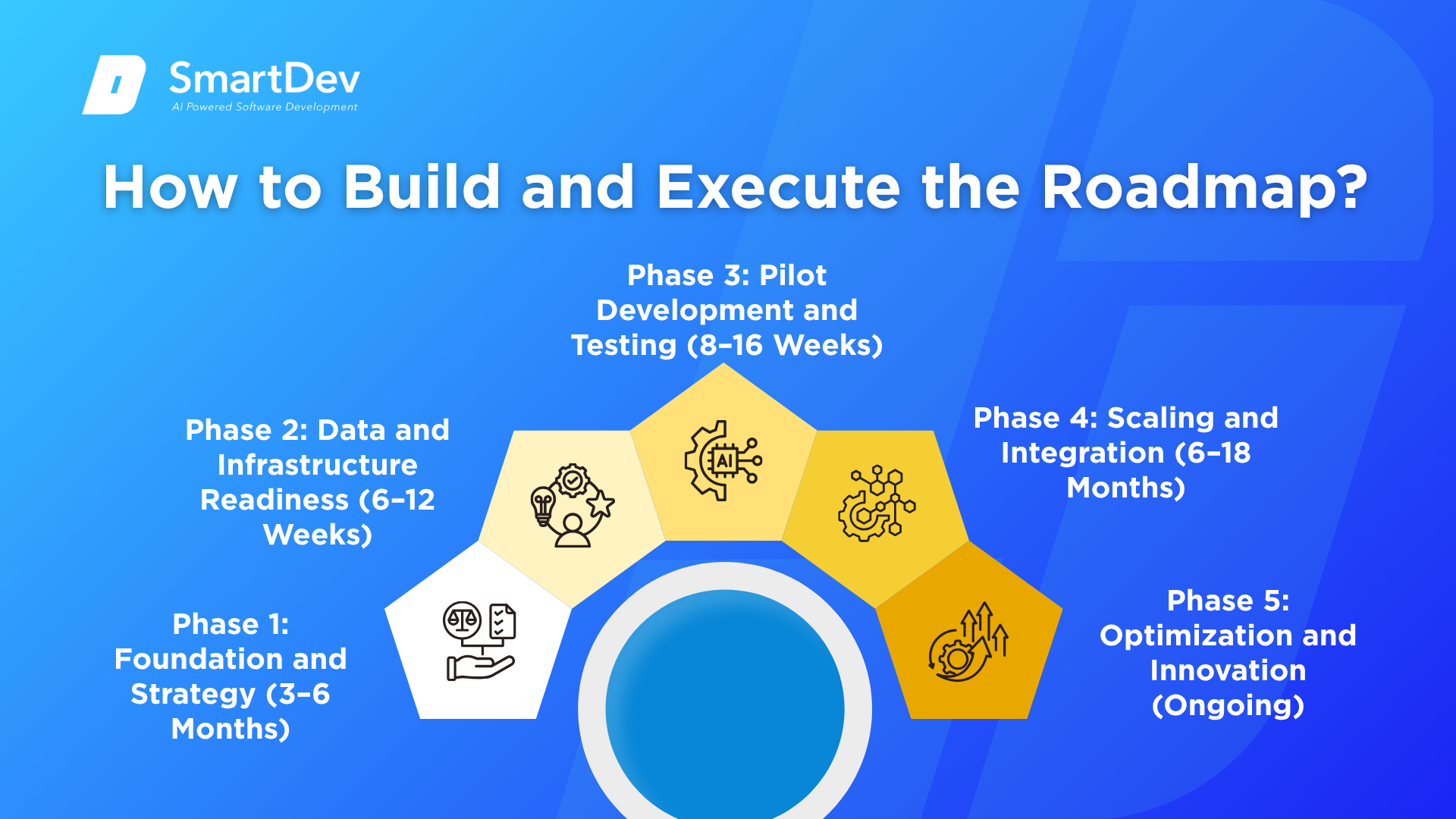
Undeniably, executing an AI Enterprise Roadmap strictly demands a methodical, five-phase approach. This phased execution perfectly balances rapid innovation with strict risk management.
Phase 1: Foundation and Strategy (3–6 Months): First, the organization honestly assesses its current technological capabilities and actively aligns AI goals with broader business priorities. During this crucial phase, leaders confidently secure an executive budget totaling 3% to 5% of annual revenue.
Phase 2: Data and Infrastructure Readiness (6–12 Weeks): Subsequently, data engineers conduct incredibly deep internal data audits. Since 99% of AI projects face fatal data issues, building clean, heavily governed data pipelines remains an absolute necessity.
Phase 3: Pilot Development and Testing (8–16 Weeks): Following thorough data preparation, teams strongly apply the “Fail Early and Cheap” principle. The business enthusiastically runs targeted, high-impact pilots—like AI customer service agents—to definitively prove a 20% to 30% efficiency gain.
Phase 4: Scaling and Integration (6–18 Months): Once proven successful, engineers seamlessly phase the AI solutions into major enterprise systems like ERP and CRM software. Simultaneously, comprehensive change management programs go into full effect to guarantee at least 70% user adoption.
Phase 5: Optimization and Innovation (Ongoing): Finally, because all models inevitably suffer from data drift, teams must conduct continuous monitoring and retraining. Eventually, the matured company proactively explores advanced, futuristic technologies like Agentic AI.
How Much Does It Cost?
Admittedly, adequately funding an enterprise-grade AI system is incredibly capital-intensive. In 2026, launching a robust AI Enterprise Roadmap easily starts at $1 million. Furthermore, this figure can rapidly exceed $10 million for highly complex, mission-critical systems.
Initial CAPEX Breakdown
Surprisingly, initial data preparation acts as the most expensive phase, generally consuming 30% to 50% of the entire project budget. Moreover, securing specialized technical talent (like MLOps and AI Engineers) strictly demands massive salaries ranging from $120,000 to $180,000 annually per head.
Meanwhile, fully customizing a private enterprise AI model often costs well over $200,000. In addition, securely integrating this model into legacy IT systems easily adds another $150,000 to the bill.
Ongoing OPEX and Maintenance
However, the true financial burden truly begins after the initial deployment. Specifically, annual system maintenance typically costs an astonishing 15% to 30% of the original build price. Furthermore, running cloud computing infrastructure for continuous real-time inference can easily drain $10,000 to $50,000+ per month.
Consequently, continuous model retraining, strict bias testing, and legal compliance audits form hidden, constantly escalating operational costs. Ultimately, enterprises must carefully prepare for these expenses to totally avoid budget exhaustion.
Other Related Terms
To successfully navigate an AI Enterprise Roadmap, modern leaders must completely understand the evolving technical glossary. Therefore, here are the most essential related terms:
- Artificial Intelligence (AI): Broadly, this is the expansive scientific field dedicated to creating computer machines that seamlessly mimic human cognition.
- Large Language Model (LLM): Specifically, this represents a massive neural network rigorously trained on vast text data to intelligently understand and generate natural human language.
- Retrieval-Augmented Generation (RAG): Crucially, this powerful architectural framework securely connects an LLM directly to private enterprise databases, practically eliminating factual hallucinations.
- Agentic AI: Furthermore, these are highly autonomous software systems that actively plan, act, and execute complex long-term goals without requiring constant human intervention.
- Machine Learning Bias: Unfortunately, this remains a systemic error where AI models accidentally reflect unfair societal prejudices originally found in their training data.
- Generative Engine Optimization (GEO): Meanwhile, in the modern SEO realm, this is the innovative strategy of structuring brand content so that AI response engines (like ChatGPT) confidently cite the business as an authoritative source.
- Zero-Click Result: Consequently, this phenomenon occurs when an AI engine directly answers a user’s query directly on the search page, completely eliminating the user’s need to click on a traditional website link.