En bref :
- AI test case generation uses artificial intelligence to automatically create the test cases needed to verify that software behaves correctly, dramatically reducing the manual effort involved in quality assurance.
- AI can produce comprehensive test suites covering functional, edge, and regression scenarios in minutes rather than the hours or days required for manual test writing.
- Businesses adopting AI-generated testing report faster release cycles, fewer production defects, and development teams that can redirect QA time toward higher-value testing activities.

Software testing is essential, but writing test cases manually is time-consuming, repetitive, and often incomplete. AI test case generation tackles all three of those problems at once, giving development and QA teams the coverage they need without the bottleneck that manual test writing creates in fast-moving software projects.
What is AI Test Case Generation?
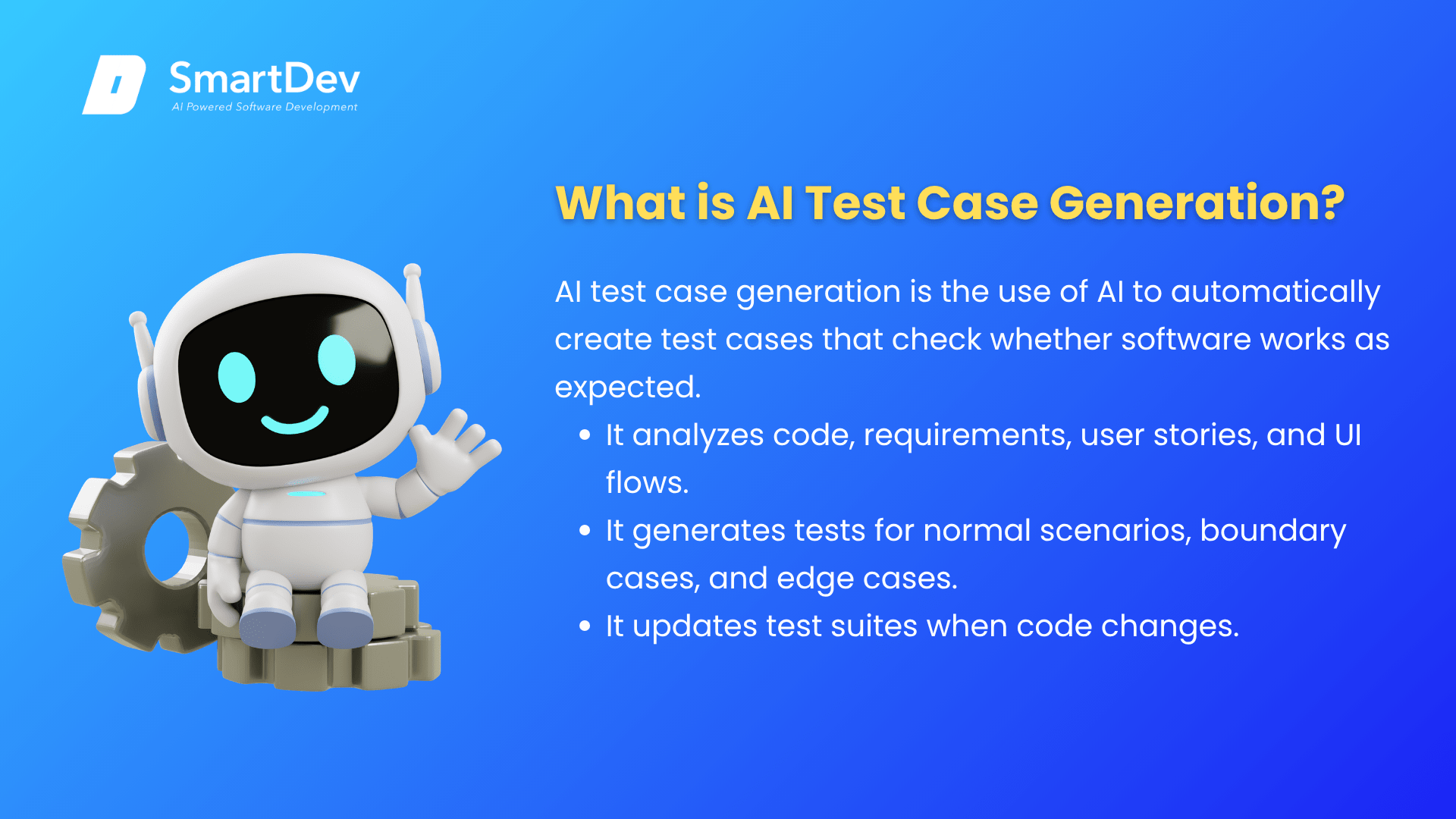
AI test case generation is the use of artificial intelligence to automatically create structured test cases that verify whether a software application behaves as expected. Rather than having a QA engineer manually write each test scenario, the AI analyzes the application’s code, requirements documents, user interface flows, and existing behavior to produce a comprehensive set of tests covering normal operation, boundary conditions, and edge cases.
A test case is a defined scenario consisting of specific inputs, the steps to execute, the expected outcome, and often the conditions that must exist before the test runs. Traditionally, creating these test cases required QA professionals to read through requirements, identify all possible scenarios a user might encounter, and write out each test by hand. For complex applications, this process can take weeks and still leave significant gaps in coverage.
AI changes the equation by processing requirements and code at machine speed. Given a user story, a requirements specification, or a code module, an AI test generation tool can produce a first draft of all relevant test cases in minutes. These drafts are then reviewed and refined by human QA engineers, who make the final judgment on which tests to include and whether the generated scenarios accurately reflect real business requirements.
Beyond initial generation, AI tools can also update test suites automatically when code changes. When a developer modifies a function, the AI identifies which existing tests are affected, which may now be incomplete, and what new test cases the change requires. This keeps testing coverage current with the codebase without requiring QA teams to manually track every code modification.
Pourquoi c'est important pour les entreprises
Inadequate software testing is a leading cause of expensive production failures. According to research cited in 2026 by multiple quality assurance analysts, the cost of fixing a defect discovered in production is 10 to 100 times higher than catching it during development. AI test case generation addresses this risk by making comprehensive testing faster and more economically viable at every stage of development.
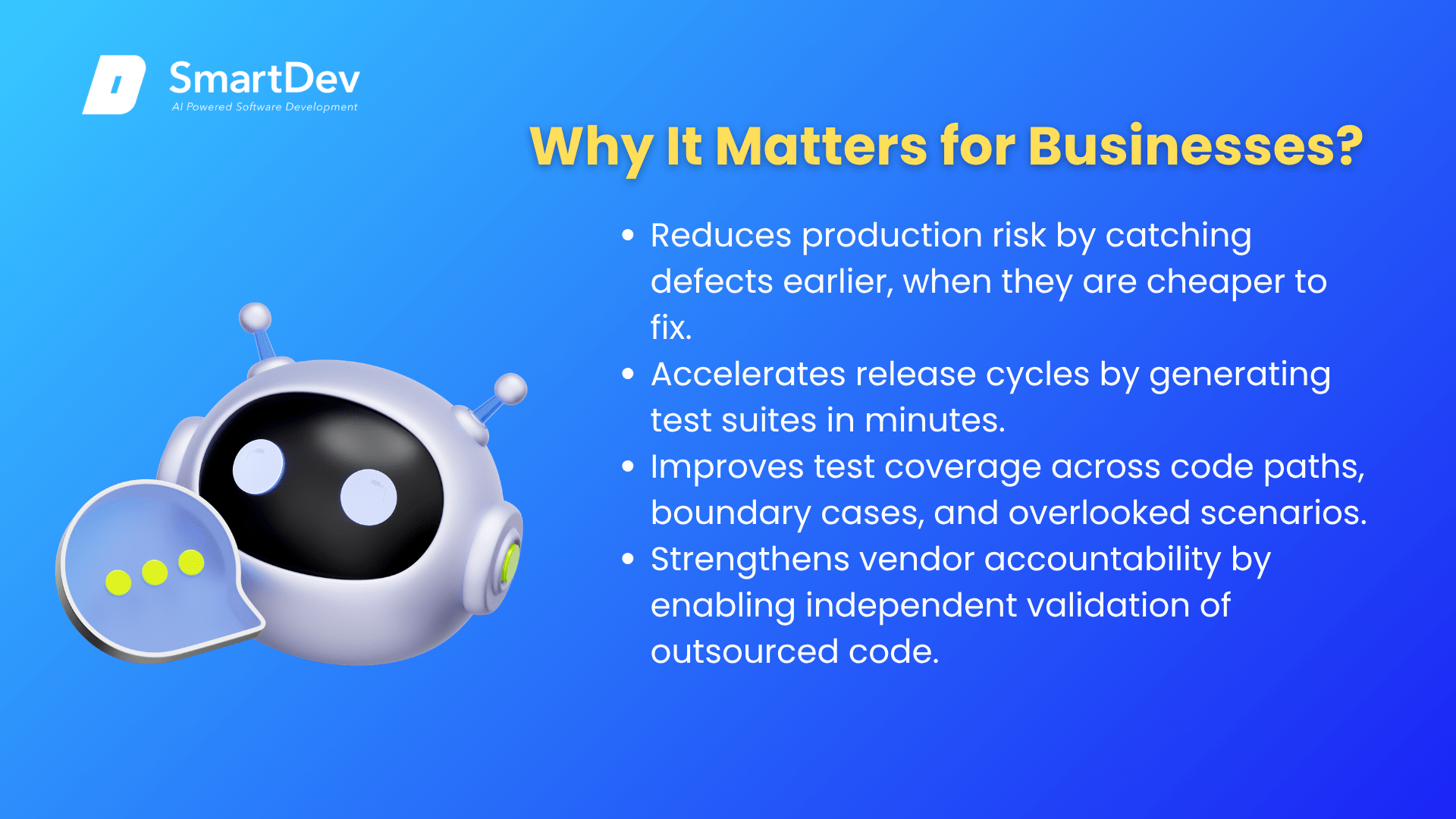
For business leaders, the most compelling benefit is the acceleration of release cycles without a proportional increase in testing costs. When AI can generate a comprehensive test suite from requirements in minutes, QA becomes less of a bottleneck to shipping software and more of a quality gate that can be applied consistently and quickly. Organizations that previously struggled to test thoroughly within sprint timelines find that AI-generated testing makes thorough coverage feasible within the same window.
Test coverage also improves qualitatively, not just quantitatively. Manual test case writing is inevitably shaped by the tester’s familiarity with the system. An experienced QA engineer tests the scenarios they have seen fail before; an AI analyzes all code paths and boundary conditions systematically, generating tests for scenarios that even experienced testers might overlook. This broader coverage reduces the number of defects that slip through to production.
For businesses working with outsourced software development partners, AI test case generation provides an additional layer of quality assurance that does not depend entirely on the vendor’s own testing practices. In-house teams can generate independent test suites from their own requirements documents and validate delivered code against those tests, creating an objective verification mechanism that strengthens vendor accountability.
Who Benefits from AI Test Case Generation?
QA engineers and test managers benefit most directly, gaining a tool that handles the most repetitive and time-consuming parts of test design. With AI generating initial test cases, QA professionals can focus on test strategy, exploratory testing, and the nuanced judgment calls that truly require human expertise rather than spending the majority of their time on test case authoring.
Development teams benefit from faster feedback cycles. When comprehensive tests are available earlier in the development process, developers can run them immediately after making changes and receive rapid confirmation of whether their code works as expected. This shortens the feedback loop that is central to agile development practices.
Product managers and business owners benefit from greater confidence in release decisions. When a release is backed by a comprehensive, AI-generated test suite that covers all specified requirements, the decision to ship is better informed. Teams can quantify what has been tested and what gaps remain, rather than relying on subjective assessments of testing completeness.
IT outsourcing clients and managed service buyers benefit from a more structured approach to quality verification. Rather than simply trusting a vendor’s testing claims, clients can define acceptance criteria, generate test cases from those criteria, and require vendors to pass those tests as a delivery condition. This transforms quality from a subjective discussion into a measurable contractual standard.
How Much Can AI Test Case Generation Save?
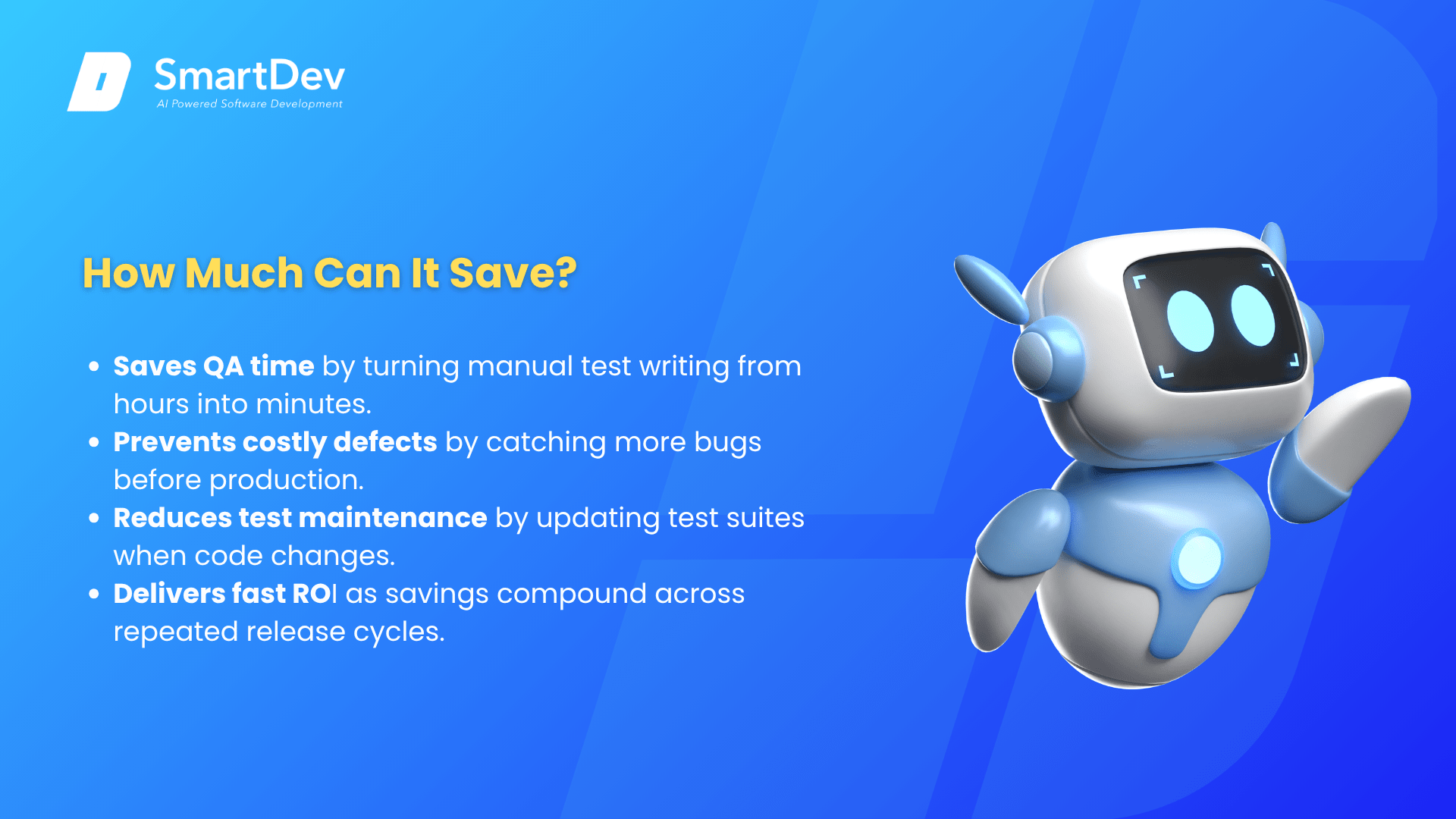
The return on investment from AI test case generation comes from multiple directions simultaneously. First, there is the direct time saving from automated test creation. Writing test cases manually for a medium-complexity feature can take a QA engineer several hours to a full day. AI generation reduces that to minutes, freeing the engineer’s time for review and refinement rather than initial authoring.
Second, there is the cost of defects prevented. By improving test coverage, AI-generated testing catches more bugs before they reach production. Given that production defects are significantly more expensive to fix than pre-release defects, each additional defect caught early represents a meaningful cost avoidance. Organizations consistently report fewer production incidents after implementing AI-assisted testing, with one 2026 fintech case study citing a 50% reduction in production incidents within months of adoption.
Third, there is the cost of maintaining test suites over time. When requirements change, manually maintained test suites require significant effort to keep current. AI tools that automatically update tests when code changes eliminate a substantial portion of this ongoing maintenance burden, reducing the test debt that accumulates in most long-running software projects.
The ROI timeline for AI test case generation tools typically reaches a positive position within the first few months as time savings compound across multiple development cycles. For businesses running continuous release practices, the compounding effect is particularly pronounced.
Autres termes associés
Verification Loop: A verification loop is an automated feedback mechanism within an AI system that reviews and validates outputs before they are delivered to users or acted upon by the system itself.
AI Slop: AI slop refers to low-quality, mass-produced content generated by AI tools, often prioritizing quantity over value. It floods digital platforms like social media and search engines, often resulting in shallow, repetitive, or misleading content.
Agentic Flow: Agentic flow is an AI-driven workflow where autonomous agents reason through goals, make decisions, take actions, and adapt across multi-step processes with minimal human intervention.