
TL;DR
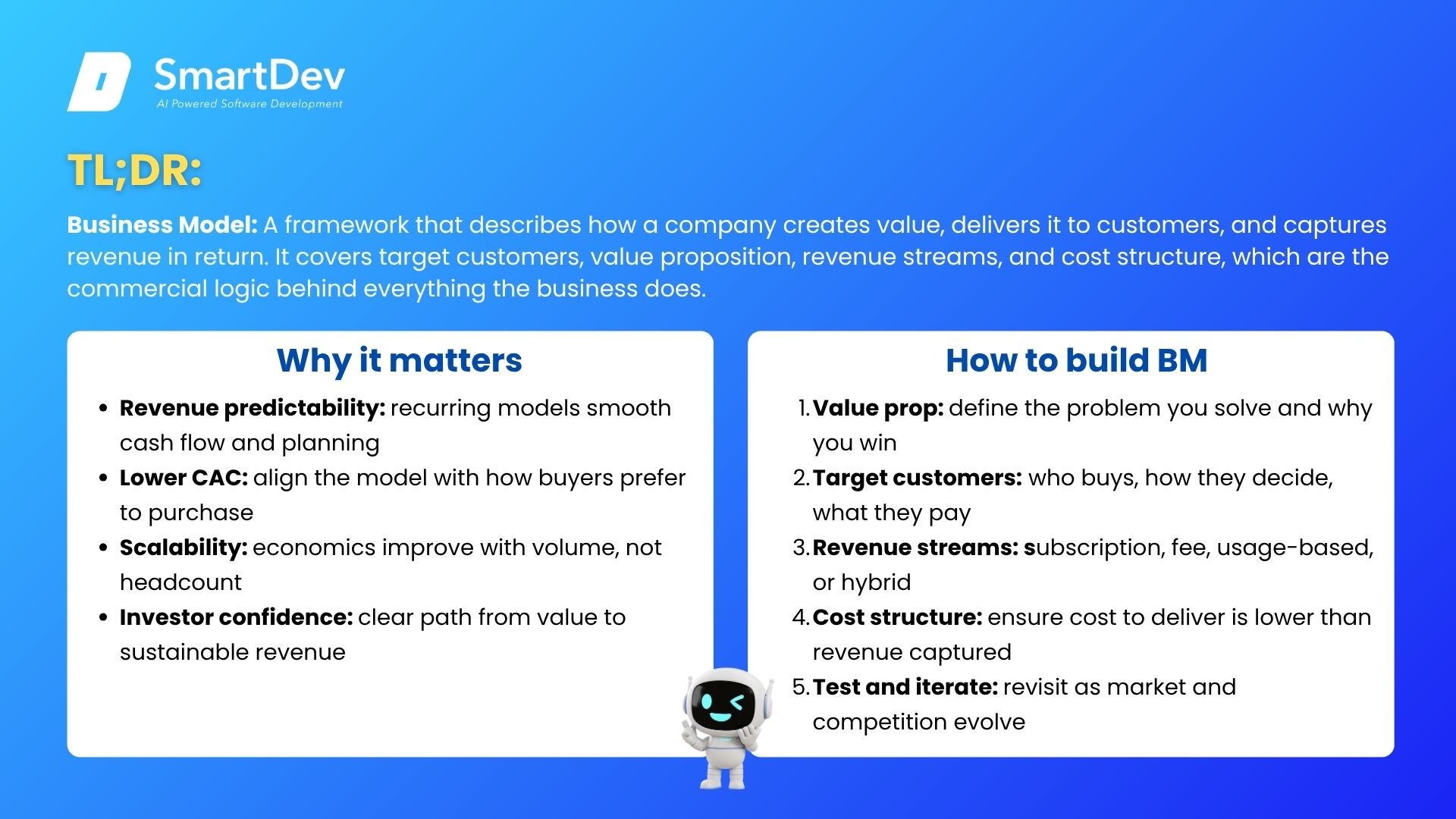
- A Business Model defines how a company creates, delivers, and captures value, essentially how it makes money and sustains itself over time.
- Choosing the right business model is as important as the product itself; the wrong model can undermine even the best technology or service.
- Technology companies typically use models such as SaaS subscriptions, licensing, transaction fees, or managed services, often combining several simultaneously.
A Business Model is the foundation of every company’s commercial strategy. It defines not just what a business sells, but how it operates, serves customers, and generates revenue. For technology and IT outsourcing companies in particular, choosing the right model determines profitability, scalability, and competitive positioning. This article breaks down what a business model is and how to think about it.
What is a Business Model?
A Business Model is a structured framework that describes how an organization creates value for customers, delivers it through products or services, and captures a portion of that value as revenue. It covers the company’s target customers, value proposition, revenue streams, cost structure, and key operational activities that make the whole system work.
Common business model types in the technology sector include:
- SaaS (Software as a Service): Customers pay a recurring subscription to access cloud-hosted software
- Licensing: Customers purchase the right to use software, often paired with annual maintenance and support fees
- Transaction-based: Revenue is generated as a percentage or fee on each transaction processed through the platform
- Services gérés: A provider takes ongoing responsibility for a client’s IT operations in exchange for a recurring monthly fee
Pourquoi c'est important pour les entreprises
A business model is not just an accounting concern. It shapes every strategic decision a company makes, from pricing and partnerships to hiring and technology investment. Companies that choose the wrong model for their market often struggle to grow, even with a strong product, because they cannot generate revenue efficiently or attract the right customers.
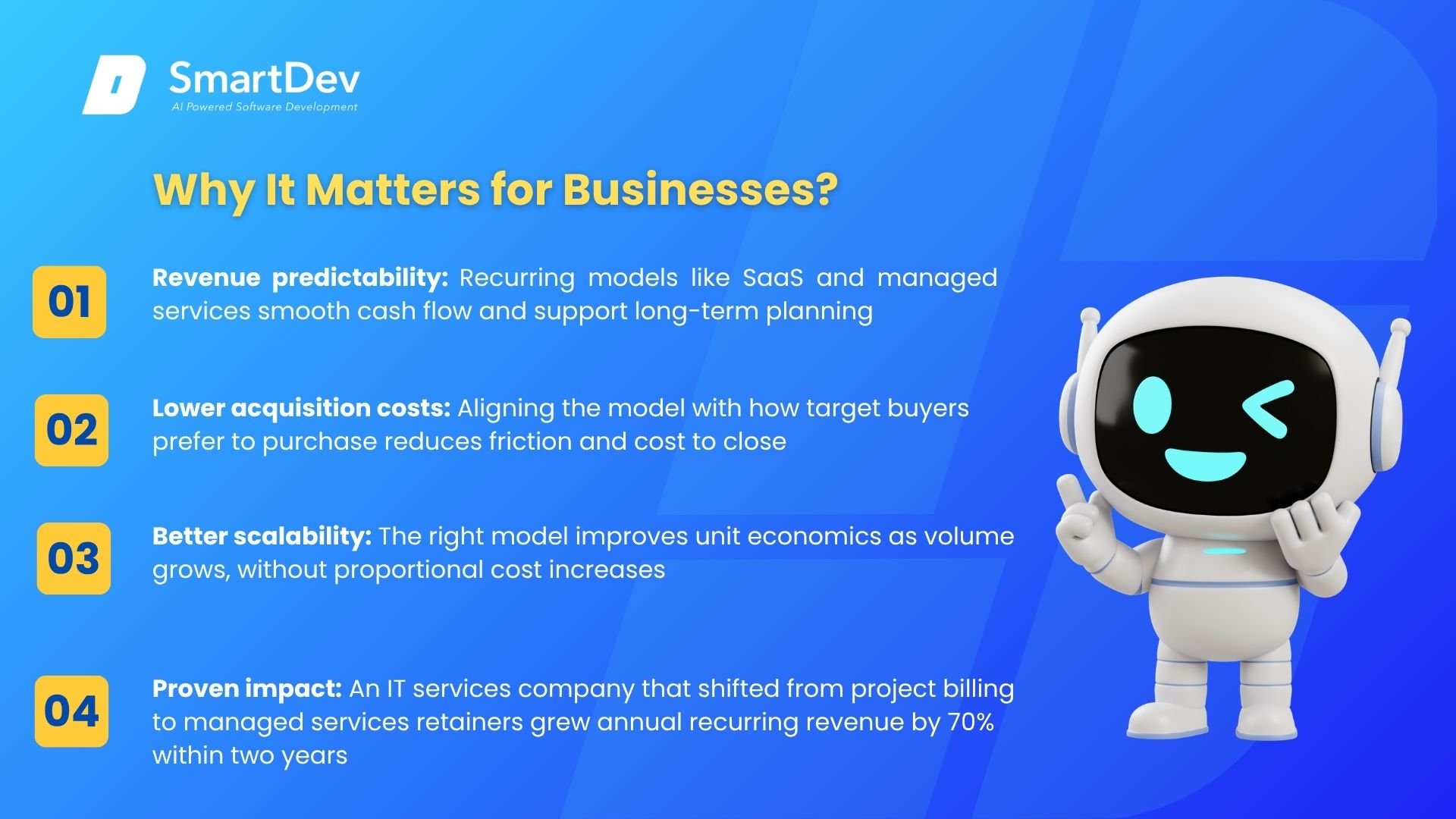
- Increase revenue predictability by choosing recurring revenue models (SaaS, managed services) that smooth cash flow and support long-term planning
- Reduce customer acquisition costs by aligning the business model with how your target buyers prefer to purchase and consume your service
- Improve scalability by selecting a model whose economics improve as customer volume grows, without proportional increases in cost
- Accelerate investor and partner confidence by demonstrating a clear, proven path from customer value to sustainable revenue
For example, an IT services company that shifted from project-based billing to a managed services retainer model increased its annual recurring revenue by 70% within two years. Predictable monthly fees allowed the business to invest in talent and tooling with confidence, improving both service quality and profitability.
How Does a Business Model Work?
- Define the value proposition: Identify the specific problem your product or service solves for a defined customer segment, and why your solution is better than the alternatives.
- Identify target customers: Determine who your buyers are, how they make purchasing decisions, and what they are willing to pay for the value you deliver.
- Design revenue streams: Choose how you will charge customers, whether through subscriptions, one-time fees, usage-based pricing, or a combination of models.
- Structure the cost model: Map out the key activities, resources, and partnerships required to deliver the value proposition, and ensure the cost to deliver is lower than the revenue captured.
- Test and iterate: Business models are not fixed. Successful companies regularly revisit pricing, packaging, and customer targeting as market conditions and competitive dynamics shift.
The result is a commercially viable, scalable operation where value creation, delivery, and revenue capture are all working in alignment.
Who Uses Business Model Design?
Business model design is relevant across a broad range of organizations:
- Technology startups must define and validate their business model early to attract investment and achieve product-market fit before resources run out
- Established enterprises revisit their business model during digital transformation, when legacy revenue models are threatened by new competitors or changing customer expectations
- IT outsourcing providers continually refine their service packaging and pricing models to compete effectively on value, not just cost, as commoditization pressures increase
Key decision-makers include CEOs, CFOs, Chief Strategy Officers, and heads of product and sales, who must align the business model with market opportunity and operational capability.
Autres termes associés
AI ROI: The measurable return an organization achieves from its investment in AI tools, systems, and implementation. Business Model design directly determines how AI ROI is captured. A managed services model, for example, embeds AI costs into a monthly fee and measures ROI through operational savings, whereas a project-based model ties ROI to a one-time delivery milestone.
AI Transformation: The organization-wide shift in how a business operates when AI becomes embedded in its core processes and decision-making. AI Transformation frequently triggers a business model review. When AI changes the cost structure or value delivery mechanism of a company, the existing pricing and revenue model often no longer reflects the value being created.
AI Use Cases / Business Case for AI: The specific business problems or opportunities that an organization identifies as suitable for AI solutions, along with the expected return on investment. A Business Model shapes which AI use cases are worth pursuing. Companies with subscription-based models prioritize AI use cases that reduce churn or improve retention, while transaction-based models focus on use cases that increase throughput or reduce per-transaction cost.