
TL;DR
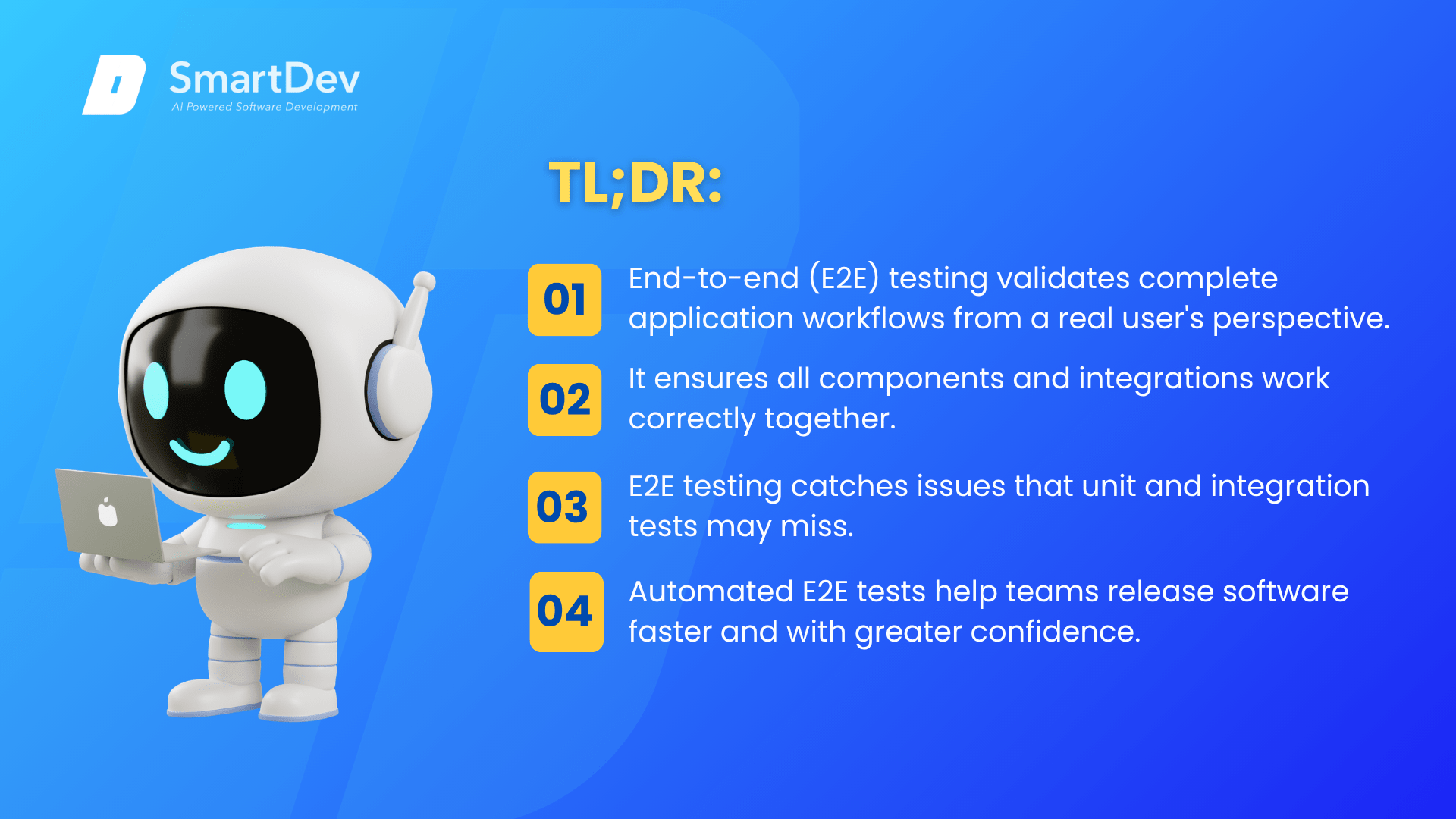
- End-to-end testing validates a complete application workflow from start to finish, confirming that all connected components work correctly together from the user’s perspective.
- Unlike unit or integration tests that check individual components, end-to-end tests simulate real user journeys through the entire system, catching failures that only appear when everything runs together.
- For businesses using outsourced development, automated end-to-end testing is the most reliable way to verify that delivered features work correctly in the full production environment before users encounter them.
End-to-end testing is the quality checkpoint that sits closest to your actual users. While other forms of testing verify individual components in isolation, end-to-end tests confirm that your entire application works correctly from start to finish the way a real user would experience it. This article explains what end-to-end testing is, why it matters for businesses, and when to use it.
What is End-to-End Testing?
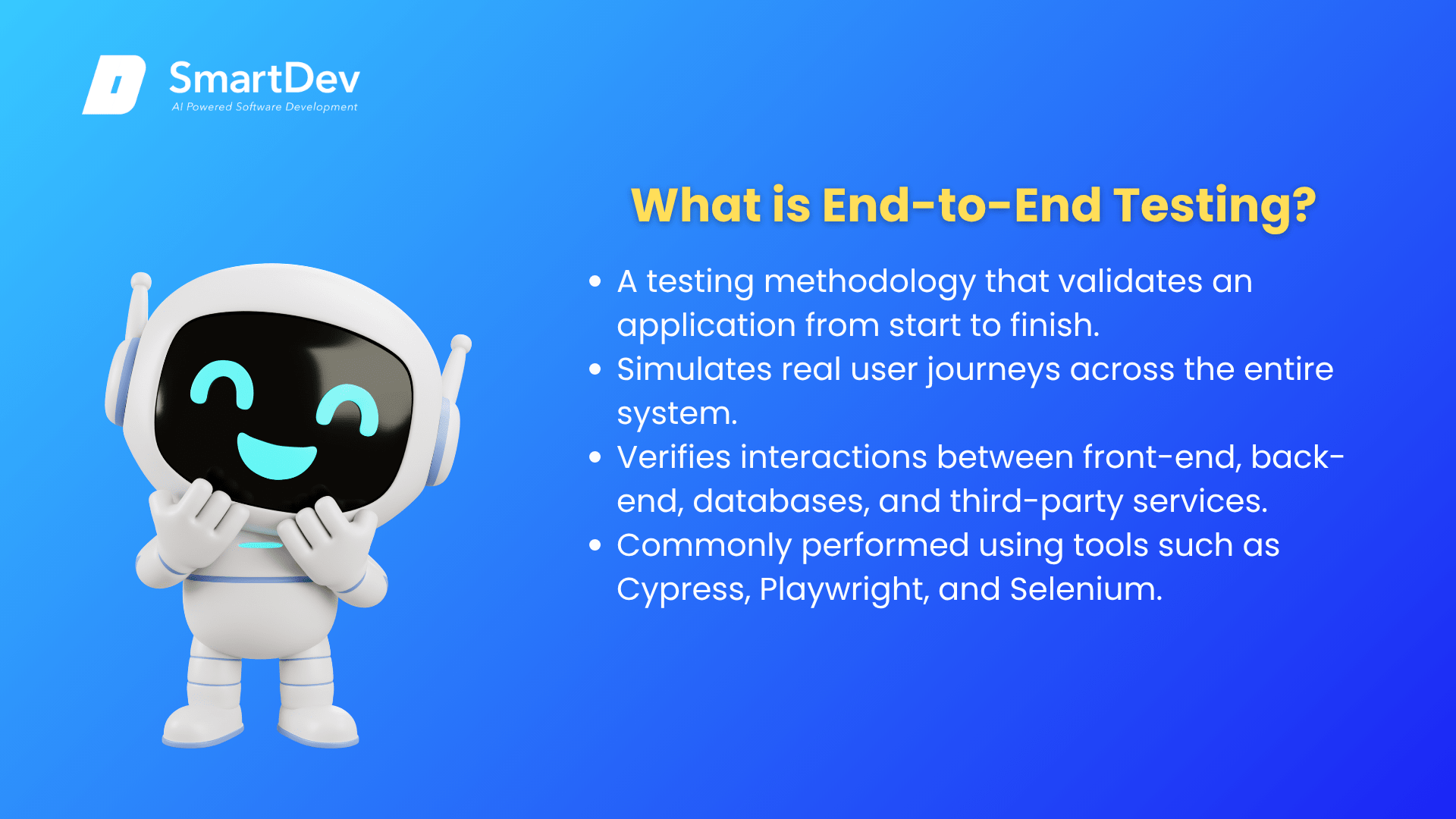
End-to-end (E2E) testing is a software testing methodology that validates an entire application workflow from beginning to end, confirming that all integrated components, including the front end, back end, databases, and third-party services, work correctly together as a unified system.
Where unit tests verify that a single function or component works in isolation, and integration tests verify that two or more components work together, end-to-end tests simulate a complete user journey through the whole application. A typical end-to-end test might simulate a user logging in, searching for a product, adding it to a cart, completing checkout, and receiving a confirmation, verifying that every step in that chain works correctly.
End-to-end tests are typically written and run using purpose-built automation frameworks such as:
- Cypress: A popular JavaScript-based E2E testing framework used for web applications, known for its developer-friendly interface and fast feedback cycles
- Playwright: A Microsoft-maintained framework that supports multiple browsers and is widely adopted for enterprise-scale E2E test suites
- Selenium: One of the oldest and most widely deployed E2E testing tools, supporting multiple programming languages and browser environments
Pourquoi c'est important pour les entreprises
Modern applications are complex systems where the front end, APIs, databases, payment processors, email services, and third-party integrations all interact. Each integration point is a potential failure location that only reveals itself when the full system is running together. End-to-end testing finds these failures before your customers do.
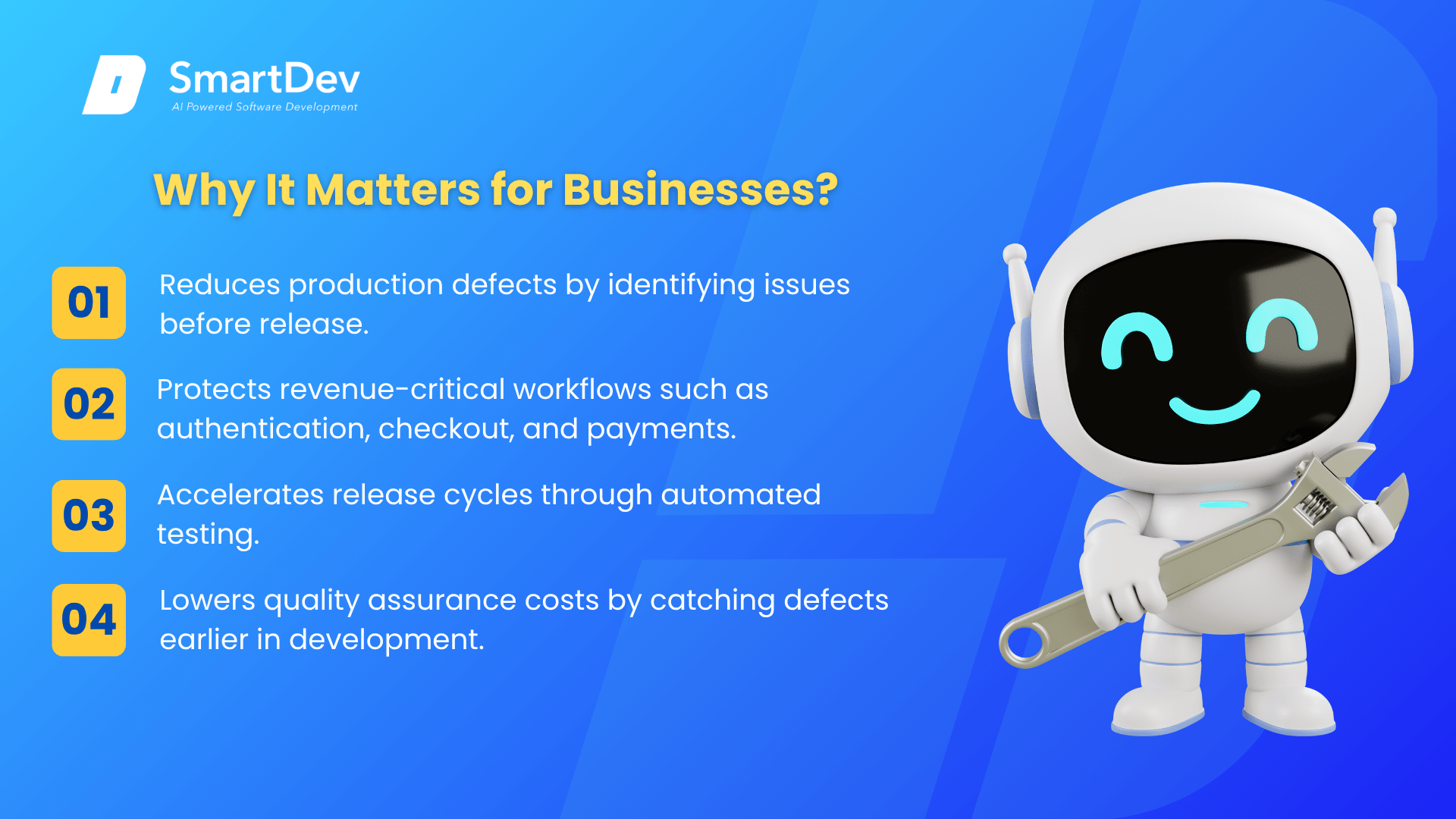
- Reduce production defects: By testing complete user journeys before release, E2E testing catches integration failures, UI breakages, and data flow errors that unit and integration tests miss because they test components in isolation.
- Protect revenue-critical workflows: E2E tests are typically written first for the most business-critical paths, such as checkout, authentication, and payment processing. Automated tests on these paths catch failures within minutes of a code change, before they reach users.
- Accelerate release cycles: Automated E2E test suites replace hours of manual regression testing with automated runs that complete in minutes, enabling teams to release more frequently without proportionally increasing QA effort.
- Reduce cost of quality: Defects caught in automated testing before release are 10 to 100 times cheaper to fix than those discovered in production. Investing in E2E automation shifts defect discovery left, where it is least disruptive and least expensive.
For example, an online retail company managing an outsourced development team implemented automated E2E tests for their checkout and order management workflows. When a code change from the offshore team broke the payment confirmation email integration, the E2E test suite caught the failure within five minutes of the pull request being created, well before the change could reach production and affect real orders.
 How Does End-to-End Testing Work?
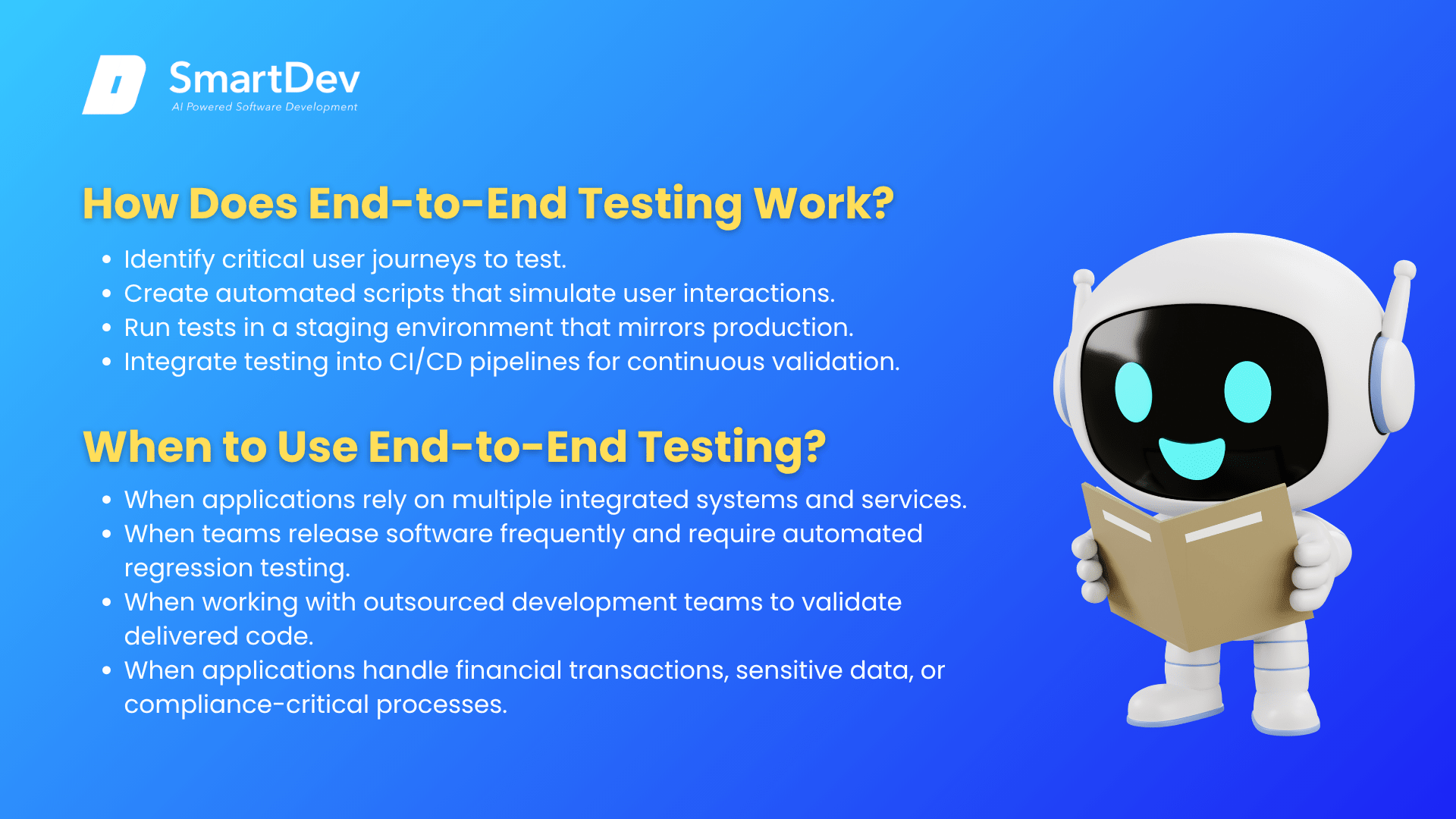
- Identify critical user journeys: The team selects the most important user workflows to test, prioritizing those most likely to affect revenue, user trust, or business compliance if they fail. Common starting points include authentication, checkout, and core feature workflows.
- Write test scripts: QA engineers or developers write automated test scripts that simulate real user interactions with the application, clicking buttons, filling forms, navigating pages, and verifying that expected outcomes appear at each step of the journey.
- Run against a test environment: The E2E test suite runs against a staging environment that closely mirrors production, using realistic data to simulate conditions the application will encounter in real use.
- Integrate into the CI/CD pipeline: E2E tests are added to the CI/CD pipeline so they run automatically on every code change, reporting results before the change can be merged or deployed. Failures block the deployment until the issue is resolved.
- Maintain and expand the suite: As the application evolves, the test suite is updated to reflect new features and changed workflows. Tests that no longer reflect real user behavior are updated or retired to prevent false failures from slowing the team.
The result is an automated safety net that verifies the complete user experience with every code change, giving teams and business stakeholders confidence that each release works as intended.
When to Use End-to-End Testing?
End-to-end testing should be introduced at any stage of product development, but becomes especially important when:
- Your application has multiple integrated systems: Any application that connects a front end, API, database, and third-party services benefits from E2E testing because integration failures are otherwise invisible until production.
- You are releasing frequently: Teams aiming for weekly or more frequent releases need automated regression testing. Manual E2E testing cannot scale to the pace of modern agile delivery.
- You work with an outsourced development team: E2E tests serve as an automated quality gate for code contributed by external teams, ensuring that delivered changes do not break existing user journeys before they are approved for production.
- Your application handles financial transactions or sensitive data: E2E testing of payment, authentication, and data handling workflows is a critical risk management practice in any application where errors carry legal, financial, or reputational consequences.
When NOT to rely on E2E tests exclusively:
- E2E tests are slow to run and brittle to maintain compared to unit tests. Use a balanced testing strategy with a larger base of fast unit tests and a smaller set of high-value E2E tests covering the most critical paths, rather than trying to cover every scenario end-to-end.
Autres termes associés
CI/CD Pipeline: The automated delivery system where end-to-end tests are integrated and run on every code change, serving as an automated quality gate that blocks broken changes from reaching production.
Code Review: The process of examining code changes before merging, which complements end-to-end testing by catching logic errors, security issues, and design problems that automated tests may not cover.
Continuous Integration: The practice of automatically building and testing code changes throughout the day, providing the infrastructure within which end-to-end test suites run to validate each developer’s changes against the full application.