En bref :
- A Global Delivery Model (GDM) is an IT outsourcing framework that distributes work across multiple geographies to optimize cost, talent access, and delivery continuity.
- It enables organizations to leverage offshore, nearshore, and onshore teams in a coordinated structure that follows the sun and reduces delivery risk.
- Companies adopting a GDM can achieve significant cost savings while maintaining quality through disciplined governance and communication frameworks.
As technology projects grow in complexity and global talent markets mature, the question is no longer whether to distribute work internationally, but how to do it effectively. The Global Delivery Model provides the strategic and operational framework for managing distributed technology delivery across multiple locations, time zones, and cultures in a way that delivers consistent, high-quality results.
What is a Global Delivery Model?
A Global Delivery Model (GDM) is a structured approach to IT service delivery in which work is distributed across teams located in multiple countries or regions. Rather than concentrating all resources in a single location, a GDM deliberately places different functions, teams, or workstreams in locations that offer the optimal combination of cost, talent availability, time zone coverage, and risk diversification.
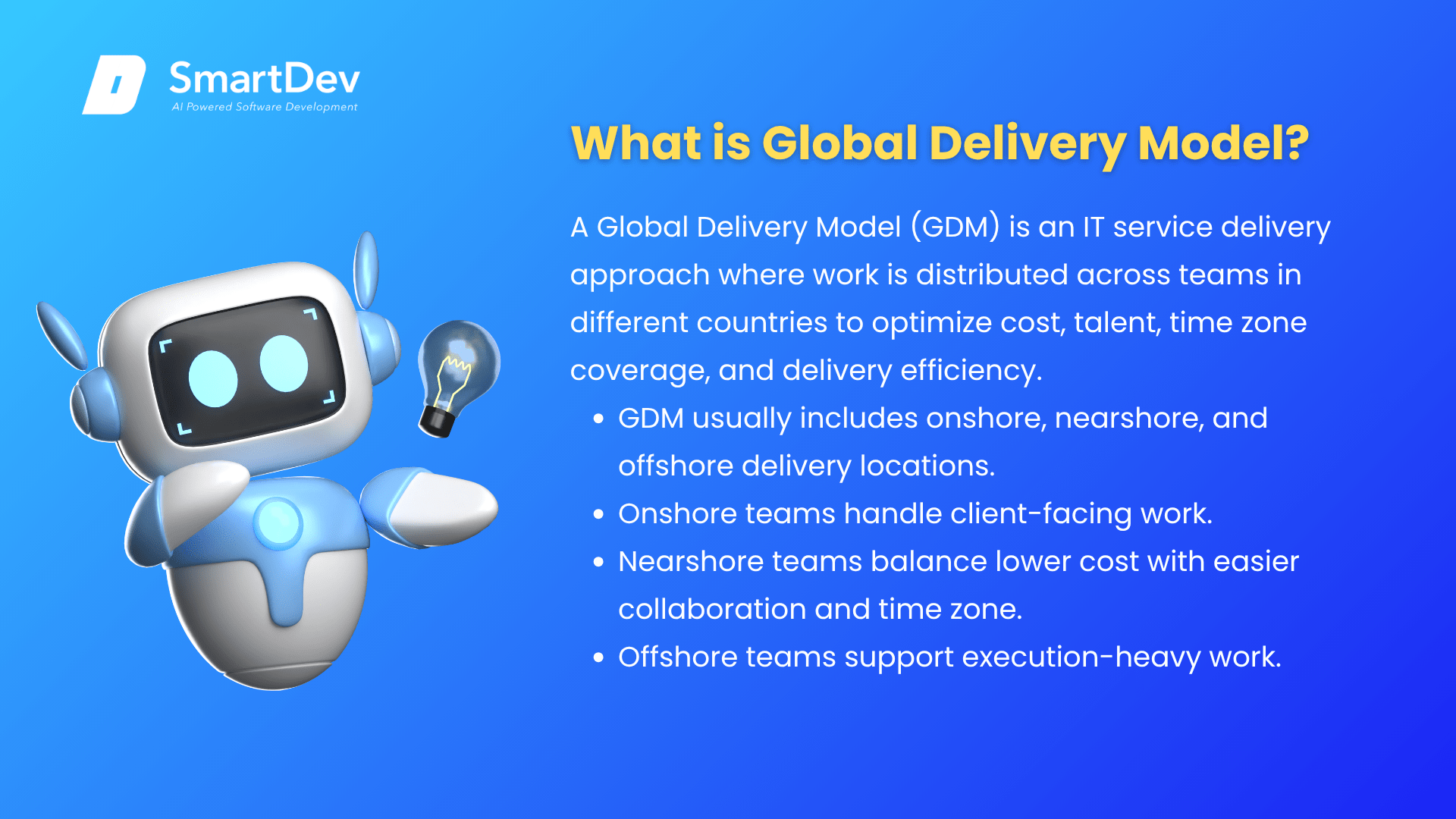
A typical GDM involves three categories of delivery locations. Onshore locations, usually in the client’s home country, house client-facing roles such as account management, business analysis, and project management, which require frequent direct interaction with the client organization. Nearshore locations, in countries within a similar time zone or geographic region, offer a balance of cost reduction and collaboration ease, with overlapping business hours that facilitate real-time communication. Offshore locations, often in Asia or Eastern Europe, provide the greatest cost efficiency and access to large talent pools for execution-intensive roles such as software development, testing, and infrastructure management.
The GDM is built around the principle of right-shoring: placing each function or role in the location where it can be performed most effectively and economically. Work that requires deep client interaction stays onshore. Work that benefits from a large talent pool and lower cost structures moves offshore. Work that requires a balance of both goes nearshore.
Governance is central to the GDM. Clear communication protocols, shared delivery standards, defined escalation paths, and robust project management practices are essential to ensuring that distributed teams operate as a coherent unit rather than isolated silos.
Pourquoi c'est important pour les entreprises
For organizations managing large or complex technology portfolios, the Global Delivery Model offers a combination of strategic advantages that no single-location model can replicate. The most immediate benefit is cost optimization. By shifting execution-intensive work to lower-cost offshore locations while retaining client-facing functions onshore, organizations can achieve labor cost savings of 40 to 60 percent compared to fully onshore delivery, without sacrificing quality or responsiveness.
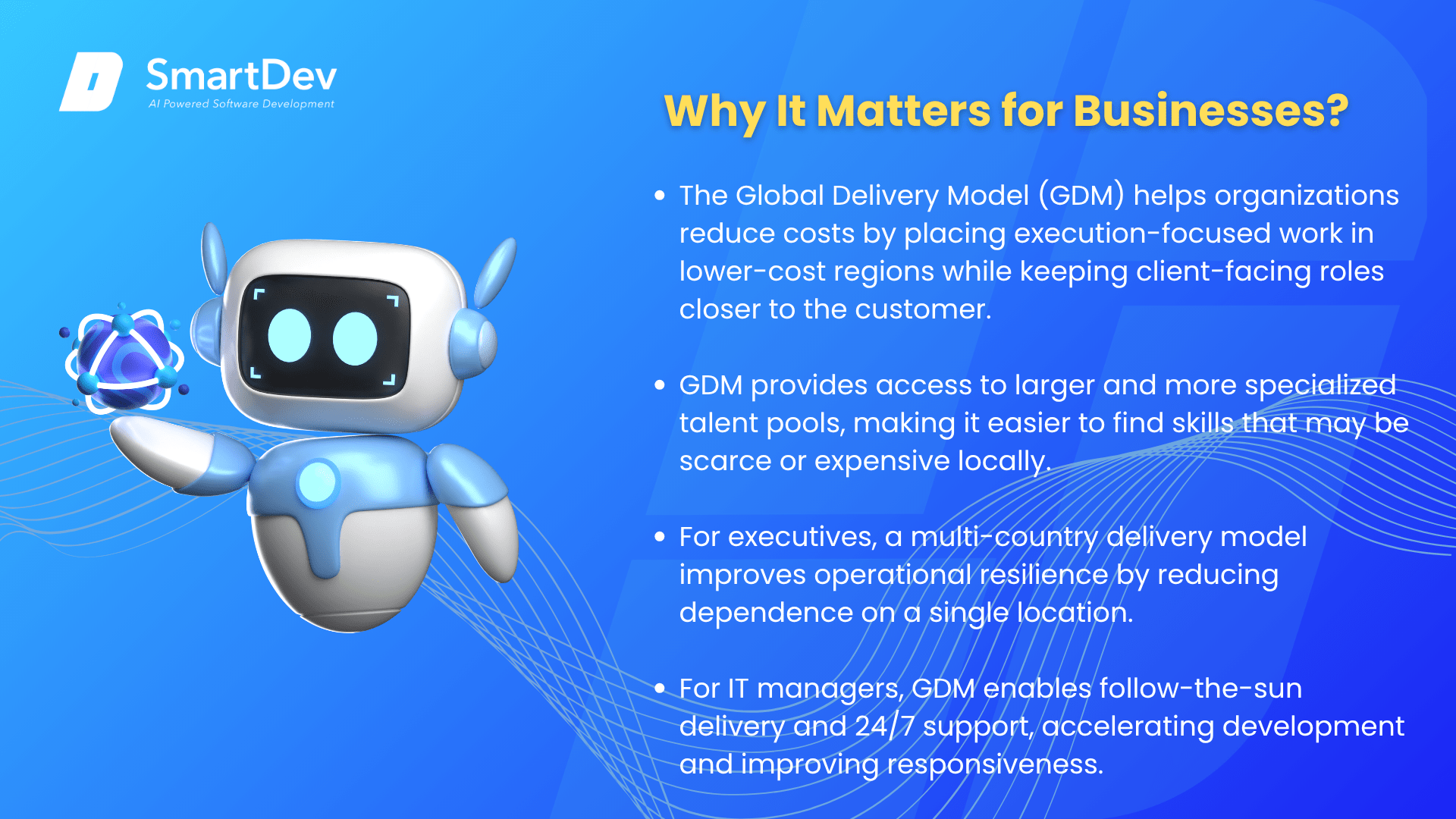
Beyond cost, the GDM expands access to specialized talent. Technology skill shortages are a persistent challenge in many mature markets. Offshore and nearshore delivery centers in countries such as Vietnam, India, Poland, and the Philippines provide access to large pools of engineers, data scientists, QA specialists, and cloud architects that may be difficult or expensive to hire domestically.
For C-level executives, the GDM also provides operational resilience. A delivery model that spans multiple geographies is inherently more robust than one concentrated in a single location. Natural disasters, political instability, infrastructure outages, and public health disruptions are less likely to simultaneously affect teams in different regions. This geographic diversification reduces single-point-of-failure risk in critical technology operations.
From an IT manager’s perspective, a well-implemented GDM enables follow-the-sun delivery, where teams in different time zones hand off work continuously, compressing development cycles and enabling faster turnaround on critical tasks. Support functions can be staffed to provide 24/7 coverage without requiring any single team to work outside normal business hours.
How Does a Global Delivery Model Work?
The GDM operates through a layered governance and delivery structure. At the client interface layer, onshore relationship managers, business analysts, and project leads translate client requirements into work packages that can be distributed to the appropriate delivery teams. This layer owns the client relationship and ensures that all distributed work remains aligned with business objectives.
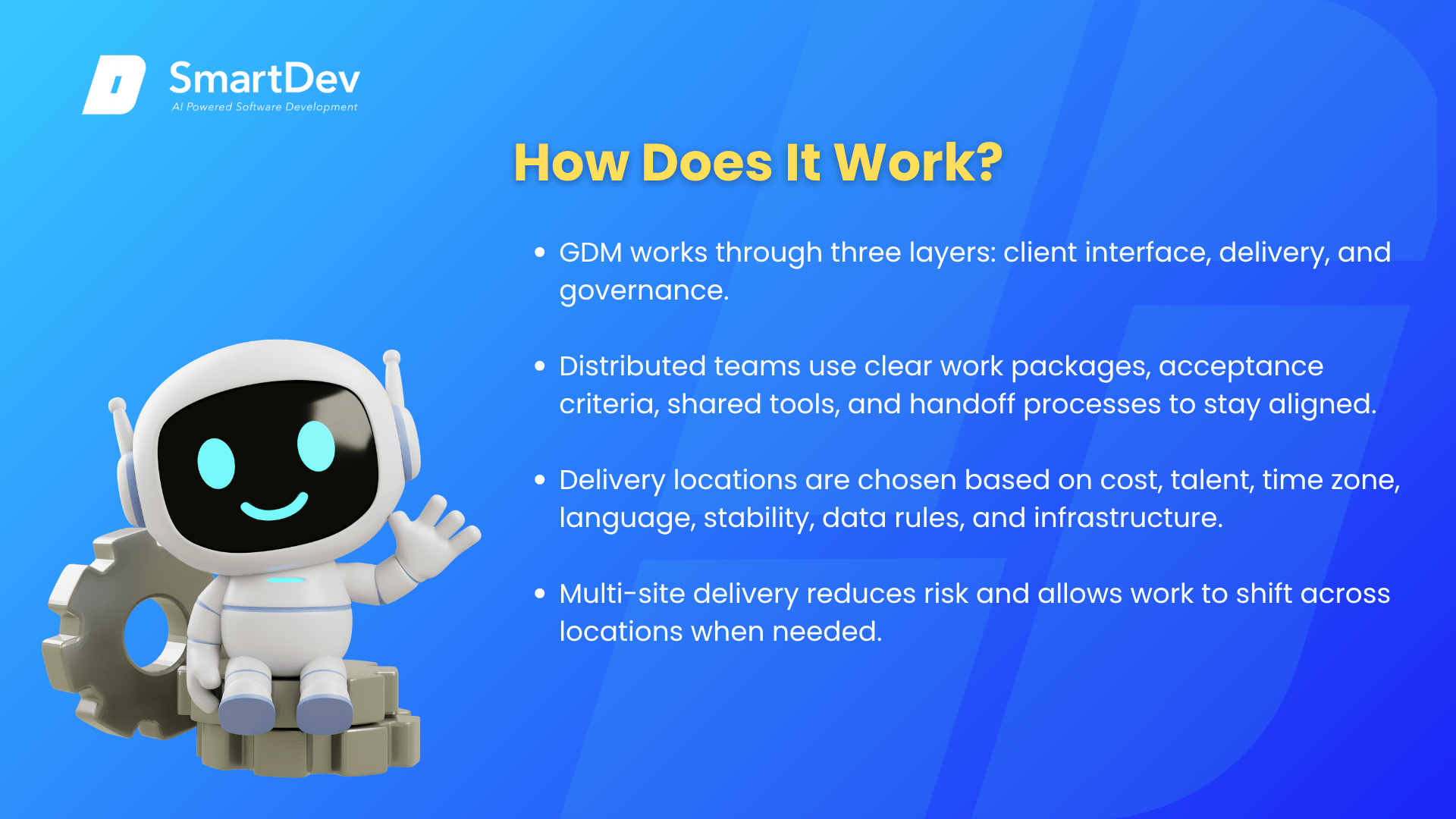
At the delivery layer, offshore and nearshore teams receive well-defined work packages with clear acceptance criteria, execute development or testing cycles, and return completed work through structured review and quality assurance processes. Daily or regular standup calls, shared project management tools, and documented handoff protocols keep distributed teams synchronized across time zones.
At the governance layer, delivery dashboards, SLA monitoring, regular reporting cadences, and escalation frameworks provide visibility into performance across all locations. Governance meetings at the program and portfolio level ensure that issues are identified and resolved before they affect delivery timelines.
Technology enablement is a critical component of an effective GDM. Collaboration platforms such as Jira, Confluence, Slack, and Microsoft Teams, combined with version control, CI/CD pipelines, and cloud-based development environments, allow geographically distributed teams to work on shared codebases and maintain high levels of coordination without requiring physical co-location.
Cultural alignment is equally important. Vendors with mature GDM capabilities invest in cross-cultural training, standardized onboarding for distributed teams, and regular in-person touchpoints to build the relationships and trust that make remote collaboration effective over the long term.
Where is Work Delivered in a Global Delivery Model?
Location strategy is one of the most consequential decisions in designing a Global Delivery Model. The selection of delivery locations depends on a range of factors including labor cost, talent pool depth and quality, time zone alignment with the client, language proficiency, political stability, data protection regulations, and infrastructure quality.
For clients headquartered in North America, common offshore locations include India, Vietnam, and the Philippines, which offer large English-speaking developer populations and significant cost advantages. Nearshore options include Mexico, Colombia, and Eastern European countries such as Poland, Romania, and Ukraine, which offer strong technical talent with closer time zone alignment.
For European clients, Eastern Europe and parts of Southeast Asia are common nearshore and offshore choices respectively. Time zone overlap is a critical consideration; teams with less than four hours of overlap with the client require more asynchronous communication disciplines and documentation rigor.
Multi-site GDM strategies also consider redundancy. Concentrating all offshore delivery in a single country creates concentration risk. Distributing offshore capacity across two or more locations reduces the impact of any single-country disruption and provides flexibility to shift workloads as talent markets and geopolitical conditions evolve.
Autres termes associés
IT Outsourcing: The practice of hiring an external vendor to provide technology services such as software development, testing, cloud operations, cybersecurity, or IT support. GDM is one of the most common ways outsourcing vendors organize and deliver those services across onshore, nearshore, and offshore teams.
Governance Framework: A governance framework is a structured set of rules, roles, processes, and controls used to manage how a project or service is delivered.
Distributed Development Team: A group of professionals working collaboratively across multiple physical locations, connected through digital tools and structured communication practices. The Global Delivery Model is built on the effective management of distributed teams at scale.