
En bref :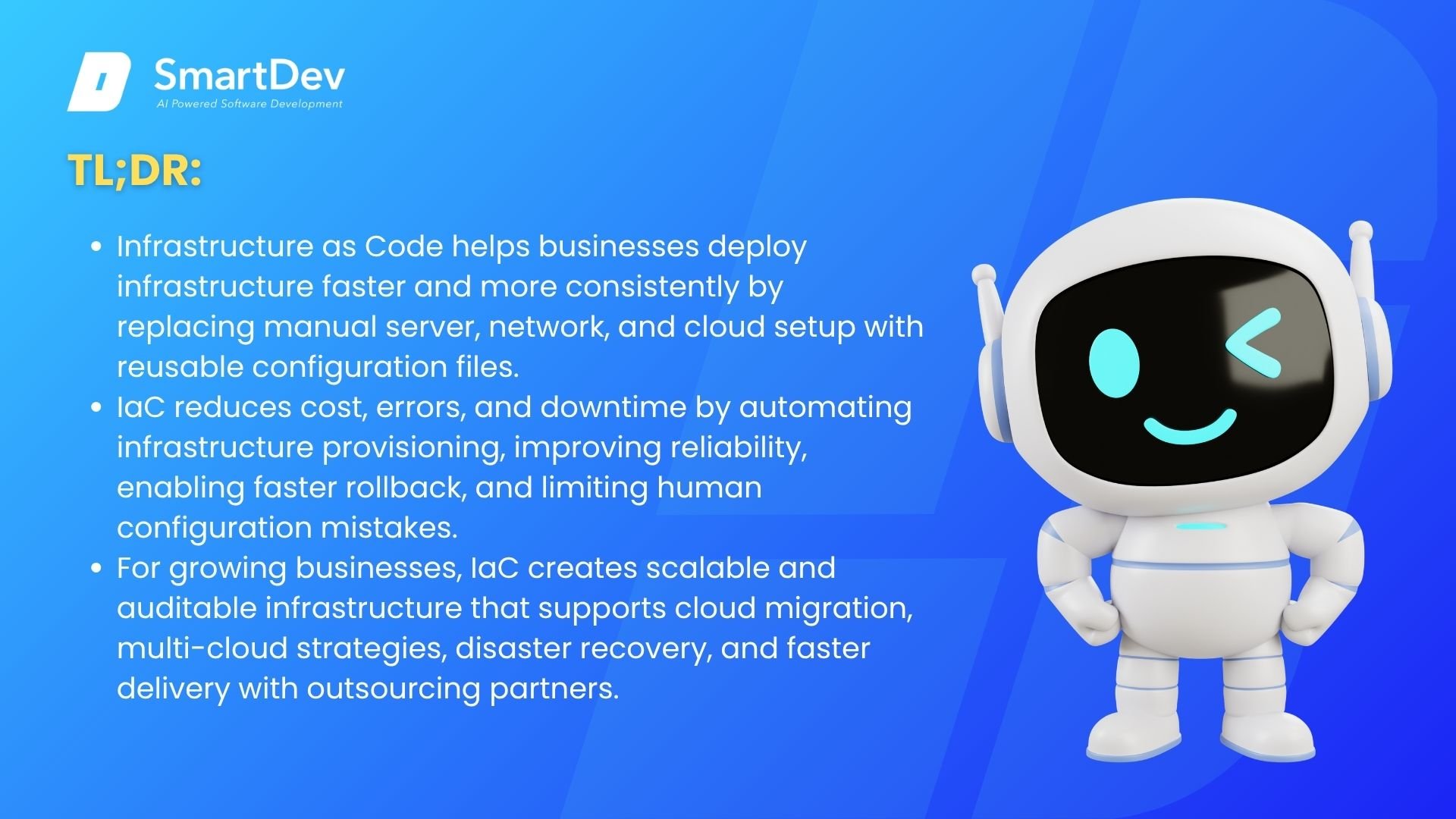
- Infrastructure as Code helps businesses deploy infrastructure faster and more consistently by replacing manual server, network, and cloud setup with reusable configuration files.
- IaC reduces cost, errors, and downtime by automating infrastructure provisioning, improving reliability, enabling faster rollback, and limiting human configuration mistakes.
- For growing businesses, IaC creates scalable and auditable infrastructure that supports cloud migration, multi-cloud strategies, disaster recovery, and faster delivery with outsourcing partners.
What is Infrastructure as Code?
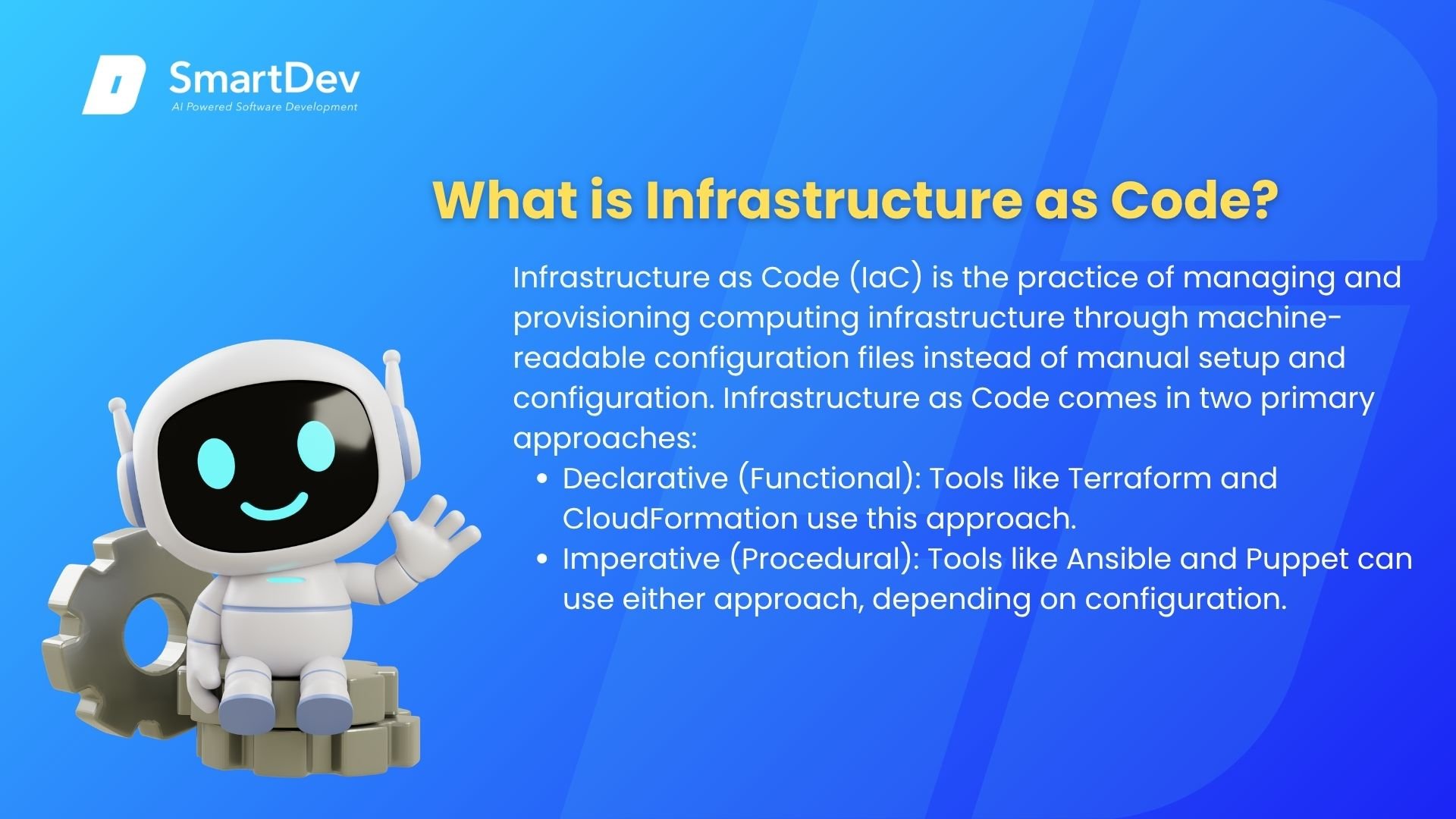 Infrastructure as Code (IaC) is the practice of managing and provisioning computing infrastructure through machine-readable configuration files instead of manual setup and configuration. By treating infrastructure like software, organizations accelerate deployment, reduce errors, and significantly lower operational costs. Infrastructure as Code comes in two primary approaches:
- Declarative (Functional): You specify the desired final state, and the system figures out how to achieve it. Tools like Terraform and CloudFormation use this approach.
- Imperative (Procedural): You write scripts that specify exact steps to build infrastructure. Tools like Ansible and Puppet can use either approach, depending on configuration.
Pourquoi c'est important pour les entreprises
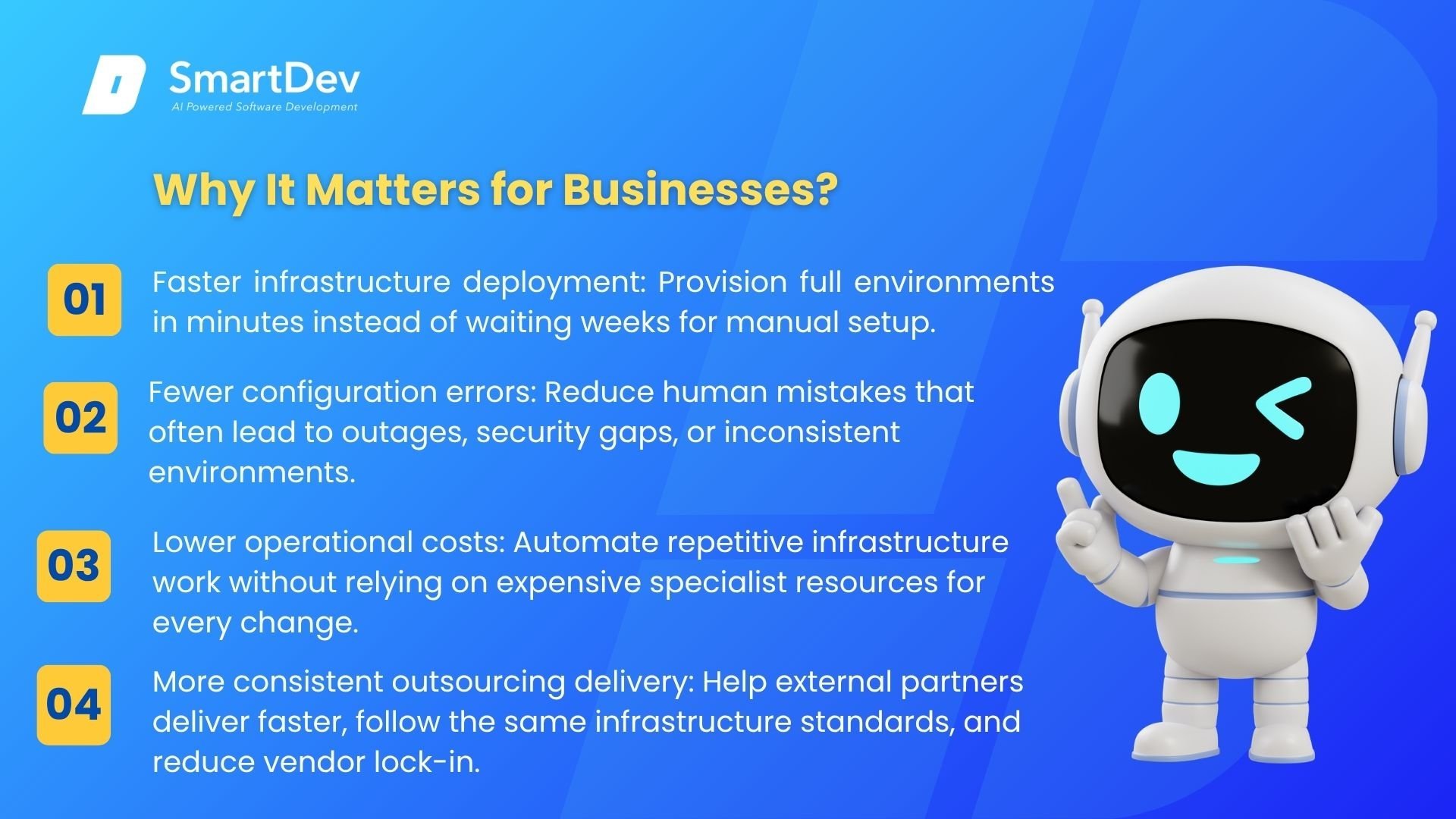 Infrastructure as Code solves critical business problems: manual infrastructure setup takes weeks, introduces human error, and requires expensive specialists. IaC enables your team to provision entire environments in minutes, reduce configuration mistakes that cause outages, and scale infrastructure on demand without hiring additional staff. When working with outsourcing partners, IaC enables faster, more consistent delivery and reduces vendor lock-in.
Key business benefits of Infrastructure as Code include:
- Reduce operational costs by 30-50 percent through automation and elimination of manual configuration work
- Increase deployment speed from weeks to hours, accelerating time-to-market for new services
- Improve reliability by eliminating human error in infrastructure configuration and updates
- Accelerate cloud migration and multi-cloud strategies through portable, cloud-agnostic code
- Protect business continuity through automated disaster recovery and infrastructure recreation
For example, a logistics company working with an IT outsourcing partner implemented Infrastructure as Code for their cloud environment. Instead of waiting 3-4 weeks for manual server provisioning, they deployed new infrastructure in 2 hours using automated IaC scripts. This reduced vendor dependency, cut infrastructure costs by 40 percent, and enabled rapid scaling during peak shipping seasons.
How does Infrastructure as Code work?
Infrastructure as Code operates through a structured process that mirrors software development practices:
1. Write configuration files: Infrastructure architects define servers, networks, databases, and security rules in code files (YAML, JSON, or domain-specific languages).
2. Version control: Configuration files are stored in Git or similar version control systems, enabling change tracking, code review, and rollback capabilities.
3. Test and validate: Automated tools scan configurations for security vulnerabilities, compliance violations, and syntax errors before deployment.
4. Deploy automatically: CI/CD pipelines execute the infrastructure code, provisioning cloud resources in the correct sequence and confirming successful deployment.
5. Monitor and update: Running infrastructure is continuously monitored, and configuration drift (unintended changes) is detected and corrected through automated remediation.
The result is repeatable, auditable infrastructure that matches its code definition exactly.
How much can IaC save your business?
Organizations implementing Infrastructure as Code typically see quantifiable returns within 6-12 months:
- Time savings: 70-80 percent reduction in infrastructure provisioning time (weeks to hours)
- Cost reduction: 20-40 percent lower cloud infrastructure costs through automated optimization and waste elimination
- Labor efficiency: Reduce dedicated infrastructure team headcount by 30-50 percent through automation
- Uptime improvement: 25-50 percent reduction in unplanned downtime due to configuration consistency
Three factors determine your IaC savings potential:
1. Infrastructure complexity: Organizations managing 50+ servers or multi-cloud environments see faster ROI than smaller deployments; automation benefits scale with infrastructure size.
2. Deployment frequency: Teams deploying multiple times daily capture more value than quarterly-deployment organizations; IaC benefits compound with usage frequency.
3. Tool and skill maturity: Advanced implementations using Kubernetes orchestration and GitOps practices generate 2-3x greater savings than basic IaC adoption.
Compared to outsourced manual infrastructure management, IaC-driven providers typically offer 25-35 percent cost advantages and 2-3x faster response times.
Autres termes associés
DevOps: A set of practices combining software development and IT operations, emphasizing automation, collaboration, and continuous improvement. Infrastructure as Code is a cornerstone of DevOps practices.
CI/CD Pipeline: Continuous Integration and Continuous Deployment systems that automate code testing, building, and deployment. IaC fits within CI/CD pipelines to automate infrastructure changes.
Terraform: An open-source Infrastructure as Code tool that uses declarative configuration language (HCL) to define cloud infrastructure across multiple providers including AWS, Azure, and Google Cloud.