En bref :
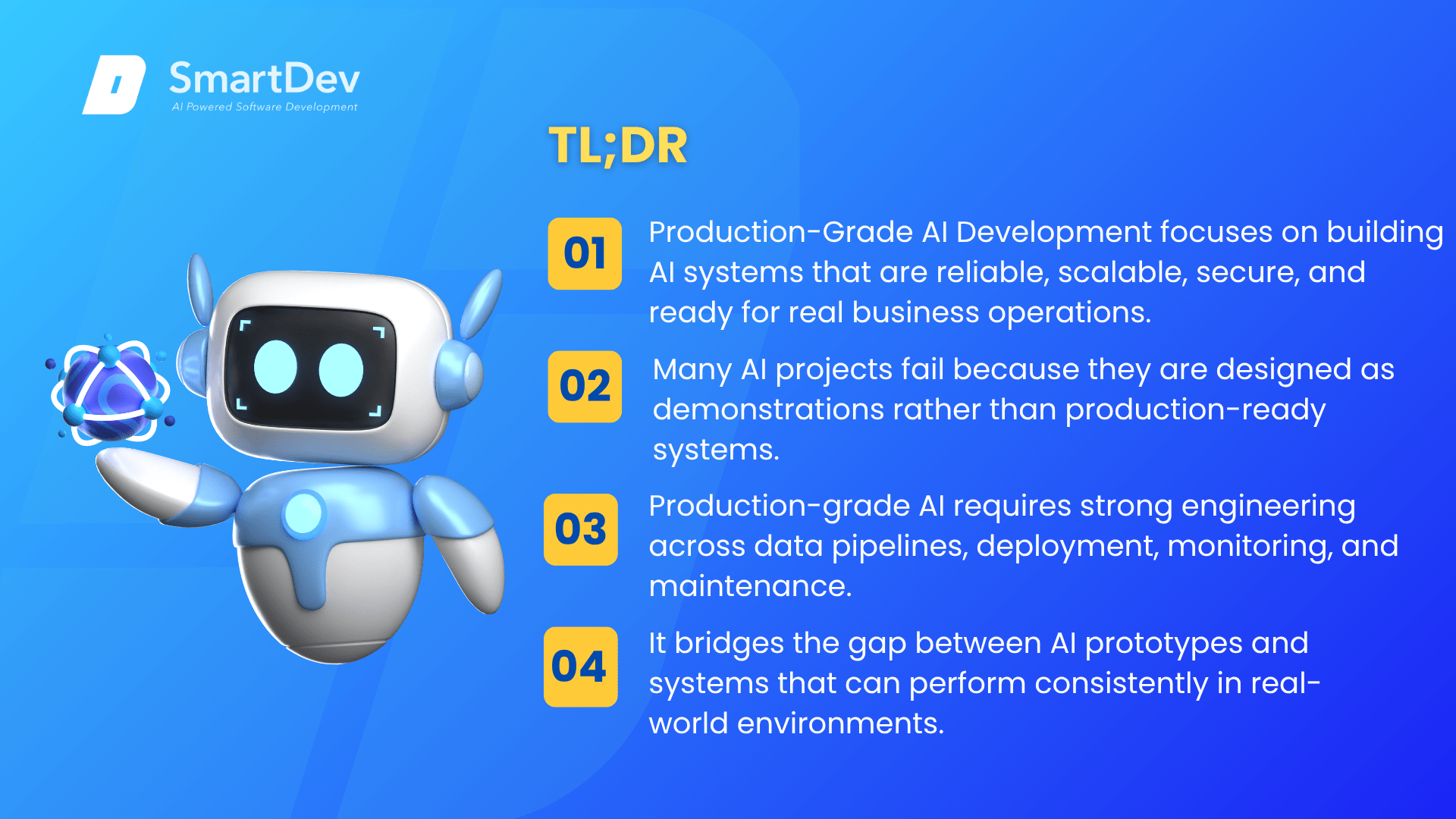
- Production-Grade AI Development is the practice of building AI systems with the reliability, scalability, security, and governance standards required for live business environments, not just controlled experiments.
- Most AI projects fail to reach production because they are built for demonstration rather than for the demanding conditions of real operational systems, making this distinction critically important.
- Achieving production-grade AI requires engineering discipline across the full system lifecycle, from data pipelines and model training to deployment infrastructure, monitoring, and ongoing maintenance.
There is a significant difference between an AI system that works in a demonstration and one that works reliably in a live business environment. Production-grade AI development is the discipline that bridges that gap, applying the standards of enterprise software engineering to AI systems that must perform accurately, securely, and consistently under real-world conditions.
What is Production-Grade AI Development?
Production-grade AI development involves building artificial intelligence systems that satisfy operational, technical, and governance standards required for deployment successfully. Organizations cannot classify systems as production-grade simply because models generate accurate outputs within controlled testing environments consistently alone. Production-grade systems must operate reliably under unpredictable real-world conditions while supporting the request volumes businesses generate continuously daily. These systems must also integrate seamlessly with enterprise platforms, maintain performance over time, and satisfy organizational compliance requirements. Production-grade AI systems adapt effectively as data patterns, customer behavior, and operational conditions evolve across changing business environments globally.
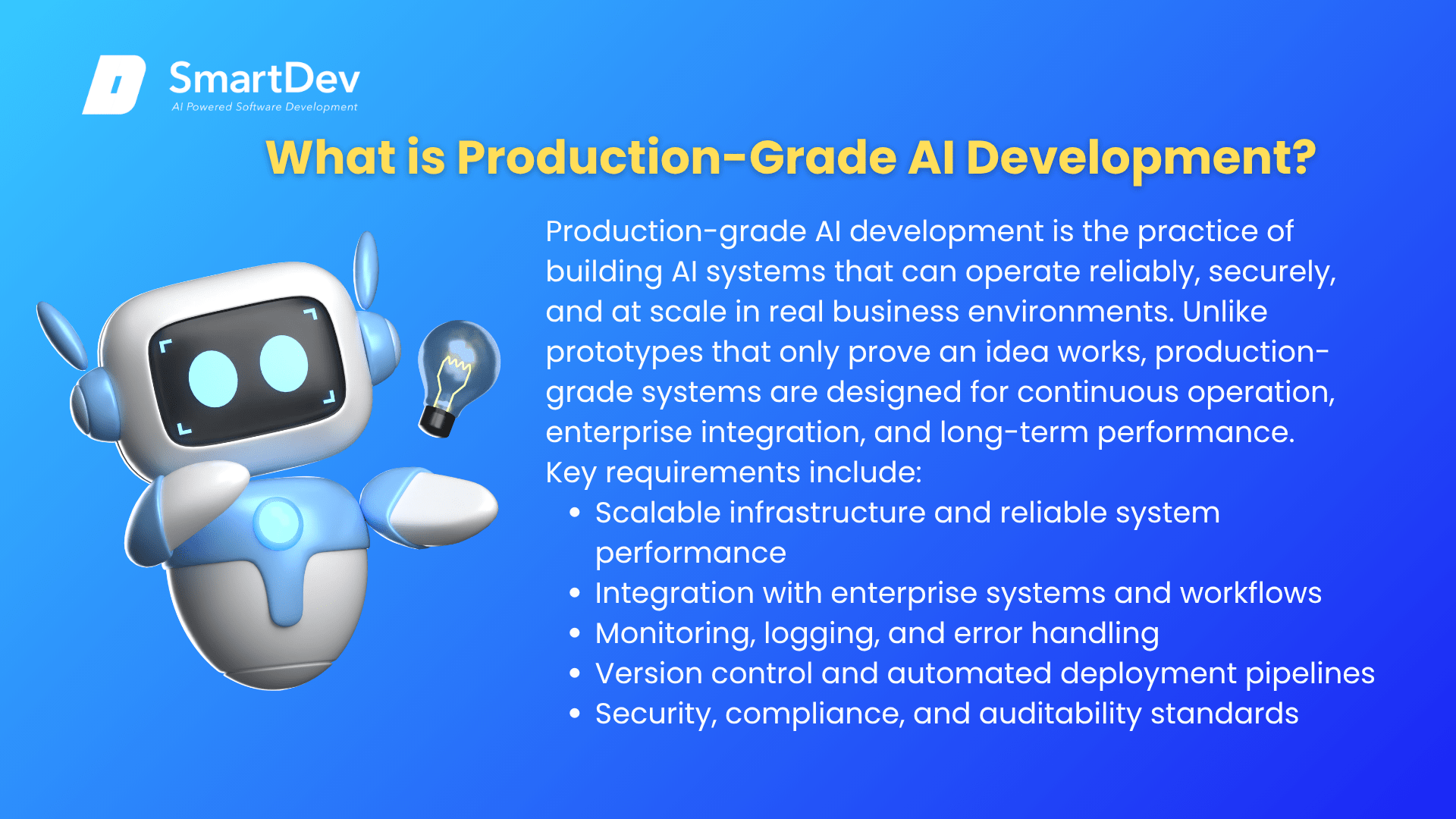
The difference between prototypes and production-grade AI systems remains substantial across technical, operational, and long-term organizational implementation contexts today. Prototypes demonstrate that models can potentially solve specific problems under limited development or experimental conditions successfully during testing. Production-grade systems solve those problems continuously, reliably, and at the operational scale organizations require for sustained business performance. Engineering teams build production-grade systems with integrated error handling, logging mechanisms, monitoring systems, and structured version control processes. Organizations treat production-grade AI systems as enterprise software products subject to rigorous engineering and operational quality standards consistently.
Production-grade AI development also requires deterministic model behavior that organizations can audit, evaluate, and reproduce across operational environments reliably. Engineering teams implement comprehensive testing procedures covering inference logic, training pipelines, and critical data processing workflows systematically throughout development. Teams establish structured logging systems that record inputs, outputs, and operational states for debugging, auditing, and regulatory compliance purposes. Organizations also maintain version control systems for both training datasets and deployed machine learning model versions across environments. Automated deployment pipelines allow engineering teams to release updates quickly while minimizing operational risks and service interruptions effectively. Real-time monitoring systems continuously alert teams whenever performance degradation, abnormal behavior, or operational instability affects deployed AI applications significantly.
Why It Matters for Businesses
Production-grade AI development matters because organizations lose most enterprise AI investments between prototype development and reliable production deployment. Industry estimates show that only 10 to 20 percent of AI projects successfully reach production and remain operational. Most projects fail during deployment or scaling because development teams prioritize model accuracy instead of operational system reliability initially. Many organizations build prototypes that perform well during testing but cannot handle the complexity of real-world business operations consistently.
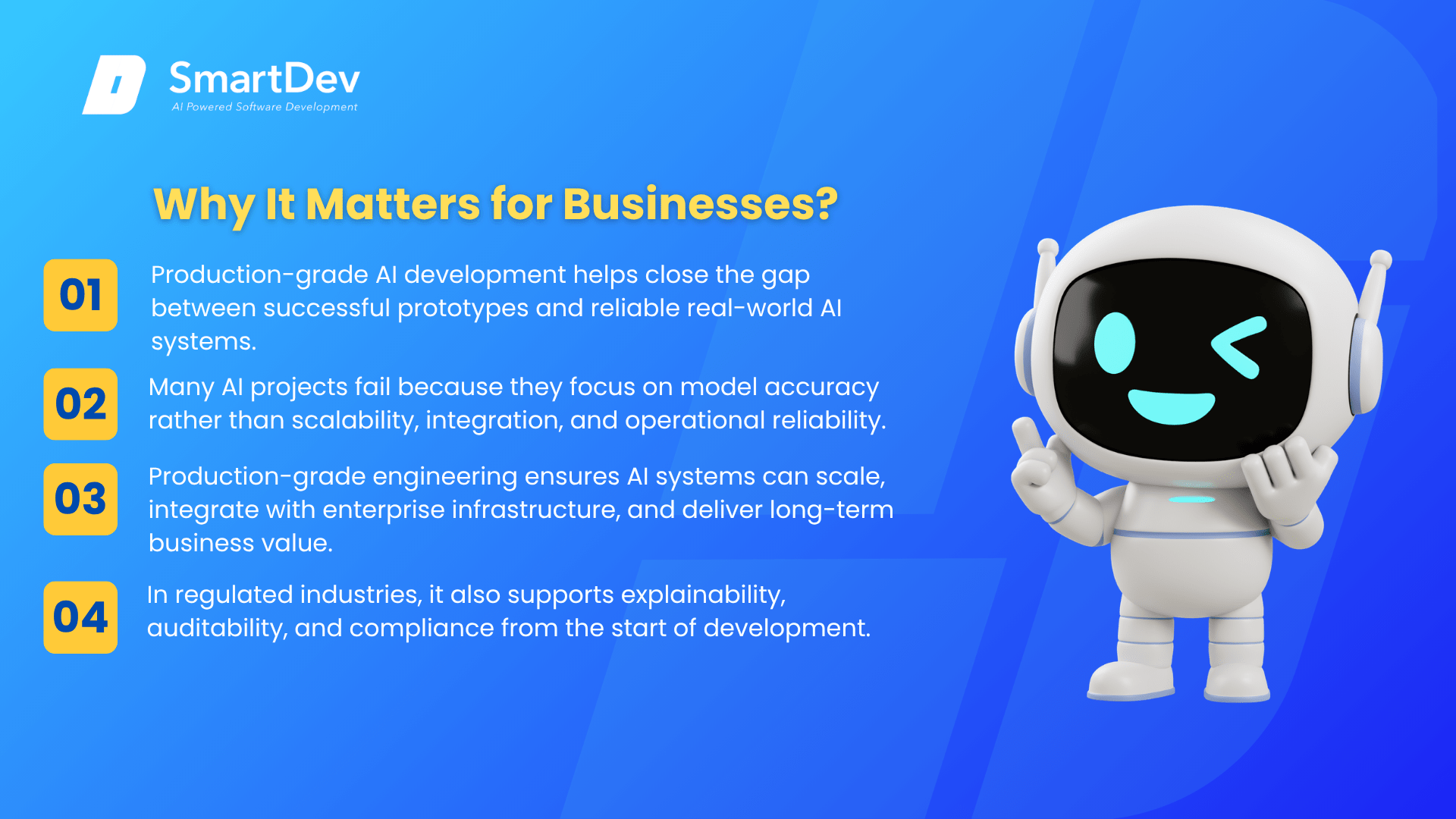
For business leaders, this distinction creates direct financial consequences that affect long-term returns on enterprise AI investments significantly today. Prototype-level AI systems may generate impressive results during controlled tests without supporting sustainable operational performance under business conditions. Systems that cannot integrate with legacy platforms, scale effectively, or support reliable monitoring fail to generate lasting business value. Organizations also lose value when engineering teams cannot update AI systems without disrupting critical operational workflows and services. Production-grade AI development converts experimental AI potential into scalable, reliable, and sustainable business performance through disciplined engineering practices.
Organizations operating within regulated industries face even greater operational, legal, and compliance risks when deploying artificial intelligence systems today. Healthcare providers, insurance companies, and financial institutions must demonstrate that AI systems operate consistently, transparently, and auditably under regulations. Regulators increasingly require organizations to explain how AI systems generate decisions and maintain accountability across sensitive operational processes. Engineering teams must build transparency, explainability, and auditability directly into production-grade systems during the initial development process. Organizations cannot effectively retrofit these governance capabilities after operational failures, compliance violations, or regulatory concerns emerge within deployed environments.
How Production-Grade AI Development Works?
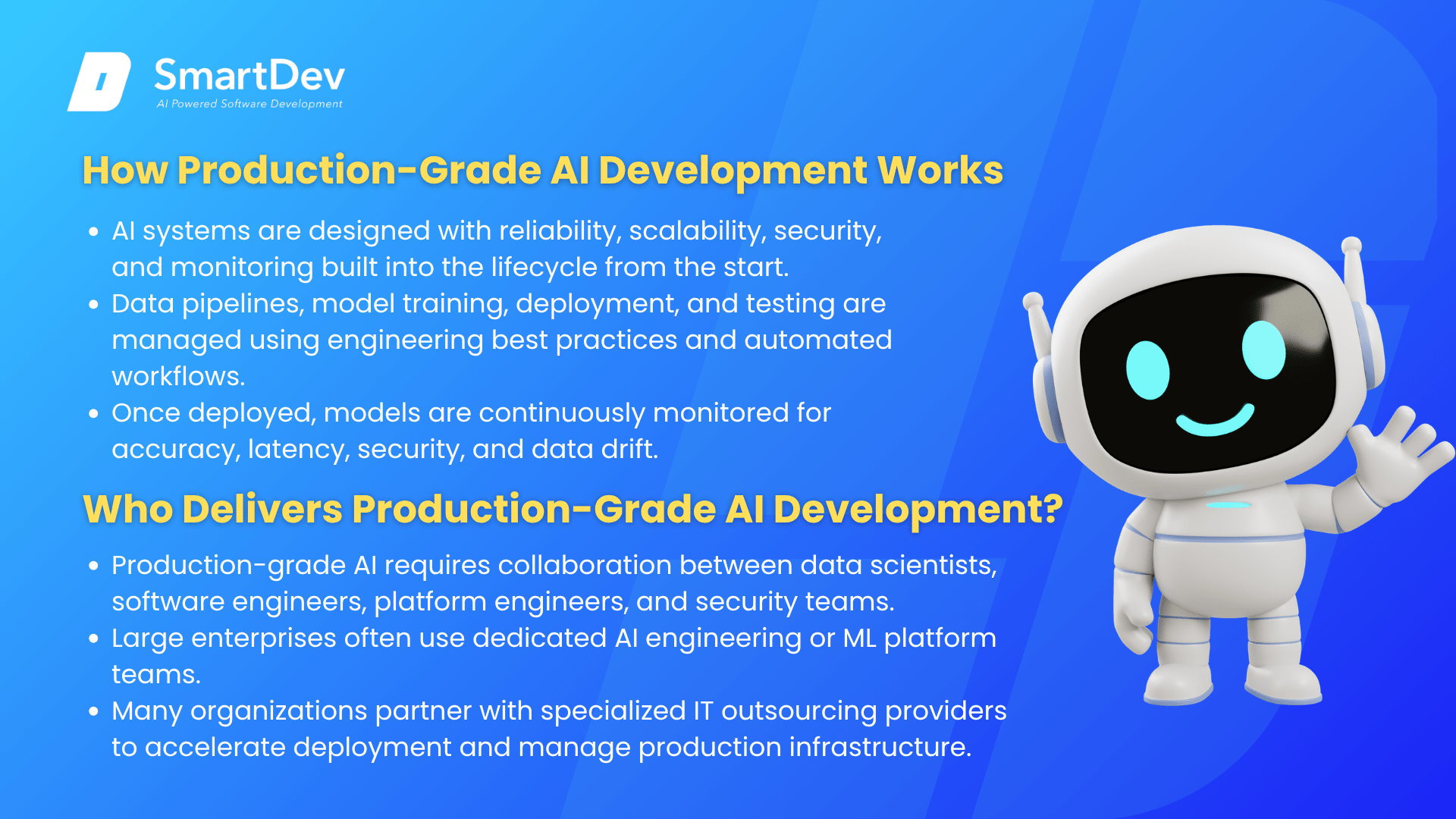
Production-grade AI development follows a lifecycle that parallels enterprise software engineering but extends it to address the unique challenges of AI systems. The process begins during the design phase, where architects define the system’s reliability requirements, integration points with existing business systems, data governance needs, and the monitoring framework that will track model performance over time.
Data pipelines are built and tested with the same rigor applied to application code, with automated quality checks, lineage tracking, and error handling. Models are trained in reproducible environments using versioned datasets, ensuring that results can be audited and replicated. Deployment is managed through continuous integration and delivery pipelines that allow new model versions to be tested, validated, and released safely without manual steps that introduce human error. Once live, models are monitored for accuracy, latency, and data drift, with alerting systems that notify engineering teams when intervention is needed. Security reviews ensure that model endpoints, data access, and inference logs meet the organization’s information security standards.
Who Delivers Production-Grade AI Development?
Production-grade AI development requires organizations to combine expertise across data science, software engineering, platform engineering, and cybersecurity disciplines effectively. Large technology companies often assign dedicated AI engineering and machine learning platform teams to manage these operational responsibilities internally. Most organizations outside the technology sector struggle to build these capabilities because recruitment, training, and infrastructure investments require substantial resources. Enterprises must often provide competitive salaries, specialized hiring processes, advanced tooling, and continuous workforce development to support production-grade AI initiatives successfully.
Many organizations therefore partner with IT outsourcing providers specializing in production-grade AI system development and enterprise-scale deployment services globally. These providers contribute established engineering frameworks, experienced AI professionals, and deployment-ready infrastructure supporting faster production implementation timelines significantly. Organizations can move from prototype development to operational deployment faster than internal teams building capabilities independently from the beginning. Effective outsourcing partnerships usually allow internal business teams to retain ownership of AI strategy and organizational use-case priorities. Specialist partners then manage engineering execution, infrastructure operations, and deployment processes required for reliable production-grade AI system performance consistently.
Autres termes associés
- AI Model Deployment: The process of moving a trained AI model into a live production environment, representing the critical final step that production-grade AI development is designed to make reliable and repeatable.
- Agentic Flow: The structured sequence of steps an AI agent follows to plan, act, use tools, check results, and hand off to humans when needed. Production-Grade AI needs Agentic Flows that are reliable, observable, secure, and controllable, not just “smart” in a demo.
- Data Infrastructure: The systems that supply clean, reliable data to production AI models, serving as the foundational layer on which production-grade AI development depends.