
TL;DR
- Staff augmentation is an outsourcing model where external specialists join your existing team on a temporary basis to fill specific skill gaps or capacity needs.
- Unlike managed services or project outsourcing, your team retains direct control and management of augmented staff, who work as integrated team members rather than a separate vendor team.
- Staff augmentation is fastest path to adding specialized capacity without the cost, time, or risk of permanent hiring.
Demand for technology talent rarely aligns perfectly with permanent headcount. Projects accelerate, skill requirements shift, and critical deadlines arrive before hiring pipelines can respond. Staff augmentation is the model that bridges this gap, giving you immediate access to skilled professionals who integrate with your team and work under your direction without the overhead of a permanent hire.
What is Staff Augmentation?
Staff augmentation is an IT outsourcing model in which external professionals with specific technical skills are engaged on a flexible, typically time-bound basis to work directly within a client’s existing team, under the client’s management and processes, to supplement internal capacity or fill defined skill gaps.
The defining characteristic of staff augmentation is the management model. Augmented staff are sourced by a vendor but managed day-to-day by the client. They attend your stand-ups, follow your development processes, use your project management tools, and report to your team leads. The vendor handles employment, payroll, and HR administration. You direct the work.
This distinguishes staff augmentation from project outsourcing, where a vendor manages their own team to deliver a defined outcome, and from managed services, where the vendor runs an ongoing function independently. Staff augmentation is about adding people to your team, not delegating work to another team.
Pourquoi c'est important pour les entreprises
The global shortage of technology talent makes it increasingly difficult and expensive to hire specialized engineers permanently. Staff augmentation provides an alternative that gives access to the skills you need, on the timeline you need them, without the cost and risk of permanent headcount addition.
- Reduce time-to-capability from months (permanent hiring cycle) to weeks (staff augmentation onboarding), allowing projects to start on schedule rather than waiting for the talent pipeline.
- Increase flexibility by scaling your team up and down in response to project demand rather than carrying permanent headcount during periods of lower activity.
- Improve access to specialized skills that your market may not supply in sufficient quantity for permanent hiring, such as AI/ML engineers, cloud security specialists, or niche platform developers.
- Protect budget predictability through transparent, fixed day rates rather than the fully loaded cost of a permanent employee including benefits, training, and management overhead.
For example, a fintech company needed to accelerate its mobile banking app ahead of a market window that was closing. Its permanent engineering team lacked iOS expertise. Rather than hiring permanently (a 90-day process at minimum), the company engaged two senior iOS engineers through a staff augmentation partner within three weeks. The engineers integrated with the existing team, the app launched on schedule, and the engagement ended cleanly when the feature set was complete.
 How Does Staff Augmentation Work?
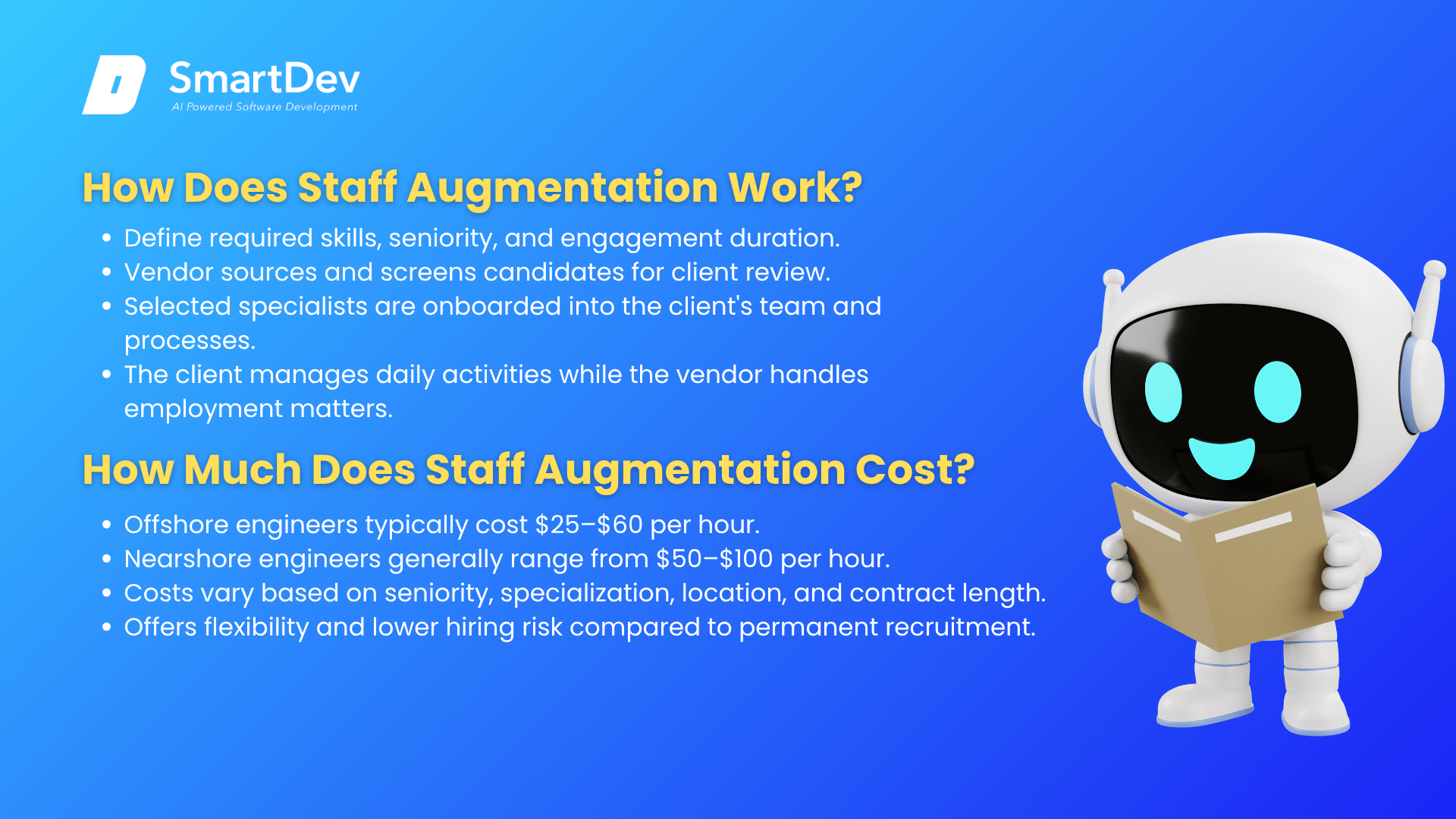
- Define Your Requirements: Specify the skills, seniority level, and engagement duration you need. The more precisely you define what you are looking for, the faster and more accurately the vendor can match candidates.
- Vendor Sourcing and Screening: Your staff augmentation partner identifies and pre-screens candidates against your requirements, providing you with a shortlist for technical interviews. You make the final selection.
- Onboarding and Integration: Selected candidates are onboarded into your team’s tools, processes, and communication channels. Unlike project outsourcing, this integration is direct and immediate.
- Direct Management: You manage the augmented staff day-to-day exactly as you manage your permanent team. The vendor handles employment logistics and provides a point of escalation for HR matters.
The result is a fast, flexible way to grow your team’s effective capacity with people who work as genuine team members under your direction, without the commitment or overhead of permanent hiring.
How Much Does Staff Augmentation Cost?
Staff augmentation rates depend on location, skill specialization, and seniority. Nearshore engineers (Latin America, Eastern Europe) typically range from $50 to $100 per hour. Offshore engineers (Southeast Asia, South Asia) typically range from $25 to $60 per hour. Senior specialists in high-demand areas such as AI/ML, cloud security, or blockchain command the higher end of these ranges.
Three factors that most affect cost include the engineer’s seniority and specialization (senior architects cost significantly more than mid-level developers), geographic location of the talent pool, and engagement duration (longer commitments typically attract lower rates).
Compared to permanent hiring, staff augmentation typically costs 20-40% more per hour when all permanent employee costs are included (benefits, taxes, equipment, management overhead, turnover risk), but eliminates severance risk and provides flexibility that permanent headcount cannot.
Autres termes associés
IT Outsourcing: The broader category of practices in which organizations contract external partners for IT services, of which staff augmentation is one specific model focused on individual talent placement rather than outcome-based delivery.
Centre de développement offshore: A more structured outsourcing model where a dedicated team is established in a lower-cost geography, offering greater scale and longer-term commitment than typical staff augmentation engagements.
Skill Matrix: The capability mapping tool used to identify exactly which skills a team is missing, providing the specification that a staff augmentation request is built around.