
TL;DR
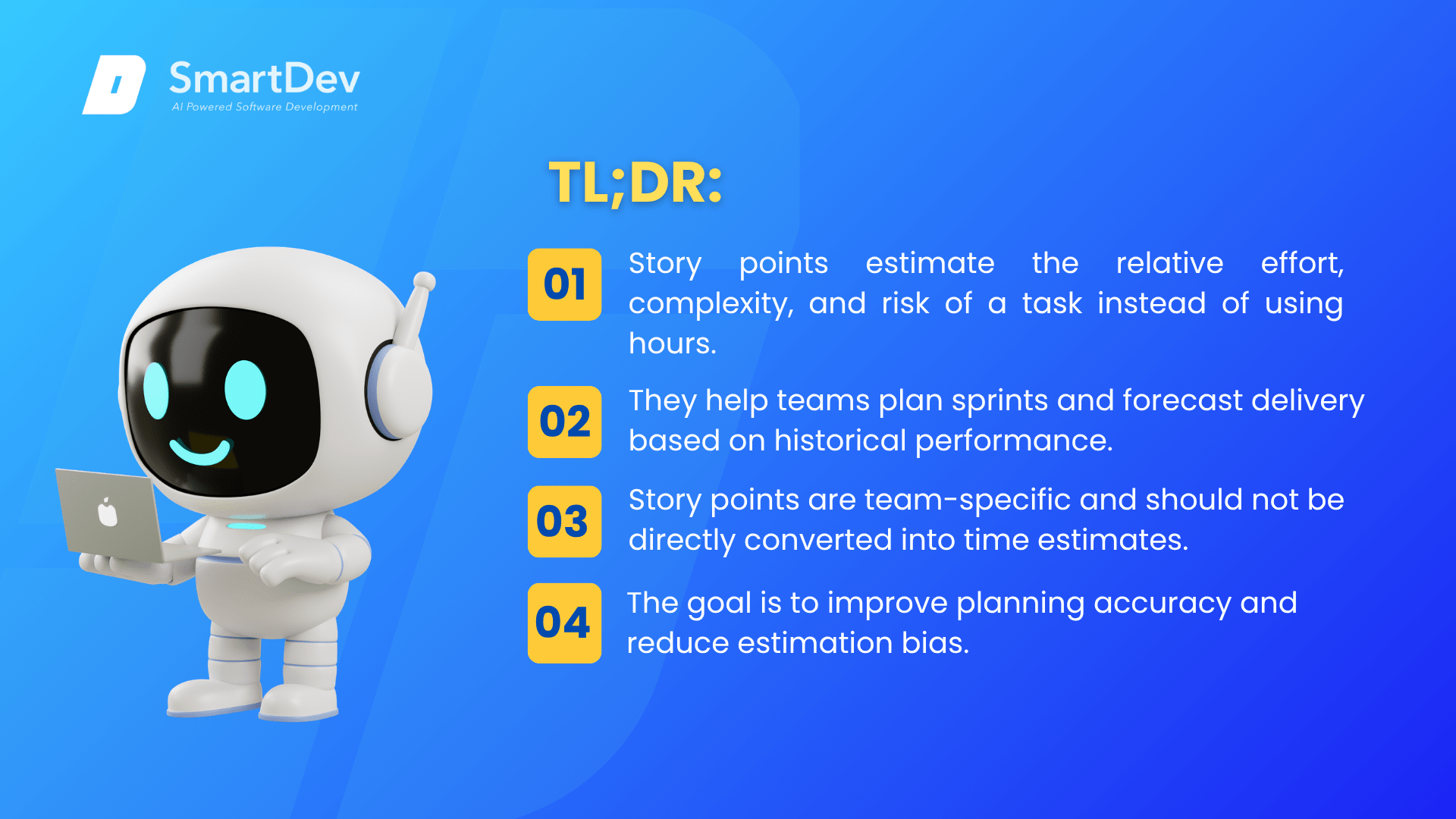
- A story point is a unit of measure used in agile development to estimate the relative effort, complexity, and risk of completing a backlog item, without tying the estimate to a specific number of hours.
- Story points enable teams to plan realistic sprint commitments and forecast delivery timelines based on their historical throughput rather than optimistic time guesses.
- Story points are a team-specific measure. The same task may be worth 3 points to one team and 8 points to another, and that is by design.
Asking a software engineer “how long will this take?” reliably produces unreliable answers. Time estimates carry too much variability, too much pressure to look productive, and too little accounting for complexity and risk. Story points solve this by shifting the question from “how long?” to “how big?” and letting the team’s actual delivery history translate size into a reliable forecast.
What is a Story Point?
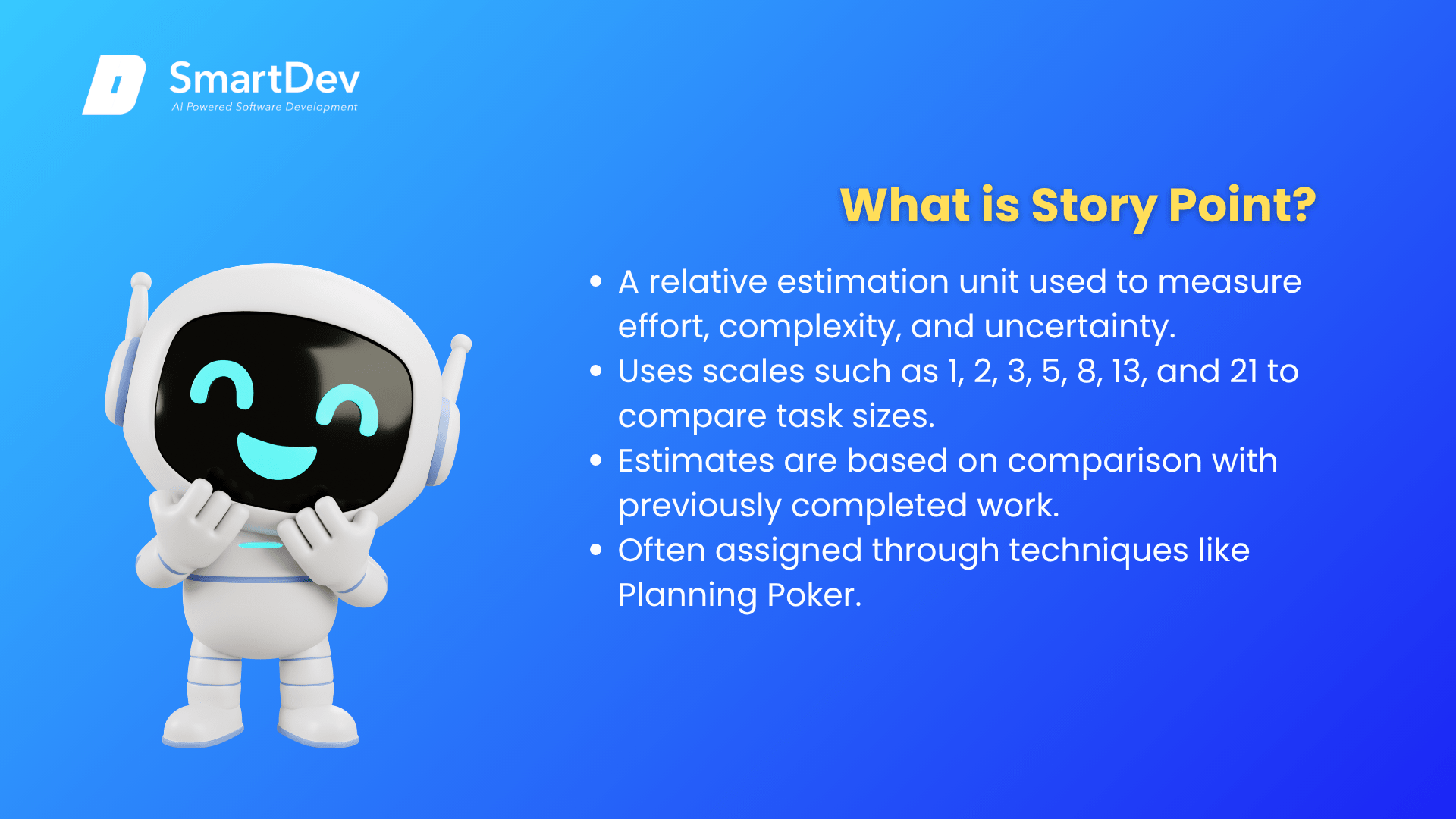
A story point is a relative unit of estimation used by agile development teams to measure the effort, complexity, and uncertainty involved in completing a user story or backlog item, where the value assigned reflects the item’s size relative to other items the team has previously estimated rather than an absolute number of hours or days.
Story points are typically assigned using a Fibonacci-like scale: 1, 2, 3, 5, 8, 13, 21. The non-linear scale is intentional. The larger the item, the more uncertainty surrounds it, and the wider the gaps between point values reflect this growing imprecision. An item estimated at 13 points is not precisely 13 times harder than a 1-point item. It is significantly larger, with a correspondingly wider confidence interval on the delivery estimate.
Teams commonly use “planning poker” to estimate story points: each team member independently selects a card representing their estimate, all reveal simultaneously, and discussion focuses on outliers to reach a consensus estimate. This process surfaces hidden assumptions and complexity that individual estimation misses.
Pourquoi c'est important pour les entreprises
Software delivery forecasting is notoriously inaccurate when based on individual time estimates. Story points, combined with velocity tracking (the number of points a team completes per sprint), provide a statistically grounded basis for forecasting that improves over time as the team accumulates historical data.
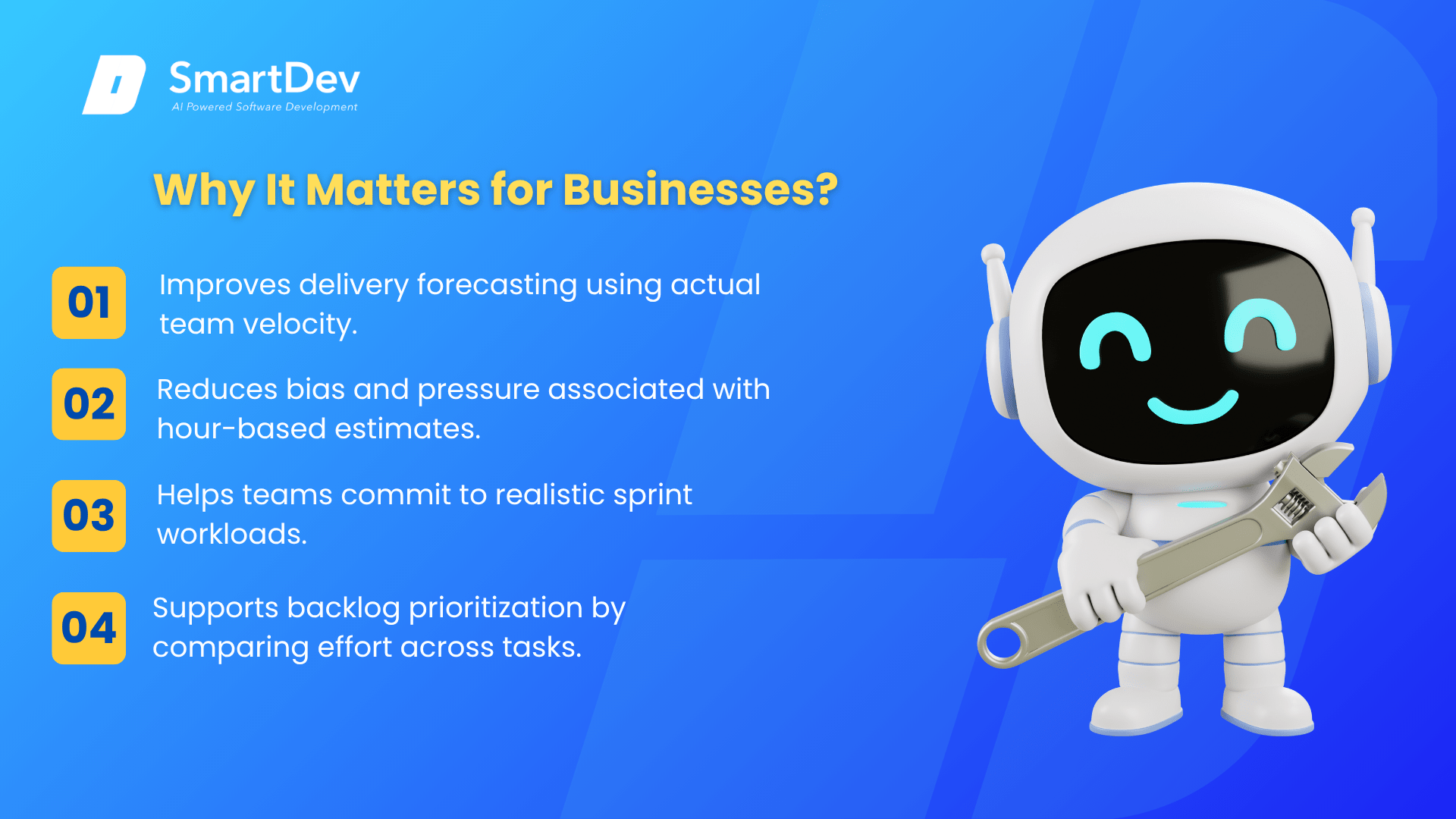
- Improve delivery forecasting accuracy by basing predictions on the team’s actual historical throughput rather than point-in-time optimistic estimates.
- Reduce estimation bias by removing the social pressure that causes developers to underestimate when asked directly “how many hours will this take?”
- Increase planning reliability by enabling sprint planning that is calibrated to the team’s proven capacity rather than theoretical maximum effort.
- Accelerate backlog prioritization by giving the Product Owner a consistent unit to compare effort across different backlog items when making sequencing decisions.
For example, a product team that tracked its velocity consistently over eight sprints discovered that it completed an average of 42 story points per sprint, with a standard deviation of 6. With a product backlog totaling 210 points, the team could confidently forecast five to six sprints to complete the work, giving the business a realistic delivery window with quantified uncertainty rather than an unsupported promise.
How Does Story Point Estimation Work?
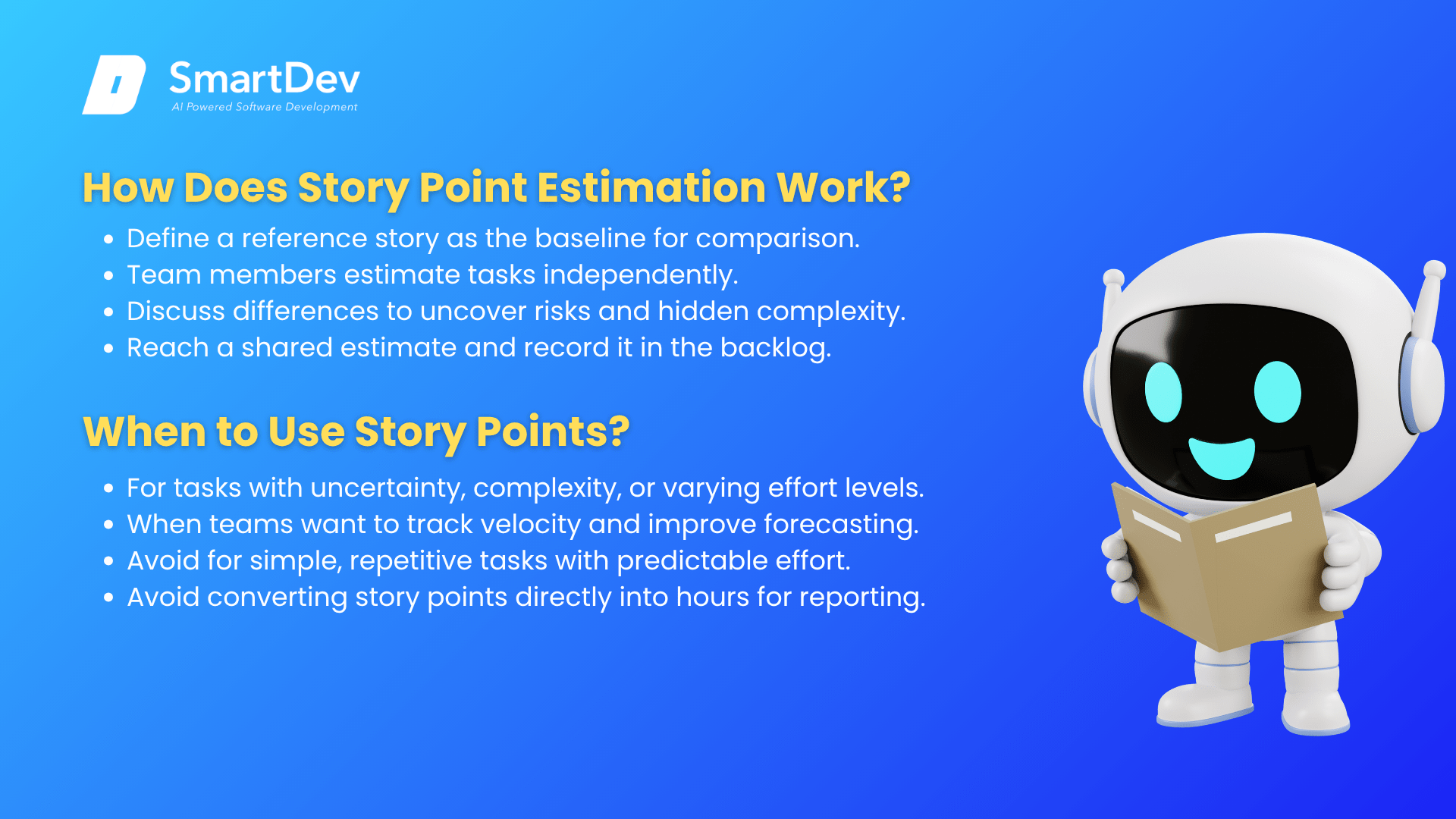
- Establish a Reference Story: The team agrees on a “baseline” story from past work and assigns it a point value (commonly 1, 2, or 3) to serve as a reference. All subsequent estimates are made relative to this baseline.
- Estimate Individually: Each team member independently assigns a point value to the item being estimated. Planning poker cards or digital tools are used to keep individual estimates private until all are revealed simultaneously.
- Discuss Outliers: When estimates diverge significantly, the highest and lowest estimators explain their reasoning. This discussion surfaces assumptions, risks, or implementation approaches that others had not considered.
- Reach Consensus: The team arrives at a consensus estimate, which is recorded in the backlog. Teams typically re-estimate if the discussion reveals that the item is significantly different from initial assumptions.
The result is a backlog with consistent, team-calibrated estimates that enable reliable sprint planning and delivery forecasting based on how this specific team actually works.
When to Use Story Points?
- Use story points for any backlog item where complexity, unknowns, or team skill variation could make a time estimate unreliable.
- Use story points when you want to build a velocity baseline over multiple sprints that enables forecasting of future delivery timelines.
- Avoid using story points for simple, routine tasks where effort is genuinely predictable and consistent, as the estimation overhead adds no value.
- Avoid translating story points directly to hours for reporting to stakeholders. Story points are a planning tool, not a billing mechanism.
Autres termes associés
Sprint Planning: The agile ceremony in which the team uses story point estimates to select backlog items for the upcoming sprint, calibrated against the team’s historical velocity to set a realistic and achievable sprint scope.
Fixed price contract: A type of agreement in which the client and vendor agree on a single total price for a defined scope of work before the project begins.
Scrum Framework: The agile methodology within which story points and velocity tracking are most commonly used, as part of the structured sprint planning and backlog management practices the framework defines.